The Lives of John Coltrane & Billie Holiday Are Now Told in Two Graphic Novels
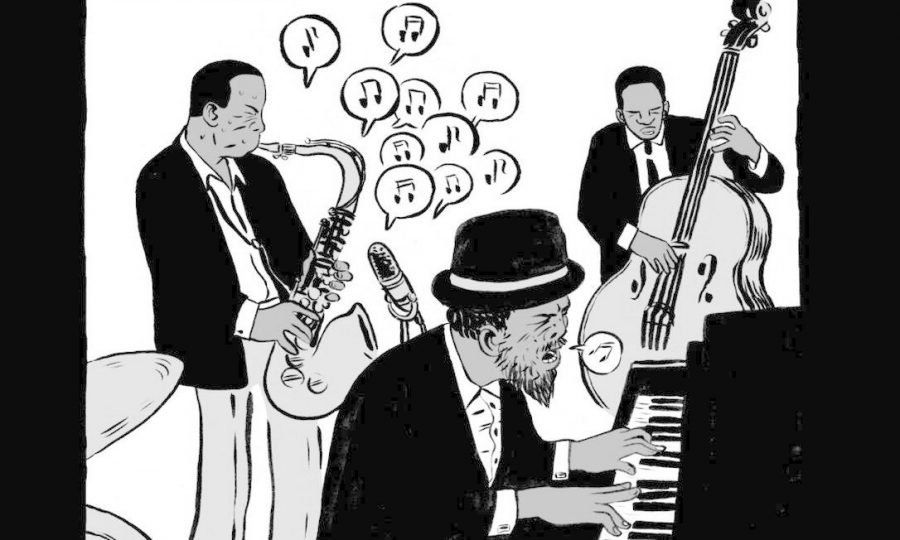
How do you tell the stories of larger-than-life cultural figures—of people whose histories intersect with pivotal moments in American history, whose careers set new standards for excellence—without oversimplifying and risking caricature? With comic art, of course. Graphic novels have long proven themselves worthy vehicles for biography. Something about the bold strokes of the illustrations, the dialogue in word bubble form, and the panel style of storytelling makes for a particularly vivid encounter with history.
Artist Paolo Parisi has capitalized on this kismet of form and content in three biographical graphic novels now, one of which—the story of Jean-Michel Basquiat’s rise to fame and fortune—we highlighted just a couple days ago.
Parisi’s earlier efforts took on no less iconic figures than John Coltrane and Billie Holiday in Coltrane and Blues for Lady Day: The Story of Billie Holiday. The Italian artist has demonstrated a passion for American music, especially jazz, in his career as an illustrator. As a writer, he also displays a talent for restraint, largely letting the images tell the story.
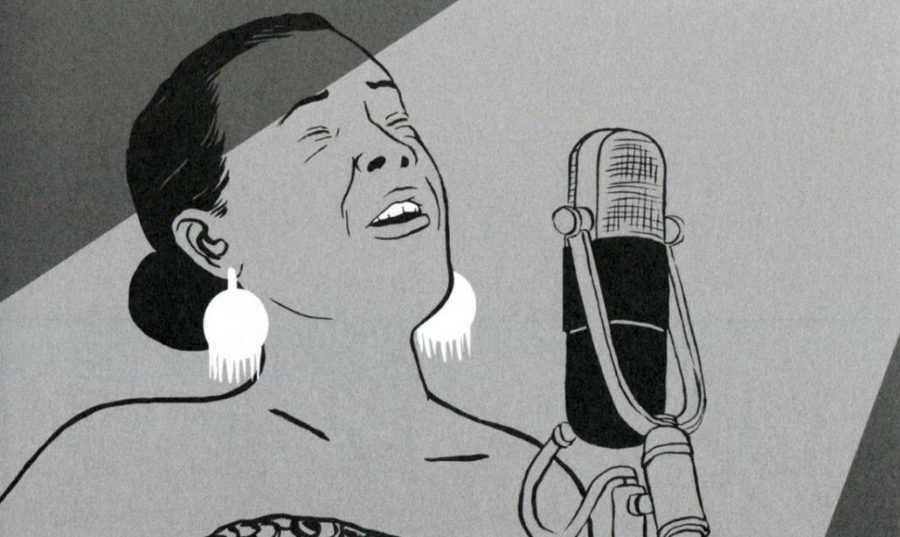
As in Basquiat, these images are both drawn from famous photographs and from imaginative reconstructions of what it might have been like, sitting in on recording sessions, in the clubs, and in the heated conversations. Parisi may inevitably view his subjects through an outsider’s lens—he may romanticize them at times and may elide important, but hard to visualize, details, as is the nature of the form.
But he excels at making these two musical giants approachable, telling their stories in broad strokes so that those who haven’t read the dense, heavily-footnoted tomes about them can develop appreciation and empathy for their art and too-short lives. It is a sad irony that those who burn bright and die young leave behind the most compelling material for those who tell their stories.
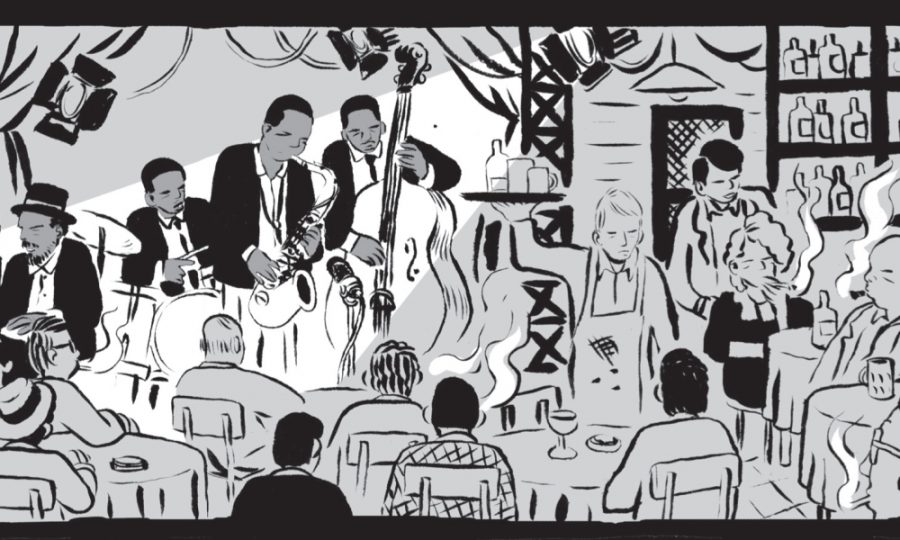
Parisi seems drawn to such tragic figures, or perhaps the form itself requires high-contrast highs and lows. “How could a graphic treatment provide anything other than the sketchiest of details?” asks Coltrane reviewer William Rycroft Tring. “Perhaps by choosing the right subject.” In Coltrane and Holiday, Parisi has two subjects whose lives were inherently dramatic, full of major triumphs and tragedies.
Above all is the music. Graphic novels may not be substitutes for a “proper biography,” as Tring writes, but they are excellent supplements for getting to know the artists as you listen to Lady Sings the Blues or A Love Supreme, whether for the first time or the millionth.
You can pick up copies of Coltrane and Blues for Lady Day: The Story of Billie Holiday online.
Related Content:
The Story of Jean-Michel Basquiat’s Rise in the 1980s Art World Gets Told in a New Graphic Novel
How “America’s First Drug Czar” Waged War Against Billie Holiday and Other Jazz Legends
Josh Jones is a writer and musician based in Durham, NC. Follow him at @jdmagness
Read More...Discover Kōlams, the Traditional Indian Patterns That Combine Art, Mathematics & Magic
Have accomplished abstract geometrical artists come out of any demographic in greater numbers than from the women of South Asia? Not when even the most demanding art-school curriculum can’t hope to equal the rigor of the kōlam, a complex kind of line drawing practiced by women everywhere from India to Sri Lanka to Malaysia to Thailand. Using humble materials like chalk and rice flour on the ground in front of their homes, they interweave not just lines, shapes, and patterns but religious, philosophical, and magical motifs as well — and they create their kōlams anew each and every day.

“Feeding A Thousand Souls: Kōlam” by Thacher Gallery at the University of San Francisco is licensed under CC BY-SA 2.0
“Taking a clump of rice flour in a bowl (or a coconut shell), the kōlam artist steps onto her freshly washed canvas: the ground at the entrance of her house, or any patch of floor marking an entrypoint,” writes Atlas Obscura’s Rohini Chaki.
“Working swiftly, she takes pinches of rice flour and draws geometric patterns: curved lines, labyrinthine loops around red or white dots, hexagonal fractals, or floral patterns resembling the lotus, a symbol of the goddess of prosperity, Lakshmi, for whom the kōlam is drawn as a prayer in illustration.”

Colorful Kolam — — Own work
Kōlams are thought to bring prosperity, but they also have other uses, such as feeding ants, birds, and other passing creatures. Chaki quotes University of San Francisco Theology and Religious Studies professor Vijaya Nagarajan as describing their fulfilling the Hindu “karmic obligation” to “feed a thousand souls.” Kōlams have also become an object of genuine interest for mathematicians and computer scientists due to their recursive nature: “They start out small, but can be built out by continuing to enlarge the same subpattern, creating a complex overall design,” Chaki writes. “This has fascinated mathematicians, because the patterns elucidate fundamental mathematical principles.”
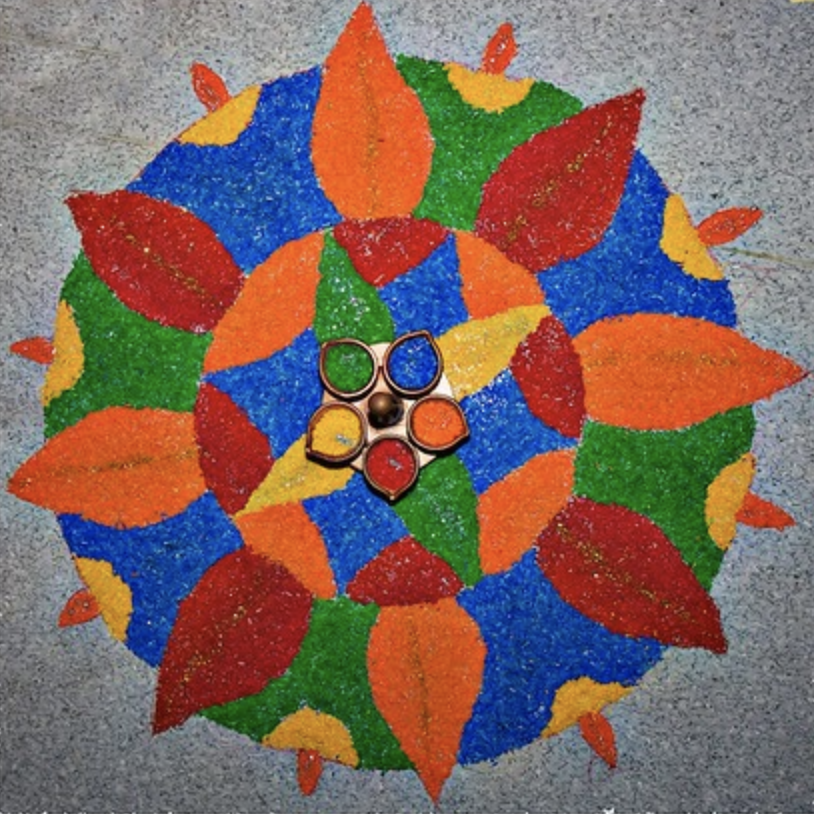
“Kolam” by resakse is licensed under CC BY-ND 2.0
Like any traditional art form, the kōlam doesn’t have quite as many practitioners as it used to, much less practitioners who can meet the standard of mastery of completing an entire work without once standing up or even lifting their hand. But even so, the kōlam is hardly on the brink of dying out: you can see a few of their creators in action in the video at the top of the post, and the age of social media has offered kōlam creators of any age — and now even the occasional man — the kind of exposure that even the busiest front door could never match. Some who get into kōlams in the 21st century may want to create ones that show ever more complexity of geometry and depth of reference, but the best among them won’t forget the meaning, according to Chaki, of the form’s very name: beauty.
Read more about kōlams at Atlas Obscura.
Related Content:
Mathematics Made Visible: The Extraordinary Mathematical Art of M.C. Escher
New Iranian Video Game, Engare, Explores the Elegant Geometry of Islamic Art
The Complex Geometry of Islamic Art & Design: A Short Introduction
Based in Seoul, Colin Marshall writes and broadcasts on cities, language, and culture. His projects include the book The Stateless City: a Walk through 21st-Century Los Angeles and the video series The City in Cinema. Follow him on Twitter at @colinmarshall, on Facebook, or on Instagram.
Read More...Paris, New York & Havana Come to Life in Colorized Films Shot Between 1890 and 1931
Cities have long provided a rich environment for photography, at least to photographers not interested exclusively in nature. But only with the advent of the motion picture camera did the subject of cities find a photographic form that truly suited it. Hence the popularity in the 1920s of “city symphony” films, each of which sought to capture and present the real life of a different bustling industrial metropolis. But while city symphonies certainly hold up as works of art, they do make modern-day viewers wonder: what would all these capitals look like if I could gaze backward in time, looking not through the jittery, colorless medium of early motion-picture film, but with my own eyes?
Youtuber Ignacio López-Francos offers a step closer to the answer in the form of these four videos, each of which takes historical footage of a city, then corrects its speed and adds color to make it more lifelike.
At the top of the post we have “a collection of high quality remastered prints from the dawn of film taken in Belle Époque-era Paris, France from 1896–1900.” Shot by the Lumière company (which was founded by Auguste and Louis Lumière, inventors of the projected motion picture), the sights captured by the film include the Avenue des Champs-Élysées, Tuileries Garden, the then-new Eiffel Tower, and the now-soon-to-be-rehabilitated but then-intact Notre Dame cathedral.
The Paris footage was colorized using DeOldify, “a deep learning-based project for colorizing and restoring old images.” So was the footage just above, which shows New York City in 1911 as shot by the Swedish company Svenska Biografteatern and released publicly by the Museum of Modern Art. “Produced only three years before the outbreak of World War I, the everyday life of the city recorded here — street traffic, people going about their business — has a casual, almost pastoral quality that differs from the modernist perspective of later city-symphony films,” say the accompanying notes. “Take note of the surprising and remarkably timeless expression of boredom exhibited by a young girl filmed as she was chauffeured along Broadway in the front seat of a convertible limousine.”
Shot twenty years later, these clips of New York’s Theater District have also undergone the DeOldify treatment, which gets the bright lights (and numerous ballyhooing signs) of the big city a little closer to the stunning quality they must have had on a new arrival in the 1930s. The streets of Havana were seemingly quieter during that same decade, at least if the colorized footage below is to be believed. But then, the history of tourism in Cuba remembers the 1930s as something of a dull stretch after the high-living 1920s that came before, during the United States’ days of Prohibition — let alone the even more daiquiri- and mojito-soaked 1950s that would come later, speaking of eras one dreams of seeing for oneself.
Related Content:
Immaculately Restored Film Lets You Revisit Life in New York City in 1911
The Oldest Known Footage of London (1890–1920) Features the City’s Great Landmarks
Berlin Street Scenes Beautifully Caught on Film (1900–1914)
The Oldest Known Footage of London (1890–1920) Features the City’s Great Landmarks
Based in Seoul, Colin Marshall writes and broadcasts on cities, language, and culture. His projects include the book The Stateless City: a Walk through 21st-Century Los Angeles and the video series The City in Cinema. Follow him on Twitter at @colinmarshall, on Facebook, or on Instagram.
Read More...A Mesmerizing Trip Across the Brooklyn Bridge: Watch Footage from 1899
It’s hardly original advice but bears repeating anyway: no one visiting New York should leave, if they can help it, before they cross the Brooklyn Bridge—preferably on foot, if possible, and at a reverential pace that lets them soak up all the Neo-gothic structure’s storied history. Walk from Manhattan to Brooklyn, then back again, or the other away around, since that’s what the bridge was built for—the commutes of a nineteenth century bridge-but-not-yet-tunnel crowd (the first NYC subway tunnel didn’t open until 1908).
In 1899, filmmakers from American Mutoscope and Biograph elected for a mode of travel for a New York century, putting a camera at “the front end of a third rail car running at high speed,” notes a 1902 American Mutoscope catalogue. They accelerated the tour to the pace of a modern machine, chosing the Manhattan to Brooklyn route. “The entire trip consumes three minutes of time, during which abundant opportunity is given to observe all the structural wonders of the bridge, and far distant river panorama below.” (See one-third of the trip just below.)
Filmmaker Bill Morrison looped excerpts of those three New York minutes and extended them to nine in his short, stereoscopic journey “Outerborough,” at the top, commissioned by The Museum of Modern Art in 2005 and scored with original music by Todd Reynolds. Taking the 1899 footage as its source material, the film turns a rapid transit tour into a moving mandala, a fractal repetition at frighteningly faster and faster speeds, of the bridge’s most mechanical vistas—the views of its looming, vaulted arches and of the steel cage surrounding the tracks.
One of the engineering wonders of the world, the Brooklyn Bridge opened 136 years ago this month, on May 24th, 1883. The first person to walk across it was the woman who oversaw its construction for 11 of the 14 years it took to build the bridge. After designer John Roebling died of tetanus, his son Washington took over, only to succumb to the bends during the sinking of the caissons and spend the rest of his life bedridden. Emily, his wife, “took on the challenge,” notes the blog 6sqft, consulting with her husband while actively supervising the project.
She “studied mathematics, the calculations of catenary curves, strengths of materials and the intricacies of cable construction.” On its opening day, Emily walked the bridge’s 1,595 feet, from Manhattan to Brooklyn, “her long skirt billowing in the wind as she showed [the crowd] details of the construction,” writes David McCullough in The Great Bridge. Six days later, an accident caused a panic and a stampede that killed twelve people. Some months later, P.T. Barnum’s Jumbo led a parade of 21 elephants over the bridge in a stunt to prove its safety.
Barnum’s theatrics were surprisingly honest—the bridge may have needed selling to skeptical commuters, but it needed no hype. It outlived most of its contemporaries, despite the fact that it was built before engineers understood the aerodynamic properties of bridges. The Roeblings designed and built the bridge to be six times stronger than it needed to be, but no one could have foreseen just how durable the structure would prove.
It elicited a fascination that never waned for its palpable strength and beauty, yet fewer of its admirers chose to document the journey that has taken millions of Brooklynites over the river to lower Manhattan, by foot, bike, car, and yes, by train. Leave it to that futurist for the common man, Thomas Edison, to film the trip. See his 1899 footage of Brooklyn to Manhattan by train just above.
Related Content:
Immaculately Restored Film Lets You Revisit Life in New York City in 1911
An Online Gallery of Over 900,000 Breathtaking Photos of Historic New York City
New York City: A Social History (A Free Online Course from N.Y.U.)
Josh Jones is a writer and musician based in Durham, NC. Follow him at @jdmagness
Read More...What is Camp? When the “Good Taste of Bad Taste” Becomes an Aesthetic
Even if you don’t care about high fashion or high society — to the extent that those two things have a place in the current culture — you probably glimpsed some of the coverage of what attendees wore to the Met Gala earlier this month. Or perhaps coverage isn’t strong enough a word: what most of the many observers of the Metropolitan Museum of Art’s Costume Institute annual fundraising gala did certainly qualified as analysis, and in not a few cases tipped over into exegesis. That enthusiasm was matched by the flamboyance of the clothing worn to the event — an event whose co-chairs included Lady Gaga, a suitable figurehead indeed for a party that this year took on the theme of camp.
But what exactly is camp? You can get an in-depth look at how the world of fashion has interpreted that elaborate and entertaining but nevertheless elusive cultural concept in the Met’s show Camp: Notes on Fashion, which runs at the Met Fifth Avenue until early September.
“Susan Sontag’s 1964 essay Notes on ‘Camp’ provides the framework for the exhibition,” says the Met’s web site, “which examines how the elements of irony, humor, parody, pastiche, artifice, theatricality, and exaggeration are expressed in fashion.” But for a broader understanding of camp, you’ll want to go back to Sontag’s and read all of the 58 theses it nailed to the door of the mid-1960s zeitgeist.
According to Sontag, camp is “not a natural mode of sensibility” but a “love of the unnatural: of artifice and exaggeration.” It offers a “way of seeing the world as an aesthetic phenomenon.” Most anything manmade can be camp, and Sontag’s list of examples include Tiffany lamps, “the Brown Derby restaurant on Sunset Boulevard in L.A.,” Aubrey Beardsley drawings, and old Flash Gordon comics. Elevating style “at the expense of content,” camp is suffused with “the love of the exaggerated, the ‘off,’ of things-being-what-they-are-not.” Camp is not irony, but it “sees everything in quotation marks.” The essential element of camp is “seriousness, a seriousness that fails.” Camp “asserts that good taste is not simply good taste; that there exists, indeed, a good taste of bad taste.”
“When Sontag published ‘Notes on Camp,’ she was fascinated by people who could look at cultural products as fun and ironic,” says Sontag biographer Benjamin Moser in a recent Interview magazine survey of the subject. And though Sontag’s essay remains the definitive statement on camp, not everyone has agreed on exactly what counts and does not count as camp in the 55 years since its publication in the Partisan Review. “Camp to me means over-the-top humor, usually coupled with big doses of glamour,” says fashion designer Jeremy Scott in the same Interview article. “To be interesting, camp has to have some kind of political consciousness and self-awareness about what it’s doing,” says filmmaker Bruce Labruce, challenging Sontag’s description of camp as apolitical.
And what will become of camp in the all-digitizing 21st century, when many eras increasingly coexist on the same culture plane? Our time “has cannibalized camp,” says cultural history professor Fabio Cleto, “but to say that it’s no longer camp because its aesthetics have gone mainstream is an overly simplistic reading. Camp has always been mourning its own death.” Even so, some of camp’s most high-profile champions have cast doubt on its viability. The phrase “good taste of bad taste” brings no figure to mind more quickly than Pink Flamingos and Hairspray director John Waters (who speaks on the origin of his good taste in bad taste in the Big Think video above). But even he speaks pessimistically to Interview about camp’s future: “Camp? Nothing is so bad it’s good now that we have Trump as president. He even ruined that.”
Related Content:
Why So Many People Adore The Room, the Worst Movie Ever Made? A Video Explainer
David Foster Wallace on What’s Wrong with Postmodernism: A Video Essay
The Star Wars Holiday Special (1978): It’s Oh So Kitsch
Susan Sontag’s 50 Favorite Films (and Her Own Cinematic Creations)
John Waters Talks About His Books and Role Models in a Whimsical Animated Video
Based in Seoul, Colin Marshall writes and broadcasts on cities, language, and culture. His projects include the book The Stateless City: a Walk through 21st-Century Los Angeles and the video series The City in Cinema. Follow him on Twitter at @colinmarshall or on Facebook.
Read More...Why the World’s Best Mathematicians Are Hoarding Japanese Chalk
Here’s the latest from Great Big Story: “Once upon a time, not long ago, the math world fell in love … with a chalk. But not just any chalk! This was Hagoromo: a Japanese brand so smooth, so perfect that some wondered if it was made from the tears of angels. Pencils down, please, as we tell the tale of a writing implement so irreplaceable, professors stockpiled it.”
Head over to Amazon and try to buy it, and all you get is: “Currently unavailable. We don’t know when or if this item will be back in stock.” Indeed, they’ve stockpiled it all.
If you would like to support the mission of Open Culture, consider making a donation to our site. It’s hard to rely 100% on ads, and your contributions will help us continue providing the best free cultural and educational materials to learners everywhere. You can contribute through PayPal, Patreon, and Venmo (@openculture). Thanks!
Related Content:
Stephen Hawking’s Lectures on Black Holes Now Fully Animated with Chalkboard Illustrations
The Map of Mathematics: Animation Shows How All the Different Fields in Math Fit Together
Read More...
Watch Six New Short Alien Films: Created to Celebrate the 40th Anniversary of Ridley Scott’s Film
Alien came out 40 years ago this month, not that its age shows in the least. The terror of the ever-diminishing crew of the Nostromo trapped on their ship with the merciless extraterrestrial monster of the title remains as visceral as it was in 1979, and the dank, pre-digital confines of its setting have taken on a retro patina that successive generations of filmmakers struggle to recreate for themselves.
Now, in a series of brand new short films set in the Alien universe, you can see how six young filmmakers pay tribute to Ridley Scott’s original film and its cinematic legacy, each in their own way. These shorts come as the fruits of an initiative launched by 20th Century Fox to mark 40 years of Alien.
“Developed by emerging filmmakers selected from 550 submissions on the Tongal platform,” writes Collider’s Dave Trumbore, “the anniversary initiative focused on finding the biggest fans of the Alien franchise to create new, thrilling stories for the Alien fandom.”
These stories include many of the elements that fandom has come to expect — isolated and endangered spacefarers, bleak colonies on distant planets, tough women, fearsome creatures lurking in the darkness, escape pods, chest-bursting — as well a few it hasn’t. Indiewire’s Michael Nordine highlights Noah Miller’s Alone, “which follows a woman named Hope who’s hurtling through space on her lonesome. She eventually gains access to a restricted part of her ship after a system malfunction, and you can probably guess what’s on the other side of that sealed-off door.” But you certainly won’t be able to guess what happens next.
Nordine also has praise for the protagonist of the Spears Sisters’ Ore: “A miner about to welcome her latest grandchild, she puts herself in harm’s way rather than risk letting the latest alien specimen make it out of the mine and threaten the colony (and, more to the point, her family) above. That’s a simple, familiar tack, but it’s well told — something true of most Alien stories.” Collectively, he writes, these shorts “emphasize what makes Alien such an enduring franchise: its industrial, working-class environs full of clunky green-screen computers and disgruntled laborers; its bleak view of the corporate bureaucrats who enable the xenomorphs’ carnage by trying to control them and writing off their underlings as collateral damage; and, of course, its heroines.”
Taking pitches from fans through a crowdsourcing platform and distributing the resulting films on Youtube may seem like an almost parodically 21st-century way of extending a franchise that began in the 1970s, but testing out different filmmakers’ visions has long been a part of the greater Alien project: the sequels directed in the 1980s and 90s by James Cameron, David Fincher, and Jean-Pierre Jeunet hinted at the great variety of possibilities laid down by Scott’s original, the cinematic standard-bearer for the contest of wills between man and alien — or rather, woman and alien.
Related Content:
High School Kids Stage Alien: The Play and You Can Now Watch It Online
Sigourney Weaver Stars in a New Experimental Sci-Fi Film: Watch “Rakka” Free Online
Three Blade Runner Prequels: Watch Them Online
Based in Seoul, Colin Marshall writes and broadcasts on cities, language, and culture. His projects include the book The Stateless City: a Walk through 21st-Century Los Angeles and the video series The City in Cinema. Follow him on Twitter at @colinmarshall or on Facebook.
Read More...Hear Raymond Carver’s Story “Fat” Read by Anne Enright
“Fat” is the first story in Raymond Carver’s 1976 collection Will You Please Be Quiet Please?. Thanks to The Guardian, you can hear the story read above by Irish author Anne Enright.
Find the story listed in our collection, 1,000 Free Audio Books: Download Great Books for Free.
If you would like to support the mission of Open Culture, consider making a donation to our site. It’s hard to rely 100% on ads, and your contributions will help us continue providing the best free cultural and educational materials to learners everywhere. You can contribute through PayPal, Patreon, and Venmo (@openculture). Thanks!
Hear Five JG Ballard Stories Presented as Radio Dramas

Image by Thierry Erhmann via Wikimedia Commons
These episodes of the Canadian radio drama series Vanishing Point were adapted from the short stories of British writer J.G. Ballard (1930–2009). “The writers commissioned to create the dramas included Lawrence Russell (A Question of Re-entry, The Dead Astronaut), Margaret Hollingsworth (The Cloud Sculptors of Coral D), Brian Wade (Low Flying Aircraft, News From The Sun), Paul Milliken (Having A Wonderful Time), and James R. Wallen (Escapement). Lauded at the time, these forgotten gems explore the dramatic aspects of JGB’s early short stories within an auditory medium.” Stream them below, and find them listed in our collection 1,000 Free Audio Books: Download Great Books for Free:
If you would like to support the mission of Open Culture, consider making a donation to our site. It’s hard to rely 100% on ads, and your contributions will help us continue providing the best free cultural and educational materials to learners everywhere. You can contribute through PayPal, Patreon, and Venmo (@openculture). Thanks!
Read More...Support Us
We're hoping to rely on loyal readers, rather than erratic ads. Please click the Donate button and support Open Culture. You can use Paypal, Venmo, Patreon, even Crypto! We thank you!

About Us

Open Culture scours the web for the best educational media. We find the free courses and audio books you need, the language lessons & educational videos you want, and plenty of enlightenment in between.
Advertise With Us

FREE UPDATES!
GET OUR DAILY EMAIL
Get the best cultural and educational resources on the web curated for you in a daily email. We never spam. Unsubscribe at any time.
FOLLOW ON SOCIAL MEDIA

Open Culture editor Dan Colman scours the web for the best educational media. He finds the free courses and audio books you need, the language lessons & movies you want, and plenty of enlightenment in between.
Advertise With Us


