The History of the World in One Video: Every Year from 200,000 BCE to Today
“Where are you from?” a character at one point asks Babe, the hapless protagonist of the Firesign Theatre’s classic comedy album How Can You Be in Two Places at Once When You’re Not Anywhere at All. “Nairobi, ma’am,” Babe replies. “Isn’t everybody?” Like most of that psychedelic radio troupe’s pieces of apparent nonsense, that memorable line contains a truth: trace human history back far enough and you inevitably end up in east Africa, a point illustrated in reverse by the video above, “A History of the World: Every Year,” which traces the march of humanity between 200,000 BCE and the modern day.
To a dramatic soundtrack which opens and closes with the music of Hans Zimmer, video creator Ollie Bye charts mankind’s progress out of Africa and, ultimately, into every corner of all the continents of the world.
Real, documented settlements, cities, empires, and entire civilizations rise and fall as they would in a computer game, with a constantly updated global population count and list of the civilizations active in the current year as well as occasional notes about politics and diplomacy, society and culture, and inventions and discoveries.
All that happens in under 20 minutes, a pretty swift clip, though not until the very end does the world take the political shape we know today, including even the late latecomer to civilization that is the United States of America. Bye’s many other videos tend to focus on the history of other parts of the world, such as India, the British Isles, and that cradle of our species, the African continent, all of which we can now develop first-hand familiarity with in this age of unprecedented human mobility. Though the condition itself takes the question “Where are you from?” to a degree of complication unknown not only millennia but also centuries and even decades ago, at least now you have a snappy answer at the ready.
Related Content:
The History of Civilization Mapped in 13 Minutes: 5000 BC to 2014 AD
Take Big History: A Free Short Course on 13.8 Billion Years of History, Funded by Bill Gates
The History of the World in 46 Lectures From Columbia University
The History of the World in 20 Odd Minutes
A Crash Course in World History
5‑Minute Animation Maps 2,600 Years of Western Cultural History
Based in Seoul, Colin Marshall writes and broadcasts on cities and culture. His projects include the book The Stateless City: a Walk through 21st-Century Los Angeles and the video series The City in Cinema. Follow him on Twitter at @colinmarshall or on Facebook.
Read More...Watch an Episode of TV-CBGB, the First Rock ‘n’ Roll Sitcom Ever Aired on Cable TV (1981)
For a good long while, or at least a few decades, the best things on TV in the U.S. happened outside the major broadcast and national cable networks. And like a great many other cultural happenings of the previous century, you would have to live in New York to experience them. I mean, of course, the weird, wonderful world of Manhattan public access cable TV. Here you could watch, for example, Glenn O’Brien’s TV Party, created by the titular host as “a drug-fueled re-interpretation of Hugh Hefner’s Playboy After Dark”—as we noted in a recent post—and featuring the most cutting-edge artists and musicians of the day.
Around the same time, Andy Warhol conducted his version of a celebrity interview show on local cable, and as the banal infotainment of daytime talk show and 24-hour-cable news developed on mainstream TV, a dozen bizarre, hilarious, raunchy, and ridiculous interview and call-in shows took hold on New York cable access in the years to follow (some of them still exist).
I happened to catch the tail end of this golden era, which tapered off in the nineties as the internet took over for the communities these shows served. But oh, what it must have been like to watch the thriving downtown scene document itself on TV from week-to-week, alongside the legendarily flamboyant Manhattan subcultures that found their voices on cable access?
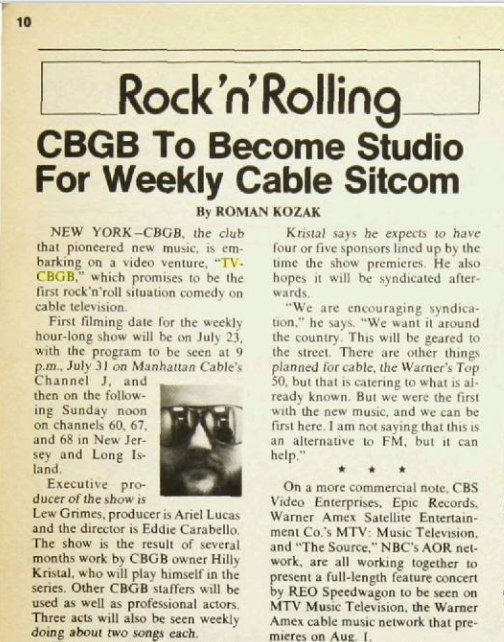
Quite a few people remember it well, and were thrilled when the video at the top emerged from obscurity: an episode of TV-CBGB shot in 1981, “an odd glimpse,” writes Martin Schneider at Dangerous Minds, “of a CBGB identity that never took shape, as a cable access mainstay.” It is unclear how many episodes of the show were shot, or aired, or still exist in some form, but what we do have above seems representative, according to two Billboard articles describing the show. The first, from July 11, 1981, called the project “the first rock’n’roll situation comedy on cable television.”
Created by CBGBs owner, Hilly Kristal, the show aimed to give viewers slices of life from the Bowery institution, which was already famous, according to Billboard, as “the club that pioneered new music.” Kristal told the trade magazine, “There will always be a plot, though a simple plot. It will be about what happens in the club, or what could happen.” He then goes on to describe a series of plot ideas which, thankfully, didn’t dominate the show—or at least what we see of it above. The episode is “90% performance,” though “not true concert footage,” Schneider writes.
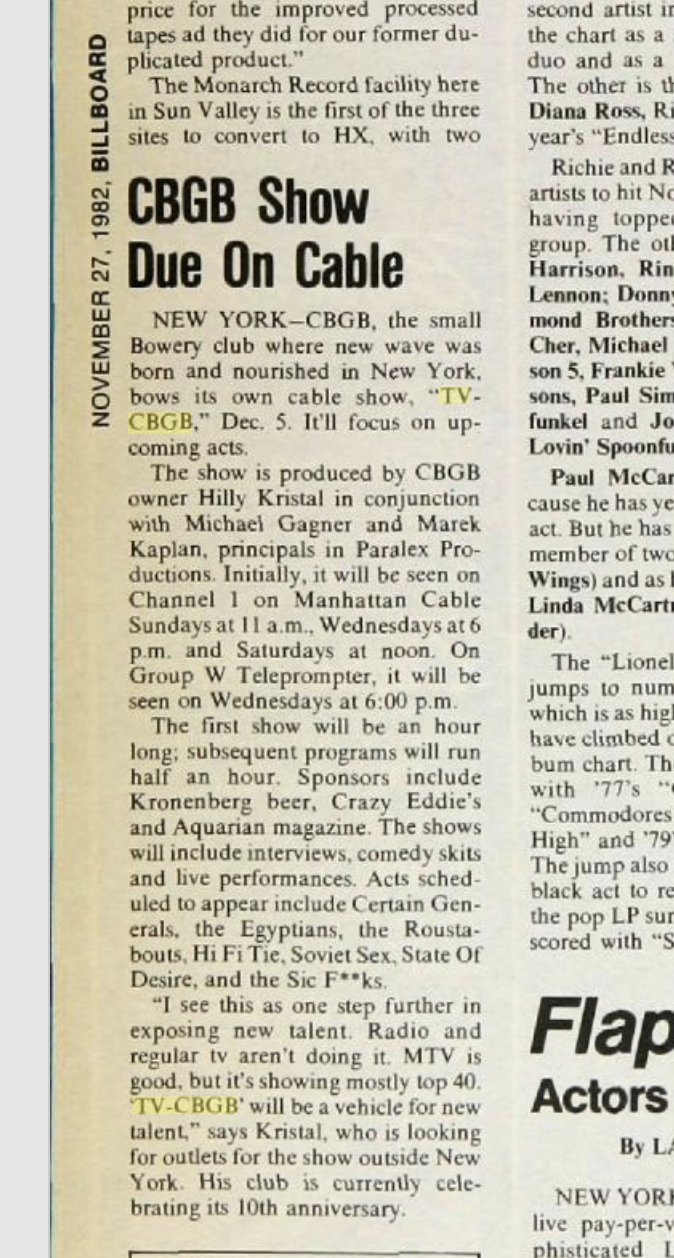
After an odd opening intro, we’re thrown into a song from Idiot Savant. Other acts include The Roustabouts, The Hard, Jo Marshall, Shrapnel, and Sic Fucks. While not among the best or most well-known to play at the club, these bands put on some excellent performances. By November of the following year, it seems the first episode had still not yet aired. Billboard quotes Kristal as calling TV-CBGB “one step further in exposing new talent. Radio and regular tv aren’t doing it. MTV is good, but it’s showing mostly top 40.”
Had the show migrated to MTV, Schneider speculates, it might have become a “national TV icon,” fulfilling Kristal’s vision for a new means of bringing obscure downtown New York musicians to the world at large. It might have worked. Though the sketches are lackluster, notable as historical curiosities, the music is what makes it worthwhile, and there’s some really fun stuff here—vital and dramatic. While these bands may not have had the mass appeal of, say, Blondie or the Ramones, they were stalwarts of the early 80s CBGB scene.
The awkward, strangely earnest, and often downright goofy skits portraying the goings-on in the lives of club regulars and employees are both somehow touching and tedious, but with a little polish and better direction, the whole thing might have played like a punk rock version of Fame—which maybe no one needed. As it stands, given the enthusiasm of several YouTube commenters who claim to have watched it at the time or been in the club themselves, the episode constitutes a strange and rare document of what was, if not what could have been.
Related Content:
Take a Virtual Tour of CBGB, the Early Home of Punk and New Wave
CBGB is Reborn … As a Restaurant in Newark Airport
When Glenn O’Brien’s TV Party Brought Klaus Nomi, Blondie & Basquiat to Public Access TV (1978–82)
Josh Jones is a writer and musician based in Durham, NC. Follow him at @jdmagness
Read More...David Bowie: The Last Five Years Is Now Airing/Streaming on HBO
FYI: David Bowie died two years ago today. And to commemorate the anniversary, HBO has just started airing David Bowie: The Last Five Years, a 90-minute BBC documentary that revisits Bowie’s less public final years. If you don’t already have HBO, you could always watch the doc by signing up for a free trial for HBO Now (HBO’s streaming service). Here’s a quick summary/overview of the film:
In the last years of his life, David Bowie ended nearly a decade of silence to engage in an extraordinary burst of activity, producing two groundbreaking albums and a musical. David Bowie: The Last Five Years explores this unexpected end to a remarkable career.
On the 2003–2004 “Reality” tour, David Bowie had a frightening brush with mortality, suffering a heart attack during what was to be his final full concert. He then disappeared from public view, only re-emerging in the last five years of his life to make some of the most important music of his career. Made with remarkable access, Francis Whately’s documentary is a revelatory follow-up to his acclaimed 2013 documentary David Bowie: Five Years, which chronicled Bowie’s golden ‘70s and early-‘80s period.
While illuminating iconic moments of his extraordinary and prolific career, David Bowie: The Last Five Years focuses on three major projects: the albums The Next Day and the jazz-infused Blackstar (released on Bowie’s 69th birthday, two days before his death in 2016), and the musical Lazarus, which was inspired by the character he played in the 1976 film The Man Who Fell to Earth.
Dispelling the simplistic view that his career was simply predicated on change, the film includes revealing interviews with many of Bowie’s closest creative collaborators, including: Tony Visconti, Bowie’s long-time producer; musicians who contributed to The Next Day and Blackstar; Jonathan Barnbrook, the graphic designer of both albums; Robert Fox, producer of Lazarus, along with cast members from the show, providing a unique behind-the-scenes look at Bowie’s creative process; and Johan Renck, director of Bowie’s final music video, “Lazarus,” which was widely discussed as foreshadowing his death.
You can watch a trailer for the new film up above.
If you would like to support the mission of Open Culture, consider making a donation to our site. It’s hard to rely 100% on ads, and your contributions will help us continue providing the best free cultural and educational materials to learners everywhere. You can contribute through PayPal, Patreon, and Venmo (@openculture). Thanks!
Related Content:
David Bowie Urges Kids to READ in a 1987 Poster Sponsored by the American Library Association
Read More...A Map of George Orwell’s 1984

Many fictional locations resist mapping. Our imaginations may thrill, but our mental geolocation software recoils at the impossibilities in Italo Calvino’s Invisible Cities—a series of geographically whimsical tales told by Marco Polo to Genghis Khan; or China Miéville’s The City and the City, in which two metropolises—Besźel and Ul Qoma—occupy much of the same physical space, and a secretive police power compels citizens to willfully “unsee” one city or the other.
That’s not to say such maps cannot be made. Calvino’s strange cities have been illustrated, if not at street level, in as fanciful a fashion as the narrator describes them. Miéville’s weird cities have received several literal-minded mapping treatments, which perhaps mistake the novel’s careful construction of metaphor for a kind of creative urban planning.
Miéville himself might disavow such attempts, as he disavows one-to-one allegorical readings of his fantastic detective novel—those, for example, that reduce the phenomenon of “unseeing” to an Orwellian means of thought control. “Orwell is a much more overtly allegorical writer,” he tells Theresa DeLucci at Tor, “although it’s always sort of unstable, there’s a certain kind of mapping whereby x means y, a means b.”
Orwell’s speculative worlds are easily decoded, in other words, an opinion shared by many readers of Orwell. But Miéville’s comments aside, there’s an argument to be made that The City and the City’s “unseeing” is the most vividly Orwellian device in recent fiction. And that the fictional world of 1984 does not, perhaps, yield to such simple mapping as we imagine.
Of course it’s easy to draw a map (see above, or in a larger format here) of the three imperial powers the novel tells us rule the world. Frank Jacobs at Big Think tidily sums them up:
Oceania covers the entire continents of America and Oceania and the British Isles, the main location for the novel, in which they are referred to as ‘Airstrip One’.
Eurasia covers Europe and (more or less) the entire Soviet Union.
Eastasia covers Japan, Korea, China and northern India.
These three superstates are perpetually at war with each other, though who’s at war with whom is unclear. “And yet… the war might just not even be real at all”—for all we know it might be a fabrication of the Ministry of Truth, to manufacture consent for austerity, mass surveillance, forced nationalism, etc. It’s also possible that the entirety of the novel’s geo-politics have been invented out of whole cloth, that “Airstrip One is not an outpost of a greater empire,” Jacobs writes, “but the sole territory under the command of Ingsoc.”
One commenter on the map—which was posted to Reddit last year—points out that “there isn’t any evidence in the book that this is actually how the world is structured.” We must look at the map as doubly fictional, an illustration, Lauren Davis notes at io9, of “how the credulous inhabitant of Airstrip One, armed with only maps distributed by the Ministry of Truth, might view the world, how vast the realm of Oceania seems and how close the supposed enemies in Eurasia.” It is the world as the minds of the novel’s characters conceive it.
All maps, we know, are distortions, shaped by ideology, belief, perspectival bias. 1984’s limited third-person narration enacts the limited views of citizens in a totalitarian state. Such a state necessarily uses force to prevent the people from independently verifying constantly shifting, contradictory pieces of information. But the novel itself states that force is largely irrelevant. “The patrols did not matter… Only the Thought Police mattered.”
In Orwell’s fiction “similar outcomes” as those in totalitarian states, as Noam Chomsky remarks, “can be achieved in free societies like England” through education and mass media control. The most unsettling thing about the seeming simplicity of 1984’s map of the world is that it might look like almost anything else for all the average person knows. Its elementary-school rudiments metaphorically point to frighteningly vast areas of ignorance, and possibilities we can only imagine, since Winston Smith and his compatriots no longer have the ability, even if they had the means.
Related Content:
George Orwell Explains in a Revealing 1944 Letter Why He’d Write 1984
A Complete Reading of George Orwell’s 1984: Aired on Pacifica Radio, 1975
Josh Jones is a writer and musician based in Durham, NC. Follow him at @jdmagness
Read More...Hear a Dramatization of Neil Gaiman’s Anansi Boys: Free for a Limited Time
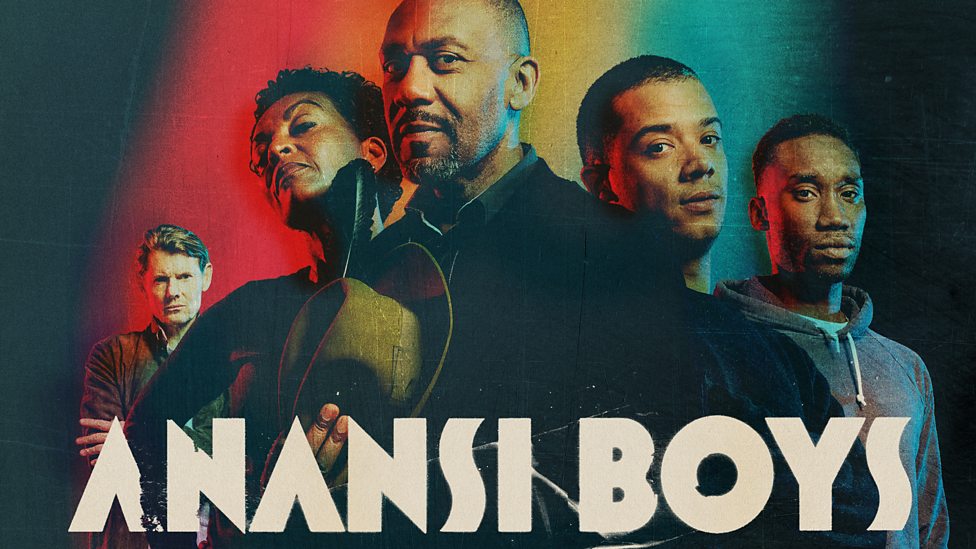
A quick heads up: The BBC is now streaming a new, six-part adaptation of Anansi Boys, Neil Gaiman’s mythical fantasy novel from 2006. Only available for the next few weeks, each episode runs about 30 minutes. Find them here.
Fans of Neil Gaiman will also definitely want to check out this post in our archive: 18 Stories & Novels by Neil Gaiman Online: Free Texts & Readings by Neil Himself.
If you would like to support the mission of Open Culture, consider making a donation to our site. It’s hard to rely 100% on ads, and your contributions will help us continue providing the best free cultural and educational materials to learners everywhere. You can contribute through PayPal, Patreon, and Venmo (@openculture). Thanks!
Related Content:
1,000 Free Audio Books: Download Great Books for Free
Hear Radio Dramas of Isaac Asimov’s Foundation Trilogy & 7 Classic Asimov Stories
Read More...Watch Every Episode of Bob Ross’ The Joy Of Painting Free Online: 403 Episodes Spanning 31 Seasons
Whether your New Year’s resolution involves taking up painting, managing stress, cultivating a more positive outlook, or building a business empire, the late television artist Bob Ross can help you stick it out.
Like Fred Rogers’ Mr Rogers’ Neighborhood, Ross’ long-running PBS show, The Joy of Painting, did not disappear from view following its creator’s demise. For over twenty years, new fans have continued to seek out the half-hour long instructional videos, along with its mesmerizingly mellow, easily spoofed host.
Now all 403 episodes have been made available for free on Ross’ official Youtube channel. That covers all 31 seasons.
It’s said that 90% of the regular viewers tuning in to watch Ross crank out his signature “wet-on-wet” landscapes never took up a brush, despite his belief that, with a bit of encouragement, anyone can paint.
Perhaps they preferred sad clowns or big-eyed children to scenic landscapes of the sort that would not have looked out of place in a 1970’s motel.… Or perhaps Ross, himself, was the big draw.
Like Mister Rogers, Ross spoke softly, using direct address to create an impression of intimacy between himself and the viewer. Twenty years in the military had soured him on barked-out, rigid instructions. Instead, Ross reassured less experienced painters that the 16th-century ”Alla Prima” technique he brought to the masses could never result in mistakes, only “happy accidents.” He was patient and kind and he didn’t take his own abilities too seriously, though he seemed like he would certainly have taken pleasure in yours.
Ross’ Land of Make Believe was a character-free natural world, in which many of the same elements appear over and over. According to Five Thirty Eight culture editor Walt Hickey’s statistical analysis, trees reigned supreme. The real life landscapes he observed as first sergeant of the U.S. Air Force Clinic at Eielson Air Force Base in Alaska became his lifelong subject, and by extension, that of untold numbers of home viewers.
His devotees may be content just seeing “happy little trees” and “pretty little mountains” bloom on canvas, but in an interview with NPR, Ross’ business partner, Annette Kowalski, suggests that he would not have been.
The gentle, forest-and-cloud-loving host was also an ambitious and highly focused businessman, who used TV as the medium for his success. Every folksy comment was rehearsed before filming and he stuck with the permed hairdo he loathed, rather than scrapping what had become a highly visual brand identifier.
Where there’s a will, there’s a way.
Watch all 31 seasons of Bob Ross’ The Joy of Painting here, or right here on this page. Official Bob Ross painting kits are widely available online, or source your own using a cobbled together supply list.
Season Three
Season Four
Season Five
Season Six
We will continuing adding seasons to this list as they become available.
Season Seven
Season Eight
Season Nine
Season Ten
Season 11
Season 12
Season 13
Season 14
Season 15
Season 16
Season 17
Season 18
Season 19
Season 20
Season 21
Season 22
Season 23
Season 24
Season 25
Season 26
Season 27
Season 28
Season 29
Season 30
Season 31
Related Content:
Watch Bob Ross’ The Joy of Painting, Seasons 1–3, Free Online
Mr. Rogers Goes to Congress and Saves PBS: Heartwarming Video from 1969
Stream 23 Free Documentaries from PBS’ Award-Winning American Experience Series
Ayun Halliday is an author, illustrator, theater maker and Chief Primatologist of the East Village Inky zine. Her resolution is to spend less time online, but you can still follow her @AyunHalliday.
Read More...Ian McKellen Recites Shakespeare’s Sonnet 20, Backed by Garage Rock Band, the Fleshtones, on Andy Warhol’s MTV Variety Show (1987)
80s revivalism can be done badly and it can be done well. Those old enough to remember the decade seem best placed to recreate it, but the success of Stranger Things offers an excellent counterexample. The millennial Duffer brothers did a marvelous job of conjuring the look and feel of mid-80s mise-en-scène by stitching together close viewings of a dozen or so films—from the massively popular E.T. to more obscure flicks like made-for-TV Mazes and Monsters (not to mention such precious archival footage as this.)
When it comes to music however, 80s retro tends to confine themselves to early hip and hop and electro, the synthpop of Gary Numan and Duran Duran or the cheesy hair metal of Mötley Crüe. But this lens misses the significant 60s revivalism that emerged at the time. Garage, surf, and psych rock and the jangly sounds of The Byrds inspired R.E.M., the B52s, the Replacements, the House of Love, and the Fleshtones, a much lesser-known NYC band who may never have gotten their commercial due, but who certainly appealed to 60s art star Andy Warhol.
When Warhol remade himself as a TV personality in the 80s with his MTV variety show Andy Warhol’s 15 Minutes he cast the Fleshtones as the backing band for rising theater and film star Ian McKellen, a match-up that represents another hallmark of 80s pop culture—the postmodern juxtaposition of genres, styles, and registers which Warhol helped pioneer 20 years earlier when he brought kitschy silk-screened soup cans, sexy street hustlers, and the Velvet Underground into the art scene.
Warhol’s television work turned this impulse into a multimedia circus featuring “The high and the low. The rich and the famous. The struggling artists and the rising stars,” as Warhol Museum curator Geralyn Huxley puts it. In this particularly fitting example, McKellen and the Fleshtones bring Shakespeare’s racy Sonnet 20 to young, hip MTV audiences in 1987. L.A. Weekly lists a few of the “cool points” from the clip:
- A young, hot, already insanely talented Ian McKellen
- Wearing awesome New Wave fashions
- At Andy Warhol’s Factory in 1987
- Backed by cult group the Fleshtones
- Reciting a Shakespeare Sonnet
What’s not to love? Start your 2018 with some Shakespeare-meets-garage-rock coolness from 31 years ago—and revisit more of Warhol’s MTV variety show at our previous post. For serious students of the decade, this is essential viewing.
Related Content:
Pink Floyd’s David Gilmour Sings Shakespeare’s Sonnet 18
Josh Jones is a writer and musician based in Durham, NC. Follow him at @jdmagness
Read More...How to “Hijack” Amazon Prime for Good: Short Video Shows How Prime & Other Instant Delivery Services Can Easily Help the Homeless
Today, it’s 18 degrees in New York City, 4 degrees in Chicago, and 13 degrees in Boston. It’s damn cold, especially for the homeless.
Keep this in mind as you watch Rob Bliss’ short video above. In a poignant video, he points out how services offering the immediate delivery of products and services could easily help the homeless. While he uses Amazon Prime as an example, the same idea could be extended to services like DoorDash, GrubHub, and UberEats (which is apparently now outgrowing the taxi business in some cities).
If you would like to support the mission of Open Culture, consider making a donation to our site. It’s hard to rely 100% on ads, and your contributions will help us continue providing the best free cultural and educational materials to learners everywhere. You can contribute through PayPal, Patreon, and Venmo (@openculture). Thanks!
Read More...What Happens When a Cat Watches Hitchcock’s Psycho
Let’s suspend disbelief for a moment and watch Hitchcock give new meaning to “scaredy cat.” Enjoy.
If you would like to support the mission of Open Culture, consider making a donation to our site. It’s hard to rely 100% on ads, and your contributions will help us continue providing the best free cultural and educational materials to learners everywhere. You can contribute through PayPal, Patreon, and Venmo (@openculture). Thanks!
Related Content:
Alfred Hitchcock’s Rules for Watching Psycho (1960)
Hitchcock’s Secret Sauce for Creating Suspense
Alfred Hitchcock’s 7‑Minute Master Class on Film Editing
Alfred Hitchcock Presents Ghost Stories for Kids (1962)
Read More...Photographer Nan Goldin Now on Instagram
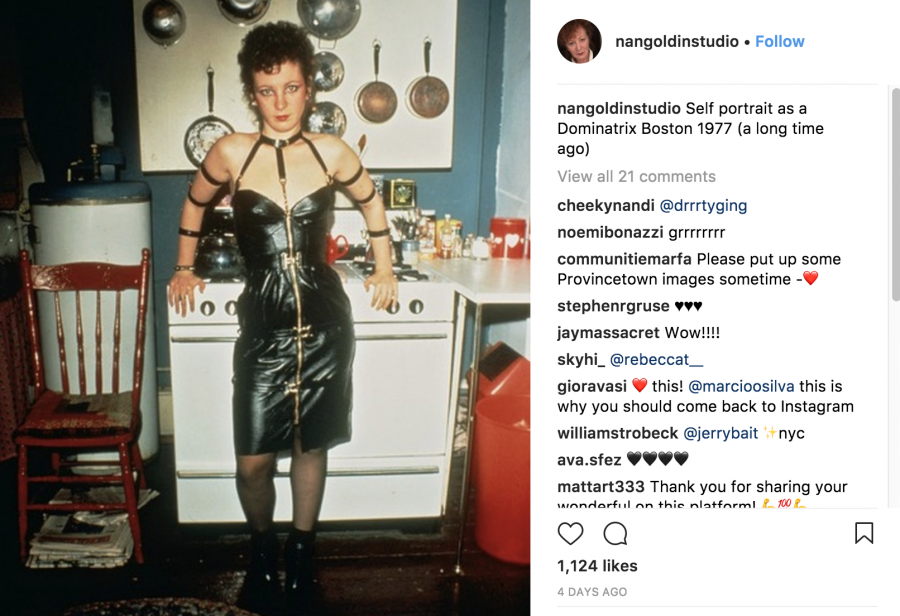
A quick heads up: Back in August, Cindy Sherman, one of the best
Goldin’s Instagram account makes its debut at the same time that Steidl Books has re-released Nan Goldin: The Beautiful Smile–the memoir in which Goldin famously photographed, writes The New York Times, the subjects who “have been those closest to her: Transsexuals, cross-dressers, drug users, lovers, all people she befriended when she moved to New York” and who lived in what mainstream critics would coldly call the ‘margins of society’.” The highly-praised book is now out again.
Related Content:
Say What You Really Mean with Downloadable Cindy Sherman Emoticons
Museum of Modern Art (MoMA) Launches Free Course on Looking at Photographs as Art
Read More...Support Us
We're hoping to rely on loyal readers, rather than erratic ads. Please click the Donate button and support Open Culture. You can use Paypal, Venmo, Patreon, even Crypto! We thank you!

About Us

Open Culture scours the web for the best educational media. We find the free courses and audio books you need, the language lessons & educational videos you want, and plenty of enlightenment in between.
Advertise With Us

FREE UPDATES!
GET OUR DAILY EMAIL
Get the best cultural and educational resources on the web curated for you in a daily email. We never spam. Unsubscribe at any time.
FOLLOW ON SOCIAL MEDIA

Open Culture editor Dan Colman scours the web for the best educational media. He finds the free courses and audio books you need, the language lessons & movies you want, and plenty of enlightenment in between.
Advertise With Us


