Watch a New, “Original” Episode of Seinfeld Performed Live on Stage
The last episode of Seinfeld aired in 1998. So maybe you’re ready for a brand new episode of the show featuring “uncanny portrayals of the central characters, 90s commercial parodies, and original Seinfeld standup”?
You won’t get it from Jerry Seinfeld and Larry David.
You will get it from the comedy team Bellevue, which has created a “sketch show about nothing.”
Bellevue wrote and performed their own 30-minute episode of Seinfeld called “The Leaning Susan.” Presented at the Upright Citizens Brigade in NYC, the “show” features Cathryn Mudon as Elaine, Noah Forman as Jerry, Dru Johnston as George, Michael Antonucci as Kramer, and Joanna Bradley as Susan. (Remember Susan?) And, as one Youtuber put it, “if you squint…, you could swear you’re watching an episode of Seinfeld. The actors here are phenomenal.”
Enjoy…
Follow us on Facebook, Twitter, Google Plus and LinkedIn and share intelligent media with your friends. Or better yet, sign up for our daily email and get a daily dose of Open Culture in your inbox.
Related Content:
Watch Classic Seinfeld Scenes Dubbed in …. Yiddish
What’s the Deal with Pop Tarts? Jerry Seinfeld Explains How to Write a Joke
Seinfeld & Nothingness: A Supercut of the Show’s Emptiest Moments
Read More...The Art of Making Intelligent Comedy Movies: 8 Take-Aways from the Films of Edgar Wright
We’ve posted a lot of stuff on this site by Tony Zhou, the creator of the brilliant video essay series Every Frame a Painting. He delivered an insightful essay on David Fincher’s visual economy and he did a truly masterful take on movement in the films of Akira Kurosawa. And, in the piece above, he delves into the work of British director Edgar Wright, who directed such cult masterpieces as Shaun of the Dead, Hot Fuzz and Scott Pilgrim vs. the World.
As Zhou notes, comedies are boring these days. In movies like Bridesmaids and The Hangover, the camera oftentimes just records the actors riffing. The humor is almost entirely dependent on the dialogue. And while that might yield some yuks, in terms of moviemaking, these movies are woefully limited. Film is a visual medium after all.
Wright, on the other hand, is a terrifically inventive filmmaker who knows how to tell jokes visually. One of the reasons Shaun of the Dead and his other films are so damned funny is because he is able to cram jokes into moments where other movies would be content with just pushing the plot forward. “This is what separates mediocre directors from great ones,” says Zhou. “The ability to take the most simple, mundane scenes and find new ways to do them.”
Like Eisenstein and Ozu and just about every other cinematic master out there, Wright is keenly aware of not just what is in the frame but what is not in the frame. Unlike Eisenstein — who, let’s face it, is not funny – Wright knows how to mine the comic potential of the frame.
Zhou ends his spiel with a challenge to Hollywood directors out there. He rattles off eight things that Wright does with picture and sound that he would like other filmmakers to work into their movies.
1. Things entering the frame in funny ways
2. People leaving the frame in funny ways.
3. There and back again.
4. Matching scene transitions.
5. The perfectly timed sound effect.
6. Action synchronized to the music.
7. Super-dramatic lighting cues.
8. Fence gagsAnd the bonus point
9. Imaginary gun fights.
Related Content:
Learn the Elements of Cinema: Spielberg’s Long Takes, Scorsese’s Silence & Michael Bay’s Shots
How Akira Kurosawa Used Movement to Tell His Stories: A Video Essay
Jonathan Crow is a Los Angeles-based writer and filmmaker whose work has appeared in Yahoo!, The Hollywood Reporter, and other publications. You can follow him at @jonccrow. And check out his blog Veeptopus, featuring lots of pictures of badgers and even more pictures of vice presidents with octopuses on their heads. The Veeptopus store is here.
Read More...The Thrill is Gone: See B.B. King Play in Two Electric Live Performances
One of the last great Mississippi bluesmen, Riley B. King, is gone, passed away last night at the age of 89. King made perhaps the most successful crossover of any blues artist into mainstream rock and roll, recording with Clapton and playing for rock audiences for decades. But his sound remained rooted firmly in the very blues he cut his teeth on in the fields of the Mississippi Delta and in Memphis, where he hitchhiked at 22, with $3 in his pocket, and quickly became a hit as a songwriter and D.J. called the Beale Street Blues Boy—B.B. for short. He “was paid four cents,” writes Buzzfeed, “for every album he made.”
“By his 80th birthday,” writes The New York Times, “he was a millionaire many times over. He owned a mansion in Las Vegas, a closet full of embroidered tuxedoes and smoking jackets, a chain of nightclubs…and the personal and professional satisfaction of having endured.” King’s signature guitars, customized Gibson 355s he named Lucille, are as elegant and stylish as the man himself. I once stood in front of one of them in a glass case at the Stax museum in Memphis, staring in awe, examining the places where his hands had worn into the wood, trying to absorb a little of the magic. King’s story is one of success far beyond what most of his peers could imagine. But it is also one of profound dedication to the blues, and of overcoming racism, poverty, and pain—suffering he channeled into his music and never lost sight of through the wealth and fame.
Well-deserved tributes from fans and fellow musicians are everywhere today—to King’s personal warmth and charm, to his impassioned singing, and, of course, his incredibly expressive vibrato guitar playing. “The tone he got out of that guitar, the way he shook his left wrist, the way he squeezed the strings,” says guitarist Buddy Guy, “… man, he came out with that and it was all new to the whole guitar playin’ world. The way BB did it is the way we all do it now. He was my friend and father to us all.” See and hear B.B. do it above in live performances of “The Thrill is Gone” and “Blues Boys Tune.” And just above, see him play and tell his story in a short 1972 documentary called “Sounding Out.” It may be too late now to see the great man perform live, but it’s never to late to learn about his legacy as the undisputed “king of the blues.”
Related Content:
B.B. King Explains in an Animated Video Whether You Need to Endure Hardship to Play the Blues
Josh Jones is a writer and musician based in Durham, NC. Follow him at @jdmagness
Read More...Salvador Dalí Takes His Anteater for a Stroll in Paris, 1969
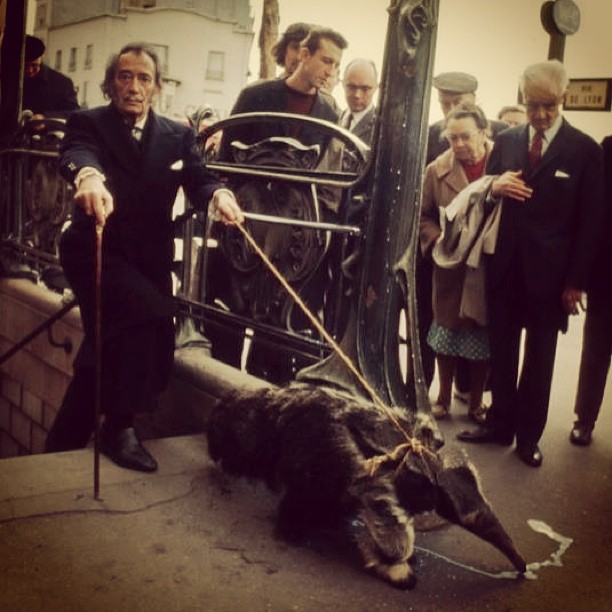
Salvador Dalí had a thing for anteaters. They made for good schtick, especially in Europe, and Dalí never saw schtick that he didn’t like.
And yet maybe there’s something a little more to this picture taken in Paris, in 1969. Maybe there’s some kind of symbolism, or even a playful tribute, taking place in the photo above.
Surrealism officially came into being in 1924, when André Breton wrote Le Manifeste du Surréalisme (read an English translation here). First a literary movement, Surrealism later embraced painters, including figures like Dalí.
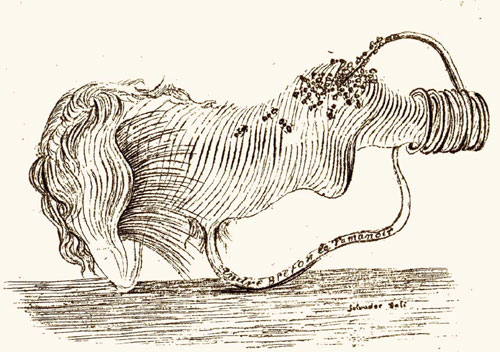
In 1930, Dalí created a bookplate for Breton called, “André Breton le tamanoir.” That translates to “André Breton the Anteater,” the nickname given to Breton by his fellow surrealists. Now consider the fact that the 1969 photo was taken three short years after Breton’s death, and perhaps we can read an homage into it.
What nickname did Breton give to Dalí, you might ask? “Avida Dollars.” An anagram for “Salvador Dalí,” “Avida Dollars” translates to “eager for dollars.” Pretty apt.
Follow us on Facebook, Twitter, Google Plus and LinkedIn and share intelligent media with your friends. Or better yet, sign up for our daily email and get a daily dose of Open Culture in your inbox.
Related Content:
Salvador Dalí Illustrates Don Quixote: Two Spaniards with Unique World Views
Salvador Dalí’s Haunting 1975 Illustrations for Shakespeare’s Romeo and Juliet
Salvador Dalí Illustrates Shakespeare’s Macbeth
Read More...10 Writing Tips from Legendary Writing Teacher William Zinsser
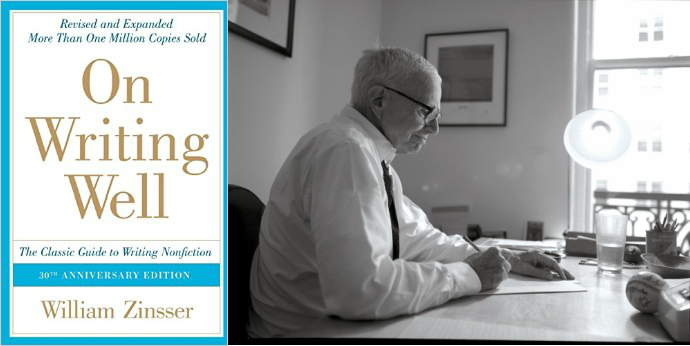
Image used with permission by Mark Ostow/Yale Alumni Magazine
Author William Zinsser died at his Manhattan home on Tuesday, May 12, 2015. The 92-year-old left behind one of the classics of writing instruction manuals as his legacy, On Writing Well. Since its first printing in 1976, the book has sold 1.5 million copies, and Zinsser made sure to update the book often. He loved the revolution in writing that computers brought, calling it a miracle.
Never have so many Americans written so profusely and with so few inhibitions. Which means that it wasn’t a cognitive problem after all. It was a cultural problem, rooted in that old bugaboo of American education: fear.
Zinsser stressed simplicity and efficiency, but also style and enthusiasm. Here are 10 of his many tips for improving your writing.
1. Don’t make lazy word choices: “You’ll never make your mark as a writer unless you develop a respect for words and a curiosity about their shades of meaning that is almost obsessive. The English language is rich in strong and supple words. Take the time to root around and find the ones you want.”
2. On the other hand, avoid jargon and big words: “Clear thinking becomes clear writing; one can’t exist without the other. It’s impossible for a muddy thinker to write good English.”
3. Writing is hard work: “A clear sentence is no accident. Very few sentences come out right the first time, or even the third time. Remember this in moments of despair. If you find that writing is hard, it’s because it is hard.”
4. Write in the first person: “Writing is an intimate transaction between two people, conducted on paper, and it will go well to the extent that it retains its humanity.”
5. And the more you keep in first person and true to yourself, the sooner you will find your style: “Sell yourself, and your subject will exert its own appeal. Believe in your own identity and your own opinions. Writing is an act of ego, and you might as well admit it.
6. Don’t ask who your audience is…you are the audience: “You are writing primarily to please yourself, and if you go about it with enjoyment you will also entertain the readers who are worth writing for.”
7. Study the masters but also your contemporaries: “Writing is learned by imitation. If anyone asked me how I learned to write, I’d say I learned by reading the men and women who were doing the kind of writing I wanted to do and trying to figure out how they did it.”
8. Yes, the thesaurus is your friend: “The Thesaurus is to the writer what a rhyming dictionary is to the songwriter–a reminder of all the choices–and you should use it with gratitude. If, having found the scalawag and the scapegrace, you want to know how they differ, then go to the dictionary.”
9. Read everything you write out loud for rhythm and sound: “Good writers of prose must be part poet, always listening to what they write.”
10. And don’t ever believe you are going to write anything definitive: “Decide what corner of your subject you’re going to bite off, and be content to cover it well and stop.”
Zinsser follows his own advice, in that this book (pick up a copy here) is a joy to read, with a rollicking humor and an infectious enthusiasm. May he rest in peace!
Finally, as someone who can’t stand to hear the word ‘unique’ modified, Zinsser has this to say: “…being ‘rather unique’ is no more possible than being rather pregnant.’”
Related Content
David Ogilvy’s 1982 Memo “How to Write” Offers 10 Pieces of Timeless Advice
Writing Tips by Henry Miller, Elmore Leonard, Margaret Atwood, Neil Gaiman & George Orwell
Ted Mills is a freelance writer on the arts who currently hosts the FunkZone Podcast. You can also follow him on Twitter at @tedmills, read his other arts writing at tedmills.com and/or watch his films here.
Read More...Nietzsche, Wittgenstein & Sartre Explained with Monty Python-Style Animations by The School of Life
Angst. Nausea. Selbstüberwindung. All, surely, words we’ve used before, but have we paid attention to their proper philosophical contexts? The well-known and widely-read philosophers Ludwig Wittgenstein, Jean-Paul Sartre, and Friedrich Nietzsche used those words and others in very specific ways to express concepts essential to their certainly eccentric but even more certainly important philosophical writings. These brief, Alain de Botton-narrated video primers from The School of Life’s series on philosophy will get you started on coming to grips with just what these 19th- and 20th-century thinkers had to tell us about our own lives.
The new video on Wittgenstein concentrates on its subject’s lifelong grappling with the problems of linguistic communication, from his first conclusion that “language works by triggering within us pictures of how things are in the world” to his second that “language is like a kind of tool that we use to play different ‘games.’ ” The video on Sartre deals with the existentialist’s contentions that “things are weirder than we think,” that “we are free,” that “we shouldn’t live in bad faith,” and that “we are free to dismantle capitalism.” The video on Nietzsche explains just what it means to become an Übermensch — a goal achievable, for example, by using your capacity for selbstüberwindung to overcome your sklavenmoral.
Though watching these philosophic primers might well make you ever so slightly conversant in Wittgenstein, Sartre, and Nietzsche, The School of Life has clearly crafted them (using goofy cut-up visuals and a healthy rate of quips per minute) primarily as an entertaining means of whetting your intellectual appetite. If you’d like to know more about these modern philosophers, have a look at our links to other related posts below. And if you’d like to go broader before you go deeper, do watch the rest of the series, which will get you started on everyone from Aristotle and the Stoics to La Rochefoucauld and Heidegger.
Related Content:
140 Free Online Philosophy Courses
Human, All Too Human: 3‑Part Documentary Profiles Nietzsche, Heidegger & Sartre
A Guide to Happiness: Alain de Botton Shows How Six Great Philosophers Can Change Your Life
Download Walter Kaufmann’s Lectures on Nietzsche, Kierkegaard, Sartre & Modern Thought (1960)
Bertrand Russell on His Student Ludwig Wittgenstein: Man of Genius or Merely an Eccentric?
Ludwig Wittgenstein’s Tractatus Gets Adapted Into an Avant-Garde Comic Opera
Colin Marshall writes on cities, language, Asia, and men’s style. He’s at work on a book about Los Angeles, A Los Angeles Primer, and the video series The City in Cinema. Follow him on Twitter at @colinmarshall or on Facebook.
Read More...Monty Python and the Holy Grail Re-Imagined as an Epic, Mainstream Hollywood Film
The original 1975 trailer for Monty Python and the Holy Grail (below) started to make some big claims for itself. It opens, with the narrator declaring:
Once in a lifetime there comes a motion picture which changes the whole history of motion pictures. A picture so stunning in its effect, so vast in its impact that it profoundly affects the lives of all who see it.
But then comes the self-effacing punchline delivered by another narrator in Japanese:
One such film is Kurosawa’s “The Seven Samurai.” Another was “Ivan the Terrible.” Then there are more run-of-the mill films like “Herbie Rides Again,” “La Notte” and “Monty Python and the Holy Grail.”
… So, if you’re an intellectual midget and you feel like giggling, you could do worse than see Monty Python and the Holy Grail.
Classic Python!
Now, if want a Python trailer that takes itself seriously, look no further than the clip above. Created last year, this trailer re-imagines Monty Python and the Holy Grail as a mainstream Hollywood film. No wit. All cheese. If you dig the concept, you can see similar reworkings of Stanley Kubrick films here.
Related Content:
Monty Python’s Best Philosophy Sketches
Terry Gilliam Reveals the Secrets of Monty Python Animations: A 1974 How-To Guide
Read More...Watch Twin Beaks, Sesame Street’s Parody of David Lynch’s Iconic TV Show (1990)
Who killed Laura Palmer?
If the answer comes unbidden to your lips, you’re no doubt old enough to have spent much of 1990 glued to Twin Peaks, cult director David Lynch’s supremely creepy series. (Note: US-based viewers can watch the show for free on Hulu.)
The name probably won’t mean much to those who entered the noughties with a wobbly toddle, and why would it? Murder victim Palmer may have driven the original series, but she didn’t rank so much as a mention in Sesame Street’s 1991 parody, Twin Beaks, above.
The Muppets also steered clear of Sherilyn Fenn’s teen vixen cherry stem trick…
No one armed men…
No scary owls…
What tethers this G‑rated kiddie version to the original, you may ask?
Hint: it carries a log.
Of course! The log lady is a staple of Twin Peaks parodies, showing up everywhere from a Saturday Night Live skit starring Twin Peaks’ Special Agent Dale Cooper (Kyle MacLachlan) to a 2.5 minute Lego homage that manages to preserve the sex, the violence, and seemingly all of the characters.
The Cookie Monster’s Special Agent Cookie does eat some “darn” fine pie, but ultimately, his fixation on why the town was named “Twin Beaks” is far less compelling than his take on Monsterpiece Theatre’s host Alistair Cooke.
Masterpiece Theatre’s iconic presenter has proved even more irresistible to parodists than the Log Lady.
(In Sesame Street’s case, it worked. There are 35 more Monsterpieces, including number-centric spoofs of The 400 Blows and (gulp) The Postman Always Rings Twice.)
Related Content:
Monsterpiece Theater Presents Waiting for Elmo, Calls BS on Samuel Beckett
Watch The Surreal 1960s Films and Commercials of Jim Henson
Ayun Halliday is an author, illustrator, and Chief Primatologist of the East Village Inky zine. Follow her @AyunHalliday
Read More...
Prince’s New Protest Song “Baltimore” Now Streaming Online
As the protests in Baltimore unfolded, Prince sat at his keyboard at Paisley Park’s soundstage in Minnesota and started penning a peaceful protest song, which just hit the web this morning. Click play and ponder the lyrics below. Then get the backstory on the writing of “Baltimore” at MyFoxTwinCities.
BALTIMORE
lyrics by Prince
NPG RECORDS, copyright 2015
NOBODY GOT IN NOBODY’S WAY
SO EYE GUESS U COULD SAY
IT WAS A GOOD DAY
AT LEAST A LITTLE BETTER THAN THE DAY IN BALTIMORE
DOES ANYBODY HEAR US PRAY?
4 MICHAEL BROWN OR FREDDIE GRAY PEACE IS MORE THAN THE ABSENCE OF WAR
ABSENCE OF WAR
R WE GONNA C ANOTHER BLOODY DAY?
WE’RE TIRED OF CRYIN’ & PEOPLE DYIN’
LET’S TAKE ALL THE GUNS AWAY
ABSENCE OF WAR- U AND ME
MAYBE WE CAN FINALLY SAY
ENUFF IS ENUFF IT’S TIME 4 LOVE
IT’S TIME 2 HEAR,
IT’S TIME 2 HEAR
THE GUITAR PLAY! (guitar solo)
If you would like to support the mission of Open Culture, consider making a donation to our site. It’s hard to rely 100% on ads, and your contributions will help us continue providing the best free cultural and educational materials to learners everywhere. You can contribute through PayPal, Patreon, and Venmo (@openculture). Thanks!
Read More...Support Us
We're hoping to rely on loyal readers, rather than erratic ads. Please click the Donate button and support Open Culture. You can use Paypal, Venmo, Patreon, even Crypto! We thank you!

About Us

Open Culture scours the web for the best educational media. We find the free courses and audio books you need, the language lessons & educational videos you want, and plenty of enlightenment in between.
Advertise With Us

FREE UPDATES!
GET OUR DAILY EMAIL
Get the best cultural and educational resources on the web curated for you in a daily email. We never spam. Unsubscribe at any time.
FOLLOW ON SOCIAL MEDIA

Open Culture editor Dan Colman scours the web for the best educational media. He finds the free courses and audio books you need, the language lessons & movies you want, and plenty of enlightenment in between.
Advertise With Us


