The Tale of the Fox: Watch Ladislas Starevich’s Animation of Goethe’s Great German Folktale (1937)
Johann Wolfgang von Goethe — the very name bespeaks literary mastery of the widest range. Not only did this best-known of all eighteenth- and — nineteenth-century German writers reach into poetry, the novel, the memoir, autobiography, criticism, science, philosophy, and even politics, but he did a bit of interpretation of classic folktales as well. The Faust and Sorrows of Young Werther author wrote a particularly lasting rendition of the adventures of Reynard the Fox, a trickster from medieval European myth. Had Goethe himself lived into the 20th century to experience the golden age of puppet animation, I feel certain his artistic mandate would have compelled him to film a version of The Tale of the Fox. Alas, the literary legend passed away in 1832, leaving the job, nearly a century later, to Russian animator Ladislas Starevich (also spelled Wladyslaw Starewicz).
Having pioneered the form of puppet animation with his 1912 film The Beautiful Lukanida, Starevich remains well-known among animation enthusiasts for shooting his pictures with animals playing the protagonists, or bugs, or seemingly whatever he happened to have at hand. The Tale of the Fox, by contrast, presented him with a comparatively vast set of resources. Produced in Paris over eighteen months in 1929 and 1930, the 65-minute animated feature, Starevich’s first and only the sixth ever made in the world at the time, tells the story of Reynard the Fox’s attempts to live his life of tomfoolery even as the lion king of this animal kingdom struggles to bring him to justice. When, seven years after completing photography, the film still lacked music, Germany’s National Socialist government, no doubt swollen with their version of Teutonic pride at seeing an adaptation of an adaptation penned by a German icon, provided a score and arranged for a Berlin premiere. But try not to think about that. Concentrate instead on the animation style used here by Starevich which, though he shot in stop-motion and used puppets, surely resembles no stop-motion animation or puppet show you’ve ever seen.
via Biblioklept
Related Content:
Mikhail Bulgakov’s The Master and Margarita, Animated in Two Minutes
The Mascot, Pioneering Stop Animation from Wladyslaw Starowicz
Colin Marshall hosts and produces Notebook on Cities and Culture and writes essays on literature, film, cities, Asia, and aesthetics. He’s at work on a book about Los Angeles, A Los Angeles Primer. Follow him on Twitter at @colinmarshall.
Read More...10 Essential Tips for Making Great Coffee at Home
Michael Haft and Harrison Suarez went to college together, served in the Marines in Afghanistan, then, after returning home, stumbled upon the world of specialty coffee and began “an obsessive quest to brew the perfect cup.” That quest resulted in the publication of an interactive digital book designed for the iPad. Perfect Coffee at Home ($4.99) uses illustrations, interactive graphics, videos and a soundtrack to make the tutorial “an immersive experience.” But you don’t need to foot the bill or have an iPad to improve your coffee making skills.
Over at The Atlantic, Haft and Suarez gave some free advice last week, publishing an article where they, among other things, enumerated 10 essential tips for making coffee. They boiled things down to this:
- Buy good coffee beans. Preferably whole beans, sustainably farmed, and roasted within the past few weeks.
- Grind your coffee just before brewing. They say, “it’s the number one thing you can do to improve your coffee at home.”
- Store your coffee properly. Keep the coffee in an airtight container, away from sunlight. Try to avoid freezing the beans, unless they’re going to linger for more than two weeks.
- Use a good amount of coffee, and the right proportion of coffee to water. The ideal is what they call “The Golden Ratio,” 17.42 units of water to 1 unit of coffee.
- Find the right grind size for your coffee beans and aim for a uniform grind.
- Control the temperature of your water. Keep it somewhere between 195 and 202 degrees. Boiling water can sour the coffee.
- If you get really skilled, you can agitate the coffee during the brewing to control the taste.
- Focus on technique. And once you learn the right technique, make sure you’re precise and consistent.
- Use quality tools. Buy the right bean grinder and coffee maker. Make a good investment in your coffee drinking future.
- When experimenting with the brewing process, adjust only one variable at a time so you can accurately track results.
The Atlantic article offers more detail than what we’ve highlighted above. So we’d encourage you to give “How to Make Perfect Coffee” a read. You can also find short video primers on the Haft & Suarez YouTube Channel. If you have your own great coffee making tips, definitely share them with us in the comments sections below. We want to know!
Related Content:
A Short, Animated Look at What’s Inside Your Average Cup of Coffee
“The Vertue of the COFFEE Drink”: An Ad for London’s First Cafe Printed Circa 1652
The Physics of Coffee Rings Finally Explained
The History of Coffee and How It Transformed Our World
Read More...Fritz Lang’s M (1931)
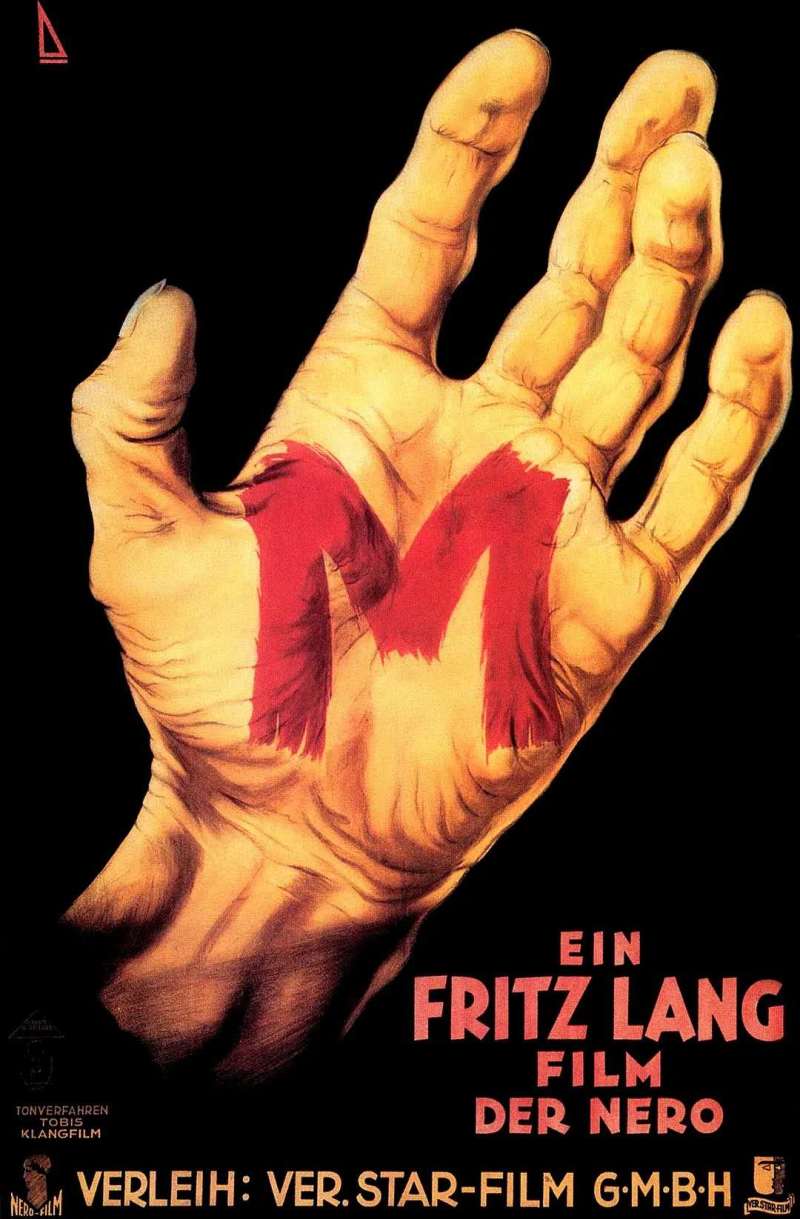
When Jean-Luc Godard asked the Austrian filmmaker Fritz Lang in 1961 to name his greatest film, the one most likely to last, Lang did not hesitate.
“M,” he said.
Made in 1931, near the end of the Weimar Republic, M is Lang’s brilliant link between silent film and talkies, and between German Expressionism and what would eventually be called Film Noir. It tells the story of a Berlin society caught up in hysteria over a series of child murders, and of the massive mobilization — by police and criminals alike — to catch the killer.
The Hungarian actor Peter Lorre plays Hans Beckert, the mentally disturbed murderer. Lorre worked on the film in the daytime while performing onstage in Bertolt Brecht’s production of Mann ist Mann in the evenings. His striking performance in M would catapult him to international stardom.
The script was written by Lang and his wife, Thea Von Harbou. It was inspired by a series of mass murders, culminating in a sensational case of serial child killings in Düsseldorf. In a 1931 article, Lang wrote:
The epidemic series of mass murders of the last decade with their manifold and dark side effects had constantly absorbed me, as unappealing as their study may have been. It made me think of demonstrating, within the framework of a film story, the typical characteristics of this immense danger for the daily order and the ways of effectively fighting them. I found the prototype in the person of the Düsseldorf serial murderer and I also saw how here the side effects exactly repeated themselves, i.e. how they took on a typical form. I have distilled all typical events from the plethora of materials and combined them with the help of my wife into a self-contained film story. The film M should be a document and an extract of facts and in that way an authentic representation of a mass murder complex.
Although M was not a great box office success when it was released in Germany in 1931, the film gradually grew in stature and is now firmly established as one of the masterpieces of 20th century cinema. The brilliance of the film’s narrative structure, its classic visual images (the killer’s shadow appearing on a poster announcing a reward for his capture, a child’s balloon caught in a power line, Lorre’s bulging eyes as he discovers a chalk “M” on his shoulder) and its inventive use of sound, for example in the serial killer’s ominous whistling of Grieg’s Peer Gynt, have made M one of the most studied and imitated films ever made.
In 1959 M was re-released in truncated form, and for several decades afterward audiences were shown a badly altered 89-minute version. A restoration project was mounted in the 1990s. The 109-minute version above, a result of that project, is closer to Lang’s original film. It’s now housed in our collection, 4,000+ Free Movies Online: Great Classics, Indies, Noir, Westerns, Documentaries & More
Related content:
Fritz Lang’s “Licentious, Profane, Obscure” Noir Film, Scarlet Street (1945)
Read More...MOOC FAQ
Where Can I Find a List of Massive Open Online Courses (MOOCs)?: We maintain a regularly-updated list of MOOCs on this page: Free MOOCs from Great Universities (Many Offering Certificates). The list aggregates courses from many different MOOC providers, both large and small.
Does Open Culture Offer Its Own MOOCs?: No, we simply aggregate MOOCs created by other organizations and institutions. We don’t offer any of our own courses.
Do These Courses Offer Certificates? Many MOOC providers will give students a “Certificate of Completion,” “Statement of Accomplishment” or some other equivalent if students successfully complete a course. If you sign up for a course, you should check to see what (if any) certificate/statement is offered.
Do the Certificates Cost Money: Some do. Increasingly the MOOC providers are switching to a model where they will give away a course for free. But the certificate costs money. On the page where we offer a list of MOOCS, we include a key that explains what credentials a course offers. If you need to pay for the credential, we include a “$” sign. For example: VC$ = Verified Certificate.
How Do Students Receive a Certificate? Students eligible for a certificate will usually access it in a digital format. They are usually downloaded. And they look something like this.
What’s the Difference Between a Certificate of Mastery, Statement of Accomplishment, Certificate of Completion etc? In short, not much. Different schools and course providers have come up with their own terminology. But they are basically equivalent.
Can I Get Credit at My University If I Take a MOOC? Generally the answer is no. If you take a MOOC and get a Certificate/Statement of Accomplishment, you generally cannot take the certificate to your university and get actual credit. There area a few rare exceptions to that rule. If you have any questions, you should check with your university.
Can I Get an Undergraduate Degree by Taking MOOCs? Given what’s said immediately above, the answer is generally no.
Can MOOCs Help Me Get a Job? That remains to be seen right now. There is not a consensus here, but there are hopeful signs. A recent article published on the Stanford Graduate School of Education web site states:
Human resources executives and recruiters tell me they aren’t seeing significant numbers of candidates touting the MOOCs they’ve completed. But those who have seen mentions of MOOCs say it’s an indication of commitment to upgrading skills and knowledge.
At Massachusetts General Hospital, recruitment manager Megan Bradley says, “I see these online courses as a form of professional development, like when people take adult ed courses. If a job requires a [specific] educational degree, these courses would not suffice.”
Bruce Allen of the Wakefield recruiting firm Point B Search says, “Any initiative that candidates take to update their skill set, acquire new skills, or simply extend their knowledge base will be viewed as positive.”
Are MOOCs Free?: The courses are almost always free, as are often the certificates offered to students who successfully complete the courses. In some cases, students will need to pay nominal fees for texts.
What If I See an Interesting MOOC That Has Already Started or Has Already Finished?: Often MOOCs get offered several times a year. You can follow our list of MOOCs to find future offerings. There are some “evergreen” MOOCs that you can take any time. Find a list here.
Who Are MOOCs Good For? We think MOOCs are a good thing if you’re a lifelong learner who lacks easy access to educational opportunities, in whatever form they might come. But if you’re an undergraduate, and if your school is trying to replace real teachers with MOOCs, you’re probably not getting a great deal. Case in point.
Are There Any Questions Not Answered by This FAQ? Feel free to send us a note and let us know.
Read More...A Radio Play Based on Pink Floyd’s The Dark Side of the Moon. Coming Monday. Watch the Trailer.
This year, Pink Floyd’s masterful prog rock album The Dark Side of the Moon turns 40. Yes, 40. Exploring themes ranging from conflict and greed, to mental illness and the passing of time, The Dark Side of the Moon has “everything you’d ever want … : Grand, transporting melodies, synapse-ripping synth experiments and sound collages, intricate musicianship, state-of-the-art studio sound and John Lennon-meets-Thom Yorke lyrics like ‘The lunatic is on the grass/Remembering games and daisy chains and laughs/Got to keep the loonies on the path.’ ” Or, so that’s how Rolling Stone magazine sums up the album that it now ranks 43rd on its list of “The 500 Greatest Albums of All Time.”
Next Monday, BBC Radio 2 will honor Pink Floyd’s magnum opus with a new radio drama from legendary playwright Sir Tom Stoppard. Apparently Stoppard (who co-wrote the screenplays for Brazil and Shakespeare in Love) first considered writing a play based on the album back in 1973. Now, some 40 years later, he has “transformed the Pink Floyd classic into a psychedelic mash-up of Kantian philosophy, epic rock and John Prescott soundbites,” writes The Independent. To get you ready for Darkside, as the play will be called, Aardman Animations has created a three-minute trailer that evokes themes from the album and play. Says the director Darren Dubicki:
I spent time absorbing the rich detail from the Pink Floyd album, their art and the drama script. What was fundamentally important to us was that we retained a consistent visual tone that echoed the imagery created over the years for the band. The insanely surreal and powerful artwork created by Storm Thorgerson and Hipgnosis has always had a strong distortion on reality. Their sense of space and twisted context make for some uncomfortably beautiful art. This tone has been consistent for decades and we wanted to honour this with our contemporary digital, and analogue, slant on the style.
You can watch the trailer above, and find some wonderful Pink Floyd material in the section below.
Related Content:
Pink Floyd’s David Gilmour Sings Shakespeare’s Sonnet 18
Watch Pink Floyd Plays Live in the Ruins of Pompeii (1972)
Pink Floyd’s Roger Waters Performs The Wall at the Berlin Wall (1990)
Read More...The “Most Amazing [Borrowed] College Welcome Speech Ever”
Georgia Tech sophomore and Mechanical Engineering major Nick Selby gave a rousing welcome speech at the 2013 Freshman Convocation. It didn’t take long for the speech to go viral. Or for Gawker to realize that the speech had been borrowed from a 2008 speech given by Andy Stone, once the debate team champion at Arizona State. (Click here and then skip to the 8:40 mark to see the similar part of Stone’s speech.) But here’s perhaps the most straightforward explanation. It turns out that Selby was once coached by Stone, and on his Facebook page, Selby writes: “I had an awesome speech coach in high school by the name of Andy Stone, and was absolutely thrilled when he agreed to let me use the end of his award-winning speech as the foundation for my own.”
Read More...Dick Cavett’s Wide-Ranging TV Interview with Ingmar Bergman and Lead Actress Bibi Andersson (1971)
Many film fans wish we could have a director like Ingmar Bergman working today. Just as many television fans surely wish we could have a talk show host like Dick Cavett working today. But both Bergman, who died in 2007, and Cavett, who still writes but seems to have put televisual pursuits behind him, produced substantial bodies of work. And, thanks to the internet, you can experience their films and broadcasts even more easily than when they first appeared. Take, for instance, this 1971 Dick Cavett Show episode featuring the curious and dry-witted conversationalist’s interview with the Swedish maker of such pictures still viewed widely and enthusiastically as The Seventh Seal, The Virgin Spring, Persona, and Fanny and Alexander. No enthusiast of serious conversation about film would want to miss the hour when these two men’s worlds collide. But we get an insight into more than these men’s worlds: partway through the episode, and to the delight of Bergman’s fans, actress Bibi Andersson turns up.
Eventually to star in more than ten Bergman pictures, including Persona, The Magician, and The Passion of Anna, Andersson appears ostensibly in promotion of her and Bergman’s then-most recent collaboration, The Touch. “Does he understand women?” Cavett suddenly asks Andersson, who replies with every interviewer’s bête noire, the one-word answer: “Yes.” Bergman then explains his conviction that women possess greater natural acting ability and comfort with the craft than men do. “Acting,” he says, “is a very special woman’s profession.” The full conversation reveals more about the filmmaker’s surprising feminism, as well as his childhood fear of movies, his lifelong fear of drugs, his views on punctuality, his on-set temper, his struggles with restless leg syndrome, the pride he takes in his soap commercials, his homeland’s supposed preponderance of beautiful women, and how many more films he intends to make. “Five, maybe six,” the director guesses. “Make it six, could you?” asks the host. He ended up making twelve.
Related Content:
Ingmar Bergman’s Soap Commercials Wash Away the Existential Despair
How Woody Allen Discovered Ingmar Bergman, and How You Can Too
Colin Marshall hosts and produces Notebook on Cities and Culture and writes essays on literature, film, cities, Asia, and aesthetics. He’s at work on a book about Los Angeles, A Los Angeles Primer. Follow him on Twitter at @colinmarshall.
Read More...Watch John Cleese as Sherlock Holmes in The Strange Case of the End of Civilization as We Know It
Here’s something to lighten your day a little: Monty Python’s John Cleese as Sherlock Holmes in the 1977 British television film The Strange Case of the End of Civilization as We Know It.
As the title suggests, it’s a very silly film. Cleese plays Arthur Sherlock Holmes, grandson of the famous detective. His sidekick, Dr. Watson, is similarly descended from a familiar character in the Arthur Conan Doyle stories. Together they set out to foil a diabolical plot by their nemesis, a descendent of Professor Moriarty. The modern-day Holmes has some of the same mannerisms as his famous grandfather, but is decidedly less clever and likes to keep his calabash pipe filled with exotic varieties of cannabis.
Cleese co-wrote the script with Jack Hobbs and the film’s director, Joseph McGrath, who is best known for directing the Peter Sellers movies Casino Royale and The Magic Christian. It was produced for London Weekend Television by Humphrey Barclay, who is generally credited with bringing together much of what eventually became the Monty Python cast, including American animator Terry Gilliam, in the subversive late-1960s children’s show Do Not Adjust Your Set. Cleese’s wife at the time, Connie Booth, who was also collaborating with him on the TV series Fawlty Towers, plays the detective’s landlady Mrs. Hudson. And Arthur Lowe is very funny as the dim-witted Dr. Watson.
The Strange Case of the End of Civilization as We Know It is a low-budget affair — extremely goofy — and not for everyone. But if you’re a fan of classic British TV comedy and you love outlandish gags, you should get a kick out of it. The funniest parts begin after the 13-minute mark, when Cleese arrives onscreen.
You can find The Strange Case of the End of Civilization as We Know It in our collection, 4,000+ Free Movies Online: Great Classics, Indies, Noir, Westerns, Documentaries & More.
Related content:
Monty Python’s Best Philosophy Sketches
Arthur Conan Doyle Discusses Sherlock Holmes and Psychics in a Rare Filmed Interview (1927)
John Cleese Plays the Devil, Makes a Special Appeal for Hell, 1966
Read More...Crime Writer Elmore Leonard Provides 13 Writing Tips for Aspiring Writers
Note: Elmore Leonard, the crime writer who gave us Get Shorty, Freaky Deaky, and Glitz, died at his home in Bloomfield Village, Michigan. He was 87. If you never had a chance to read Leonard, you can start with “Ice Man,” a 2012 story that appeared in The Atlantic. It’s free online. You can also get a feel for his writing by revisiting a post written here by Mike Springer last year. It gives an overview of Leonard’s tips for aspiring writers. And, in so doing, it provides valuable insight into how Leonard approached his craft. Elmore Leonard’s Ultimate Guide for Would-Be Writers is reprinted in full below.
“If it sounds like writing,” says Elmore Leonard, “I rewrite it.”
Leonard’s writing sounds the way people talk. It rings true. In novels like Get Shorty, Rum Punch and Out of Sight, Leonard has established himself as a master stylist, and while his characters may be lowlifes, his books are received and admired in the highest circles. In 1998 Martin Amis recalled visiting Saul Bellow and seeing Leonard’s books on the old man’s shelves. “Bellow and I agreed,” said Amis, “that for an absolutely reliable and unstinting infusion of narrative pleasure in a prose miraculously purged of all false qualities, there was no one quite like Elmore Leonard.”
In 2006 Leonard appeared on BBC Two’s The Culture Show to talk about the craft of writing and give some advice to aspiring authors. In the program, shown above, Leonard talks about his deep appreciation of Ernest Hemingway’s work in general, and about his particular debt to the 1970 crime novel The Friends of Eddie Coyle, by George V. Higgins. While explaining his approach, Leonard jots down three tips:
- “You have to listen to your characters.”
- “Don’t worry about what your mother thinks of your language.”
- “Try to get a rhythm.”
“I always refer to style as sound,” says Leonard. “The sound of the writing.” Some of Leonard’s suggestions appeared in a 2001 New York Times article that became the basis of his 2007 book, Elmore Leonard’s 10 Rules of Writing. Here are those rules in outline form:
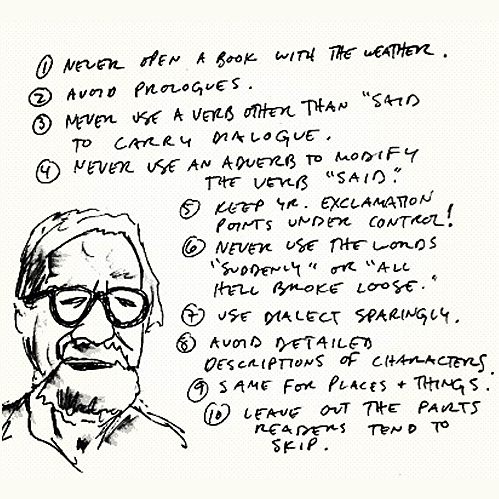
You can read more from Leonard on his rules in the 2001 Times article. And you can read his new short story, “Ice Man,” in The Atlantic.
Read More...“The Lost Paris Tapes” Preserves Jim Morrison’s Final Poetry Recordings from 1971
Billed and sold as the ninth and final studio album by The Doors, An American Prayer tends to divide Jim Morrison fans. On the one hand, it’s a captivating document of the late singer reading his free-associative poetry: dark, weirdly beautiful psychedelic lyrical fugues. On the other hand, it’s only a “Doors album” in that the three remaining members convened in 1978 to record original music over the deceased Morrison’s solo readings. While the resulting product is both a haunting tribute and an immersive late-night listen, many have felt that the band’s rendering did violence to the departed singer’s original intentions. (Listen to and download it here for free.)
An American Prayer’s readings were recorded unaccompanied in March 1969 and December 1970. In 1971, Morrison joined his long-time lover Pamela Courson in Paris. That same year, Jim Morrison died, under some rather mysterious circumstances, at the age of 27.
Before his death, however, he made what is said to be his final studio recording, a poetry reading/performance with a couple of unknown Parisian street musicians. Although Doors keyboardist Ray Manzarek allegedly dismissed this recording as “drunken gibberish,” Doors fans have circulated it since 1994—combined with a 37-minute poetry reading from 1968—as a bootleg called The Lost Paris Tapes.
While it’s true that An American Prayer is a powerful and haunting album, it’s also true that The Lost Paris Tapes represents the unadorned, unedited Morrison, in full control of how his voice sounds, and without his famous band. I cannot help you find a copy of The Lost Paris Tapes, but many of the tracks are on Youtube, such as “Orange County Suite” (top), an affecting piece written for Pamela Courson. Other excerpts from the bootleg, such as “Hitler Poem” (above) show Morrison in a very strange mood indeed, and show off his unsetting sense of humor. While the work on The Lost Paris Tapes ranges in quality, all of it preserves the seductive voice and cryptic imagination that Jim Morrison never lost, even as he began to slip away into alcoholism.
Related Content:
A Young, Clean Cut Jim Morrison Appears in a 1962 Florida State University Promo Film
Animations Revive Lost Interviews with David Foster Wallace, Jim Morrison & Dave Brubeck
Josh Jones is a writer and musician based in Durham, NC. Follow him at @jdmagness
Read More...Support Us
We're hoping to rely on loyal readers, rather than erratic ads. Please click the Donate button and support Open Culture. You can use Paypal, Venmo, Patreon, even Crypto! We thank you!

About Us

Open Culture scours the web for the best educational media. We find the free courses and audio books you need, the language lessons & educational videos you want, and plenty of enlightenment in between.
Advertise With Us

FREE UPDATES!
GET OUR DAILY EMAIL
Get the best cultural and educational resources on the web curated for you in a daily email. We never spam. Unsubscribe at any time.
FOLLOW ON SOCIAL MEDIA

Open Culture editor Dan Colman scours the web for the best educational media. He finds the free courses and audio books you need, the language lessons & movies you want, and plenty of enlightenment in between.
Advertise With Us

