Richard Ford, Jonathan Franzen, and Anne Enright Give Ten Candid Pieces of Writing Advice Each

The way people read on the internet has encouraged the provision of “tips,” especially presented as short sentences collected in lists. While we here at Open Culture seldom ride that current, we make exceptions for lists of tips by authors best known for their long-form textual achievements. Richard Ford (The Sportswriter books), Jonathan Franzen (The Corrections and Freedom), and Anne Enright (The Portable Virgin, The Gathering) here offer ten suggestions each to guide your own writing habits. Though presumably learned in the process of writing novels, many of these lessons apply just as well to other forms. I, for example, write mostly essays, but still find great value in Franzen’s instruction to treat the reader as a friend, Enright’s point that description conveys opinion, and Ford’s injunction not to write reviews (or at least, as I read it, not reviews as so narrowly defined).
Some of these tips have to do with technique: Ford advises against drinking while writing, Franzen advises against using “then” as a conjunction, and Enright advises you simply to keep putting words on the page. Others have more to do with maintaining a certain temperament: “Don’t have arguments with your wife in the morning, or late at night,” says Ford; “You have to love before you can be relentless,” says Franzen; “Have fun,” says Enright. And as any successful writer knows, you can’t pull it off at all without a strong dose of practicality, as exemplified by Enright’s “Try to be accurate about stuff,” Franzen’s doubt that “anyone with an internet connection at his workplace is writing good fiction,” and Ford’s “Don’t have children.” Can we draw out an overarching guideline? Avoid distraction, perhaps. But you really have to read these authors’ lists in full, like you would their novels, to grasp them. The lists below originally appeared in The Guardian, along with tips from various other esteemed writers.
Richard Ford
1 Marry somebody you love and who thinks you being a writer’s a good idea.
2 Don’t have children.
3 Don’t read your reviews.
4 Don’t write reviews. (Your judgment’s always tainted.)
5 Don’t have arguments with your wife in the morning, or late at night.
6 Don’t drink and write at the same time.
7 Don’t write letters to the editor. (No one cares.)
8 Don’t wish ill on your colleagues.
9 Try to think of others’ good luck as encouragement to yourself.
10 Don’t take any shit if you can possibly help it.
Jonathan Franzen
1 The reader is a friend, not an adversary, not a spectator.
2 Fiction that isn’t an author’s personal adventure into the frightening or the unknown isn’t worth writing for anything but money.
3 Never use the word “then” as a conjunction – we have “and” for this purpose. Substituting “then” is the lazy or tone-deaf writer’s non-solution to the problem of too many “ands” on the page.
4 Write in the third person unless a really distinctive first-person voice offers itself irresistibly.
5 When information becomes free and universally accessible, voluminous research for a novel is devalued along with it.
6 The most purely autobiographical fiction requires pure invention. Nobody ever wrote a more autobiographical story than “The Metamorphosis”.
7 You see more sitting still than chasing after.
8 It’s doubtful that anyone with an internet connection at his workplace is writing good fiction.
9 Interesting verbs are seldom very interesting.
10 You have to love before you can be relentless.
Anne Enright
1 The first 12 years are the worst.
2 The way to write a book is to actually write a book. A pen is useful, typing is also good. Keep putting words on the page.
3 Only bad writers think that their work is really good.
4 Description is hard. Remember that all description is an opinion about the world. Find a place to stand.
5 Write whatever way you like. Fiction is made of words on a page; reality is made of something else. It doesn’t matter how “real” your story is, or how “made up”: what matters is its necessity.
6 Try to be accurate about stuff.
7 Imagine that you are dying. If you had a terminal disease would you finish this book? Why not? The thing that annoys this 10-weeks-to-live self is the thing that is wrong with the book. So change it. Stop arguing with yourself. Change it. See? Easy. And no one had to die.
8 You can also do all that with whiskey.
9 Have fun.
10 Remember, if you sit at your desk for 15 or 20 years, every day, not counting weekends, it changes you. It just does. It may not improve your temper, but it fixes something else. It makes you more free.
Related Content:
Writing Tips by Henry Miller, Elmore Leonard, Margaret Atwood, Neil Gaiman & George Orwell
Seven Tips From Ernest Hemingway on How to Write Fiction
Seven Tips From F. Scott Fizgerald on How to Write Fiction
Ray Bradbury Gives 12 Pieces of Writing Advice to Young Authors (2001)
John Steinbeck’s Six Tips for the Aspiring Writer and His Nobel Prize Speech
The Shape of A Story: Writing Tips from Kurt Vonnegut
Elmore Leonard’s Ultimate Guide for Would-Be Writers
The Shape of A Story: Seven Tips From William Faulkner on How to Write Fiction
Colin Marshall hosts and produces Notebook on Cities and Culture and writes essays on literature, film, cities, Asia, and aesthetics. He’s at work on a book about Los Angeles, A Los Angeles Primer. Follow him on Twitter at @colinmarshall.
Read More...Who’s Who on a Movie Crew: An Animated Primer
Next time the credits are rolling, stick around so you can educate your fellow audience members on what exactly a gaffer does.
This is but one of the mysteries addressed in Who’s Who on a Movie Crew, a campy but undeniably informative primer on film set responsibilities and hierarchies. Some job details get glossed over — grips have far more to keep track of than can ever fit in a rhyming couplet — but it’s in keeping with the deliberately anachronistic animation style and equipment. The breezy style makes for appropriate viewing for all ages. Hundreds of starry-eyed youngsters (and their parents) stand to benefit.
Honey, are you sure you want to be a production assistant?
More in-depth, non-rhyming explanations of the various roles can be found on Vimeo’s Video School. Ditto Producer Christine Vachon’s dishy how-to / memoir A Killer Life, which goes into key positions that failed to make the Video School cut, such as parking manager and caterer (when you’re starving and bored, there’s no one who’s greater-er….)
Related Content:
The Film Before the Film: An Introduction to the History of Title Sequences in 10 Minutes
Alfred Hitchcock on the Filmmaker’s Essential Tool: ‘The Kuleshov Effect’
Filmmaking Advice from Quentin Tarantino and Sam Raimi (NSFW)
Spike Lee Shares His NYU Teaching List of 87 Essential Films Every Aspiring Director Should See
Ayun Halliday appears as the least believable female cop in NYC in an upcoming short adaption of Italo Calvino’s The Man Who Only Came Out at Night. Follow her at @AyunHalliday.
Read More...Watch Werner Herzog’s From One Second to the Next, an Eye-Opening Film Reveals the Dangers of Texting While Driving
Soon after I started driving, back in high school, I got a mobile phone capable of SMS messaging. As with any technology not yet widespread, it then seemed more novelty than convenience; I hardly knew anybody else with a cellphone, much less with one capable of receiving my messages. But in the intervening dozen years, everyone started texting, and the practice turned from oddity into near-necessity, no matter the time, no matter the place.
Now, having taken for granted the ability to instantly send short messages across the city, country, or world to one another, society has, inevitably, begun to focus on the associated dangers of texting. But few of us have thought quite as hard about them as has Werner Herzog, director of Aguirre, the Wrath of God, Fitzcarraldo, Cave of Forgotten Dreams, and now a documentary against texting while driving. But don’t people already know the dangers? Haven’t public service announcements cautioned them not to do it, and stiff, fee-threatening laws gone on the books across America?
Judging by the sudden popularity of Herzog’s new 35-minute film From One Second to the Next, sponsored by cell service provider AT&T, a German New Wave luminary’s words carry more weight. “I’m not a participant of texting and driving — or texting at all,” many have already quoted him as saying, “but I see there’s something going on in civilization which is coming with great vehemence at us.” Despite not having driven regularly since high school, I do on my rare occasions at the wheel feel that strangely strong temptation to text in motion. Having watched Herzog’s unblinking take on the real-life consequences of doing so — unpayably high medical bills at best, paralysis and death at worst — I don’t see myself giving in next time. Whether or not it similarly effects the students of the 40,000 schools in which it will screen, it marks a vast improvement upon all the murky, heavy-handed cautionary videos I remember from my own driver’s ed days. Perhaps what Herzog did for Bad Lieutenant, he should now do for that classroom classic Red Asphalt.
You can find From One Second to the Next in our collection of 550 Free Movies Online.
Related Content:
Portrait Werner Herzog: The Director’s Autobiographical Short Film from 1986
An Evening with Werner Herzog
Errol Morris and Werner Herzog in Conversation
Werner Herzog Has a Beef With Chickens
Colin Marshall hosts and produces Notebook on Cities and Culture and writes essays on literature, film, cities, Asia, and aesthetics. He’s at work on a book about Los Angeles, A Los Angeles Primer. Follow him on Twitter at @colinmarshall.
Read More...See Patti Smith Give Two Dramatic Readings of Allen Ginsberg’s “Footnote to Howl”
We’ve brought you some choice tidbits recently from beat poet granddaddy Allen Ginsberg, including his first recorded reading of “Howl” and a glimpse of his annotated collection of photographs. And we’ve also served up a few delicious treats from godmother of punk poetry Patti Smith, like her recounting of William S. Burroughs’ advice to writers and a reading of Federico Garcia Lorca.
Today, we bring the two together, in two versions of Smith reading Ginsberg’s “Footnote to Howl,” the orgiastic coda to his 1955 epic. This makes so much sense I wonder why we haven’t featured it before, and yet, here we are. In the first rendition, above, from 2012, Smith is backed by Philip Glass, her own Incredible Band, and some saffron-clad Tibetan monks. The ensemble convened in honor of a visit by the Dalai Lama.
There are doubtless dozens of stories to tell about Ginsberg and Smith. My favorite is their first chance meeting in 1969:
It’s November 1969 and Ms. Smith is trying to buy a cheese sandwich at the Horn & Hardart Automat on West 23rd Street in Manhattan. When she finds herself a dime short, Ginsberg approaches her and asks if he can help. He offers her the extra 10 cents and also treats her to a cup of coffee. The two are talking about Walt Whitman when Ginsberg suddenly leans forward and asks if she’s a girl.
“Is that a problem?” she asks.
He laughs and says: “I’m sorry. I took you for a very pretty boy.”
“Well, does this mean I return the sandwich?”
“No, enjoy it. It was my mistake.”
Holy that sandwich! Watch Smith above in Florence, Italy forty years later, chanting a cappella from “Footnote to Howl” while the audience claps, and howls, along. It’s decidedly rough footage, taken with a handheld camera (cell phone?) from the crowd, but the audio is good, and it’s stirring stuff despite, or because of, the raw quality.
Head over to The Allen Ginsberg Project for a few more recordings of Smith reading from “Howl.”
Related Content:
Allen Ginsberg Reads His Famously Censored Beat Poem, Howl (1959)
“Expansive Poetics” by Allen Ginsberg: A Free Course from 1981
James Franco Reads a Dreamily Animated Version of Allen Ginsberg’s Epic Poem ‘Howl’
Josh Jones is a writer and musician based in Washington, DC. Follow him at @jdmagness
Read More...14-Year-Old Girl’s Blistering Heavy Metal Performance of Vivaldi
She is 14 years old, and apparently French. Not much else is known about this precocious young guitarist who goes by the name “Tina S” on her YouTube channel.
Tina became an Internet sensation in late May, when she posted an astonishing cover version of “Eruption,” from Van Halen’s debut album. Eddie Van Halen’s son Wolfgang was so impressed he tweeted, “I need to meet this girl!!!”
Writing as “@Tina_Guitare,” the young musician replied, “I need to meet you too! Haha :))” Talk show host Ellen DeGeneres also went on Twitter and said, “This girl is incredible. If you know where she is, I want her on my show immediately.” There was no reply to that one — at least not on Twitter.
Now Tina is back with a new video, made by her teacher Renaud Louis-Servais, in which she rips through a cover of “Vivaldi Tribute,” Patrick Rondat’s speed metal adaptation of the climactic “Presto” (very fast) movement of the Baroque composer Antonio Vivaldi’s “Summer” concerto from The Four Seasons. It’s an amazing performance for a 14-year-old, although you should also see her playing classical guitar when she was nine.
If you would like to support the mission of Open Culture, consider making a donation to our site. It’s hard to rely 100% on ads, and your contributions will help us continue providing the best free cultural and educational materials to learners everywhere. You can contribute through PayPal, Patreon, and Venmo (@openculture). Thanks!
Read More...Hear the Never-Before-Released Bob Dylan Song “Pretty Saro” (1970)
I recently read an article in which a music critic argued for Bob Dylan’s 1970 double album Self Portrait as his best. This provoked so much derision and outrage in the comments that I almost felt sorry for the author. But this is not unusual. Rolling Stone’s Greil Marcus opened his review of the record with a surly “What is this shit?” Dylan himself explained in a 1984 interview with the magazine that the record was intentionally bad, a “screw you” to his less discerning fans. And why not? Bob Dylan can do whatever he wants.
Well, the album The Onion’s AV Club calls “almost universally loathed” is being reissued in a four-disc set that includes outtakes and bootlegs, as well as alternates and demo takes from Nashville Skyline and 1970’s New Morning. You’ll find the full tracklist of what will be released on August 27 as Another Self Portrait here. (The album itself can be pre-ordered here.) For a preview, watch the video above of “Pretty Saro,” an 18th century English folk tune Dylan recorded for Self Portrait but never released. As with Marcus’ review and Dylan’s explanatory interview, this comes to us via the stalwart Rolling Stone.
Filmmaker Jennifer Lebeau made the video, which consists of carefully selected photos from the Farm Security Administration and which Lebeau says “literally goes from women on farms with wagons to Rosie the Riveter.” It’s a cool concept and a beautiful song. Might it persuade you to re-evaluate Self Portrait? If you never loathed it but defended it, does this outtake enhance your appreciation of its genius? Maybe you’re in need of a refresher on the confused, amused, and infuriated reactions that this record generates. If so, you may wish to visit this site for “24 minutes of footage of people talking about Bob Dylan’s puzzling” 1970 album.
Related Content:
Bob Dylan and The Grateful Dead Rehearse Together in Summer 1987. Listen to 74 Tracks.
Two Legends Together: A Young Bob Dylan Talks and Plays on The Studs Terkel Program, 1963
Andy Warhol Shoots “Screen Tests” of Bob Dylan, Nico & Salvador Dalí
Josh Jones is a writer and musician based in Washington, DC. Follow him at @jdmagness
Read More...Master of Light: A Close Look at the Paintings of Johannes Vermeer Narrated by Meryl Streep
We all thrilled to Johannes Vermeer painting his best-known portrait as dramatized in Peter Webber’s 2003 film Girl with a Pearl Earring. But for every heightened, scintillating feature film built around a well-known artist, there exists — or should exist, anyway — a documentary that examines the work itself in greater detail. For such a counterpart to the aforementioned Colin Firth/Scarlett Johansson vehicle, I nominate Joe Krakora’s 2001 Vermeer: Master of Light, a rich look at the paintings of the well-known visual chronicler of seventeenth-century middle-class Dutch life, whose use of color could reach pretty formidable heights of scintillation itself. Providing its narration, we have a certain Meryl Streep.

Click each image for a larger version
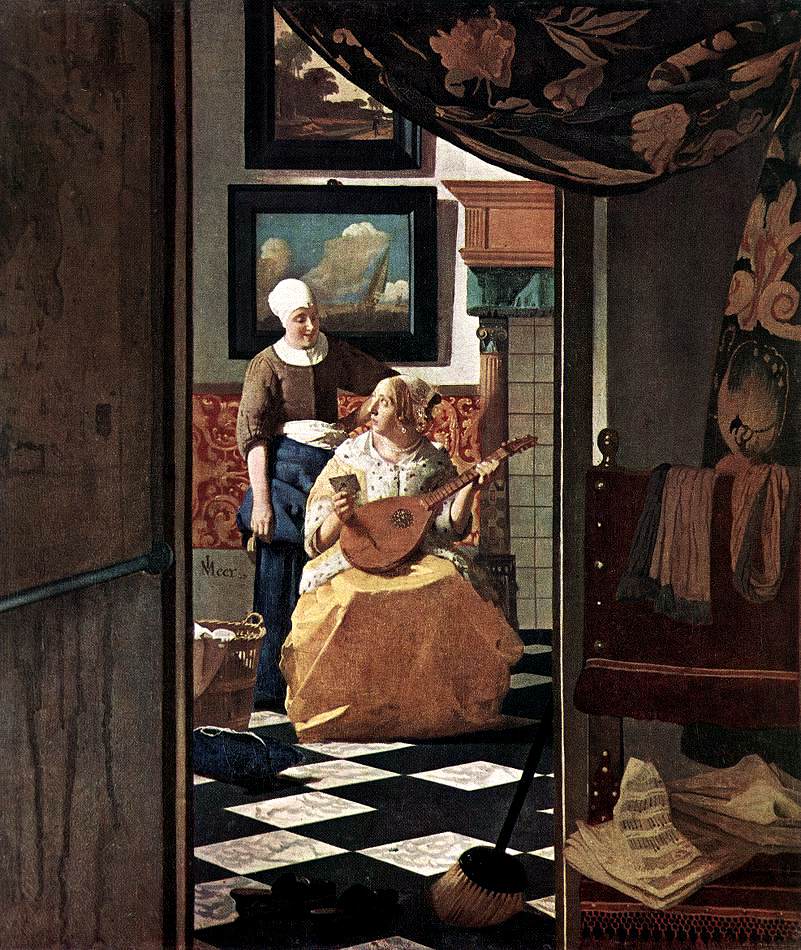
Streep’s words and those of the documentary’s expert interviewees must of necessity focus on Vermeer’s actual paintings, since we know little of the painter’s life. And we don’t even have very many paintings to talk about: living from 1632 to 1672, Vermeer turned out fewer than 40 canvases. But what canvases: Master of Light goes into detail on his particular mastery not only of light and color, but of textures, perspectives, and seemingly minor but nonetheless painstaking touches. We do, however, offer a viewing tip: unless you particularly enjoy shots of light through windows, you may want to begin the video at 5:22 or so. The analysis of Vermeer takes its time coming, but when it begins, it offers a wealth of surprising detail — just as do the paintings themselves. But don’t believe me; find out for yourself by viewing fifteen of them up close at the Google Art Project, including Lady at the Virginal with a Gentleman just above, or, below, The Love Letter.
Related Content:
The Rijksmuseum Puts 125,000 Dutch Masterpieces Online, and Lets You Remix Its Art
Flashmob Recreates Rembrandt’s “The Night Watch” in a Dutch Shopping Mall
The National Gallery Makes 25,000 Images of Artwork Freely Available Online
Google “Art Project” Brings Great Paintings & Museums to You
Colin Marshall hosts and produces Notebook on Cities and Culture and writes essays on literature, film, cities, Asia, and aesthetics. He’s at work on a book about Los Angeles, A Los Angeles Primer. Follow him on Twitter at @colinmarshall.
Read More...A Trip to the Moon (and Five Other Free Films) by Georges Méliès, the Father of Special Effects
If you’ve taken a film studies course, you’ve almost certainly seen the work of Georges Méliès. His 1902 short A Trip to the Moon, at the top, which some cinema scholars cite as the picture where special effects as we know them began, has a particularly important place in cinema history. Nobody who watches that fourteen-minute production ever forgets the image of the moon’s consternation after the protagonists’ spacecraft crashes into it. And the rest of the movie, if narratively shaky, still has an impressive visual power. If anybody had both sufficient imagination and sufficient know-how to commit such a voyage to that cutting-edge medium known as motion film over a century ago, the theater owner and seasoned illusionist Méliès did. Charged by the cinematic pioneering of his countrymen the Lumière brothers, he began doing it in 1896, and continued until 1913, which makes A Trip to the Moon a mid-career highlight.
A mid-career highlight, that is, alongside 1904’s The Impossible Voyage (just above), which continues in the same vein of Jules Verne-style fantastical science fiction. This time, in fact, Méliès took not just the sensibility from Verne but, in part, a story, drawing inspiration from Verne’s play Journey Through the Impossible about a young Danish baron tempted to travel to far-off lands, planets, and realities. He wrote into this sequel, of sorts, a natural destination: the sun. MUBI.com’s “public domain greats” page offers a list of these and other Méliès films available free to watch online, the likes of which inspired Martin Scorsese to adapt Brian Selznick’s Méliès-centric novel The Invention of Hugo Cabret into Hugo, a film visually inventive by the early 21st century’s standards just as A Voyage to the Moon excelled by the early 20th century’s. Those films currently available include:
- A Trip to the Moon (1902)
- The Infernal Cauldron (1903)
- The Impossible Voyage (1904)
- The Living Playing Cards (1905)
- The Hilarious Posters (1906)
- The Devilish Tenant (1909)
They will all be added to our collection of 550 Free Movies Online.
Related Content:
The Power of Silent Movies, with The Artist Director Michel Hazanavicius
The Birth of Film: 11 Firsts in Cinema
The Early Days of Animation Preserved in UCLA’s Video Archive
Colin Marshall hosts and produces Notebook on Cities and Culture and writes essays on literature, film, cities, Asia, and aesthetics. He’s at work on a book about Los Angeles, A Los Angeles Primer. Follow him on Twitter at @colinmarshall.
Read More...Francis Ford Coppola’s Handwritten Casting Notes for The Godfather
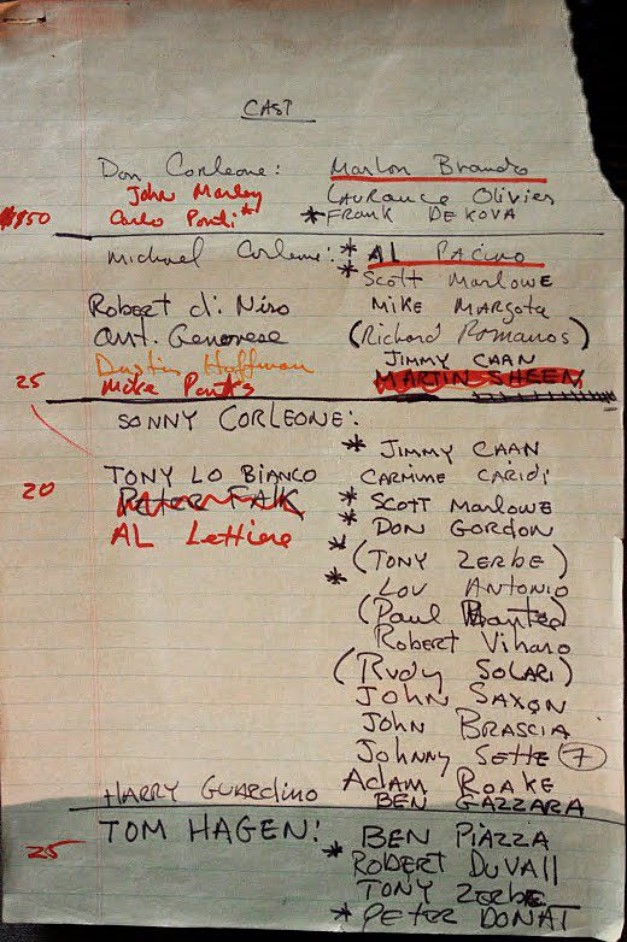
Laurence Olivier as Vito Corleone? Dustin Hoffman as Michael? Those are two of the intriguing options director Francis Ford Coppola was apparently mulling over when he jotted down these notes while preparing to make his classic 1972 film The Godfather.
The casting of The Godfather was a notoriously contentious affair. Executives at Paramount Pictures thought Marlon Brando — Coppola’s first choice to play Mafia “Godfather” Vito — was too difficult to work with. They thought Al Pacino was too short to play his son Michael.
“The war over casting the family Corleone was more volatile than the war the Corleone family fought on screen,” writes former Paramount head of production Robert Evans in his memoir, The Kid Stays in the Picture. At one point the studio wanted Danny Thomas to play Vito and Warren Beatty to play Michael. A long list of leading Hollywood actors were considered for the role of Michael, including Robert Redford, Ryan O’Neal and Jack Nicholson.
Coppola eventually settled on Pacino as the cerebral Michael and the little-known Carmine Caridi as Michael’s tough-guy older brother, Sonny. Evans told the director he could have one but not both. In a passage from the book, quoted in Mark Seal’s 2009 Vanity Fair piece, “The Godfather Wars,” Evans describes a tense meeting with Coppola:
“You’ve got Pacino on one condition, Francis.”
“What’s that?”
“Jimmy Caan plays Sonny.”
“Carmine Caridi’s signed. He’s right for the role. Anyway, Caan’s a Jew. He’s not Italian.”
“Yeah, but he’s not six five, he’s five ten. This aint Mutt and Jeff. This kid Pacino’s five five, and that’s in heels.”
“I’m not using Caan.”
“I’m not using Pacino.”
Slam went the door. Ten minutes later, the door opened. “You win.”
For more on the casting of The Godfather, including excerpts from screen tests and remembrances from Coppola and others, see our earlier post “A Behind-the-Scenes Look at the Casting of The Godfather with Coppola, De Niro & Caan.”
via A.V. Club
Read More...The Historic Meeting Between Dickens and Dostoevsky Revealed as a Great Literary Hoax
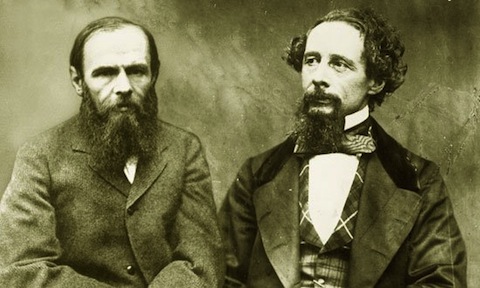
Given the way nineteenth-century literature is sometimes conceived—as the special province of a few great, hairy celebrity novelists—one might imagine that a meeting between Charles Dickens and Fyodor Dostoevsky would not be an unusual occurrence. Maybe it was even routine, like Jay Z and Kanye bumping elbows at a party! So when I read that the two had once met, in London in 1862, my first thought was, “well, sure. And then Herman Melville and Gustave Flaubert stopped by, and they got into a brawl over the check.” Alright, that’s ridiculous. Melville didn’t achieve any degree of fame until after his death, after all, and while the other three were respected, even wildly famous (in Dickens’ case), it is unlikely they read much of each other, much less traveled hundreds of miles for personal visits.
And yet, the story of Dickens and Dostoevsky—since revealed to be as much a fabrication as the image above—was plausible enough to find purchase in two recent Dickens biographies. Though the two men had vastly different sensibilities, their shared experiences of the seamier side of life, and their sprawling serialized novels cataloguing their time’s social ills in great detail, would seem likely to draw them together. New York Times literary critic Michiko Kakutani seemed to think so when she repeated the story as told in Claire Tomalin’s 2011 Charles Dickens, A Life. Tomalin—who found the story in the Dickensian, the journal of the Dickens Fellowship, and reported it in good faith—recounts how the Russian novelist intentionally sought out his English counterpart in London, and, upon finding him, heard Dickens bare his soul, confessing that he longed to be like his honest, simple characters, but used his own personal failings to construct his villains.
The story might still have currency had not several Russian literature scholars read Kakutani’s review and found it far too credulous: Why would Dostoevsky have only mentioned the encounter in a letter written sixteen years after the fact, a letter no scholar has seen? What language would the two men have in common—and if they had one, probably French, would they be fluent enough to have a heart to heart? And even if Dostoevsky visited London in 1862, as it seems, he did, would he have intentionally sought out Charles Dickens? Eric Naiman, professor of Slavic Language and Literatures at UC Berkeley, doubted all of this, and, in undertaking some research, found it to be the elaborate production of a man named A.D. Harvey, who has created for himself a coterie of fictional academic identities so thorough as to constitute what Naiman calls a “community of scholars who can analyse, supplement and occasionally even ruthlessly criticise each other’s work.”
As far as literary hoaxers go, Harvey is quite accomplished. You may find his story—driven, as such things often are, by wounded ego, misplaced talent, vanity, and frustrated ambition—much more interesting than any supposed tête-à-tête between the Russian and British novelists. A recent Guardian piece profiles the “man behind the great Dickens and Dostoevsky hoax,” and Eric Naiman’s exhaustive Times Literary Supplement expose of the hoax shows us just how deeply embedded such spurious lore can become in a literary community before it can be rooted out by skeptical scholars. The lesson here is trite, I guess. Don’t believe everything you read. But when we’re inclined—mostly for good reasons—to trust the word of those who pose as experts and authorities, this can be a hard lesson to heed.
Related Content:
Find works by Dostoevsky and Dickens in our collections of Free Audio Books and Free eBooks.
Albert Camus Talks About Adapting Dostoyevsky for the Theatre, 1959
Watch Piotr Dumala’s Wonderful Animations of Literary Works by Kafka and Dostoevsky
Celebrate the 200th Birthday of Charles Dickens with Free Movies, eBooks and Audio Books
Josh Jones is a writer and musician based in Washington, DC. Follow him at @jdmagness
Read More...Support Us
We're hoping to rely on loyal readers, rather than erratic ads. Please click the Donate button and support Open Culture. You can use Paypal, Venmo, Patreon, even Crypto! We thank you!

About Us

Open Culture scours the web for the best educational media. We find the free courses and audio books you need, the language lessons & educational videos you want, and plenty of enlightenment in between.
Advertise With Us

FREE UPDATES!
GET OUR DAILY EMAIL
Get the best cultural and educational resources on the web curated for you in a daily email. We never spam. Unsubscribe at any time.
FOLLOW ON SOCIAL MEDIA

Open Culture editor Dan Colman scours the web for the best educational media. He finds the free courses and audio books you need, the language lessons & movies you want, and plenty of enlightenment in between.
Advertise With Us


