John Cleese, Monty Python Icon, on How to Be Creative
A couple of years ago, Maria Popova highlighted for us a 2009 talk by John Cleese that offered a handbook for creating the right conditions for creativity. Of course, John Cleese knows something about creativity, being one of the leading forces behind Monty Python, the beloved British comedy group.
Now, we have another talk, recorded circa 1991, where Cleese uses scientific research to describe what creativity is … and what creativity isn’t. He starts by telling us, creativity is not a talent. It has nothing to do with IQ. It is a way of doing things, a way of being — which means that creativity can be learned. The rest he explains in 37 thought-filled minutes.
Related Content:
Malcolm McLaren: The Quest for Authentic Creativity
Amy Tan: The Sources of Creativity
The Universal Mind of Bill Evans: Advice on Learning to Play Jazz & The Creative Process
Follow us on Facebook, Twitter and now Google Plus and share intelligent media with your friends! They’ll thank you for it.
Read More...Reading David Foster Wallace’s The Pale King Live on Stage; Paperback Coming Soon
“David Foster Wallace’s writing sort of lends itself to being read aloud,” says actor Brian Elerding. He understates the case; at times, Wallace seems to have crafted his prose specifically to reflect and embody spoken language. He listened to the English actually used today, including all its tics, hitches, solecisms, and deliberate inarticulacies, with an observatory precision and rigor approaching the scientific. Actor-writer-director John Krasinski first put this quality of Wallace’s writing to a high-profile test with his 2009 film adaptation of Brief Interviews with Hideous Men. In the above clip, we see the making of a similar project in a very different form: last April in Beverly Hills, the PEN (Poets, Essayists, and Novelists) Center USA put on a live reading where “eleven talented actors” performed David Foster Wallace monologues “to an enthusiastic crowd of 300.”
These monologues came adapted from The Pale King, Wallace’s famously posthumous novel about what, if anything, lays beyond the crushing veil of tedium at a Peoria IRS branch office. As we enter the throes of United States tax time, the book gears up for a paperback release featuring additional material, some of which appeared last month at The Millions. PEN’s reading, introduced by Los Angeles Times book critic David L. Ulin, showcased interpretations of The Pale King’s characters through the voices of actors like Nick Offerman and Josh Radnor, comedians like Rob Delaney and June Diane Raphael, and even former Black Flag frontman Henry Rollins. Now best known as a spoken-word artist, Rollins understands well the power and depth of human speech. “It’s trying to reach you on every page,” he says of Wallace’s writing. “He’s trying to make a connection.” Struggling to pin down the exact nature of Wallace’s resonance, so strong with so many readers, literary scholars have used hundreds of thousands of their own words to draw the very same conclusion.
Related content:
David Foster Wallace: The Big, Uncut Interview
‘This Is Water’: Complete Audio of David Foster Wallace’s Kenyon Graduation Speech (2005)
Colin Marshall hosts and produces Notebook on Cities and Culture. Follow him on Twitter at @colinmarshall.
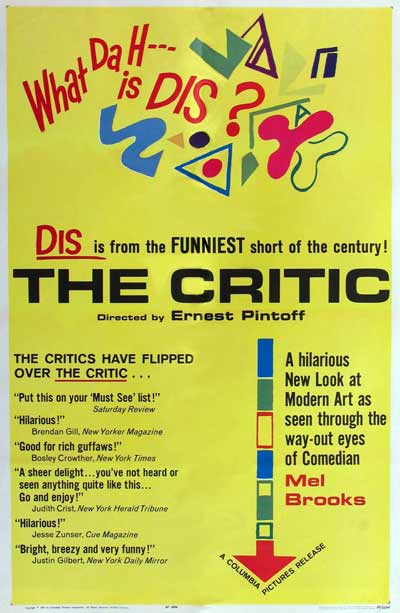
Read More...Watch The Critic: The Oscar-Winning, Animated Film Narrated by Mel Brooks (1963)
One day in early 1962, Mel Brooks was sitting in a New York City theater watching an avant-garde film by the Scottish-born Canadian animator Norman McLaren when he heard someone in the audience expressing bewilderment. “Three rows behind me,” Brooks told Kenneth Tynan for a 1979 New Yorker profile, “there was an old immigrant man mumbling to himself. He was very unhappy because he was waiting for a story line and he wasn’t getting one.”
Brooks had made a study of old curmudgeons ever since he was a boy growing up in a Jewish neighborhood of Brooklyn. In a 1975 Playboy interview he described his eccentric Uncle Joe, who would say to him when he was five years old, “Don’t invest. Put da money inna bank. Even the land could sink.”
Later, as a young comedian learning his craft on the borscht belt circuit, Brooks paid close attention to the elocution and timing of the old Yiddish comedians. After working as a writer for Sid Caesar’s early television program, Your Show of Shows, Brooks and fellow writer Carl Reiner hit it big as performers in 1961, with their “2000-Year-Old Man” routine. Reiner was the straight man interviewing an old man played by Brooks. In one famous scene Reiner asked, “You knew Jesus?” Brooks replied, “Yeah. He was a thin man, always wore sandals. Came into the store but never bought anything.”
So when he overheard the old kvetch in the movie theater giving a running commentary on his own bewilderment, Brooks recognized the comedic possibilities. He approached director Ernest Pintoff, whose Oscar-nominated 1959 short The Violinist had been narrated by Reiner, about making a movie. Pintoff hired artist Bob Heath to create the animation, and chose Bach to set the highbrow tone. Brooks was 36 years old when he created the voice of the 71-year-old man. As he told Tynan, the commentary was ad-libbed:
I asked my pal Ernie Pintoff to do the visuals for a McLaren-type cartoon. I told him, ‘Don’t let me see the images in advance. Just give me a mike and let them assault me.’ And that’s what he did…I sat in a viewing theatre looking at what Ernie showed me, and I mumbled whatever I felt that old guy would have mumbled, trying to find a plot in this maze of abstractions. We cut it down to three and a half minutes and called it The Critic.
The film was a critical as well as a popular success, winning the Academy Award for best animated short film of 1963. Putting The Critic into perspective, Samuel Raphael Franco of J, the Jewish news weekly, wrote in 2009:
The film is a relic of quintessential borscht belt humor.…It is also a valuable sociologic portrait of the predominant cultural attitudes of Brooklyn’s first generation of Russian-Jewish immigrants. The influence of Brooks’ development as a comic as a tummler for the crowds in the Catskills surfaces right away in the first line, “Vat the hell is dis?”
The Critic has been added to the Animation section of our Free Movies collection, and also to our list of 30 Free Oscar Winning Films.
The Invention (and Demonstration) of the First Football Helmet, 1932
British Pathe continues to dust off and digitize some amazing clips from its archive. First came The World’s First Mobile Phone (1922) and footage of The King’s Speech in 1938 — you know, the real King George VI working his way through a public speech in Scotland. Now British Pathe returns with some 1932 footage of an inventor showing off the first football helmet, his modest “attempt to prevent fatal injuries” in the sport. You won’t want to miss the demo of this new fangled piece of sports equipment. H/T Devour
If you would like to support the mission of Open Culture, consider making a donation to our site. It’s hard to rely 100% on ads, and your contributions will help us continue providing the best free cultural and educational materials to learners everywhere. You can contribute through PayPal, Patreon, and Venmo (@openculture). Thanks!
Read More...How the Titanic Sank: James Cameron’s New CGI Animation
It was 100 years ago next Sunday that the luxury liner Titanic struck an iceberg and sank in the North Atlantic Ocean with 1,514 souls aboard. It was one of the deadliest maritime disasters in history.
Last night, the National Geographic Channel broadcast the premier of The Titanic: The Final Word With James Cameron, in which the famed undersea explorer and director of the 1997 blockbuster movie about the disaster presents the latest forensic evidence of what happened that night a century ago. At one point in the show, Cameron, fresh off of his dive to the bottom of the Mariana Trench, gives a sort of “play-by-play” analysis of the mechanics of the disaster (see above) using Computer Graphic Imaging (CGI) software. The tragic element is completely abstracted out of the picture.
For more on the Titanic centenary, including interactive features and a 46-minute documentary film on the disaster, visit the National Geographic “Adventure on the Titanic” Web page.
Read More...Pink Floyd’s Roger Waters Performs The Wall at the Berlin Wall (1990)
Perhaps you enjoyed yesterday’s post on Pink Floyd: Live at Pompeii but today find yourself unsatisfied, longing for more footage that combines the band with a historically iconic work of architecture. Today, dear readers, we have a concert film that might fit your bill: The Wall — Live in Berlin, viewable free on YouTube. While it features neither the actual Berlin Wall — that had already fallen — nor the complete lineup of Pink Floyd, it compensates with a degree of spectacle that, in terms of human labor, must rank alongside several of the wonders of the ancient world. This live performance of The Wall, Pink Floyd’s driving, paranoid 1979 rock opera, takes place on Potsdamer Platz, nor far from where the Berlin Wall stood a mere eight months before. The show’s crew gradually builds their own wall right there onstage over the course of the show, expressly to suffer the same fate as both the real one that divided East Germany from the West and the metaphorical one that separates The Wall’s disaffected rock-star protagonist from the rest of humanity.
The Wall — Live in Berlin happened not as an official Pink Floyd show, but more as a production by founding member Roger Waters. But you couldn’t accurately call it a Roger Waters solo show either, since, even aside from the large technical staff needed to orchestrate such an event, he enlisted countless guest stars to put their own spin on the songs, including Cyndi Lauper, Van Morrison, Thomas Dolby, Germany’s own Scorpions, and — who could forget? — the band of the Combined Soviet Forces in Germany.
The performance drew hundreds of thousands of viewers, a sight from the stage which must surely have kept Waters wondering, in the following decades, if it might make sense to return to The Wall’s well. But could the show ultimately represent a non-replicable moment in cultural, musical, and political history? Could only the Berlin of July 1990 have seen progressive rockers and pop stars join forces to turn a dark, heady double concept album into one of the most elaborate and well-attended concerts in rock history?
You can find an answer to these questions in Waters’ recent The Wall Live tour, which began in September 2010. The video above captures the show in Melbourne last year. Just as they did not simply stage a live replica of The Wall (the album) for Live in Berlin, Rogers and company have, this time around, wisely chosen not to attempt a recreation of that impressive evening twenty years before. While no less bold and complex than its all-out predecessor, the project of The Wall Live somehow interprets its musical source material in a more subdued and — for lack of a better word — artistic manner. These choices acknowledge the fact that popular music, even as generated by the Lady Gagas of the world, has stepped back from the straightforward spectacle at its height in the late eighties. Understanding, too, that the world-dividing clash between communism and capitalism no longer looms quite so overwhelmingly in the zeitgeist, Waters has updated the new shows with an infusion of his current anti-war views. In Pink Floyd: Live in Pompeii, Waters openly worried about becoming “a relic of the past.” Watch the evolution between these two performances and judge for yourself whether he’s succeeded so far in avoiding it.
H/T goes to Kate for flagging this concert for us…
Colin Marshall hosts and produces Notebook on Cities and Culture. Follow him on Twitter at @colinmarshall.
Read More...The Birth and Decline of a Book: Two Videos for Bibliophiles
If you’ve ever spent any time with old books, or stepped into the right used bookstore, you’ve encountered that distinctive smell. Produced by Abe’s Books, and drawing on research from chemists at University College, London, this video looks at the science behind the aroma of used books — at what happens when chemicals and organic matter confront heat, light, moisture and time.
When you’re done watching the video, you might want to spend time with a second clip that deals with another part of the lifecycle of the book — the birth of a book. Shot by Glen Milner at Smith-Settle Printers in Leeds, England, this short film lets you watch firsthand a book — Suzanne St Albans’ Mango and Mimosa — being made with old school printing methods. Enjoy.
If you would like to support the mission of Open Culture, consider making a donation to our site. It’s hard to rely 100% on ads, and your contributions will help us continue providing the best free cultural and educational materials to learners everywhere. You can contribute through PayPal, Patreon, and Venmo (@openculture). Thanks!
Read More...Views from Hitchcock’s Rear Window in Timelapse
Alfred Hitchcock shot many great films. (Watch 21 of his films online here.) But, if you ask the critics, they’ll often say Rear Window, his 1954 classic starring Jimmy Stewart and Grace Kelly, was his finest. We won’t rehearse the plot, except to say that it’s an incredible study of voyeurism and it all revolves around a photographer confined to a wheelchair who spends long days looking out of his rear window, surveilling the apartments around his courtyard. Now filmmaker Jeff Desom has taken this footage — all the footage looking outside the Rear Window — and stitched it into a great little timelapse film. The order of events is the same seen in the movie, and the music, a re-arrrangement of Brahms’ Hungarian Dance No. 5, is provided by Hugo Winterhalter… via metafilter
Related Content:
Alfred Hitchcock Recalls Working with Salvador Dali on Spellbound
François Truffaut’s Big Interview with Alfred Hitchcock (Free Audio)
Read More...David Lynch’s New ‘Crazy Clown Time’ Video: Intense Psychotic Backyard Craziness (NSFW)
What could be more wholesome and all-American than a backyard barbecue? Unless, of course, the backyard in question belongs to David Lynch.
Lynch has long-since established himself as a sort of anti-Norman Rockwell. This week, with the release of a new video to go with his debut music album, Crazy Clown Time, Lynch stays true to form. As he explained to Entertainment Weekly when the video was still in production, “A ‘Crazy Clown Time’ should have an intense psychotic backyard craziness, fueled by beer.” Yesterday Lynch offered further explanation when he sent a message on Twitter announcing the release: “Be the 1st on your block to see the Advancement of the Race which Conway Twitty spoke so clearly.”
The video lasts seven minutes and might be considered NSFW, depending on your office’s policy on nudity, demonic wailing and depictions of people pouring lighter fluid on their spiked mohawk hairdo and setting it afire.
Related Content:
David Lynch’s Surreal Commercials
David Lynch’s Eraserhead Remade in Clay
Read More...Making Paper in L.A., Pianos in Paris: Old Craftsmen Hanging on in a Changing World
In a world of accelerating obsolescence, of plastic products and digital information, a few old-school craftsman are still hanging on. But they’re getting harder and harder to find. In this pair of short films we meet a few craftsmen on both sides of the Atlantic who are stubbornly persisting while the world changes around them. Above is Ink & Paper by Ben Proudfoot, a student at the University of Southern California School of Cinematic Arts. It tells the story of the men who run the last surviving letterpress printing company in downtown Los Angeles, and the oldest paper company. Below is Le Mer de Pianos (The Sea of Pianos) by Tom Wrigglesworth and Mathieu Cuvelier, about the man who has spent 28 years (the last 15 as owner) running the oldest piano repair shop in Paris.
Support Us
We're hoping to rely on loyal readers, rather than erratic ads. Please click the Donate button and support Open Culture. You can use Paypal, Venmo, Patreon, even Crypto! We thank you!

About Us

Open Culture scours the web for the best educational media. We find the free courses and audio books you need, the language lessons & educational videos you want, and plenty of enlightenment in between.
Advertise With Us

FREE UPDATES!
GET OUR DAILY EMAIL
Get the best cultural and educational resources on the web curated for you in a daily email. We never spam. Unsubscribe at any time.
FOLLOW ON SOCIAL MEDIA

Open Culture editor Dan Colman scours the web for the best educational media. He finds the free courses and audio books you need, the language lessons & movies you want, and plenty of enlightenment in between.
Advertise With Us

