Sci-Fi Writer Arthur C. Clarke Predicts the Future in 1964: Artificial Intelligence, Instantaneous Global Communication, Remote Work, Singularity & More
Are you feeling confident about the future? No? We understand. Would you like to know what it was like to feel a deep certainty that the decades to come were going to be filled with wonder and the fantastic? Well then, gaze upon this clip from the BBC Archive YouTube channel of sci-fi author Arthur C. Clarke predicting the future in 1964.
Although we best know him for writing 2001: A Space Odyssey, the 1964 television-viewing public would have known him for his futurism and his talent for calmly explaining all the great things to come. In the late 1940s, he had already predicted telecommunication satellites. In 1962 he published his collected essays, Profiles of the Future, which contains many of the ideas in this clip.
Here he correctly predicts the ease with which we can be contacted wherever in the world we choose to, where we can contact our friends “anywhere on earth even if we don’t know their location.” What Clarke doesn’t predict here is how “location” isn’t a thing when we’re on the internet. He imagines people working just as well from Tahiti or Bali as they do from London. Clarke sees this advancement as the downfall of the modern city, as we do not need to commute into the city to work. Now, as so many of us are doing our jobs from home post-COVID, we’ve also discovered the dystopia in that fantasy. (It certainly hasn’t dropped the cost of rent.)
Next, he predicts advances in biotechnology that would allow us to, say, train monkeys to work as servants and workers. (Until, he jokes, they form a union and “we’d be back right where we started.) Perhaps, he says, humans have stopped evolving—what comes next is artificial intelligence (although that phrase had yet to be used) and machine evolution, where we’d be honored to be the “stepping stone” towards that destiny. Make of that what you will. I know you might think it would be cool to have a monkey butler, but c’mon, think of the ethics, not to mention the cost of bananas.
Pointing out where Clarke gets it wrong is too easy—nobody gets it right all of the time. However, it is fascinating that some things that have never come to pass—being able to learn a language overnight, or erasing your memories—have managed to resurface over the years as science fiction films, like Eternal Sunshine of the Spotless Mind. His ideas of cryogenic suspension are staples of numerous hard sci-fi films.
And we are still waiting for the “Replicator” machine, which would make exact duplicates of objects (and by so doing cause a collapse into “gluttonous barbarism” because we’d want unlimited amounts of everything.) Some commenters call this a precursor to 3‑D printing. I’d say otherwise, but something very close to it might be around the corner. Who knows? Clarke himself agrees about all this conjecture—it’s doomed to fail.
“That is why the future is so endlessly fascinating. Try as we can, we’ll never outguess it.”
Note: An earlier version of this post appeared on our site in 2022.
Related Content:
How French Artists in 1899 Envisioned What Life Would Look Like in the Year 2000
Isaac Asimov Predicts the Future on The David Letterman Show (1980)
In 1926, Nikola Tesla Predicts the World of 2026
Ted Mills is a freelance writer on the arts.
Read More...What You Would See and Feel While Traveling Near the Speed of Light
We all learn in school, or at least from our more rigorous choices of science fiction, that we’ll never be able to travel faster than the speed of light. At first, this may sound disappointing, but upon reflection, 186,000 miles per second is nothing to sneeze at. Questions about how to achieve that speed soon give way to questions about what an attempt to do so would be like, many of them answered by the animated video from ScienceClic above. The first surprise is that moving so fast, in and of itself, would have no negative effect on us. When we travel by bicycle, car, airplane, spacecraft, or what have you, we feel only the acceleration. If that remains at a safe rate, no absolute speed will be a problem, in theory, assuming you can get up to it. Still, it couldn’t hurt to buckle up, not that it would help much in the event of a collision, even with a speck of dust.
Putting that out of our minds by assuming that “our ship is equipped with a force field that repels dangerous objects and allows us to roam freely through space,” we can concentrate on what we’d see through the window. First, “the stars in front of us, which we get closer to, seem to gradually move away. The sky contracts before us,” much as rain appears to fall from the front when you’re driving through it.
“Behind us, the sky seems to widen, and becomes darker,” and any object we pass “would appear to be slightly angled in our direction.” Just as the light in the sky we see while stargazing takes some time to reach us, thus constituting a view of the stars as they were in the past, events on the Earth from which we’re moving away — presuming we had a way to see them — would appear to be taking place in “slow motion.” Earth’s image would shift toward the color red, and that of everything in front of us would shift toward blue. After a few hundred days, our ship begins to approach light speed, and that’s when things get even stranger.
This, scientifically speaking, is when special relativity comes into play, causing our ship to swerve onto its own “time axis” apart from the one followed by Earth. From our perspective, the entire universe would contract along our length of motion, making our journey shorter than we’d expected. As we move faster and faster, the view in front of us intensifies, while the view behind us turns completely black. And what would happen when we finally reach light speed? Nothing, because we can’t reach it: “You may try to catch a light ray, but from your point of view, it will always escape at the same speed.” Accelerate all you like; “from your point of view, you are still motionless, and light escapes inexorably.” At best, “our ship will continue to accelerate forever, and our field of vision will shrink ever more, until forming an infinitely bright spot in front of us, surrounded by an infinitely black sky.” But there may be a loophole, in that, even if an object can’t do it, “nothing prohibits space itself from moving faster than light” — a premise for some truly mind-blowing sci-fi if ever there was one.
via Aeon
Related Content:
M.I.T. Camera Captures Speed of Light: A Trillion-Frames-Per-Second
Professor Ronald Mallett Wants to Build a Time Machine in this Century … and He’s Not Kidding
What It Feels Like to Fly Over Planet Earth
Based in Seoul, Colin Marshall writes and broadcasts on cities, language, and culture. He’s the author of the newsletter Books on Cities as well as the books 한국 요약 금지 (No Summarizing Korea) and Korean Newtro. Follow him on the social network formerly known as Twitter at @colinmarshall.
Read More...Explore 1,000,000 Digitized Artworks from Across the UK: Paintings, Sculptures, Street Art & More
No art enthusiast’s visit to the United Kingdom would be complete without days at the British Museum, the Tate, the V&A and the National Gallery. The fact that all those respected institutions are in London constitutes a plausible excuse never to stray outside the capital. But that capital is surrounded, lest we forget, by not just a whole country, but a whole United Kingdom’s worth of countries. Each region of England has its own museums and galleries worth visiting, and so do Scotland, Wales, and Northern Ireland. But why just visit museums and galleries? Universities, libraries, town halls, hospitals, homes: these places and more also put art on display for anyone who cares to visit them, which you can now do not just physically, but also online at Art UK.

A free-to-all portal that “connects everyone with the UK’s public art collections,” Art UK has taken it as its mission to “digitally unite one million artworks from 3,500 institutions.” Some of the most popular of the roughly 70,000 artists whose work it makes available to view online include Francis Bacon, Agnes Martin, Salvador Dalí, Andy Warhol, Tracey Emin, Paul Gauguin, Constantin Brâncuși, Damien Hirst, and Yayoi Kusama.
As even that short list reflects, what’s on digital display at Art UK is by no means limited to British works, nor are there any restrictions on medium or sensibility. Paintings, drawings, photographs, sculptures, ceramics, digital art: if it’s held at a UK institution, it’s available for your viewing pleasure — or your education, your research, whatever your purpose may be.

A decade into Art UK’s evolution, one of the most fascinating sections of its digital holdings may hardly contain any work by artists whose names you’ve heard. That’s because it’s a collection of the UK’s murals and street art, whose digitization began in early 2024. “The project followed the successful, award-winning sculpture digitization and engagement project, which firmly established Art UK as the home for showcasing the UK’s public realm artworks,” writes photographer Tracy Jenkins. “We have now recorded over 6,600 murals, bringing the total number of public artworks on the website to 21,400.” Dating from 1000 AD to the present, these “include wall paintings in historic churches, post-war ceramic and concrete works, and contemporary painted murals and mosaics.” Collectively, they remind us that, in our haste to tour the most august temples of art, we ignore at our peril the museums without walls — or rather, the museums that are walls. Enter Art UK here.

Related Content:
The British Museum Puts 1.9 Million Works of Art Online
Great Art Cities: Visit the Fascinating, Lesser-Known Museums of London & Paris
Google Puts Online 10,000 Works of Street Art from Across the Globe
The British Museum is Full of Looted Artifacts
Based in Seoul, Colin Marshall writes and broadcasts on cities, language, and culture. He’s the author of the newsletter Books on Cities as well as the books 한국 요약 금지 (No Summarizing Korea) and Korean Newtro. Follow him on the social network formerly known as Twitter at @colinmarshall.
Read More...9 Things a Woman Couldn’t Do in 1971
More than a century after women’s suffrage in the United States, it’s not enough to bone up on the platforms of female primary candidates (though that’s an excellent start).
A Twitter user and self-described Old Crone named Robyn urged her fellow Americans to take a good long gander at a list of nine freedoms that women in the United States were not universally granted in 1971, the year Helen Reddy released the soon-to-be anthem, “I Am Woman,” above.
Even those of us who remember singing along as children may experience some shock that these facts check out on Snopes.
- CREDIT CARDS: Prior to the Equal Credit Opportunity Act of 1974, married women couldn’t get credit cards without their husbands’ signatures. Single women, divorcees, and widows were often required to have a man co-sign. The double standard also meant female applicants were frequently issued card limits up to 50% lower than that of males who earned identical wages.
- PREGNANT WORKERS: The Pregnancy Discrimination Act of 1978 protected pregnant women from being fired because of their impending maternity. But it came with a major loophole that’s still in need of closing. The language of the law stipulates that employers must accommodate pregnant workers only if concessions are being made for other employees who are “similar in their ability or inability to work.”
- JURY DUTY: In 1975, the Supreme Court declared it constitutionally unacceptable for states to deny women the opportunity to serve on juries. This is an arena where we’ve all come a long way, baby. It’s now completely normal for men to be excused from jury duty as the primary caregivers of their young children.
- MILITARY COMBAT: In 2013, former Secretary of Defense Leon Panetta and former Chairman of the Joint Chiefs of Staff, General Martin Dempsey announced that the Pentagon was rescinding the direct combat exclusion rule that barred women from serving in artillery, armor, infantry and other such battle roles. At the time of the announcement, the military had already seen more than 130 female soldiers killed, and 800 wounded on the front lines in Iraq and Afghanistan.
- IVY LEAGUE ADMISSIONS: Those who conceive of elite colleges as breeding grounds for sexual assault protests and Title IX activism would do well to remember that Columbia College didn’t admit women until 1983, following in the marginally deeper footsteps of others in the Ivy League—Harvard (1977), Dartmouth (1972), Brown (1971), Yale (1969), and Princeton (1969). These days, single-sex higher education options for women far outnumber those for men, but the networking power and increased earning potential an Ivy League degree confers remain the same.
- WORKPLACE HARASSMENT: In 1977, women who’d been sexually harassed in the workplace received confirmation in three separate trials that they could sue their employers under Title VII of the 1964 Civil Rights Act. In 1998, the Supreme Court ruled that same-sex harassment was also unlawful. In between was the television event of 1991, Anita Hill’s shocking testimony against her former boss, U.S. Supreme Court justice (then nominee) Clarence Thomas.
- SPOUSAL CONSENT: In 1993, spousal rape was officially outlawed in all 50 states. Not tonight honey, or you’ll have a headache in the form of your wife’s legal backup.
- HEALTH INSURANCE: In 2010, the Patient Protection and Affordable Care Act decreed that any health insurance plan established after March of that year could not charge women higher premiums than men for identical benefits. This was bad news for women who got their health insurance through their jobs, and whose employers were grandfathered into discriminatory plans established prior to 2010. Of course, that’s all ancient history now.
- CONTRACEPTIVES: In 1972, the Supreme Court made it legal for all citizens to possess birth control, irrespective of marital status, stating “if the right of privacy means anything, it is the right of the individual, married or single, to be free from unwarranted governmental intrusion into matters so fundamentally affecting a person as the decision whether to bear or beget a child.” (It’s worth noting, however, that in 1972, states could still constitutionally prohibit and punish sex outside of marriage.)
Feminism is NOT just for other women.
Note: An earlier version of this post appeared on our site in 2019.
Related Content:
No Women Need Apply: A Disheartening 1938 Rejection Letter from Disney Animation
How the Bicycle Accelerated the Women’s Rights Movement (Circa 1890)
Odd Vintage Postcards Document the Propaganda Against Women’s Rights 100 Years Ago
Ayun Halliday is an author, illustrator, and theater maker in NYC.
Read More...The Self-Balancing Monorail: A 1910 Train That Could Balance Without Falling
If monorails have a bad name, The Simpsons may be to blame. In an episode acclaimed for its hilariousness since it first aired 33 years ago, a huckster shows up in Springfield and convinces the town to build just such a transit system, which turns out to be not just suspiciously unnecessary (at least in young Lisa’s judgment) but also dangerously shoddy. I watched it while growing up in the suburbs of Seattle, a city that endured bitterly protracted contention over whether or not to build out its own rudimentary monorail system — a World’s Fair artifact, like the Space Needle — but finally opted not to. Concerns were perpetually raised, rightly or wrongly, about the noise and darkness that could result from extending the wide elevated track on which it ran.
But what if there were another way to build a monorail? Indeed, what if it could run on the ground, like a traditional two-railed train? Such was the idea in the head of the indefatigable Irish-Australian engineer Louis Brennan, who’s remembered today for inventing a wire-guided torpedo back in 1877.
If things had gone differently, maybe he’d be better remembered for inventing the gyro monorail, the subject of the Primal Space video above. In Brennan’s design, which he actually got built and working, the car balances on a single rail with the aid of a pair of spinning powered gyroscopes that prevent it from falling over (and, in the case of power loss, could keep spinning for half an hour to allow a safe evacuation), allowing it to run faster and corner more tightly than the trains the world knew.
Brennan’s gyro monorail made its public debut at the Japan-British Exhibition in London in 1910, giving 50 passengers at a time the opportunity to ride around in a circle at 20 miles per hour. Though the interest it drew inspired a minor boom of gyro-stabilized children’s toys, it never actually translated into a real transit system. Around the same time, a group in Germany also unveiled their own version, and in the decades thereafter, additional abortive efforts were made in Russia. The engineering involved was impressive, as the video explains, but also a bit too complicated and expensive for its time. The development of a new German app-ordered autonomous gyro monorail system was announced just a few years ago. Given the possibility of its entering production as soon as 2032, we could soon be hearing choruses of “Monorail, monorail, monorail” — or rather, “Monocab, Monocab, Monocab” — once again.
Related content:
Paris Had a Moving Sidewalk in 1900, and a Thomas Edison Film Captured It in Action
A Subway Ride Through New York City: Watch Vintage Footage from 1905
Why Public Transit Sucks in the United States: Four Videos Tell the Story
A Harrowing Test Drive of Buckminster Fuller’s 1933 Dymaxion Car: Art That Is Scary to Ride
Based in Seoul, Colin Marshall writes and broadcasts on cities, language, and culture. He’s the author of the newsletter Books on Cities as well as the books 한국 요약 금지 (No Summarizing Korea) and Korean Newtro. Follow him on the social network formerly known as Twitter at @colinmarshall.
Read More...How the CIA Secretly Funded Abstract Expressionism During the Cold War
Considering the possibility of a truly proletarian art, the great English literary critic William Empson once wrote, “the reason an English audience can enjoy Russian propagandist films is that the propaganda is too remote to be annoying.” Perhaps this is why American artists and bohemians have so often taken to the political iconography of far-flung regimes, in ways both romantic and ironic. One nation’s tedious socialist realism is another’s radical exotica.
But do U.S. cultural exports have the same effect? One need only look at the success of our most banal branding overseas to answer in the affirmative. Yet no one would think to add Abstract Expressionist painting to a list that includes fast food and Walt Disney products.
Nevertheless, the work of such artists as Jackson Pollock, Mark Rothko, and Willem de Kooning wound up as part of a secret CIA program during the height of the Cold War, aimed at promoting American ideals abroad.

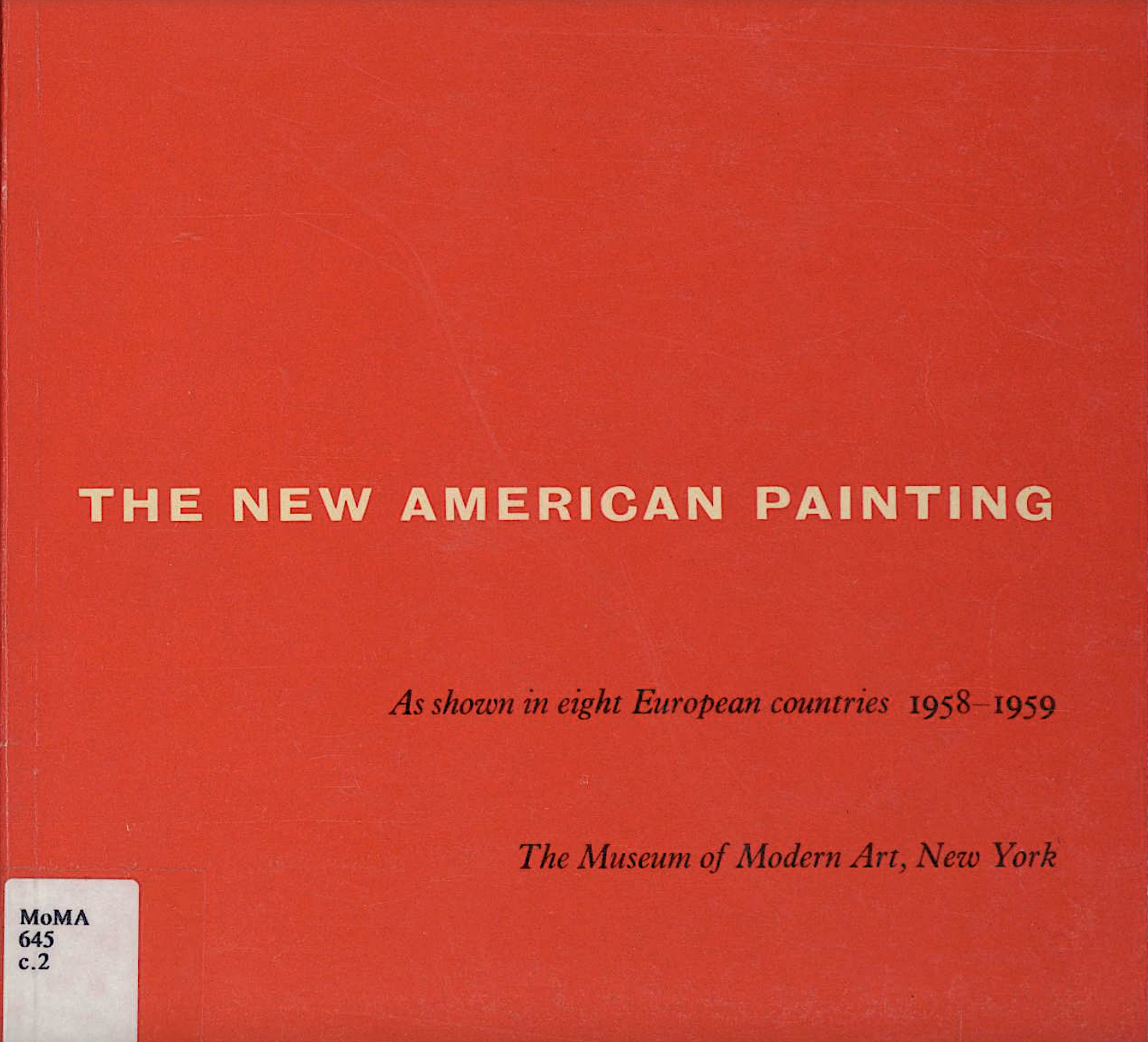
The artists themselves were completely unaware that their work was being used as propaganda. On what agents called a “long leash,” they participated in several exhibitions secretly organized by the CIA, such as “The New American Painting” (see catalog cover at top), which visited major European cities in 1958–59 and included such modern primitive works as surrealist William Baziotes’ 1947 Dwarf (below) and 1951’s Tournament by Adolph Gottlieb above.

Of course what seems most bizarre about this turn of events is that avant-garde art in America has never been much appreciated by the average citizen, to put it mildly. American Main Streets harbor undercurrents of distrust or outright hatred for out-there, art-world experimentation, a trend that filters upward and periodically erupts in controversies over Congressional funding for the arts. A 1995 Independent article on the CIA’s role in promoting Abstract Expressionism describes these attitudes during the Cold War period:
In the 1950s and 1960s… the great majority of Americans disliked or even despised modern art—President Truman summed up the popular view when he said: “If that’s art, then I’m a Hottentot.” As for the artists themselves, many were ex- communists barely acceptable in the America of the McCarthyite era, and certainly not the sort of people normally likely to receive US government backing.
Why, then, did they receive such backing? One short answer:
This philistinism, combined with Joseph McCarthy’s hysterical denunciations of all that was avant-garde or unorthodox, was deeply embarrassing. It discredited the idea that America was a sophisticated, culturally rich democracy.
The one-way relationship between modernist painters and the CIA—only recently confirmed by former case officer Donald Jameson—supposedly enabled the agency to make the work of Soviet Socialist Realists appear, in Jameson’s words, “even more stylized and more rigid and confined than it was.” (See Evdokiya Usikova’s 1959 Lenin with Villagers below, for example). For a longer explanation, read the full article at The Independent. It’s the kind of story Don DeLillo would cook up.

William Empson goes on to say that “a Tory audience subjected to Tory propaganda of the same intensity” as Russian imports, “would be extremely bored.” If he is correct, it’s likely that the average true believer socialist in Europe was already bored silly by Soviet-approved art. What surprises in these revelations is that the avant-garde works that so radically altered the American art world and enraged the average congressman and taxpayer were co-opted and collected by suave U.S. intelligence officers like so many Shepard Fairey posters.
Note: An earlier version of this post appeared on our site in 2013.
Related Content:
When the State Department Used Dizzy Gillespie and Jazz to Fight the Cold War (1956)
How “America’s First Drug Czar” Waged War Against Billie Holiday and Other Jazz Legends
The CIA’s Style Manual & Writer’s Guide: 185 Pages of Tips for Writing Like a Spook
Josh Jones is a writer and musician based in Washington, DC.
Read More...Discover Gadsby: The 50,000-Word Novel Written Without Using the Letter E (1939)
“If Youth, throughout all history, had had a champion to stand up for it; to show a doubting world that a child can think; and, possibly, do it practically; you wouldn’t constantly run across folks today who claim that ‘a child don’t know anything.’ ” Ranked alongside the other notable opening sentences of American literature, this falls somewhat short of, say, “Call me Ishmael.” The entire novel that follows is written in the same oddly stilted, circumlocutive prose, and a reader who skips the author’s introduction may not perceive just what has set it askew for some time. They’d also have to be reading an edition other than the first, with its bold promise of a “50,000 WORD NOVEL WITHOUT THE LETTER ‘E.’ ”
The book is Ernest Vincent Wright’s Gadsby (1939). Though self-published in the late nineteen-thirties to no fanfare, it’s now acknowledged more or less widely as a literary oddity, far more often cited as a piece of trivia than actually read. (I first learned of it from a list of fun facts on the back of a cereal box, which, looking back now, seems culturally appropriate.) As the Disambi video above explains, in denying himself e, the single most common letter in the English language, Wright denied himself the, as well as “the majority of pronouns, like he, she, they, them, theirs,” and so on. “Past-tense words that use -ed are out of the question, as is any number between six and thirty.”
To some, more surprising than the fact that Wright managed to compose a full-length novel this way (overlooking three thes and an officer that slipped into the initial print run) is the nature of the story he channeled this considerable effort into telling. John Gadsby — not to be confused with the similarly named, much more famous title character of another novel from the previous decade — returns in middle age to his hometown of Branton Hills, which has slid into a state of advanced dissolution. In despair, he assembles a youth league dedicated to breathing life back into the place, and before those 50,000 very nearly e‑less words have passed, the population has grown thirtyfold, and he’s become the mayor.
In truth, American literature of the early twentieth century is littered with Gadsbys; it’s just that none of the authors of those forgotten homilies on civic-minded boosterism thought to use so striking a gimmick. Technically called a lipogram, the technique of omitting a particular letter has since been used since to greater literary effect. With their characteristic weakness for American eccentricity, certain French intellectuals eventually took up Gadsby as a kind of model. In 1969, Georges Perec published the longer but similarly e‑less La Disparition, which would have been much more challenging to write, given the French language’s even greater reliance on that missing vowel. Far from a parlor trick, its lipogram resonates with both the content of the story and sense of absence felt by the author, who’d lost both parents in World War II. As for this post, perhaps you’ve noticed that it’s been written thus far without a single instance of the letter z. Please clap.
Related Content:
How to Jumpstart Your Creative Process with William S. Burroughs’ Cut-Up Technique
An Introduction to the Codex Seraphinianus, the Strangest Book Ever Published
American Literature, From the Beginnings to the Civil War: A Free Online Course from NYU
Based in Seoul, Colin Marshall writes and broadcasts on cities, language, and culture. He’s the author of the newsletter Books on Cities as well as the books 한국 요약 금지 (No Summarizing Korea) and Korean Newtro. Follow him on the social network formerly known as Twitter at @colinmarshall.
Read More...Watch 434 Avant-Garde and Surreal Short Films Online: Salvador Dalí, Marcel Duchamp, Luis Buñuel and Many More
Much has been written lately about the crisis in Hollywood, which has left many apparently sure-fire blockbusters floundering, theaters empty, and production jobs lost. There are many factors in play — some of them, as few diagnoses fail to point out, structural — but can we ignore the possibility of fatigue, perhaps even boredom, with film itself? We’ve posted in recent years here on Open Culture about the decay of cinema, the rise of “visual muzak” on Netflix, why movies don’t feel real anymore, and why movies don’t even feel like movies anymore. Even if they’ve limited their exposure to big-budget spectacles, most once-avid cinephiles will have felt all those phenomena for themselves by now, and many will be considering whether to look for a new art form to enjoy. But some will wonder: maybe there’s a cure?
There could well be, and a bracing one. If you seek a re-enchantment with film, there could be few better places to look than in the work of filmmakers who have broken that medium down to its very components and put it together again in unconventional ways. Some of the results shocked audiences fifty, sixty, seventy, even a hundred years ago — and indeed, some retain that power today.
You can take a journey through the history of such experimental, avant-garde, and surreal motion pictures with the YouTube playlist at the top of the post, which comprises 434 such videos. The exact number will vary depending upon your region of the world, as well as upon how many of them have come and gone since the playlist’s creation. Whatever the total, not even a fringe-cinema habitué will have seen everything on it (at least, not more than once).
Longtime Open Culture readers may recognize on the playlist the work of Dadaist Hans Richter and Marcel Duchamp, abstraction pioneer Viking Eggeling, early feminist filmmaker Germaine Dulac, and animator (as well as city symphonist) Walter Ruttmann, not to mention Salvador Dalí and Luis Buñuel.
They may or may not already have encountered the cinematic legacy of, say, Shūji Terayama, the all-around avant-gardist and provocateur whose influence is still felt in Japanese art today; Stan Brakhage, who forewent even the use of a camera and created his own cinema by manipulating film directly; or Michael Snow, whose Wavelength tells a story without leaving a single room in which very little happens. But then, after enough of these experimental, avant-garde, and surreal viewing experiences, you’ll remember that there are many ways for a film to tell a story — and much, much more that film can do besides storytelling, if only we’d let it.
Related Content:
A Page of Madness: The Lost Avant Garde Masterpiece from Early Japanese Cinema (1926)
Watch the Meditative Cinepoem “H20”: A Landmark Avant-Garde Art Film from 1929
Watch Meshes of the Afternoon, the Experimental Short Voted the 16th Best Film of All Time
Based in Seoul, Colin Marshall writes and broadcasts on cities, language, and culture. He’s the author of the newsletter Books on Cities as well as the books 한국 요약 금지 (No Summarizing Korea) and Korean Newtro. Follow him on the social network formerly known as Twitter at @colinmarshall.
Read More...How a Clean, Tidy Home Can Help You Survive the Atomic Bomb: A Cold War Film from 1954
Not too far back, we revisited some Cold War propaganda that taught upstanding American citizens How to Spot a Communist Using Literary Criticism. It’s a gem, but it has nothing on the 1954 film, The House in the Middle. Selected for preservation in the National Film Registry by the Library of Congress, the short documentary makes the ultimate case for cleanliness. Bringing viewers to the Nevada Proving Grounds, the 12-minute film shows what happens when clean, white houses are subjected to heat waves from an atomic blast, versus what happens when a dingy, ill-kept house goes through the same drill. It turns out that neat people can not only claim moral victory (as they always do). They also get to live another day. Consider it proof of the survival of the tidiest.
The film was produced by the National Clean Up-Paint Up-Fix Up Bureau with support from the Federal Civil Defense Administration. The National Paint, Varnish and Lacquer Association also apparently played a role, suggesting that corporate interests were capitalizing on wartime fear. Not the first time that’s happened in America. Or that last…
If you would like to support the mission of Open Culture, consider making a donation to our site. It’s hard to rely 100% on ads, and your contributions will help us continue providing the best free cultural and educational materials to learners everywhere. You can contribute through PayPal, Patreon, and Venmo (@openculture). Thanks!
Note: An earlier version of this post appeared on our site in 2013.
Related Content:
Watch Ducked and Covered: A Survival Guide to the Post Apocalypse (A Little NSFW)
How to Spot a Communist by Using Literary Criticism: A 1955 Manual from the U.S. Military
Animated Films Made During the Cold War Explain Why America is Exceptionally Exceptional
Read More...Watch the Titanic and Lusitania Sink in Real Time: One Fast, One Slow
Asked to name famous shipwrecks at a bar trivia night, a fair few participants might think immediately of Pearl Harbor, whether or not they can recall that it was the USS Arizona bombed there. More firmly within living memory sits the SS Andrea Doria, though she’s hardly the cultural reference she used to be. The wreck of the SS Edmund Fitzgerald passed its fiftieth anniversary just last year, which gave a boost to its remembrance, if mostly by Gordon Lightfoot fans. There is, of course, the Endurance, though the ship herself has always been overshadowed by the efforts of her captain to get the whole crew home alive. The schooner Hesperus does come to mind as a particularly unfortunate vessel, perhaps all the more so because she didn’t actually exist.
Nearly everyone at the bar is, of course, going to put down the RMS Titanic first. Even before she received the James Cameron treatment, that “unsinkable” ocean liner was easily the most famous shipwreck of the twentieth century, and quite possibly of all history. But second place has to go to the RMS Lusitania, which went under just three years after the Titanic. As close as the year 1915 may sound to 1912, developments in Europe had rearranged the world in the meantime. The Titanic met her end by colliding with an iceberg, and about two and a half hours later, as you can see in the real-time sinking video at the top of the post, it was on the bottom of the North Atlantic. When the Lusitania was torpedoed by a German U‑boat, by contrast, she went down in just eighteen minutes.
You can witness those minutes re-created in the animated video from Oceanliner Designs just above. Though the Great War was raging, the ship hadn’t yet been commissioned as an armed merchant cruiser, but was conducting her usual transatlantic passenger service while — as the German side insisted and the British at first denied — carrying war materials on the side. She’d been traveling due east for six days when U‑20 sighted her; after an hour of tracking came the launch of the fateful underwater missile and its 160-kilogram explosive payload. The video shows and explains not just how the Lusitania slipped below the water, but also the breakdown along the way of her various structural elements and mechanical systems, including the elevators that had once seemed such marvelous innovations.
It seems that after the torpedo hit, practically everything that could have consequently gone wrong did, right down to the few deployable lifeboats dropping catastrophically from their davits. The crew of the Titanic managed to launch most of her lifeboats, but there weren’t enough of them in the first place. That contributed to a final death toll of around 1,500, as compared with 1,197 on the Lusitania. Though similar in scale and historical timing, these two maritime disasters ended up with very different meanings. The wreck of the Titanic continues to capture imaginations by resonating with the industrial romance, class stratification, and imperial hubris of the long nineteenth century; that of the Lusitania, whose sinking played a major role in bringing the United States into what we now call World War I, shows us nothing so clearly as the merciless geopolitical logic of the twentieth.
Related content:
Watch the Sinking of the Lusitania Animated in Real Time (1915)
How James Cameron Shot Titanic’s Hugely Complex Sinking Scene
The Costa Concordia Shipwreck Viewed from Outer Space
Based in Seoul, Colin Marshall writes and broadcasts on cities, language, and culture. He’s the author of the newsletter Books on Cities as well as the books 한국 요약 금지 (No Summarizing Korea) and Korean Newtro. Follow him on the social network formerly known as Twitter at @colinmarshall.
Read More...Support Us
We're hoping to rely on loyal readers, rather than erratic ads. Please click the Donate button and support Open Culture. You can use Paypal, Venmo, Patreon, even Crypto! We thank you!

About Us

Open Culture scours the web for the best educational media. We find the free courses and audio books you need, the language lessons & educational videos you want, and plenty of enlightenment in between.
Advertise With Us

FREE UPDATES!
GET OUR DAILY EMAIL
Get the best cultural and educational resources on the web curated for you in a daily email. We never spam. Unsubscribe at any time.
FOLLOW ON SOCIAL MEDIA

Open Culture editor Dan Colman scours the web for the best educational media. He finds the free courses and audio books you need, the language lessons & movies you want, and plenty of enlightenment in between.
Advertise With Us

