A Billion Years of Tectonic-Plate Movement in 40 Seconds: A Quick Glimpse of How Our World Took Shape
We all remember learning about tectonic plates in our school science classes. Or at least we do if we went to school in the 1960s or later, that being when the theory of plate tectonics — which holds, broadly speaking, that the Earth’s surface comprises slowly moving slabs of rock — gained wide acceptance. But most everyone alive today will have been taught about Pangea. An implication of Alfred Wegener’s theory of “continental drift,” first proposed in the 1910s, that the single gigantic landmass once dominated the planet.
Despite its renown, however, Pangea makes only a brief appearance in the animation of Earth’s history above. Geological scientists now categorize it as just one of several “supercontinents” that plate tectonics has gathered together and broken up over hundreds and hundreds of millennia. Others include Kenorland, in existence about 2.6 billion years ago, and Rodinia, 900 million years ago; Pangea, the most recent of the bunch, came apart around 175 million years ago. You can see the process in action in the video, which compresses a billion years of geological history into a mere 40 seconds.
At the speed of 25 million years per second, and with outlines drawn in, the movement of Earth’s tectonic plates becomes clearly understandable — more so, perhaps, than you found it back in school. “On a human timescale, things move in centimeters per year, but as we can see from the animation, the continents have been everywhere in time,” as Michael Tetley, co-author of the paper “Extending full-plate tectonic models into deep time,” put it to Euronews. Antarctica, which “we see as a cold, icy inhospitable place today, actually was once quite a nice holiday destination at the equator.”
Climate-change trends suggest that we could be vacationing in Antarctica again before long — a troubling development in other ways, of course, not least because it underscores the impermanence of Earth’s current arrangement, the one we know so well. “Our planet is unique in the way that it hosts life,” says Dietmar Müller, another of the paper’s authors. “But this is only possible because geological processes, like plate tectonics, provide a planetary life-support system.” Earth won’t always look like it does today, in other words, but it’s thanks to the fact that it doesn’t look like it did a billion years ago that we happen to be here, able to study it at all.
Related Content:
A Map Shows Where Today’s Countries Would Be Located on Pangea
What Earth Will Look Like 100 Million Years from Now
Based in Seoul, Colin Marshall writes and broadcasts on cities, language, and culture. His projects include the Substack newsletter Books on Cities, the book The Stateless City: a Walk through 21st-Century Los Angeles and the video series The City in Cinema. Follow him on Twitter at @colinmarshall or on Facebook.
Read More...
Hear Louis Armstrong’s Last Reel-to-Reel Tape, Made Hours Before His Death (1971)
50 years ago today Louis Armstrong made his final reel-to-reel tape. After concluding it with “April in Paris” from the “Ella and Louis” album he went to sleep and passed away. This video contains the final minute of “April in Paris” directly transferred from that last tape. pic.twitter.com/9zq9jWtiPj
&mdash Louis Armstrong (@ArmstrongHouse) July 5 2021
When Louis Armstrong first recorded “Hello, Dolly!”, in 1963, he “found the song trite and lifeless,” says his biographer Laurence Bergreen, a surprising fact since it became one of his signature tunes. “Armstrong had transformed the song, infusing it with irrepressible spirit and swing,” Marc Silver writes at NPR. He did so all the way to the end of his life, playing “Hello, Dolly!” after accepting an award at the National Press Club in one of his final performances on January 29, 1971. “He sang in a voice more gravelly than ever” and performed despite the fact that he “was under doctor’s orders not to break out his trumpet” after a heart attack that nearly felled the jazz giant. He died five months later on the morning of July 6th.
Armstrong spent July 5th, 1971, his final night, at home, relaxing and recording reel-to-reel tapes in his den at his home in Corona, Queens. Transferring his music to tape and making covers with his own collage art had been a decades-long hobby for Armstrong, a lifelong archivist and memoirist. “
It appears,” the Louis Armstrong House notes, “his [tape] numbering system got well into the 400s.” In 2009, Armstrong House Archivist Ricky Riccardi ran across an oddity, an unnumbered tape with no art on the cover. The only identifying information came from a note on the box in Armstrong’s wife’s Lucille’s handwriting, “Last Tape recorded by Pops. 7/5/71.”
As Riccardi explains in a post here (from a longer series on the last two years of Armstrong tapes), it would take five more years before he discovered the contents of the final Armstrong tape — an audio document of the LPs Satchmo listened to just hours before his death.
“Finally,” Riccardi writes, “around 11 a.m. on an early February day [in 2013], I was ready. I explained to my volunteer, Harvey Fisher, what was about to happen. I went into the stacks, grabbed the tape, sat at the tape deck and loaded the tape onto the hub. I hit ‘Play’ and held my breath as it started spinning.” What came out was “Listen to the Mockingbird” from Armstrong’s 1952 collaboration with Gordon Jenkins, Satchmo in Style.
“I felt tears in my eyes while dubbing it,” Riccardi writes. After recording this song, Armstrong flipped the record over, recorded the second side, then went on to record the entire 2‑LP set of Satchmo at Symphony Hall, “probably with fond memories of the musicians and friends on that album who were no longer living.” Finally, Armstrong put on his first, 1956 collaboration with Ella Fitzgerald, an album, writer and musician Tom Maxwell argues, that made a “cultural leap [in] the middle of that tumultuous century, that two black performers could be considered the best interpreters of white show tunes, and that the extemporaneous heart of jazz could elevate the whole to iconic status, desegregating American popular culture in just eleven songs.”
After the final song, “Louis left his den and headed down the hallway to his bedroom,” Riccardi writes, where, Lucille says, he “was feeling frisky and tried to initiate ‘the vonce.’ She declined, fearing for his health. He went to sleep. About 5:30 in the morning of July 6, Louis Armstrong passed away in his sleep…. Can you think of a better way to go out?” It was a peaceful end to a hard life lived in devotion to spreading his musical joy. You can hear a playlist compiled by Riccardi of most of the music from Armstrong’s 1969–1971 tapes above. It starts with “Hello Dolly!” and ends with the last song on Ella and Louis, and on Armstrong’s final reel-to-reel tape, the last song he ever heard: “April in Paris.”
Related Content:
Louis Armstrong Remembers How He Survived the 1918 Flu Epidemic in New Orleans
When Louis Armstrong Stopped a Civil War in The Congo (1960)
Josh Jones is a writer and musician based in Durham, NC. Follow him at @jdmagness.
Read More...Hunter Thompson Explains What Gonzo Journalism Is, and How He Writes It (1975)
There’ve been any number of aspiring “gonzo journalists” over the past half-century, but there was only one Hunter S. Thompson. Having originated with his work in the early 1970s, this sense of gonzo made it into the Random House Dictionary within his lifetime. “Filled with bizarre or subjective ideas, commentary, or the like,” says its first definitions. And its second: “Crazy; eccentric.” Thompson seems to have approved, seeing as he kept a copy of this very edition, put on display at the Owl Farm Private Museum (run by the Gonzo Foundation) after his death in 2005. Thirty years earlier, he had the question put to him in the interview above: “What is gonzo journalism?”
“That word has really plagued me,” Thompson says. But he also credits it with putting distance between himself and the recently ascendant “New Journalists” like Tom Wolfe, Gay Talese, and Joan Didion: “I wasn’t sure I was doing that, but I was sure I wasn’t doing what we call straight journalism.” Indeed, few pieces could have seemed less “straight” than “The Kentucky Derby Is Decadent and Depraved,” first published in Scanlan’s Monthly in 1970. Assembled in desperation out of pages pulled straight from Thompson’s notebook and illustrated by Ralph Steadman (the beginning of a long and fruitful collaboration), the piece struck some readers as a revelation. A friend of Thompson’s declared it “pure gonzo” — an unconventional name for an unconventional form.
“Christ,” Thompson remembers thinking, “if I made a breakthrough, we’ve got to call it something.” Why not use a label with at least one instance of precedent? (It also appealed, he admits, to his inner “word freak.”) As for the substance of gonzo, he attributes to it “a mixture of humor and a high, stomping style, a bit more active than your normal journalism” — as well as whatever gets him past his innate hatred of writing. “All I can really get off on,” he says, is “when I can let my mind run. I start to laugh. I understand that Dickens used to laugh at his typewriter. I don’t laugh at my typewriter until I hit one of those what I consider pure gonzo breakthroughs. Then it’s worth it.”
Published three years earlier, Thompson’s best-known book Fear and Loathing in Las Vegas marked the culmination of a particular writing project: “to eliminate the steps, or the blocks, between the writer and the page. That’s why I always get the fastest and newest typewriter. If they make one that costs twelve million dollars, I’ll write a bad check and get it for a while.” Regulating this signature gonzo directness is a rigorous stylistic discipline. “That’s the one book of mine that I’ve even read,” Thompson says, thanks to the “four or five rewrites” he performed on the manuscript. “There’s not a word in there — I mean, there might be fifteen or twenty, but that’s about all — that don’t have to be there.”
Interviewing Thompson is veteran journalist Harrison Salisbury, the New York Times’ Moscow bureau chief in the 1940s and 50s. He also wrote many books including The Shook-Up Generation, a 1958 study of juvenile delinquency (and a volume found in Marilyn Monroe’s personal library) that could have primed his interest in Thompson’s debut Hell’s Angels when it came out a decade later. Appear though he may to be the kind of establishment figure who’d have little enthusiasm for gonzo journalism, Salisbury’s questions suggest a thorough knowledge and understanding of Thompson’s work, right down to the “tension” that drives it. “It could be drug-induced, or adrenaline-induced, or time-induced,” Thompson says of that tension. “I’ve been told by at least one or two confident specialists that the kind of tension I maintain cannot be done for any length of time without… I’ll either melt or explode, one of the two.”
Related Content:
Read 9 Free Articles by Hunter S. Thompson That Span His Gonzo Journalist Career (1965–2005)
“Gonzo” Defined by Hunter S. Thompson’s Personal Copy of the Random House Dictionary
A Young Hunter S. Thompson Appears on the Classic TV Game Show, To Tell the Truth (1967)
Based in Seoul, Colin Marshall writes and broadcasts on cities, language, and culture. His projects include the Substack newsletter Books on Cities, the book The Stateless City: a Walk through 21st-Century Los Angeles and the video series The City in Cinema. Follow him on Twitter at @colinmarshall or on Facebook.
Read More...Leon Theremin Advertises the First Commercial Production Run of His Revolutionary Electronic Instrument (1930)
“The theremin specifically, and Leon Theremin’s work in general is the biggest, fattest, most important cornerstone of the whole electronic music medium. That’s were it all began.” — Robert Moog
In the mid-twentieth century, the theremin — patented by its namesake inventor Leon Theremin (Lev Sergeyevich Termen) in 1928 — became something of a novelty, its sound associated with sci-fi and horror movies. This is unfortunate given its pedigree as the first electronic musical instrument, and the only musical instrument one plays without touching. Such facts alone were not enough to sell the theremin to its first potential players and listeners. The inventor and his protege Clara Rockmore realized they had proved the theremin was not only suitable for serious music but for the most beloved and well-known of compositions, a strategy not unlike the Moog synthesizer’s popularization on Wendy Carlos’ Switched on Bach.

Photo by Science Museum Group
© The Board of Trustees of the Science Museum, shared under Creative Commons Attribution NonCommercial-ShareAlike 4.0 License
For Theremin and Rockmore, demonstrating the new instrument meant more than making records. When he arrived in the United States in 1928, the inventor had just wrapped a long European tour. He showed off his new musical device in the U.S. at the New York Philharmonic. “At first, Theremin’s instruments were limited to just a few that the inventor himself personally made,” notes RCATheremin.
He then “trained a small group of musicians in the art of playing them.” The sound began to catch on with such popular musicians as crooner Rudy Vallée, “who developed such a fondness for the theremin,” writes Theremin player Charlie Draper, “that he commissioned his own custom instrument from Leon Theremin, and featured it in performances of his orchestra, The Connecticut Yankees.”

Photo by Science Museum Group
© The Board of Trustees of the Science Museum, shared under Creative Commons Attribution NonCommercial-ShareAlike 4.0 License
In the same year that Vallée and Charles Henderson released their popular song “Deep Night,” Theremin granted production rights to the instrument to RCA, and the company produced a limited test run of 500 machines. As RCATheremin points out, these were hardly accessible to the average person:
Factory-made RCA Theremins were first demonstrated in music stores in several major U.S. cities on October 14, 1929 and were marketed primarily in 1929 and 1930. Theremins were luxury items, priced at $175.00, not including vacuum tubes and RCA’s recommended Model 106 Electrodynamic Loudspeaker, which brought the total cost of buying a complete theremin outfit up to about $232.00. This translates to about $3,217 in today’s currency.
The prohibitive price of the RCA Theremin would doom the design when the stock market crashed later that year. Other factors contributed to its demise, such as a “significant miscalculation on the part of RCA,” who encouraged “the perception that the theremin was easy to play.” Advertising copy claimed it involved “nothing more complicated than waving one’s hands in the air!”
As masterful players, Theremin and Rockmore might have made it look easy, but as with any musical instrument, true skill on the therein requires talent and practice. To advertise the new commercial design by RCA, Theremin himself appeared in “the relatively new medium of sound film” in 1930, playing Henderson and Vallée’s “Deep Night” (top). Draper and pianist Paul Jackson recreate the moment just above, on a fully restored RCA theremin nicknamed “Electra.”
Only around 136 of the RCA theremins survive, some of them made by Theremin himself and others by different engineers. They are now among the rarest electric devices of any kind. See one of them, serial number 100023, further up, a resident of the National Science and Media Museum in Bradford, UK, and learn much more about the rare RCA Theremins here.
Related Content:
Wendy Carlos Demonstrates the Moog Synthesizer on the BBC (1970)
Josh Jones is a writer and musician based in Durham, NC. Follow him at @jdmagness.
Read More...Eastern Philosophy Explained: From the Buddha to Confucius and Haiku to the Tea Ceremony
There was a time, not so long ago in human history, when practically no Westerners looked to the East for wisdom. But from our perspective today, this kind of philosophical seeking has been going on long enough to feel natural. When times get trying, you might turn to the Buddha, Lao Tzu, or even Confucius for wisdom as soon as you would to any other figure, no matter your culture of origin. And here in the 21st century, introductions to their thought lie closer than ever to hand: on The School of Life’s “Eastern philosophy” Youtube playlist, you’ll find primers on these influential sages and others besides, all playfully animated and narrated by Alain de Botton.
De Botton himself has written on many subjects, but has found some of his greatest success in one particular area: presenting the work of writers and thinkers from bygone eras in a manner helpful to modern-day audiences. That his best-known books include The Consolations of Philosophy and How Proust Can Change Your Life suggests a personal inclination toward the Western, but throughout subsequent projects his purview has widened.
With the School of Life’s Youtube channel he’s cast an especially wide cultural and intellectual net, which has pulled in not just the ideas of Plato, Kant, and Foucault but the principles of rock appreciation, kintsugi, and wu wei as well.
Who among us couldn’t stand to cultivate a little more appreciation for rocks, or indeed for the other seemingly mundane elements of the world we pass our days ignoring? And surely we could all use a bit of the worldview behind kintsugi, the art of repairing broken pottery in such a way as to brilliantly highlight the cracks rather than hide them, or wu wei, a kind of flexibility of being comparable to slight drunkenness.
If these concepts appeal to you, you can go slightly deeper with the School of Life’s introductions to such historical personages as Zen poet Matsuo Bashō, acknowledged as the master of haiku, and Sen no Rikyū, who developed the Japanese “way of tea.” These would once have seemed unlikely subjects to interest people from the other side of the world; but as the popularity of these videos underscores, that era has passed. And as the School of Life expands, might it not find an even more robust audience of Easterners getting into Western philosophy?
Watch nine videos here.
Related Content:
“The Philosophy of “Flow”: A Brief Introduction to Taoism
In Basho’s Footsteps: Hiking the Narrow Road to the Deep North Three Centuries Later
Buddhism 101: A Short Introductory Lecture by Jorge Luis Borges
Wabi-Sabi: A Short Film on the Beauty of Traditional Japan
Based in Seoul, Colin Marshall writes and broadcasts on cities, language, and culture. His projects include the Substack newsletter Books on Cities, the book The Stateless City: a Walk through 21st-Century Los Angeles and the video series The City in Cinema. Follow him on Twitter at @colinmarshall or on Facebook.
Read More...Watch L’Inferno (1911), Italy’s First Feature Film and Perhaps the Finest Adaptation of Dante’s Classic
In its second decade, cinema struggled to evolve. The first films by the Lumière Brothers and Thomas Edison were short and gimmicky — shots of trains racing towards the screen, couples kissing and cute kittens getting fed. A quick rush. A bit of fun. Its creators didn’t see much past the novelty of cinema but then other filmmakers like Georges Méliès, Edwin S Porter, Alice Guy-Blaché and D.W. Griffith started injecting this new medium with elements of story. It started aspiring towards art.
To this end, filmmakers started to expand the canvas on which they created. Films that were just two to eight minutes lengthened in duration as their stories grew in complexity. The first feature-length movie came in 1906 with the Australian movie The Story of the Kelly Gang.
In 1915, D.W. Griffith premiered his racist drama The Birth of a Nation, which crystallized film language and proved that longer movies could be financially successful. In between those two movies came L’Inferno (1911) – perhaps the finest cinematic adaptation of Dante’s Inferno out there and the first feature-length Italian movie ever.
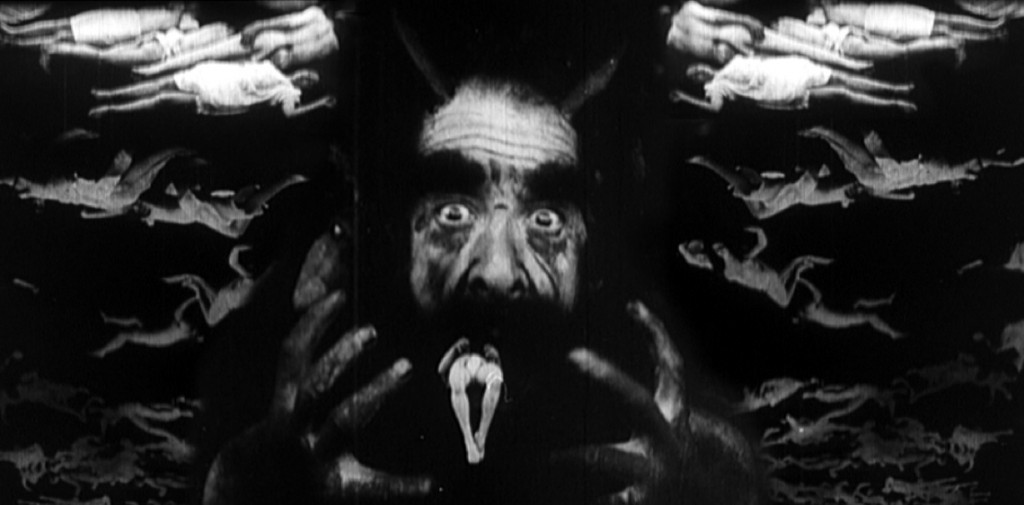
Like Griffith, the makers of L’Inferno — Francesco Bertolini, Adolfo Padovan and Giuseppe de Liguoro – sought to raise cinema to the ranks of literature and theater. Unlike Griffith, they didn’t really do much to forward the language of cinema. Throughout L’Inferno, the camera remains wide and locked down like the proscenium of a stage. Instead, they focused their efforts on creating gloriously baroque sets and costumes. Much of the film looks like it was pulled straight from Gustave Dorè’s famed illustrations of The Divine Comedy. Yet seeing a picture in a book of a demon is one thing. Seeing it leap around lashing the naked backs of the damned is something else entirely. If you were ever tempted by the sin of simony, you’ll think twice after seeing this film.
L’Inferno — now added to our collection of 1,000+ Free Movies Online — became both a critical and commercial hit worldwide, raking in over $2 million (roughly $48 million in today’s money) in the US alone. “We have never seen anything more precious and fine than those pictures. Images of hell appear in all their greatness and power,” gushed famed Italian novelist and reporter Matilde Serao when the film came out.
American film critic for The Moving Picture World, W. Stephen Bush, was even more effusive:
“I know no higher commendation of the work than mention of the fact that the film-makers have been exceedingly faithful to the words of the poet. They have followed, in letter and in spirit, his conceptions. They have sat like docile scholars at the feet of the master, conscientiously and to the best of their ability obeying every suggestion for his genius, knowing no inspiration, except such as came from the fountainhead. Great indeed has been their reward. They have made Dante intelligible to the masses. The immortal work, whose beauties until now were accessible only to a small band of scholars, has now after a sleep of more than six centuries become the property of mankind.”
Of course, the film’s combination of ghoulishness and nudity made it ripe to be co-opted by shady producers who had less that lofty motives. Scenes from L’Inferno were cut into such exploitation flicks as Hell-O-Vision (1936) and Go Down, Death! (1944).
You can watch the full movie above. Be sure to watch to the end where Satan himself can be seen devouring Brutus and Cassius.
Related Content:
Gustave Doré’s Haunting Illustrations of Dante’s Divine Comedy
A Free Course on Dante’s Divine Comedy from Yale University
Why Should We Read Dante’s Divine Comedy? An Animated Video Makes the Case
What David Lynch Can Do With a 100-Year-Old Camera and 52 Seconds of Film
Jonathan Crow is a Los Angeles-based writer and filmmaker whose work has appeared in Yahoo!, The Hollywood Reporter, and other publications. You can follow him at @jonccrow.
Read More...Watch Footage of the Allies Rolling Through a Defeated German Town in April, 1945: Restored & Colorized with AI
Early April, 1945. The Soviets are closing in on Germany, liberating Warsaw, Krakow, and Budapest. American troops have crossed the Rhine. Adolf Hitler won’t live to see May. World War II is coming to an end. This footage, taken from film by American troops in and around Nordhausen, Germany, shows the wreckage of a defeated nation. Enhanced by AI into 60fps, with color and atmospheric sound added, it’s another of YouTube’s increasing library of old footage that looks like it was shot yesterday. (Unfortunately, the video has changed the film’s ratio, widening all the humans in it.)
The original film—you can watch it here at the United States Holocaust Memorial Museum—has an interesting history itself. Shot by a member of the US Army Signal Corps, the film was kept in the National Archives and Records Administration until being unearthed by Douglas Hackney while researching his grandfather who served in the war. (Apparently he is seen in one of the other films in the original collection.) The digitization was then gifted to the Holocaust Memorial Museum.
The 60fps version is assembled from several reels. We see fighting in a forest outside Nordhausen, then a gathering of captured Nazi soldiers, then troops celebrating with freed prisoners with some shots of liquor, a bit of morning downtime, and the effects of allied bombing.
Nordhausen was the sight of the Dora-Mittelbau concentration camp, built in August of 1943 so Nazis could use its prisoners as slave labor, digging tunnels into the nearby hillside for German factories related to the V‑2 rocket program.
According to the Holocaust history website, remember.org:
On April 11th, the 104th Infantry Division entered the Dora camp and the 3rd Armored Division entered the Boelcke-Kaserne subcamp. Although members of the VII Corps had been forewarned there was a prison camp, they certainly could not have expected the inhumane atrocities they were about to witness. The dead and near-dead were everywhere, piled upon one another, and immediate medical attention was given to the few survivors. There were 3000 corpses and 750 emaciated survivors that were abandoned by the SS.
Of the 60,000 prisoners to enter the Dora-Mittelbau camps, it is estimated that 13,000–18,000 died in the camp. Common causes of death included tuberculosis, pneumonia, starvation, dysentery, and trauma.
One can hope these 60fps enhanced videos continue to be uploaded to YouTube. Personally, the colorization adds little, but as a window into time really not that long ago (and with neo-Nazis still kicking around) we need reminders of where it can all lead without our vigilance.
Related Content:
Real D‑Day Landing Footage, Enhanced & Colorized with Artificial Intelligence (June 6, 1944)
Watch the Only Known Footage of Anne Frank
Ted Mills is a freelance writer on the arts who currently hosts the Notes from the Shed podcast and is the producer of KCRW’s Curious Coast. You can also follow him on Twitter at @tedmills, and/or watch his films here.
Read More...Watch the Tate Modern Restore Mark Rothko’s Vandalized Painting, Black on Maroon: 18 Months of Work Condensed Into 17 Minutes
“The people who weep before my pictures are having the same religious experience I had when I painted them. And if you, as you say, are moved only by their color relationship, then you miss the point.” — Mark Rothko
In 2012, a Russian artist calling himself Vladimir Umanets wrote his name and the words “A potential piece of yellowism” in black marker on the corner of Mark Rothko’s 1958 canvas Black on Maroon. The damage to the painting, housed at the Tate Modern since 1970, was substantial, and it turned out to be one of the museum’s most challenging restoration projects, as well as one of its most successful — “far more successful than any of us dared hope,” said Tate director Nicholas Serota. The painting went back on display in May of 2014.
Due to Rothko’s layered technique, the painting’s “surface is really delicate and it turned out that most of the solvent systems that could dissolve and remove the ink could potentially damage the painting as well.” Patricia Smithen, the Tate’s head of conservation, told The Guardian. The video above from the museum shows the art and science that went into restoring the famous work, an eighteen-month-long process that involved some reverse engineering from a canvas donated by the Rothko family.
Black on Maroon seemed like an odd choice for a protest, as a blogger at Art History Abroad wrote the following day: “‘Why Rothko?’. His paintings [are] often criticised by those who don’t favour their abstraction, but rarely deemed politically or socially motivated to a point that they might provoke vandalism.” The presence of Black on Maroon and other Seagram Murals at the Tate, in fact, mark an act of protest by Rothko himself (who committed suicide the day the paintings arrived at the London museum).
The Seagram Murals were originally commissioned for the Four Seasons restaurant in the Seagram building in New York, designed by Mies van der Rohe and Philip Johnson. Seven paintings were commissioned, Rothko made 30. He reportedly told Harper’s editor John Fischer he wanted to create “something that will ruin the appetite of every son-of-a-bitch who ever eats in that room.” When he finally got the chance to dine at the completed restaurant, he was disgusted, withdrew his work, and returned his commission, writing, “it seemed clear to me at once that the two were not for each other.” He spent the next decade thinking about how and where to display the paintings.
Umanets did not seem to care much about the history of the murals in the Tate’s Rothko Room and claims his choice had no meaning. “I didn’t single out Rothko to make my statement,” he wrote in a public letter of apology published after he spent a year and a half in prison. “I would have done the same had the artist been Damien Hirst or Tracey Emin. It was a spontaneous decision and nothing personal.” Likewise, his Dada-esqe “Manifesto of Yellowism” outlines a program with a distinct lack of concern for specificity and a vaguely satirical desire to flatten art into one color, one purpose, one meaning.
Even as he publicly abjured his act of protest (maybe by order of the court?), Umanets also expressed a genuine concern for the future of art, “Art has become a business, which appears to serve only the needs of the art market. As a result the art world no longer has radical thinkers and polemicists willing to scythe new and different pathways. Everyone is playing safe.” He might have made his point more clearly by going after Jeff Koons. Rothko was a radical thinker, and his Seagram Murals represent a final refusal to compromise with the demands of the art market.
Related Content:
A Short Documentary on Artist Jeff Koons, Narrated by Scarlett Johansson
The MoMA Teaches You How to Paint Like Pollock, Rothko, de Kooning & Other Abstract Painters
Josh Jones is a writer and musician based in Durham, NC. Follow him at @jdmagness
Read More...Hear Bach’s Brandenburg Concertos Played on Original Baroque Instruments
“Subtle and brilliant at the same time, they are a microcosm of Baroque music, with an astonishingly vast sample of that era’s emotional universe.” — Ted Libbey
The portfolio, the demo, the head shot, the resume…. These are not materials made for general consumption, much less the praise and admiration of posterity. But not every applicant is Johann Sebastian Bach, who wrote his six Brandenburg concertos, in essence, “because, like pretty much everyone throughout history, Bach needed a job,” notes String Ovation. In 1721, he applied for a position with the Margrave of Brandenburg, younger brother of King Frederick Wilhelm I of Prussia, by sending the music: “It’s one of the few manuscripts that Bach wrote out himself, rather than give to a copyist…. At the time, Bach was the Kapellmeister in the small town of Cöthen. Working for His Royal Highness would have been a seriously upward move.”
He didn’t get the job. Indeed, it seems his application was ignored, and nearly lost several times throughout history. Now, Bach’s calling cards are some of the most virtuoso compositions of Baroque music we know. “Each concerto is a concerto grosso, a concerto that’s a continuous interplay of small groups of soloists and full orchestra…. The range of instruments with solos throughout the six concertos was designed to give opportunities to show the potential of nearly every instrument in the orchestra. Even the recorder got a solo.” The six together present themselves as an anthology of sorts, “a Baroque musical travelogue moving through ‘the courtly elegance of the French suite, the exuberance of the Italian solo concerto and the gravity of German counterpoint.’”
These pieces do not only demonstrate Bach’s compositional mastery; they also represent his “ultimate view,” as the Netherlands Bach Society points out, “of the most important large-scale instrumental genre of his day: the concerto.” In the third of these works, for example, he makes the “surprising” choice to compose for “three violins, three violas, three cellos and basso continuo. In other words, 3x3, which is a rational choice you would expect from a modernist like Pierre Boulez, rather than a Baroque composer like Bach.” In order to play these pieces the way Bach intended them to be heard, Ted Libbey writes at NPR, they must be played on the original instruments for which he composed, something a growing number of ensembles have been doing.
Voices of Music, one of the most prominent ensembles recovering the original sounds of Bach’s time, performs Concerto Number Three in G Major at the top and Concerto Number Six in B Flat just above, another surprising arrangement for the time. The final Brandenburg Concerto also upsets the musical order of things again: “Violins — usually the golden boys of the orchestra,” writes the Netherlands Bach Society, “are conspicuous by their absence! Instead, two violas play the leading role. As the highest parts, they ‘play first fiddle’ as soloists, supported by two viola da gambas, a cello, double bass and harpsichord.” The Margrave of Brandenburg, it seems had little time or interest, and never had these pieces performed by his ensemble, which may have lacked the skill and instrumentation. After hearing this music in its original glory, we can be grateful Bach’s handwritten resume survived the neglect.
Related Content:
Hear 10 of Bach’s Pieces Played on Original Baroque Instruments
Watch J.S. Bach’s “Air on the G String” Played on the Actual Instruments from His Time
Josh Jones is a writer and musician based in Durham, NC. Follow him at @jdmagness
Read More...Support Us
We're hoping to rely on loyal readers, rather than erratic ads. Please click the Donate button and support Open Culture. You can use Paypal, Venmo, Patreon, even Crypto! We thank you!

About Us

Open Culture scours the web for the best educational media. We find the free courses and audio books you need, the language lessons & educational videos you want, and plenty of enlightenment in between.
Advertise With Us
FREE UPDATES!
GET OUR DAILY EMAIL
Get the best cultural and educational resources on the web curated for you in a daily email. We never spam. Unsubscribe at any time.
FOLLOW ON SOCIAL MEDIA
Open Culture editor Dan Colman scours the web for the best educational media. He finds the free courses and audio books you need, the language lessons & movies you want, and plenty of enlightenment in between.
Advertise With Us

