Watch Artisans Make Hand-Carved Championship Chess Sets: Each Knight Takes Two Hours
Whether because of the popularity of Netflix’s The Queen’s Gambit or because of how much time indoors the past year and a half has entailed, chess has boomed lately. Luckily for those would-be chessmasters who’ve had their interest piqued, everything they need to learn the game is available free online. But the deeper one gets into any given pursuit, the greater one’s desire for concrete representations of that interest. In the case of chess players, how many, at any level, have transcended the desire for a nice board and pieces? And how many have never dreamed of owning one of the finest chess sets money can buy?
Such a set appears in the Business Insider video above. “You can pick up a plastic set for $20 dollars, but a wooden set certified for the World Chess Championship costs $500,” says its narrator. “Much of the value of a high-quality of the set comes down to how well just one piece is made: the knight.”
Properly carved by a master artisan, each knight — with its horse’s head, the only realistic piece in chess — takes about two hours. Very few are qualified for the job, and one knight carver appears in an interview to explain that it took him five or six years to learn it, as against the four or five months required to master carving the other pieces.
The workshop introduced in this video is located in Amritsar (also home to the Golden Temple and its enormous free kitchen, previously featured here in Open Culture). To those just starting to learn about chess, India may seem an unlikely place, but in fact no country has a longer history with the game. “Chess has been played for over 1,000 years, with some form of the game first appearing in India around the sixth century,” says the video’s narrator. “Over the past two centuries, high-level competitions have drawn international interest.” For most of that period, fluctuations in public enthusiasm for chess have resulted in proportionate fluctuations in the demand for chess sets, much of which is satisfied by large-scale industrial production. But the most experienced players presumably feel satisfaction only when handling a knight carved to artisanal perfection.
Related Content:
Learn How to Play Chess Online: Free Chess Lessons for Beginners, Intermediate Players & Beyond
A Brief History of Chess: An Animated Introduction to the 1,500-Year-Old Game
Man Ray Designs a Supremely Elegant, Geometric Chess Set in 1920–and It Now Gets Re-Issued
The Bauhaus Chess Set Where the Form of the Pieces Artfully Show Their Function (1922)
A Beautiful Short Documentary Takes You Inside New York City’s Last Great Chess Store
Based in Seoul, Colin Marshall writes and broadcasts on cities, language, and culture. His projects include the Substack newsletter Books on Cities, the book The Stateless City: a Walk through 21st-Century Los Angeles and the video series The City in Cinema. Follow him on Twitter at @colinmarshall or on Facebook.
Read More...Hiroshige, Master of Japanese Woodblock Prints, Creates a Guide to Making Shadow Puppets for Children (1842)
Even if the name Utagawa Hiroshige doesn’t ring a bell, “Hiroshige” by itself probably does. And on the off chance that you’ve never heard so much as his mononym, you’ve still almost certainly glimpsed one of his portrayals of Tokyo — or rather, one of his portrayals of Edo, as the Japanese capital, his hometown, was known during his lifetime. Hiroshige lived in the 19th century, the end of the classical period of ukiyo‑e, the art of woodblock-printed “pictures of the floating world.” In that time he became one of the form’s last masters, having cultivated not just a high level of artistic skill but a formidable productivity.
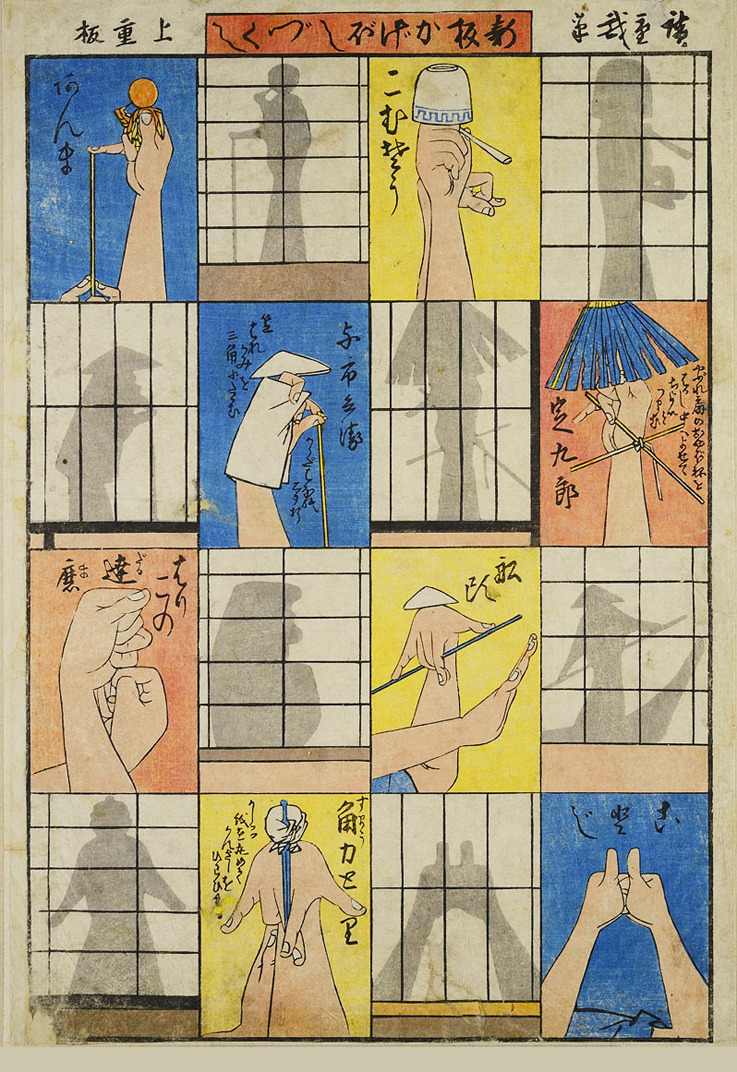
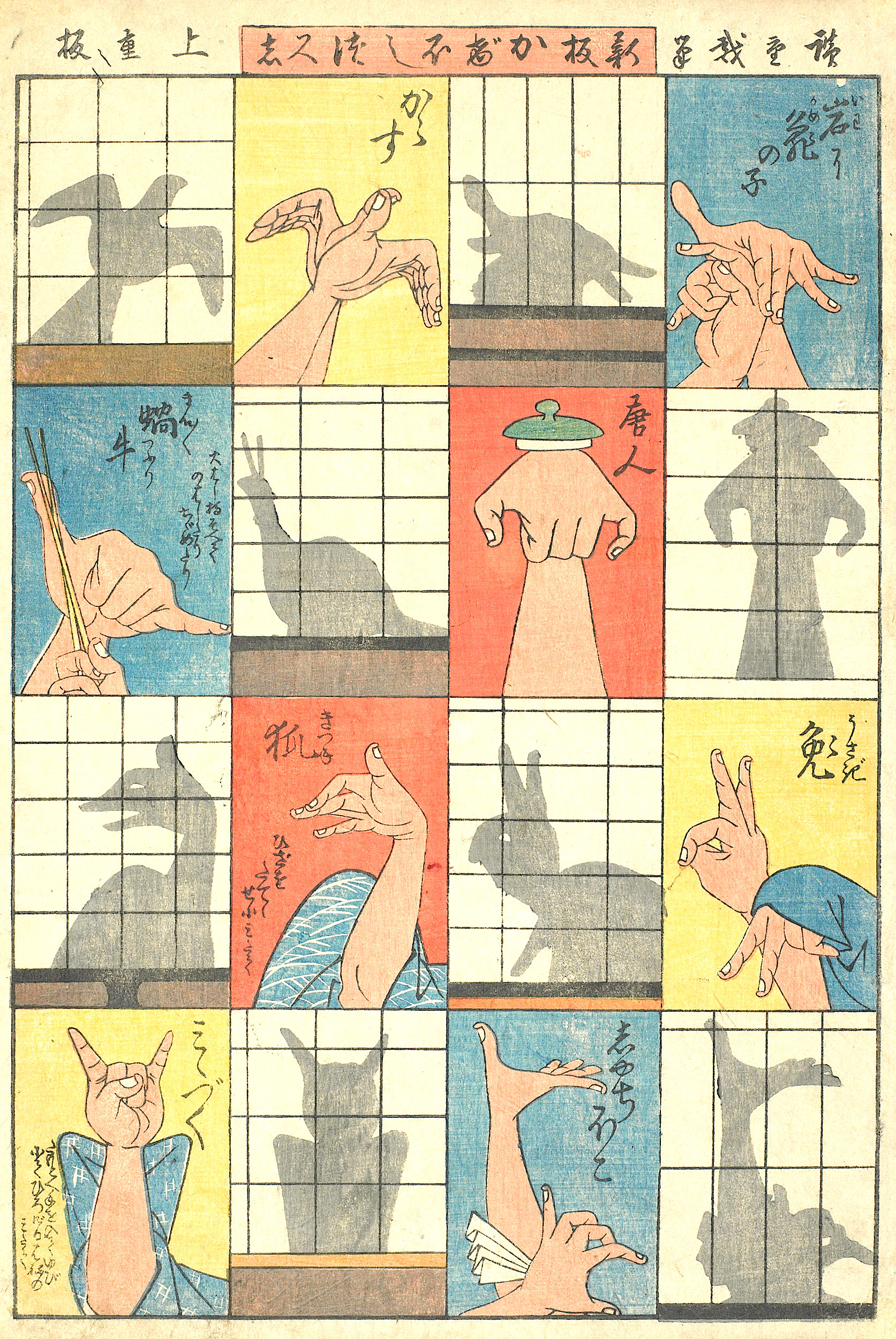
In total, Hiroshige produced more than 8,000 works. Some of those are accounted for by his well-known series of prints like The Fifty-three Stations of the Tōkaidō, The Sixty-nine Stations of the Kisokaidō, One Hundred Famous Views of Edo. But his mastery encompassed more than the urban and rural landscapes of his homeland, as evidenced by this much humbler project: a set of omocha‑e, or instructional pictures for children, explaining how to make shadow puppets.
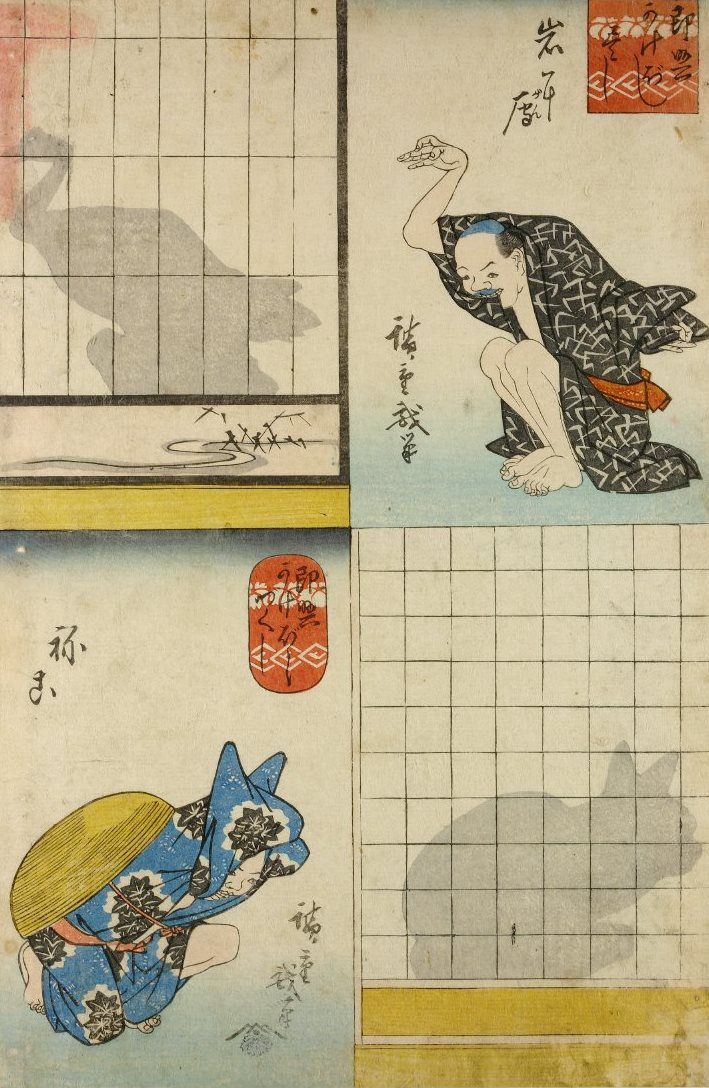
Hiroshige explains in clear and vivid images “how to twist your hands into a snail or rabbit or grasp a mat to mimic a bird perched on a branch,” writes Colossal’s Grace Ebert. “Appearing behind a translucent shoji screen, the clever figures range in difficulty from simple animals to sparring warriors and are complete with prop suggestions, written instructions for making the creatures move — ‘open your fingers within your sleeve to move the owl’s wings’ or ‘draw up your knee for the fox’s back’ — and guides for full-body contortions.” The difficulty curve does seem to rise rather sharply, beginning with puppets requiring little more than one’s hands and ending with full-body performances surely intended more for amusement than imitation.
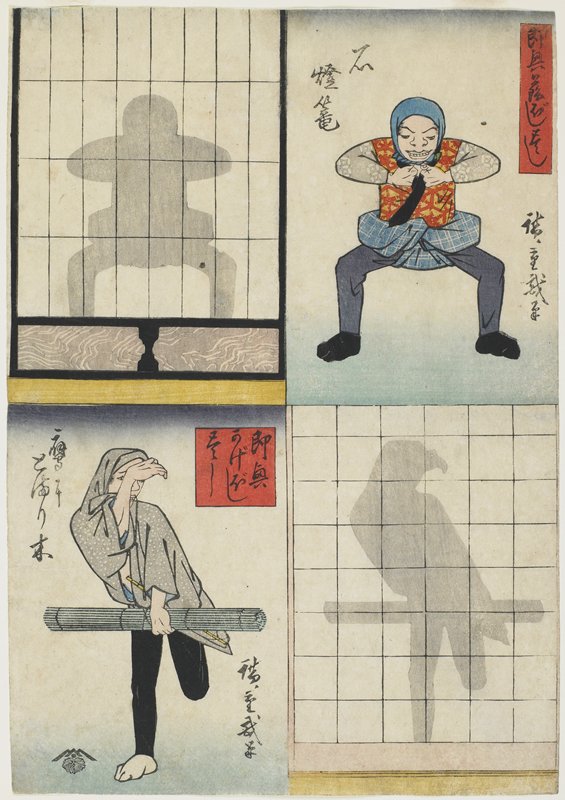
But then, kids take their fun wherever they find it, whether in 2021 or in 1842, when these images were originally published. Though it was a fairly late date in the life of Hiroshige, at that time modern Japan hadn’t even begun to emerge. The children who entertained themselves with his shadow puppets against the shoji screens of their homes would have come of age with the arrival of United States Commodore Matthew C. Perry’s “black ships,” which began the long-closed Japan’s process of re-opening itself to world trade — and set off a whirlwind of civilizational transformation that, well over a century and a half later, has yet to settle down.
Related Content:
Wagashi: Peruse a Digitized, Centuries-Old Catalogue of Traditional Japanese Candies
Jim Henson Teaches You How to Make Puppets in Vintage Primer From 1969
Based in Seoul, Colin Marshall writes and broadcasts on cities, language, and culture. His projects include the Substack newsletter Books on Cities, the book The Stateless City: a Walk through 21st-Century Los Angeles and the video series The City in Cinema. Follow him on Twitter at @colinmarshall or on Facebook.
Read More...Why Finland & Denmark Are Happier Than the United States
We may never convince the greediest among us that money won’t buy happiness. But if we weren’t persuaded before the pandemic, it seems more of us are now, since thousands of workers refuse to return to exploitative conditions. “The Covid job market,” the Harvard Business Review admits, “is not like 2008, nor really like anything anyone has observed since the birth of modern capitalism.” This observation comes amidst a discussion of the factors influencing hiring, but most economist-speak avoids the emotional language we use to talk about our jobs.
The fact is, most of us are stressed out, unhappy, overworked, and underpaid, with little in terms of public policy or corporate benefits to help reduce the burdens on the average American worker. It’s far worse for other workers around the world. “The average US workweek is 38.6 hours,” notes Business Insider. “That may feel like forever to some people, but it’s nothing compared to some countries’ workweeks.” Workers in Colombia, for example, spend an average of 47.7 hours at work.
Much of that time could be spent caring for ourselves and our families, and lockdowns, quarantines, shelter-in-place and work-from-home orders have given us time to reconsider how we’ve been living. As we do, we might look to Finland and Denmark, where people profess some of the highest rates of happiness in the world, according to the most recent World Happiness Report, a series of measures co-created by Jeffrey Sachs, Director of Columbia University’s Center for Sustainable Development.
“In a lamentable year,” the report points out, “Finland again is the happiest country in the world.” Denmark isn’t far behind. What does this mean? “It’s not primarily a measure of whether one laughed or smiled yesterday,” says Sachs, “but how one feels about the course of one’s life.” This feeling is measured according to “six areas of life satisfaction,” CNBC notes in an introduction to the video above — a short documentary on Finnish and Danish happiness — including “income, healthy life expectancy, social support, freedom, trust and generosity.”
“We need urgently to learn from Covid-19,” says Sachs. “The pandemic reminds us of our global environmental threats, the urgent need to cooperate, and the difficulties of achieving cooperation in each country and globally. The World Happiness Report 2021 reminds us that we must aim for wellbeing rather than mere wealth, which will be fleeting indeed if we don’t do a much better job of addressing the challenges of sustainable development.” Learn what makes the Finns and Danes so happy in the video above (spoiler: it isn’t exorbitant salaries) and learn more about why people in the “happiest” countries thrive at the World Happiness Report.
Related Content:
How Much Money Do You Need to Be Happy? A New Study Gives Us Some Exact Figures
The Keys to Happiness: The Emerging Science and the Upcoming MOOC by Raj Raghunathan
Josh Jones is a writer and musician based in Durham, NC. Follow him at @jdmagness
Read More...Storytelling and Race in Captain America — Pretty Much Pop: A Culture Podcast #98

What is it for a super-hero to represent America? Though the character created by Joe Simon and Jack Kirby in 1941 may have been a way to capitalize on WWII patriotism, it has since been used to ask questions about what it really means to be patriotic and how America’s ideals and its reality may conflict. We’re of course talking about race, a theme explored by Sam Wilson, formerly Cap’s side-kick, picking up the shield in the comics and now on TV (and in the forthcoming film).
Your Pretty Much Pop hosts Mark Linsenmayer, Erica, and Brian are joined by comic super-fan Anthony LeBlanc (returning from our ep. 56 on black nerds) to discuss the recent comic runs by Ta-Nehishi Coates and Nick Spencer and especially Truth: Red, White and Black, Marvel’s 2003 comics mini-series by Robert Morales and Kyle Baker that tells the story of American super-soldier experiments on unknowing black men (reminiscent of the real-life Tuskegee Syphilis Study). This was the source of the “first black Captain America” character Isaiah Bradley featured in The Falcon and the Winter Soldier Disney+ show, which we also discuss.
Here are a few articles that fed into our discussion:
- “The Power of a Skeptical Captain America” by Sophie Gilbert
- “‘The Falcon and the Winter Soldier’ Never Took Its Protagonist Seriously” by Justin Charity
- “‘The Falcon and the Winter Soldier’ Was Riddled With Contradictions” by Alison Herman
- “When Sam Wilson Became Captain America” by Brittany Matter
- “Why I’m Writing Captain America, and Why It Scares the Hell out of Me” by Ta-Nehishi Coates
- “My Secret History With Secret Empire: Looking Back At Nick Spencer’s Captain America” by Vishal Gullapalli
- “Secret Empire Creators Preview Captain America’s Assault on the Marvel Universe” by Christian Holub
- “Captain America Goes to War With Jordan Peterson” by Matthew Gault
- “Black Panther Writer Criticizes Marvel’s Treatment of Comic Creators” by Robert Wood
The final issue of Ta-Nehisi Coates’ Captain America is coming July 7.
We recommend the Captain America Comic Book Fans podcast for more information. Their recent interview with longtime editor Tom Brevoort was illuminating, and they spent eps. 33 and 34 walking through Truth: Red, White & Black.
Hear more of this podcast at prettymuchpop.com. This episode includes bonus discussion that you can access by supporting the podcast at patreon.com/prettymuchpop. This podcast is part of the Partially Examined Life podcast network.
Pretty Much Pop: A Culture Podcast is the first podcast curated by Open Culture. Browse all Pretty Much Pop posts.
Read More...How Ramen Became the Currency of Choice in Prison, Beating Out Cigarettes
The last decade ushered in a slew of traditional Japanese-style ramen restaurants — enough to justify ramen maps to New York City, Chicago, and the Bay Area.
Yet most Americans still conceive of ramen as the pack of seasoning and dehydrated instant noodles that have long sustained broke artists and college students.
Add incarcerated persons to the list of packaged ramen’s most ardent consumers.
In the above episode of Vox’s series, The Goods, we learn how those ubiquitous cellophane packages have outstripped cigarettes and postage stamps as the preferred form of prison currency.
Ramen is durable, portable, packaged in standard units, available in the prison commissary, and highly prized by those with a deep need to pad their chow hall meals.
Ramen can be used to pay for clothing and hygiene products, or services like laundry, bunk cleaning, dictation, or custom illustration. Gamblers can use it in lieu of chips.
Ramen’s status as the preferred form of exchange also speaks to a sharp decline in the quantity and quality of food in American penal institutions.
Ethnographer Michael Gibson-Light, who spent a year studying homegrown monetary practices among incarcerated populations, notes that slashed prison budgets have created a culture of “punitive frugality.”
Called upon to model a demonstrably tough on crime stance and cut back on expenditures, the institutions are unofficially shunting many of their traditional costs onto the prisoners themselves.
In response, those on the inside have pivoted to edible currency:
What we are seeing is a collective response — across inmate populations and security levels, across prison cliques and racial groups, and even across states — to changes and cutbacks in prison food services…The form of money is not something that changes often or easily, even in the prison underground economy; it takes a major issue or shock to initiate such a change. The use of cigarettes as money in U.S. prisons happened in American Civil War military prisons and likely far earlier. The fact that this practice has suddenly changed has potentially serious implications.
Ramen may be a relatively new development in the prison landscape, but culinary experimentation behind bars is not. From Pruno prison wine to Martha Stewart’s prison grounds crabapple jelly, it’s a nothing ventured, nothing gained type of deal. Work with what you’ve got.
Gustavo “Goose” Alvarez, who appears in Vox’s video, collected a number of the most adventurous recipes in his book, Prison Ramen: Recipes and Stories from Behind Bars. Anyone can bring some variety on the spur of the moment by sprinkling some of your ramen’s seasoning packet into your drinking water, but amassing the ingredients for an ambitious dish like Orange Porkies — chili ramen plus white rice plus ½ bag of pork skins plus orange-flavored punch — takes patience and perseverance.
Alvarez’s Egg Ramen Salad Sandwich recipe earns praise from actor Shia LeBoeuf, whose time served is both multiple and minimal.

Someone serving a longer sentence has a more compelling reason to search for the ramen-centered sense of harmony and wellbeing on display in Tampopo, the first “ramen western”:
Appreciate its gestalt. Savor the aromas.
Joe Guerrero, host of YouTube’s AfterPrisonShow, is not immune to the pleasures of some of his ramen-based concoctions, below, despite being on the outside for several years now.
You’re free to wrinkle your nose at the thought of snacking on a crumbled brick of uncooked ramen, but Guerrero points out that someone serving a long sentence craves variety in any form they can get. Experiencing it can tap into the same sense of pride as self-governance.
Guerrero’s recipes require a microwave (and a block of ramen).
Even if you’re not particularly keen on eating the finished product, there’s a science project appeal to his Ramen Noodle Cookie. It calls for no additional ingredients, just ten minutes cooking time, an outrageous prospect in a communal setting with only one microwave.
Related Content:
The Proper Way to Eat Ramen: A Meditation from the Classic Japanese Comedy Tampopo (1985)
What Goes Into Ramen Noodles, and What Happens When Ramen Noodles Go Into You
Japanese Animation Director Hayao Miyazaki Shows Us How to Make Instant Ramen
Ayun Halliday is an author, illustrator, theater maker and Chief Primatologist of the East Village Inky zine. Follow her @AyunHalliday.
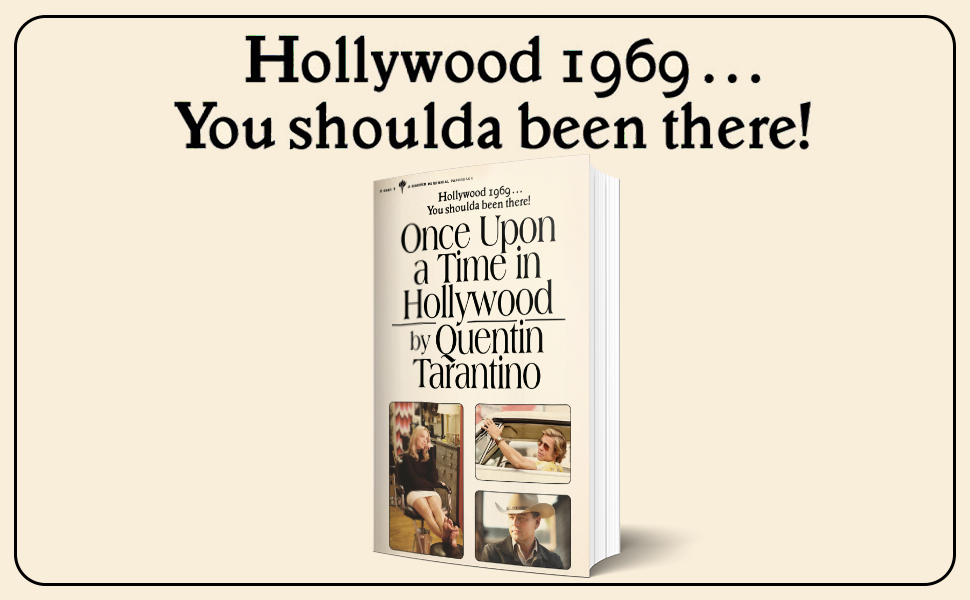
Read More...Quentin Tarantino Releases His First Novel: A Pulpy Novelization of Once Upon a Time in Hollywood
There’s no business like show business. Or maybe — as Bart Simpson once wrote on the blackboard — “there are plenty of businesses like show business.”
Quentin Tarantino’s ninth film, 2019’s Once Upon a Time in Hollywood, follows aging TV star, Rick Dalton, being pushed into playing villainous character roles. Drunk and depressed, Dalton and his sidekick/hanger-on/stunt double Cliff Booth watch reruns of his show and get into a series of increasingly serious scrapes as the actor searches for a role that will redeem him. The film’s outline–shorn of historical references that made critics lionize it as “a love letter to old Hollywood”–sounds suspiciously like another media property in the middle of its final season that summer.
Called a Mad Men replacement, Netflix’s satirical adult cartoon series Bojack Horseman also follows an aging former TV star and his sidekicks/hanger(s)-on through their misadventures in Hollywood (“Hollywoo”). Along the way they confront issues that fall under the rubric of “toxic masculinity,” such as workplace harassment, emotional immaturity, and the abuse of power in an industry with wildly unequal power dynamics. The show makes clear that neither old, nor new, Hollywood deserves a love letter — no more than other industries that allow such behavior. (It also features a caricature of Tarantino.)
Once Upon a Time in Hollywood, by contrast, celebrates the old star system and its privileges — or so Richard Brody argues at The New Yorker — in an “obscenely regressive vision of the 60s” that scrubs the decade of its protests and brutal crackdowns. The premise underlying Tarantino’s alternate-history dramedy seems to be: “If only the old-line Hollywood people of the fifties and sixties had maintained their pride of place—if only the times hadn’t changed, if only the keys to the kingdom hadn’t been handed over to the freethinkers and decadents of the sixties—then both Hollywood and the world would be a better, safer, happier place.”
Tarantino sets up “hippies,” a favorite pejorative of his characters, as fall guys for the Manson Family murders, rather than Manson’s own white supremacist beliefs. As many critics noted at the time, “the only substantial character of color, Bruce Lee (Mike Moh), is played… as a haughty parody” who gets “dramatically humiliated” by Pitt’s swashbuckling stuntman — who is rumored to have murdered his wife and who dispatches the film’s female Manson cult villains with the sadistic glee of a true psychopath, a scene, Brody writes, “that only hammers [Tarantino’s] doctrine home.”
Celebration there may be in the film, but there is also mourning. Christopher Hooten at Little White Lies scoffs at the “love letter” idea and sees the film instead as a lament for the end of cinema’s “freethinkers”:
This is Tarantino’s passion project – potentially his last film – and it comes across as him trying to sneak out a movie with a ’70s sensibility and tone before it’s no longer possible. Once the likes of Tarantino and Martin Scorsese have bowed out, that might well be it for auteur-driven filmmaking on a blockbuster scale. We’ve reached a polarisation in the industry where a director either works as a hired (and frequently fired) gun for a Disney or a Warner Bros, or else goes cap in hand in the hope of scraping together a few million dollars to make something more personal and unique.
The Tarantinos of the world might be a dying breed, but Tarantino isn’t leaving his art behind so much as turning his hand to “more personal and unique” projects – in this case a novel, and more specifically, “the pulpiest of pulp fiction — the novelization,” writes Peter Bradshaw at The Guardian. Once Upon a Time in Hollywood: A Novel finds him “cranking up the backstories, mulching up reality and alt.reality pastiche, ladling in new episodes,” and flexing his formidable strengths as a writer of crackling dialogue and action. The book also promises an ending viewers of the film won’t see coming.
The novel explores the inner lives of its female characters, including, of course, Sharon Tate “and the fictional child actor Trudi Fraser,” and adds an even darker edge to Cliff Booth, who is said to admire a certain character despite or because he is “unconsciously racist, consciously misogynistic.” This is Tarantino, after all, none of whose characters are ever shining examples of virtue. But in the post-auteur, post-Weinstein future, he seems to suggest, maybe old-Hollywood anti-heroes like Cliff Booth and Leonardo DiCaprio’s washed-up star Rick Dalton will only shine on streaming TV shows and in the pages of throwback pulp novels, “packaged like those New English Library paperbacks that used to be on carousel displays in supermarkets and drugstores.” You can pick up a copy of Once Upon a Time in Hollywood: A Novel here.
Related Content:
Quentin Tarantino Explains How to Write & Direct Movies
An Analysis of Quentin Tarantino’s Films Narrated (Mostly) by Quentin Tarantino
Josh Jones is a writer and musician based in Durham, NC. Follow him at @jdmagness
Read More...Moralities of Everyday Life: A Free Online Course from Yale University
How can we explain kindness and cruelty? Where does our sense of right and wrong come from? Why do people so often disagree about moral issues? This course from Yale University, Moralities of Everyday Life, explores the psychological foundations of our moral lives. Taught by psychology & cognitive science professor Paul Bloom, the course focuses on the origins of morality, compassion, how culture/religion influence moral thought and moral action, and beyond. If you select the “Audit” option, you can take the course for free.
Moralities of Everyday Life will be added to our collection of Free Psychology Courses, a subset of our larger collection, 1,700 Free Online Courses from Top Universities.
If you would like to support the mission of Open Culture, consider making a donation to our site. It’s hard to rely 100% on ads, and your contributions will help us continue providing the best free cultural and educational materials to learners everywhere. You can contribute through PayPal, Patreon, and Venmo (@openculture). Thanks!
Related Content:
Introduction to Psychology: A Free Course from Yale University
Positive Psychology: A Free Online Course from Harvard University
A Crash Course on Psychology: A 30-Part Video Series from Hank Green
Read More...The Conspiracy Behind the Iconic Statue, the Venus de Milo
The Venus de Milo is one of art’s most widely recognized female forms.
The Mona Lisa may be the first stop on many Louvre visitors’ agendas, but Venus, by virtue of being unclothed, sculptural, and prominently displayed, lends herself beautifully to all manner of souvenirs, both respectful and profane.
Delacroix, Magritte, Dali, and The Simpsons have all paid tribute, ensuring her continued renown.
Renoir is that rare bird who was impervious to her 6’7” charms, describing her as the “big gendarme.” His own Venus, sculpted with the help of an assistant nearly 100 years after the Venus de Milo joined the Louvre’s collection, appears much meatier throughout the hip and thigh region. Her celebrity cannot hold a candle to that of her armless sister.
In the Vox Almanac episode above, host Phil Edwards delves into the Venus de Milo’s appeal, taking a less delirious approach than sculptor Auguste Rodin, who rhapsodized:
…thou, thou art alive, and thy thoughts are the thoughts of a woman, not of some strange, superior being, artificial and imaginary. Thou art made of truth alone, outside of which there is neither strength nor beauty. It is thy sincerity to nature which makes thee all powerful, because nature appeals to all men. Thou art the familiar companion, the woman that each believes he knows, but that no man has ever understood, the wisest not more than the simple. Who understands the trees? Who can comprehend the light?
Edwards opts instead for a Sharpie and a tiny 3‑D printed model, which he marks up like a plastic surgeon, drawing viewers’ attention to the missing bits.
The arms, we know.
Also her earlobes, most likely removed by looters eager to make off with her jewelry.
One of her massive marble feet (a man’s size 15) is missing.
And so is a portion of the plinth on which she once stood.
Interestingly, the plinth was among the items discovered by accident on the Greek island of Milos in 1820, along with two pillars topped with busts of Hercules and Hermes, the bisected Venus, and assorted marble fragments, including — maybe — an upper arm and hand holding a round object (a golden apple, mayhaps?)
Edwards doesn’t delve into the conflicting accounts surrounding the wheres and whys of this discovery. Nor does he go into the complications of the sculpture’s acquisition, and how it very nearly wound up on a ship bound for Constantinople.
What he’s most interested in is that plinth, which would have given the lie to the long-standing assertion that the Venus de Milo was created in the Classical era.
This incorrect designation made the Louvre’s newest resident a most welcome replacement for the loot France had been compelled to return to the Vatican in the wake of Napoleon’s first abdication.
The plinth may have been “lost” under mysterious circumstances, but its inscription was preserved in a sketch by A. Debay, whose father had been a student of Jacques-Louis David, Napoleon’s now-banished First Painter, a Neo-Classicist.
(David’s final painting, Mars Disarmed by Venus and the Three Graces, completed a couple of years after Venus de Milo was installed in the Louvre, was considered a bust.)
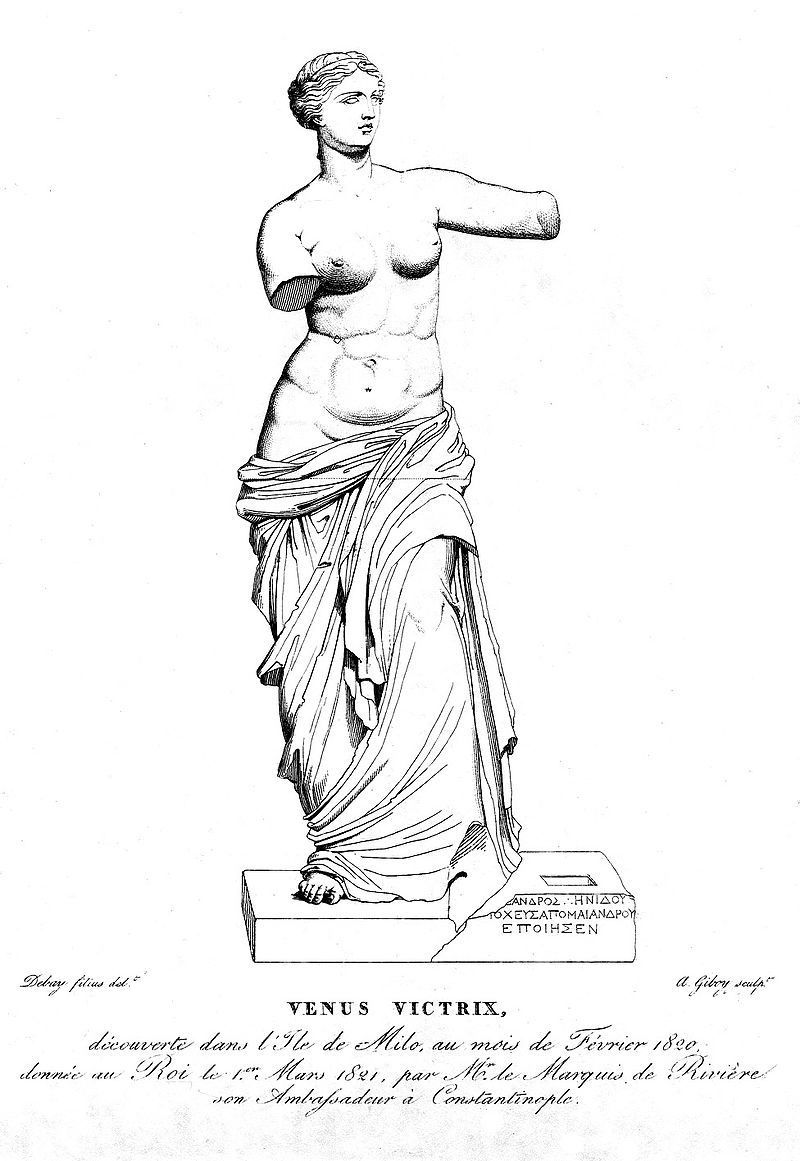
Debay’s faithful recreation of the plinth’s inscription as part of his study of the Venus de Milo offers clues as to her creator — “ …andros son of …enides citizen of …ioch at Meander made.”
It also dates her creation to 150–50 BCE, corroborating notes French naval officer Jules d’Urville had made in Greece weeks after the discovery.
The birth of this Venus should have been attributed to the Hellenistic, not Classical period.
This would have been problematic for both France and the Louvre, as art historian Jane Ursula Harris writes in The Believer:
Had her true author been known, she likely would’ve been locked away in the museum’s archive, if not sold off. Hellenistic art had by then been denigrated by Renaissance scholars who re-conceived it in anti-classical terms, finding in its expressive, experimental form and emotional content a provocative realism that defied everything their era stood for: modesty, intellect, and equanimity…It helped that the Venus de Milo possessed several classical attributes. Her strong profile, short upper lip, and smooth features, for example, were in keeping with Classical figural conventions, as was the continuous line connecting her nose and forehead. The partially-draped figure with its attenuated silhouette – which the Regency fashion of the day imitated with its empire bust-line – also recalled classical sculptures of Aphrodite, and her Roman counterpart, Venus. Yet despite all these classical identifiers, the Venus de Milo flaunted a definitive Hellenistic influence in her provocatively low-slung drapery, high waist line, and curve-enhancing contrapposto—far more sensual and exaggerated than classical ideals allowed.
It took the Louvre over a hundred years to come clean as to its star sculpture’s true provenance.
What happened to the plinth remains anyone’s guess.
The only mystery the museum’s website seems concerned with is one of identity — is she Aphrodite, goddess of beauty, or Poseidon’s wife, Amphitrite, the sea goddess worshipped on the island on which she was discovered?
For a deeper dive into the Venus de Milo’s complicated journey to the Louvre, we recommend Rachel Kousser’s article, “Creating the Past: The Venus de Milo and the Hellenistic Reception of Classical Greece,” which can be downloaded free here. Or do as Vox’s Edwards suggests and 3‑D print a tiny Venus de Milo in a decidedly non-Classical color using MyMiniFactory’s free pattern.
Related Content:
The Making of a Marble Sculpture: See Every Stage of the Process, from the Quarry to the Studio
Ayun Halliday is an author, illustrator, theater maker and Chief Primatologist of the East Village Inky zine. Follow her @AyunHalliday.
Read More...Haruki Murakami’s Daily Routine: Up at 4:00 a.m., 5–6 Hours of Writing, Then a 10K Run
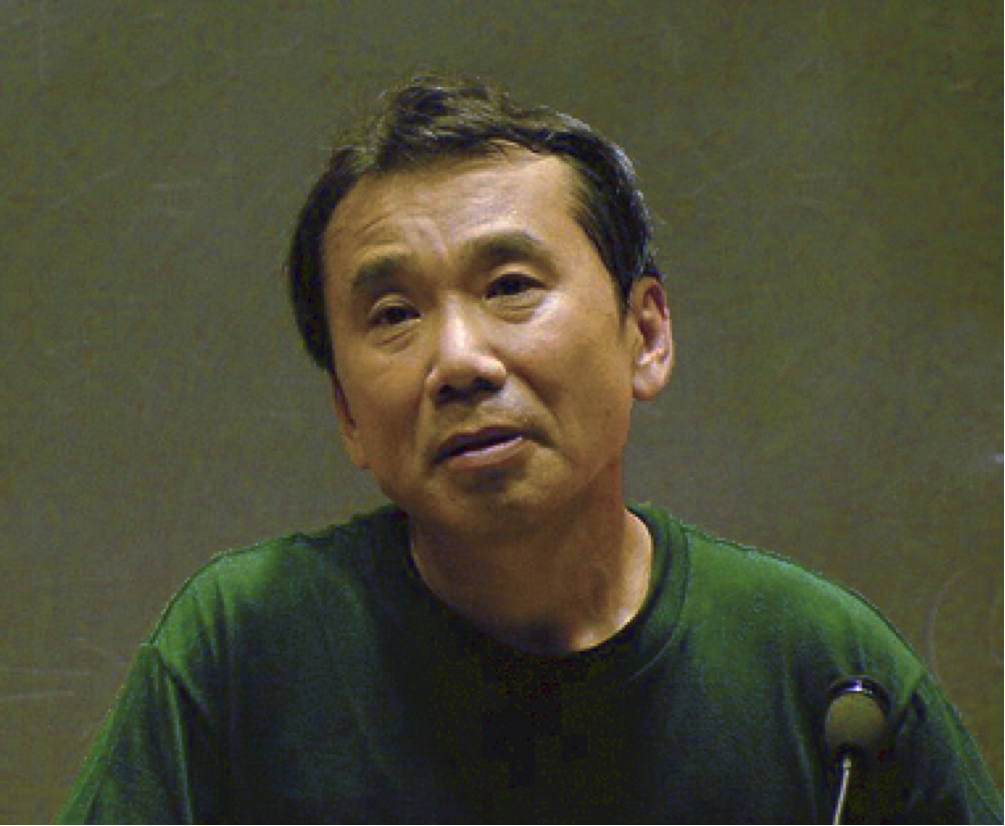
Photo via Wikimedia Commons
Haruki Murakami has been famous as a novelist since the 1980s. But for a decade or two now, he’s become increasingly well known around the world as a novelist who runs. The English-speaking world’s awareness of Murakami’s roadwork habit goes back at least as far as 2004, when the Paris Review published an Art of Fiction interview with him. Asked by interviewer John Ray to describe the structure of his typical workday, Murakami replied as follows:
When I’m in writing mode for a novel, I get up at four a.m. and work for five to six hours. In the afternoon, I run for ten kilometers or swim for fifteen hundred meters (or do both), then I read a bit and listen to some music. I go to bed at nine p.m. I keep to this routine every day without variation. The repetition itself becomes the important thing; it’s a form of mesmerism. I mesmerize myself to reach a deeper state of mind. But to hold to such repetition for so long — six months to a year — requires a good amount of mental and physical strength. In that sense, writing a long novel is like survival training. Physical strength is as necessary as artistic sensitivity.
This stark physical departure from the popular notion of literary work drew attention. Truer to writerly stereotype was the Murakami of the early 1980s, when he turned pro as a novelist after closing the jazz bar he’d owned in Tokyo. “Once I was sitting at a desk writing all day I started putting on the pounds,” he remembers in The New Yorker. “I was also smoking too much — sixty cigarettes a day. My fingers were yellow, and my body reeked of smoke.” Aware that something had to change, Murakami performed an experiment on himself: “I decided to start running every day because I wanted to see what would happen. I think life is a kind of laboratory where you can try anything. And in the end I think it was good for me, because I became tough.”
Adherence to such a lifestyle, as Murakami tells it, has enabled him to write all his novels since, including hits like Norwegian Wood, The Wind-Up Bird Chronicle, and Kafka on the Shore. (On some level, it also reflects his protagonists’ tendency to make transformative leaps from one version of reality into another.) Its rigor has surely contributed to the discipline necessary for the rest of his output as well: translation into his native Japanese of works including The Great Gatsby, but also large quantities of first-person writing on his own interests and everyday life. Protective of his reputation in English, Murakami has allowed almost none of the latter to be published in this language.
But in light of the voracious consumption of self-improvement literature in the English-speaking world, and especially in America, translation of his memoir What I Talk About When I Talk About Running must have been an irresistible proposition. “I’ve never recommended running to others,” Murakami writes in The New Yorker piece, which is drawn from the book. “If someone has an interest in long-distance running, he’ll start running on his own. If he’s not interested in it, no amount of persuasion will make any difference.” For some, Murakami’s example has been enough: take the writer-vlogger Mel Torrefranca, who documented her attempt to follow his example for a week. For her, a week was enough; for Murakami, who’s been running-while-writing for nearly forty years now, there could be no other way.
Related Content:
Haruki Murakami Lists the Three Essential Qualities For All Serious Novelists (And Runners)
The Daily Habits of Famous Writers: Franz Kafka, Haruki Murakami, Stephen King & More
Haruki Murakami Translates The Great Gatsby, the Novel That Influenced Him Most
Haruki Murakami’s Passion for Jazz: Discover the Novelist’s Jazz Playlist, Jazz Essay & Jazz Bar
Read 12 Stories By Haruki Murakami Free Online
Based in Seoul, Colin Marshall writes and broadcasts on cities, language, and culture. His projects include the Substack newsletter Books on Cities, the book The Stateless City: a Walk through 21st-Century Los Angeles and the video series The City in Cinema. Follow him on Twitter at @colinmarshall or on Facebook.
Read More...Support Us
We're hoping to rely on loyal readers, rather than erratic ads. Please click the Donate button and support Open Culture. You can use Paypal, Venmo, Patreon, even Crypto! We thank you!

About Us

Open Culture scours the web for the best educational media. We find the free courses and audio books you need, the language lessons & educational videos you want, and plenty of enlightenment in between.
Advertise With Us
FREE UPDATES!
GET OUR DAILY EMAIL
Get the best cultural and educational resources on the web curated for you in a daily email. We never spam. Unsubscribe at any time.
FOLLOW ON SOCIAL MEDIA
Open Culture editor Dan Colman scours the web for the best educational media. He finds the free courses and audio books you need, the language lessons & movies you want, and plenty of enlightenment in between.
Advertise With Us


