Alfred Hitchcock Explains the Difference Between Suspense & Surprise: Give the Audience Some Information & Leave the Rest to Their Imagination
The Hitchcockian mode of filmmaking involves the maximum use of suspense to keep viewers in a heightened state of anxiety. “There is no terror in the bang, only in the anticipation of it,” Hitchcock himself once said. How did he create suspense? In the interview clip above from 1973, Hitchcock explains how his films “convey visually certain elements in storytelling that transfers itself to the mind of the audience, whereas other films make visual statements, so that the audience becomes a spectator.” Turning audiences into spectators, he says, accounts for the excesses of blood and gore onscreen in horror films: “there’s no subtlety.” The critique goes beyond squeamishness. In Hitchcock, spectacles are secondary, at best, to information.
Visual information also takes precedence over exposition or narrative coherence in Hitchcock’s creation of suspense. “The open-palmed hand reaching for the door, the simulated fall down the staircase, the whorling retreat of the camera from a dead woman’s face,” Samuel Medina writes at Metropolis. “These stark snippets imbue the films with their uncanny allure and imprint themselves in the mind of the spectator much more effectively than any of the master’s convoluted plots.”
Hitchcock does not deploy images to shock, he says, but to make the audience complicit in the construction of the film. “I prefer to suggest something and let the audience figure it out,” he says. “The big difference between suspense and shock or surprise is that in order to get suspense, you provide the audience with a certain amount of information and leave the rest of it to their own imagination.”
Hitchcock’s preferred techniques of conveying information often rely on what feminist scholar and filmmaker Laura Mulvey famously called “the male gaze” in her 1975 essay “Visual Pleasure and Narrative Cinema.” She revised and softened her critique in a recent collection, writing, for example, that Vertigo arrived at a time of “melancholic liberation” for the Hollywood studio system, “as the professional world of the masters faced its own end.” Hitchcock might have striven for relevance by trying to revive his heyday. Instead, he returned to the cinematic language with which he’d begun his career in the 1920s as a set designer for silent German Expressionist films.
Like Rear Window, another of the director’s vehicles built around a male character’s obsessive surveillance of women, Vertigo both enacts and subverts its subject. “On one level,” Koraljka Suton writes at Cinephilia and Beyond, the film is “about the factuality of the unrelenting male gaze that dominates and dictates both our shared collective reality…. But it should also be viewed as a clever deconstruction of it.” What does Hitchcock’s use, and subversion, of the voyeuristic male gaze have to do with suspense? The two are perhaps inseparable in Hitchcockian cinema.
In an earlier, 1970, interview, the director offered another distinction: “Mystery is when the spectator knows less than the characters in the movie. Suspense is when the spectator knows more than the characters” — usually because they have been spying on the characters. Such illicit knowledge reverses the gaze. Neither able to remain aloof nor stop the horrors they see coming, “the audience is made aware of itself as audience,” writes Popmatters, “and they are forced to wonder at their own existence as spectacle.” Or as Hitchcock put it in his inimitable way, “Give them pleasure. The same pleasure they have when they wake up from a nightmare.”
Related Content:
How Edward Hopper’s Paintings Inspired the Creepy Suspense of Alfred Hitchcock’s Rear Window
Andy Warhol Interviews Alfred Hitchcock (1974)
Josh Jones is a writer and musician based in Durham, NC. Follow him at @jdmagness
Read More...Vincent Van Gogh’s “The Starry Night”: Why It’s a Great Painting in 15 Minutes
I had always wanted to see Van Gogh’s “The Starry Night” in person and many years ago I got a chance when I visited the Museum of Modern Art in New York. However, two dozen other people, who also wanted that chance, were there too, and my vision of Van Gogh’s masterpiece was one behind a phalanx of cell phones all trying to grab a “been there, done that” pic. Fortunately, the video above from the Great Art Explained YouTube channel takes you closer to the painting that an in-person viewing could without setting off an alarm. In 15 minutes, narrator/creator James Payne lays out the history, the creation, and the technique of “Starry Night” in great detail.
Some of the key takeaways from the video include:
1. A re-evaluation of asylums in the 19th century. While certainly many asylums for those with mental illness were despairing places, not so the small one in Saint-Rémy, in Provence. Though there were bars on the windows, Van Gogh’s views were of lush countryside and the small town nearby; views that would soon become the subject of his paintings. And the doctors realized that painting, and the freedom to work on his art, was the best thing for Van Gogh’s mental health. During his one-year stay at the asylum, he finished at least 150 paintings. “The Starry Night,” painted on June 18, 1889, was one of them.
But there were many masterpieces before that, including “Irises,” painted in the asylum’s walled garden before lunch one day; and many of the surrounding countryside once doctors decided he was safe to be let out alone.
2. The formative effect of Impressionism and Japanese ukiyo‑e on his work. From Monet and others, Van Gogh took the attention to natural light, the visible brushstrokes, and the pointillist coloring that would form new colors in the viewer’s eye. From the Japanese he took bold, bright colors and radical composition.
We can pinpoint the exact time and date of “Starry Night” and see what Van Gogh saw from his window (thanks to Griffith Park Observatory). And what we learn is…the man was an artist. He collaged the best bits of what he wanted us to see, from constellation and planets, to the village below (taken from a different viewpoint), to the cypress tree, which he brought forward in the composition. Van Gogh was taking a cue from Paul Gauguin, who encouraged him to use his imagination more, and finding the asylum led to a more active and more critical way of thinking about painting.
3. The “unappreciated-in-his-lifetime” myth. Yes, Van Gogh died too young. But no, he wasn’t an obscure artist. As Payne sends us off, he points out that Van Gogh was very much a part of the impressionist art scene, showed his paintings *and* sold them, and even had critics write about him. So, it might be better to call him a rising star, snuffed out too early. We can only wonder where he would have gone in his art, and what he would have created.
Related content:
In a Brilliant Light: Van Gogh in Arles–A Free Documentary
Ted Mills is a freelance writer on the arts who currently hosts the Notes from the Shed podcast and is the producer of KCRW’s Curious Coast. You can also follow him on Twitter at @tedmills, and/or watch his films here.
Read More...Klaus Kinski Has a Tantrum on the Set of Werner Herzog’s Fitzcarraldo
Ford and Wayne, Hitchcock and Stewart, Truffaut and Léaud, Scorsese and De Niro: these are just a few of film history’s most beloved collaborations between a director and an actor who never threatened to murder one another. If we remove that qualifier, however, the list lengthens to include the work of Werner Herzog and Klaus Kinski. Between the early 1970s and the late 1980s, Herzog directed Kinski in Aguirre, the Wrath of God, Nosferatu the Vampyre, Woyzeck, Fitzcarraldo, and Cobra Verde — to the extent, in any case, that the volatile Kinski was directable at all. The clip above captures just one of his explosions, this one on the set of Fitzcarraldo.
“By some rare chance, I was not the brunt of it this time,” Herzog says over the footage, which comes from his documentary on Kinski, My Best Fiend. “I didn’t bother to interfere because Kinski, compared with his other outbreaks, seemed rather mild.” But the star’s ravings proved “a real problem for the Indians, who solved their conflicts in a totally different manner.”
For the production had recruited a number of native locals, operating as it was in the Peruvian jungle for maximum realism. (Its story of an aspiring rubber baron dragging a steamship over a hill also necessitated, at Herzog’s insistence, dragging a real steamship over a real hill.) At one point a chief offered to kill Kinski, but Herzog had to turn him down. There was a movie to finish, and he’d already shot almost half of it once, with Jason Robards in the title role, but when Robards came down with dysentery he was forced to re-cast and re-shoot.
A normal filmmaker would perhaps hesitate to introduce a notoriously erratic actor into an already difficult production — but then, Herzog is hardly a normal filmmaker. He was also one of the few directors who could work with Kinski, the two having known each other since they lived in the same boarding house as teenagers. (In My Best Fiend, Herzog remembers the young Kinski locking himself in the bathroom for two days and tearing it apart.) While shooting Aguirre, the Wrath of God, Herzog had employed an unorthodox technique to put an end to Kinski’s meltdowns: pulling out a gun. “You will have eight bullets through your head, and the last one is going to be for me,” he later recalled telling Kinski in an interview with Terry Gross. “So the bastard somehow realized that this was not a joke anymore.” All such director-actor collaborations hinge on the former knowing how to get the best performance out of the latter — by any mean necessary.
Related Content:
Portrait Werner Herzog: The Director’s Autobiographical Short Film from 1986
Werner Herzog Offers 24 Pieces of Filmmaking and Life Advice
Werner Herzog Gets Shot During Interview, Doesn’t Miss a Beat
Start Your Day with Werner Herzog Inspirational Posters
Norman Mailer: Strong Writer, Weak Actor, Brutally Wrestles Actor Rip Torn
Based in Seoul, Colin Marshall writes and broadcasts on cities, language, and culture. His projects include the Substack newsletter Books on Cities, the book The Stateless City: a Walk through 21st-Century Los Angeles and the video series The City in Cinema. Follow him on Twitter at @colinmarshall or on Facebook.
Read More...Flash Sale: Get 75% Off Udacity’s Online Courses and Nanodegree Programs (Through July 13)

FYI: Back by popular demand, Udacity is running a 75% off flash sale through July 13. Founded by computer scientist and entrepreneur Sebastian Thrun, Udacity partners with leading tech companies and offers an array of courses (and Nanodegree programs) in data science, cyber security, machine learning, artificial intelligence, cloud computing, and autonomous systems. To get the 75% off discount, click here and select a course/program. The discount should be applied automatically. But in case you have any problems, you could always use the code JULY75 at checkout.
Note: Open Culture has a partnership with Udacity. If readers enroll in certain Udacity courses and programs, it helps support Open Culture.
Related Content:
For a complete list of online courses, please visit our complete collection, 1,700 Free Online Courses from Top Universities.
For a list of online certificate programs, visit 200 Online Certificate & Microcredential Programs from Leading Universities & Companies, which features programs from our partners Coursera, Udacity, FutureLearn and edX.
And if you’re interested in Online Mini-Masters and Master’s Degrees programs from universities, see our collection: Online Degrees & Mini Degrees: Explore Masters, Mini Masters, Bachelors & Mini Bachelors from Top Universities.
Read More...Considering Mare of Easttown — Pretty Much Pop: A Culture Podcast #97
Insofar as something is a TV hit at all these days, the small-town Pennsylvania murder mystery starring Kate Winslet seems to qualify, but what distinguishes it from the many many other crime dramas on TV? Your Pretty Much Pop hosts Mark Linsenmayer, Erica Spyres, and Brian Hirt discuss the plot structure, casting, and other creative choices and try to figure out how the show relates to Broadchurch, The Undoing, etc. Should there be a season two?
Here are a few of the articles that fed the discussion:
- “‘Mare of Easttown’ Was Not a Show About Murder” by Alison Herman
- “Does It Take a Murder to Make an HBO Show About Women a Hit?” by Anna Nordberg
- “‘Mare of Easttown’ Ended with a Shocking Twist. But That’s Not the Only Reason the Show Was a Hit.” by Emily Yahr
- “Kate Winslet Shows There’s More to Middle Age Than a Saggy Belly” by Gaby Hinsliff
- “Why Most Actors Won’t Even Attempt a Philadelphia Accent” by Sam Adams
- “Mare of Easttown Season 2 Could Happen — but It Shouldn’t” by Marc McLaren
- “ ‘Murdur Durdur’: Inside SNL’s Killer Mare of Easttown Parody” by Hillary Busis
Hear more of this podcast at prettymuchpop.com. This episode includes bonus discussion that you can access by supporting the podcast at patreon.com/prettymuchpop. This podcast is part of the Partially Examined Life podcast network.
Pretty Much Pop: A Culture Podcast is the first podcast curated by Open Culture. Browse all Pretty Much Pop posts.
Read More...How Jaco Pastorius Invented the Electric Bass Solo & Changed Musical History (1976)
How does one define a masterpiece? Is it personally subjective, or it is just another word we use for status symbols? In an essay on bass player Jaco Pastorius’ 1976 self-titled debut album, scholar Uri González offers an older definition: “in the old European guild system, the aspiring journeyman was expected to create a piece of handicraft of the highest quality in order to reach the status of ‘master.’ One was then officially allowed to join the guild and to take pupils under tutelage.”
Pastorius’ debut album certified him as a master musician; he leapt from “anonymity to jazz stardom, earning admiration both from the average musically uneducated concert-goer to the hippest jazz cat,” and he gained a following among an “ever growing number of adept students that, still today, study his solos, licks, compositions and arrangements.” Pastorius’ solo on his version of the Charlie Parker tune “Donna Lee,” especially, helped redefine the instrument by, first, inventing the electric bass solo.
The “Donna Lee” solo, Pat Metheny writes, is “one of the freshest looks at how to play on a well traveled set of chord changes in recent jazz history — not to mention that it’s just about the hippest start to a debut album in the history of recorded music.”
Whether you like Jaco Pastorius’ music or not, it’s beyond question that his playing changed musical history through a transformative approach to the instrument. In the video at the top, producer Rick Beato explains the importance of the “Donna Lee” solo, an interpretation of a jazz standard played on a fretless bass Pastorius made himself, and creating a sound no one had heard before.
Beato’s is a technical explanation for those with a background in music theory, and it highlights just how intimidating Pastorius’ playing can be for musicians and non-musicians alike. But technique, as Herbie Hancock noted in a blurb on Jaco Pastorius, means little without the musical sensibilities that move people to care, and Pastorius had it in abundance. “He had this wide, fat swath of a sound,” wrote one of his most famous collaborators, Joni Mitchell, in tribute. “He was an innovator…. He was changing the bottom end of the time, and he knew it.”
One of those changes, from “Donna Lee” to the end of Pastorius’ tumultuous life and career in 1987 involved moving the electric bass into a melodic role it had not played before. This not only meant leaving the lower root notes, but also crafting a bright, round, lively tone that for those upper registers. “In the Sixties and Seventies,” writes Mitchell, “you had this dead, distant bass sound. I didn’t care for it. And the other thing was, I had started to think, ‘Why couldn’t the bass leave the bottom sometimes and go up and play in the midrange and then return?’” She found the answer to her questions in Jaco.
Hear Pastorius’ original recording of “Donna Lee” further up, and see a live version from 1982 above to take in what Mitchell called his “joie de vivre.” The song, which already had a venerable jazz history, is now considered, González writes, “the quintessential bass players’ manifesto.” Or, as conga player Don Alias, the only accompanist during Pastorius’ famous solo, put it, “every bass player I know can now cut ‘Donna Lee’ thanks to Jaco.”
Related Content:
Jazz Legend Jaco Pastorius Gives a 90 Minute Bass Lesson and Plays Live in Montreal (1982)
Legendary Studio Musician Carol Kaye Presents 150 Free Tips for Practicing & Playing the Bass
What Makes Flea Such an Amazing Bass Player? A Video Essay Breaks Down His Style
Josh Jones is a writer and musician based in Durham, NC. Follow him at @jdmagness
Read More...The Pulp Tarot: A New Tarot Deck Inspired by Midcentury Pulp Illustrations
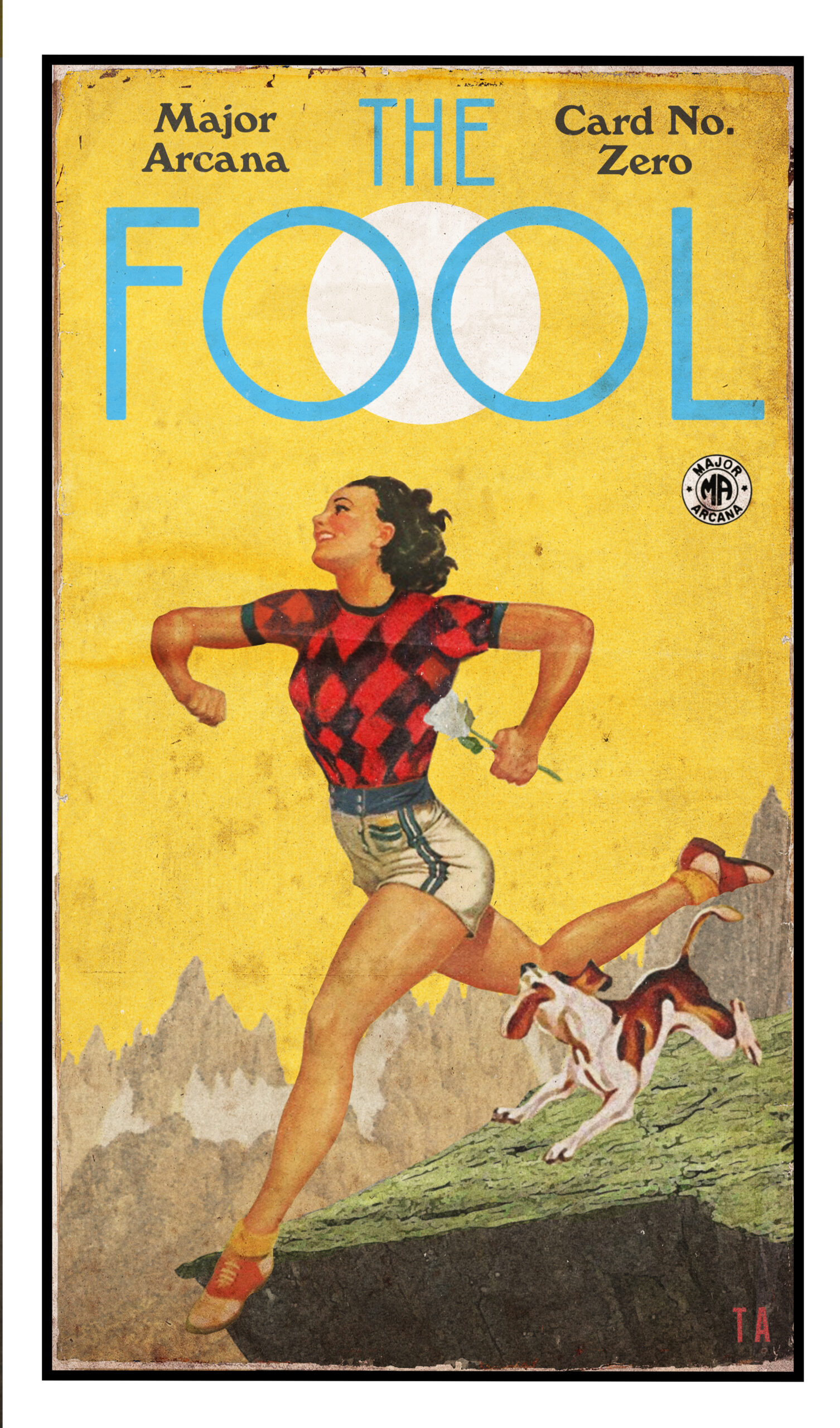
Graphic artist Todd Alcott has endeared himself to Open Culture readers by retrofitting midcentury pulp paperback covers and illustrations with classic lyrics from the likes of David Bowie, Prince, Bob Dylan, and Talking Heads.
Although he’s dabbled in the abstractions that once graced the covers of psychology, philosophy, and science texts, his overarching attraction to the visual language of science fiction and illicit romance speak to the premium he places on narrative.
And with hundreds of “mid-century mashups” to his name, he’s become quite a master of bending existing narratives to his own purposes.
Recently, Alcott turned his attention to the creation of the Pulp Tarot deck he is funding on Kickstarter.
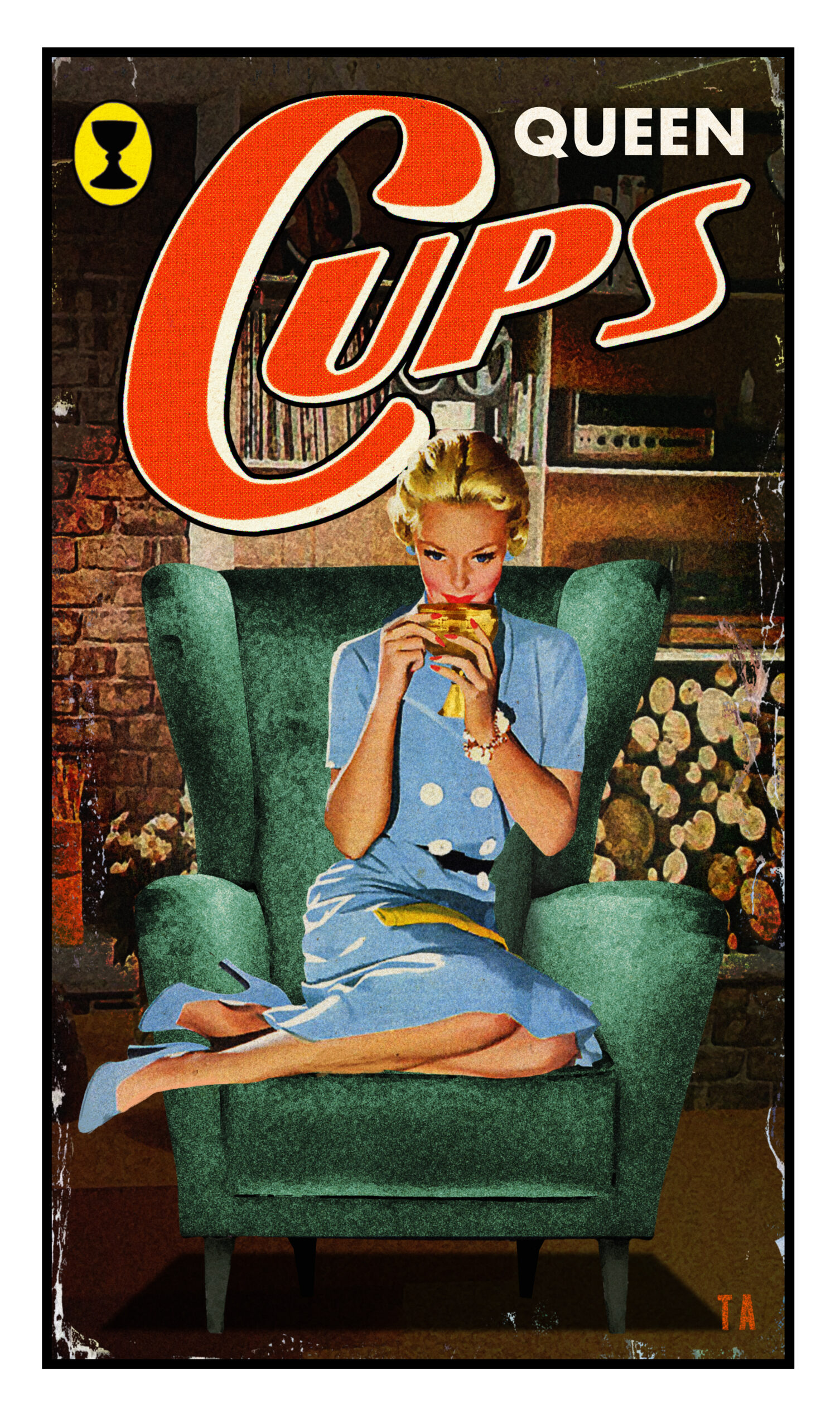
A self-described “clear-eyed skeptic as far as paranormal things” go, Alcott was drawn to the “simplicity and strangeness” of Pamela Colman Smith’s “bewitching” Tarot imagery:
Maybe because they were simply the first ones I saw, I don’t know, but there is something about the narrative thread that runs through them, the way they delineate the development of the soul, with all the choices and crises a soul encounters on its way to fulfillment, that really struck a chord with me. You lay out enough Tarot spreads and they eventually coalesce around a handful of cards that really seem to define you. I don’t know how it happens, but it does, every time: there are cards that come up for you so often that you think, “Yep, that’s me,” and then there are others that turn up so rarely that, when they do come up, you have to look them up in the little booklet because you’ve never seen them before.
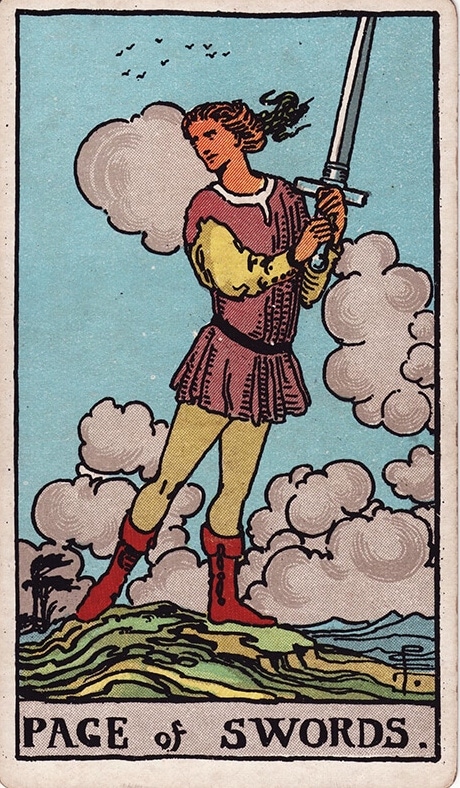
One such card for Alcott is the Page of Swords. In the early 90s, curious to know what the Tarot would have to say about the young woman he’d started dating, he shuffled and cut his Rider-Waite-Smith deck “until something inside said “now” and he flipped over the Page of Swords:
I looked it up in the booklet, which said that the Page of Swords was a secret-keeper, like a spy. I thought about that for a moment; the woman I was seeing was nothing like a spy, and had no spy-like attributes. I shrugged and began the process again, shuffling and cutting and shuffling and cutting, until, again, something inside said “now,” and turned up the card again. It was the Page of Swords, again. My heart leaped, I put the deck back in its box and quietly freaked out for a while. The next day, I asked the young lady if the Page of Swords meant anything to her, and she said “Oh sure, when I was a kid, that was my card.” Anyway, I’m now married to her.
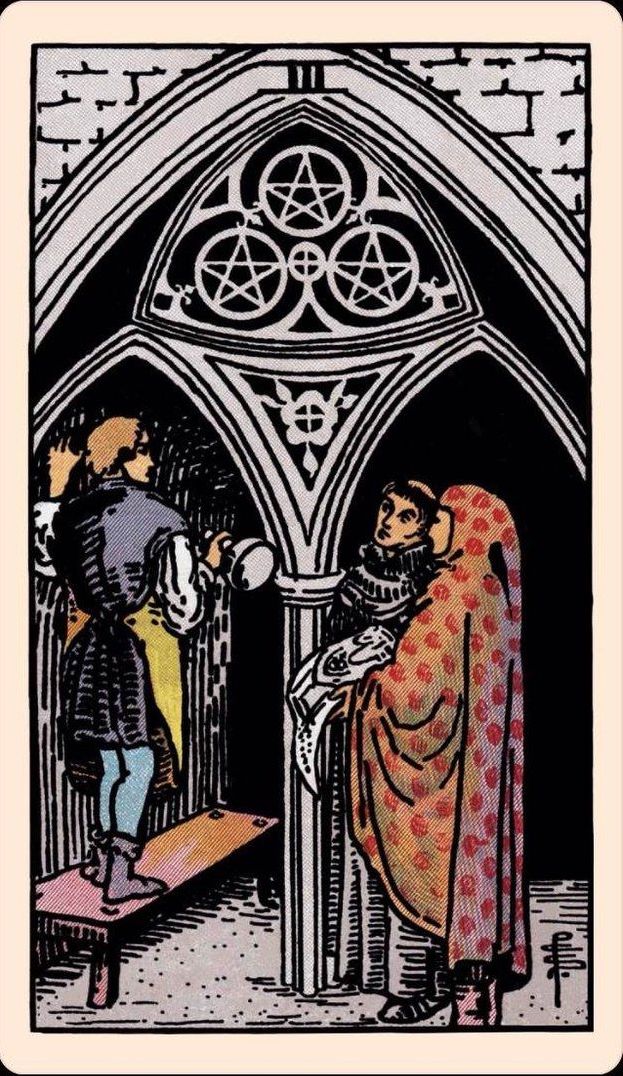
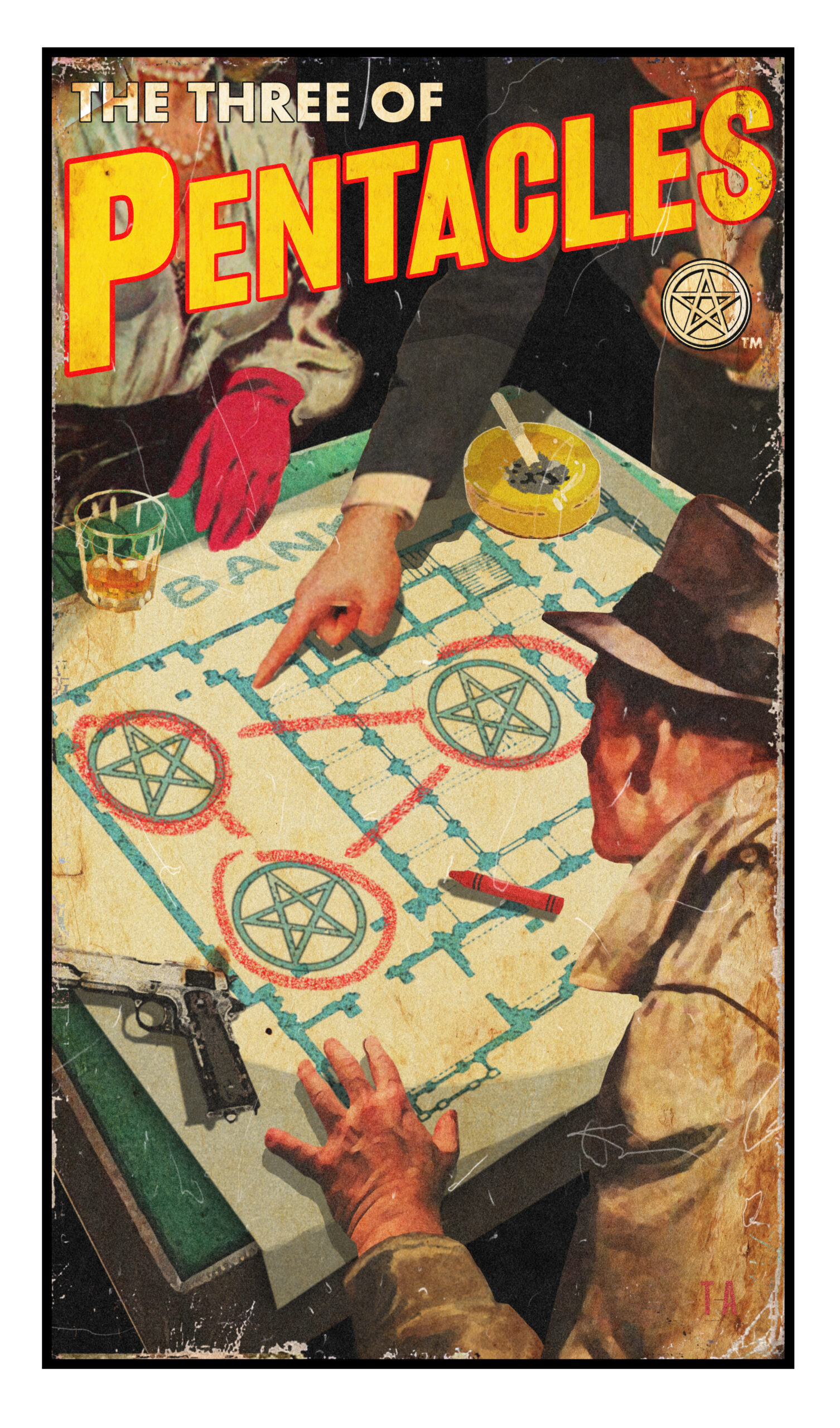
The Three of Pentacles is another favorite, one that presented a particular design challenge.
The Smith deck shows a stonemason, an architect and a church official, collaborating on building a cathedral. Now, there are no cathedrals in the pulp world, so I had to think, well, in the pulp world, pentacles represent money, so the obvious choice would be to show three criminals planning a heist. I couldn’t find an image anything close to the one in my head, so I had to build it: the room, the table, the map of the bank, the plan, the people involved, and then stitch it all together in Photoshop so it ended up looking like a cohesive illustration. That was a really joyful moment for me: there were the three conspirators, the Big Cheese, the Dame and The Goon, their roles clearly defined despite not seeing anyone’s face. It was a real breakthrough, seeing that I could put together a little narrative like that.
Smith imagined a medieval fantasy world when designing her Tarot deck. Alcott is drawing on 70 years of pop-culture ephemera to create a tribute to Smith’s vision that also works as a deck in their own right “with its own moral narrative universe, based on the attitudes and conventions of that world.”
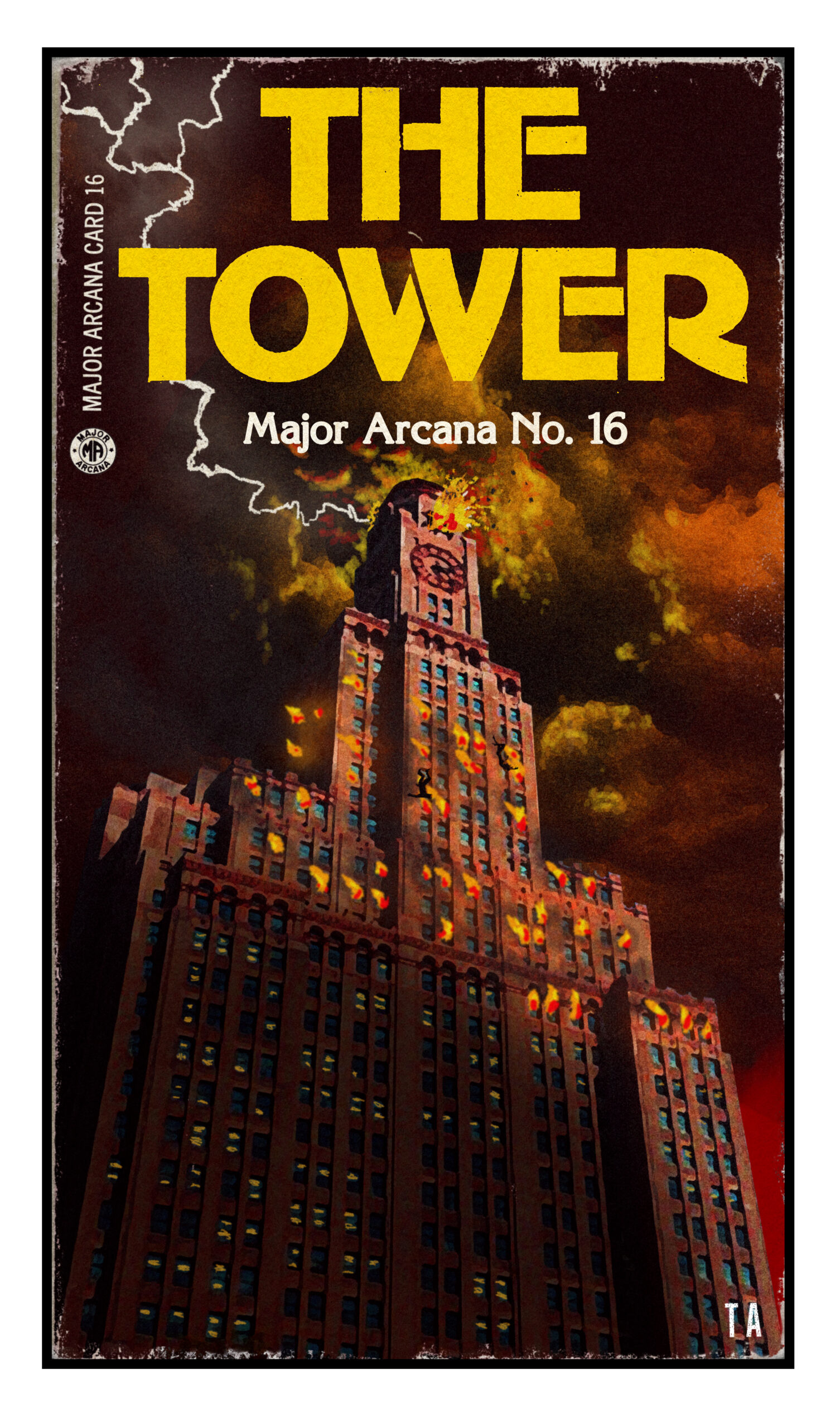
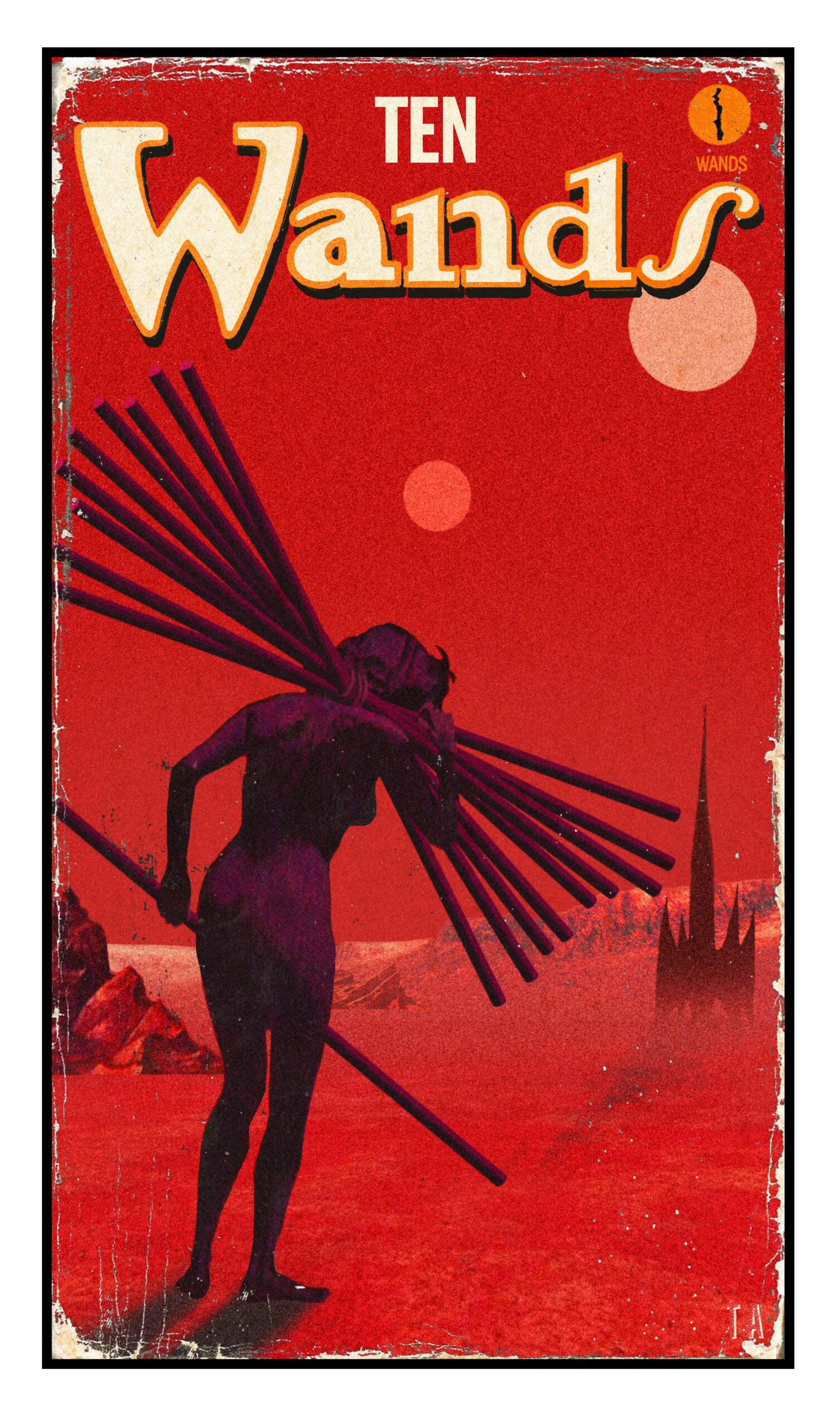
Before drafting each of his 70 cards, Alcott studied Smith’s version, researching its meaning and design as he contemplates how he might translate it into the pulp vernacular. He has found that some of Smith’s work was deliberately exacting with regard to color, attitude, and costume, and other instances where specific details took a back seat to mood and emotional impact:
Once I understand what a card is about, I look through my library to find images that help get that across. It can get really complicated! A lot of times, the character’s body is in the right position but their face has the wrong expression, so I have to find a face that fits what the card is trying to say. Or their physical attitude is right, but I need them to be gripping or throwing something, so I have to find hands and arms that I can graft on, Frankenstein style. In some cases, there will be figures in the cards cobbled together from five or six different sources.
These cards are easily the most complex work I’ve ever done in that sense. The song pieces I do are a conversation between the piece and the song, but these cards are a conversation between me, Smith, the entire Tarot tradition, and the universe.
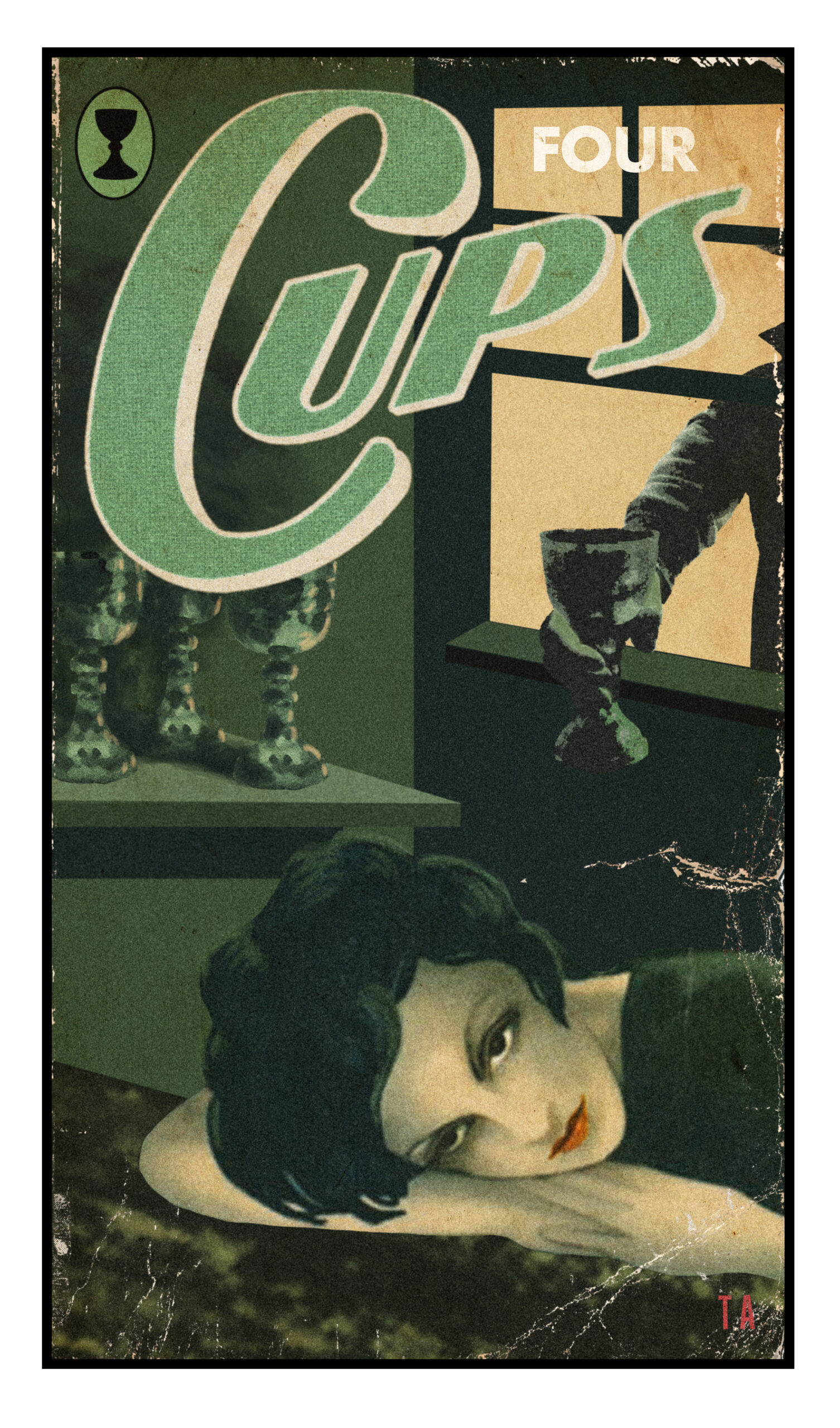
Visit Todd Alcott’s Etsy shop to view more of his mid-century mash ups, and see more cards from The Pulp Tarot and support Kickstarter here.
All images from the Pulp Tarot used with the permission of artist Todd Alcott.
Related Content:
Songs by Joni Mitchell Re-Imagined as Pulp Fiction Book Covers & Vintage Movie Posters
Ayun Halliday is an author, illustrator, theater maker and Chief Primatologist of the East Village Inky zine. Follow her @AyunHalliday.
Read More...The Making of a Marble Sculpture: See Every Stage of the Process, from the Quarry to the Studio
Some marble statues, even when stripped of their color by the sands of time since the heyday of Greece and Rome, look practically alive. But they began their “lives,” their appearance often makes us forget, as rough-hewn blocks of stone. Not that just any marble will do: following the example of Michelangelo, the discerning sculptor must make the journey to the Tuscan town of Carrara, “home of the world’s finest marble.” So claims the video above, a brief look at the process of Hungarian sculptor Márton Váró. That entire process, it appears, takes place in the open air: mostly in his outdoor studio space, but first at the Carrara quarry (see bottom video) where he picks just the right block from which to make his vision emerge.
Like Michelangelo, Váró has a manifestly high level of skill at his disposal — and unlike Michelangelo, a full set of modern power tools as well. But even today, some sculptors work without the aid of angle cutters and diamond-edged blades, as you can see in the video from the Getty above.
In it a modern-day sculptor introduces traditional tools like the point chisel, the tooth chisels, and the rasp, describing the different effects achievable with them by using different techniques. If you “lose your ego and just flow into the stone through your tools,” he says, “there’s no end of possibilities of what you can do inside that space” — the space of limitless possibilities, that is, afforded by a simple block of marble.
In the video above, sculptor Stijepo Gavrić further demonstrates the proper use of such hand tools, painstakingly refining a roughly human form into a lifelike version of an already realistic clay model — and one that holds up quite well alongside the original model, when she shows up for a comparison. The Great Big Story documentary short below takes us back to Tuscany, and specifically to the town of Pietrasanta, where marble has been quarried for five centuries from a mountain first discovered by Michelangelo.
It’s also home to hardworking sculptors well known for their ability to replicate classic and sacred works of art. “Marble is my life, because in this area you feed off marble,” says one who’s been at such work for about 60 years. If stone gives the artist life, it does so only to the extent that he breathes life into it.
Related Content:
Watch a Masterpiece Emerge from a Solid Block of Stone
Michelangelo’s David: The Fascinating Story Behind the Renaissance Marble Creation
How Ancient Greek Statues Really Looked: Research Reveals Their Bold, Bright Colors and Patterns
Roman Statues Weren’t White; They Were Once Painted in Vivid, Bright Colors
Rare Film of Sculptor Auguste Rodin Working at His Studio in Paris (1915)
Based in Seoul, Colin Marshall writes and broadcasts on cities, language, and culture. His projects include the Substack newsletter Books on Cities, the book The Stateless City: a Walk through 21st-Century Los Angeles and the video series The City in Cinema. Follow him on Twitter at @colinmarshall or on Facebook.
Read More...Take 193 Free Tech and Business Courses Online at Udacity: Product Design, Programming, A.I., Marketing & More
Each of us now commands more technological power than did any human being alive in previous eras. Or rather, we potentially command it: what we can do with the technology at our fingertips — and how much money we can make with it — depends on how well we understand it. Luckily, the development of learning methods has more or less kept pace with the development of everything else we now do with computers. Take the online-education platform Udacity, which offers “nanodegree” programs in areas like programming, data science, and cybersecurity. While the nanodegrees themselves come with fees, Udacity doesn’t charge for the constituent courses: in other words, you can earn what you need to know for free.
Above you’ll find the introduction to Udacity’s Product Design course by Google (also creator of the Coursera professional-certificate programs previously featured here on Open Culture). “Designed to help you materialize your game-changing idea and transform it into a product that you can build a business around,” the course “blends theory and practice to teach you product validation, UI/UX practices, Google’s Design Sprint and the process for setting and tracking actionable metrics.”
This is a highly practical learning experience at the intersection of technology and business, as are many other of Udacity’s 193 free courses, like App Marketing, App Monetization, How to Build a Startup, and Get Your Startup Started.
If you have no particular interest in founding and running the next Google, Udacity also hosts plenty of courses that focus entirely on the workings of different branches of technology, from programming and artificial intelligence to 2D game development and 3D graphics. (In addition to the broad introductions, there are also relatively advanced courses of a much more specific focus: Developing Android Apps with Kotlin, say, or Deploying a Hadoop Cluster.) And if you’d simply like to get your foot in the door with a job in tech, consider such offerings as Refresh Your Résumé, Strengthen Your LinkedIn Network & Brand, and a variety of interview-preparation courses for jobs in data science, machine learning, product management, virtual-reality development, and other subfields. And however cutting-edge their work, who couldn’t another spin through good old Intro to Psychology?
Find a list of 193 Free Udacity courses here. For the next week Nanodegrees are 75% off (use code JULY75). Find more free courses in our list, 1,700 Free Online Courses from Top Universities.
Note: Open Culture has a partnership with Udacity. If readers enroll in certain Udacity courses and programs that charge a fee, it helps support Open Culture.
Related Content:
Learn How to Code for Free: A DIY Guide for Learning HTML, Python, Javascript & More
1,700 Free Online Courses from Top Universities
Based in Seoul, Colin Marshall writes and broadcasts on cities, language, and culture. His projects include the Substack newsletter Books on Cities, the book The Stateless City: a Walk through 21st-Century Los Angeles and the video series The City in Cinema. Follow him on Twitter at @colinmarshall or on Facebook.
Read More...The Acoustics of Stonehenge: Researchers Build a Model to Understand How Sound Reverberated within the Ancient Structure
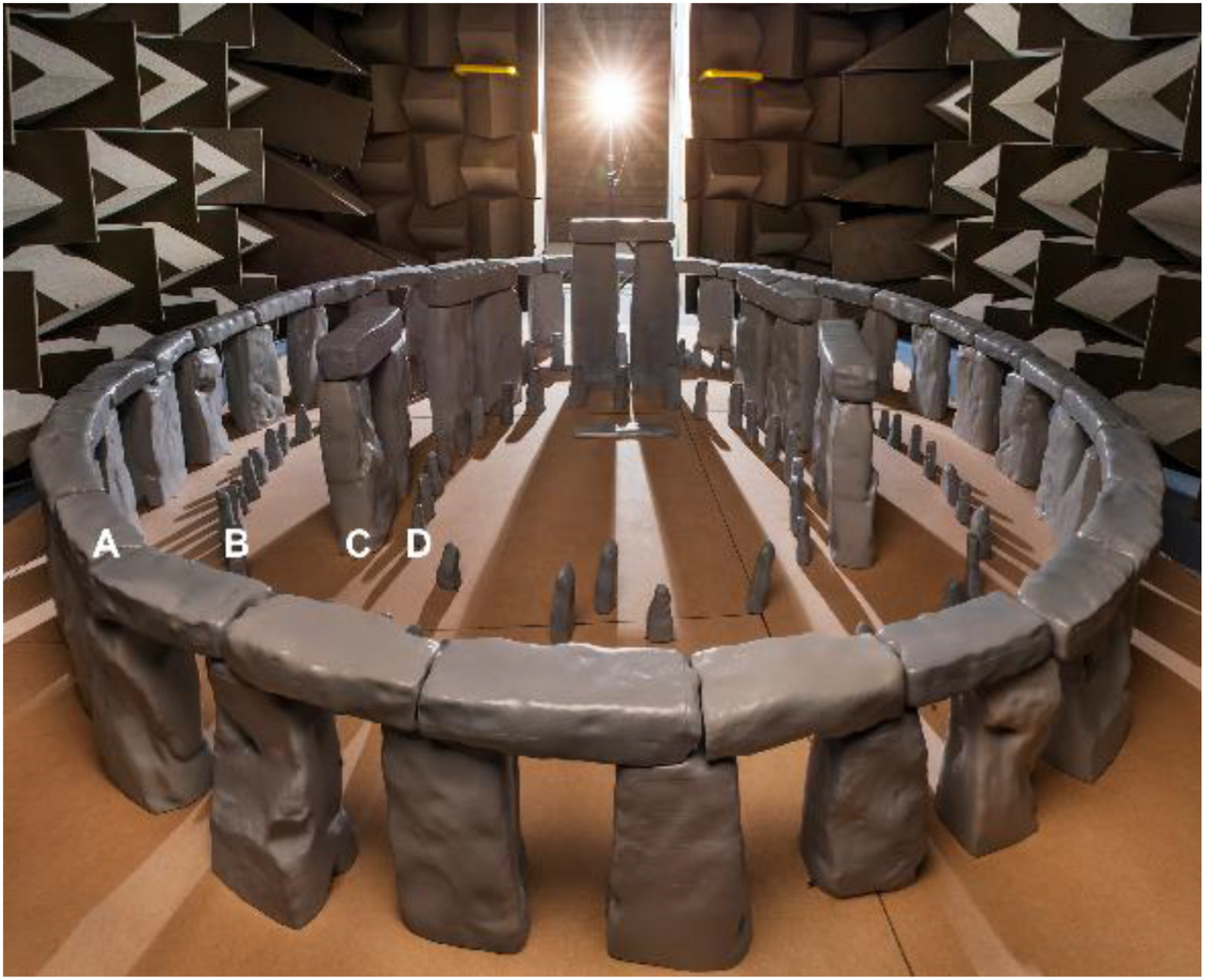
It’s impossible to resist a Spinal Tap joke, but the creators of the complete scale model of England’s ancient Druidic structure pictured above had serious intentions — to understand what those inside the circle heard when the stones all stood in their upright “henge” position. A research team led by acoustical engineer Trevor Cox constructed the model at one-twelfth the actual size of Stonehenge, the “largest possible scale replica that could fit inside an acoustic chamber at the University of Salford in England, where Cox works,” reports Bruce Bower at Science News. The tallest of the stones is only two feet high.
This is not the first time acoustic research has been carried out on Stonehenge, but previous projects were “all based on what’s there now,” says Cox. “I wanted to know how it sounded in 2200 B.C., when all the stones were in place.” The experiment required a lot of extrapolation from what remains. The construction of “Stonehenge Lego” or “Minihenge,” as the researchers call it, assumes that “Stonehenge’s outer circle of standing sarsen stones — a type of silcrete rock found in southern England — had originally consisted of 30 stones.” Today, there are 17 sarsen stones in the outer circle among the 63 complete stones remaining.
“Based on an estimated total 157 stones placed at the site around 4,200 years ago, the researchers 3‑D printed 27 stones of all sizes and shapes,” Bower explains. “Then, the team used silicone molds of those items and plaster mixed with other materials to re-create the remaining 130 stones. Simulated stones were constructed to minimize sound absorption, much like actual stones at Stonehenge.” Once Cox and his team had the model completed and placed in the acoustic chamber, they began experimenting with sound waves and microphones, measuring impulse responses and frequency curves.
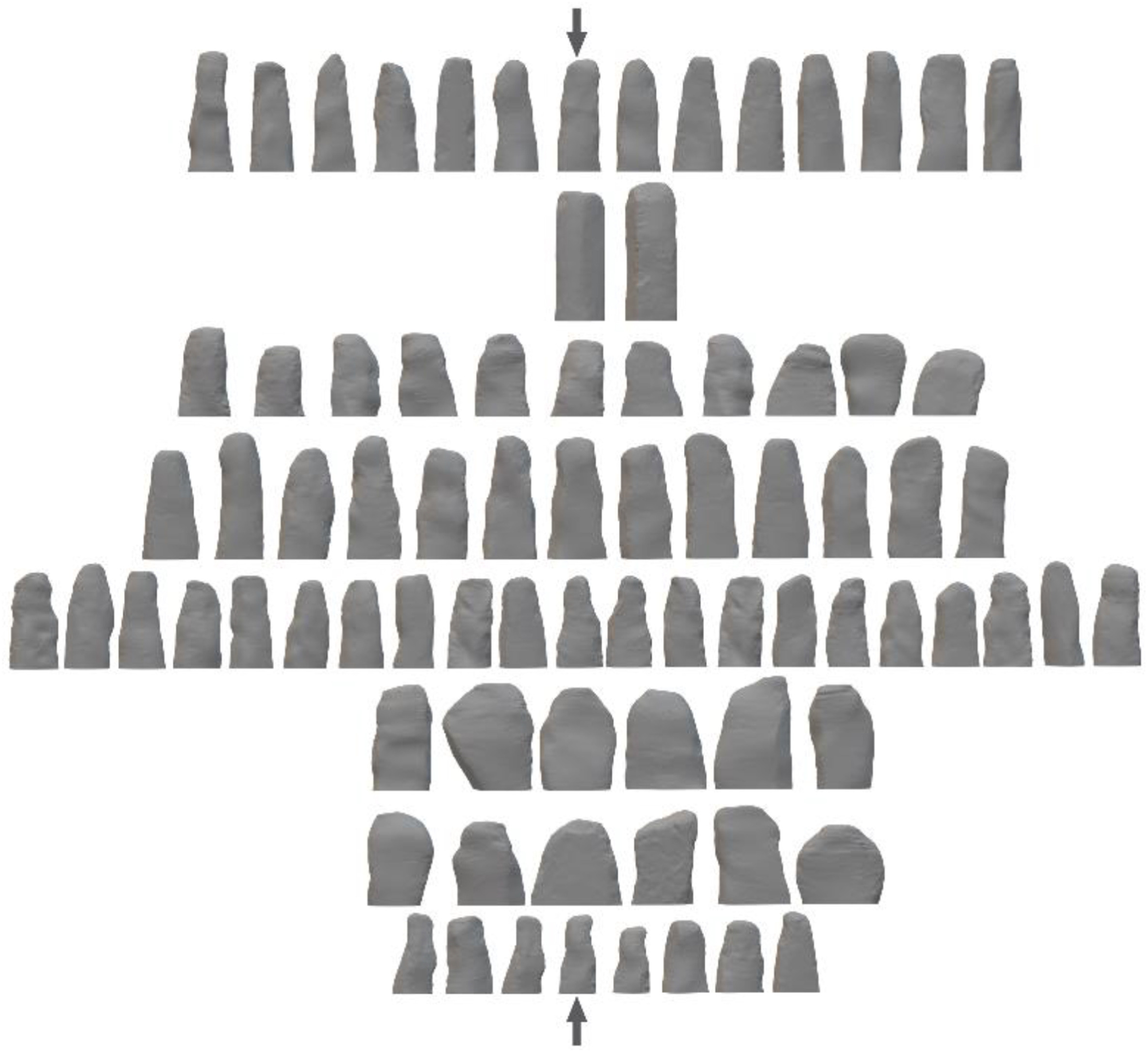
What were the results of this sonic Stonehenge recreation? “We expected to lose a lot of sound vertically, because there’s no roof,” says Cox. Instead, researchers found “thousands upon thousands of reflections as the sound waves bounced around horizontally.” Participants in ritual chants or musical celebrations inside the circle would have heard the sound amplified and clarified, like singing in a tiled bathroom. For those standing outside the monument, or even within the outer circle of stones, the sound would have been muffled or dampened. Likewise, the arrangement would have dampened sound entering the inner circle from outside.
Indeed, the effect was so pronounced that “the placement of the stones was capable of amplifying the human voice by more than four decibels, but produced no echoes,” notes Artnet. This suggests that the site’s acoustic properties were not accidental, but designed as part of its essential function for an elite group of participants, “even though the site’s construction would have required a huge amount of manpower.” This is hardly different from other monumental ancient religious structures like pyramids and ziggurats, built for royalty and an elite priesthood. But it’s only one interpretation of the structure’s purpose.
While Cox and his team do not believe acoustics were the primary motivation for Stonehenge’s design — astrological alignment seems to have been far more important — it clearly played some role. Other scholars have their own hypotheses. Research still needs to account for environmental factors — or why “Stonehenge hums when the wind blows hard,” as musicologist Rupert Till points out. Some have speculated the stones may have been instruments, played like a giant xylophone, a theory tested in a 2013 study conducted by researchers from the Royal College of Art, but this, too, remains speculative.
As the great Stonehenge enthusiast Nigel Tufnel once sang, “No one knows who they were, or what they were doing.” But whatever it sounded like, Cox and his colleagues have shown that the best seats were inside the inner circle. Read the research team’s full article here.
Related Content:
The Ancient Astronomy of Stonehenge Decoded
The Spinal Tap Stonehenge Debacle
Josh Jones is a writer and musician based in Durham, NC. Follow him at @jdmagness
Read More...Support Us
We're hoping to rely on loyal readers, rather than erratic ads. Please click the Donate button and support Open Culture. You can use Paypal, Venmo, Patreon, even Crypto! We thank you!

About Us

Open Culture scours the web for the best educational media. We find the free courses and audio books you need, the language lessons & educational videos you want, and plenty of enlightenment in between.
Advertise With Us
FREE UPDATES!
GET OUR DAILY EMAIL
Get the best cultural and educational resources on the web curated for you in a daily email. We never spam. Unsubscribe at any time.
FOLLOW ON SOCIAL MEDIA
Open Culture editor Dan Colman scours the web for the best educational media. He finds the free courses and audio books you need, the language lessons & movies you want, and plenty of enlightenment in between.
Advertise With Us

