Listen to the Never-Heard Song Written for Kubrick’s 2001: A Space Odyssey
Hollywood film scores have become blandly formulaic, thanks to filmmakers’ over-reliance on the same kinds of “temp music” during the editing process, a practice that can lead to a boilerplate approach at the scoring stage. But the use of temporary music is nothing new. Stanley Kubrick left the temp score for 2001: A Space Odyssey as the film’s official soundtrack, opting for Richard Strauss’s Also Sprach Zarathustra for the iconic opening sequence over the score composed by Alex North.
While composers may now stick too closely to temp music, North strayed too far, Kubrick complained, writing a score “which could not have been more alien to the music we had listened to.” Another composer, Wendy Carlos, scored two of Kubrick’s films—The Shining and A Clockwork Orange. In both cases, her original music was mostly cut in favor of classical recordings. Kubrick described his attitude in an interview with Michael Ciment: “Why use music which is less good when there is such a multitude of great orchestral music available from the past and from our own time?”
Few have argued with the results of Kubrick’s ruthless approach, though Carlos refused to work with him again. Maybe Kubrick’s films would have been equally well-received with different music, who can say? But if the director found North’s score “alien,” consider what he must have thought when he heard Mike Kaplan’s lyrical interpretation of his sci-fi epic, “2001: A Garden of Personal Mirrors.” Weird doesn’t really begin to describe it, and it’s odder still given that Kubrick himself commissioned the song. After rejecting another songwriter’s demo at MGM’s offices, he supposedly turned to Kaplan, then a young publicist, and said, “I hear you write music. Why don’t you write something?”
There’s no indication that Kubrick had “MacArthur Park” in mind as inspiration, but Kaplan chose to “emulate the success of the quirky hit,” writes Vanessa Thorpe at The Guardian. After 52 years, Kaplan’s song has finally been released, “thanks to a small British record label.” Thorpe quotes Observer film critic Mark Kermode, who played the song on his radio show: “Audience reaction was utterly polarized, but I have the suspicion it will become a cult favorite. It is very ear-wormy.” It was supposed to be, anyway, as a single to promote the film to confused audiences.
When Kaplan played the version above with folk singer Naomi Gardner for Kubrick, Thorpe writes, he got a very different response: “Although the great director liked the title, he said he could not imagine it becoming a hit. The two friends never discussed the song again, although they continued to work together closely on A Clockwork Orange.” Kaplan didn’t take the rejection personally, but he’s pleased it has finally emerged for the public to hear. “I know it doesn’t sound like anything else,” he says. It certainly doesn’t sound remotely like any of the music in 2001.
Kubrick may not have cared for “2001: A Garden of Personal Mirrors,” but it does, in its way, capture the spirit of a film Kaplan calls “a metaphysical drama encompassing evolution, reincarnation, the beauty of space, the terror of science and the mystery of mankind,” a film that “required critics and audiences to surrender to its unique rhythms.”
via MetaFilter
Related Content:
Watch the Opening of Kubrick’s 2001: A Space Odyssey with the Original, Unused Score
The Classical Music in Stanley Kubrick’s Films: Listen to a Free, 4 Hour Playlist
Pink Floyd’s “Echoes” Provides a Soundtrack for the Final Scene of Kubrick’s 2001: A Space Odyssey
Josh Jones is a writer and musician based in Durham, NC. Follow him at @jdmagness
Read More...When the Frequency for Tuning Instruments Became a Grand Conspiracy Theory
Conspiracy theories are like blockbuster Hollywood movies. Instead of the painful, confusing tedium of historical detail that meets us when we try to understand the world, they offer spectacle, clear dichotomies of good and evil, the promise of redemptive resolution. If only, say, we could rid ourselves of scurrilous figures behind the scenes, we could get back to the garden and make everything great. Or, if only we could change the frequency of standard musical pitch from 440 Hz to 432 Hz, we could throw off the yoke of Nazi mind control, experience pure meditative bliss, open our root chakras, and.… Wait… what?
If this one’s new to you, you’ll find rabbit holes aplenty to fall into online. Retired dentist Leonard Horowitz, for example, has elaborated a theory that has “the Rockefeller Foundation’s military commercialization of music,” then Nazi propaganda minister Joseph Goebbels, tricking the world into 440 Hz, “effectively persuading Hitler’s supposed enemies in Britain to adopt this allegedly superior standard tuning for the ‘Master Race.’” Meanwhile, on YouTube (and even in scientific journals), notes Thom Dunn at Boing Boing, pseudoscience about the “‘meditative qualities of 432 Hertz” proliferates, “which, of course, relates back to Horowitz’s theory that 440 Hertz is a weapon of Nazi aggression.”
Like most conspiracy theories, “there is a kernel of truth here—that there has been an historical debate between these frequencies for middle ‘A,’ and that 440 Hertz won out largely because of Western industrialization, which coincided with some World Wars.” The history, however, predates the Rockefeller Foundation and the Nazis, extending back at least to 1885, as Alan Cross writes at Global News, when “the Music Commission of the Italian Government declared that all instruments and orchestras should use a tuning fork that vibrated at 440 Hz, which was different from the original standard of 435 Hz and the competing 432 Hz used in France.”
The push for worldwide commercial standardization finally decided the question in the 20th century, not mind control. It was just business, but why do the proponents of 432 Hz believe this is the superior frequency? In the video above, guitar teacher Paul Davids satirizes the reasoning (over the X‑Files theme): something to do with “the natural harmonics found in sacred numbers” and the “psychic poisoning of the mass of humanity.” Davids quickly moves on to discuss the actual history of tuning, from the 15th century onward, when standards ranged from country to country, even city to city, anywhere between 400 and 500 Hz. (Learn more about the history of pitch in the video above.)
Some classical musicians who play Bach, for example, tune to 415 Hz, not because it has magical qualities but because it’s the frequency Bach used, one semitone below today’s standard 440 Hz. But all of this is academic. Should not our ears and chakras be the judge? I stick closely to the criterion, “if it sounds good, it is good,” so I’m open to considering the superiority of 432 Hz. So is Davids, and he demonstrates the difference between the two pitches in some fingerpicked examples of classical and contemporary hits. What do we hear?
Each of us will have a different response to these frequencies, depending on several factors, not least of which is our degree of conditioning to 440 Hz. Musicians and composers, for example, are far more sensitive to changes in pitch and more likely to feel the difference, especially if they try to sing or play along. What does Davids hear? He personally dismisses any notion that 432 Hz tuning will “let a different part of the universe vibrate,” or whatever. For one thing, playing in a different key makes the frequency change largely irrelevant. For another, every musical note resonates at multiple frequencies, never only one.
Logically, the difference between 432 and 440 Hz is arbitrary, even in the most meditative of relaxing 432 Hz videos on YouTube. “It all comes down,” says Davids, “to what you’re playing and how it sounds.” Or as Thelonious Monk put it in his indispensable advice to musicians, “You’ve got to dig it to dig it, you dig?” and “A note can be small as a pin or as big as the world, it depends on your imagination.”
For more, read Ted Gioia’s 2017 piece in The Daily Beast, Are We All Mistuning Our Instruments, and Can We Blame the Nazis?.
via Boing Boing
Related Content:
The History of Music Told in Seven Rapidly Illustrated Minutes
Visit an Online Collection of 61,761 Musical Instruments from Across the World
Josh Jones is a writer and musician based in Durham, NC. Follow him at @jdmagness
Read More...YInMn Blue, the First Shade of Blue Discovered in 200 Years, Is Now Available for Artists
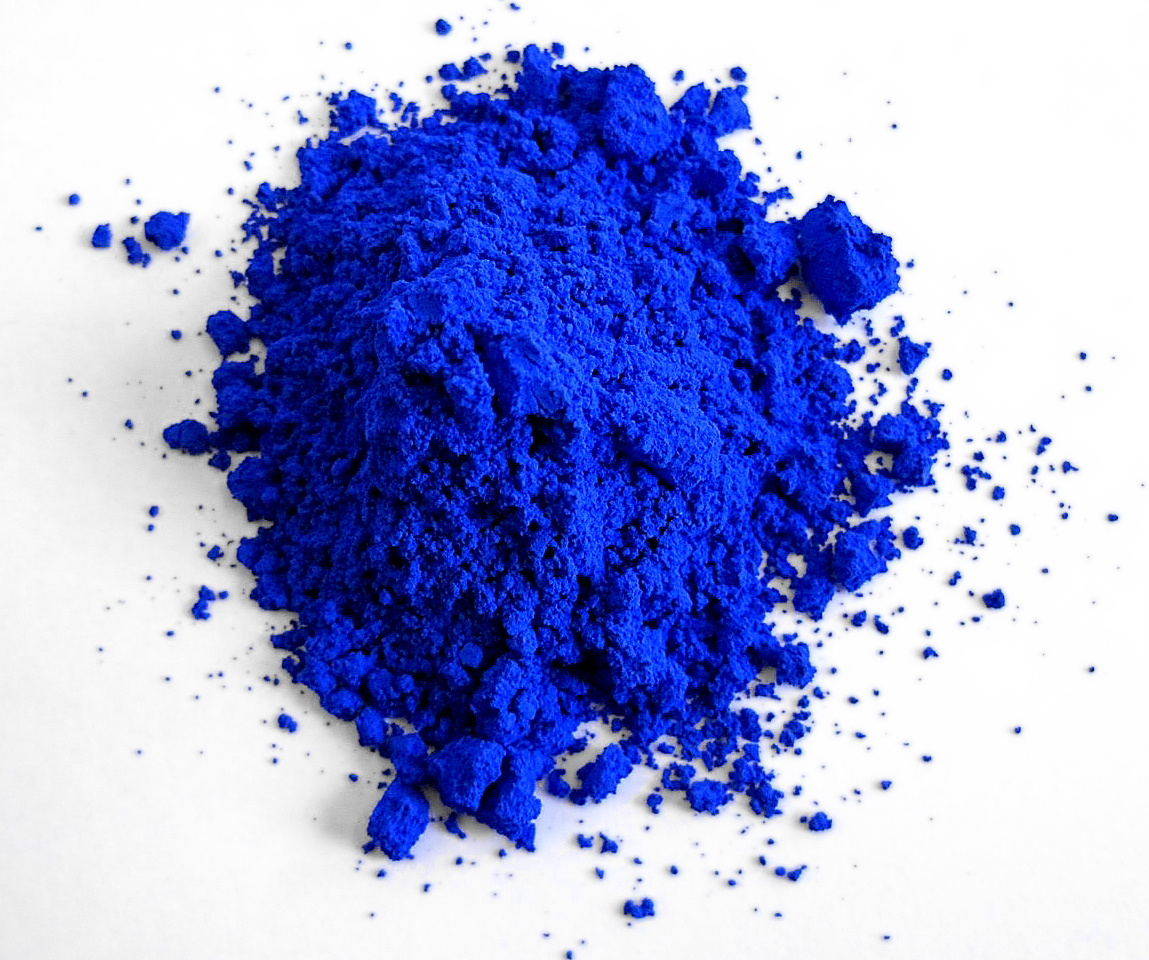
Photo via Oregon State University
“Color is part of a spectrum, so you can’t discover a color,” says Professor Mas Subramanian, a solid-state chemist at Oregon State University. “You can only discover a material that is a particular color”—or, more precisely, a material that reflects light in such a way that we perceive it as a color. Scientific modesty aside, Subramanian actually has been credited with discovering a color—the first inorganic shade of blue in 200 years.
Named “YInMn blue” —and affectionately called “MasBlue” at Oregon State—the pigment’s unwieldy name derives from its chemical makeup of yttrium, indium, and manganese oxides, which together “absorbed red and green wavelengths and reflected blue wavelengths in such a way that it came off looking a very bright blue,” Gabriel Rosenberg notes at NPR. It is a blue, in fact, never before seen, since it is not a naturally occurring pigment, but one literally cooked in a laboratory, and by accident at that.
The discovery, if we can use the word, should justly be credited to Subramanian’s grad student Andrew E. Smith who, during a 2009 attempt to “manufacture new materials that could be used in electronics,” heated the particular mix of chemicals to over 2000 degrees Fahrenheit. Smith noticed “it had turned a surprising, bright blue color [and] Subramanian knew immediately it was a big deal.” Why? Because the color blue is a big deal.
In an important sense, color is something humans discovered over long periods of time in which we learned to see the world in shades and hues our ancestors could not perceive. “Some scientists believe that the earliest humans were actually colorblind,” Emma Taggart writes at My Modern Met, “and could only recognize black, white, red, and only later yellow and green.” Blue, that is to say, didn’t exist for early humans. “With no concept of the color blue,” Taggart writes, “they simply had no words to describe it. This is even reflected in ancient literature, such as Homer’s Odyssey,” with its “wine-dark sea.”

Photo via Oregon State University
Sea and sky only begin to assume their current colors some 6,000 years ago when ancient Egyptians began to produce blue pigment. The first known color to be synthetically produced is thus called Egyptian blue, created using “ground limestone mixed with sand and a copper-containing mineral, such as azurite or malachite.” Blue holds a special place in our color lexicography. It is the last color word that develops across cultures and one of the most difficult colors to manufacture. “People have been looking for a good, durable blue color for a couple of centuries,” Subramanian told NPR.
And so, YInMn blue has become a sensation among industrial manufacturers and artists. Patented in 2012 by OSU, it received approval for industrial use in 2017. That same year, Australian paint supplier Derivan released it as an acrylic paint called “Oregon Blue.” It has taken a few more years for the U.S. Environmental Protection Agency to come around, but they’ve finally approved YlnMn blue for commercial use, “making it available to all,” Isis Davis-Marks writes at Smithsonian. “Now the authenticated pigment is available for sale in paint retailers like Golden in the US.”
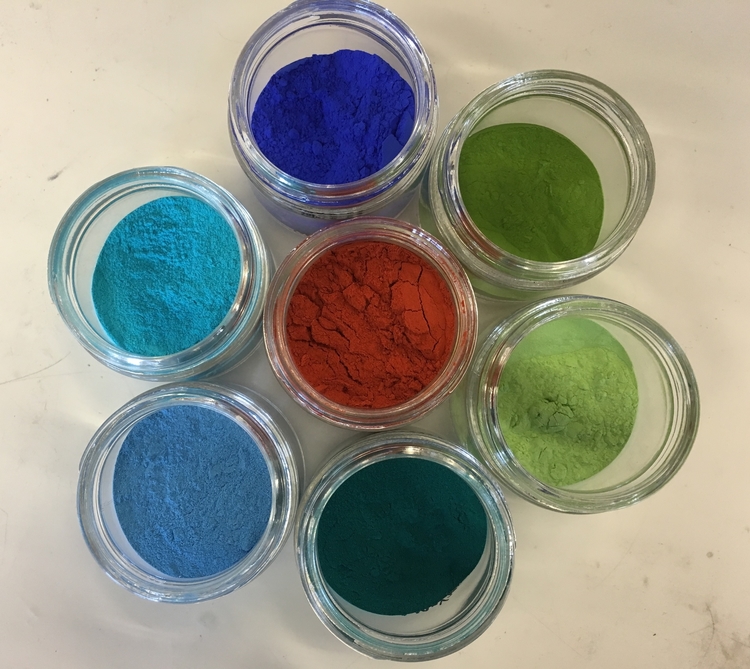
Photo via Oregon State University
The new blue solves a number of problems with other blue pigments. It is nontoxic and not prone to fading, since it “reflects heat and absorbs UV radiation.” YInMn blue is “extremely stable, a property long sought in a blue pigment,” says Subramanian. It also fills “a gap in the range of colors,” says art supply manufacturer Georg Kremer, adding, “The pureness of YInBlue is really perfect.”
Since their first, accidental color discovery, “Subramanian and his team have expanded their research and have made a range of new pigments to include almost every color, from bright oranges to shades of purple, turquoise and green,” notes the Oregon State University Department of Chemistry. None have yet had the impact of the new blue. Learn much more about the unique chemical properties of YInMn blue here and see Professor Subramanian discuss its discovery in his TED talk further up.
Related Content:
Behold One of the Earliest Known Color Charts: The Table of Physiological Colors (1686)
A 900-Page Pre-Pantone Guide to Color from 1692: A Complete Digital Scan
Josh Jones is a writer and musician based in Durham, NC. Follow him at @jdmagness
Read More...The Great Gatsby Is Now in the Public Domain and There’s a New Graphic Novel
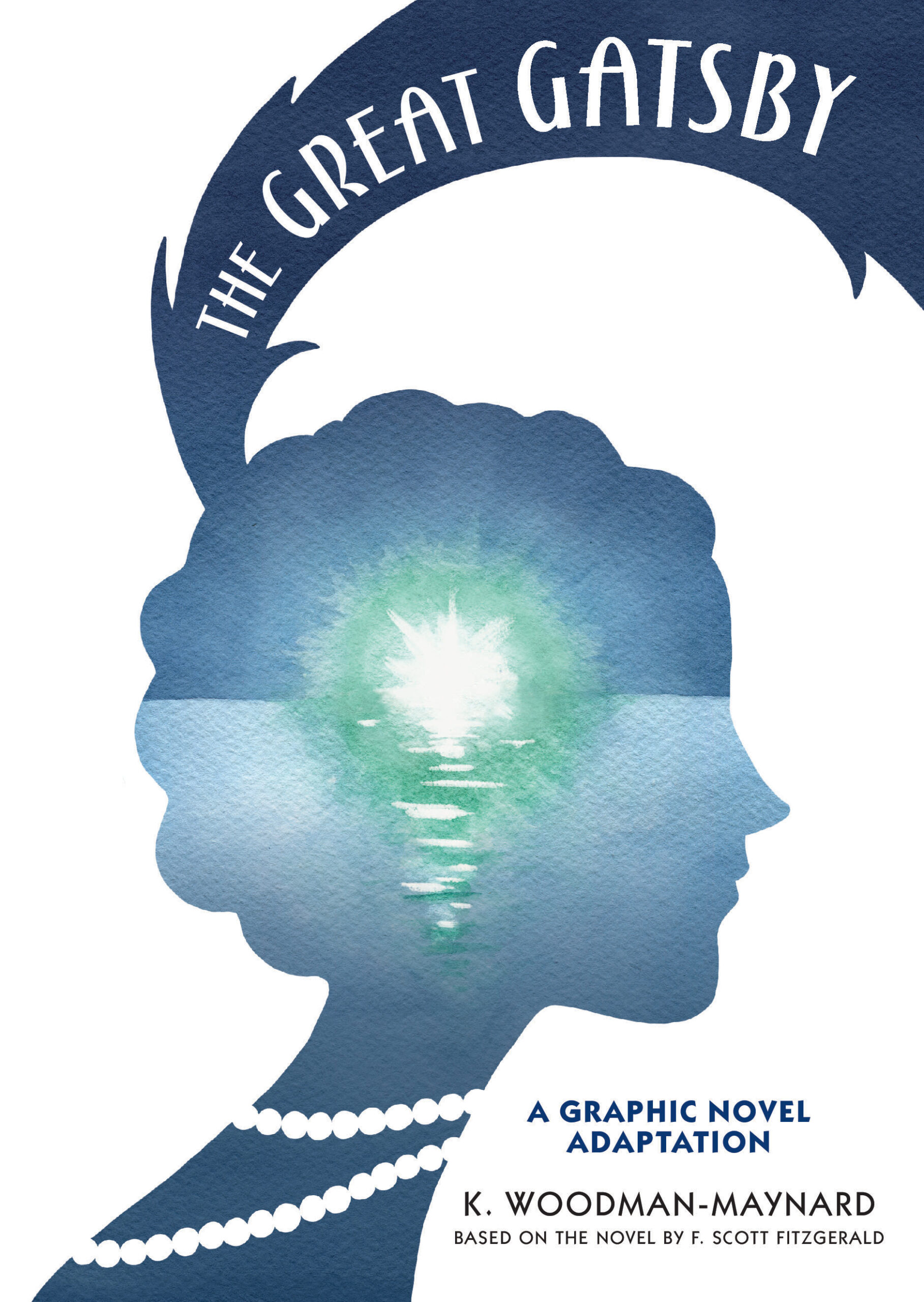
If you’ve ever dreamed about mounting that “Great Gatsby” musical, or writing that sci-fi adaptation based on Gatsby but they’re all androids, there’s some good news: as of January 1, 2021, F. Scott Fitzgerald’s classic novel finally entered the public domain. (Read a public domain copy here.) Creatives can now do what they want with the work: reprint or adapt it any way they like, without having to negotiate the rights.
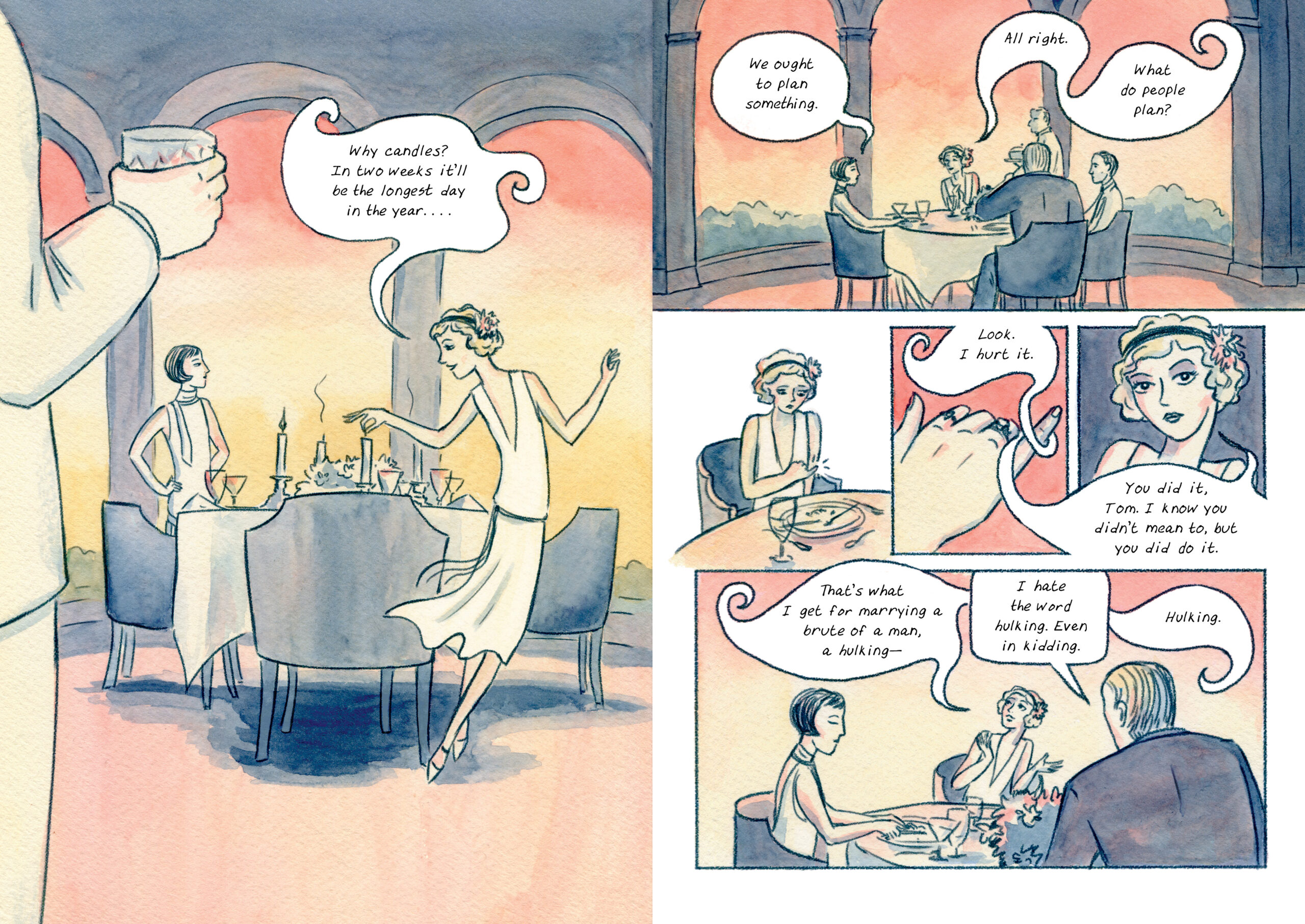
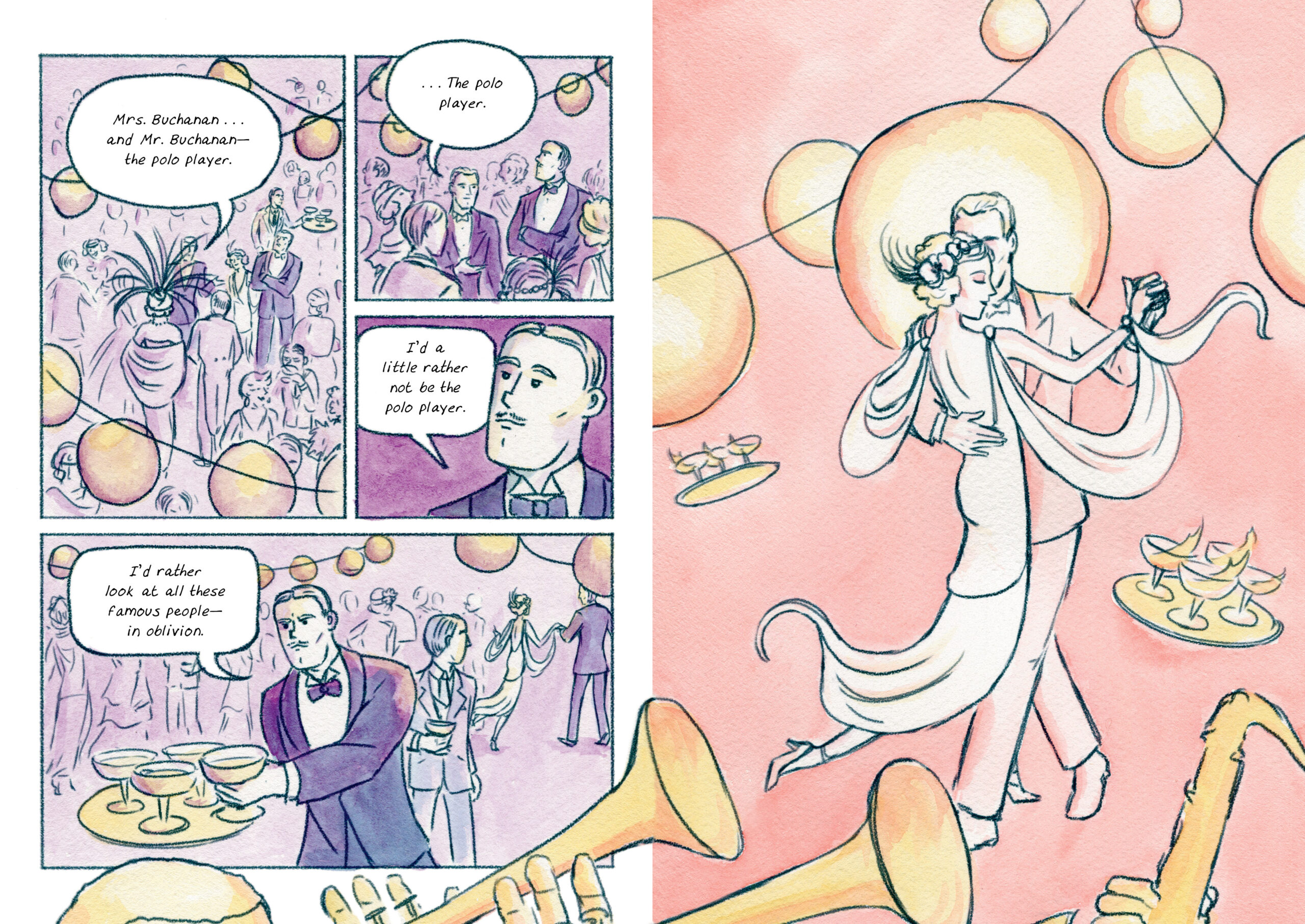
Or you could, just like Minneapolis-based artist K. Woodman-Maynard adapt the work into a beautiful graphic novel, pages of which you can glimpse here. Her version is all light and pastel watercolors, with a liberal use of the original text alongside more fantastic surreal imagery, making visual some of Fitzgerald’s word play. At 240 pages, there’s a lot of work here and, as if it needs repeating, no graphic novel is a substitute for the original, just…a jazz riff, if you were.
But Woodman-Maynard was one of many waiting for Gatsby to enter the public domain, which apart from Disney property, will happen to most recorded and written works over time. Many authors have been waiting for the chance to riff on the novel and its characters without worrying about a cease and desist letter. Already you can find The Gay Gatsby, B.A. Baker’s slash fiction reinterpretation of all the suppressed longing in the original novel; The Great Gatsby Undead, a zombie version; and Michael Farris Smith’s Nick, a prequel that follows Nick Carraway through World War I and out the other side. And there are plenty more to come.
Copyright law stipulates that any work after 95 years will enter the public domain. (Up until 1998, this used to be 75 years, but some lawyers talked to some congresscritters).
As of 2021, along with The Great Gatsby, the public domain gained:
Mrs. Dalloway — Virginia Woolf
In Our Time — Ernest Hemingway
The New Negro — Alain Locke (the first major compendium of Harlem Renaissance writers)
An American Tragedy — Theodore Dreiser (adapted into the 1951 film A Place in the Sun)
The Secret of Chimneys — Agatha Christie
Arrowsmith — Sinclair Lewis
Those Barren Leaves — Aldous Huxley
The Painted Veil — W. Somerset Maugham
Now, the thing about The Great Gatsby is that it is both loved by readers and hard to adapt into other mediums by its fans. It has been adapted five times for the screen (the Baz Luhrmann-Leonardo DiCaprio version is the most recent from 2013) and they have all dealt with the central paradox: Fitzgerald gives us so little about Gatsby. The author is intentionally hoping the reader to create this “great man” in our heads, and there he must stay. The novel is very much about the “idea” of a man, much like the idea of the “American Dream.” But film must cast somebody and Hollywood absolutely has to cast a star like Leonardo DiCaprio or Robert Redford. A graphic novel, however, does not have those concessions to the market. Woodman-Maynard’s version is not even the first graphic novel based on Fitzgerald’s book—-Scribner published a version adapted by Fred Fordham and illustrated by Aya Morton last year—-and it certainly will not be the last. Get ready for a bumper decade celebrating/critiquing the Roaring ‘20s, while we still figure out what to call our own era.
Related Content:
The Great Gatsby and Waiting for Godot: The Video Game Editions
Ted Mills is a freelance writer on the arts who currently hosts the Notes from the Shed podcast and is the producer of KCRW’s Curious Coast. You can also follow him on Twitter at @tedmills, and/or watch his films here.
Read More...PBS American Masters Archive Releases 1,000+ Hours of Uncut, Never-Before-Seen Interviews: Patti Smith, David Bowie, Neil Young & More
When we think of American masters, we don’t think of David Bowie, who despite being a master was also the most English rock star ever to live. But an interview with Bowie, never before seen in full, nonetheless appears in the newly opened American Masters archive, having been shot for the long-running PBS series’ 1997 documentary on Lou Reed — if not the most American rock star ever to live, then surely the most New York one. “For me, New York was always James Dean walking out in the middle of the road, and it was always the Fugs, the Village Fugs. It was the Beats and it was SoHo. It was that kind of bohemian intellectual extravagance that made it so vibrant for someone like me, growing up in quite a gray, suburban, tenement-filled South London environment.”
As with any society or culture, it takes an outsider to see things most clearly, or at any rate most vividly. But then, certain American-born Americans also have pretty vivid impressions of their own. No less a New York icon than Patti Smith, for instance, also sat for an interview about Lou Reed — as well as Bob Dylan, Andy Warhol, the Chelsea Hotel, poetry, labels, improvisation, John Coltrane, Jackson Pollock, CBGB, and much else besides.
Smith’s full interview runs 44 minutes, much longer than the brief clip above, but even it constitutes just a small fraction of the over 1,000 hours of similarly uncut interview footage now made available, complete with searchable transcripts, in the American Masters archive.
Since its debut in 1986 American Masters has profiled cultural figures from Maya Angelou to Aretha Franklin, Ernest Hemingway to Edgar Allan Poe, Mae West to Marilyn Monroe, Carol Burnett to Mel Brooks. Those last episodes include interviews with the late Carl Reiner, a towering American comedian in his own right. In addition to Reiner’s half-hour on Burnett and hour on Brooks, you’ll also find in the archive four different interviews of Brooks himself, as well as a solid three and a half hours with Burnett herself. Neil Young on David Geffen, William F. Buckley on Walter Cronkite, Cybill Shepherd on Jeff Bridges, and Quincy Jones on Sidney Poitier — as well as, in two interviews totaling nearly four hours, on Quincy Jones. Like all the best American lives, his contains many more stories than one can tell at a sitting. Enter the the American Masters archive here.
via Kottke
Related Content:
Free Archive of Audio Interviews with Rock, Jazz & Folk Legends Now on iTunes
Library of Congress Releases Audio Archive of Interviews with Rock ‘n’ Roll Icons
Based in Seoul, Colin Marshall writes and broadcasts on cities, language, and culture. His projects include the Substack newsletter Books on Cities, the book The Stateless City: a Walk through 21st-Century Los Angeles and the video series The City in Cinema. Follow him on Twitter at @colinmarshall or on Facebook.
Read More...The Life Cycle of a Cup of Coffee: The Journey from Coffee Bean, to Coffee Cup
Do you think you would recognize a coffee plant if you came across one in the wild? Not that it’s likely outside the so-called “coffee belt,” the region of the world most rich in soil, shade, mild temperatures, and copious rainfall. Farmed coffee plants “are pruned short to conserve their energy,” the National Coffee Association notes, but they “can grow to more than 30 feet (9 meters) high. Each tree is covered with green, waxy leaves growing opposite each other in pairs. Coffee cherries grow along the branches. Because it grows in a continuous cycle, it’s not unusual to see [white] flowers, green fruit and ripe [red] fruit simultaneously on a single tree.”
That’s a festive image to call to mind when you brew—or a barista brews—your coffee beverage of choice. After watching the TED-Ed video above, you’ll also have a sense of the “globe-spanning process” between the coffee plant and that first cup of the morning. “How many people does it take to make a cup of coffee?” the lesson asks. Far more than the one it takes to push the brew button…. The journey begins in Colombia: forests are clear-cut for neat rows of shrub-like coffee trees. These were first domesticated in Ethiopia and are still grown across sub-Saharan Africa as well as South America and Southeast Asia, where low-wage workers harvest the coffee cherries by hand.
The cherries are then processed by machine, sorted, and fermented. The resulting coffee beans require more human labor, at least in the example above, to fully dry them over a period of three weeks. Further machine sorting and processing takes place before the beans reach a panel of experts who determine their quality and give them a grade. More hands load the coffee beans onto container ships, unload them, transport them around the country (the U.S. imports more coffee than any other nation in the world), and so on and so forth. “All in all, it takes hundreds of people to get coffee to its intended destination, and that’s not counting the people maintaining the infrastructure that makes the journey possible.”
Many of the people in that vast supply chain are paid very little, the video points out. Some are paid nothing at all. The history of coffee, like the histories of other addictive commodities like sugar and tobacco, is filled with stories of exploitation and social and political upheaval. And like the supply chains of every other contemporary staple, the story of how coffee gets to us, from plant to cup, involves the stories of hundreds of thousands of people connected by a global chain of commerce, and by our constant need for more caffeine.
Related Content:
How to Make the World’s Smallest Cup of Coffee, from Just One Coffee Bean
Philosophers Drinking Coffee: The Excessive Habits of Kant, Voltaire & Kierkegaard
Josh Jones is a writer and musician based in Durham, NC. Follow him at @jdmagness
Read More...Watch the Pilot of Breaking Bad with a Chemistry Professor: How Sound Was the Science?
Even the grittiest, hardest-hitting TV dramas require willing suspension of disbelief to enjoy. This is especially true if you, the viewer, happen to be an expert on such subjects as emergency medicine, police procedures, criminal law, FBI profiling, crime scene investigation, etcetera. Those of us who don’t know anything about these fields may have an easier time of it, provided the writers do their diligence and make the actors sound convincing. I never much questioned the science of Breaking Bad, for example. Surely, the hit show accurately depicted how a desperate high school chemistry teacher would build a meth lab in the desert? How should I know otherwise?
I might watch the show with a chemist, for one thing, like Professor Donna Nelson or the University of Nottingham’s Sir Martyn Poliakoff, who had himself refused to watch Breaking Bad until “one day when I’m old.” That day has come at last: he finally sat down with the pilot and discussed his impressions on YouTube channel Periodic Videos. Poliakoff approached the experiment with almost no preconceptions. He knew the show was about a chemistry teacher who made “some sort of drug, I didn’t know which one,” and that “there were a lot of episodes.”
He also knew that “at some point, HF, hydrogen fluoride, played a part.” But before the chemistry critique begins, Poliakoff notices that Walter White’s pants floating through the desert air in the pilot’s iconic opening are a physical impossibility given their origination. Bummer. He loved the opening sequence spelling out the show’s title with elements from the periodic table, and even imagined how his own name (including “Sir”) might be spelled the same way.
As you might expect, Poliakoff has some nits to pick with the lesson White gives his students in the first few minutes. For one, White—who shows himself to be very safety-conscious, if not risk-averse, later in the episode—wears no safety gear while spraying chemicals into an open flame. The director can be forgiven for not wanting to obscure Bryan Cranston’s expressive face in this crucial scene of character development. But what of the lesson itself? Overall, he says, it’s “quite good.” He likes White’s definition of chemistry as “the study of change,” but thinks it should more fully be “the way that matter changes.”
The discussion prompts Poliakoff to reflect that no one’s ever asked him to define chemistry before. (When asked to define “inorganic chemistry” in high school, his son answered, “it’s what my dad does.”) We quickly begin to see the benefits of watching a well-crafted show like Breaking Bad with an expert. The drama of the show, and its unusual approach to what we normally consider a dry subject, draws out our chemist’s enthusiasm and helps us make connections we might not otherwise make, such as Walter White’s resemblance to well-known British scientist and science communicator Robert Winston.
Hearing Poliakoff discuss the Breaking Bad pilot turns out to be so entertaining that TV executives should take note—this could become a new, easy-to-produce genre when we finally run out of shows, provided there are enough eminent professors willing to offer commentary on hit series of the past. But as we can surmise from Professor Poliakoff’s general lack of interest in TV, and from his thriving career as a chemistry professor, he’s probably busy. He’s already done more than enough to make chemistry interesting to us layfolk by contributing to Periodic Videos for over a decade now.
Further up, see a fun demonstration of exploding hydrogen bubbles (“the title pretty much says it”). Just above and below, see Professor Poliakoff enlighten us on the properties of elements 35 and 56, Bromine and Barium, and watch Periodic Videos full series on the periodic table here.
Related Content:
The Science of Breaking Bad: Professor Donna Nelson Explains How the Show Gets it Right
The Breaking Bad Theme Played with Meth Lab Equipment
How Breaking Bad Crafted the Perfect TV Pilot: A Video Essay
Josh Jones is a writer and musician based in Durham, NC. Follow him at @jdmagness
Read More...The Formula for The Coen Brothers/Noah Hawley’s Fargo – Pretty Much Pop: A Culture Podcast #79
Your hosts Mark Linsemayer, Erica Spyres, and Brian Hirt are joined by Tamler from the Very Bad Wizards podcast to consider the plaudits and complaints heaped on this morality-tale-turned-organized-crime-drama that began with the 1006 film and has continued through a 4‑season TV show. We delve into its elaborate style, “tundra western” setting, dry humor (including “Minnesota nice”), speechifying, gender issues, stunt casting, and the role of chance in its plotting. Did the show go downhill in its later seasons, and is there altogether too much rehash involved? Yes, there are spoilers, but no, it barely matters.
Check out these resources for more opinions and background information:
- “How All the Fargo Seasons are Connected” by Pete Peppers
- “Fargo Season 4 Has a Lot of Nothing to Say About America” by Darren Franich
- “Fargo: The 10 Best Examples of Stunt Casting on the Series” by David Mello
- “‘Fargo’ Season 4 Wanted to Talk About Race, but Had a Big Communication Problem” by Julian Kimble
- “‘Fargo’ Showrunner Noah Hawley Reveals What Happens Between Season 4 Finale and the Beginning of Season 2″ by Daniel Holloway
- “A Superb ‘Fargo’ Swerves into the ’70s with Almost Too Much Story to Tell” by Hank Steuver
- “Fargo’s Second Season Will Be a Classic in Its Own Right” by Matt Zoller Seitz
- “‘Fargo’: How a Great Movie Became a Perfect TV Series” by Jeff Ridskopf
- “A Guide to the New ‘Fargo’ ” by Alicia Lutes
Follow @tamler. Hear him on The Partially Examined Life. Check out his book, Why Honor Matters.
Hear more of this podcast at prettymuchpop.com. This episode includes bonus discussion that you can access by supporting the podcast at patreon.com/prettymuchpop. This podcast is part of the Partially Examined Life podcast network.
Pretty Much Pop: A Culture Podcast is the first podcast curated by Open Culture. Browse all Pretty Much Pop posts.
Read More...Watch John Cage Play His “Silent” 4′33″ in Harvard Square, Presented by Nam June Paik (1973)
Have you ever played 4′33″ in public? Or rather, have you ever not played 4′33″ in public? Calling as its score does for no notes at all over its titular duration, John Cage’s signature 1952 composition has made many ponder (and just as many joke about) what it means to actually perform the thing. If music is, by its most basic definition, organized sound, then 4′33″ is anti-music, the deliberate absence of organized sound. Yet it isn’t silence: rather, the piece offers a performative frame for the disorganized sound that occurs uncontrollably in the environment.
In a concert hall, 4′33″ encompasses all the non-musical noises made by everyone onstage and in the seats, try though they might to make none at all. Naturally, the piece sounds completely different when played in, say, the streets of a major city. John Cage did exactly that in 1973, sitting at a piano in the middle of Boston’s Harvard Square.
“He flipped open the piano cover while traffic roared by, and, except for periodically checking his stopwatch, did nothing for four minutes and thirty-three seconds,” writes the Brooklyn Rail’s Ellen Pearlman. “Then workmen slowly carted the piano off while Cage keened like a distressed Japanese monk.” You can witness this public happening, or at least one minute and 22 seconds of it, in the video above.
The clip comes from A Tribute to John Cage, the video artist Nam June Paik’s audiovisual homage to the composer, who counted among his major sources of inspiration along with his compatriots in the international experimental art movement Fluxus. (Just over a decade later, Paik would involve Cage in a much higher-profile project, the New Year’s broadcast Good Morning, Mr. Orwell.) Here Paik “reverses John Cage’s proposal by overloading the screen with messages,” writes Thérèse Beyler at the New Media Encyclopedia. “This is Zen for TV,” announces one of his onscreen messages. “Do you hear a cricket?” asks another. “… or a mouse.” Unlikely, at the intersection of Brattle and JFK — but then, we can hear anything when offered an opportunity truly to listen.
Related Content:
John Cage’s Silent, Avant-Garde Piece 4’33” Gets Covered by a Death Metal Band
The Curious Score for John Cage’s “Silent” Zen Composition 4’33”
The 4’33” App Lets You Create Your Own Version of John Cage’s Classic Work
Based in Seoul, Colin Marshall writes and broadcasts on cities, language, and culture. His projects include the Substack newsletter Books on Cities, the book The Stateless City: a Walk through 21st-Century Los Angeles and the video series The City in Cinema. Follow him on Twitter at @colinmarshall or on Facebook.
Read More...Watch Amanda Gorman Read “The Hill We Climb,” “Making Mountains As We Run,” “Fury and Faith,” and More
Led by celebrity host Tom Hanks, the Biden inauguration’s entertainers, A‑listers all, were safe bets, reliable stadium-fillers with instant mass appeal. They “did exactly what we needed them to do,” remarked Stephanie Zacharek at TIME, offering the reassurance that “we no longer need to live in dread.” They were “singers you actually know,” Alexis Petridis wrote at The Guardian. The comment was a dig at the previous administration’s C and D‑list lineup, and also, perhaps, an admission that what Americans most crave is the familiar, which, of course, means, first and foremost, a national focus on celebrities we all know and love.
For a moment, however, this repetition of comforting household names was punctuated by an entirely new young face and voice—that of a poet, no less, a standard bearer of the form that has held the nation’s rapt attention in the work of Whitman, Frost, Hughes, and Angelou.
Amanda Gorman, chosen as the first National Youth Poet Laureate in 2017, channeled a tradition of American lyric writing about America in her inauguration poem, and she brought to it her own experiences as a Gen Z black feminist and activist who overcame a speech impediment to address the country at one of the most significant televised public events in recent history.
Gorman’s resume is a testament to her generation’s commitment to art and activism in the face of compounding crises, and to her personal commitment to change in a country that promises little for young black artists in particular. Named youth poet laureate of Los Angeles in 2014 at age 16, she published her first book of poetry, The One for Whom Food is Not Enough, the following year. She then went on to found a nonprofit writing and leadership program, open the literary season for the Library of Congress in 2017, and graduate cum laude from Harvard College with a degree in sociology in 2020.
While charting her own literary path, Gorman learned to use her voice as “a political choice,” as she says in her TED-Ed student talk above, in which she confidently asks a small audience of her peers, “whose shoulders do you stand on?” and “what do you stand for?” These are the questions she asks students in workshops, she says, to shake them out of the idea that poetry is for “dead white men who were just born to be old.” Then she shares her own answers. Gorman’s public appearances tend to focus on process as much as on politics and prosody. In a talk on “Presentation and Reading” at the Academy of Arts & Sciences in Cambridge below, she reads a poem, then has a brief discussion of “how it came to be.”
Gorman is as skilled a storyteller as she is a poet and educator. In her 2017 Moth GrandSLAM appearance in Boston, further up, she tells the story of trying to catch her big break auditioning for Broadway, an aspiration shaped by her childhood love of The Lion King. Her inaugural poem, she tells PBS, was written to “be accessible to anyone who might be watching, that they can feel that they are represented and well-established in this poem,” an act of writing she calls “a really difficult dance to do.” The effort did not blunt the poem’s most incisive lines, however, including its reference to “the belly of the beast,” in which “we’ve learned that quiet isn’t always peace.”
For Gorman, speaking out is a personal imperative she honed as “a form of a pathology,” overcoming her speech issues “by embarking on spoken word over and over and over again and reciting my poems. No matter how terrified I was, because I had the support of others, I was able to kind of slowly climb my way to the place I am at today.”
For millions of young people who watched the inauguration, it will be Gorman’s story of perseverance, community, personal growth, and refusal to be passive and silent in the face of social injustice that will most resonate, perhaps for the rest of their lives, amidst celebrations of a longed-for return to the familiar. See Gorman read more of her poetry above and below, including a poem for another inauguration, that of Harvard President Lawrence S. Bacow, in 2018.
Related Content:
Animated Poetry by US Poet Laureate
Josh Jones is a writer and musician based in Durham, NC. Follow him at @jdmagness
Read More...Support Us
We're hoping to rely on loyal readers, rather than erratic ads. Please click the Donate button and support Open Culture. You can use Paypal, Venmo, Patreon, even Crypto! We thank you!

About Us

Open Culture scours the web for the best educational media. We find the free courses and audio books you need, the language lessons & educational videos you want, and plenty of enlightenment in between.
Advertise With Us
FREE UPDATES!
GET OUR DAILY EMAIL
Get the best cultural and educational resources on the web curated for you in a daily email. We never spam. Unsubscribe at any time.
FOLLOW ON SOCIAL MEDIA
Open Culture editor Dan Colman scours the web for the best educational media. He finds the free courses and audio books you need, the language lessons & movies you want, and plenty of enlightenment in between.
Advertise With Us

