The Films of Hayao Miyazaki Celebrated in a Glorious Concert Arranged by Film Composer Joe Hisaishi
Director Hayao Miyazaki’s working relationship with composer Joe Hisaishi is up there with the other great film pairings: Sergio Leone with Ennio Morricone, Alfred Hitchcock with Bernard Herrmann, David Lynch with Angelo Badalamenti. Working together they attain a symbiosis of sound and vision, one of the reasons their work has become part of film history. But it’s also rare that a film composer gets to celebrate that relationship with a stunner of a retrospective concert like the one above.
In 2008, Hisaishi conducted and performed at a two-hour retrospective of 25 years working with Miyazaki at Studio Ghibli. This mammoth performance at the 14,000-seat Tokyo Budokan was big in every way: six featured vocalists, the 200-member New Japan Philharmonic World Dream Orchestra, the 800 combined voices of the Ippan Koubo, Ritsuyuukai and Little Singers of Tokyo choirs, along with a 160-piece marching band made up of members from four high schools.
The concert features selections from Nausicaä of the Valley of Wind, Princess Mononoke, My Neighbor Totoro, Kiki’s Delivery Service, Howl’s Moving Castle, Spirited Away, Porco Rosso, and what would have been his most recent score at the time, Ponyo. For those wondering when the marching band and color guard turn up, it’s 50 minutes in, playing selections from Laputa, Castle in the Sky.
Hayao Miyazaki met Joe Hisaishi in 1983, when his record company recommended him to score Nausicaä of the Valley of the Wind. They became true friends and collaborators, and the director himself appears just after an hour in to speak to the audience.
“After [our first] meeting,” Miyazaki says (according to a translation in the comments) “he sent me some piano sketches, which are used in many scenes in Nausicaä anyway, and those were so amazing that I played tapes of them on my desk over and over again while I was working…I have been working thanks to so many pieces of luck, and meeting him is definitely one of them. I guess I couldn’t wish for better luck than that.”
For someone whose music is often romantic, beautiful, and relaxed, the composer says the work doesn’t come easy.
“The most painful element of my life is composing because sometimes nothing comes to mind,” he told the South China Morning Post. “It is very hard and very difficult. Sometimes the result is zero, but I go to bed and I feel something and some idea is born. So in the end there might be a composition, but the experience is often most painful.” For those who have recently seen similar memes of Miyazaki being super hard on himself, it’s no wonder the two are friends.
A few in the YouTube comment section actually attended the concert, and this quote from “Love W” sums up what was an emotional concert for Ghibli and Hisaishi fans:
“It was also quiet afterwards. No one was talking very loudly, even with hundreds of people streaming out of the building. I think everyone were just too touched and wanted to reflect over what they had seen.”
Related Content:
Studio Ghibli Producer Toshio Suzuki Teaches You How to Draw Totoro in Two Minutes
A Virtual Tour Inside the Hayao Miyazaki’s Studio Ghibli Museum
Ted Mills is a freelance writer on the arts who currently hosts the Notes from the Shed podcast and is the producer of KCRW’s Curious Coast. You can also follow him on Twitter at @tedmills, and/or watch his films here.
Read More...All 80 Issues of the Influential Zine Punk Planet Are Now Online & Ready for Download at the Internet Archive

Punk didn’t die, it evolved, since its inception in the 70s to the ethos of majorly influential figures like Kathleen Hanna and Ian MacKaye in the 90s, two of the most prominent faces of progressive DIY punk in the U.S. Then, as before, scenes came together around zines, sites of cultural recognition, dissemination, and recording for posterity in the archives of physical print. One zine critical to the socially conscious punk that emerged at the time, Punk Planet, has recently been digitized in all 80 issues by the Internet Archive.

Based in Chicago and founded by editor Dan Sinker (whom you may know from his presence on Twitter), Punk Planet ran from 1994 to 2007, focusing “most of its energy on looking at punk subculture,” the Internet Archive writes, “rather than punk as simply another genre of music to which teenagers listen. In addition to covering music, Punk Planet also covered visual arts and a wide variety of progressive issues—including media criticism, feminism, and labor issues.”

Punk Planet “transcended stereotypes to chronicle the progressive underground community, from thoughtful band interviews to exceptionally thorough investigative features,” wrote the A.V. Club’s Kyle Ryan in an interview with Sinker the year of the magazine’s demise.
“Over the course of 13 years, Punk Planet became heavily influential beyond the increasingly small world of independent publishing.” Arguably, that influence can be felt in online magazines like Rookie as well as music-focused stalwarts like Pitchfork, who note that Punk Planet’s “issues included interviews with Sleater-Kinney, Nick Cave, Ralph Nader, and countless other cultural icons.”
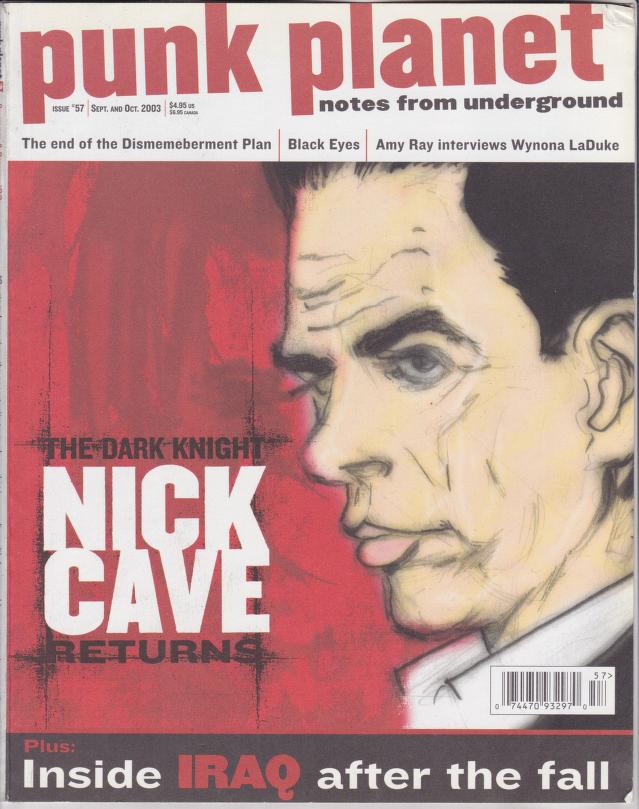
The magazine folded for the usual reasons, as Utne noted in a farewell, leaving a “gaping hole in the landscape of independent magazines…. The deck was stacked against Punk Planet, though, and the hard knocks of independent publishing finally became too much to bear.” Sinker says he saw the end as part of a bigger picture and “started looking at the larger issues that were also affecting us. Things like, ‘Hey, wow, record labels are going under because no one is paying for music!’ And, ‘Hey, look at this, people are going to these Internet sites because people can pick up a record review the same day the record came out!’”

It’s a moot point now—2020 has not made it any easier for small publications and independent musicians to survive. But the continued existence of Punk Planet online for new generations to discover promises to foster the continuity that carried the spirit of punk rock through decades of evolutionary change. Enter the Punk Planet archive here.
Related Content:
Josh Jones is a writer and musician based in Durham, NC. Follow him at @jdmagness
Read More...How Giorgio Moroder & Donna Summer’s “I Feel Love” Created the “Blueprint for All Electronic Dance Music Today” (1977)
House, trance, techno—any DJ playing a four-on-the-floor groove can drop Donna Summer and Giorgio Moroder’s “I Feel Love” into a set and instantly mesmerize the crowd. It has been happening since 1977. The disco hit doesn’t just hold up as a classic moment of nostalgia: it’s still one of the greatest dance tracks ever produced. “‘I Feel Love’ was and remains an astonishing achievement,” Jon Savage writes at The Guardian. “A futuristic record that still sounds fantastic 35 years on. Within its modulations and pulses, it achieves the perfect state of grace that is the ambition of every dance record: it obliterates the tyranny of the clock.”
DJ Jim Stanton puts it this way: “It is safe to say [‘I Feel Love’] was the blueprint for all electronic dance music today. It still has a massive impact every time I play it.”
The song was not only a “radical breakthrough” at the time but it was explicitly meant to be one, an experimental studio collaboration between Moroder, Pete Bellotte, drummer Keith Forsey, and engineer Robby Wedel, who was classical composer Eberhard Schoener’s assistant and was hired because he was the only one who knew how to work Schoener’s borrowed Moog Modular 3P. Wedel cooked up the bassline and Moroder and Bellotte pieced the track together from twenty to thirty-second snippets, since the Moog “would go out of tune every few minutes,” Moroder remembered. “It was quite a job.”
Bellotte and Summer wrote the lyrics and Summer, fresh off an important call with her astrologer about her love life, “turned up to the studio,” Bill Brewster writes at Mixmag, “and delivered the song in one take.” Upon hearing “I Feel Love” on its release, during the Berlin sessions for David Bowie’s Low, no less a shaper of the future than Brian Eno immediately realized its potential, running into the studio to proclaim, “I have heard the sound of the future. This is it, look no further. This single is going to change the sound of club music for the next fifteen years.” He was not wrong.
“Until ‘I Feel Love,’” Brewster writes, “synthesizers had either been the province of serious musicians like Keith Emerson, Jean-Michel Jarre or Tangerine Dream or used as a novelty prop in throwaway songs.” They had gained respect in the classical world, thanks to Wendy Carlos’ Switched on Bach, and by the late seventies they popped up in the mix of rock and funk often. Moroder’s creation, however, put the instrument at the center of a dance track for the first time. “‘I Feel Love’ was a rejection of the intellectualization of the synthesizer in favour of pure pleasure.”
The song killed on Soul Train and “went to No 1 in the UK during the high summer of 1977, and stayed there for four weeks—filling dance floors everywhere,” writes Savage. “Like David Bowie’s Low and Heroes, and Kraftwerk’s Trans-Europe Express, it was also the secret vice of those punks who were already tiring of sped-up pub rock, and it sowed the seeds for the next generation of UK electronica.” It didn’t chart in the U.S. but became “an all-time gay classic,” and hence a staple of the pre‑A.I.D.S. house music era. Remixes appeared immediately, including Patrick Cowley’s psychedelic 15-minute version, “which really does go on for ever and ever without trashing—even enhancing—the concept of the original.”
Indeed, “I Feel Love” is as near a pure archetype of the dance track as we’re ever going to find, so timeless it obliterates time, stretching out to 30 minutes in the “Disco Purrfection” version below, the first song to “fully utilize the potential of electronics, replacing lush disco orchestration with the hypnotic precision of machines,” and ushering in the age of New Order, Depeche Mode, and countless classic house and techno records from Chicago, New York, and Detroit, none of which hold up as well Moroder and Summer’s slick, sultry “I Feel Love.”
Related Content:
A Soul Train-Style Detroit Dance Show Gets Down to Kraftwerk’s “Numbers” in the Late 80s
Josh Jones is a writer and musician based in Durham, NC. Follow him at @jdmagness
Read More...The Beach Boys’ Brian Wilson & Beatles Producer George Martin Break Down “God Only Knows,” the “Greatest Song Ever Written”
As an Englishman of a certain age, George Martin could, realistically, choose only one means of conveyance in Los Angeles: a red Coupe de Ville convertible, and a genuine 1950s model at that. But whatever that era’s glories of automobile design, its music was still in the dark ages — at least according to the millions upon millions of Beatles fans around the world today. The pop-cultural revolution that band ignited in the early 1960s owes, by some reckonings, as much to Martin’s work as it does to that of the Fab Four themselves. In his capacity as a producer and arranger — not to mention as the man who signed them to Parlophone records — Martin arguably led the Beatles to discover their own musical potential. And once they’d become a phenomenon, they also felt pressure to surpass themselves from other sources.
One was a young American singing group called the Beach Boys, who in less than five years had gone from putting out simple, repetitive tunes about surfing and root beer to crafting the teenage-symphonic masterpiece Pet Sounds. That album, so pop-music history tells it, picked up the gauntlet thrown down by the Beatles’ Rubber Soul, and in response to it came Sgt. Pepper’s Lonely Hearts Club Band, an era-defining release since popularly thought to have won the bands’ friendly competition.
But with his ear for composition, Martin surely knew that Pet Sounds would never truly be defeated, thanks in large part to “God Only Knows,” which Martin describes as “one of my favorite Beach Boys songs.” He does so in the clip at the top of the post, of a 1997 visit to Los Angeles in which he pilots his Cadillac to the home of the group’s musical mastermind Brian Wilson.
The two then enter the studio and pull out the original master tapes of “Got Only Knows” to listen to its components one by one. You can see and hear more of what went into its recording sessions through this two-part video from Behind the Sounds that presents raw tracks from the studio with notes on the various techniques and players (including the famous “Wrecking Crew,” with bassist Carol Kaye) involved. “What Brian had done was to write a beautiful song full of unusual changes,” says Martin, “and then devise a tapestry of sounds to enhance it.” As Martin rebuilds the tracks on the console, Wilson says he’s “making a better mix of this than I did in the master.” It’s quite a compliment, considering the source — but then so is the declaration of “God Only Knows “as “the greatest song ever written,” issued as it was by a certain Paul McCartney.
Related Content:
How the Beach Boys Created Their Pop Masterpieces: “Good Vibrations,” Pet Sounds, and More
Hear the Unique, Original Compositions of George Martin, Beloved Beatles Producer (RIP)
George Martin, Legendary Beatles Producer, Shows How to Mix the Perfect Song Dry Martini
Based in Seoul, Colin Marshall writes and broadcasts on cities, language, and culture. His projects include the Substack newsletter Books on Cities, the book The Stateless City: a Walk through 21st-Century Los Angeles and the video series The City in Cinema. Follow him on Twitter at @colinmarshall or on Facebook.
Read More...How Vaccines Improved Our World In One Graphic

In 1796, the British doctor Edward Jenner developed the first vaccine to fight a contagious disease–in this particular case, the smallpox virus. Since then vaccines have helped eradicate, or firmly control, a long list of diseases–everything from diphtheria and the measles, to rubella and polio. Designed by Leon Farrant in 2011, the infographic above reminds us of the miracles brought by vaccines, showing the degree to which they’ve tamed 14 crippling diseases. Before too long, we hope COVID-19 will be added to the list.
For the data used to make the graphic, visit this document online.
If you would like to support the mission of Open Culture, consider making a donation to our site. It’s hard to rely 100% on ads, and your contributions will help us continue providing the best free cultural and educational materials to learners everywhere. You can contribute through PayPal, Patreon, and Venmo (@openculture). Thanks!
Related Content:
How Do Vaccines (Including the COVID-19 Vaccines) Work?: Watch Animated Introductions
19th Century Maps Visualize Measles in America Before the Miracle of Vaccines
How Fast Can a Vaccine Be Made?: An Animated Introduction
Read More...The Bauhaus Chess Set Where the Form of the Pieces Artfully Show Their Function (1922)

Learning to play chess first necessitates learning how each piece moves. This is hardly the labor of Hercules, to be sure, though it does come down to pure memorization, unaided by any verbal or visual cues. Does the name “pawn,” after all, sound particularly like something that can only step forward? And what about the shape of the knight suggests the shape of the knight’s move? The form of a chess piece, in other words, doesn’t follow its function — and under certain sets of aesthetic principles, there could be few greater crimes. Leave it to a member of the Bauhaus, the art school and movement that aimed to unify not just form and function but art, craft, and design — to bring them all into line.
Brought into the Bauhaus in 1921 by its founder Walter Gropius, the sculptor Josef Hartwig began work on his redesigned chess set the following year. In all its iterations, the pieces takes on forms made of simple shapes: “The sphere, double cube, and three sizes of block, singly or combined, yield pieces that, despite their highly geometric stylization, are strongly suggestive of their rank or power,” says the Metropolitan Museum of Art, owner of one of one of Hartwig’s original sets.
“The bishops are clearly implied by the cross outline, and the rooks by the simple stability of a cube. Most ingenious of all are the knights, formed of three double cubes joined in such a fashion that each face of the resulting form shows two cubes one above the other and a third on the side, an embodiment of the knight’s move.”
Like many Bauhaus works, Hartwig’s chess set found a dual existence as both a piece of art and a consumer good. The artist himself also “made a poster to talk about his product” and “a box to package it,” says cuator Anne Monier in the video above, “so we really are in a total creation around a game of chess.” In addition to making the game’s movements easier to learn, it also constitutes a visual demonstration of what it means for form to follow function. The idea, says Monier, is “to spread the ideas of the Bauhaus in people’s everyday life, to be able in fact to change the living environment, to take part in creating a new society.” The video comes from Bauhaus Movement, an online shop where you can invite the spread into your home by ordering a replica Hartwig chess set. It’ll set you back €495, but ideals, now as in the heyday of the Bauhaus, don’t come cheap.

Related Content:
Harvard Puts Online a Huge Collection of Bauhaus Art Objects
The Politics & Philosophy of the Bauhaus Design Movement: A Short Introduction
Based in Seoul, Colin Marshall writes and broadcasts on cities, language, and culture. His projects include the Substack newsletter Books on Cities, the book The Stateless City: a Walk through 21st-Century Los Angeles and the video series The City in Cinema. Follow him on Twitter at @colinmarshall or on Facebook.
Read More...Do We Need Yet More Films About Time Loops? A Pretty Much Pop Discussion (#80) of Groundhog Day and its Descendents

Tine looping, where a character is doomed to repeat the same day (or hour, or longer period) is a sci-fi trope dating back more than a century, but really entered American consciousness with the 1993 Bill Murray film Groundhog Day. Since then, and especially in the last five years, there have been numerous iterations of this idea in various genres from racial police-shooting drama to teen sex comedy. But do we need more of this? What are the philosophical ideas involved, and how do these change with tweaks to the scenario?
Mark, Erica, Brian, and returning guest Ken Gerber discuss not only the very recent and popular forays into this genre with Hulu’s Palm Springs and Netflix’s Russian Doll, but also touch on Edge of Tomorrow, Repeaters, 12:01 PM, Before I Fall, The Fare, and episodes of The Twilight Zone, Star Trek: Discovery, The X‑Files, and Rick & Morty.
There are of course other film and TV uses of this trope. For a relatively full list, you can see this wiki page listing time loop films and this other wiki page discussing literary antecedents. Also see the “Groundhog Day” Loop page on tvtropes.org, and here’s a relevant reddit thread.
Here are more articles:
- “Catch a Movie About Time Loops” by Noel Murray (This came out after we recorded, so we missed out on Source Code and Final Girls.)
- “From Groundhog Day to Russian Doll, the Inescapable Power of the Time Loop” by Jen Chaney
- “Time-Loop Stories Are About Being Stuck, but the Genre Keeps Moving Forward” by Karen Han
- “How the ‘Palm Springs’ Team Found a New Wrinkle in the Time-Loop Movie” by Jake Kring-Schreifels
- “What the Ambiguous Ending of Netflix’s ‘Russian Doll’ Means for the Show” by Esther Zuckerman (Yes, there is a season 2 coming out this year)
- “Behind the Scenes of New Short Film, ‘Two Distant Strangers,’ About Police Killings in America” by Degen Pener
Watch the 12:01 PM 1990 short film. This bonus episode of the 11.22.63 podcast had a great discussion of time loop media including the Ken Grimwood novel Replay and the short story “12:01 P.M.” and its sequels. You can read the 1941 Malcolm Jameson story “Doubled and Redoubled” online. As a forerunner to the time loop idea, check out the very short 1892 children’s story “Christmas Every Day” by William Dean Howells, where time does move forward with its consequences, but it’s always Christmas!
We talked a little about Happy Death Day with its costume designer in our ep. 38 and got into time travel more generally with Ken in ep. 22 and into “weird situations” in our Twilight Zone ep. 52. You may also enjoy Wes Alwan’s (sub)Text podcast discussing the psychological implications of Groundhog Day.
Check out the time loop movie bingo card that Brian put together (with groundhog picture by Ken):

Hear more of this podcast at prettymuchpop.com. This episode includes bonus discussion that you can access by supporting the podcast at patreon.com/prettymuchpop. This podcast is part of the Partially Examined Life podcast network.
Pretty Much Pop: A Culture Podcast is the first podcast curated by Open Culture. Browse all Pretty Much Pop posts.
Read More...
Tony Bennett Duets with Lady Gaga, Amy Winehouse & Other Musicians, Passing on the Great American Songbook
I was possessed with a wonderful example of my Italian American family. They would come over and join us every Sunday, all my aunts and uncles and nephews and nieces, and I would sing for them. I was 10 years old, and I was just saying, “Who am I? What am I supposed to do?” And they told me that they love the way I sang. It created a passion in my life that exists to this moment as I speak to you, that is stronger now at 89 than in my whole life. I still feel that I can get better somehow. And I search for it all of the time. —Tony Bennett, Weekend Edition interview, October 10, 2015
Tony Bennett “is not just an artist for the ages, but an artist for all ages,” the Library of Congress wrote in its announcement of the iconic singer as the 2017 Gershwin Prize Winner. Bennett’s life and career have truly been extraordinary. The golden-voiced crooner from Queens “has been on the front lines of history” as a World War II veteran who “fought in the Battle of the Bulge and participated in the liberation of a concentration camp.” He “marched with Martin Luther King in Selma to support civil rights,” then went on to win 19 Grammys, sell 10 million records, perform “for 11 U.S. presidents,” and become a prolific visual artist who “continues to paint every day, even as he tours internationally.”
When he received the Gershwin honor, Bennett had already been diagnosed with Alzhiemers disease, a diagnosis just revealed to the public by Bennett’s wife, Susan Benedetto. He had been showing signs all the way back in 2014 when he released Cheek to Cheek, an album of jazz standards recorded with Lady Gaga. When AARP’s John Colapinto visited him at his New York City apartment recently, “there was little doubt that the disease had progressed.”
But Bennett’s golden voice and insatiable desire to get better remain. He still paints every day and rehearses twice a week, and even as his symptoms worsened over the past few years, he performed and recorded with younger artists, determined to pass on the tradition of the “Great American Songbook” in the 21st century.
Bennett’s advocacy for jazz singing through his duets with singers like Lady Gaga and Amy Winehouse may turn out to be his most enduring legacy. 2011’s Duets II began the collaborations with Lady Gaga. During the recording of Cheek to Cheek, Bennet enthusiastically told NPR that “It’s the first time that young people that love [her] so much will fall in love with George Gershwin, with Cole Porter, with Irving Berlin.” She added, “Tony’s really opening up a whole new generation.” The two then got together again four years later, going into the studio between 2018 and 2020. “Tony was a considerably more muted presence during the recording of the new album,” writes Colapinto. “In raw documentary footage of the sessions, he speaks rarely, and when he does his words are halting; at times he seems lost and bewildered.” It may “very well be the last Tony Bennett record.”
This sense of finality is why Benedetto and their son Danny “have jointly decided to break the silence around his condition, a decision they have, necessarily, had to make without Tony’s input, since he is, Susan said, incapable of understanding the disease.” Nonetheless, the new album of duets, due out this spring, promises to show Bennett in the fine form he has maintained throughout the progression of his disease, exercising his voice to keep the worst symptoms at bay. “He is doing so many things, at 94, that many people without dementia cannot do,” says Bennett’s neurologist Gayatri Devi. “He really is the symbol of hope for someone with a cognitive disorder.” Benedetto is open about what’s been lost. “There’s a lot about him that I miss,” she says. “Because he’s not the old Tony anymore. … But when he sings, he’s the old Tony.”
See Bennett in classic duets with Amy Winehouse and Lady Gaga above, including the stunning live version of “Anything Goes” with Gaga, just above, from 2014. “I feel very validated by this,” she said that year. “You know, he’s given my fans a gift by saying to them that he likes the way I sing jazz.” See those fans look on with rapt attention, absorbing the songs Bennett loved so much through a new generation of singers inspired by his incredible legacy. Just below, see several more career-capping duets from Duets II, and even more at the YouTube playlist here.
Related Content:
How Music Can Awaken Patients with Alzheimer’s and Dementia
Dementia Patients Find Some Eternal Youth in the Sounds of AC/DC
Christopher Walken Reads Lady Gaga
Josh Jones is a writer and musician based in Durham, NC. Follow him at @jdmagness
Read More...Watch 36 Short Animations That Tell the Origin Stories of Mexico’s Indigenous Peoples in Their Own Languages
In our efforts to preserve endangered species we seem to overlook something equally important. To me it is a sign of a deeply disturbed civilization where tree huggers and whale huggers in their weirdness are acceptable while no one embraces the last speakers of a language.
Trees and whales aside, we suspect the ever quotable Herzog would warm to fellow director Gabriela Badillo’s 68 Voices, 68 Hearts, a series of one-minute animations that preserve indigenous Mexican stories with narration provided by native speakers.
“It was created in order to help foster pride, respect, and the use of indigenous Mexican languages between speakers and non-speakers, as well as to help reduce discrimination and foster a sense of pride towards all communities and cultures that are part of the cultural richness that makes up Mexico,” Badillo says in an interview with Awasqa.
The project stemmed from a realization in the wake of the death of her grandfather, a Maxcanu from Yucatan:
Aside from losing a loved one, I realized that an enormous wisdom had also been lost: a language, stories, traditions and customs, a whole world had dissolved with him.
Each animation involves collaboration with the National Institute of Indigenous Language and the community whose story is being shared. Community members choose the subject, then supply narration and translation. Their children draw scenes from the selected story, which steers the style of animation.
Prior to being released to the general public, each film is presented to its community of origin, along with a booklet of suggested educational activities for parents and teachers to use in conjunction with screenings. Boxes of postcards featuring artwork from the series are donated to the community school.
Some of the entries, like the above About Earthquakes and the Origin of Life on Earth, narrated in Ch’ol by Eugenia Cruz Montejo, pack a massive amount of story into the allotted minute:
They say many years ago Ch’ujtiat, the Heaven’s lord, created the Earth with 12 immortal men to carry it. And it is when they get tired that the Earth moves, provoking earthquakes.
At the same time he created the first men, who were ungrateful, so Ch’ujtiat sent the flood and turned the survivors into monkeys, and the innocent children into stars. He then created our first parents, na’al, Ixic y Xun’Ok, who multiplied and populated the Earth.
That’s how life on Earth began.That’s how the Ch’oles tell it.
Variants of “that’s how we tell it” are a common refrain, as in the Cora (also known as Náayeri) story of how the Mother Goddess created earth (and other gods), narrated by Pedro Muñiz López.
Here is the written version, in Cora:
E’itɨ tiuséijre cháanaka
Yaapú ti’nyúukari tɨkɨn a’najpú ɨtyáj náimi ajnáana Náasisaa, Téijkame jemín ɨ cháanaka ajtá ɨ máxkɨrai, góutaaguaka’a ɨ tabóujsimua yaati’xáata tɨkɨn mata’a já guatéchaɨn majtá tyuipuán iyakúi cháanaka japuá.
Muxáj kɨmenpú góutaaguaka’a tɨ’kí nájkɨ’ta gojoutyájtua. Áuna me’séira aɨjme taboujsimua matákua’naxɨ.
Tɨ’kí aɨjna tanáana Náasisaa, ukɨpuapú guatákɨɨnitya’a, yán guajaikagua’xɨjre uyóujmua matɨ’jmí jetsán guatyáakɨ yán miye’ntiné tajapuá. Kapú aɨn jé’i, matákua’naxɨ máj akábibɨɨ yán juté’e, makaupɨxɨɨ ujetsé matɨ’jmí chuéj kɨj tentyóu metya’úrara, ajtá ɨ Taja’as xu’rabe’táana tiuɨrɨj tyautyájtua ajpúi tanáana Náasisaa tsíikɨri guatyákɨstaka ukɨpuá kɨmen. Japuanpú aɨjna chuéj utíajka tɨ’kí goutaíjte aɨjme tabóujsimua guatáijte máj atapa’tsaren metya’tanya’tɨkɨ’káa ayaapú tiutéjbe máj tiunéitan.
Ayaapú tiuséijre cháanaka. Ayáj tigua’nyúukari Náayeri.
Badillo’s educational mission is well served by one of our favorites, The Origin of the Mountains. In addition to mountains, this Cucapá story, narrated by Inocencia González Sainz, delves into the origin of oceans and the Colorado River, though fair warning—it may be difficult to restore classroom order once the students hear that testicles and earwax figure prominently.
To watch a playlist of the 36 animations completed so far with English subtitles, click here.
68 Voices, 68 Heart’s Kickstarter page has more information about this ongoing project. Contributions will go toward animating stories in the three languages that are at the highest risk of disappearing—Akateko, Popoloca, and Ku’ahl.
As Badillo writes:
When a language disappears, not only a sound, a way of writing, a letter or a word goes away. Something much deeper than just a form of communication disappears — a way of seeing and conceiving the world, stories, tales, a way of naming and relating to things, an enormous knowledge that we should relearn because of its deep respect with nature.
via Boing Boing
Related Content:
Ayun Halliday is an author, illustrator, theater maker and Chief Primatologist of the East Village Inky zine. She most recently appeared as a French Canadian bear who travels to New York City in search of food and meaning in Greg Kotis’ short film, L’Ourse. Follow her @AyunHalliday.
Read More...Japanese Violinist Covers Eddie Van Halen’s “Eruption”: Metal Meets Classical Again
In a 1992 journal article “Eruptions: heavy metal appropriations of classical virtuosity,” musicologist Robert Walser explored the link between heavy metal and classical music–the way in which metal guitarists studied classical music and created “a new kind of guitar virtuosity.” Published by Cambridge University Press, Walser’s essay comes to focus on Eddie Van Halen’s “Eruption,” the “solo that transformed rock guitar.” He writes: “Released in 1978 on Van Halen’s first album, ‘Eruption’ [see an extended live version below] is one minute and twenty-seven seconds of exuberant and playful virtuosity, a violinist’s precise and showy technique inflected by the vocal rhetoric of the blues and rock ’n’ roll irreverence.” The solo features rhythmic patterns reminiscent of J. S. Bach’s famous ‘Prelude in C major’, while “the harmonic progressions of ‘Eruption’ lead the listener along an aural adventure,” much like you’d find in the music of Vivaldi. None of this was an accident. As a youngster, Eddie Van Halen was raised on a diet of Mozart and Beethoven.
Above, you can watch “Jill,” a member of the Japanese metal band Unlucky Morpheus, perform a violin-driven version of “Eruption.” It’s classical meets metal once again, except this time a classical instrument takes the lead. Enjoy.
If you would like to support the mission of Open Culture, consider making a donation to our site. It’s hard to rely 100% on ads, and your contributions will help us continue providing the best free cultural and educational materials to learners everywhere. You can contribute through PayPal, Patreon, and Venmo (@openculture). Thanks!
Related Content:
14-Year-Old Girl’s Blistering Heavy Metal Performance of Vivaldi
Musical Comedian Reggie Watts Reinvents Van Halen’s Classic, “Panama”
Read More...Support Us
We're hoping to rely on loyal readers, rather than erratic ads. Please click the Donate button and support Open Culture. You can use Paypal, Venmo, Patreon, even Crypto! We thank you!

About Us

Open Culture scours the web for the best educational media. We find the free courses and audio books you need, the language lessons & educational videos you want, and plenty of enlightenment in between.
Advertise With Us
FREE UPDATES!
GET OUR DAILY EMAIL
Get the best cultural and educational resources on the web curated for you in a daily email. We never spam. Unsubscribe at any time.
FOLLOW ON SOCIAL MEDIA
Open Culture editor Dan Colman scours the web for the best educational media. He finds the free courses and audio books you need, the language lessons & movies you want, and plenty of enlightenment in between.
Advertise With Us

