Algerian Cave Paintings Suggest Humans Did Magic Mushrooms 9,000 Years Ago
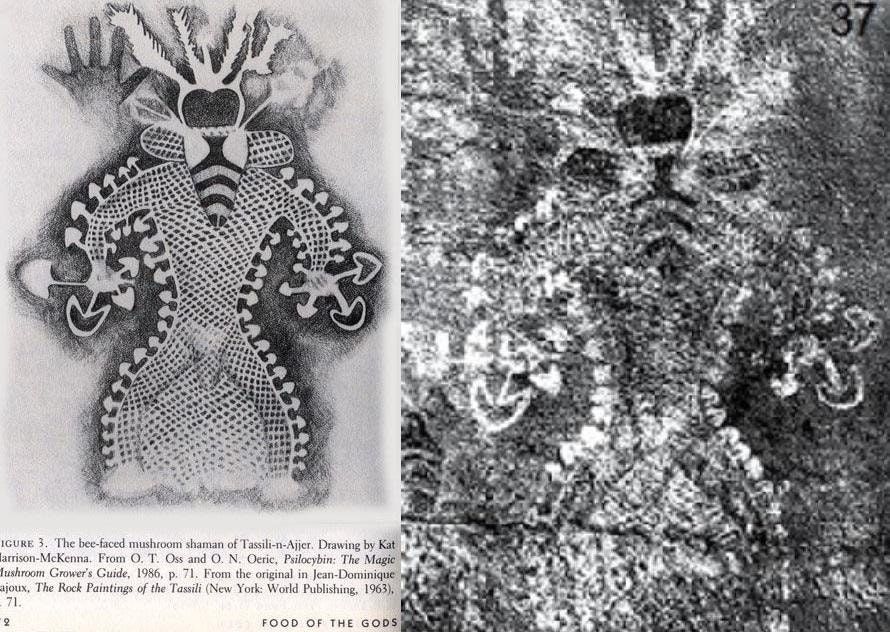
We moderns might wonder what ancient peoples did when not hunting, gathering, and reproducing. The answer is that they did mushrooms, at least according to one interpretation of cave paintings at Tassili n’Ajjer in Algeria, some of which go back 9,000 years. “Here are the earliest known depictions of shamans with large numbers of grazing cattle,” writes ethnobotanist/mystic Terence McKenna in his book Food of the Gods: The Search for the Original Tree of Knowledge. “The shamans are dancing with fists full of mushrooms and also have mushrooms sprouting out of their bodies. In one instance they are shown running joyfully, surrounded by the geometric structures of their hallucinations. The pictorial evidence seems incontrovertible.”
McKenna wasn’t the only scholar of the psychedelic experience to take an interest in Tassili. Giorgio Samorini had written about its ancient paintings a few years before, focusing on one that depicts “a series of masked figures in line and hieratically dressed or dressed as dancers surrounded by long and lively festoons of geometrical designs of different kinds.” Each dancer “holds a mushroom-like object in the right hand,” but the key visual element is the parallel lines that “come out of this object to reach the central part of the head of the dancer.” These “could signify an indirect association or non-material fluid passing from the object held in the right hand and the mind,” an interpretation in line with the idea of “the universal mental value induced by hallucinogenic mushrooms and vegetals, which is often of a mystical and spiritual nature.”
The U.S. Forest Service acknowledges Tassili as “the oldest known petroglyph depicting the use of psychoactive mushrooms,” adding the postulate that “the mushrooms depicted on the ‘mushroom shaman’ are Psilocybe mushrooms.” That name will sound familiar to 21st-century consciousness-alteration enthusiasts, some of whom advocate for the use of psilocybin, the psychedelic compound that occurs in such mushrooms, as not just a recreational drug but a treatment for conditions like depression. Cave art like Tassili’s suggests that such instrumental uses of hallucinogenic plants — as vital parts of rituals, for example — may stretch all the way back to the Neolithic era, when last the Sahara desert was a relatively verdant savanna rather than the vast expanse of sand we know today.
A sense of continuity with the practices of these long-ago predecessors — ancient Egyptians to the ancient Egyptians, as one Redditor frames it — must enrich mushroom use for many psychonauts today. And indeed, the “bee-headed shaman” and his compatriots have had a robust cultural afterlife: “A popularly published drawing based on one of the Tassili figures has become an icon of post-1990’s psychedelia,” says Brian Akers of Mushroom: The Journal of Wild Mushrooming. The “abstract-bizarre” style of its images have also put it “among the sites favored by ancient ET theorizing.” However rich the visions experienced by the cave-painters who once lived there, surely none could have been as mind-blowing as the idea that their work would still fire up imaginations nine millennia later.
via Reddit
Related Content:
Was a 32,000-Year-Old Cave Painting the Earliest Form of Cinema?
Based in Seoul, Colin Marshall writes and broadcasts on cities, language, and culture. His projects include the Substack newsletter Books on Cities, the book The Stateless City: a Walk through 21st-Century Los Angeles and the video series The City in Cinema. Follow him on Twitter at @colinmarshall or on Facebook.
Read More...How Richard Feynman’s Diagrams Revolutionized Physics
If you want to understand theoretical physics these days—as much as is possible without years of specialized study—there are no shortage of places to turn on the internet. Of course, this was not the case in the early 1960s when Richard Feynman gave his famous series of lectures at Caltech. In published form, these lectures became the most popular book on physics ever written. Feynman’s subsequent autobiographical essays and accessible public appearances further solidified his reputation as the foremost popular communicator of physics, “a fun-loving, charismatic practical joker,” writes Mette Ilene Holmnis at Quanta magazine, even if “his performative sexism looks very different to modern eyes.”
Feynman’s genius went beyond that of “ordinary geniuses,” his mentor, Hans Bethe, director of the Manhattan Project, exclaimed: “Feynman was a magician.” That may be so, but he was never above revealing how he learned his tricks, such that anyone could use his methods, whether or not they could achieve his spectacular results. Feynman didn’t only teach his students, and his millions of readers, about physics; he also taught them how to teach themselves. The so-called “Feynman technique” for effective studying ensures that students don’t just parrot knowledge, but that they can “identify any gaps” in their understanding, he emphasized, and bolster weak points where they “can’t explain an idea simply.”
Years before he became the foremost public communicator of science, Feynman performed the same service for his colleagues. “With physicists in the late 1940s struggling to reformulate a relativistic quantum theory describing the interactions of electrically charged particles,” Holmnis writes, “Feynman conjured up some Nobel Prize-winning magic. He introduced a visual method to simplify the seemingly impossible calculations needed to describe basic particle interactions.” The video above, animated by Holmnis, shows just how simple it was—just a few lines, squiggles, circles, and arrows.
Holmnis quotes Feynman biographer James Gleick’s description: Feynman “took the half-made conceptions of waves and particles in the 1940s and shaped them into tools that ordinary physicists could use and understand.” Feynman Diagrams helped make sense of quantum electrodynamics, a theory that “attempted to calculate the probability of all possible outcomes of particle interactions,” the video explains. Among the theory’s problems was the writing of “equations meant keeping track of all interactions, including virtual ones, a grueling, hopeless exercise for even the most organized and patient physicist.”
Using his touch for the relatable, Feynman drew his first diagrams in 1948. They remain, wrote Nobel Prize-winning physicist Frank Wilczek, “a treasured asset in physics because they often provide good approximations to reality. They help us bring our powers of visual imagination to bear on worlds we can’t actually see.” Learn more about Feynman Diagrams in the video above and at Holmnis’ article in Quanta here.
Related Content:
The “Feynman Technique” for Studying Effectively: An Animated Primer
What Made Richard Feynman One of the Most Admired Educators in the World
Josh Jones is a writer and musician based in Durham, NC. Follow him at @jdmagness
Read More...Pussy Riot’s Nadya Tolokonnikova Tells Protestors What to Do–and Not Do–If Arrested by Authoritarian Police
Note: If the subtitles don’t play automatically, please click the “cc” at the bottom of the video.
Oligarchic regimes built on corruption and naked self-interest don’t typically exhibit much in the way of creativity when responding to crises of legitimacy. The most recent challenge to the oligarchic rule of Vladimir Putin, for example, after the attempted assassination and jailing of his rival, anti-corruption activist Alexey Navalny, revealed “the regime’s utter lack of imagination and inability to plan ahead,” writes Masha Gessen at The New Yorker, and seems to promise an opening for a revolutionary movement.
Perhaps it’s safer to say, Joshua Yaffa writes, “that Russian politics are merely entering the beginning of a protracted new phase,” that will involve more large, coordinated mass protests against the “perceived impunity and lawlessness of Putin’s system,” such as happened all over the country in recent days: “In St. Petersburg, a sizable crowd blocked Nevsky Prospekt, the city’s main thoroughfare. Several thousand gathered in Novosibirsk, the largest city in Siberia. Even in Yakutsk, a faraway regional capital, where the day’s temperatures reached minus fifty-eight degrees Fahrenheit, a number of people came out to the central square.”
Footage from the protests “shows activists pelting Russian riot police and vehicles with snowballs,” Dazed reports. Massive, in-real-life protests have been organized and supported by online activists on Tik Tok, YouTube, and other social media sites, where young people like viral teenager Neurolera share tips—such as pretending to be an indignant American—that might help protestors avoid arrest. In one video calling on young students to attend Saturday’s protests, a young woman holds a book, and captions “explain how she is reading about how citizens’ rights are guaranteed,” writes Brendan Cole at Newsweek. “But wait!” she says in one caption, “In Russia things happen differently.”
Russian citizens, and especially young activists, do not walk into protest situations unprepared for arrest and detention—particularly those who follow longtime trouble-makers Pussy Riot, famous for staging flamboyant anti-Putin protests and getting arrested. In the video at the top, the band/activist collective’s Nadya Tolokonnikova explains “how to behave when you’re arrested.” Detention “is an unpleasant experience,” she says, but it need not “end up being such a traumatic experience.” One must conquer fear with knowledge. During her first arrest, “I was scared because I felt that the police officers held an enormous power over me. That’s not true.”
The English translation seems inexact and many of the intricacies of Russian law will not translate to other national contexts. Woven throughout the video, however, are generally prudent tips—like not adding criminal charges by attacking police during arrest. Last year, the group distributed anti-surveillance make-up tips also useful to activists everywhere. The viral spread of videos like Pussy Riot’s and Neurolera’s tutorial show us a worldwide desire for youthful hope and determination in the face of brutal realities. Yaffa describes the “scenes of police employing brute force” that filled his Russian-language social media during the protests:
In one such video, from St. Petersburg, a woman confronts a column of riot policemen dragging a protester by his arms and asks, “Why are you arresting him?” One of the police officers kicks her in the chest, knocking her to the ground. Watching these scenes, I couldn’t help but think of Belarus, where months of street protests against the rule of Alexander Lukashenka have been marked by brutality and torture by the security forces, and a remarkable willingness from protesters to fight back against riot police, at times forcing them to retreat or abandon making an arrest.
These images do not spread so readily in English-language media, perhaps giving a superficial impression that the current anti-Putin, pro-Navalny movement is a new, young online phenomenon, rather than the continuation of a battle-hardened resistance to twenty years of misrule. “Throwing the book at Navalny could spark protests of undetermined strength and longevity,” Yaffa argues, from which mass movements around the world draw inspiration for years to come.
via Dazed
Related Content:
A History of Pussy Riot: Watch the Band’s Early Performances/Protests Against the Putin Regime
Josh Jones is a writer and musician based in Durham, NC. Follow him at @jdmagness
Read More...Rick Steves’ Europe: Binge Watch 11 Seasons of America’s Favorite Traveler Free Online
“People who are addicted to European travel, this is kind of a frustrating time for them,” says Rick Steves in a podcast interview with The New York Times’ Sam Anderson from this past spring. He should know: since becoming a professional travel guide and educator in the late 1970s, Steves has harnessed his own European travel addiction to build a business empire. To his fellow Europhiles — and especially his fellow Europhile but monoglot Americans making their first leap across the Atlantic — Steves has sold a great many classes, tours, guidebooks, money belts, and neck pillows. Over the past three decades, almost everyone who’s got to know him has done so through his travel shows on public television, especially Rick Steves’ Europe.
“Steves is a joyful and jaunty host, all eager-beaver smiles and expressive head tilts,” writes Anderson of the show, whose star “gushes poetically about England’s Lake District (‘a lush land steeped in a rich brew of history, culture and nature’) and Erfurt, Germany (‘this half-timbered medieval town with a shallow river gurgling through its center’) and Istanbul (‘this sprawling metropolis on the Bosporus’) and Lisbon (‘like San Francisco, but older and grittier and less expensive’).”
In recent years, seasons of Rick Steves’ Europe have become free to watch on Youtube. The eleven full seasons now available also include “Germany’s Romantic Rhine”; Normandy, “War-Torn Yet Full of Life”; “Feisty and Poetic” North Wales; “Little Europe: Five Micro-Countries”; Basque country; and The Best of Slovenia.
As well known for his practical-mindedness as he is for his cheerfulness, Steves has also produced such special broadcasts as a three-part series on the travel skills necessary to cross huge swaths of Europe safely and enjoyably. Given the ongoing coronavirus pandemic, however, it will be a while before any of us can once again put our travel skills to the test. “This virus can stop our travel plans, but it cannot stop our travel dreams,” Steves declares on the podcast with Anderson, leading into the announcement of a new game: Rick Steves’ Europe Bingo, “where the cards have all of the little goofy clichés that show up in almost every one of my shows,” from “Rick visits a church” and “Rick enjoys a local drink” to signature lines like “Oh, baby!” and “Keep on travelin’.”
“You can turn it into a drinking game if you want,” Steves notes. And indeed, with or without the aid of alcohol, there are much worse ways for travelers to pass the remainder of the pandemic than with an extended binge-watch of Rick Steves’ Europe, whose seasons are organized into playlists below:
Related Content:
Explore the Entire World–from the Comfort of Quarantine — with 4K Walking Tours
Based in Seoul, Colin Marshall writes and broadcasts on cities, language, and culture. His projects include the Substack newsletterBooks on Cities, the book The Stateless City: a Walk through 21st-Century Los Angeles and the video series The City in Cinema. Follow him on Twitter at @colinmarshall, on Facebook, or on Instagram.
Read More...Resilience Skills in a Time of Uncertainty: A Free Course from the University of Pennsylvania
Who could use a course on resilience these days? To get you through this winter of discontent, the University of Pennsylvania has created a free version of Dr. Karen Reivich’s “Resilience Skills” course. (It’s part of the Foundations of Positive Psychology Specialization offered through Coursera.) This course teaches students to 1.) understand the protective factors that make one resilient, 2.) make use of non-cognitive strategies that decrease anxiety, 3.) recognize thinking traps and how they undercut resilience, and 4.) create a buffer of positivity that boosts resilience in stressful situations.
The course technically runs four weeks, but it can be binge-watched at whatever rate you like. The course draws on the instructor’s book, The Resilience Factor: 7 Keys to Finding Your Inner Strength and Overcoming Life’s Hurdles. To take the course for free, select the “Audit” option during the registration process.
If you would like to support the mission of Open Culture, consider making a donation to our site. It’s hard to rely 100% on ads, and your contributions will help us continue providing the best free cultural and educational materials to learners everywhere. You can contribute through PayPal, Patreon, and Venmo (@openculture). Thanks!
Related Content:
Introduction to Psychology: A Free Course from Yale University
Building Your Resilience: Finding Meaning in Adversity–Take a Free & Timely Course Online
Read More...Cocktails with a Curator: The Frick Pairs Weekly Art History Lectures with Cocktail Recipes
Once upon a time, not so long ago, First Fridays at the Frick were a gracious way for New Yorkers to kick off the weekend. Admission was waived, participants could take part in open sketching sessions or enjoy live performance, and curators were on hand to give mini lectures on the significance and historical context of certain prized paintings in the collection.
Rather than pull the plug entirely when the museum closed due to the pandemic, the Frick sought to preserve the spirit of this longstanding tradition with weekly episodes of Cocktails with a Curator, matching each selection with recipes for make-at-home themed drinks, with or without alcohol.
Much as we miss these communal live events, there’s something to be said for enjoying these wildly entertaining, educational mini-lectures from the comfort of one’s own couch, drink in hand, no need to crane past other visitors for a view, or worry that one might keel over from locking one’s knees too long.
Deputy Director and Peter Jay Sharp Chief Curator Xavier F. Salomon makes for an especially engaging host. His coverage of James McNeill Whistler’s Symphony in Flesh Color and Pink: Portrait of Mrs. Frances Leyland, above, touches on the artist’s affinity for butterflies, music, Japanese themes and building his own frames.
But the greatest delight is Salomon’s talent for imbuing 19th-century art world gossip with a sense of immediacy.
Sip a sake highball (or a virgin sangria-style refresher of plum juice and mint) and chew on the true nature of the artist’s relationship with his shipping magnate patron’s wife.
Sake Highball
sake (of your choice)
club soda (as much/little as needed)
lots of iceAlternative Mocktail
plum juice
ice
cut orange, lemon and apple (sangria style)
mint leaves
sugar (as needed)
Salomon returns to consider one of the Frick’s most iconic holdings, François Boucher’s rococo Four Seasons.
Commissioned in 1755 to serve as over-door decorations for King Louis XV’s mistress Madame de Pompadour, they now reside in the Frick’s ornate Boucher Room.
Salomon draws comparisons to another swooning Frick favorite, Jean-Honoré Fragonard’s series Progress of Love. While the romantic nature of these works is hardly a secret, Salomon is able to speak to the erotic significance of dolphins, grapes, and tiny 18th-century shepherdess bonnets.
Those who are respecting COVID protocols by courting outdoors this winter will welcome Salomon’s thoughts on Winter’s central figure, a coquette riding in a sleigh driven by a well-bundled man in Tartar dress:
Her hands may be warmed by a muff, but her upper body is completely exposed. It’s a combination of luxury and seduction typical of Boucher, all treated in a fanciful, even humorous manner.
Also, is it just us, or is Curator Salomon taking the opportunity to enjoy his Proust-inspired Time Regained cocktail in a kimono? (A perk of the virtual office…)
Time Regained
2 oz. Scotch whisky
0.75 oz. Dry vermouth
0.5 oz. Pisco
0.25 oz. Jasmine tea syrup (equal parts of jasmine tea and sugar)Alternative Mocktail
Cold jasmine tea
One spoonful of golden syrup
Top with tonic water
Salomon hands hosting duties to colleague Aimee Ng for Vermeer’s Mistress and Maid, one of three works by the Dutch Master in the Frick’s collection.
Here the drama is less explicitly informed by the boudoir, though there’s a big reveal around the 10 minute mark, thanks to recent advances in infrared reflectography and some well-coordinated art sleuthing.
As to the contents of the message the maid proffers her ermine trimmed mistress, we’ll never know, although those of us with ready access to the Dutch spirit genever can have fun speculating over a glass of Genever Brûlée.
Genever Brûlée
2 oz genever
1 teaspoon brown sugar
A few dashes of classic bitters
A dash of orange bitters
A splash of sparkling water
Garnished with a caramelized orange sliceAlternative Mocktail
Juice of half an orange
2 dashes orange blossom water
A splash of sparkling water
Garnished with a caramelized orange slice
To explore a playlist of every Cocktails with a Curator episode, covering such notable works as Velázquez’s King Philip IV of Spain, Claude Monet’s Vétheuil in Winter, and Hans Holbein’s Sir Thomas More, click here.
To read more in-depth coverage of each episode’s featured artwork, along with its cocktail and mocktail recipes, click here.
Related Content:
Visit 2+ Million Free Works of Art from 20 World-Class Museums Free Online
14 Paris Museums Put 300,000 Works of Art Online: Download Classics by Monet, Cézanne & More
Ayun Halliday is an author, illustrator, theater maker and Chief Primatologist of the East Village Inky zine. She most recently appeared as a French Canadian bear who travels to New York City in search of food and meaning in Greg Kotis’ short film, L’Ourse. Follow her @AyunHalliday.
Read More...How Quentin Tarantino Shoots a Film at 3 Different Budget Levels: Reservoir Dogs ($1 Million), Pulp Fiction ($8 Million), and Once Upon a Time in Hollywood ($95 Million)
Quentin Tarantino has never shied away from talking, at length and at a rapid clip, about his process. “In another life,” Colin Marshall writes in a previous post on the subject, he might have become a “foremost practitioner” of the video essay on cinema. His meticulous analyses of not only his own films but also the hundreds he references–or outright steals from–can be dizzying, the ravings of an overactive creative mind that seems impossible to rein in.
Tarantino has also given us significant insight into his screenwriting process, saying “I was put on Earth to face the blank page” and claiming that he watches the entire film in his mind’s eye before putting pen to paper. He wrote Pulp Fiction “off and on,” Mark Seal notes at Vanity Fair, “in a one-room apartment with no phone or fax” in Amsterdam. Then he sought out veteran Hollywood typist Linda Chen, who agreed to type, and edit, the manuscript for free.
“His handwriting is atrocious,” says Chen. “He’s a functional illiterate. I was averaging about 9,000 grammatical errors per page. After I would correct them, he would try to put back the errors, because he liked them.”
As a writer, Tarantino’s quirks don’t actually seem out of place. As a director, his process would not seem to lend itself to the most disciplined production. The final product of that error-ridden script, however, became what Roger Ebert called “the most influential” movie of the 90s, “so well written in a scruffy, fanzine way that you want to rub noses in it—the noses of those zombie writers who take ‘screenwriting’ classes that teach them the formulas for ‘hit films.’” Of course, great writing is an indispensable part of making a great film, but so too is great filmmaking.…
How did Tarantino go from feverishly hand-scribbled script to a “most influential” film as a director? He has worked within strict limitations, as on his directorial debut, Reservoir Dogs, with larger budgets and better sets, as on Pulp Fiction, and on his most recent film, the $95 million Once Upon a Time in Hollywood. But he has always maintained a consistent visual style easily recognizable across all nine of his films.
In the video essay above from In Depth Cine, you can learn more of the story of how Tarantino accomplished his directorial visions, and how that style followed him from film to film. The video gets into technical details like the choice of 35mm cameras and the lighting placement. It also tells the story of how three films—Reservoir Dogs, Pulp Fiction, and Once Upon a Time in Hollywood—used their vastly different budget levels, while all remaining true to each other and to their writer and director’s intentions.
Related Content:
An Analysis of Quentin Tarantino’s Films Narrated (Mostly) by Quentin Tarantino
Quentin Tarantino Explains How to Write & Direct Movies
Josh Jones is a writer and musician based in Durham, NC. Follow him at @jdmagness
Read More...When the Grateful Dead Performed on Hugh Hefner’s Playboy After Dark & Secretly Dosed Everyone With LSD (1969)
At one time, whatever else people did with it, they really did read Playboy for the articles. And whatever other vicarious thrills they might obtain from Hugh Hefner’s Playboy’s Penthouse variety show or its follow-up, Playboy After Dark, they definitely tuned in for the music. Guests included Ike & Tina Turner, The Byrds, Buddy Rich, Cher, Deep Purple, Fleetwood Mac, Steppenwolf, James Brown, and many more. On January 18, 1969, the Grateful Dead performed, and it went exactly as one might expect, meaning “things got totally out-of-hand,” Dave Melamed writes at Live for Live Music, “but everything wound up working out just fine.
Things worked out more than fine, despite, or because of, the fact that the band’s legendary sound-man Owsley “Bear” Stanley (at that time the largest supplier of LSD in the country) dosed the coffee pot on set. Dead drummer Bill Kreutzmann tells the story in the Conan clip below. It all started, he says, during soundcheck, when he noticed that the crew was acting “kinda loose.” Knowing Stanley as he did, he immediately suspected the cause: “the whole crew, all of you” he says pointing toward the Conan camera operators, “was high on acid.”
There’s not much evidence of it in the footage. There don’t seem to be any technical problems in the clip at the top. In their brief, jovial interview, Hefner and Garcia seem plenty relaxed. Jerry tells the Playboy founder why the band has two drummers. (They “chase each other around, sort of like the serpent that eats its own tail” and “make a figure in your mind” if you stand between them.) Then he takes the stage and the band plays “Mountains of the Moon” and “St. Stephen.”
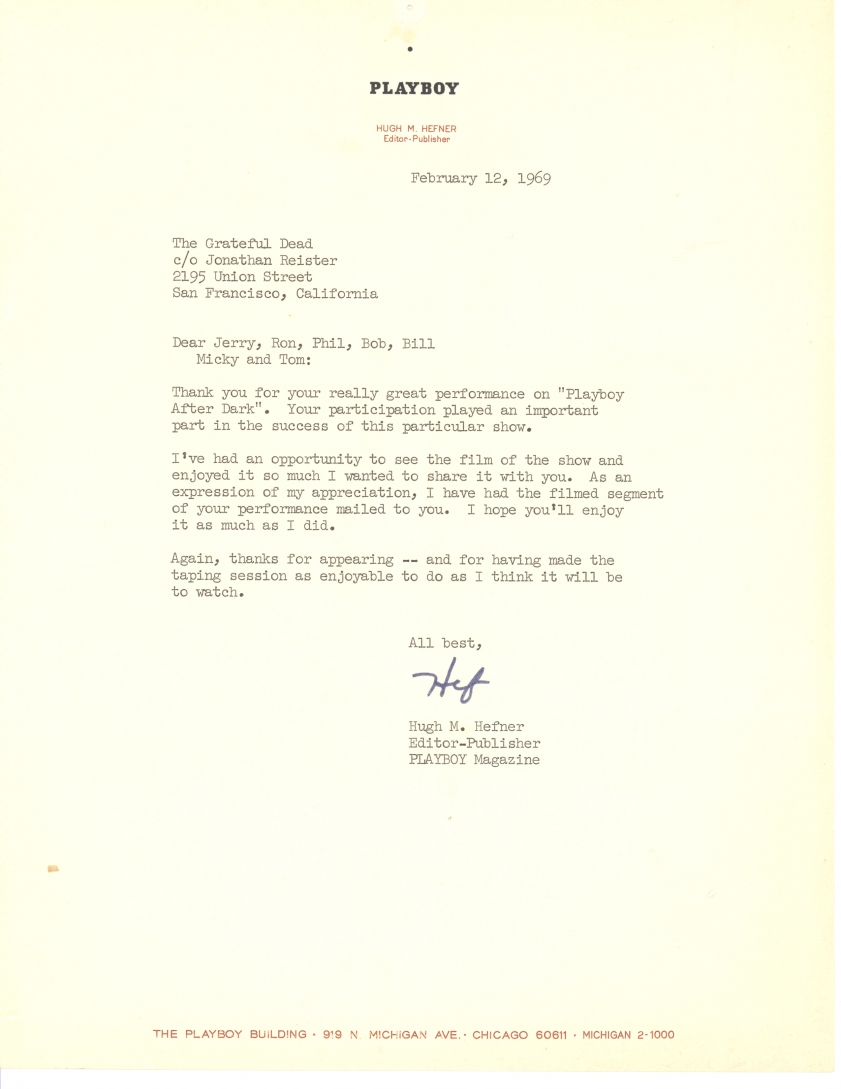
Hefner was so appreciative of whatever happened on set that he sent a personal letter of thanks the following month (below), addressed to each member of the band. “Your participation played an important part in the success of this particular show.” He enclosed a film of the performances and expressed his gratitude “for having made the taping session as enjoyable to do as I think it will be to watch.”
Kreutzmann relates some other anecdotes in his 2015 Conan interview, including a funny bit about how the band got its name. But the best part of the appearance is watching him imitate Hefner, who was apparently plastered to the wall by the end of the set, the coffee really starting to kick in.
This strange chapter of Grateful Dead history is one of many memorialized in the new graphic novel, Grateful Dead Origins.
via Laughing Squid
Related Content:
Josh Jones is a writer and musician based in Durham, NC. Follow him at @jdmagness
Read More...How to Make a Savile Row Suit: A Short Documentary from the Museum of Modern Art
Savile Row is unfashionable. This, of course, is its great strength: not for nothing does that London street stand as the last word in timeless tailoring. Since at least the early 19th century, men have gone to Savile Row not just to commission handmade suits from their favorite shops, but to participate in as many fittings as necessary throughout the process of bringing those suits ever closer to perfection. The result, over decades and indeed generations of regular patronage, is the cultivation of not fashion but style. Even so, Savile Row figures in the Museum of Modern Art’s online course Fashion as Design, whose videos on the making of a bespoke three-piece suit you can see here.
It all happens at Anderson & Sheppard, a fixture on the Row since 1906. In the first video, “behind a drawn curtain, a master cutter” — whose job includes not just cutting the cloth but interacting with the client — “takes an initial series of 27 measurements: 20 for the jacket, 7 for the trousers. From these measurements, the cutter fashions a pattern in heavy brown paper.”
We then see the cloth cut to this pattern, “and the many pieces of fabric are rolled for each garment into tiny packages, which await the tailors.” The second, which begins in the back of the house, shows how these tailors “receive their bundles of fabric and set about deciphering the cutter’s notes. Three weeks after a client’s measurements have been taken, his suit will be ready for a first fitting.”
Emphasis on “first”: though the young man being fitted here only appears for one session, some bespoke suits can require two, three, or more, worn each time as a wearable rough draft held together with bright white thread and marked up for later correction. This reflects not the tailor’s inability to get it right the first time, but the rigorous desire of the Savile Row habitué for an ideal fit. (Anderson & Sheppard’s list of former clients include such notoriously perfectionist dressers as Fred Astaire, Bryan Ferry, and Prince Charles.) Watching this process from start finish underscores the truth of those famous words, “The difference between style and fashion is quality” — famous words spoken by no less a detractor of Savile Row than Giorgio Armani, but true ones nonetheless.
Related Content:
Recalling Albert Camus’ Fashion Advice, Noam Chomsky Pans Glenn Greenwald’s Shiny Purple Tie
Fashion Designers in 1939 Predict How People Would Dress in the Year 2000
Browse a Collection of Over 83,500 Vintage Sewing Patterns
How Ladies & Gentlemen Got Dressed in the 18th Century: It Was a Pretty Involved Process
Based in Seoul, Colin Marshall writes and broadcasts on cities, language, and culture. His projects include the Substack newsletterBooks on Cities, the book The Stateless City: a Walk through 21st-Century Los Angeles and the video series The City in Cinema. Follow him on Twitter at @colinmarshall, on Facebook, or on Instagram.
Read More...Innovative Pinscreen Animations of Kafka’s “Before the Law”, Gogol’s “The Nose” & Mussorgsky’s “Night on Bald Mountain” (1932–1972)
What do Franz Kafka, Nikolai Gogol, and Modest Mussorgsky have in common? They stand alone among their peers for their darkly humorous sensibilities, fascination with the grotesque, imaginative takes on cultural traditions, and a predisposition for the proto-surreal. Like the odd figure lurching through the first movement of Mussorgsky’s Pictures at an Exhibition, they are gnomic artists: enigmatic and ambiguous, given to the aphoristic in stories and tone poems of monstrous and marvelous beings. It’s easy to imagine the three of them, or their works at least, in cryptic conversation with each other.
We might imagine that conversation as we watch three works by these major European artists—all of which we’ve featured on the site before—animated via the painstaking pinscreen method pioneered by husband-and-wife, Russian-and-French duo Alexander Alexeieff and Claire Parker.
The two invented the technique in the 1930s. Dedicated to this extremely labor-intensive process, they made 6 short films over a period of 50 years, including adaptations of Kafka’s “Before the Law,” narrated by Orson Welles, Gogol’s “The Nose,” and Mussorgsky’s Night on Bald Mountain.
We know the Mussorgsky piece as a terrifying vignette from Walt Disney’s Fantasia. Seven years before that marriage of classical music and animation came out in 1940, Alexeieff and Parker released their version, at the top. Steve Stanchfield at Cartoon Research calls it “one of the most unusual and unique looking animated films ever created.” Its “delightful and at times horrifying imagery… challenge the viewer to comprehend both their meaning and the mystery of how they were created.” The same could be said of “The Nose” (1963), whose improvised soundtrack by Hai-Minh adds dramatic tension to the eerie animation.
Each of these films uses the same method, a handmade pinscreen device in which thousands of pins are pushed by hand outward and inward for each frame to create areas of light or dark. The pair intended to move beyond the flatness of conventional cel animation techniques and capture the depth and contrast of chiaroscuro. They achieved this through the most achingly slow process imaginable, yet “the illusion of dimensional drawing in animation has rarely been created better,” Stanchfield writes, not even in the most sophisticated computer-generated imagery.
Alexeieff and Parker’s “Before the Law,” from a parable in Kafka’s The Trial, takes a picture-book approach to the animation that would reward younger viewers. Welles’ narration anchors the production with even more than his usual gravitas. In 1972, they returned to Mussorgsky, in the short Pictures at an Exhibition, above. Here, after a prologue in French and the stylizations of the opening Prelude, the figure of the “The Gnome” appears, a translucent homunculus hatching from an egg and dancing across the piano keys. I like to think Mussorgsky, Kafka, and Gogol would find this imagery irresistible.
Related Content:
Kafka’s Parable “Before the Law” Narrated by Orson Welles & Illustrated with Pinscreen Art
Josh Jones is a writer and musician based in Durham, NC. Follow him at @jdmagness.
Read More...Support Us
We're hoping to rely on loyal readers, rather than erratic ads. Please click the Donate button and support Open Culture. You can use Paypal, Venmo, Patreon, even Crypto! We thank you!

About Us

Open Culture scours the web for the best educational media. We find the free courses and audio books you need, the language lessons & educational videos you want, and plenty of enlightenment in between.
Advertise With Us
FREE UPDATES!
GET OUR DAILY EMAIL
Get the best cultural and educational resources on the web curated for you in a daily email. We never spam. Unsubscribe at any time.
FOLLOW ON SOCIAL MEDIA
Open Culture editor Dan Colman scours the web for the best educational media. He finds the free courses and audio books you need, the language lessons & movies you want, and plenty of enlightenment in between.
Advertise With Us

