The Renewed Popularity of Chess and The Queen’s Gambit: Pretty Much Pop Culture Podcast Discussion #78 with Chess Expert J.J. Lang

The high level of interest in Netflix’s adaptation of the 1984 Walter Tevis novel, The Queen’s Gambit has brought this most popular game back to the forefront of pop culture. Chess expert/teacher J.J. (who’s also a grad student in philosophy) joins your hosts Mark Linsenmayer, Erica Spyres, and Brian Hirt to consider chess culture, what gives this game its edge on other contenders (why not Terra Mystica?), player personality characteristics, and the effect of chess media.
We consider gender, genius, and other issues in Gambit, plus Pawn Sacrifice, Searching for Bobby Fisher, The Luzhin Defense, and The Coldest Game.
A few articles and lists:
- “Five Myths About Chess” by Jennifer Shahade
- “Queen’s Gambit Beauty Debate Explained” by Constance Grady
- “The Fatal Flaw of the Queen’s Gambit” by Sarah Miller
- “16 Things You Probably Didn’t Know About ‘The Queen’s Gambit’” by Janaki Jitchotvisut
- “10 Essential Movies About Chess” by Tim Grierson
- “10 Movies to Watch About Chess if You Liked Netflix’s The Queen’s Gambit” by Jake Dee
- “‘Genius’: 10 Films That Explore the Brilliant Mind” by Kat Sommers
Watch J.J. on stream on Twitch. Other interviews he’s done: Perpetual Chess, Friends and Enemies, Aakaash
Hear more of this podcast at prettymuchpop.com. This episode includes bonus discussion about more chess films and other topics that you can access by supporting the podcast at patreon.com/prettymuchpop. This podcast is part of the Partially Examined Life podcast network.
Pretty Much Pop: A Culture Podcast is the first podcast curated by Open Culture. Browse all Pretty Much Pop posts.
Read More...Rarely-Seen Illustrations of Dante’s Divine Comedy Are Now Free Online, Courtesy of the Uffizi Gallery
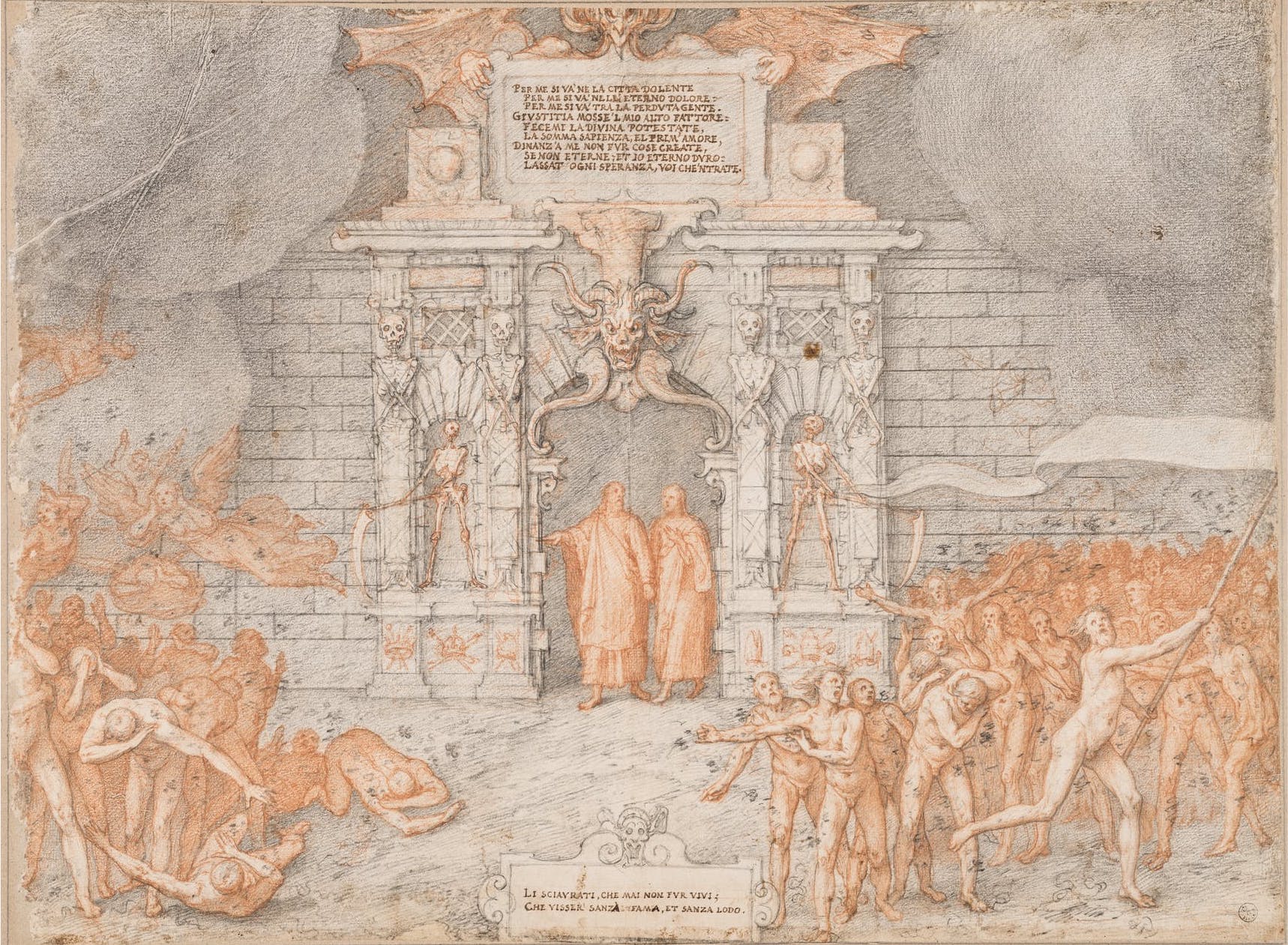
We know Dante’s Divine Comedy—especially its famous first third, Inferno—as an extended theological treatise, epic love poem, and vicious satire of church hypocrisy and the Florentine political faction that exiled Dante from the city of his birth in 1302. Most of us don’t know it the way its first readers did (and as Dante scholars do): a compendium in which “a number of medieval literary genres are digested and combined,” as Robert M. Durling writes in his translation of the Inferno.
These literary genres include vernacular traditions of romance poetry from Provence, popular long before Dante turned his Tuscan dialect into a literary language to rival Latin. They include “the dream-vision (exemplified by the Old French Romance of the Rose)”; “accounts of journeys to the Otherworld (such as the Visio Pauli, Saint Patrick’s Purgatory, the Navigatio Sancti Brendani)”; and Scholastic philosophical allegory, among other well-known forms of writing at the time.
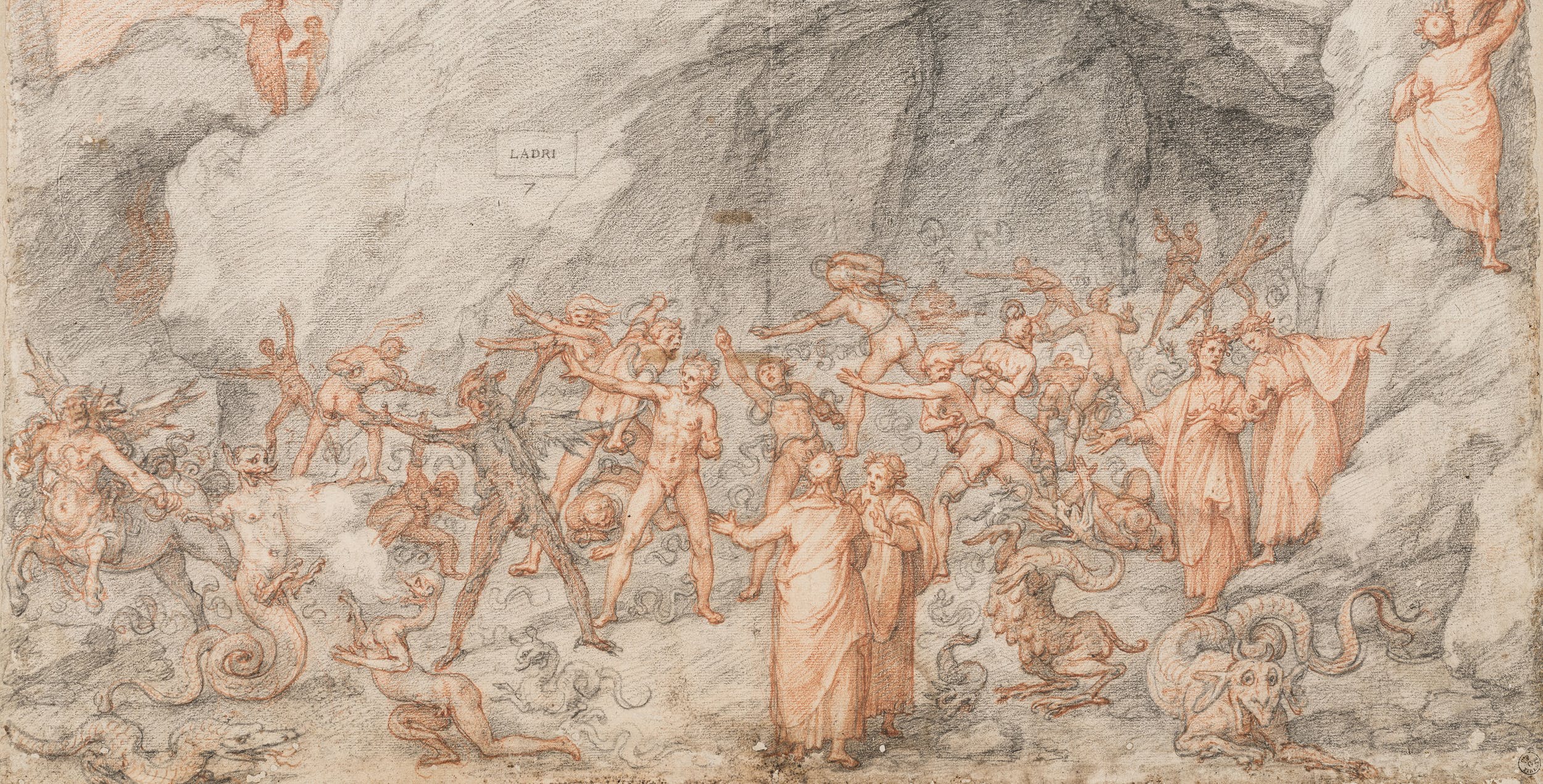
By the time the Divine Comedy captured imaginations in the period of incunabula, or the infancy of the printed book, many of these associations and influences had receded. And by the time of the Counter-Reformation, the poem most impressed readers and illustrators of the text as a divine plan for a torture chamber and an encyclopedia of the tortures therein. Whatever other associations we have with Dante’s poem, we all know the nine circles of hell and have an ominous sense of what goes on there.
No doubt we also have in our mind’s eye some of the hundreds of illustrations made of the text’s gruesome depictions of hell, from Sandro Botticelli to Robert Rauschenberg. Illustrated editions of Dante’s poem began appearing in 1472, and the first fully illustrated edition in 1491. By the late 16th century, the poem had become a literary classic (the word Divine joined Comedy in the title in 1555). By this time, the tradition of depicting a literal, rather than a literary, hell was firmly established.
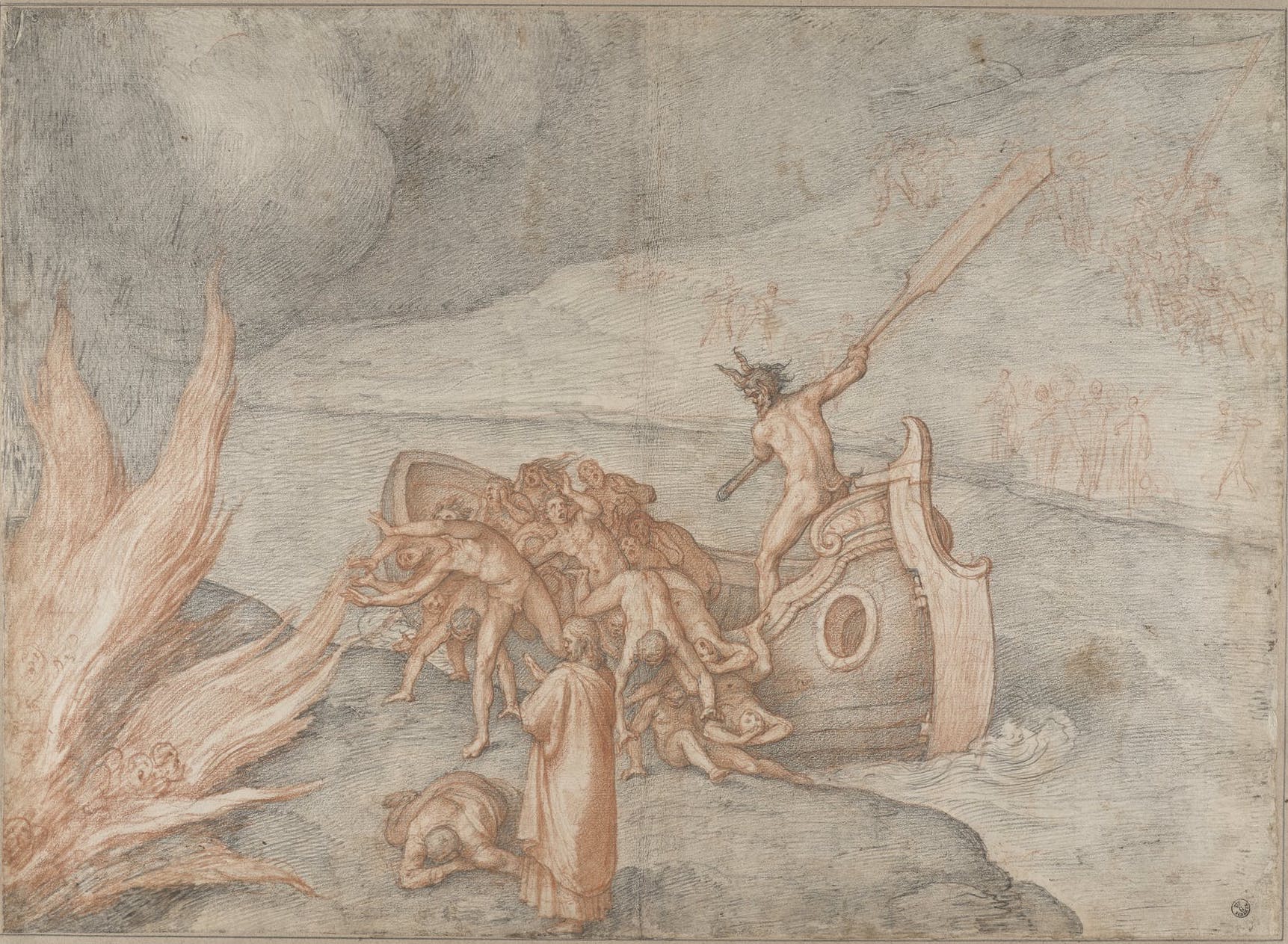
It was in this period that Frederico Zuccari made the beautiful illustrations you see here, completed, Angela Giuffrida writes at The Guardian, “during a stay in Spain between 1586 and 1588. Of the 88 illustrations, 28 are depictions of hell, 49 of purgatory and 11 of heaven. After Zuccari’s death in 1609, the drawings were held by the noble Orsini family, for whom the artist had worked, and later by the Medici family before becoming part of the Uffizi collection in 1738.”
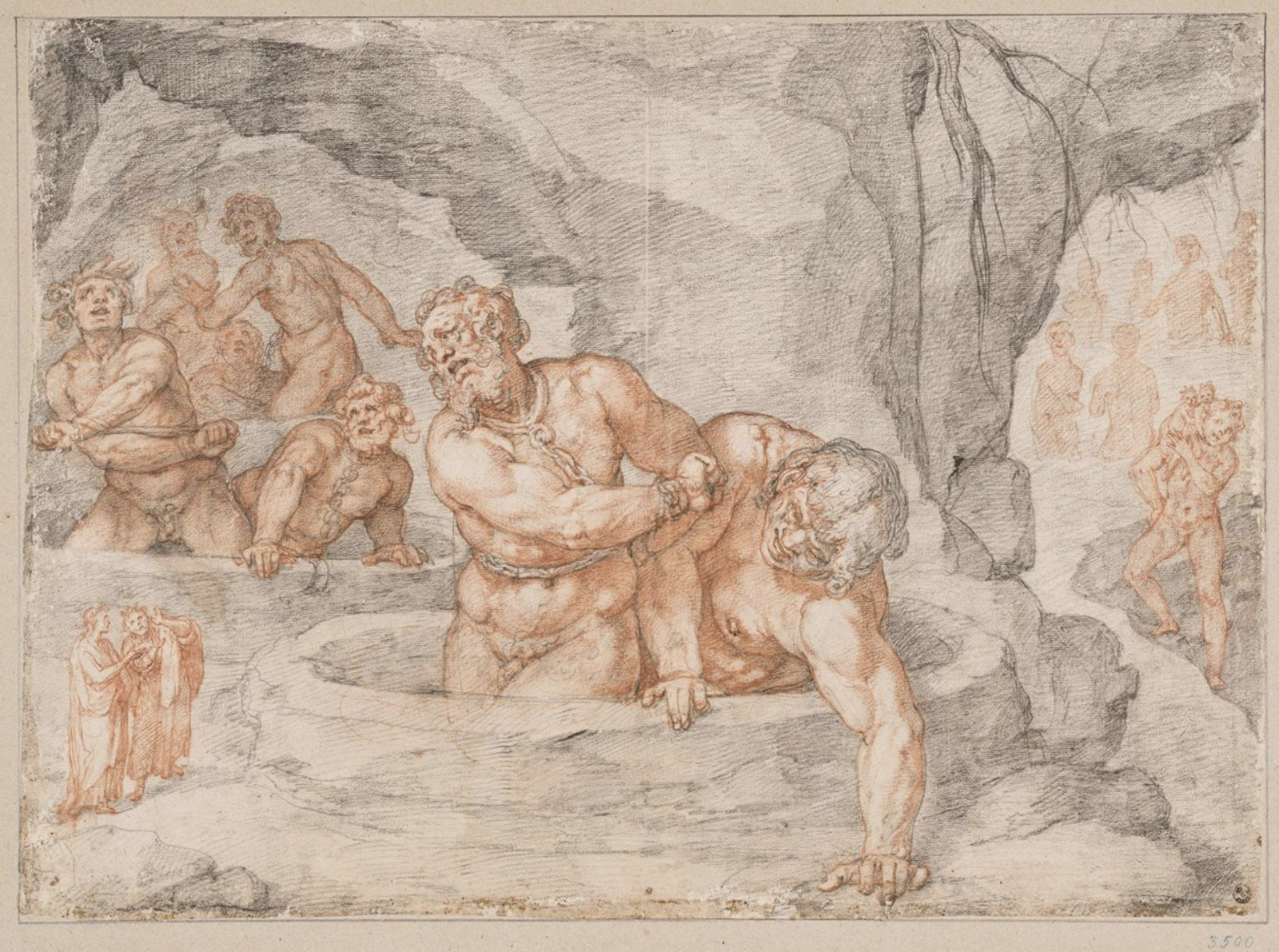
The pencil-and-ink drawings have rarely been seen before because of their fragile condition. They were only exhibited publicly for the first time in 1865 for the 600th anniversary of Dante’s birth and of Italian unification. Now, they are on display, virtually, for free, as part of a “year-long calendar of events to mark the 700th anniversary of the poet’s death.” This is an extraordinary opportunity to see these illustrations, which have until now “only been seen by a few scholars and displayed to the public only twice, and only in part,” says Uffizi director Eike Schmidt.
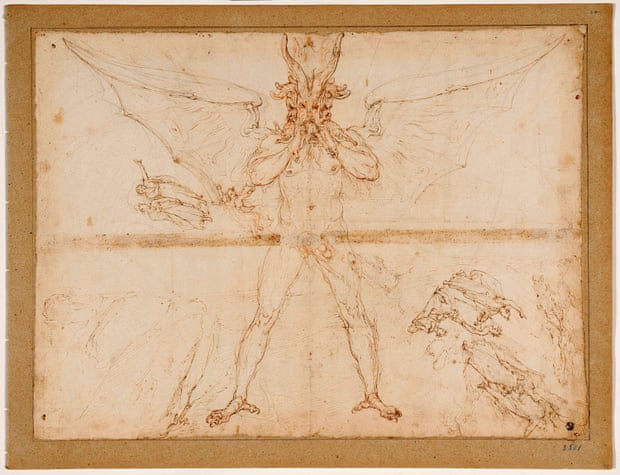
Much of the promised “didactic-scientific comment” to accompany each drawing is marked as “upcoming” on the English version of the Uffizi site, but you can see high resolution scans of each drawing and zoom in to examine the many tortures of the damned and the grotesque demons who torment them. Learn much more at Khan Academy about how Dante’s literary epic in terza rima left “a lasting impression on the Western imagination for more than half a millennium,” solidifying and reshaping images of hell “into new guises that would become familiar to countless generations that followed.” If you like, you can also take a free course on Dante’s Divine Comedy from Yale University.
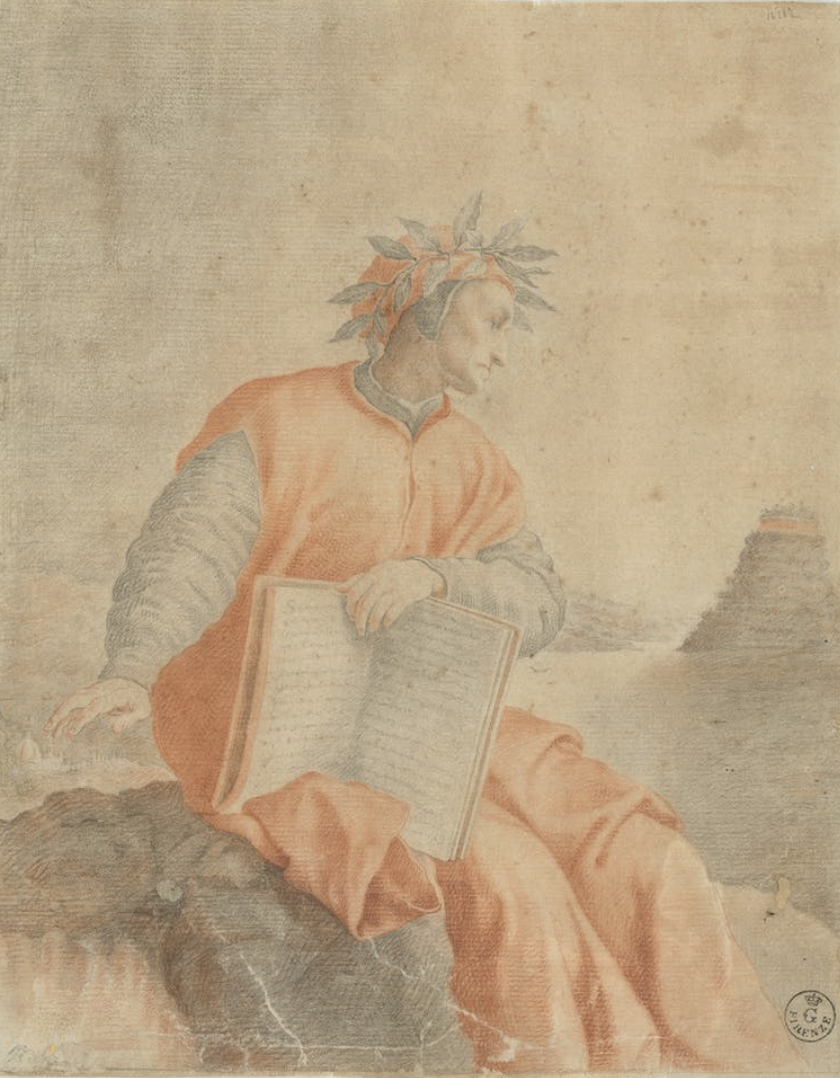
via MyModernMet/The Guardian
Related Content:
Why Should We Read Dante’s Divine Comedy? An Animated Video Makes the Case
A Digital Archive of the Earliest Illustrated Editions of Dante’s Divine Comedy (1487–1568)
Josh Jones is a writer and musician based in Durham, NC. Follow him at @jdmagness
Read More...Brâncuși Captures His Sculpture & Life on Film: Watch Rare Footage Shot Between 1923–1939
Here in the early 21st century, even the non-artists among us carry digital video cameras in our pockets. Back in the early 20th century, the ability to film your own life and work, or that of your coterie, wasn’t so close at hand — unless, of course, you ran with the avant-garde. Constantin Brâncuși did, having been brought into the artistic and intellectual scene of the Paris of the 1910s, to which he’d made his way from his native Romania. He eventually counted among his friends the likes of Pablo Picasso, Ezra Pound, Marcel Duchamp, Guillaume Apollinaire, Tristan Tzara, and Man Ray, who got the innovative, hardworking and famously low-tech sculptor practicing cinema.
“In the early 1920s, Man Ray, who had previously taught Constantin Brâncuși how to handle a still camera, introduced him to the movie camera,” says Ubuweb in a description of “fifty minutes of film, shot between 1923 and 1939,” that represents “the sum total of all the images ever filmed by Brâncuși.”
The artist “makes use of framing, shadows, incidental light and refraction in order to activate the plastic properties of his sculptures, and opens up this visual analysis to movement and to time.” Pieces such as Leda and the scandalous Princess X become the subjects of their own sequences; later, we witness “Brancusi’s journey to Romania and the construction of the Endless Column in Târgu Jiu.”
These Endless Column passages, as art critic Blake Gopnik sees them, show “Brâncuși obsessed with how his soaring sculpture comes to life in the open air.” From all this footage Gopnik gets the sense that Brâncuși was “less interested in making fancy museum objects than in putting new kinds of almost-living things into the world,” and indeed drawing inspiration from the living things of the world: “In one of the clips, Brâncuși turns his camera on a pacing hawk, which comes across as a close, natural analog to the many ‘birds’ he created as sculptures.” Another “shows one of his stone pedestals, which meant as much to him as the sculptures set on them, supporting a live flapper doing an ecstatic dance” — captivating evidence of his interest in forms of life beyond the avian.
Related Content:
Rare Film of Sculptor Auguste Rodin Working at His Studio in Paris (1915)
Man Ray’s Portraits of Ernest Hemingway, Ezra Pound, Marcel Duchamp & Many Other 1920s Icons
Based in Seoul, Colin Marshall writes and broadcasts on cities, language, and culture. His projects include the Substack newsletterBooks on Cities, the book The Stateless City: a Walk through 21st-Century Los Angeles and the video series The City in Cinema. Follow him on Twitter at @colinmarshall, on Facebook, or on Instagram.
Read More...Ursula K. Le Guin Stamp Getting Released by the US Postal Service

Here’s one thing that’s going right with America’s decaying postal system. They write on the USPS web site: “The 33rd stamp in the Literary Arts series honors Ursula K. Le Guin (1929–2018), who expanded the scope of literature through novels and short stories that increased critical and popular appreciation of science fiction and fantasy. The stamp features a portrait of Le Guin based on a 2006 photograph. The background shows a scene from her landmark 1969 novel “The Left Hand of Darkness,” in which an envoy from Earth named Genly Ai escapes from a prison camp across the wintry planet of Gethen with Estraven, a disgraced Gethenian politician. The artist for this stamp was Donato Giancola. The art director was Antonio Alcalá. The words “three ounce” on this stamp indicate its usage value. Like a Forever stamp, this stamp will always be valid for the value printed on it.” The postal service has not said precisely when the stamp will be released.
If you would like to support the mission of Open Culture, consider making a donation to our site. It’s hard to rely 100% on ads, and your contributions will help us continue providing the best free cultural and educational materials to learners everywhere. You can contribute through PayPal, Patreon, and Venmo (@openculture). Thanks!
Related Content:
Ursula K. Le Guin’s Daily Routine: The Discipline That Fueled Her Imagination
When Ursula K. Le Guin & Philip K. Dick Went to High School Together
Ursula K. Le Guin Names the Books She Likes and Wants You to Read
Read More...How Levi’s 501 Jeans Became Iconic: A Short Documentary Featuring John Baldessari, Henry Rollins, Lee Ranaldo & More
In his memoir Living Carelessly in Tokyo and Elsewhere, the American Japanologist John Nathan remembers evenings in the 1960s spent with Yukio Mishima, whose work he translated into English. “I listened raptly as he recited passages from The Tale of the Heike that revealed the fierceness and delicacy of Japan’s warrior-poets, or showed me the fine calibration of the Chinese spectrum,” Nathan writes. “One night he stood up abruptly from behind his desk, asked me to wait a minute, and left the room. When he came back he had changed into a pair of blue jeans and a thick black leather belt. He explained that he had been sandpapering the jeans to make them identical to the pair Marlon Brando had worn in The Wild One.”
Even a figure like Mishima, who within a few years would die in an ultranationalistic ritual suicide after a hopeless attempted coup, felt the allure of American blue jeans. Though Nathan doesn’t note whether Mishima’s pair were genuine Levi’s 501s, the exacting standards to which Mishima held himself in all respects would seem to demand that measure of authenticity.
“Authenticity,” of course, is a quality from which Levi Strauss & Co. have drawn a great deal of value for their brand, their signature riveted denim product going back as it does nearly a century and a half, to a time when rugged pants were in great demand from the miners of California’s gold rush. But it was in the economically flush and newly media-saturated decades after the Second World War that jeans took their hold on the American imagination, and soon on the world’s.
The pants, the myth, and the legend star in The 501 Jean: Stories of an Original, a three-part series of short documentaries produced by Levi’s themselves and narrated by American folk singer Ramblin’ Jack Elliott. Its gallery of 501-wearers includes such job titles as Musician, Photographer, Garmentologist, Biker, Creative Director, Music/Style Consultant, and Urban Cowboy. Conceptual artist John Baldessari discusses the childhood love of cowboy shows that lodged jeans permanently into his worldview. Album designer Gary Burden brings out his own work, a copy of Neil Young’s After the Gold Rush, to demonstrate the impact of jeans on popular music. That both Burden and Baldessari have passed away since these videos’ production underscores the current fast departure of the generations who took jeans from the realm of the utilitarian into that of the iconic — some of whose members have doubtless chosen to be buried in their 501s.
Related Content:
Based in Seoul, Colin Marshall writes and broadcasts on cities, language, and culture. His projects include the Substack newsletterBooks on Cities, the book The Stateless City: a Walk through 21st-Century Los Angeles and the video series The City in Cinema. Follow him on Twitter at @colinmarshall, on Facebook, or on Instagram.
Read More...The Deadliest Garden in the World: Visit Alnwick’s Poison Garden in Northumberland, England
The mind reels to think of all the early humans who sacrificed themselves, unwittingly, in the prehistoric quest to learn which plants were safe to eat, which were suitable for healing, and which would maim or kill whoever who touched them. Even now, of course, the great majority of us rely on experts to make these distinctions for us. Unless we’re steeped in field training and/or folk knowledge, it’s safe to say most of us wouldn’t have a clue how to avoid poisoning ourselves in the wild.
This need not overly concern us on a visit to The Poison Garden, however. Nestled in manicured lanes at Alnwick Garden, “one of north England’s most beautiful attractions,” Natasha Geiling writes at Smithsonian, the Poison Garden includes such infamous killers as hemlock, Atropa belladonna (a.k.a. Deadly Nightshade), and Strychnos nux-vomica, the source of strychnine, in its collections. Just don’t touch the plants and you should be fine. Oh, and also, guides tell visitors, “don’t even smell them.” It should go without saying that tasting is out.
The Poison Garden is hardly the main attraction at Alnwick, in Northumberland. The castle itself was used as the setting for Hogwarts in the first two Harry Potter films. The 14 acres of controversial modern landscape gardens–designed by the flamboyant Jane Percy, Duchess of Northumberland–have become famous in their own right, in part for violating “England’s architectural patrimony,” a scandal you can read about here. (One garden designer and critic called it a “popular entertainment, the dream of a girl who looks like Posh and lives at Hogwarts.”)
The duchess responds to criticism of her extravagant designs with a shrug. “A lot of my ideas come from Las Vegas and Euro Disney,” she admits. The Poison Garden has a much more venerable source, the Orto Botanico in Padua, the oldest extant academic botanical garden, founded in 1545, with its own poison garden that dates to the time of the Medicis. After a visit, Percy “became enthralled with the idea of creating a garden of plants that could kill instead of heal,” writes Geiling. She thought of it, specifically, as “a way to interest children.” As the duchess says:
Children don’t care that aspirin comes from the bark of a tree. What’s really interesting is to know how a plant kills you, and how the patient dies, and what you feel like before you die.
What child doesn’t wonder about such things? And if we teach kids how to avoid poisonous plants, they can keep the rest of us alive should we have to retreat into the woods and become foragers again. The Poison Garden also grows plants from which common recreational drugs derive, like cannabis and cocaine, “as a jumping-off point for drug education,” Geiling points out.
Provided visitors follow the rules, the garden is safe, “although some people still occasionally faint from inhaling toxic fumes,” Alnwick Garden’s website warns. And while it’s designed to attract and educate kids, there’s a little something for everyone. Percy’s favorite poisonous plant, for example, Brugmansia, or angel’s trumpet, acts as a powerful aphrodisiac before it kills. She explains with glee that “Victorian ladies would often keep a flower from the plant on their card tables and add small amounts of its pollen to their tea to incite an LSD-like trip.” You can learn many other fascinating facts about plants that kill, and do other things, at Alnwick’s Poison Garden when the world opens up again.
Related Content:
Josh Jones is a writer and musician based in Durham, NC. Follow him at @jdmagness
Read More...Wilhelm Reich’s Orgone Energy Accumulator Was Beloved by William S. Burroughs and Banned by the FDA: Find Plans to Build the Controversial Device Online

Was Austrian Marxist psychoanalyst Wilhelm Reich a trenchant socio-political thinker or a total crank? A fraud or a prophet? Maybe a little from each column, at different times during the course of his bizarre career. An enthusiastic student of Sigmund Freud, Reich applied his teacher’s theories of repressed libido to the frightening political theater of the 1930s, writing against the spread of Nazism in his prescient 1933 book The Mass Psychology of Fascism. Here, Reich brought Marx and Freud together to argue that sexual inhibition and fear led to arrested development and submission to authoritarianism.
Reich was “a sexual evangelist,” Christoper Turner writes at The Guardian, “who held that satisfactory orgasm made the difference between sickness and health.” His work was banned and burned by the Nazis, and he fled to a succession of Scandinavian countries, then to the U.S. in 1939, “by which time his former psychoanalytic colleagues were questioning his sanity.” The primary reason for their suspicion: Reich’s devotion to what he called “orgone,” an all-pervasive sexual energy that permeates the universe… according to Reich. Orgone and related concepts appear in his early work, but by the end of the 1930s, they came to entirely dominate his thinking.
“In the strange and colorful history of pseudoscience, Wilhelm Reich’s ‘discovery’ of orgone—a substance that’s not only a life force, but indeed makes up the very fabric of space—must surely be a watershed,” writes Matt Simon at Wired. Reich intensified his belief in the glowing blue energy of orgone with the invention of the Orgone Energy Accumulator, an isolation box that supposedly charged those who sat inside it with the power of orgone. The device went through a few iterations (see the use of the “orgone blanket, above), until its final form of a metal-lined box roughly the size of a wardrobe or telephone booth.
Reich’s influence on 20th century culture goes far beyond the creation of this weird device. He might be said to have predicted and precipitated what he himself called the “sexual revolution.” (“No power on earth will stop it,” Reich wrote in the 30s.) Critics dismissed his belief in the liberating potential of free love as a “genitial utopia.” Their scorn mattered little to the countercultural figures who picked up and disseminated his work. “Almost a century” after Reich’s invention of orgone, writes Simon, “his bonkers ideas live on,” including the notion that nearly every health condition can be traced to an imbalance of orgone energy.
The Orgone Accumulator was popularized by William S. Burroughs, a true believer—as he was in many things, from Scientology to Shamanism—and an enthusiastic promoter of “life in orgone boxes.” (Jack Kerouac called Burroughs’ accumulator a “mystical outhouse” in On the Road.) Burroughs swore by the accumulator and wrote a 1977 article for Oui magazine in which he defended Reich’s claims that time spent in the sealed box might cure cancer—a claim that prompted the FDA to file an injunction against Reich in 1954 to stop use of the device and literature pertaining to it.
“Reich continued profiting from the accumulators,” writes Simon, “and the court found him in contempt of the injunction. He was sentenced to federal prison, where he died in 1957.” Devotees of his work have defended him ever since. (“Who is the FDA,” wrote Burroughs indignantly, “to deprive cancer patients of any treatment that could be efficacious?”). James DeMeo, Ph.D., director of the Orgone Biophysical Research Laboratory in Ashland Oregon, has recently released the 3rd, revised and expanded, edition of his Orgone Accumulator Handbook, a thorough reference guide, “with construction plans.”
Should you have the desire to build your own “mystical outhouse,” DeMeo’s text would seem to be a definitive reference. Proceed at your own risk. Wilhelm Reich’s orgone therapy remains squarely on a list of treatments unapproved by the FDA. The FBI, on the other hand, who “have a whole section on their website dedicated to Wilhelm Reich,” notes Mary Bellis, found no cause to prosecute the Austrian psychologist. “In 1947,” they note, “a security investigation concluded that neither the Orgone Project nor any of its staff were engaged in subversive activities.” But what could have been more subversive to the post-war U.S. establishment than maintaining the world’s ills could be cured by really good sex? Download a free copy of DeMeo’s book here.
Related Content:
A Look Inside William S. Burroughs’ Bunker
The Famous Break Up of Sigmund Freud & Carl Jung Explained in a New Animated Video
Josh Jones is a writer and musician based in Durham, NC. Follow him at @jdmagness
Read More...A Magical Look Inside the Painting Process of Studio Ghibli Artist Kazuo Oga
The magic of Studio Ghibli’s films owes much to their characters: the high-flying Princess Nausicaä of the Valley of the Wind; the World War I‑fighter ace-turned-swine Porco Rosso; the spirited ten-year-old Chihiro, spirited away into the realm of folklore; the dog-raccoon-bear-cat forest spirit known only as Totoro. But to understand what makes these figures come alive, we must remember that they inhabit living worlds. A Ghibli production stands or falls (which would still count as an artistic triumph at most other studios) on not just character design and animation but background art, which demands the kind of careful and inspired work you can witness in the video above.
The artist at the desk is Kazuo Oga, a veteran background artist credited as art director on Ghibli’s My Neighbor Totoro, Only Yesterday, Pom Poko, Princess Mononoke, and The Tale of Princess Kaguya, among other anime projects. His work begins at about 9:30 in the morning, as he brings out a modestly size sheet of paper and prepares its surface to receive paint.
24 different colors of Japanese-made Nicker Poster Color brand gouache stand ready right nearby, and with them Oga applies the ground, or first layer of paint. Even before he takes a seat, a forest scene has clearly begun to emerge. Then downward strokes become the thin trunks of its trees, which by the early afternoon have branches.
Broadly speaking, Oga works from the large details in toward the small, arriving midway through the 2:00 hour to the stage of adding light purple flowers. These are Paulownia, called kiri in Japan, where these “princess trees” (that also appear on the official Government Seal) carry a certain symbolic weight. The final painting, Paulownia Rain (or kiri same), emerges only at 3:40 in the afternoon, after six hours of painting. This evocative forest landscape attests to the truth of an inversion of the Pareto principle, in that the parts of the job that seem smallest require most of the work to achieve — and to the truth of the Ghibli’s apparent artistic principle that every pain is worth taking.
Related Content:
Studio Ghibli Producer Toshio Suzuki Teaches You How to Draw Totoro in Two Minutes
Watch Hayao Miyazaki Animate the Final Shot of His Final Feature Film, The Wind Rises
A Virtual Tour Inside the Hayao Miyazaki’s Studio Ghibli Museum
Based in Seoul, Colin Marshall writes and broadcasts on cities, language, and culture. His projects include the Substack newsletterBooks on Cities, the book The Stateless City: a Walk through 21st-Century Los Angeles and the video series The City in Cinema. Follow him on Twitter at @colinmarshall, on Facebook, or on Instagram.
Read More...What Can You Do About QAnon?: A Short Take from Documentary Filmmaker Kirby Ferguson
You know that QAnon supporters figured prominently in the Capitol insurrection. Two QAnon conspiracy theorists now hold seats in Congress. And perhaps you read the disturbing profile this weekend about the QAnon supporter who attended the elite Dalton School in Manhattan and then Harvard. So–you’re maybe thinking–it’s finally worth understanding what QAnon is, and what we can do about it. Above, watch a 10 minute Op-Doc from filmmaker Kirby Ferguson, whose work we’ve featured here before. As you’ll see, his recommendations (from late October) align with expert advice found in our recent post, How to Talk with a Conspiracy Theorist: What the Experts Recommend. After the violence of January 6, however, it’s reasonable to ask whether we need something more than coddling and patience.
Related Content:
Constantly Wrong: Filmmaker Kirby Ferguson Makes the Case Against Conspiracy Theories
How to Talk with a Conspiracy Theorist: What the Experts Recommend
Read More...An Origami Samurai Made from a Single Sheet of Rice Paper, Without Any Cutting
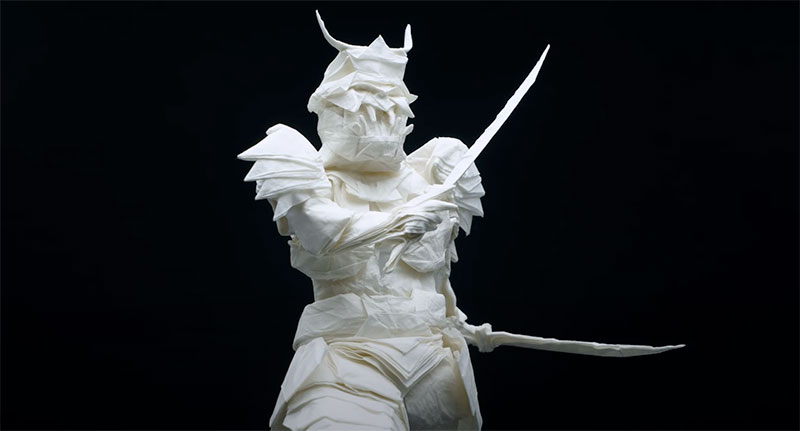
Origami artist Juho Könkkölä spent 50 hours folding an origami samurai from a single square sheet of paper, with no cutting or ripping used in the process. He describes his process on Reddit:
Folded from a single square sheet of 95cm x 95cm Wenzhou rice paper without any cutting. The finished size of the work is 28cm x 16cm x 19cm. Only dry and wet folding techniques were used to fold the model. It took 2 months to design and 1 month to fold, although I was working on few other projects during that time too.
It took some effort and experimentation to fold the texture for the armor, while trying to simplify it to be somewhat manageable to fold. I folded 4 rough test attempts in total, and all of them took 3 days to fold each. There are several hundreds of steps to fold it from the square and there are probably thousands of individual folds. The asymmetry in the design allowed me to include sword on only one arm, while being able to make the character look symmetric.
Find the finished product below. Watch the creative process, from start to finish, above.
If you would like to support the mission of Open Culture, consider making a donation to our site. It’s hard to rely 100% on ads, and your contributions will help us continue providing the best free cultural and educational materials to learners everywhere. You can contribute through PayPal, Patreon, and Venmo (@openculture). Thanks!
Related Content:
MIT Creates Amazing Self-Folding Origami Robots & Leaping Cheetah Robots
Designer Creates Origami Cardboard Tents to Shelter the Homeless from the Winter Cold
Download Classic Japanese Wave and Ripple Designs: A Go-to Guide for Japanese Artists from 1903
Read More...Support Us
We're hoping to rely on loyal readers, rather than erratic ads. Please click the Donate button and support Open Culture. You can use Paypal, Venmo, Patreon, even Crypto! We thank you!

About Us

Open Culture scours the web for the best educational media. We find the free courses and audio books you need, the language lessons & educational videos you want, and plenty of enlightenment in between.
Advertise With Us
FREE UPDATES!
GET OUR DAILY EMAIL
Get the best cultural and educational resources on the web curated for you in a daily email. We never spam. Unsubscribe at any time.
FOLLOW ON SOCIAL MEDIA
Open Culture editor Dan Colman scours the web for the best educational media. He finds the free courses and audio books you need, the language lessons & movies you want, and plenty of enlightenment in between.
Advertise With Us

