MIT’s Introduction to Microeconomics: A Free Online Course
From MIT comes a free introductory undergraduate course on Microeconomics. Taught by Professor Jonathan Gruber, the 26-lecture course covers the fundamentals of microeconomics, including “supply and demand, market equilibrium, consumer theory, production and the behavior of firms, monopoly, oligopoly, welfare economics, public goods, and externalities.” Watch the lectures above (or on YouTube). Find the syllabus and lectures notes on MIT’s site. Coursera also offers a host of other econ courses.
Principles of Microeconomics will be added to the Economics section of our meta list, 1,700 Free Online Courses from Top Universities.
If you would like to support the mission of Open Culture, consider making a donation to our site. It’s hard to rely 100% on ads, and your contributions will help us continue providing the best free cultural and educational materials to learners everywhere. You can contribute through PayPal, Patreon, and Venmo (@openculture). Thanks!
Related Content:
Free Online Economics & Finance Courses
Read More...Take a New Virtual Reality Tour of the Metropolitan Museum of Art
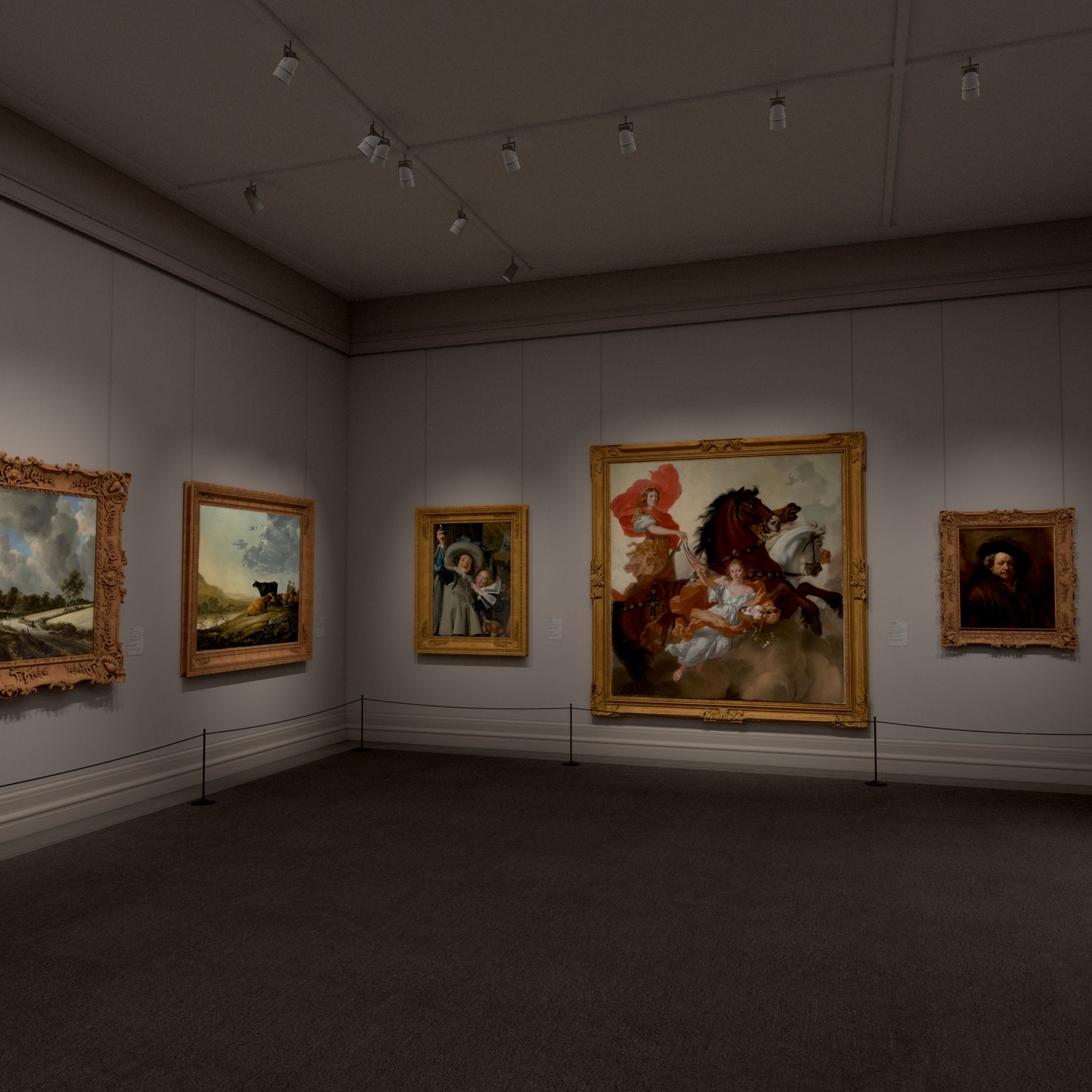
You can go to the Metropolitan Museum of Art today, and in real life at that. This isn’t true of all the world’s great art institutions, still shut down as many are by measures in response to the past year’s coronavirus pandemic. But then, none of them have offered a digital visiting experience quite like The Met Unframed, recently launched in partnership with cellphone service provider Verizon. For a period of five weeks, anyone can join and freely roam a virtual reconstruction, or rather reimagining, of the Met and its galleries. There they’ll encounter paintings by Pollock, Van Gogh, and Rembrandt, as well as work by current artists and majestic artifacts from antiquity.
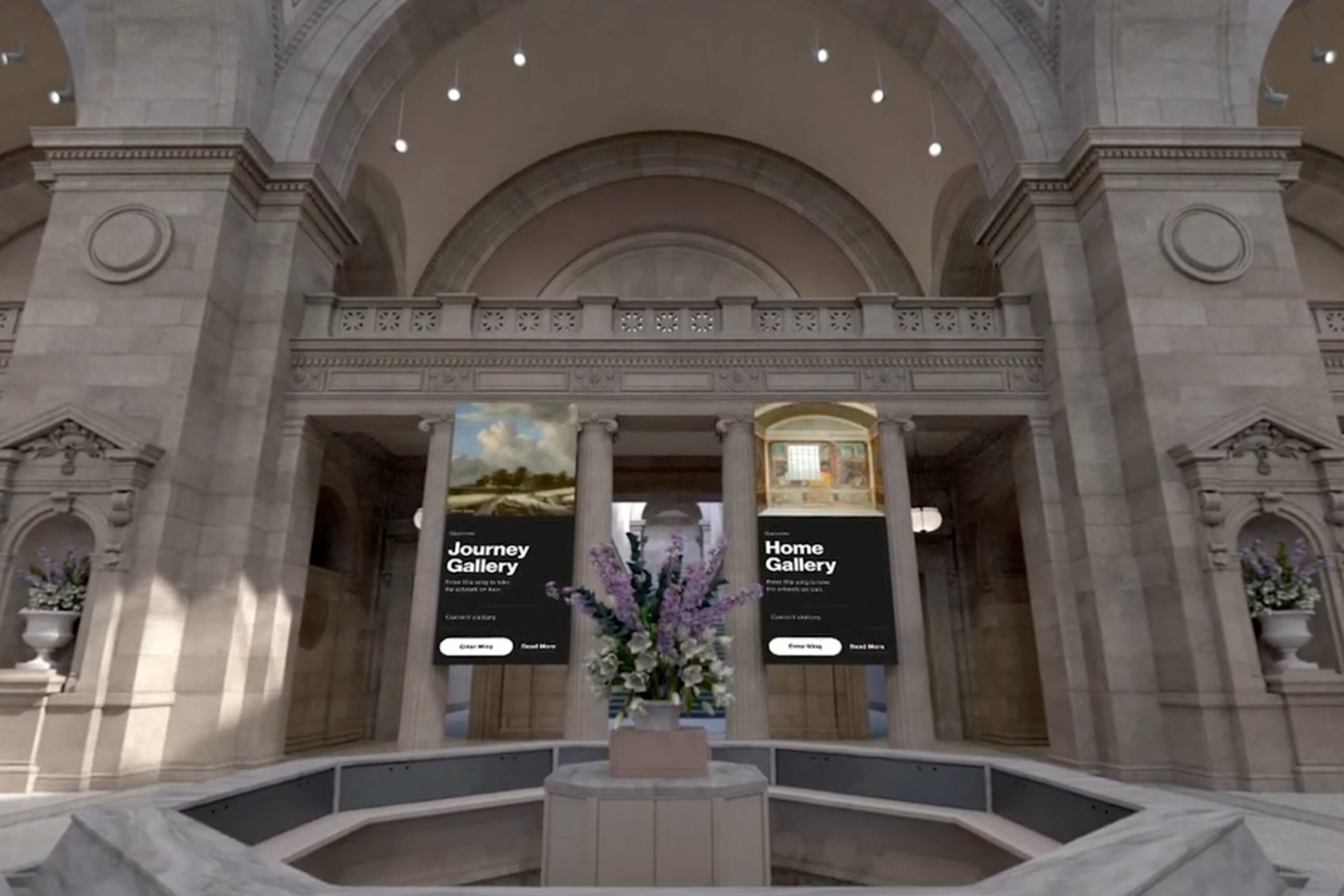
“Upon entering the website, visitors are welcomed to the museum’s Great Hall with a view of Kent Monkman’s diptych mistikôsiwak: Wooden Boat People (2019),” writes Hyperallergic’s Hakim Bishara. “From there, banners offer broad thematic concepts — Power, Home, Nature, and Journey — through which visitors can explore the galleries.”
Embedded in certain pieces of art, you’ll find not just historical details and audio-tour explanations but mini-games, which “include trivia questions and riddles that encourage close observation of the artworks and labels. A game called ‘Analysis’ uses the Met’s infrared and X‑ray conservation scans of paintings to reveal underdrawings and other hidden details of well-known paintings.”
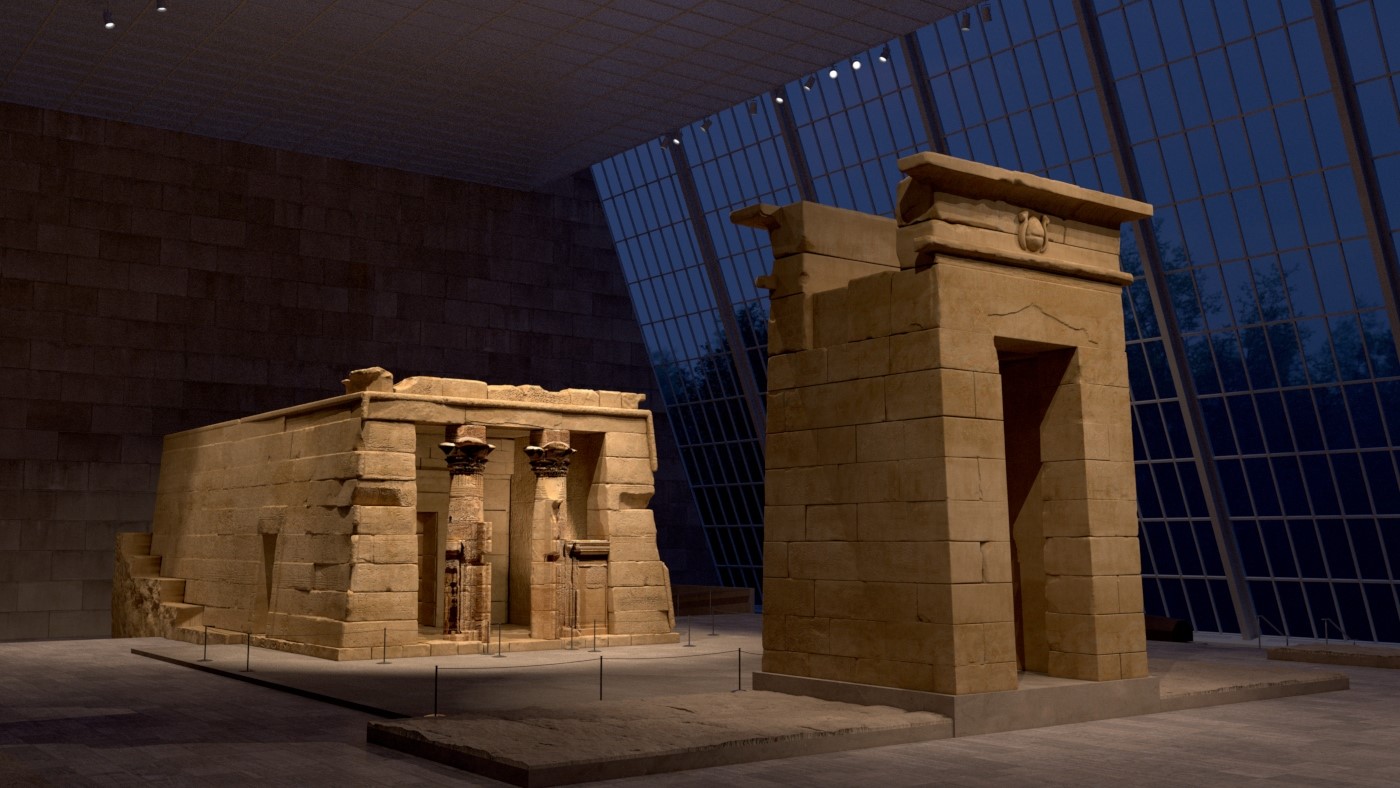
Win enough such games, and you’ll get the chance to “borrow” the artwork you’ve clicked to display, through augmented reality, in your space of choice — for fifteen minutes, at least. At Artnet, critic Ben Davis writes of placing here and there around his apartment Frederic Edwin Church’s Heart of the Andes, Jacob Lawrence’s The Photographer, and a Baby Yoda-scaled version of Rembrandt’s Self-Portrait. He even makes a serious if ultimately frustrated effort to win digital borrowing rights to the ancient Egyptian Temple of Dendur, one of the Met’s pièces de résistance since the late 1970s.
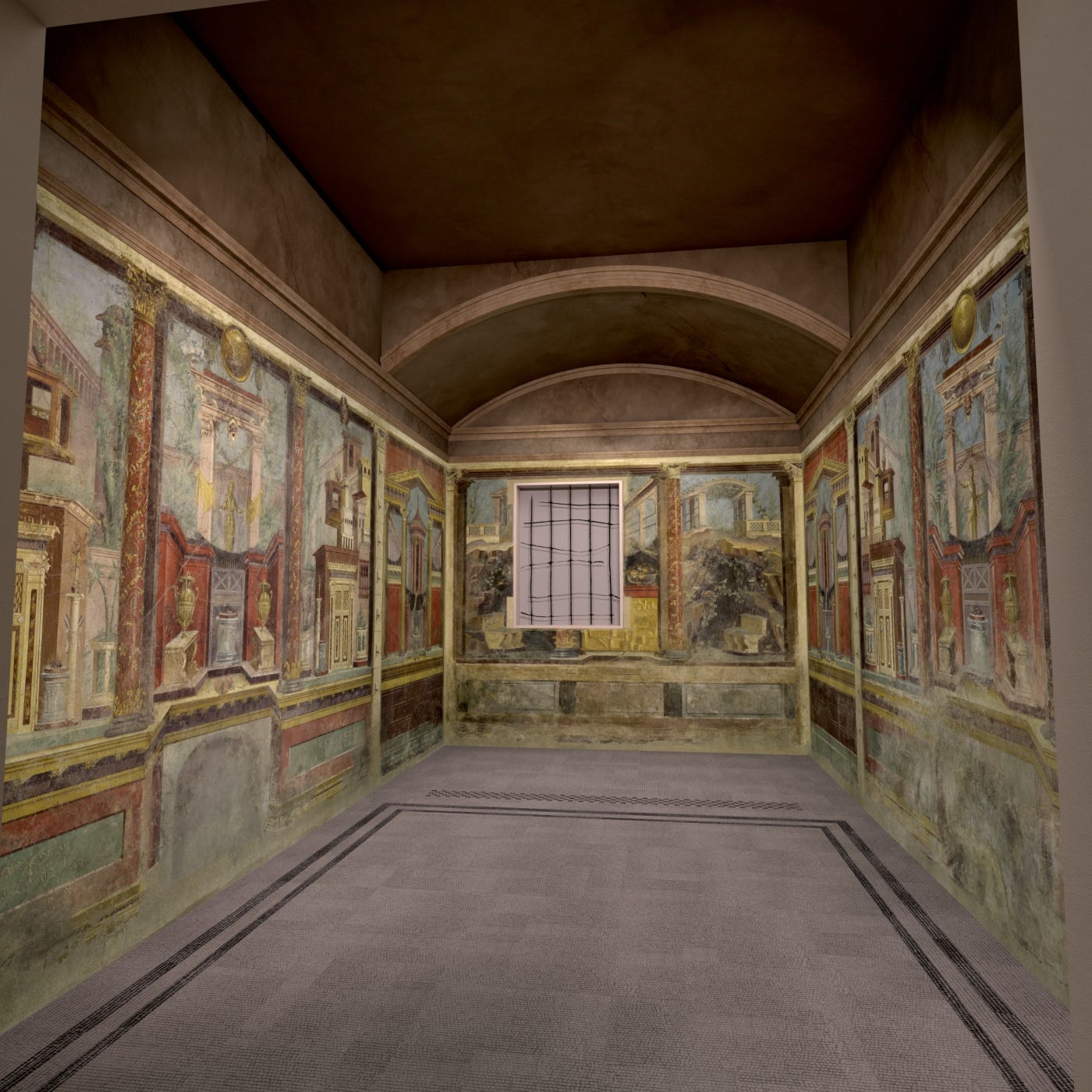
To experience The Met Unframed for yourself, just head over to its web site and use your phone to scan the QR code that comes up (if you’re not browsing on your phone in the first place). You’ll then be taken straight to the virtual Great Hall, which you can navigate by swiping in any direction — or physically moving your phone around, if you’ve enabled gyroscope mode — and tapping the icons glowing along the ground or on the walls. The combination of high technology, historical reference, depopulated but elegantly designed settings, puzzle challenges, and a score in which synthesizers meet ambient noise will remind visitors of a certain age of nothing so much as the adventure games of the early 1990s, especially Myst and its clones. But then, what does a museum do if not unite the past and the present?
Related Content:
Download 584 Free Art Books from The Metropolitan Museum of Art
The Metropolitan Museum of Art Puts 400,000 High-Res Images Online & Makes Them Free to Use
Take a Virtual Tour of 30 World-Class Museums & Safely Visit 2 Million Works of Fine Art
Based in Seoul, Colin Marshall writes and broadcasts on cities, language, and culture. His projects include the Substack newsletterBooks on Cities, the book The Stateless City: a Walk through 21st-Century Los Angeles and the video series The City in Cinema. Follow him on Twitter at @colinmarshall, on Facebook, or on Instagram.
Read More...The Anti-Gluttony Door in Portugal’s Alcobaça Monastery Shamed Plump Monks to Start Fasting
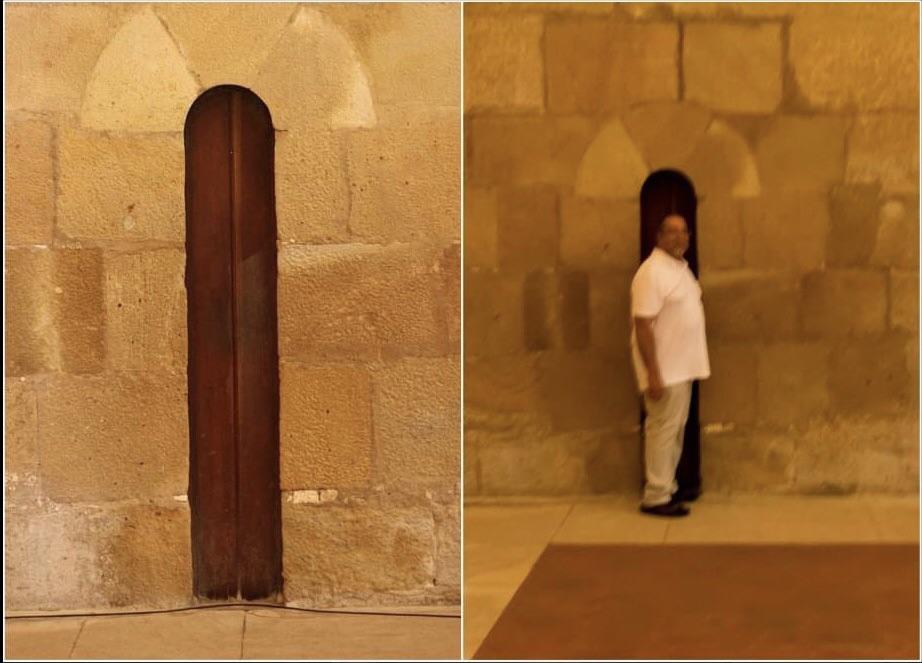
Consider that you eat the sins of the people
—inscription carved above the entrance to the Monastery of Alcobaça’s refectory
Apparently, the Monastery of Alcobaça’s resident monks were eating plenty of other things, too.
Eventually their reputation for excessive plumpness became problematic.
A hefty physique may have signified prosperity and health in 1178 when construction began on the UNESCO World Heritage site, but by the 18th-century, those extra rolls of flesh were considered at odds with the Cistercian monks’ vows of obedience, poverty and chastity.
Its larders were well stocked, thanks in part to the rich farmland surrounding the monastery.
18th-century traveler William Beckford described the kitchen in Recollections of an Excursion to the Monasteries of Alcobaça and Batalha:
On one side, loads of game and venison were heaped up; on the other, vegetables and fruit in endless variety. Beyond a long line of stoves extended a row of ovens, and close to them hillocks of wheaten flour whiter than snow, rocks of sugar, jars of the purest oil, and pastry in vast abundance, which a numerous tribe of lay brothers and their attendants were rolling out and puffing up into a hundred different shapes, singing all the while as blithely as larks in a corn-field.
Later he has the opportunity to sample some of the dishes issuing from that kitchen:
The banquet itself consisted of not only the most excellent usual fare, but rarities and delicacies of past seasons and distant countries; exquisite sausages, potted lampreys, strange messes from the Brazils, and others still stranger from China (edible birds’ nests and sharks’ fins), dressed after the latest mode of Macao by a Chinese lay brother. Confectionery and fruits were out of the question here; they awaited us in an adjoining still more spacious and sumptuous apartment, to which we retired from the effluvia of viands and sauces.
Later in his travels, he is taken to meet a Spanish princess, who inquires, “How did you leave the fat waddling monks of Alcobaça? I hope you did not run races with them.”
Perhaps such tattle is what convinced the brass that something must be done.
The remedy took the form of a porta pega-gordo (or “fat catcher door”), 6′ 6″ high, but only 12.5” wide.
Keep in mind that David Bowie, at his most slender, had a 26” waist.
Allegedly, each monk was required to pass through it from the refectory to the kitchen to fetch his own meal. Those who couldn’t squeeze through were out of luck.
Did they have to sit in the refectory with their faces to the walls, silently eating the sins of the people (respicite quia peccata populi comeditis) while their slimmer brethren filled their bellies, also silently, face-to-the-wall, as a reader read religious texts aloud from a pulpit?
History is a bit unclear on this point, though Beckford’s enthusiasm waned when he got to the refectory:
…a square of seventy or eighty feet, begloomed by dark-coloured painted windows, and disgraced by tables covered with not the cleanest or least unctuous linen in the world.
According to a German Wikipedia entry, the monks passed through the porta pega-gordo monthly, rather than daily, a more manageable mortification of the flesh for those with healthy appetites.

Image via Wikimedia Commons
If you are assembling a bucket list of destinations for when we can travel freely again, consider adding this beautiful Gothic monastery (and the celebrated pastry shop across the street). Your choice whether or not to suck it in for a photo in front of the porta pega-gordo.
Related Content:
Medieval Monks Complained About Constant Distractions: Learn How They Worked to Overcome Them
How Tibetan Monks Use Meditation to Raise Their Peripheral Body Temperature 16–17 Degrees
Ayun Halliday is an author, illustrator, theater maker and Chief Primatologist of the East Village Inky zine. She most recently appeared as a French Canadian bear who travels to New York City in search of food and meaning in Greg Kotis’ short film, L’Ourse. Follow her @AyunHalliday.
Read More...David Lynch’s Projection Instructions for Mulholland Drive (2001)
David Lynch is known for being persnickety about delivering the correct viewing experience to his audience, as he considers the cinema a sacred place. In a documentary short a few years back, he explained, “It’s so magical, I don’t know why, to go into a theater and have the lights go down. It’s very quiet and then the curtains start to open. And then you go into a world.”
However, the cinematheque is also the space where directors have the least control. They can hope that each print that goes out has been printed correctly (especially during the days of film), or that the sound is clear and/or loud enough, but, in a wide release, hope is all directors can do most of the time. There are exceptions: Stanley Kubrick oversaw the rerelease prints of his films. And Alfred Hitchcock demanded that there would be no late seating for Psycho-—a tactic that worked to the film’s advantage.
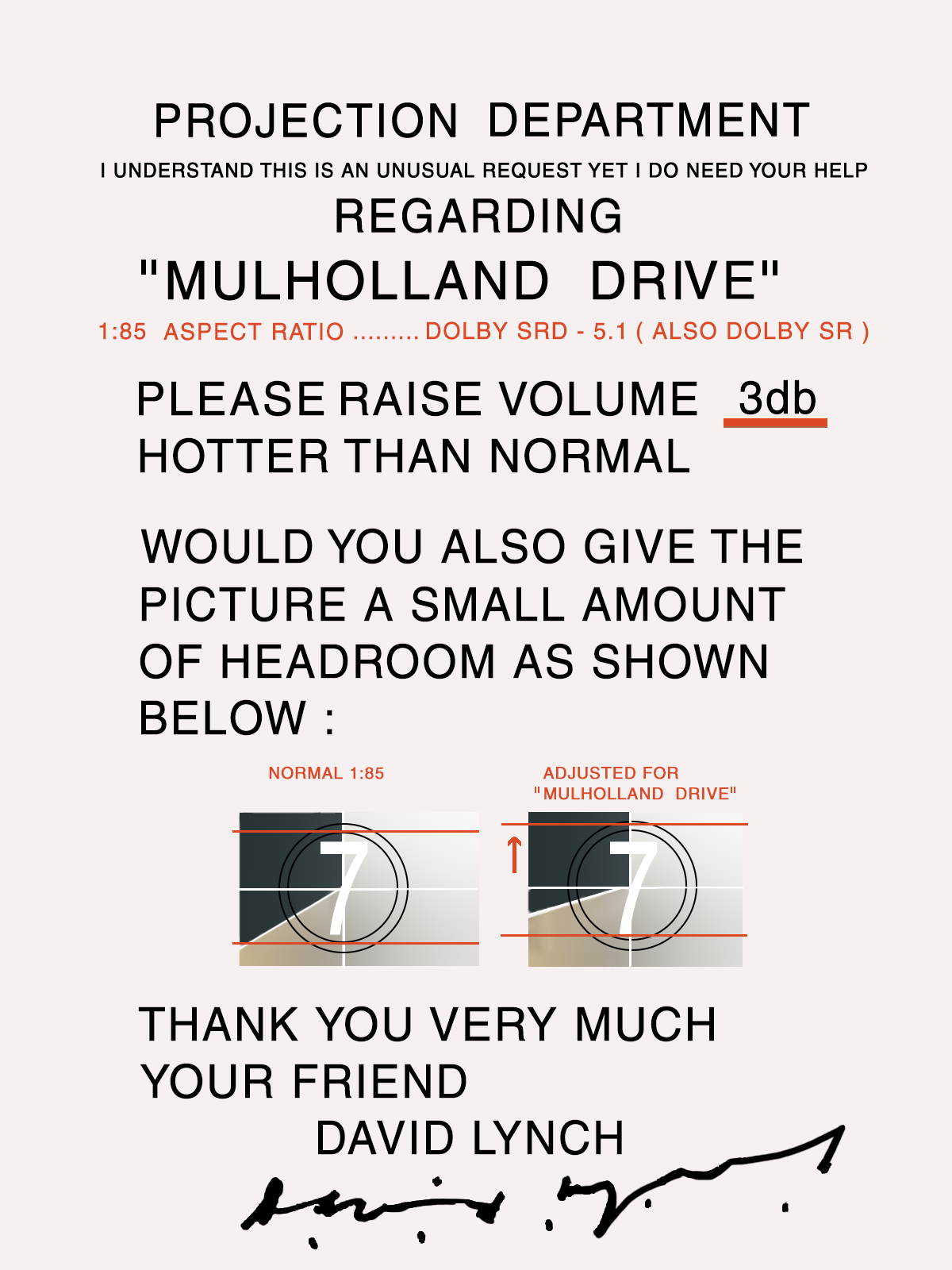
This card (above) from David Lynch came with every print of Mulholland Drive that was sent out to theaters. “I understand this is an unusual request yet I do need your help,” he writes. Lynch asks that the volume be raised 3db and that the image be given a tad more headroom.
John Neff, in a post on the Facebook Lynchland group, explained the card: “The volume request was because when we heard it in the Director’s Guild Theater for the cast and crew screening, David thought it was too quiet. The picture headroom request was because of the original TV aspect ratio. These concerns have been addressed in all format releases since the original DVD release.”
Mulholland Drive was originally shot, or rather, the first half of the film was shot as a television pilot for ABC, so a 16:9 (1.78:1) aspect ratio was expected. But when the studios passed on the pilot, Lynch finished the film as a standalone feature. Cinemas matt projections at 1.85:1, cutting down on the headroom. (None of this effects the original negative, which is standard 35mm.)
Lynch similarly cares about home viewers. The first director-approved box set of his short films came with a similar, Lynch-created calibration video so you could control the color and the white balance. And one of the reasons fans keep waiting for a proper Blu-Ray release of Lost Highway is that Lynch has yet to oversee a proper transfer. When Kino Lorber released theirs in 2019, Lynch took to Twitter to tell fans to skip it: “Dear Twitter Friends, A Blu-ray of LOST HIGHWAY will be released very soon. It was made from old elements and NOT from a restoration of the original negative. I hope that a version from the restoration of the original negative will happen as soon as possible.”
As far as I know, he has not weighed in on the current problems associated with HDTVs, but Tom Cruise has been taking care of that. And whatever you do, do not watch Mulholland Drive on your iPhone.
Related Content:
Watch an Epic, 4‑Hour Video Essay on the Making & Mythology of David Lynch’s Twin Peaks
David Lynch Explains How Simple Daily Habits Enhance His Creativity
David Lynch Being a Madman for a Relentless 8 Minutes and 30 Seconds
Ted Mills is a freelance writer on the arts who currently hosts the Notes from the Shed podcast and is the producer of KCRW’s Curious Coast. You can also follow him on Twitter at @tedmills, and/or watch his films here.
Read More...Why Should You Read Toni Morrison’s Beloved? An Animated Video Makes the Case
“Tell me,” said Beloved, smiling a wide happy smile. “Tell me your diamonds.”
The unforgettable portrayal of Beloved, the mysterious, 20-year-old woman (Thandie Newton)—who appears in Sethe’s (Oprah Winfrey) home mysteriously just as the infant ghost haunting the family disappears—leaves an indelible image in the mind’s eye in Jonathan Demme’s 1998 film. We may learn about the history of slavery in the U.S. through a wealth of recovered data and historical sources. But to understand its psychological horrors, and the lingering trauma of its survivors, we must turn to works of the imagination like Beloved.
So why not just watch the movie? It’s excellent, granted, but nothing can take the place of Toni Morrison’s prose. Her “versatility and technical and emotional range appear to know no bounds,” wrote Margaret Atwood in her 1987 review of the novel. “If there were any doubts about her stature as a pre-eminent American novelist, of her own or any other generation, Beloved will put them to rest.” The novel’s American gothic narrative recalls the “magnificent practicality” of haunting in Wuthering Heights. “All the main characters in the book believe in ghosts, so it’s merely natural for this one to be there.”
“Everyone at 124 Bluestone Road,” the Ted-Ed video lesson by Yen Pham begins, “knows their house is haunted. But there’s no mystery about the spirit tormenting them. This ghost is the product of an unspeakable trauma.” Demme’s film dramatizes the horrors Sethe endured, and committed, and tells the story of the Sweet Home plantation and its aftermath upon her family. What it cannot convey is the novel’s treatment of “a barbaric history that hangs over much more than this homestead.”
For this greater resonance, we must turn to Morrison’s book, written, Atwood says, “in an antiminimalist prose that is by turns rich, graceful, eccentric, rough, lyrical, sinuous, colloquial and very much to the point.” The novel brings us into contact with the human experience of enslavement:
Through the different voices and memories of the book, including that of Sethe’s mother, a survivor of the infamous slave-ship crossing, we experience American slavery as it was lived by those who were its objects of exchange, both at its best—which wasn’t very good—and at its worst, which was as bad as can be imagined. Above all, it is seen as one of the most viciously antifamily institutions humans ever devised…. It is a world in which people suddenly vanish and are never seen again, not through accident or covert operation or terrorism, but as a matter of everyday legal policy.”
Morrison’s fictionalizing of the true story of Margaret Garner, an enslaved mother who killed her child rather than let the infant become enslaved to such a future, “points to history on the largest scale, to the global and world-historical,” Pelagia Goulimari writes in a monograph on Morrison. Morrison uses “Garner’s 1856 infanticide—a cause célèbre—as point of access to the ‘Sixty Million and more’: the victims of the Middle Passage and of slavery.”
Perhaps only the novel, and especially the novels of Toni Morrison, can tell world-historical stories through the actions of a few characters: Sethe, Denver, Baby Suggs, Paul D., and Beloved, the angry ghost of a murdered daughter and a desperate mother’s trauma and the traumatic psychic wounds of slavery, returned. Learn more about why you should read Beloved in the animated lesson above, directed by Héloïse Dorsan Rachet, and discover more at the TED-Ed lesson’s additional resources page.
Related Content:
Toni Morrison Deconstructs White Supremacy in America
Josh Jones is a writer and musician based in Durham, NC. Follow him at @jdmagness.
Read More...The CIA Has Declassified 2,780 Pages of UFO-Related Documents, and They’re Now Free to Download
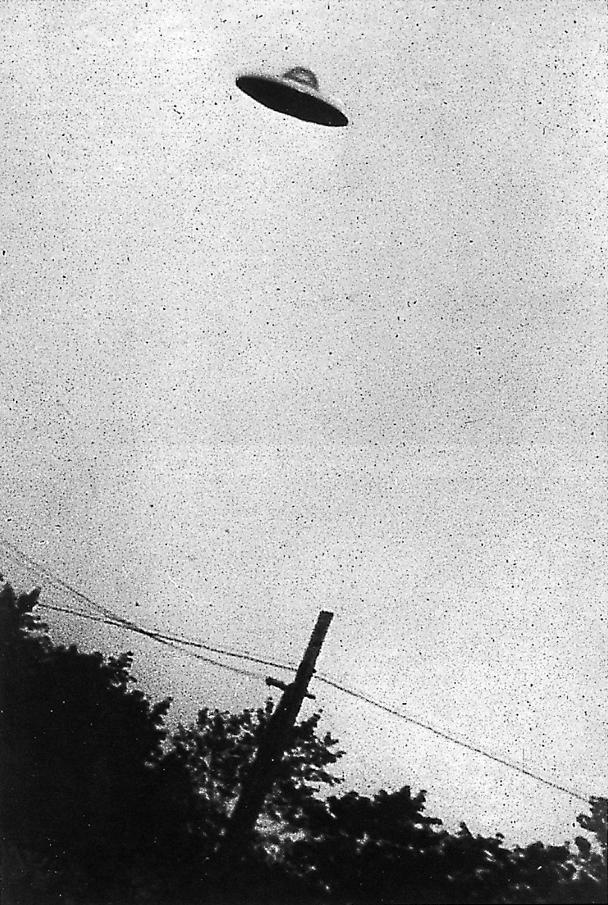
Everybody knows that UFO stands for “unidentified flying object.” Coined by the United States Air Force in 1953, the term has come to stand for a wide range of phenomena that suggest we’ve been contacted by alien civilizations — and in fact has even spawned the field of ufology, dedicated to the investigation of such phenomena. But times change, and with them the approved terminology. These days the U.S. government seems to prefer the abbreviation UAP, which stands for “unidentified aerial phenomenon.” Those three words may sound more precisely descriptive, but they also provide some distance from the decades of not entirely desirable cultural associations built up around the concept of the UFO.
Yet this is hardly a bad time to be a ufologist. “Buried in the latest federal omnibus spending bill signed into law on December 27, 2020 — notable for its inclusion of coronavirus relief — is a mandate that may bring UFO watchers one step closer to finding out whether the government has been watching the skies,” writes Mental Floss’ Jake Rossen.
That same site’s Ellen Gutoskey followed up with an announcement that the CIA’s entire collection of declassified UFO documents is now available to download. You can do so at The Black Vault, a clearing house for UFO related-information run by ufologist John Greenewald Jr. These documents come to 2,780 pages in total, the release of which necessitated the filing of more than 10,000 Freedom of Information Act reports.
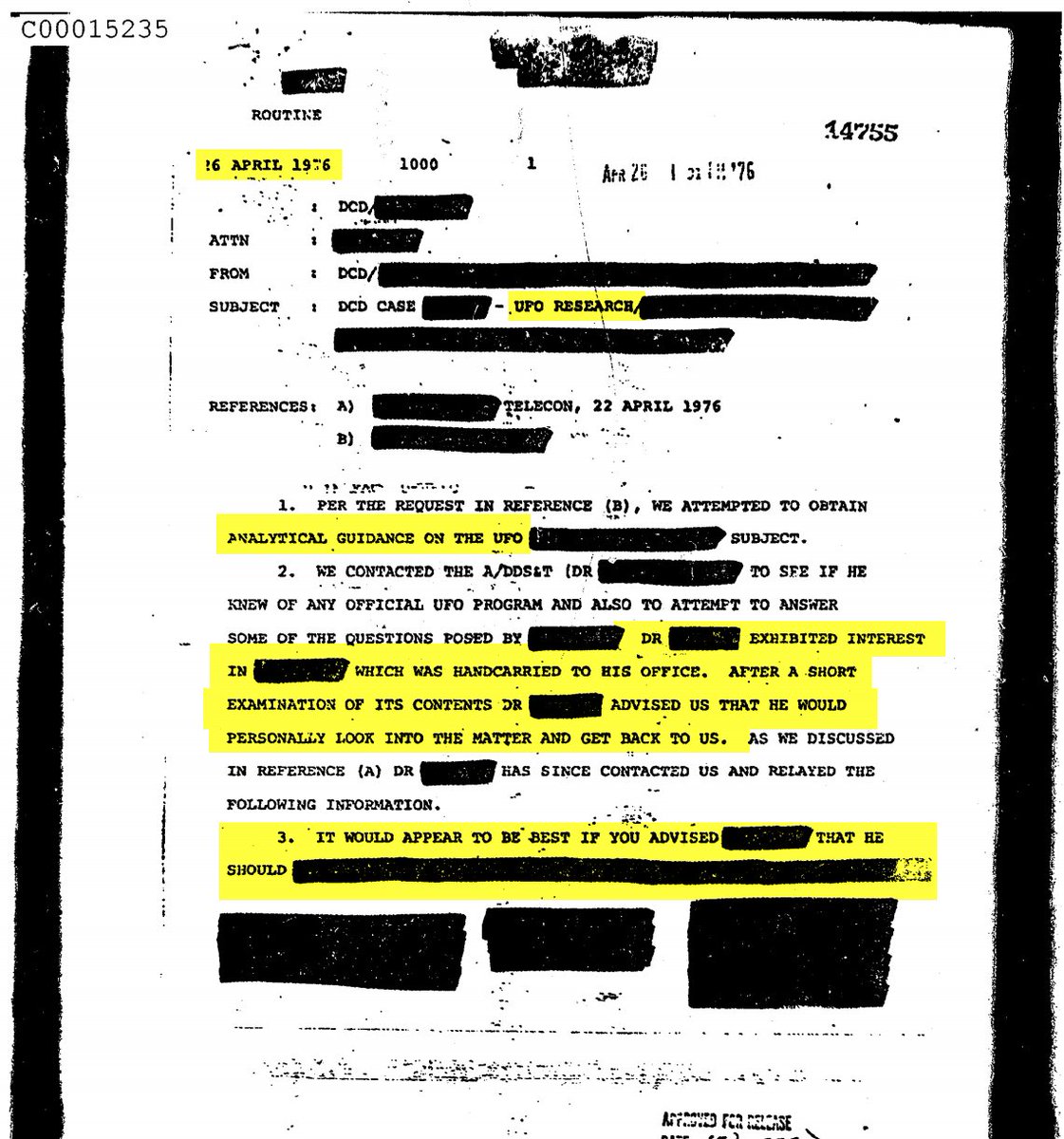
Samir Ferdowsi at Vice’s Motherboard quotes Greenewald describing the process as “like pulling teeth,” with results more impressive in quantity than quality. “The CIA has made it INCREDIBLY difficult to use their records in a reasonable manner,” Greenewals writes. “They offer a format that is very outdated (multi page .tif) and offer text file outputs, largely unusable,” all of which “makes it very difficult for people to see the documents, and use them, for any research purpose.” He’s thus also made available a version of the CIA’s declassified UFO documents converted into 713 PDFs. The Black Vault advises downloaders to bear in mind that “many of these documents are poorly photocopied, so the computer can only ‘see’ so much to convert for searching.”
But even with these difficulties, UFO enthusiasts have already turned up material of interest: “From a dispute with a Bosnian fugitive with alleged E.T. contact to mysterious midnight explosions in a small Russian town, the reports definitely take readers for a wild ride,” writes Ferdowsi. “One of the most interesting documents in the drop, Greenewald said, involved the Assistant Deputy Director for Science & Technology being hand-delivered some piece of information on a UFO in the 1970s.” This document, like most of the others, comes with many parts blacked out, but as Greenewald recently tweeted, “I have an open ‘Mandatory Declassification Review’ request to HOPEFULLY get some of these redactions lifted, so we can see what was hand delivered, and what his advice may be.” Ufology demands a great deal of curiosity, but an even greater deal of patience. Enter the Black Vault here.
Related Content:
The Appeal of UFO Narratives: Investigative Journalist Paul Beban Visits Pretty Much Pop #14
Richard Feynman: The Likelihood of Flying Saucers
Carl Jung’s Fascinating 1957 Letter on UFOs
Based in Seoul, Colin Marshall writes and broadcasts on cities, language, and culture. His projects include the Substack newsletter Books on Cities, the book The Stateless City: a Walk through 21st-Century Los Angeles and the video series The City in Cinema. Follow him on Twitter at @colinmarshall, on Facebook, or on Instagram.
Read More...Should You Race Back to Theaters When It’s Safe? Pretty Much Pop: Culture Podcast (#77) on the Big Screen Experience

The pandemic has kept us out of the movie theaters, forcing new streaming practices so that films can be released at all, but as these restrictions end in 2021, do we want things to go back just to the way they were?
Your hosts Mark Linsenmayer, Erica Spyres, and Brian Hirt reviewed many articles where filmmakers fretted about the future of cinema. Even before the pandemic, concerns about falling movie house attendance and the increased use of streaming have had the industry worried about films being viewed in the manner their creators intended, or even made at all.
For at least the first half our of this discussion, we largely ignored all that in favor of musing on our own past theater-going habits and experiences. What has worked and hasn’t in the shift toward more spectacle and amenities? What do we like and loathe about being in an audience with others? Is the theater experience essential just for big special effects films, or does it make any film more effective? How would we improve moviegoing and home viewing? We consider the list of films that were supposed to come out this year and were either delayed or moved to streaming, like Tenet, Soul, In the Heights, etc.
Here are those articles, in case you’re curious:
- “Every Movie Release Date Affected by the Coronavirus Pandemic” by Christopher Rosen
- “Hollywood’s Obituary, the Sequel. Now Streaming.” by Brooks Barnes
- “On the Future of (Going to the) Movies” by Jordan Crucchiola
- “The Future of Movie Theaters In the Age of Coronavirus: A Dialogue” by Brent Lang, et al
- “Streaming Is the Future for 2021, but I’m Not Convinced It’s the Future of Movies” by Matt Goldberg
- “Michael Shamberg On How The Theatrical Business Can Rebound From Covid-19″
- “How Will Movies Survive the Next 10 Years?” by Kyle Buchanan
- “Here’s How Movie Theaters Will Survive the Next 10 Years: Exhibitors Speak Out” by Eric Kohn
- “Christopher Nolan Rips HBO Max as “Worst Streaming Service,” Denounces Warner Bros.’ Plan” by Kim Masters
- “Patty Jenkins, Aaron Sorkin on Warner Bros.’ HBO Max Shocker: ‘We’re All Scared Everything’s Going to Change Now’” by Adam Vary
- “After Warner Bros.: The New Long-Term Deal Hollywood Studios, Movie Theaters and Netflix Need” by Eric Rosenbaum
Hear more of this podcast at prettymuchpop.com. This episode includes bonus discussion you can access by supporting the podcast at patreon.com/prettymuchpop. This podcast is part of the Partially Examined Life podcast network.
Pretty Much Pop: A Culture Podcast is the first podcast curated by Open Culture. Browse all Pretty Much Pop posts.
Read More...A 16th-Century Astronomy Book Featured “Analog Computers” to Calculate the Shape of the Moon, the Position of the Sun, and More
Did your college math textbooks have moving parts? From 1524 on, a famous German cosmography book came with 5 volvelles! Peter Apian (later knighted for a different book), opted for a novel, tactile-visual teaching style for all earthly and heavenly measurements. pic.twitter.com/XgskoGb0Ss
— Atlas Obscura (@atlasobscura) July 3, 2020
If you want to learn how the planets move, you’ll almost certainly go to one place first: Youtube. Yes, there have been plenty of worthwhile books written on the subject, and reading them will prove essential to further deepening your understanding. But videos have the capacity of motion, an undeniable benefit when motion itself is the concept under discussion. Less than twenty years into the Youtube age, we’ve already seen a good deal of innovation in the art of audiovisual explanation. But we’re also well over half a millennium into the age of the book as we know it, a time that even in its early phases saw impressive attempts to go beyond text on a page.
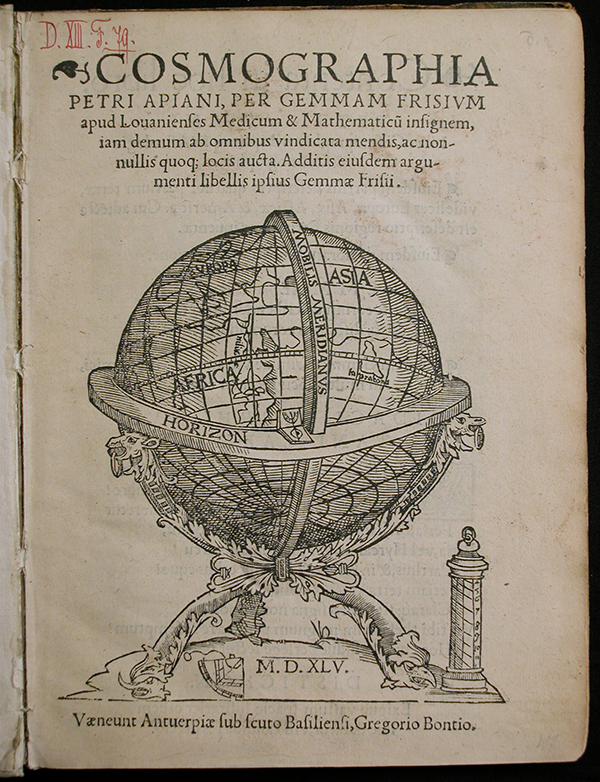
Take, for example, Peter Apian’s Cosmographia, first published in 1524. A 16th-century German polymath, Apian (also known as Petrus Apianus, and born Peter Bienewitz) had a professional interest in mathematics, astronomy and cartography. At their intersection stood the subject of “cosmography” from which this impressive book takes its name, and its project of mapping the then-known universe.
“The treatise provided instruction in astronomy, geography, cartography, navigation, and instrument-making,” writes Frank Swetz at the Mathematical Association of America. “It was one of the first European books to depict and discuss North America and included movable volvelles allowing the readers to interact with and use some of the charts and instrument layouts presented.”
The terrestrial and lunar dials are the most visually complex. The lunar one shows the changing shape of the moon through a cut-out window, but its content had already been preceded in table format by Regiomontanus in 1474. Still, its effect on farming remained vital knowledge. pic.twitter.com/MUuyJYUysQ
— Atlas Obscura (@atlasobscura) July 3, 2020
Pop-up book enthusiasts like Ellen Rubin will know what volvelles are; you and I may not, but if you’ve ever moved a paper wheel or slider on a page, you’ve used one. The volvelle first emerged in the medieval era, not as an amusement to liven up children’s books but as a kind of “analog computer” embedded in serious scientific works. “The volvelles make the practical nature of cosmography clear,” writes Katie Taylor at Cambridge’s Whipple Library, which holds a copy of Cosmographia. “Readers could manipulate these devices to solve problems: finding the time at different places and or one’s latitude, given the height of the Sun above the horizon.”
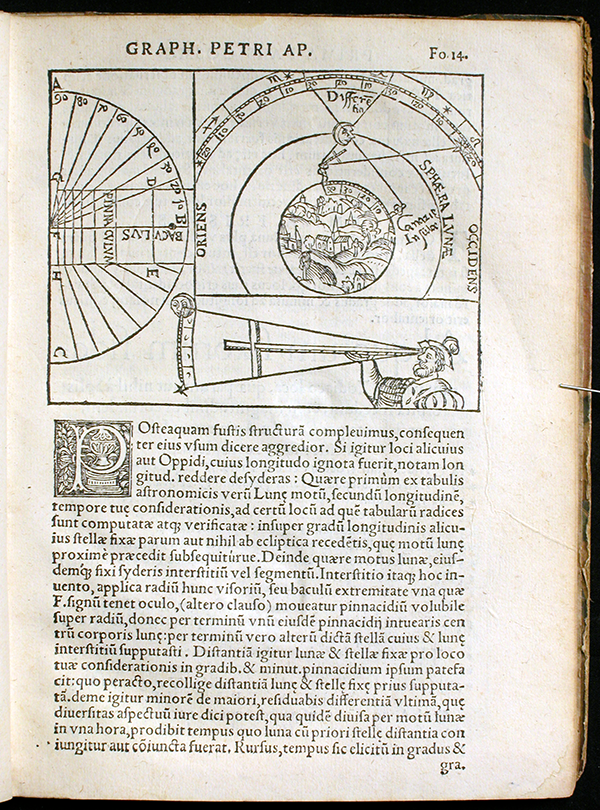
Apian originally included three such volvelles in Cosmographia. Later, his disciple Gemma Frisius, a Dutch physician, instrument maker and mathematician, produced expanded editions that included another. “In all its forms,” writes Swetz, “the book was extremely popular in the 16th century, going through 30 printings in 14 languages.” Despite the book’s success, it’s not so easy to come by a copy in good (indeed working) condition nearly 500 years later. If these descriptions of its pages and their volvelles have piqued your curiosity, you can see these ingenious paper devices in action in these videos tweeted out by Atlas Obscura. As with planets themselves, you can’t fully appreciate them until you see them move for yourself.
Related Content:
When Astronomer Johannes Kepler Wrote the First Work of Science Fiction, The Dream (1609)
Based in Seoul, Colin Marshall writes and broadcasts on cities, language, and culture. His projects include the Substack newsletter Books on Cities, the book The Stateless City: a Walk through 21st-Century Los Angeles and the video series The City in Cinema. Follow him on Twitter at @colinmarshall, on Facebook, or on Instagram.
Read More...Peanuts Plays Yes’ “Roundabout”
Digital filmmaker Garren Lazar gives us a creative parody video and a badly-needed mental health break. Enjoy.
To watch previous Peanuts parodies of songs by Queen, Lynyrd Skynyrd, Journey & more, click here.
If you would like to support the mission of Open Culture, consider making a donation to our site. It’s hard to rely 100% on ads, and your contributions will help us continue providing the best free cultural and educational materials to learners everywhere. You can contribute through PayPal, Patreon, and Venmo (@openculture). Thanks!
Related Content
Umberto Eco Explains the Poetic Power of Charles Schulz’s Peanuts
How Franklin Became Peanuts‘ First Black Character, Thanks to a Caring Schoolteacher (1968)
Read More...
A Look Inside William S. Burroughs’ Bunker
When everybody had one or two vodkas and smoked a few joints, it was always the time for the blowgun. —John Giorno
From 1974 to 1982, writer William S. Burroughs lived in a former locker room of a 19th-century former-YMCA on New York City’s Lower East Side.
When he moved on, his stuff, including his worn out shoes, his gun mags, the typewriter on which he wrote Cities of the Red Night, and half of The Place of Dead Roads, a well-worn copy of The Medical Implications of Karate Blows, and a lamp made from a working Civil war-era rifle, remained.
His friend, neighbor, tourmate, and occasional lover, poet John Giorno preserved “The Bunker” largely as Burroughs had left it, and seems to delight in rehashing old times during a 2017 tour for the Louisiana Channel, above.
It’s hard to believe that Burroughs found Giorno to be “pathologically silent” in the early days of their acquaintance:
He just wouldn’t say anything. You could be there with him the whole evening, he wouldn’t say a word. It was not the shyness of youth, it was much more than that, it was a very deep lack of ability to communicate. Then he had cancer and after the operation that was completely reversed and now he is at times a compulsive talker, when he gets going there is no stopping him.
According to Burroughs’ companion, editor and literary executor, James Grauerholz, during this period in Burroughs’ life, “John was the person who contributed most to William’s care and upkeep and friendship and loved him.”
Giorno also prepared Burroughs’ favorite dish—bacon wrapped chicken—and joined him for target practice with the blowgun and a BB gun whose projectiles were forceful enough to penetrate a phonebook.
Proximity meant Giorno was well acquainted with the schedules that governed Burroughs’ life, from waking and writing, to his daily dose of methadone and first vodka-and-Coke of the day.
He was present for many dinner parties with famous friends including Andy Warhol, Lou Reed, Frank Zappa, Allen Ginsberg, Debbie Harry, Keith Haring, Jean-Michel Basquiat, and Patti Smith, who recalled visiting the Bunker in her National Book Award-winning memoir, Just Kids:
It was the street of winos and they would often have five cylindrical trash cans to keep warm, to cook, or light their cigarettes. You could look down the Bowery and see these fires glowing right to William’s door… he camped in the Bunker with his typewriter, his shotgun and his overcoat.
All Giorno had to do was walk upstairs to enjoy Burroughs’ company, but all other visitors were subjected to stringent security measures, as described by Victor Bockris in With William Burroughs: A Report from the Bunker:
To get into the Bunker one had to pass through three locked gates and a gray bulletproof metal door. To get through the gates you had to telephone from a nearby phone booth, at which point someone would come down and laboriously unlock, then relock three gates before leading you up the single flight of gray stone stairs to the ominous front door of William S. Burroughs’ headquarters.
Although Burroughs lived simply, he did make some modifications to his $250/month rental. He repainted the battleship gray floor white to counteract the lack of natural light. It’s pretty impregnable.
He also installed an Orgone Accumulator, the invention of psychoanalyst William Reich, who believed that spending time in the cabinet would improve the sitter’s mental, physical, and creative wellbeing by exposing them to a mysterious universal life force he dubbed orgone energy.
(“How could you get up in the morning with a hangover and go sit in one of these things?” Giorno chuckles. “The hangover is enough!”)
Included in the tour are excerpts of Giorno’s 1997 poem “The Death of William Burroughs.” Take it with a bit of salt, or an openness to the idea of astral body travel.
As per biographer Barry Miles, Burroughs died in the Lawrence Memorial Hospital ICU in Kansas, a day after suffering a heart attack. His only visitors were James Grauerholz, his assistant Tom Peschio, and Dean Ripa, a friend who’d been expected for dinner the night he fell ill.
Poetic license aside, the poem provides extra insight into the men’s friendship, and Burroughs’ time in the Bunker:
The Death of William Burroughs
by John Giorno
William died on August 2, 1997, Saturday at 6:01 in the
afternoon from complications from a massive heart attack
he’d had the day before. He was 83 years old. I was with
William Burroughs when he died, and it was one of the best
times I ever had with him.Doing Tibetan Nyingma Buddhist meditation practices, I
absorbed William’s consciousness into my heart. It seemed as
a bright white light, blinding but muted, empty. I was the
vehicle, his consciousness passing through me. A gentle
shooting star came in my heart and up the central channel,
and out the top of my head to a pure field of great clarity
and bliss. It was very powerful—William Burroughs resting
in great equanimity, and the vast empty expanse of
primordial wisdom mind.I was staying in William’s house, doing my meditation
practices for him, trying to maintain good conditions and
dissolve any obstacles that might be arising for him at that
very moment in the bardo. I was confident that William had
a high degree of realization, but he was not a completely
enlightened being. Lazy, alcoholic, junkie William. I didn’t
allow doubt to arise in my mind, even for an instant,
because it would allow doubt to arise in William’s mind.Now, I had to do it for him.
What went into William Burroughs’ coffin with his dead body:
About ten in the morning on Tuesday, August 6, 1997,
James Grauerholz and Ira Silverberg came to William’s
house to pick out the clothes for the funeral director to put
on William’s corpse. His clothes were in a closet in my
room. And we picked the things to go into William’s coffin
and grave, accompanying him on his journey in the
underworld.His most favorite gun, a 38 special snub-nose, fully loaded
with five shots. He called it, “The Snubby.” The gun was my
idea. “This is very important!” William always said you can
never be too well armed in any situation. Of his more than
80 world-class guns, it was his favorite. He often wore it on
his belt during the day, and slept with it, fully loaded, on
his right side, under the bed sheet, every night for fifteen
years.Grey fedora. He always wore a hat when he went out. We
wanted his consciousness to feel perfectly at ease, dead.His favorite cane, a sword cane made of hickory with a
light rosewood finish.Sport jacket, black with a dark green tint. We rummaged
through the closet and it was the best of his shabby clothes,
and smelling sweet of him.Blue jeans, the least worn ones were the only ones clean.
Red bandana. He always kept one in his back pocket.
Jockey underwear and socks.
Black shoes. The ones he wore when he performed. I
thought the old brown ones, that he wore all the time,
because they were comfortable. James Grauerholz insisted,
“There’s an old CIA slang that says getting a new
assignment is getting new shoes.”White shirt. We had bought it in a men’s shop in Beverly
Hills in 1981 on The Red Night Tour. It was his best shirt,
all the others were a bit ragged, and even though it had
become tight, he’d lost a lot of weight, and we thought it
would fit. James said,” Don’t they slit it down the back
anyway.”Necktie, blue, hand painted by William.
Moroccan vest, green velvet with gold brocade trim, given
him by Brion Gysin, twenty-five years before.In his lapel button hole, the rosette of the French
government’s Commandeur des Arts et Lettres, and the
rosette of the American Academy of Arts and Letters,
honors which William very much appreciated.A gold coin in his pants pocket. A gold 19th Century Indian
head five dollar piece, symbolizing all wealth. William
would have enough money to buy his way in the
underworld.His eyeglasses in his outside breast pocket.
A ball point pen, the kind he always used. “He was a
writer!”, and sometimes wrote long hand.A joint of really good grass.
Heroin. Before the funeral service, Grant Hart slipped a
small white paper packet into William’s pocket. “Nobody’s
going to bust him.” said Grant. William, bejeweled with all
his adornments, was traveling in the underworld.I kissed him. An early LP album of us together, 1975, was
called Biting Off The Tongue Of A Corpse. I kissed him on
the lips, but I didn’t do it . . . and I should have.
Related Content:
How William S. Burroughs Influenced Rock and Roll, from the 1960s to Today
William S. Burroughs’ Class on Writing Sources (1976)
Ayun Halliday is an author, illustrator, theater maker and Chief Primatologist of the East Village Inky zine. She most recently appeared as a French Canadian bear who travels to New York City in search of food and meaning in Greg Kotis’ short film, L’Ourse. Follow her @AyunHalliday
Read More...Support Us
We're hoping to rely on loyal readers, rather than erratic ads. Please click the Donate button and support Open Culture. You can use Paypal, Venmo, Patreon, even Crypto! We thank you!

About Us

Open Culture scours the web for the best educational media. We find the free courses and audio books you need, the language lessons & educational videos you want, and plenty of enlightenment in between.
Advertise With Us
FREE UPDATES!
GET OUR DAILY EMAIL
Get the best cultural and educational resources on the web curated for you in a daily email. We never spam. Unsubscribe at any time.
FOLLOW ON SOCIAL MEDIA
Open Culture editor Dan Colman scours the web for the best educational media. He finds the free courses and audio books you need, the language lessons & movies you want, and plenty of enlightenment in between.
Advertise With Us

