How Lava Lamps Help Secure the Internet
Try not to think too hard about the concept of randomness — and especially about the question of how, exactly, one generates a random number. Most of us, of course, simply ask a computer to do it. But how can a computer, which by its very nature follows unambiguous directions in a predictable manner, come up with a truly random number, in the literal sense of the word? As far as the everyday purposes for which we might need “random” numbers — setting the combination on a lock, for instance — merely unpredictable numbers suffice. But where, exactly, can we draw the line between unpredictability and randomness?
Albert Einstein famously pronounced that “God does not play dice with the universe,” drawing on a metaphor still central to humanity’s conception of randomness. Dice provide “random” numbers in that, when thrown, they’re subject to too many physical factors — an area of some interest for Einstein — for us to reliably guess which way they’ll land. And so we find ourselves again delivered back from randomness into unpredictability. But achieving ever-greater unpredictability, which has proven invaluable to fields like cryptography, has necessitated combining computers with analog physical phenomena essentially similar to the rolling of dice.
Using a somewhat less ancient technology, internet security provider Cloudflare has taken a step closer to genuine randomness. “Every time you log in to any website, you’re assigned a unique identification number,” explains Wired’s Ellen Airhart. “It should be random, because if hackers can predict the number, they’ll impersonate you.” But who could predict “the goopy mesmeric swirlings of oil, water, and wax” within a lava lamp, let alone an entire wall covered with them? “Cloudflare films the lamps 24/7 and uses the ever-changing arrangement of pixels to help create a superpowered cryptographic key.”
Theoretically, Airhart acknowledges, “bad guys could sneak their own camera into Cloudflare’s lobby to capture the same scene,” but the company also “films the movements of a pendulum in its London office and records the measurements of a Geiger counter in Singapore to add more chaos to the equation. Crack that, Russians.” Constant vigilance against a threat from Russia aided by psychedelic bedroom light fixtures? You’d be forgiven for feeling unstuck in time, partially transported to the reality of half a century ago. But then, Cloudflare is headquartered in San Francisco — a city where the groundbreaking and the groovy haven’t parted ways just yet.
Related Content:
Stephen Fry Explains Cloud Computing in a Short Animated Video
“The Bay Lights,” The World’s Largest LED Light Sculpture, Debuts in San Francisco
How Art Nouveau Inspired the Psychedelic Designs of the 1960s
Visualizing WiFi Signals with Light
Based in Seoul, Colin Marshall writes and broadcasts on cities, language, and culture. His projects include the Substack newsletter Books on Cities, the book The Stateless City: a Walk through 21st-Century Los Angeles and the video series The City in Cinema. Follow him on Twitter at @colinmarshall, on Facebook, or on Instagram.
Read More...Discover the First Illustrated Book Printed in English, William Caxton’s Mirror of the World (1481)
The printing history of early English books may not seem like the most fascinating subject in the world, but if you mention the name William Caxton to a book historian, you may get a fascinating lecture nonetheless. Caxton, the merchant and diplomat who introduced the printing press to England in 1476, was an unusually enterprising figure. He first learned the trade in Cologne and was pressured to begin printing in English after the success of his translation of the Recuyell of the Historyes of Troye, a series of stories based on Homer’s Iliad. His first known printed book was Chaucer’s Canterbury Tales, and he went on to print translations of classical and medieval texts from the French.
Caxton’s (often inaccurate) translations became so popular that, like Chaucer, he introduced new standards into the language as a whole with his use of court Chancery English. The books printed at the time also give us a fascinating look at how the printed book evolved slowly as a new source of scientific information and a means of literary innovation.
The so-called Gutenberg Revolution did not usher in a radical break with the late medieval past so much as a gradual evolution away from its adherence to classical and church authorities and chivalric romance stories. It would take early modern writers like Shakespeare, Cervantes, and Francis Bacon to truly revolutionize the possibilities of print.
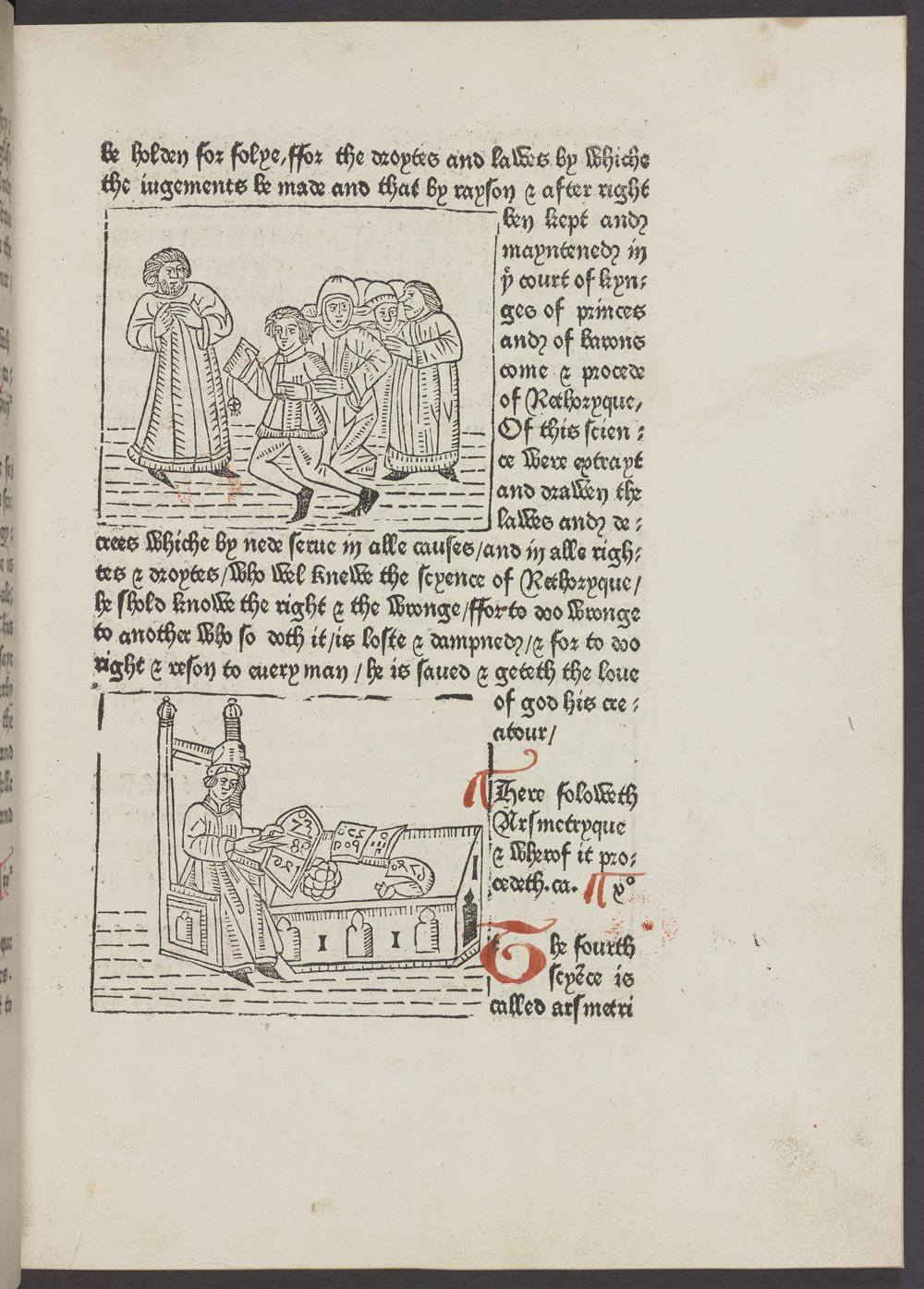
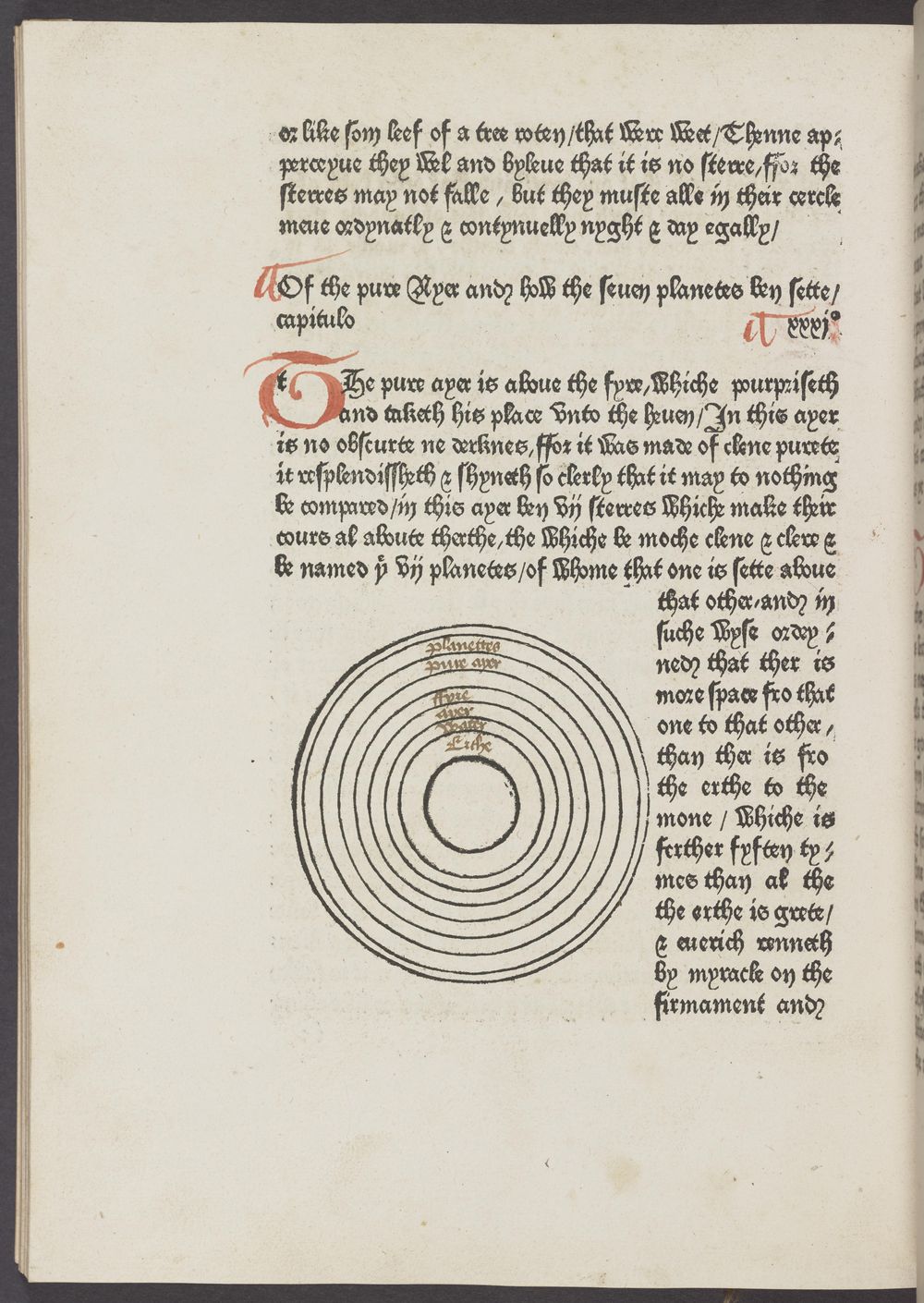
The first illustrated book Caxton printed in English offers an excellent example of early printing history’s reliance on reproducing extant medieval ideas rather than disseminating new ones. The Mirror of the World, first written in French as L’image du monde, was an encyclopedia based on a 12th century text by Honorius Augustodunensis called Imago mundi. “Encyclopedic texts were popular throughout the Middle Ages,” Glasgow University Library notes. “During this period it was commonly believed that it was possible to create one volume digests of all knowledge,” drawing solely on classical and Biblical authorities. In the introduction to Caxton’s text, we are told that the book “treateth of the world & of the wonderful dyuision [division] thereof.”
We are quite a long way yet from the Royal Society’s motto Nullius in verba, or “take no one’s word for it.” But Caxton’s press made several medieval manuscript prose works available for the first time to a new readership. “Evidence of early ownership of copies of his editions,” writes the British Library, “suggests the social breadth of that audience, including royalty, nobility, gentry, the mercantile classes and religious houses.” Caxton was “not content to simply draw on pre-existing markets for manuscripts.” And he would eventually use print “to create new markets for novel and different kinds of writing,” such as the 1485 publication of Thomas Malory’s contemporary Arthurian romance, Le Morte D’arthur.
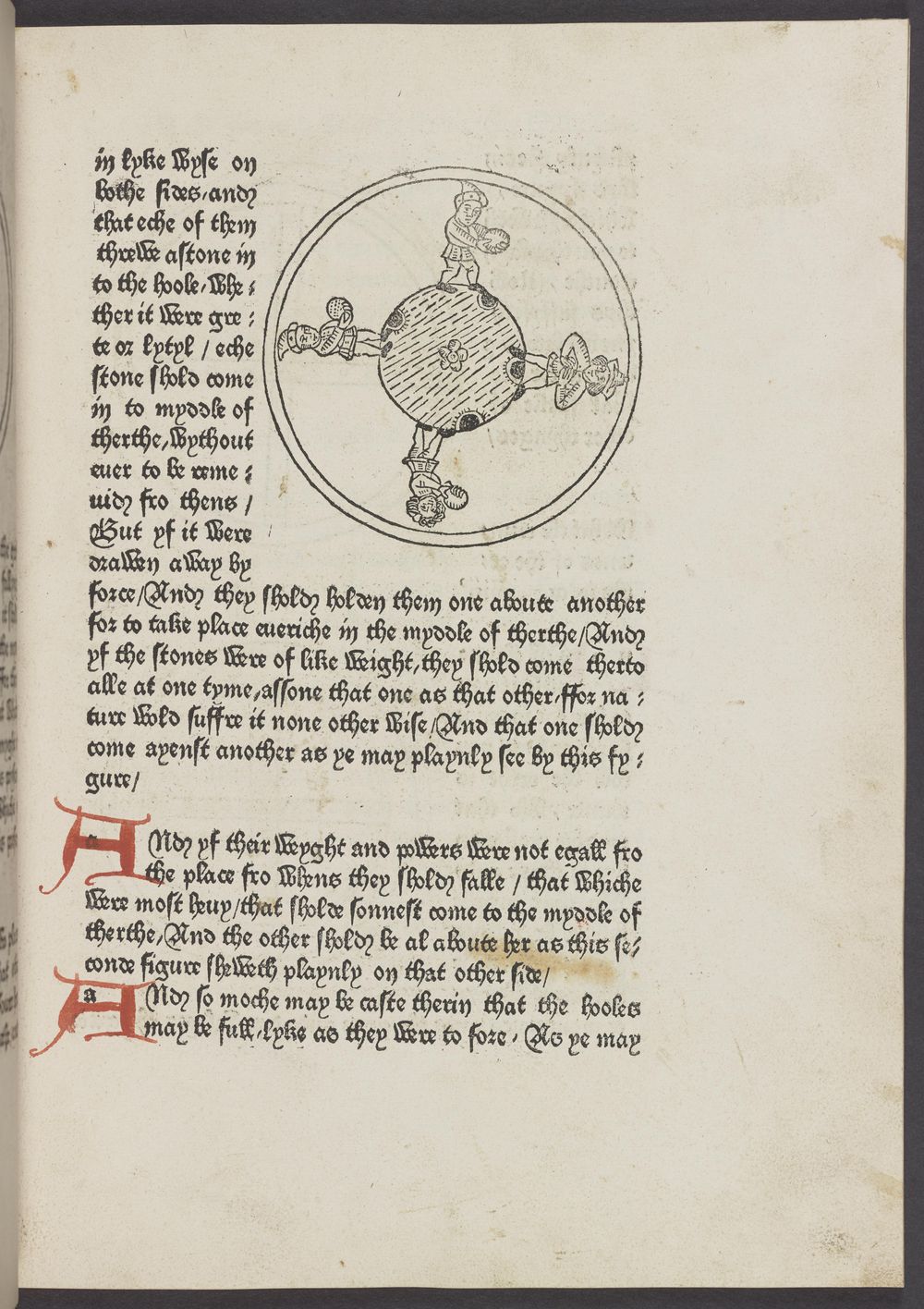
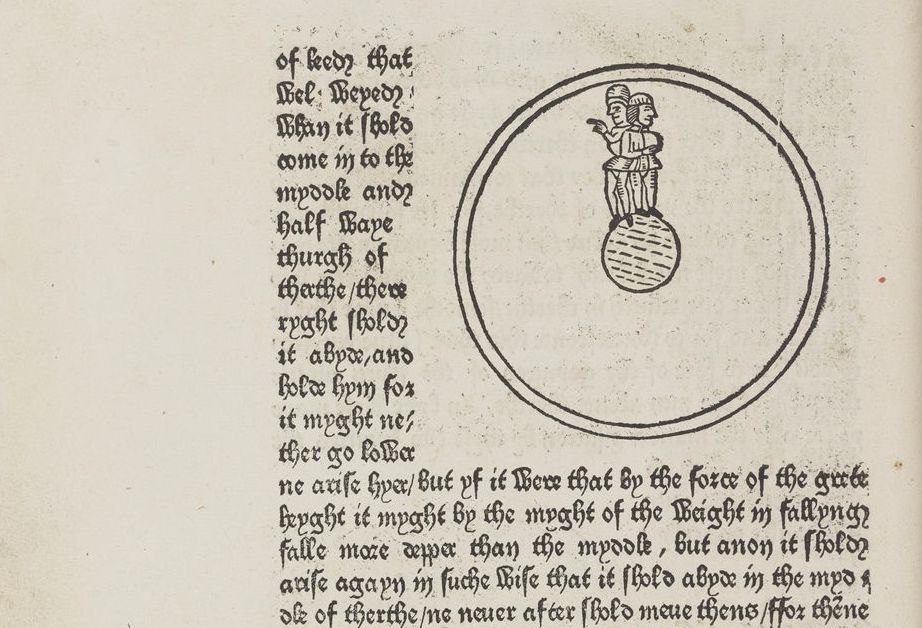
Representing the confident but cramped worldview of the medieval sciences, the Mirror of the World is “ambitious,” Allison Meier writes at Hyperallergic, dispelling any notion of a flat Earth, with descriptions of “large ideas like the roundness of the Earth and why we experience day and night… Along with some historical information, there are descriptions of the Earth, the solar system, and eclipses. The round shape of the Earth is illustrated by two men who stand back-to-back, walking away from each other and meeting again in a circle. Another describes the same idea with a rock tossed through a hole sliced in the world, with it tumbling out the other side.”
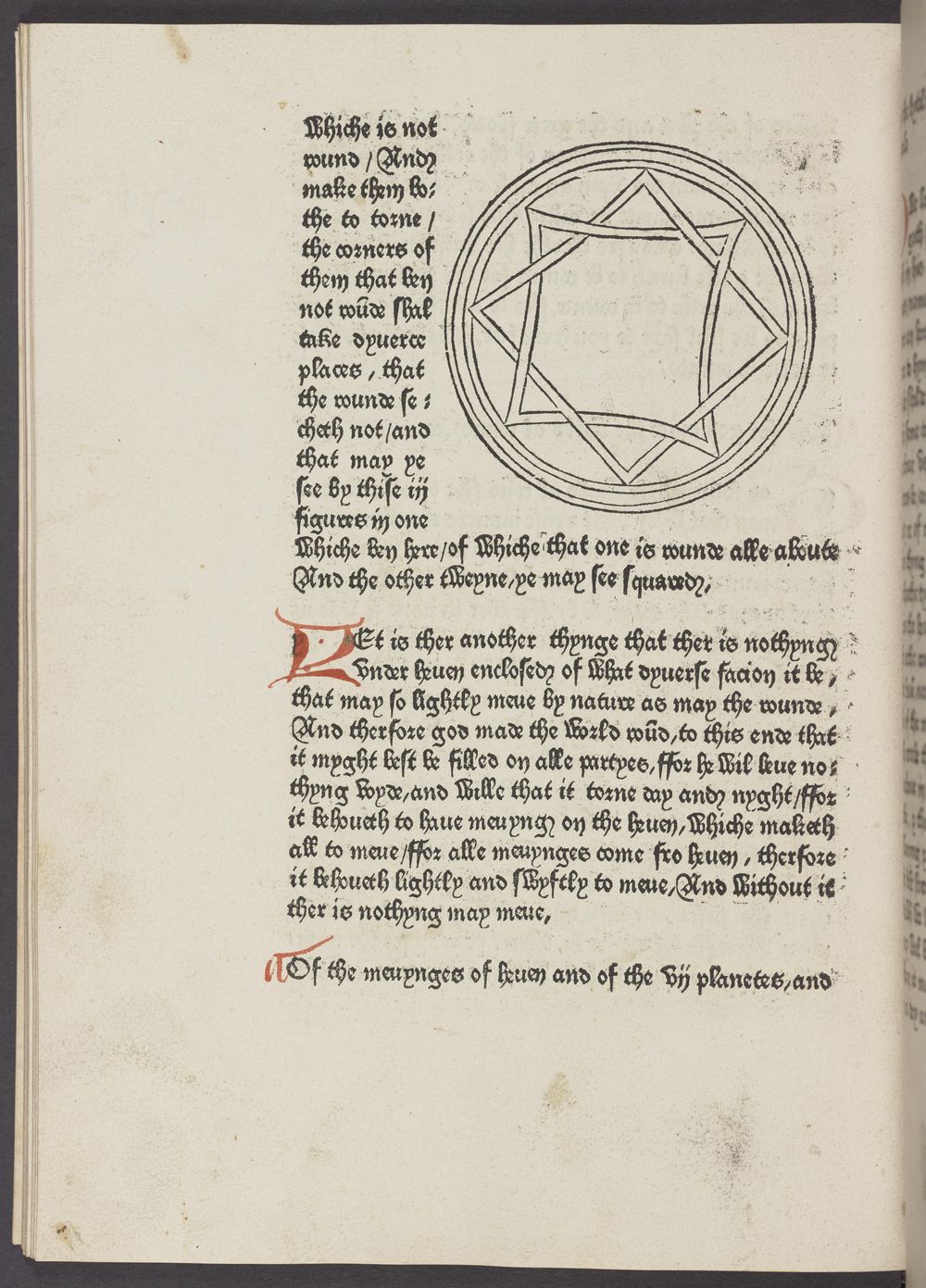
Mike Millward of the Blackburn Museum describes the images further:
The illustrations are woodcut prints which could be printed as part of the text. Caxton’s prints were probably produced in England and are rather primitive. Many are merely illustrative… Others are essential to an understanding of the text, such those illustrating the roundness of the Earth and the effect of gravity, both showing a surprisingly modern understanding
These illustrations, notes John T. McQuillan, assistant curator of printed books at the Pierpont Morgan library, were remarkably preserved from the original French text of two centuries earlier. “Print only carried on existing manuscript and textual traditions,” he notes, “and did not radically alter them, at first. Anyone who wanted to buy this text would have expected it to have these specific illustrations, and Caxton provided that to them.” Pierpont Morgan himself, who owned several of Caxton’s early printed books, “valued Caxton even over Gutenberg,” Meier writes, and “had the printer painted on the ceiling of his library’s East Room.”
Another rare books library, Princeton’s Scheide, which holds perhaps the finest collection of early European and American printing in the world, features a scanned full-text edition of Mirror of the World, the first illustrated book printed in England and a work that sits squarely on the threshold between the medieval and the modern, and that challenges our ideas about both designations.
Related Content:
One of World’s Oldest Books Printed in Multi-Color Now Opened & Digitized for the First Time
See the Oldest Printed Advertisement in English: An Ad for a Book from 1476
Josh Jones is a writer and musician based in Durham, NC. Follow him at @jdmagness
Read More...New Documentary Sisters with Transistors Tells the Story of Electronic Music’s Female Pioneers
“Technology is a tremendous liberator,” says Laurie Anderson in her voiceover narration for the new documentary Sisters with Transistors, a look at the women who have pioneered electronic music since its beginnings and been integral to inventing new sounds and ways of making them. “Women were naturally drawn to electronic music. You didn’t have to be accepted by any of the male-dominated resources. You could make something with electronics, and you could present music directly to an audience.”
Technology as liberator may sound utopian to our jaded 21st century ears, accustomed as we are to focusing on tech’s misuses and abuses. But machines have very often been a means of social progress, just as when “bicycles promised freedom to women long accustomed to relying on men for transportation.” The creation and innovation of recording and broadcasting equipment deserves its own place in women’s history.
Radio in particular gave women the opportunity to experiment with sound and reach millions who might not otherwise give them a hearing. The influence of BBC radio composers like Delia Derbyshire and Daphne Oram, for example, remains pervasive, and the electronic soundscapes they created for radio and television helped define the sonic world we now inhabit. It is a world, director Lisa Rovner tells AFI’s Malin Kan below, permeated by electronic music.
“I can’t actually remember,” says Rovner, “a time when I wasn’t aware of electronic music. Electronic music penetrates pretty much every single aspect of my life since I was a kid, whether that’s stuff that’s on television or the video games that I played with my brother.” Her interest in the music’s “transcendent” qualities was first piqued, she says, at a rave. The film project happened to “check all the boxes” for her, with its focus not only on the electronic music women have made for over a century, but also on “the wider social, political and cultural context of the 20th century,” as the film’s site notes.
Sisters with Transistors covers a range of composers, several of whom we’ve previously featured on Open Culture, including Derbyshire, Oram, Clara Rockmore, Bebe Barron, Maryanne Amacher, Eliane Radigue, Suzanne Ciani, Laurie Spiegel, and Pauline Oliveros. “The history of women has been a history of silence,” Rovner writes. “Music is no exception.” Or as Oliveros put it in a 1970 New York Times Op-Ed:
Why have there been no “great” women composers? The question is often asked. The answer is no mystery. In the past, talent, education, ability, interests, motivation were irrelevant because being female was a unique qualification for domestic work and for continual obedience to and dependence upon men.
As Sisters with Transistors shows, new technologies broke that dependence for many women, including Oliveros, who provided us with a different answer to questions about the paucity of women composers. Why are there no “great” women in electronic music? Because you haven’t heard them yet. Learn their names and stories in the new documentary.
via Hyperallergic
Related Content:
The Deeply Meditative Electronic Music of Avant-Garde Composer Eliane Radigue
Two Documentaries Introduce Delia Derbyshire, the Pioneer in Electronic Music
Daphne Oram Created the BBC’s First-Ever Piece of Electronic Music (1957)
Hear Seven Hours of Women Making Electronic Music (1938–2014)
Josh Jones is a writer and musician based in Durham, NC. Follow him at @jdmagness
Read More...See Devo Perform Live for the Very First Time (Kent State University, 1973)
Kent State University is known as the site of two important events in American culture: the massacre of May 4, 1970, and the formation of Devo. When the National Guard shot thirteen students at a Vietnam War protest, it signaled to many the end of the youth-driven optimism of the late 1960s. It also motivated a group of musically inclined undergraduates to consolidate the band/conceptual art project they’d premised on the idea of “de-evolution.” Around that time, the group’s founders, art students Gerald Casale and Bob Lewis, met a keyboardist named Mark Mothersbaugh, who contributed some of the signature musical and comedic sensibilities of what would become Devo.
“The band, or at least a band known as Sextet Devo, first performed at a 1973 arts festival in Kent,” writes Calvin C. Rydbom in The Akron Sound: The Heyday of the Midwest’s Punk Capital. Filling out that sextet were Casale’s brother Bob, drummer Rod Reisman, and vocalist Fred Weber. A handout for the show promises a series of “polyrhythmic exercises in de-evolution,” including a number called “Private Secretary,” footage of which appears above.
“The group were all dressed oddly, Bob in scrubs, Jerry in a butcher’s coat, Bob Lewis behind the keyboards in a monkey mask, and Mark in a doctor’s robe,” writes George Gimarc in Punk Diary: The Ultimate Trainspotter’s Guide to Underground Rock, 1970–1982. “The audience was, at times, confused, amused, and some even danced.”
Sextet Devo “would have been off the charts in most environments,” says Myopia, a retrospective volume on Mothersbaugh’s work. At the Kent Creative Arts Festival “the band actually fit within the spectrum of normal behavior, albeit at the far end of the scale.” But even their most appreciative viewers couldn’t have known how far the concept of de-evolution had to go, to say nothing of the pop-cultural heights to which the oddballs onstage would carry it. Just five years later, Devo would make their national-television debut as a quintet on Saturday Night Live, “de-evolving” the Rolling Stones’ “Satisfaction.” But they didn’t forget where they’d come from: nearly thirty years after their first show, they came back around to 1970 for a de-evolution of Crosby, Stills, Nash & Young’s “Ohio.”
Related Content:
The Mastermind of Devo, Mark Mothersbaugh, Presents His Personal Synthesizer Collection
DEVO Is Now Selling COVID-19 Personal Protective Equipment: Energy Dome Face Shields
Based in Seoul, Colin Marshall writes and broadcasts on cities, language, and culture. His projects include the Substack newsletter Books on Cities, the book The Stateless City: a Walk through 21st-Century Los Angeles and the video series The City in Cinema. Follow him on Twitter at @colinmarshall, on Facebook, or on Instagram.
Read More...
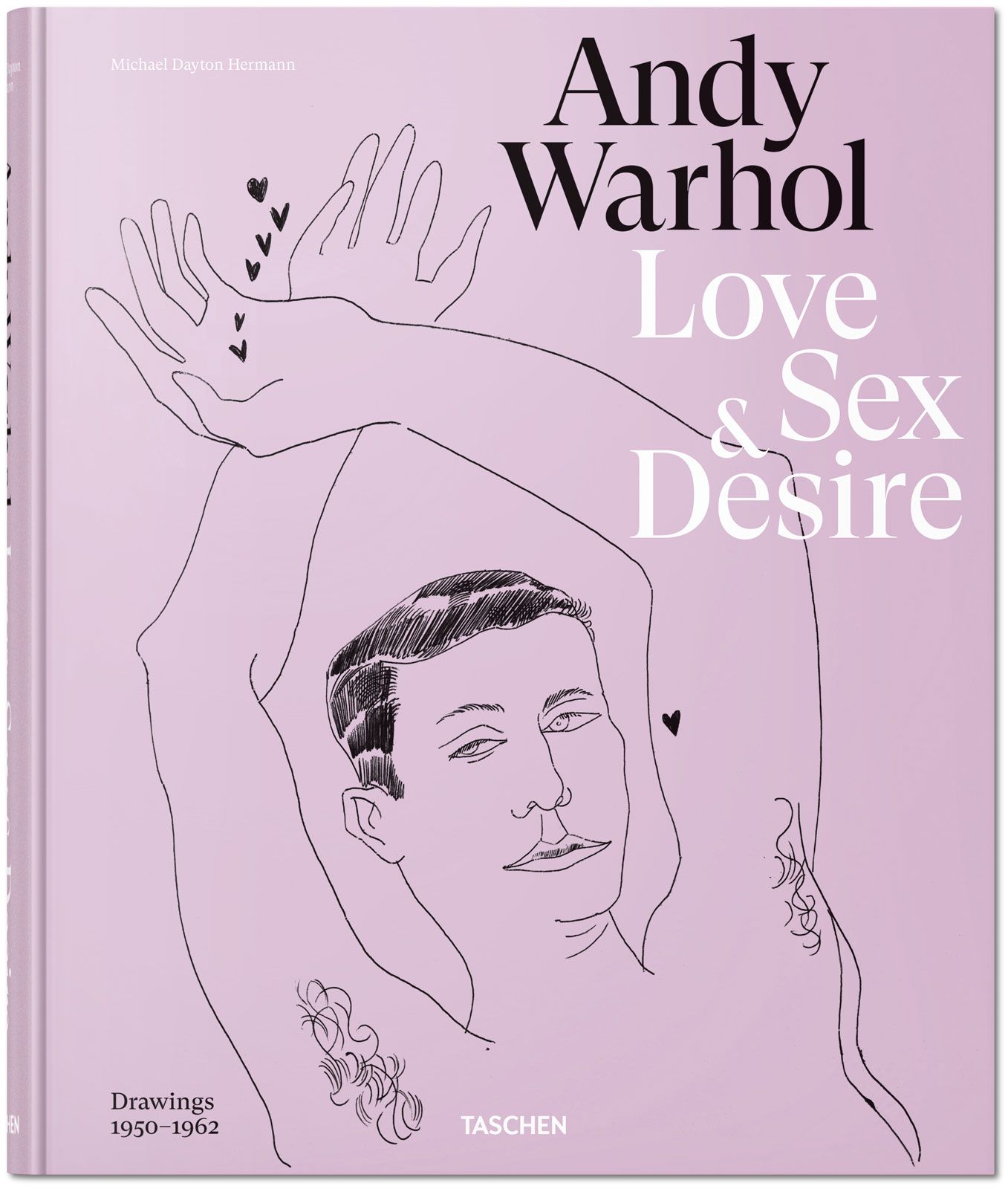
300 Rarely-Seen, Risqué Drawings by Andy Warhol Published in the New Book, Andy Warhol: Love, Sex, and Desire. Drawings (1950–1962)
It’s not the ingredients that sell the product. It’s how Warhol makes you feel about the product.
—Young and Rubicam employee, circa early 1950s
It did not take Andy Warhol long to find the status he sought as a young man. Shortly after moving to New York City in 1949, he established himself as one of the highest paid freelance illustrators of the period.
His whimsical, eye-catching line drawings for various luxury brands appeared in such high profile publications as Vogue and Harper’s Bazaar.
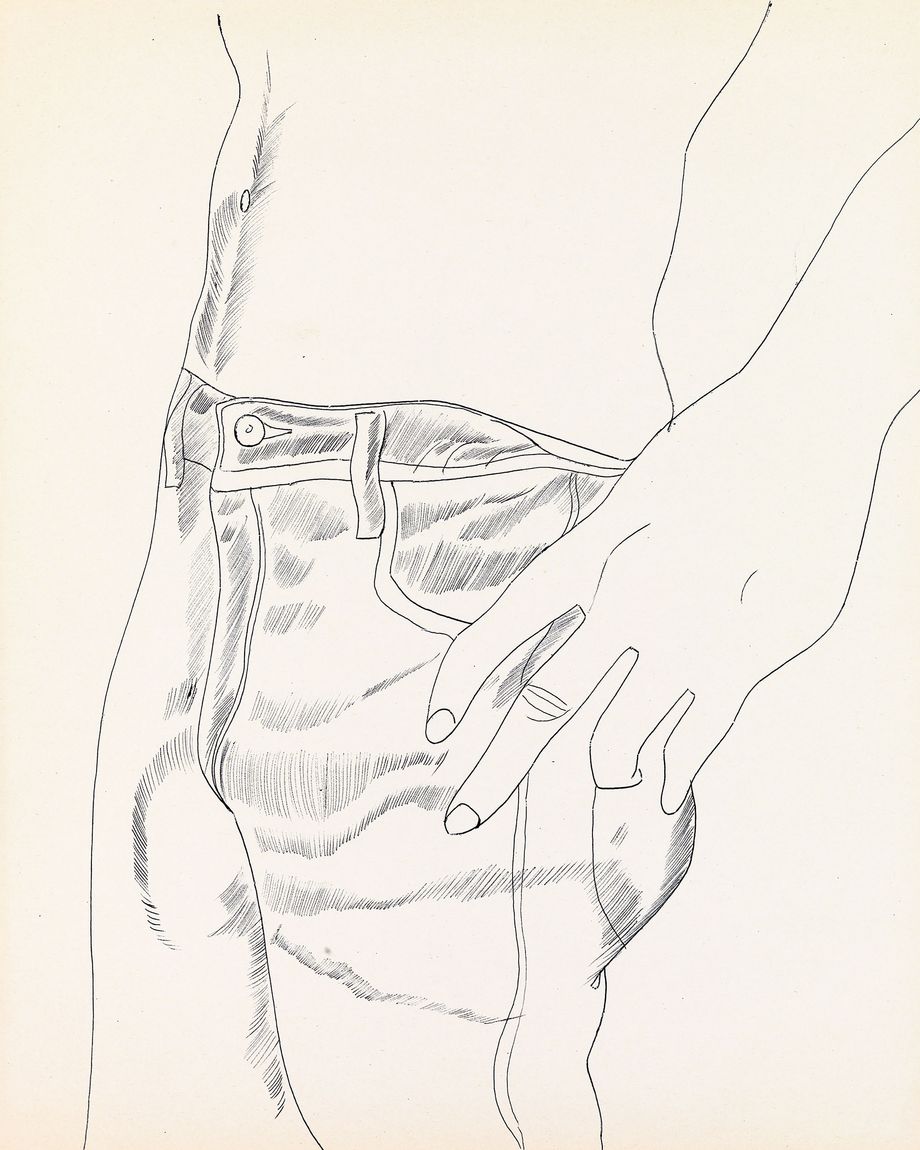
The sense of prettiness and play that animated his pictures of shoes, cats, and perfume bottles is evident in the 1000-some homoerotic drawings he produced during the same time, but those proved to be a tougher sell.
In an era when sodomy was judged to be a felony in every state, full-frontal male nudity was considered obscene, and the art world was in the thrall of the macho Abstract Expressionists, Warhol had difficulty finding a gallery to show his gentle depictions of gay intimacy.
Finally, a personal connection at the Bodley Gallery on New York’s Upper East Side agreed to host a small exhibition, opening Studies for a Boy Book by Andy Warhol on Valentine’s Day 1956.
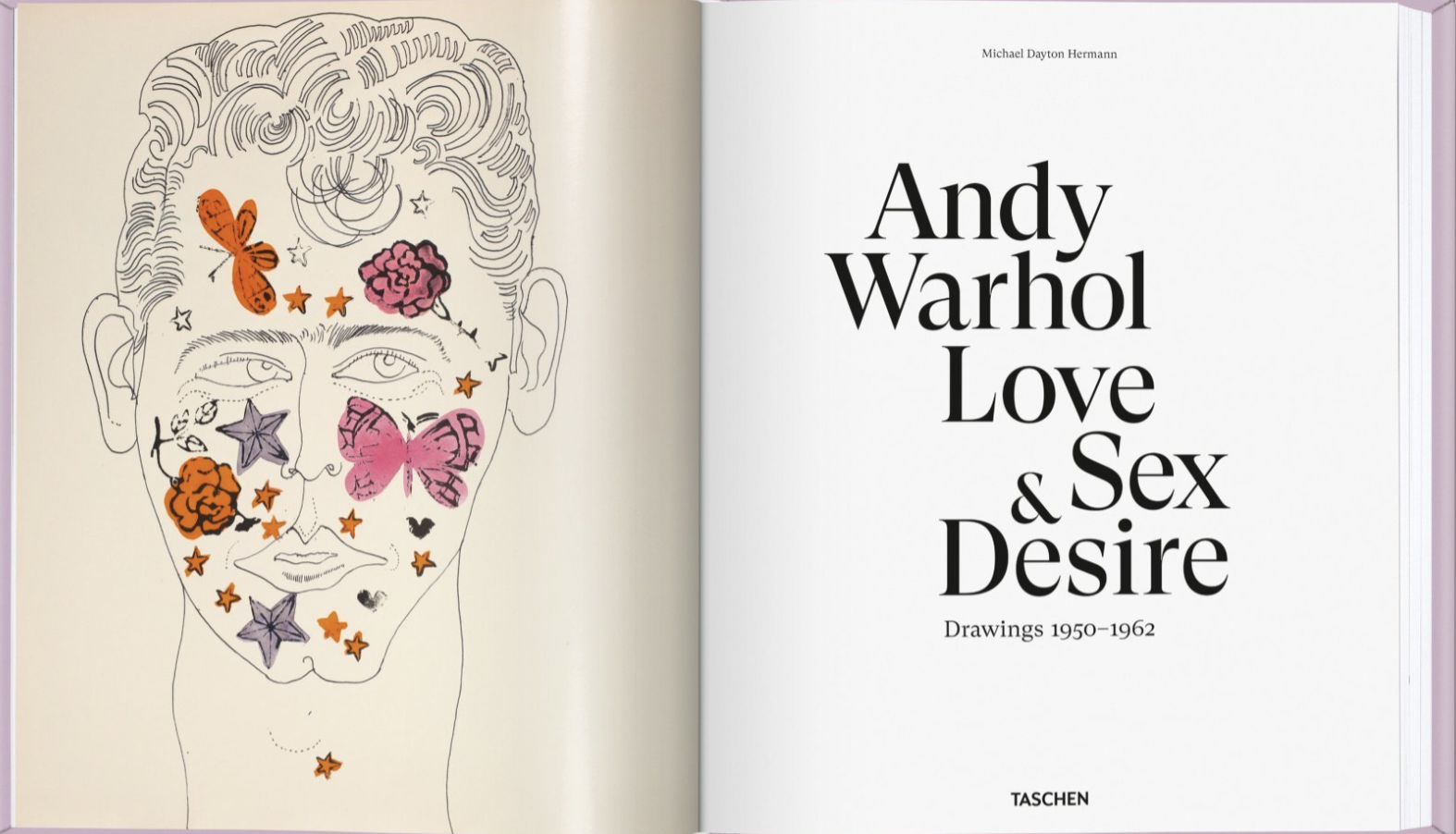
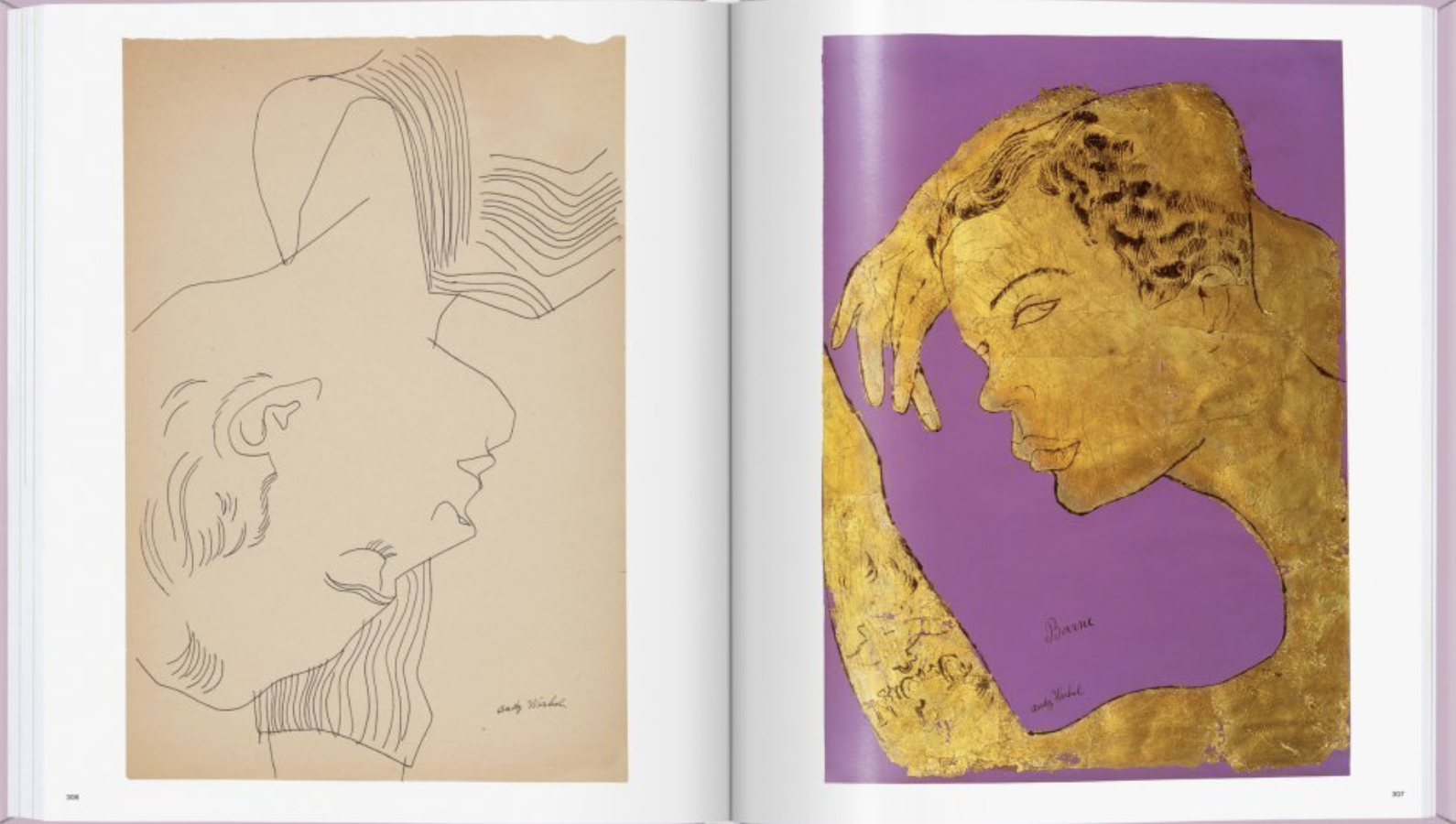
The drawings were reminiscent of Warhol favorite Jean Cocteau’s sketches’ in both subject matter and cleanly executed line. His models were friends, lovers, assistants, and other scenemakers.
Warhol’s friend, Robert Fleischer, a stationery buyer at Bergdorf Goodman’s, recalled:
He used to come over to my apartment on 76th Street. He used to come quite often. He always wanted to sketch me. At the same time, just about that time, I became a model. I was photographed a lot, and I was in retailing but earned part of my income by modeling and Andy used to sketch and sketch and sketch and sketch… He said he was going to do what he called his ‘Boy Book,’ and he wanted all of us to pose nude, and we did. There was loads of us… Andy loved to sketch models and very intimate sexual acts. Really!
Warhol’s ambition to publish a monograph of A Boy Book went unrealized during his lifetime, but 300 of the drawings appear in Taschen’s just-released Andy Warhol. Love, Sex, and Desire. Drawings 1950–1962.
The collection also features essays by biographer Blake Gopnik and critic Drew Zeiba, as well as poems by James Baldwin, Thom Gunn, Harold Norse, Allen Ginsberg, and Essex Hemphill.
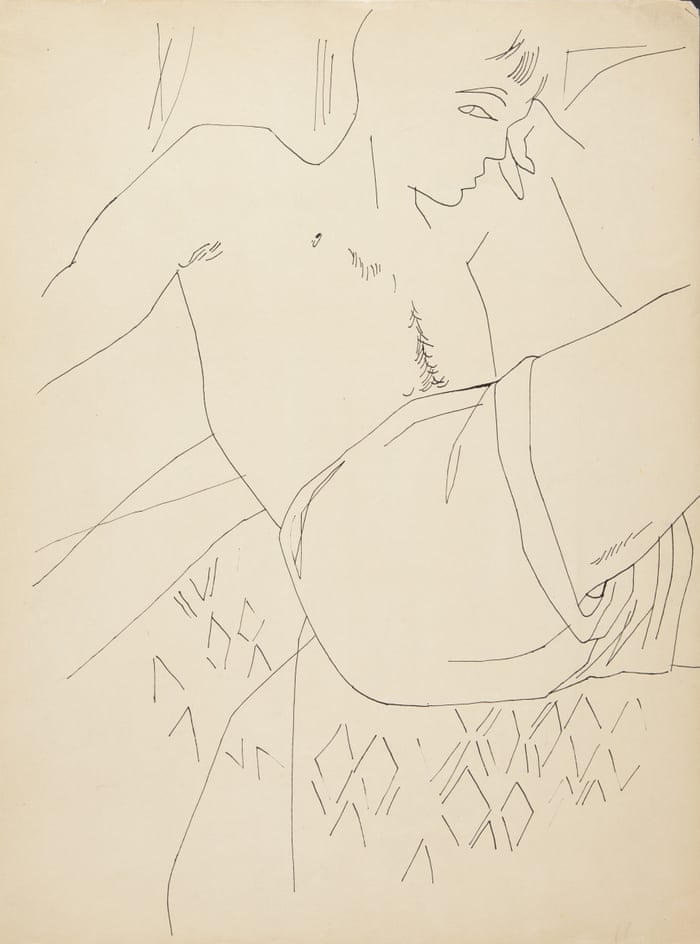
Warhol’s first studio assistant, antiquarian and illustrator Vito Giallo, remembered Warhol during this period: “He never considered himself a fine artist but he wished he could be. We often talked about that.”
As Michael Dayton Hermann, who edited Andy Warhol. Love, Sex, and Desire. Drawings 1950–1962 observes:
Collectively, the hundreds of drawings Warhol made from life during this period provide a touching portrait of the one person not depicted in any of them—Andy Warhol.
Related Content:
130,000 Photographs by Andy Warhol Are Now Available Online, Courtesy of Stanford University
Take a Virtual Tour of the Andy Warhol Exhibition at the Tate Modern
Ayun Halliday is an author, illustrator, theater maker and Chief Primatologist of the East Village Inky zine. She most recently appeared as a French Canadian bear who travels to New York City in search of food and meaning in Greg Kotis’ short film, L’Ourse. Follow her @AyunHalliday.
Read More...20 Lessons from the 20th Century About How to Defend Democracy from Authoritarianism: A Timely List from Yale Historian Timothy Snyder
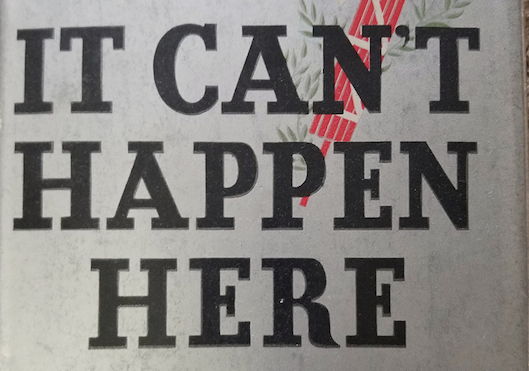
Image by Rob Kall, via Flickr Commons
Timothy Snyder, Housum Professor of History at Yale University, is one of the foremost scholars in the U.S. and Europe on the rise and fall of totalitarianism during the 1930s and 40s. Among his long list of appointments and publications, he has won multiple awards for his recent international bestsellers Bloodlands: Europe between Hitler and Stalin and last year’s Black Earth: The Holocaust as History and Warning. That book in part makes the argument that Nazism wasn’t only a German nationalist movement but had global colonialist origins—in Russia, Africa, and in the U.S., the nation that pioneered so many methods of human extermination, racist dehumanization, and ideologically-justified land grabs.
The hyper-capitalism portrayed in the U.S.—even during the Depression—Snyder writes, fueled Hitler’s imagination, such that he promised Germans “a life comparable to that of the American people,” whose “racially pure and uncorrupted” German population he described as “world class.” Snyder describes Hitler’s ideology as a myth of racialist struggle in which “there are really no values in the world except for the stark reality that we are born in order to take things from other people.” Or as we often hear these days, that acting in accordance with this principle is the “smart” thing to do. Like many far right figures before and after, Hitler aimed to restore a state of nature that for him was a perpetual state of race war for imperial dominance.
After the November 2016 election, Snyder wrote a profile of Hitler, a short piece that made no direct comparisons to any contemporary figure. But reading the facts of the historical case alarmed most readers. A few days later, the historian appeared on a Slate podcast to discuss the article, saying that after he submitted it, “I realized there was more.… there are an awful lot of echoes.” Snyder admits that history doesn’t actually repeat itself. But we’re far too quick, he says, to dismiss that idea as a cliché “and not think about history at all. History shows a range of possibilities.” Similar events occur across time under similar kinds of conditions. And it is, of course, possible to learn from the past.
If you’ve heard other informed analysis but haven’t read Snyder’s New York Review of Books columns on fascism in Putin’s Russia or the former Yanukovich’s Ukraine, or his long article “Hitler’s World May Not Be So Far Away,” you may have seen his widely-shared Facebook post making the rounds. As he argued in The Guardian last September, today we may be “too certain we are ethically superior to the Europeans of the 1940s.” On November, 15, 2016 Snyder wrote on Facebook that “Americans are no wiser than the Europeans who saw democracy yield to fascism, Nazism, or communism.” Snyder has been criticized for conflating these regimes, and rising “into the top rungs of punditdom,” but when it comes to body counts and levels of suppressive malignancy, it’s hard to argue that Stalinist Russia, any more than Tsarist Russia, was anyone’s idea of a democracy.
Rather than making a historical case for viewing the U.S. as exactly like one of the totalitarian regimes of WWII Europe, Snyder presents 20 lessons we might learn from those times and use creatively in our own where they apply. In my view, following his suggestions would make us wiser, more self-aware, proactive, responsible citizens, whatever lies ahead. Read Snyder’s lessons from his Facebook post below and consider ordering his latest book On Tyranny: Twenty Lessons from the Twentieth Century:
1. Do not obey in advance. Much of the power of authoritarianism is freely given. In times like these, individuals think ahead about what a more repressive government will want, and then start to do it without being asked. You’ve already done this, haven’t you? Stop. Anticipatory obedience teaches authorities what is possible and accelerates unfreedom.
2. Defend an institution. Follow the courts or the media, or a court or a newspaper. Do not speak of “our institutions” unless you are making them yours by acting on their behalf. Institutions don’t protect themselves. They go down like dominoes unless each is defended from the beginning.
3. Recall professional ethics. When the leaders of state set a negative example, professional commitments to just practice become much more important. It is hard to break a rule-of-law state without lawyers, and it is hard to have show trials without judges.
4. When listening to politicians, distinguish certain words. Look out for the expansive use of “terrorism” and “extremism.” Be alive to the fatal notions of “exception” and “emergency.” Be angry about the treacherous use of patriotic vocabulary.
5. Be calm when the unthinkable arrives. When the terrorist attack comes, remember that all authoritarians at all times either await or plan such events in order to consolidate power. Think of the Reichstag fire. The sudden disaster that requires the end of the balance of power, the end of opposition parties, and so on, is the oldest trick in the Hitlerian book. Don’t fall for it.
6. Be kind to our language. Avoid pronouncing the phrases everyone else does. Think up your own way of speaking, even if only to convey that thing you think everyone is saying. (Don’t use the internet before bed. Charge your gadgets away from your bedroom, and read.) What to read? Perhaps “The Power of the Powerless” by Václav Havel, 1984 by George Orwell, The Captive Mind by Czesław Milosz, The Rebel by Albert Camus, The Origins of Totalitarianism by Hannah Arendt, or Nothing is True and Everything is Possible by Peter Pomerantsev.
7. Stand out. Someone has to. It is easy, in words and deeds, to follow along. It can feel strange to do or say something different. But without that unease, there is no freedom. And the moment you set an example, the spell of the status quo is broken, and others will follow.
8. Believe in truth. To abandon facts is to abandon freedom. If nothing is true, then no one can criticize power, because there is no basis upon which to do so. If nothing is true, then all is spectacle. The biggest wallet pays for the most blinding lights.
9. Investigate. Figure things out for yourself. Spend more time with long articles. Subsidize investigative journalism by subscribing to print media. Realize that some of what is on your screen is there to harm you. Learn about sites that investigate foreign propaganda pushes.
10. Practice corporeal politics. Power wants your body softening in your chair and your emotions dissipating on the screen. Get outside. Put your body in unfamiliar places with unfamiliar people. Make new friends and march with them.
11. Make eye contact and small talk. This is not just polite. It is a way to stay in touch with your surroundings, break down unnecessary social barriers, and come to understand whom you should and should not trust. If we enter a culture of denunciation, you will want to know the psychological landscape of your daily life.
12. Take responsibility for the face of the world. Notice the swastikas and the other signs of hate. Do not look away and do not get used to them. Remove them yourself and set an example for others to do so.
13. Hinder the one-party state. The parties that took over states were once something else. They exploited a historical moment to make political life impossible for their rivals. Vote in local and state elections while you can.
14. Give regularly to good causes, if you can. Pick a charity and set up autopay. Then you will know that you have made a free choice that is supporting civil society helping others doing something good.
15. Establish a private life. Nastier rulers will use what they know about you to push you around. Scrub your computer of malware. Remember that email is skywriting. Consider using alternative forms of the internet, or simply using it less. Have personal exchanges in person. For the same reason, resolve any legal trouble. Authoritarianism works as a blackmail state, looking for the hook on which to hang you. Try not to have too many hooks.
16. Learn from others in other countries. Keep up your friendships abroad, or make new friends abroad. The present difficulties here are an element of a general trend. And no country is going to find a solution by itself. Make sure you and your family have passports.
17. Watch out for the paramilitaries. When the men with guns who have always claimed to be against the system start wearing uniforms and marching around with torches and pictures of a Leader, the end is nigh. When the pro-Leader paramilitary and the official police and military intermingle, the game is over.
18. Be reflective if you must be armed. If you carry a weapon in public service, God bless you and keep you. But know that evils of the past involved policemen and soldiers finding themselves, one day, doing irregular things. Be ready to say no. (If you do not know what this means, contact the United States Holocaust Memorial Museum and ask about training in professional ethics.)
19. Be as courageous as you can. If none of us is prepared to die for freedom, then all of us will die in unfreedom.
20. Be a patriot. The incoming president [Trump] is not. Set a good example of what America means for the generations to come. They will need it.
Note: This post originally appeared on our site in January 2017.
Related Content:
Umberto Eco Makes a List of the 14 Common Features of Fascism
George Orwell’s Final Warning: Don’t Let This Nightmare Situation Happen. It Depends on You!
Josh Jones is a writer and musician based in Durham, NC. Follow him at @jdmagness
Read More...Behold an Interactive Online Edition of Elizabeth Twining’s Illustrations of the Natural Orders of Plants (1868)
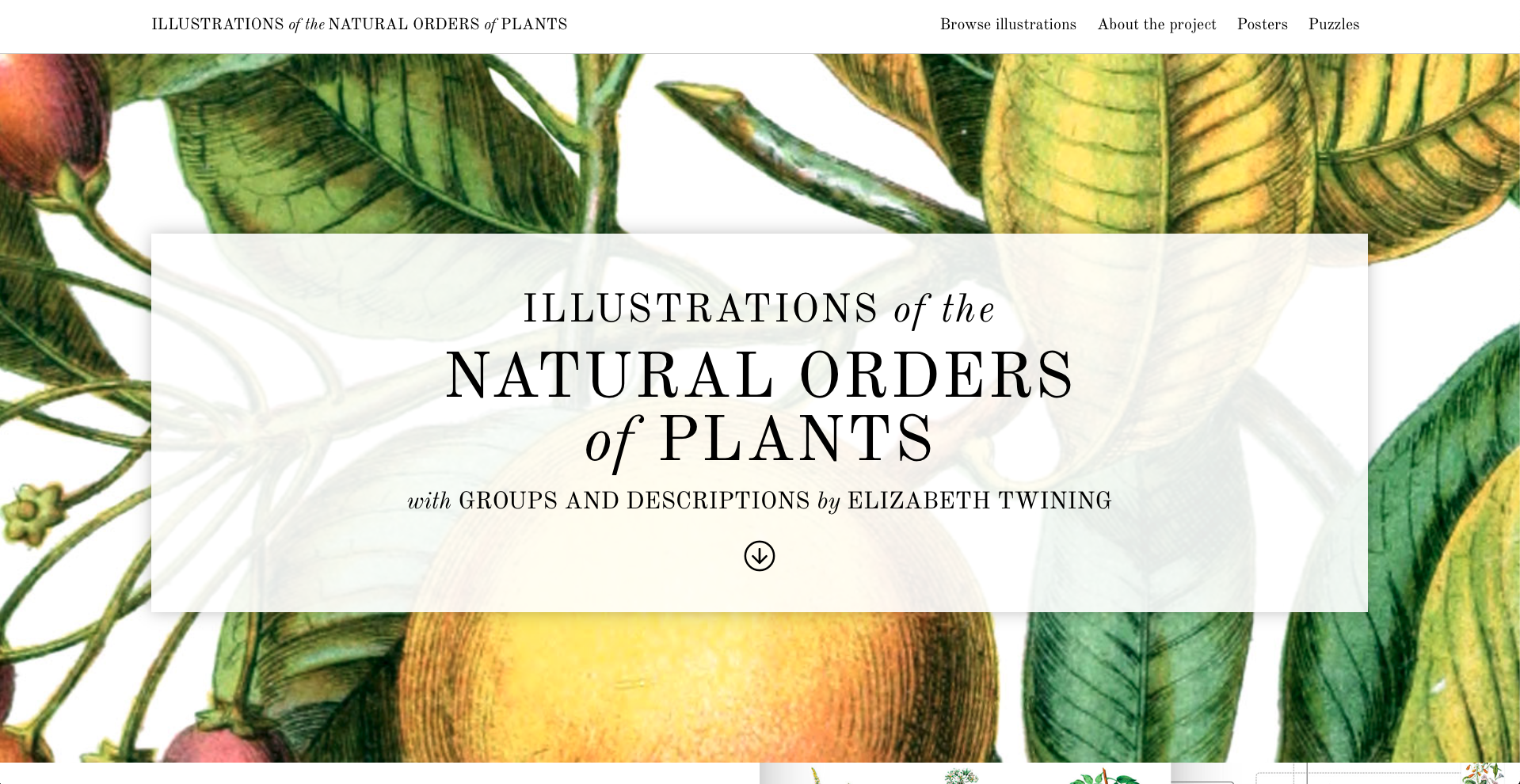
Of all the varied objects of creation there is, probably, no portion that affords so much gratification and delight to mankind as plants. —Elizabeth Twining
“Who owned nature in the eighteenth century?” asks Londa Schiebinger in Plants and Empire, a study of what the Stanford historian of science calls “colonial bioprospecting in the Atlantic World.” The question was largely decided at the time by “heroic voyaging botanists” and “biopirates” who claimed the world’s natural resources as their own. The matter was settled in the next couple centuries by merchants like Thomas Twining and his descendants, proprietors of Twinings tea. Founded as Britain’s first known tea shop in 1706, the company went on to become one of the largest purveyors of teas grown in the British colonies.
One of Twining’s descendants, Elizabeth Twining, carried on the legacy as what Schiebinger calls one of many “armchair naturalists, who coordinated and synthesized collecting from sinecures in Europe,” a role often taken on by women who could not travel the world. Twining aimed, however, not to create taxonomies of the world’s plants but those of her own country in a comparative analysis.
Her 1868 Illustrations of the Natural Orders of Plants, she wrote in her introduction, was “the first work which has thus done due honour to our British plants by connecting with others, and placing them whenever possible at the head of the Order to be illustrated.”

Twining’s revaluation of local British plants was in keeping with the reformist spirit of the age, and she herself was such a reformer. “Apart from her artistic endeavors,” writes Nicholas Rougeaux, Twining “was a notable philanthropist,” establishing almshouses and temperance halls, founding “mother’s meetings” in London, and helping to found the Bedford College for Women. She was inspired by Curtis’s The Botanical Magazine and “she practiced by making sketches from works in the Dulwich Picture Gallery, and toured famous museums thanks to her father’s patronage.”

Twining authored and illustrated several botanical books, “most notably,” Rougeux writes, “the two volume Illustrations of the Natural Orders of Plants, which included a total of 160 hand-colored lithographs, royal folio, reportedly based on observation at the Royal Botanical Gardens in Kew and at Lexden Park in Colchester.” Rougeux has done for her work what the designer previously did for other illustrated classics of science and math (see the related links below): digitizing the illustrations and transliterating the text into a digital format, with hyperlinks and sharing features.
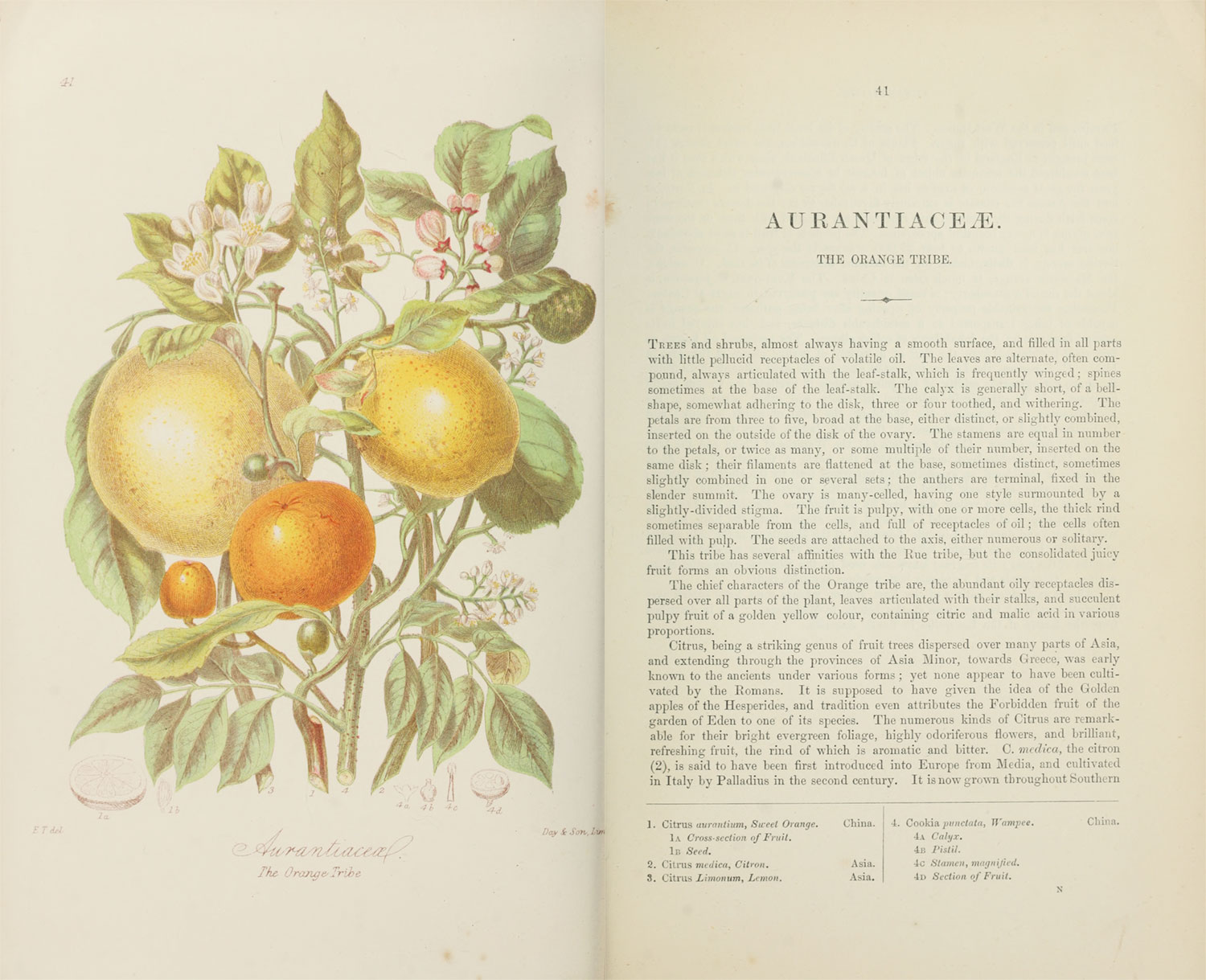
Rougeux’s Illustrations of the Natural Orders of Plants offers itself as “a complete reproduction and restoration… enhanced with interactive illustrations, descriptions, and posters featuring the illustrations.” The first two volumes of the original book were published in 1849 and 1855. Rougeux’s online version of the text is based on the 1868 second edition “with re-drawn illustrations based on her originals.” (See pages from the text above and below.) Rougeux’s digitized text is thus two steps removed from Twining’s original illustrations, but we can see the care and attention she put into classifying the flora of her native country.
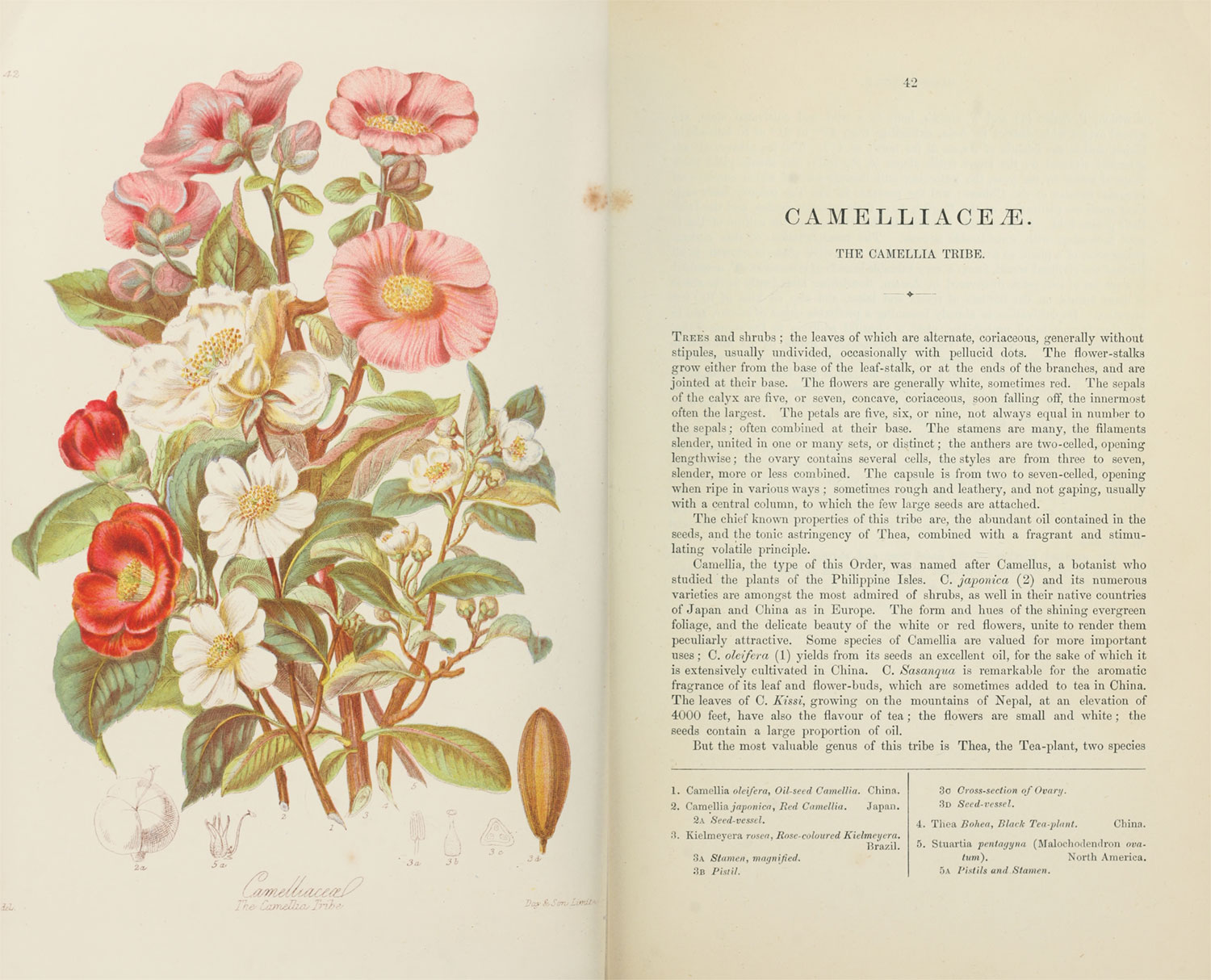
“Twining chose to illustrate plants using the classification system created by Augustin-Pyrame de Candolle based on multiple characteristics of plants—rather than the more widely used system by Carl Linnaeus which was focused on plants’ reproductive characteristics,” notes Rougeux, “because the De Candolle system was newer and she wanted her readers to be up to date as classification systems were evolving.”
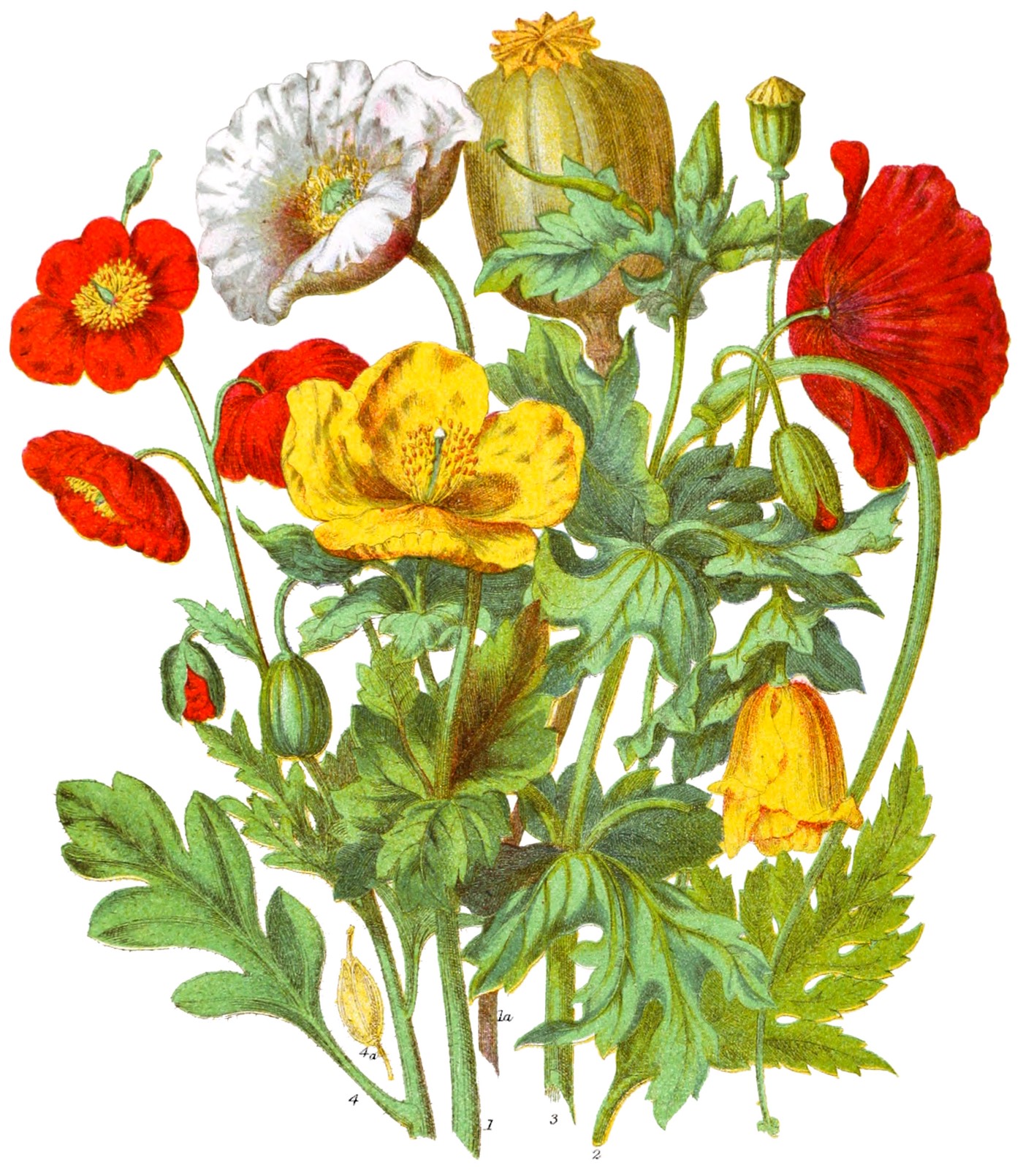
Although biological taxonomies have changed considerably since her time, Twining’s Illustrations of the Natural Orders of Plants remains an intriguing “snapshot in time” that depicts not only the latest ideas about plant classification in the mid-19th century but also the attitudes a prominent member of the British ruling class adopted toward nature as a whole. See Rougeux’s online edition of Twining’s text here.

Related Content:
Josh Jones is a writer and musician based in Durham, NC. Follow him at @jdmagness
Read More...Flair Magazine: The Short-Lived, Highly-Influential Magazine That Still Inspires Designers Today (1950)
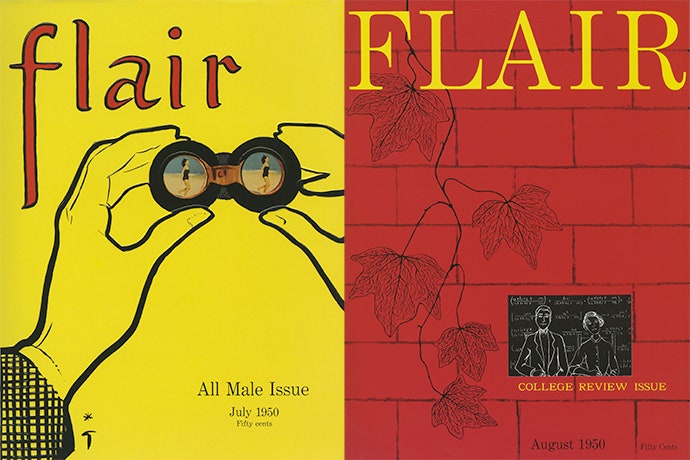
All magazines are their editors, but Flair was more its editor than any magazine had been before — or, for that matter, than any magazine has been since. Though she came to the end of her long life in England, a country to which she had expatriated with her fourth husband, a Briton, Fleur Cowles was as American a cultural figure as they come. Born Florence Freidman in 1908, she had performed on herself an unknowable number of Gatsbyesque acts of reinvention by 1950, when she found herself in a position to launch Flair. Her taste in husbands helped, married as she then was to Gardner “Mike” Cowles Jr., publisher of Look, a popular photo journal that Fleur had helped to lift from its lowbrow origins and make respectable among that all-powerful consumer demographic, postwar American women.
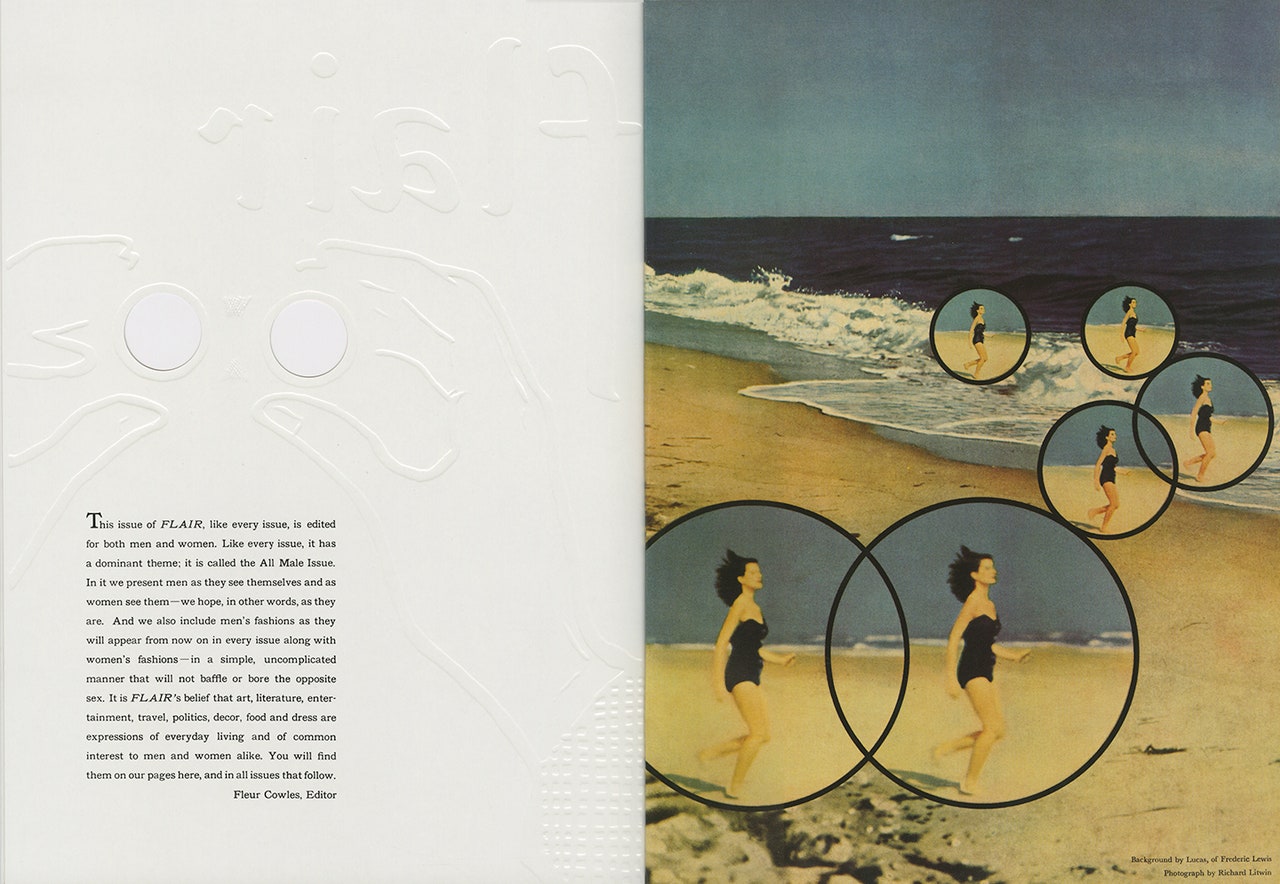
The success of the reinvented Look “allowed Cowles to ask her husband for what she really wanted: the capital to start her own publication, which she called ‘a class magazine,’ ” writes Eye on Design’s Rachel Syme. “She was tired of spreads about the best linoleum; she wanted to do an entire issue on Paris, or hire Ernest Hemingway to write a travel essay, or commission Colette to gossip about her love affairs.”
During Flair’s run she did all that and more, with a roster of contributors also including Salvador Dalí, Simone de Beauvoir, W. H. Auden, Gloria Swanson, Winston Churchill, Eleanor Roosevelt, and Jean Cocteau. In Flair’s debut issue, published in February 1950, “an article on the 28-year-old Lucian Freud came liberally accompanied with reproductions of his art—the first ever to appear in America.”
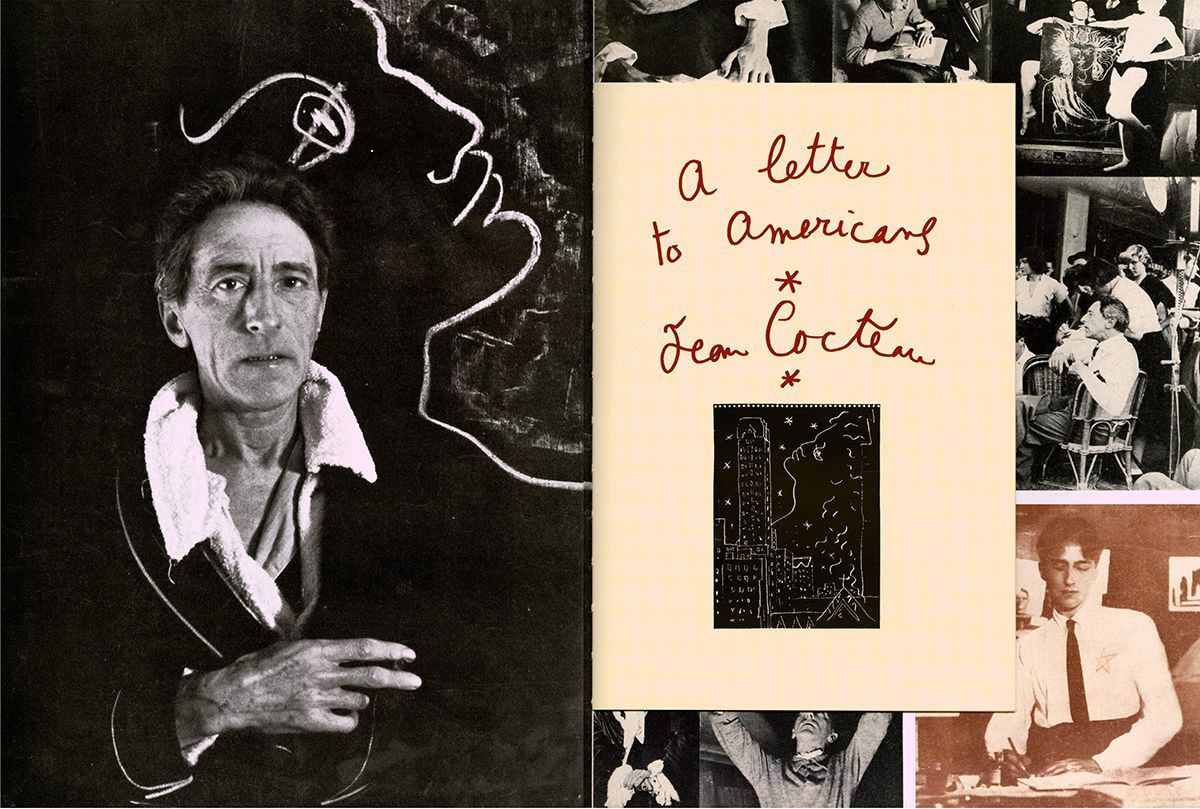
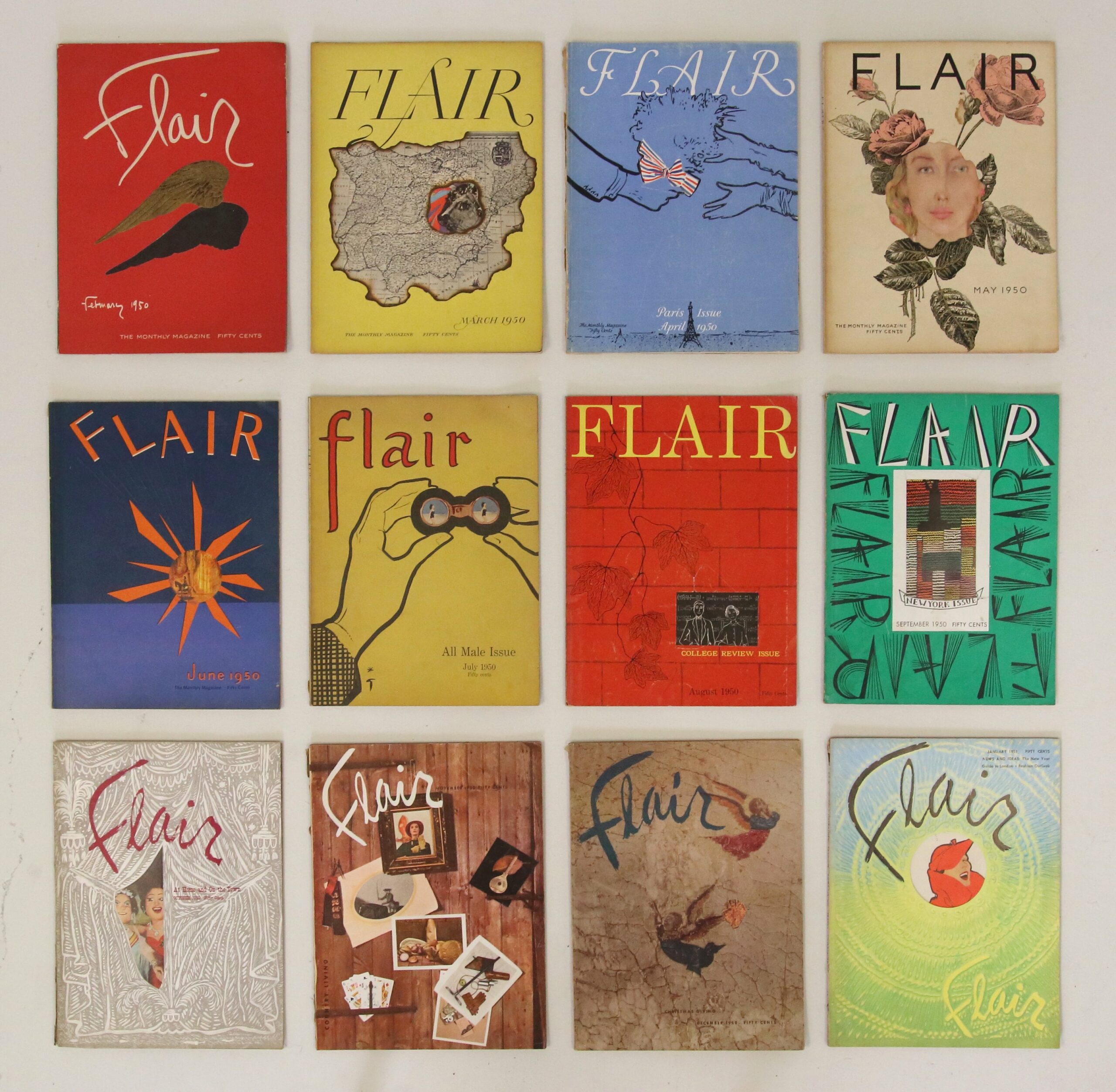
So writes Vanity Fair’s Amy Fine Collins in a profile of Clowes. “Angus Wilson and Tennessee Williams contributed short stories, Wilson’s printed on paper textured to resemble slubbed silk.” What’s more, “The Duke and Duchess of Windsor opened their home to Flair’s readers, treating them to their recondite and entertaining tips. A more futuristic approach to living was set forth in a two-page spread on Richard Kelly’s lighting design for Philip Johnson’s glass house in Connecticut.” Feature though it may have the work of an astonishingly varied group of luminaries — pulled in by Cowles’ vast and deliberately woven social net — Flair is even more respected today for each issue’s lavish, elaborate, and distinctive design.
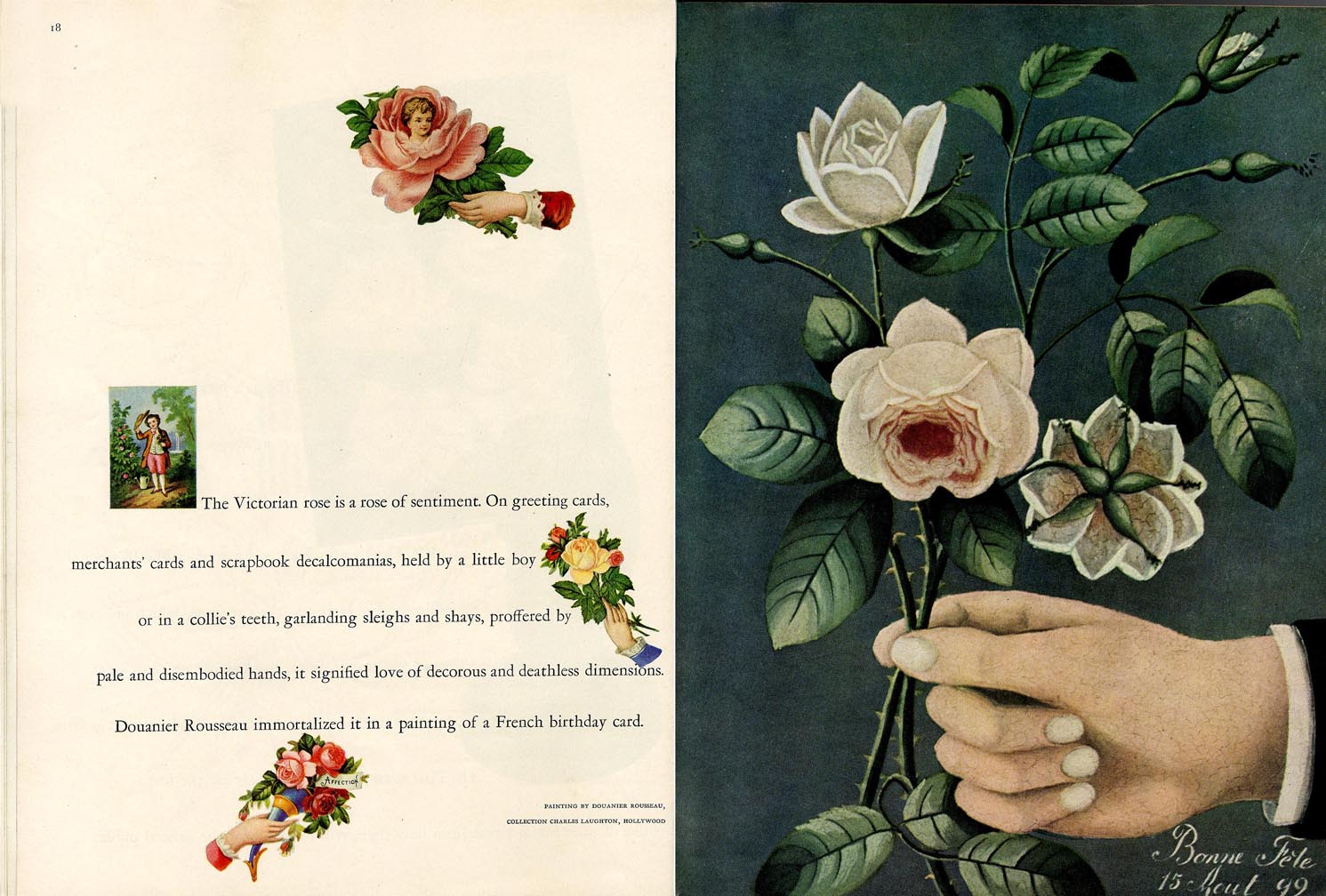
“If a feature would be better in dimension than on flat pages, why not fold half-pages inside double-page spreads?” asks Cowles in her memoirs, quoted in Print magazine. “Why not bind it as ‘a little book’ … giving it a special focus? If a feature was better ‘translated’ on textured paper, why use shiny paper?” And “if a painting was good enough to frame, why not print it on properly heavy stock? Why not bind little accordion folders into each issue to give the feeling of something more personal to the content?” One reason is the $2.5 million (1950 dollars) that Mike Cowles estimated Flair to have cost in the year it ran before he pulled its plug.
But then, by the early 1970s even the highly profitable Look had to fold — and of the two magazines, only one has become ever more sought-after, has books published in its tribute, and still inspires designers today. To take a closer look at the magazine, see The Best of Flair, a compilation of the magazine’s best content as chosen by Fleur Cowles herself. (See a video preview of the book above.)
Related Content:
Vogue Editor-in-Chief Anna Wintour Teaches a Course on Creativity & Leadership
Based in Seoul, Colin Marshall writes and broadcasts on cities, language, and culture. His projects include the Substack newsletter Books on Cities, the book The Stateless City: a Walk through 21st-Century Los Angeles and the video series The City in Cinema. Follow him on Twitter at @colinmarshall, on Facebook, or on Instagram.
Read More...Fonts in Use: Enter a Giant Archive of Typography, Featuring 12,618 Typefaces
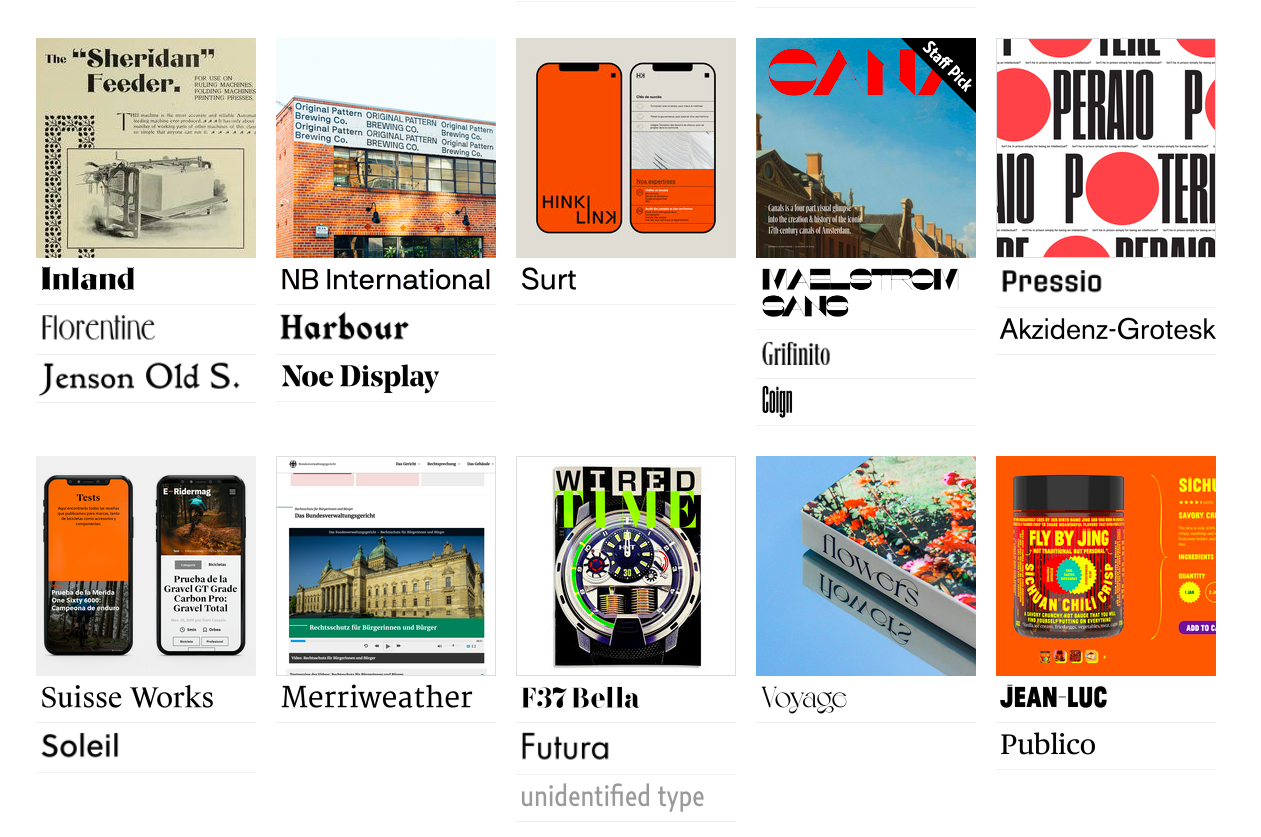
Type selection is an intensive process that requires intimate knowledge of a brand’s values, audience, competition, voice, and goals.
Fonts in Use is a typography nerd’s dream come true.
The 10-year-old independent archive of typography has collected over 17,000 designs, each using at least one of over 12,000 typeface families from more than 3,500 type companies. Each font is contextualized with images depicting them in the wild, on everything from wine labels and storefronts to book covers, record albums, movie posters and of course, advertising of all shapes and sizes.
Fonts can create unlikely bedfellows.
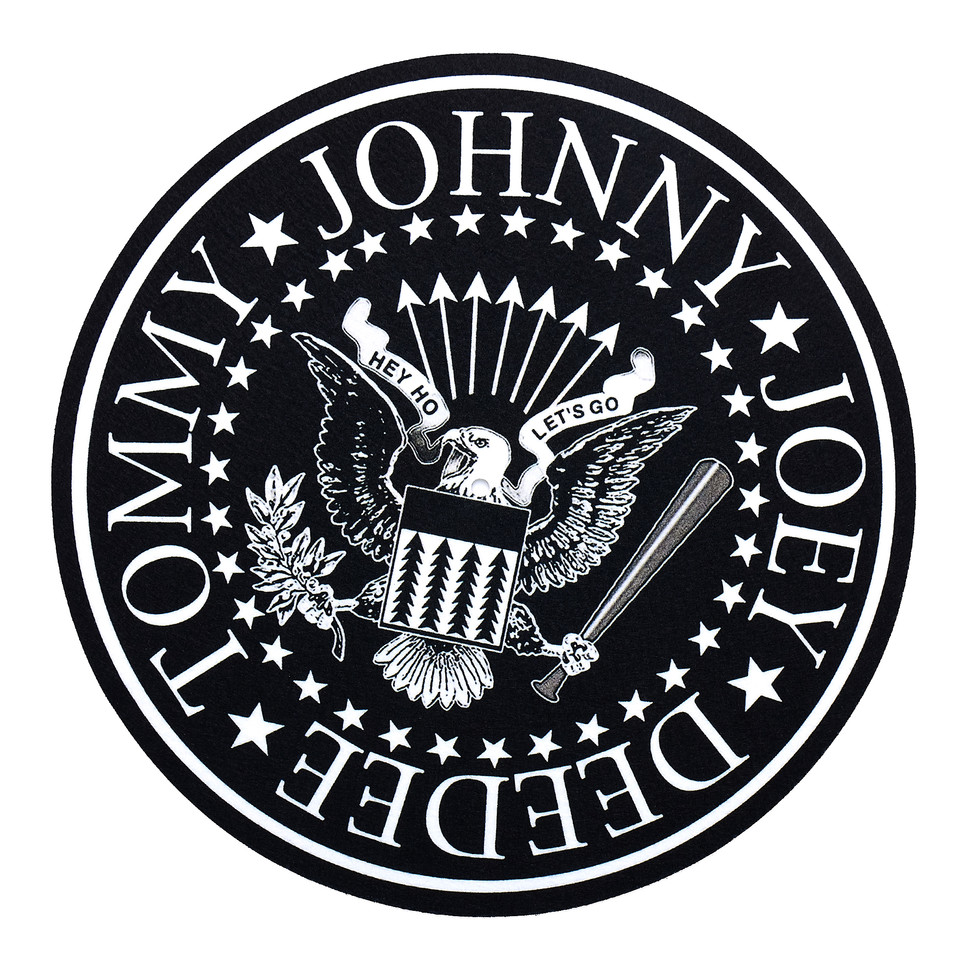
The Ramones’ iconic seal achieved its presidential look thanks to ITC Tiffany.
Other memorable appearances include the first edition cover of Italo Calvino’s experimental novel If On a Winter’s Night a Traveler and the titles for Hammer Film’s 1980 anthology TV series, Hammer House of Horror.
Fonts in Use’s managing editor, Florian Hardwig, describes ITC Tiffany as “Ed Benguiat’s 1974 revisitation and interpretation of 19th-century faces like West Old Style or Old Style Title,” noting such “Victorian details” as “large angled serifs and sharply terminated diagonals.”
The principal cast of Law & Order underwent several changes over the show’s 20-year run, but Friz Quadrata remained a constant, supplying titles and such necessary details as location, time, and date.
Friz Quadrata should be equally familiar to Dungeons & Dragons players of a certain age and fans of Garden Wafers, the packaged cookies from Hong Kong that are a staple of stateside Asian markets.
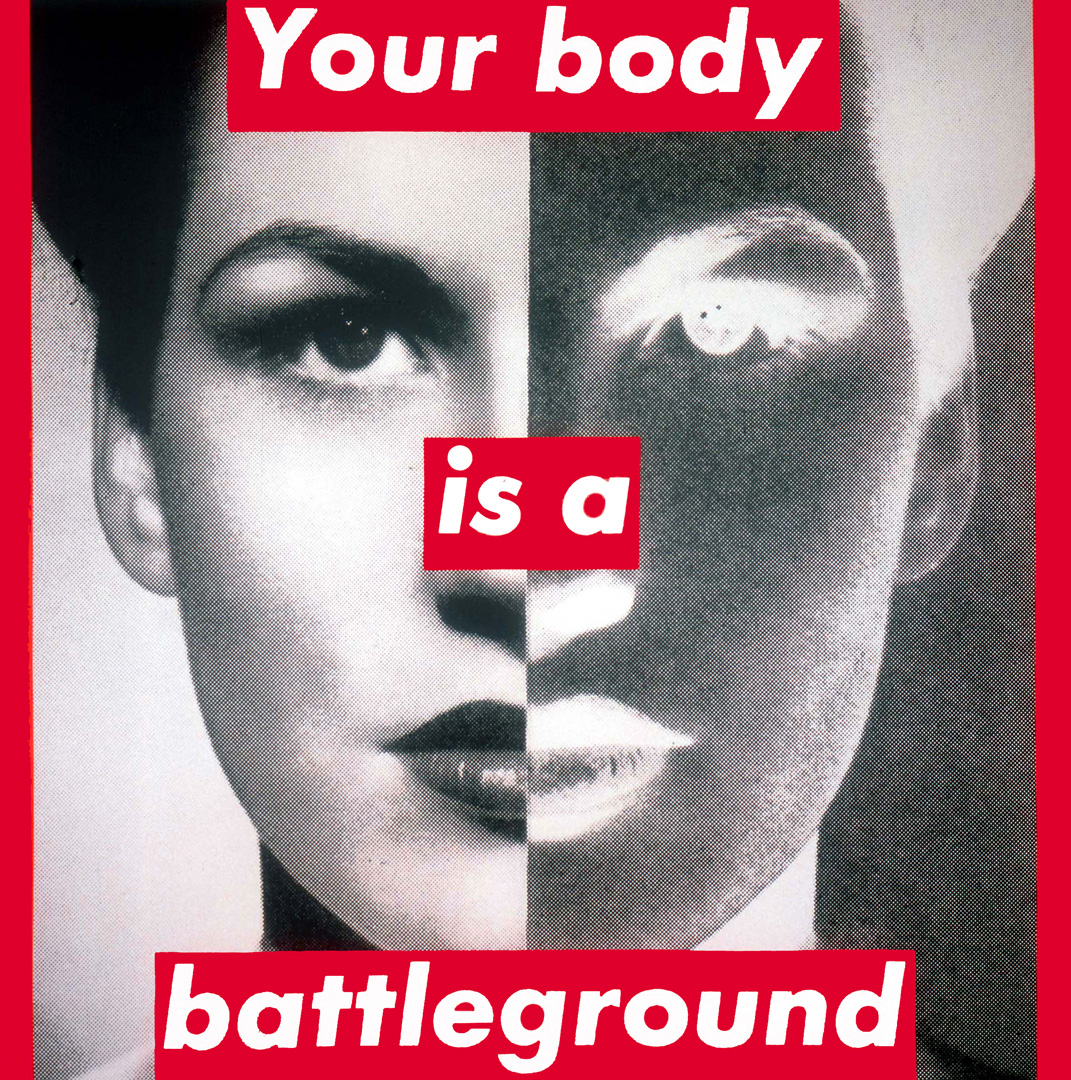
Artist Barbara Kruger’s distinctive text-based work places overt commentary in white italicized Futura on red bands on top of black and white images.
Futura was also the face of a tourist map to Berlin during the 1936 summer Olympics and author David Rees’ tongue-in-cheek guide How to Sharpen Pencils: A Practical & Theoretical Treatise on the Artisanal Craft of Pencil Sharpening for Writers, Artists, Contractors, Flange Turners, Anglesmiths, & Civil Servants.
Comic Sans may not get much love out in the real world, but it’s well represented in the archive’s user submissions.
You’ll find growing numbers of fonts in Cyrillic, as well as fonts familiar to readers of Chinese, Japanese, Korean, Arabic, Greek and Hebrew…
Newbie Netflix Sans keeps company with 19th-century sans Bureau Grot, a favorite of Vice President-Elect Kamala Harris…
Fat Albert, Tintoretto, Benguiat Caslon, Scorpio, Hoopla and Saphir are your ticket back to a far groovier period in the history of graphic art.
Spend an hour or two rummaging through the collection and we guarantee you’ll feel an urgent need to upload typographic examples pulled from your shelves and cabinets.
Fonts in Use welcomes such submissions, as long as type is clearly visible in your uploaded image and is—or was—in use (as opposed to an example of lettering for lettering’s sake). They will also consider custom typefaces which are historically significant or otherwise outstanding, and those that are available to the general public. Please include a short description in your commentary, and whenever possible, credit any designers, photographers, or sources of your image.
Typography nerds are standing by to help.
Begin your explorations of Fonts in Use here. If you’re feeling overwhelmed, the Staff Picks are a great place to start.
Related Content:
The History of Typography Told in Five Animated Minutes
Why This Font Is Everywhere: How Cooper Black Became Pop Culture’s Favorite Font
Ayun Halliday is an author, illustrator, theater maker and Chief Primatologist of the East Village Inky zine. She most recently appeared as a French Canadian bear who travels to New York City in search of food and meaning in Greg Kotis’ short film, L’Ourse. Follow her @AyunHalliday.
Read More...Thelonious Monk’s List of 25 Tips for Musicians
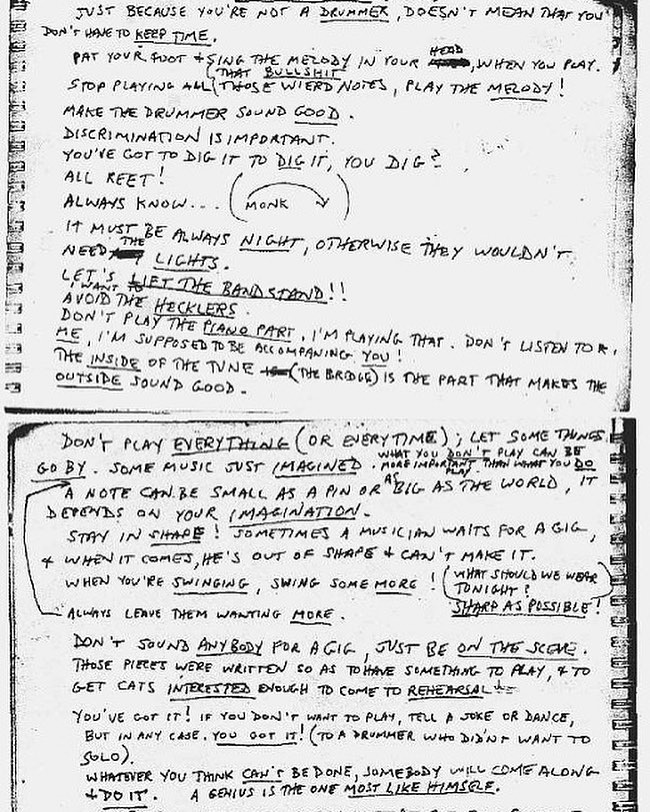
Let’s provide the context, just like host Adam Neely and guest Brian Krock do in this video: in 1960 Steve Lacy, a young, white soprano sax player, briefly joined Thelonious Monk’s band. Two years previous, Lacy had been the first jazz musician to release an album of Monk’s compositions other than the man himself. Even so, Lacy was young, excited, and starstruck at playing alongside not just Monk but John Coltrane (who shared the bill on the 16 week tour), just absorbing everything.
At some point, Monk took Lacy aside and gave his some advice which Lacy wrote down, 25 pieces of advice to be exact.
In the video below, from Neely’s always interesting channel (we’ve previously written about him here), he and Krock go through the 25 points and comment on each one. For those who love to hear musicians (or any artist) talk shop, this is wonderful stuff.
Some of the advice is such as befits a live musician—“Pat your foot & sing the melody in your head, when you play”, “Don’t play the piano part, I’m playing that”, “When you’re swinging, swing some more!,” and “A note can be small as a pin or as big as the world, it depends on your imagination.”
Others are more crucial to the business, especially “Don’t sound anybody for a gig, just be on the scene.” That is: if you around the scene enough, and show your worth, you will get asked to play. But just cold asking won’t get you anywhere. Also, when asked what to wear to a gig, Monk advises: “Sharp as possible!” which you could indeed say of Monk.
Other advice is more mystical: “You’ve got to dig it to dig it, you dig?” “What you don’t play can be more important than what you do.”
And the one that gets quoted the most, “A genius is the one most like himself.” That’s true when it comes to Monk or any of the giants of jazz. To hear Monk, or Coltrane, or Miles Davis play is to hear the artist, the genius, and the person, not just the melody or the instrument. It reminds me of the great Harry Partch quote: “The creative person shows himself naked. And the more vigorous his creative act, the more naked he appears — sometimes totally vulnerable, yet always invulnerable in the sense of his own integrity.”
And maybe that’s why we keep coming back to them, long after their physical bodies have left this plane of existence.
The full list is as follows:
- Just because you’re not a drummer, doesn’t mean you don’t have to keep time.
- Pat your foot & sing the melody in your head, when you play.
- Stop playing all that bullshit, those weird notes, play the melody!
- Make the drummer sound good.
- Discrimination is important.
- You’ve got to dig it to dig it, you dig?
- All reet!
- Always know… (monk )
- It must be always night, otherwise they wouldn’t need the lights.
- Let’s lift the band stand!!
- I want to avoid the hecklers.
- Don’t play the piano part, I’m playing that.
- Don’t listen to me. I’m supposed to be accompanying you!
- The inside of the tune (the bridge) is the part that makes the outside sound good.
- Don’t play everything (or every time); let some things go by. Some music just imagined. What you don’t play can be more important than what you do.
- Always leave them wanting more.
- A note can be small as a pin or as big as the world, it depends on your imagination.
- Stay in shape! Sometimes a musician waits for a gig, & when it comes, he’s out of shape & can’t make it.
- When you’re swinging, swing some more!
- (What should we wear tonight?) Sharp as possible!
- Don’t sound anybody for a gig, just be on the scene.
- These pieces were written so as to have something to play, & to get cats interested enough to come to rehearsal.
- You’ve got it! If you don’t want to play, tell a joke or dance, but in any case, you got it! (to a drummer who didn’t want to solo).
- Whatever you think can’t be done, somebody will come along & do it. A genius is the one most like himself.
- They tried to get me to hate white people, but someone would always come along & spoil it.
Related Content:
Thelonious Monk Bombs in Paris in 1954, Then Makes a Triumphant Return in 1969
Andy Warhol Creates Album Covers for Jazz Legends Thelonious Monk, Count Basie & Kenny Burrell
Ted Mills is a freelance writer on the arts who currently hosts the Notes from the Shed podcast and is the producer of KCRW’s Curious Coast. You can also follow him on Twitter at @tedmills, and/or watch his films here.
Read More...Support Us
We're hoping to rely on loyal readers, rather than erratic ads. Please click the Donate button and support Open Culture. You can use Paypal, Venmo, Patreon, even Crypto! We thank you!

About Us

Open Culture scours the web for the best educational media. We find the free courses and audio books you need, the language lessons & educational videos you want, and plenty of enlightenment in between.
Advertise With Us
FREE UPDATES!
GET OUR DAILY EMAIL
Get the best cultural and educational resources on the web curated for you in a daily email. We never spam. Unsubscribe at any time.
FOLLOW ON SOCIAL MEDIA
Open Culture editor Dan Colman scours the web for the best educational media. He finds the free courses and audio books you need, the language lessons & movies you want, and plenty of enlightenment in between.
Advertise With Us

