An Animated Introduction to Baruch Spinoza: The “Philosopher’s Philosopher”
The so-called Enlightenment period encompasses a surprisingly diverse collection of thinkers, if not always in ethnic or national origin, at least in intellectual disposition, including perhaps the age’s most influential philosopher, the “philosopher’s philosopher,” writes Assad Meymandi. Baruch Spinoza did not fit the image of the bewigged philosopher-gentleman of means we tend to popularly associate with Enlightenment thought.
He was born to a family of Sephardic Portuguese Marranos, Jews who were forced to convert to Catholicism but who reclaimed their Judaism when they relocated to Calvinist Amsterdam. Spinoza himself was “excommunicated by Amsterdam Jewry in 1656,” writes Harold Bloom in a review of Rebecca Goldstein’s Betraying Spinoza: “The not deeply chagrined 23-year-old Spinoza did not become a Calvinist, and instead consorted with more liberal Christians, particularly Mennonites.”
Spinoza read “Hebrew, paleo-Hebrew, Aaramaic, Greek, Latin, and to some degree Arabic,” writes Meymandi. “He was not a Muslim, but behaved like a Sufi in that he gave away all his possessions to his step sister. He was heavily influenced by Al Ghazali, Baba Taher Oryan, and Al Farabi.” He is also “usually counted, along with Descartes and Leibniz, as one of the three major Rationalists,” Loyola professor Blake D. Dutton notes at the Internet Encyclopedia of Philosophy, a thinker who “made significant contributions in virtually every area of philosophy.”
One might say without exaggeration that it is impossible to understand Enlightenment thinking without reading this most heterodox of thinkers, and in particular reading his Ethics, which is itself no easy task. In this work, as Alain de Botton puts it in his School of Life introduction to Spinoza above, the philosopher tried “to reinvent religion, moving it away from something based on superstition and direct divine intervention to something that is far more impersonal, quasi-scientific, and yet also, at times, serenely consoling.”
One might draw several lines from Spinoza to Sagan and also to Wittgenstein and other modern skeptics. His critiques of such cherished concepts as prayer and a personal relationship with a deity did not qualify him as a religious thinker in any orthodox sense, and he was derided as an “atheist Jew” in his time. But he took religion, and religious awe, very seriously, even if Spinoza’s God is indistinguishable from nature. To imagine that this great, mysterious entity should bend the rules to suit our individual needs and desires constitutes a “deeply distorted, infantile narcissism” in Spinoza’s estimation, says de Botton.
For Spinoza, a mature ethics instead consists in finding out how the universe works and accepting it, rather in the way of the Stoics or Nietzsche’s use of the Stoic idea of amor fati. It is within such acceptance, what Bloom calls Spinoza’s “icy sublimity,” that true enlightenment is found, according to Spinoza. Or as the de Botton video succinctly puts it: “The free person is the one who is conscious of the necessities that compel us all,” and who—instead of railing against them—finds creative ways to live within their limitations peacefully.
Related Content:
An Animated Introduction to Voltaire: Enlightenment Philosopher of Pluralism & Tolerance
Josh Jones is a writer and musician based in Durham, NC. Follow him at @jdmagness
Read More...How to Draw the Buddha: Explore an Elegant Tibetan Manual from the 18th-Century
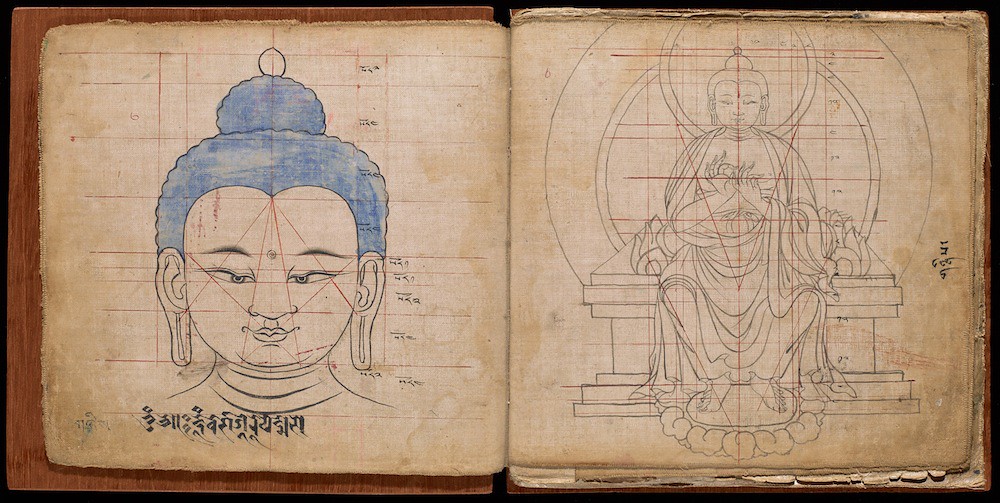
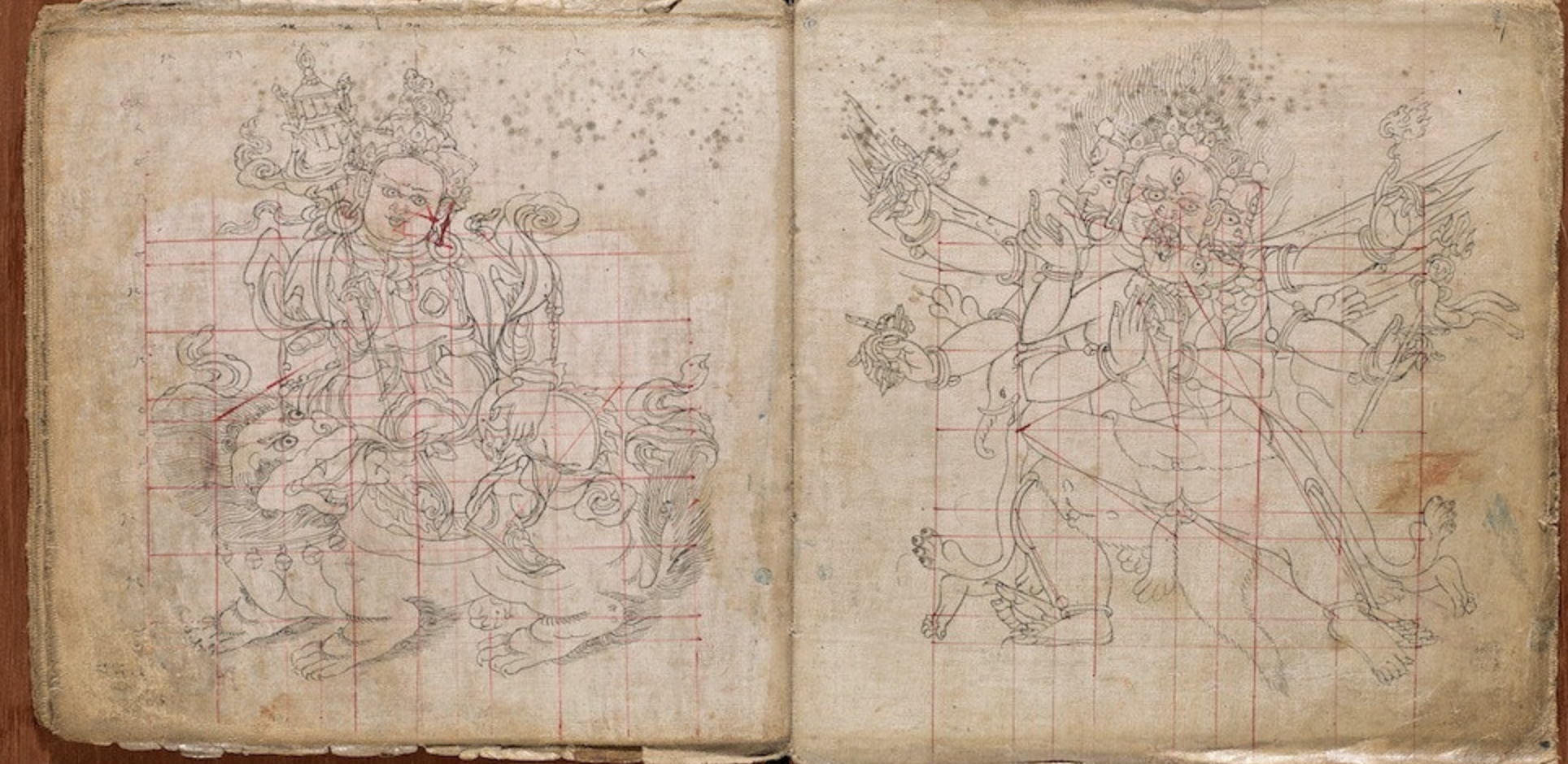
Some religions prohibit the depiction of their sacred personages. Tibetan Buddhism isn’t quite so strict, but it does ask that, if you’re going to depict the Buddha, you do it right. Hence aids like the Tibetan Book of Proportions, which provides “36 ink drawings showing precise iconometric guidelines for depicting the Buddha and Bodhisattva figures.” That description comes from the Public Domain Review, where you can behold many of those pages. Printed in the 18th century, “the book is likely to have been produced in Nepal for use in Tibet.” Now you’ll find it at the Getty Center in Los Angeles, which had made the book free to read at its digital collections.
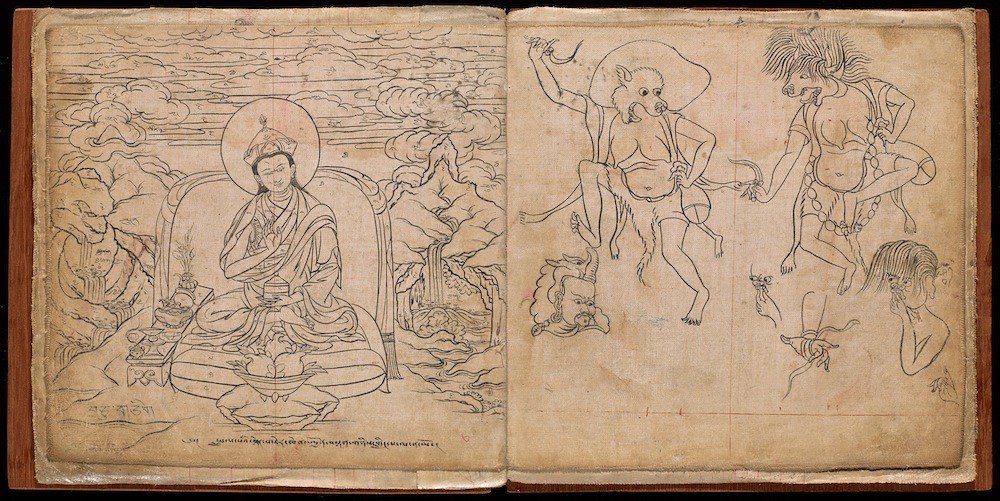
To read it properly, of course, you’ll have to know your Newari script and Tibetan numerals. But even without them, anyone can appreciate the elegance of not just the book’s recommended proportions — all presented on a standardized and notated grid — but of the book itself as well.
By the time this volume appeared, the printing used for texts related to Tibetan Buddhism had long since shown itself to be a cut above: take the 15th-century collection of recitation texts, previously featured here on Open Culture, printed forty years before the Gutenberg Bible. Only a printing culture that had mastered this level of detail could produce a book like the Tibetan Book of Proportions, visual exactitude being its entire raison d’être.
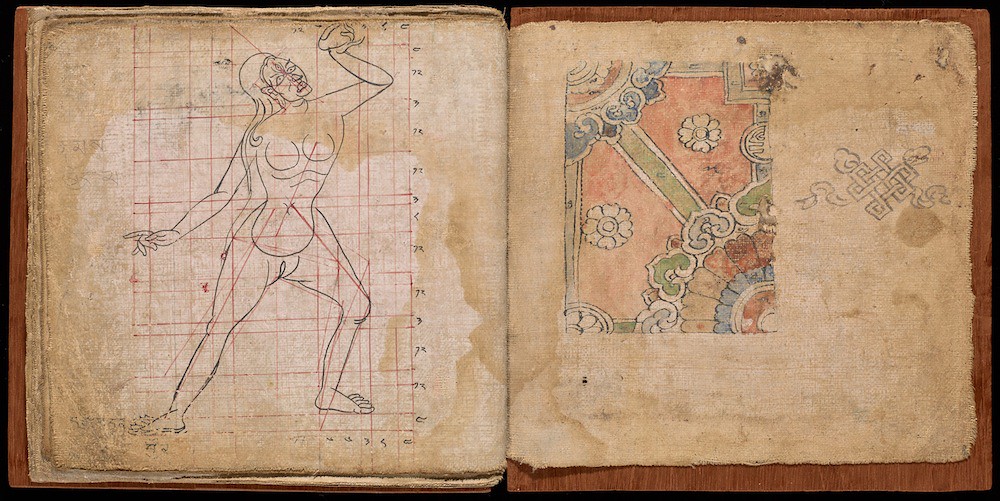
“The concept of the ‘ideal image’ of the Buddha emerged during the Golden Age of Gupta rule, from the 4th to 6th century,” says the Public Domain Review. During that Indian empire’s dominance, the importance of such depictions extended even beyond proportions to details like “number of teeth, color of eyes, direction of hairs.” Surely when it comes to showing one who has attained nirvana — or a bodhisattva, the designation for those on their way to nirvana — one can’t be too careful. Nevertheless, artworks in the form of the Buddha (of which the Victoria and Albert Museum offer a small sampling on their web site) have taken different shapes in different times and places. No matter how well-defined the ideal, the earthly realm always finds a way to introduce some variety.
Related Content:
Breathtakingly Detailed Tibetan Book Printed 40 Years Before the Gutenberg Bible
The World’s Largest Collection of Tibetan Buddhist Literature Now Online
Leonard Cohen Narrates Film on The Tibetan Book of the Dead, Featuring the Dalai Lama (1994)
Tibetan Musical Notation Is Beautiful
Based in Seoul, Colin Marshall writes and broadcasts on cities, language, and culture. His projects include the Substack newsletter Books on Cities, the book The Stateless City: a Walk through 21st-Century Los Angeles and the video series The City in Cinema. Follow him on Twitter at @colinmarshall, on Facebook, or on Instagram.
Read More...Wonder Woman 1984 in Context — Pretty Much Pop: A Culture Podcast #76

The holiday film release season has now passed, having issued only one real blockbuster, which is the return of Wonder Woman. This week’s Pretty Much Pop likewise offers a returning hero: Our college-going guest from ep. 33 on heroine journeys has now grown into a grad student in comics history, and she brings her deep WW knowledge to consider with your hosts Erica Spyres, Mark Linsenmayer, and Brian Hirt.
Part of the relevant context is the 2017 biopic Professor Marston and the Wonder Women, which revealed the unorthodox views of WW’s creator, and so of course this shows up in how WW judges us: She’s not just a Captain America-style patriot, but a foreigner who in the new film compassionately condemns our 80s greed and dishonesty. But do the themes actually make sense? And what’s with having her love interest return from the dead, hijacking another man’s body with no acknowledgment that that’s very skeevy?
Also, how does the depiction of WW’s homeland compare to other feminist utopias like Herland and “Sultana’s Dream”? Does it matter that WW was created by and initially aimed primarily at males? We learn a little about the post-Marston WW (who couldn’t join the Justice League, which was for boys only!) and talk about the ’70s TV show, the outfits, the villains, and WW in love.
Here are a few supplementary articles:
- “The Surprising Origin Story of Wonder Woman” by Jill Lepore
- “Does Wonder Woman 1984 Have a Steve Trevor Problem?” by Sarah El-Mahmoud
- “The Warped Morality of ‘Wonder Woman 1984’ ” by Dani Di Placido
- “How Wonder Woman 1984 Reboots the DC Hero’s Forgotten Superpower” by Eric Francisco
- “How ‘Wonder Woman 1984’ Villain Maxwell Lord Stays True to the Comics” by Graeme McMillan
- And from our former guest, Noah Berlatsky: “HBO Max’s ‘Wonder Woman 1984’ Stars a Trump‑y Villain, Gal Gadot’s Charm and a Garbled Message”
Hear more of this podcast at prettymuchpop.com. This episode includes bonus discussion you can access by supporting the podcast at patreon.com/prettymuchpop. This podcast is part of the Partially Examined Life podcast network.
Pretty Much Pop: A Culture Podcast is the first podcast curated by Open Culture. Browse all Pretty Much Pop posts.
Read More...
The 25th Amendment: An Introduction
Read along with the text of the 25th Amendment online here. And get some background from the Constitution Center here, and Vox’s explainer here.
Read More...How Tibetan Monks Use Meditation to Raise Their Peripheral Body Temperature 16–17 Degrees
Tibetan monks in remote regions of the Himalayas have long claimed near miraculous powers through yogic practices that resemble nothing you’ll find offered at your local gym, though they may derive from some similar Indian sources. One such meditative practice, a breathing exercise known as tummo, tum-mo, or g‑tummo, supposedly generates body heat and can raise one’s peripheral body temperature 16–17 degrees—a distinctly advantageous ability when sitting outside in the snow-capped mountains.
Perhaps a certain amount of skepticism is warranted, but in 1981, Harvard cardiologist Herbert Benson was determined to take these ancient practices seriously, even though his first encounters with western practitioners of tummo produced results he deemed “fraudulent.” Not ready to toss centuries of wisdom, Benson decided instead to travel to the source after meeting the Dalai Lama and receiving permission to study tummo practitioners in Northern India.
Benson’s research became a 20-year project of studying tummo and other advanced techniques while he also taught at the Harvard Medical School and served as president of the Mind/Body Medical Institute in Boston, where he believes the study of meditation can “uncover capacities that will help us to better treat stress-related illnesses.” The claims of monks who practice tummo have been substantiated in Benson’s work, showing, he says, “what advanced forms of meditation can do to help the mind control physical processes once thought to be uncontrollable.”
In his own experimental settings, “Benson found that [Tibetan] monks possessed remarkable capacities for controlling their oxygen intake, body temperatures and even brainwaves,” notes Aeon. Another study undertaken in 2013 by Maria Kozhevnikov, cognitive neuroscientist at the National University of Singapore, “corroborated much of what Benson had observed, including practitioners’ ability to raise their body temperatures to feverish levels by combining visualization and specialized breathing.”
In the short documentary film above—actually a 7‑minute trailer for Russ Pariseau’s feature-length film Advanced Tibetan Meditation: The Investigations of Herbert Benson MD—we get a brief introduction to tummo, a word that translates to “inner fire” and relates to the ferocity of a female deity. Benson explains the ideas behind the practice in concise terms that sum up a central premise of Tibetan Buddhism in general:
Buddhists feel the reality we live in is not the ultimate one. There’s another reality we can tap into that’s unaffected by our emotions, by our everyday world. Buddhists believe this state of mind can be achieved by doing good for others and by meditation. The heat they generate during the process is just a by-product of g Tum-mo meditation
Perhaps centuries-old non-European practices do not particularly need to be debunked, demystified, or validated by modern scientific medicine to keep working for their practitioners; but doctors have significantly benefited those in their care through an acceptance of the healing properties of, say, psilocybin or mindfulness, now serious subjects of study and clinical treatment in top Euro-American institutions. Just as this research is being popularized among both the medical establishment and general public, we may someday see a surge of interest in advanced tantric practices like tummo.
Related Content:
How Meditation Can Change Your Brain: The Neuroscience of Buddhist Practice
How Yoga Changes the Brain and May Guard Against Alzheimer’s and Dementia
Josh Jones is a writer and musician based in Durham, NC. Follow him at @jdmagness
Read More...Animation Pioneer Lotte Reiniger Adapts Mozart’s The Magic Flute into an All-Silhouette Short Film (1935)
When Lotte Reiniger began making animation in the late 1910s, her work looked like nothing that had ever been shot on film. In fact, it also resembles nothing else achieved in the realm of cinema in the century since. Even the enormously budgeted and staffed productions of major studios have yet to replicate the stark, quavering charm of her silhouette animations. Those studios do know full well, however, what Reiniger realized long before: that no other medium can more vividly realize the visions of fairy tales. To believe that, one needs only watch her 1922 Cinderella or 1955 Hansel and Gretel, previously featured here on Open Culture.
It was between those productions that Reiniger made the work for which she’s now best remembered: the 1926 One Thousand and One Nights pastiche The Adventures of Prince Achmed, the very first feature in animation history. Nine years later, she turned to source material closer at hand, culturally speaking, and adapted a section of Wolfgang Amadeus Mozart’s opera The Magic Flute.
You can watch the result, the ten-minute Papageno, at the top of the post. A bird-catcher, the title character finds one day that all the avians around him have become tiny human females. Though none of them stick around, an ostrich later delivers him a full-size maiden, only for a giant snake to drive her away. Will Papageno defeat the serpent and reclaim his beloved, or submit to despair?
“The magic of the fairy tale has always been her greatest fascination, yet her own interpretations attain a unique quality,” says the narrator of the 1970 documentary short just above, in which Reiniger re-enacts the thoroughly analog and highly labor-intensive making of Papageno. “The figures she cuts out and constructs were originally inspired by the puppets used in traditional Eastern shadow theaters, of which the silhouette form is the logical conclusion.” This hybridization of venerable narrative material from Western lands like Germany with an even more venerable aesthetic from Eastern lands like Indonesia has assured only part of her work’s enduring appeal. “Ms. Reiniger will continue to have a strange affection for each of her figures,” the narrator notes. This is “an understandable affection, for in their flexibility they have almost human characteristics of movement.” It’s an affection anyone with an interest in animation, fairy tales, or Mozart will share.
Related Content:
The First Animated Feature Film: The Adventures of Prince Achmed by Lotte Reiniger (1926)
Mozart’s Diary Where He Composed His Final Masterpieces Is Now Digitized and Available Online
Hear All of Mozart in a Free 127-Hour Playlist
Based in Seoul, Colin Marshall writes and broadcasts on cities, language, and culture. His projects include the Substack newsletter Books on Cities, the book The Stateless City: a Walk through 21st-Century Los Angeles and the video series The City in Cinema. Follow him on Twitter at @colinmarshall, on Facebook, or on Instagram.
Read More...When Iggy Pop Published an Essay, “Caesar Lives,” in an Academic Journal about His Love for Edward Gibbon’s The Decline and Fall of the Roman Empire (1995)
Purveyors of the shocking, primal idiocy of pure rock and roll can in many cases be some of the most intelligent people in pop. Or at least that’s the case with the king of shocking, primal idiocy, Iggy Pop. He has interpreted Whitman’s “barbaric yawp” and delivered the John Peel Lecture for BBC Music, becoming “a visiting professor from the School of Punk Rock Hard Knocks,” writes Rolling Stone and bringing an elder statesman’s perspective informed not only by his years in the bowels of the music industry but also by his avocation as a scholar of the Roman Empire….
Yes, that’s right, Iggy Pop is not only an adroit stylist of some of the most brilliantly stupid garage rock ever made, but he’s also a serious reader and thinker who once published a brief reflection on his relationship with Edward Gibbon’s The Decline and Fall of the Roman Empire in the academic journal Ireland Classics.
“Iggy Pop, like Bob Dylan,” writes E.J. Hutchinson, “has an avid interest in Roman antiquity and its genetic connection to contemporary life.” He may also be the sharpest, wiliest embodiment of post-industrial American decline—his entire musical personality a punch in the collective face of the nation’s delusions.
In 1982, horrified by the meanness, tedium and depravity of my existence as I toured the American South playing rock and roll music and going crazy in public, I purchased an abridged copy of The Decline and Fall of the Roman Empire (Dero Saunders, Penguin).
The grandeur of the subject appealed to me, as did the cameo illustration of Edward Gibbon, the author, on the front cover. He looked like a heavy dude.
Hutchinson gives us a finely wrought analysis of Pop’s “tour de force of classical Gibbonian English prose, a scrap of Ciceronian periodicity.” (Gibbon did, indeed, look like a heavy dude.) Pop’s reading of Gibbon, “with pleasure around 4 am, with my drugs and whisky in cheap motels,” absorbed him in its “clash of beliefs, personalities and values,” he writes, “played out on antiquity’s stage by crowds of the vulgar, led by huge archetypal characters.” All of this appealed to him, he writes, given his own role in “a political business… the music business, which is not about music at all, but is a kind of religion-rental.”
Gibbon’s massive saga, a monumental example of sweeping Enlightenment historiography, so captivated Pop that a decade later, it inspired “an extemporaneous soliloquy” he called “Caesar,” the closing track on 1993’s “overlooked masterpiece” American Caesar. The spoken word piece “made me laugh my ass off,” he writes, “because it was so true. America is Rome. Of course, why shouldn’t it be? All of Western life and institutions today are traceable to the Romans and their world. We are all Roman children for better or worse.”
But there was much more to Pop’s reading of Gibbon—which he eventually enjoyed in a “beautiful edition in three volumes of the magnificent original unabridged”—than a possibly facile comparison between one failing empire and another. Much more, indeed. Reading Gibbon, he writes (sounding very much like another proponent of the classics, Italo Calvino), taught him how to think about the present, and how to think, humbly, about himself. He ends his essay with a numbered list of “just some of the ways I benefit”:
- I feel a great comfort and relief knowing that there were others who lived and died and thought and fought so long ago; I feel less tyrannized by the present day.
- I learn much about the way our society really works, because the system-origins — military, religious, political, colonial, agricultural, financial — are all there to be scrutinized in their infancy. I have gained perspective.
- The language in which the book is written is rich and complete, as the language of today is not.
- I find out how little I know.
- I am inspired by the will and erudition which enabled Gibbon to complete a work of twenty-odd years. The guy stuck with things. I urge anyone who wants life on earth to really come alive for them to enjoy the beautiful ancestral ancient world.
Read Pop’s full 1995 Ireland Classics essay on Jstor or Medium.
Related Content:
The Splendid Book Design of the 1946 Edition of Gibbon’s Decline and Fall of the Roman Empire
Iggy Pop Reads Edgar Allan Poe’s Classic Horror Story, “The Tell-Tale Heart”
Stream Iggy Pop’s Two-Hour Radio Tribute to David Bowie
Josh Jones is a writer and musician based in Durham, NC. Follow him at @jdmagness
Read More...Discover J.R.R. Tolkien’s Little-Known and Hand-Illustrated Children’s Book, Mr. Bliss
His were usually humorous stories, full of magic, and very often, they contained a connection to the children’s lives, because it was primarily for them that he invented them.
–Sarah Zama
The fact that “much of the inspiration of the Lord of the Rings came from [J.R.R. Tolkien’s] family,” Danielle Burgos writes at Bustle, has become an oft-repeated piece of trivia, especially thanks to such popular treatments of the author’s life as Humphrey Carter’s authorized biography, the Nicholas Hoult-starring biopic, Tolkien, and the Catherine McIlwaine-edited collection Tolkien: Maker of Middle-Earth. As much as Tolkien drew on his extensive knowledge of Norse, Germanic, and other mythologies and linguistic histories, and from his harrowing experiences in WWI, his career as a legendary fantasy author may never have come about without his children.
“In just one example,” notes Burgos, a collection of Tolkien’s letters shows that the character of Tom Bombadil “was based on son Michael’s wooden toy doll.” Tolkien’s oldest son John remarked before the release of the first Peter Jackson adaptation, “It’s quite incredible. When I think when we were growing up these were just stories that we were told.”
Tolkien strenuously resisted the label of children’s author; he “firmly believed,” Maria Popova points out, “that there is no such thing as writing for children.” But the degree to which his storytelling and characterization developed from his desire to entertain and educate his kids can’t be overstated in the development of his early fiction.
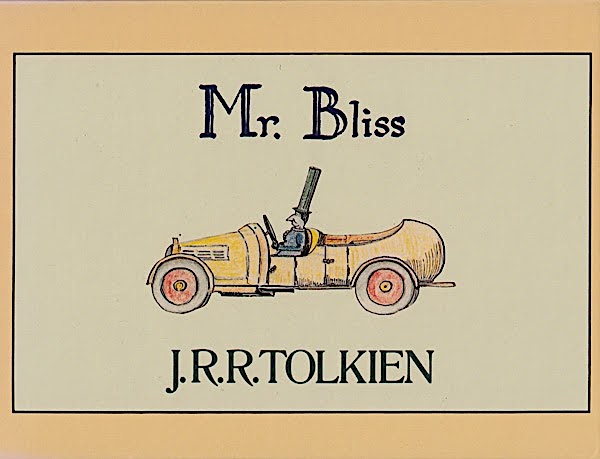
We see this in a small way in the little-known children’s book Mr. Bliss, written and illustrated by Tolkien sometime in the 1930s, kept in a drawer until 1957, and only published posthumously in 1982. The story itself “was inspired by his first car, which he purchased in 1932.” As evidence of its importance to the larger Tolkien canon, Popova writes, the author “went on to use two of the character names from the book, Gaffer Gamgee and Boffin, in The Lord of the Rings.” In other respects, however, Mr. Bliss is very unlike the medieval fantasies that surrounded its composition.
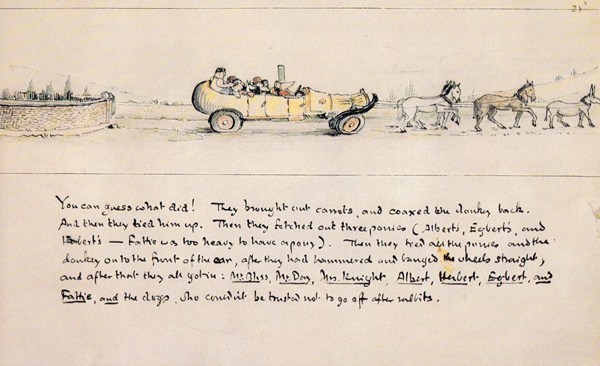
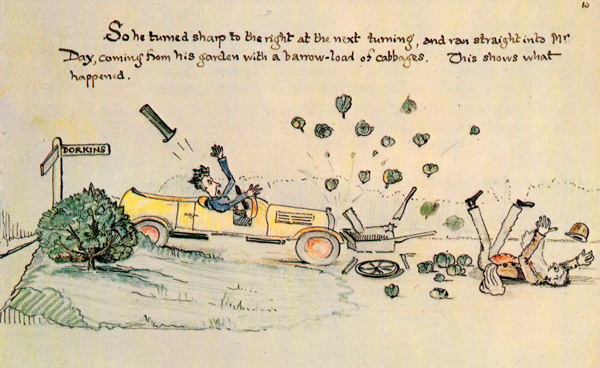
The book, affectionately handwritten and illustrated by Tolkien himself — who, also unbeknownst to many, was a dedicated artist — tells the story of Mr. Bliss, a lovable eccentric known for his exceptionally tall hats and his “girabbits,” the giraffe-headed, rabbit-bodied creatures that live in his backyard. One day, Mr. Bliss decides to buy his very first motor car[.] But his first drive en route to a friend’s house soon turns into a Rube Goldberg machine of disaster as he collides with nearly everything imaginable, then gets kidnapped by three bears.
Tolkien submitted the book for publication after the runaway success of The Hobbit created a market demand he had no particular desire to meet, telling his publisher that the story was complete. But Mr. Bliss was rejected, ostensibly because its illustrations were too expensive to reproduce. In truth, however, the public wanted more hobbits, elves, dwarves, wizards, and poetry and song in beautiful invented languages.
Tolkien would, of course, eventually deliver a “New Hobbit,” in the form of the The Lord of the Rings trilogy—books that weren’t specifically “written for his children,” Sarah Zama writes, but in which “the story he had indeed created for his children weighed heavily.” See several more Tolkien-illustrated pages from one of the trilogy’s whimsical early ancestors, Mr. Bliss, at Brain Pickings and purchase a copy of the book here.
Related Content:
110 Drawings and Paintings by J.R.R. Tolkien: Of Middle-Earth and Beyond
How J.R.R. Tolkien Influenced Classic Rock & Metal: A Video Introduction
Josh Jones is a writer and musician based in Durham, NC. Follow him at @jdmagness
Read More...Rome’s Colosseum Will Get a New Retractable Floor by 2023 — Just as It Had in Ancient Times
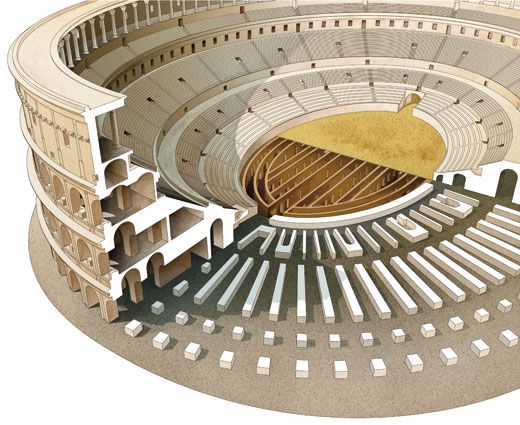
Rome wasn’t built in a day. But one of its most renowned attractions could be returned to its first-century glory in just two years — or at least, part of one of its most famous attractions could be. In our time, the Colosseum has long been a major Roman tourist destination–one that lacks even a proper floor. Visitors today see right through to its underground hypogeum, an impressive mechanical labyrinth used to convey gladiators into the arena, as well as a variety of other performers, willing and unwilling, human and otherwise. “Eyewitnesses describe how animals appeared suddenly from below, as if by magic, sometimes apparently launched high into the air,” writes Smithsonian’s Tom Mueller.
“The hypogeum allowed the organizers of the games to create surprises and build suspense,” the German Archaeological Institute in Rome’s Heinz-Jürgen Beste tells Mueller. “A hunter in the arena wouldn’t know where the next lion would appear, or whether two or three lions might emerge instead of just one.”
Now, the Italian government has announced plans to return the element of surprise to the Colosseum with a restoration of its elaborate “retractable floor.” This has drawn the attention of media concerned with history and travel, but also the world of architecture and design. With €10 million already pledged by the state, the worldwide call is out for architectural proposals, due by February 1 of this year for a tentative completion date of 2023.
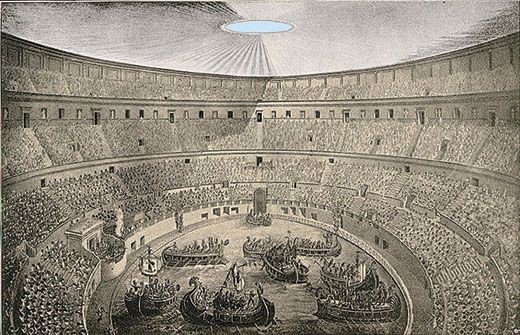
The Colosseum, which once seated 50,000 spectators, hasn’t put on a battle since the fifth century. The hypogeum’s long exposure to the elements means that any architectural firm eager to take on this project will have its work cut out for it. Few restorations could demand the striking of a trickier balance between historical faithfulness and modern functionality. Whatever design gets selected, its trap doors and hidden elevators will be employed for rather different entertainments than, say, the death matches between slaves and beasts to which so many ancient Romans thrilled. The Italian government intends to use the Colosseum’s new floor to put on theater productions and concerts – which should turn it into an even more popular attraction when we can all once again go to the theater, concerts, and indeed Italy.
Related Content:
Rome Reborn: Take a Virtual Tour of Ancient Rome, Circa 320 C.E.
Building the Colosseum: The Icon of Rome
Magnificent Ancient Roman Mosaic Floor Unearthed in Verona, Italy
Based in Seoul, Colin Marshall writes and broadcasts on cities, language, and culture. His projects include the Substack newsletter Books on Cities, the book The Stateless City: a Walk through 21st-Century Los Angeles and the video series The City in Cinema. Follow him on Twitter at @colinmarshall, on Facebook, or on Instagram.
Read More...Discover Tokyo’s Museum Dedicated to Parasites: A Unique and Disturbing Institution

Photo by Guilhem Vellut
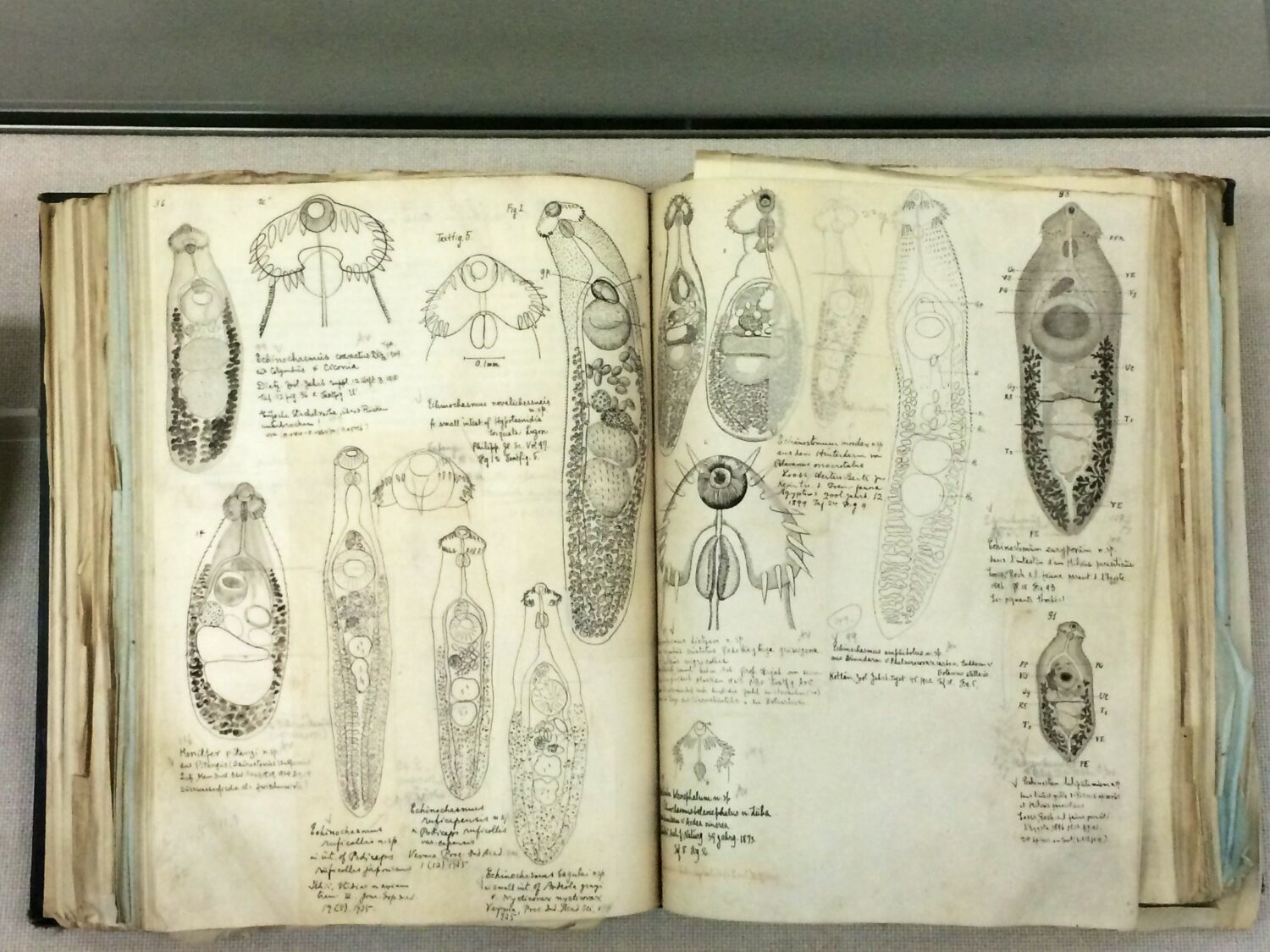
Weary as we are of hearing about not just the coronavirus but viruses in general, shall we we turn our attention to parasites instead? The Meguro Parasitological Museum has been concentrating its intellectual and educational energies in that direction since 1953. Located in the eponymous neighborhood of Tokyo, it houses more than 60,000 species of parasite, with more than 300 on display at any given time. “On the first floor we present the ‘Diversity of Parasites’ displaying various types of parasite specimens with accompanying educational movies,” write directors Midori Kamegai and Kazuo Ogawa. “The second floor exhibits are ‘Human and Zoonotic Parasites’ showing parasite life cycles and the symptoms they cause during human infection.”

Photo by Guilhem Vellut
We’ve here included a few choice pictures from the museum, but as Culture Trip’s India Irving warns, “the real-life specimens are far worse than the photographs; some of the displays present preserved parasites actually popping out of their animal hosts.”
She names as “the most repulsive item on view” a tapeworm “roughly the size of a London bus — it is the longest tapeworm in world and is exhibited alongside a rope of the same length so visitors can get a physical feel for just how enormous it actually was.” What other parasitological museum could hope to compete with that? Not that any have tried: the Meguro Parasitological Museum proudly describes itself as the only such institution in the world.

Photo by Guilhem Vellut
“Some of the displays are merely disturbing, while others are slightly more ghastly,” writes Mental Floss’ Jake Rossen. “If you’ve ever wanted to see a photo of a tropical bug prompting a human testicle to swell to the size of a gym bag, this is the place for you.” Like many other museums, it did shut down for a time earlier in the pandemic, but has been open again since June. (If you happen not to be a Japanese speaker, guides in English and other languages are available in both text and app form.) If current conditions have nevertheless kept Japan itself out of your reach, you can have a look at the Meguro Parasitological Museum’s unique offerings through this Flickr gallery — which gets many of us as close to these organisms as we care to be.
via Mental Floss
Related Content:
Discover the Japanese Museum Dedicated to Collecting Rocks That Look Like Human Faces
The First Museum Dedicated to Japanese Folklore Monsters Is Now Open
Take a Virtual Tour of the Mütter Museum and Its Many Anatomically Peculiar Exhibits
Based in Seoul, Colin Marshall writes and broadcasts on cities, language, and culture. His projects include the Substack newsletter Books on Cities, the book The Stateless City: a Walk through 21st-Century Los Angeles and the video series The City in Cinema. Follow him on Twitter at @colinmarshall, on Facebook, or on Instagram.
Read More...Support Us
We're hoping to rely on loyal readers, rather than erratic ads. Please click the Donate button and support Open Culture. You can use Paypal, Venmo, Patreon, even Crypto! We thank you!

About Us

Open Culture scours the web for the best educational media. We find the free courses and audio books you need, the language lessons & educational videos you want, and plenty of enlightenment in between.
Advertise With Us
FREE UPDATES!
GET OUR DAILY EMAIL
Get the best cultural and educational resources on the web curated for you in a daily email. We never spam. Unsubscribe at any time.
FOLLOW ON SOCIAL MEDIA
Open Culture editor Dan Colman scours the web for the best educational media. He finds the free courses and audio books you need, the language lessons & movies you want, and plenty of enlightenment in between.
Advertise With Us



