Dial-a-Poem: The Groundbreaking Phone Service That Let People Hear Poems Read by Patti Smith, William S. Burroughs, Allen Ginsberg & More (1968)
Thanks for allowing me to be a poet. A noble effort, doomed, but the only choice. —John Giorno, Thanx for Nothing
Dialing a poem today, I’m connected to Joe Brainard, who died of AIDS-related pneumonia in 1994, reading an excerpt of “I Remember.” He stumbles over some words. It’s exciting. There’s a feeling of immediacy. When the reading ends in an old-fashioned dial tone, I immediately think of a half-dozen friends I’d like to call (assuming they respond to something that’s not a tag or text).
“Take down this number,” I’d say. “641–793-8122. Don’t ask questions. Just call it. You’ll love it.”
And they probably would, though they wouldn’t hear the same recording I did.
As Dial-A-Poem’s founder, the late John Giorno, remarked in a 2012 interview:
A person asked me the other day: “What happens if I listen to a poem and I want to tell a friend to listen to it?” I told him: “Well, she can’t.” [laughs] That’s the point. What happens is, when things are really successful, you create desire that is unfulfillable. That’s what makes something work.
Giorno established Dial-A-Poem in 1968, placing ten landlines connected to reel-to-reel answering machines in a room in New York City’s Architectural League:
I sort of stumbled on [the concept] by chance… I was talking to someone on the telephone one morning, and it was so boring. I probably had a hangover and was probably crashing, and I got irritable and said to myself at that moment, “Why can’t this be a poem?” That’s how the idea came to me. And we got a quarter of a page in The New York Times with the telephone number you could dial.
In its first four-and-a-half months of operation, Dial-A-Poem logged 1,112,237 incoming calls, including some from listeners overseas. (The original phone number was 212–628-0400.) The hours of heaviest traffic suggested that a lot of bored office workers were sneaking a little poetry into their 9‑to‑5 day.
Dial-A-Poem reconceived of the telephone as a new media device:
Before Dial-A-Poem, the telephone was used one-to-one. Dial-A-Poem’s success gave rise to a Dial-A-Something industry: from Dial-A-Joke, Dial-A-Horoscope, Dial-A-Stock Quotation, Dial Sports, to the 900 number paying for a call, to phone sex, and ever more extraordinary technology. Dial-A-Poem, by chance, ushered in a new era in telecommunications.
Featured poets included such heavy hitters as William S. Burroughs, Patti Smith, Allen Ginsberg, Ted Berrigan, Robert Creeley, Sylvia Plath, Charles Bukowski, and Frank O’Hara (who “only liked you if you wrote like him”).
The content was risqué, political, a direct response to the Vietnam War, the political climate, and social conservatism. No one bothered with rhymes, and inspiration was not necessarily the goal.
Unlike Andy Warhol, Jasper Johns, and other career-minded artists who he hung out with (and bedded), Giorno never made a secret of his homosexuality. Sexually explicit and queer content had a home at Dial-a-Poem.
Meanwhile, Dial-a-Poem was featured in Junior Scholastic Magazine, and dialing in became a homework assignment for many New York City Public School students.
Two twelve-year-old boys nearly scuppered the project when one of their mothers caught them giggling over the Jim Carroll poem, above, and raised a ruckus with the Board of Ed, who in turn put pressure on the telephone company to discontinue service. The New York State Council on the Arts’ lawyers intervened, a win for horny middle schoolers… and poetry!
For anyone interested, an album called You’re A Hook: The 15 Year Anniversary Of Dial-A-Poem (1968–1983) was released in 1983. Vinyl copies are still floating around.
If you dial 641.793.8122, you can still access recordings from an archive of poetry, notes SFMoMA.
via Messy Nessy
Related Content:
Stream Classic Poetry Readings from Harvard’s Rich Audio Archive: From W.H. Auden to Dylan Thomas
Cartoonist Lynda Barry Reveals the Best Way to Memorize Poetry
Ayun Halliday is an author, illustrator, theater maker and Chief Primatologist of the East Village Inky zine. She most recently appeared as a French Canadian bear who travels to New York City in search of food and meaning in Greg Kotis’ short film, L’Ourse. Follow her @AyunHalliday
Read More...Did Beethoven Use a Broken Metronome When Composing His String Quartets? Scientists & Musicians Try to Solve the Centuries-Old Mystery
When it comes to classical composers, Beethoven was pretty metal. But was he writing some kind of classical thrash? Hardcore orchestrations too fast for the average musician to play? 66 out of 135 of Beethoven’s tempo markings made with his new metronome in the early 1800s seem “absurdly fast and thus possibly wrong,” researchers write in a recent American Mathematical Society article titled “Was Something Wrong with Beethoven’s Metronome?” Indeed, the authors go on, “many if not most of Beethoven’s markings have been ignored by latter day conductors and recording artists” because of their incredible speed.
Since the late 19th century and into the age of recorded music, conductors have slowed Beethoven’s quartets down, so that we have all internalized them at a slower pace than he presumably meant them to be played. “These pieces have throughout the years entered the subconscious of professional musicians, amateurs and audiences, and the tradition,” writes the Beethoven Project, “handed down by the great quartets of yesteryear.” Slower tempos have “become a norm against which all subsequent performances are judged.”
Eybler Quartet violist Patrick Jordan found out just how deeply musicians and audiences have internalized slower tempi when he became interested in playing and recording at Beethoven’s indicated speeds in the mid-80s. “Finding a group of people who were prepared to actually take [Beethoven’s metronome marks] seriously—that was a 30-year wait,” he tells CBC. “A huge amount of our labour required that we un-learn those things; that we get notions of what we’ve heard recorded and played in concerts many times out of our heads and try to put in what Beethoven, at least at some point in his life, believed and thought highly enough to make a note of and publish.”
But did he? The subject of Beethoven’s metronome has been a source of controversy for some time. A few historians have theorized that the inventor of the metronome, Johann Nepomuk Mälzel, “something of a mechanical wizard,” Smithsonian writes, and also something of a disreputable character, sabotaged the device he presented to the composer in 1815 as a peace offering after he sued Beethoven for the rights to a composition. (Mälzel actually stole the metronome’s design from a Dutch mechanic named Dietrich Winkel.) But most musicologists and historians have dismissed the theory of deliberate trickery.
Still, the problem of too-fast tempi persists. “The literature on the subject is enormous,” admit the authors of the American Mathematical Society study. Their research suggests that Beethoven’s metronome was simply broken and he didn’t notice. Likewise data scientists at the Universidad Carlos III de Madrid have theorized that the composer, one of the very first to use the device, misread the machine, a case of musical misprision in his reaction against what he called in 1817 “these nonsensical terms allegro, andante, adagio, presto….”
Theorists may find the tempi hard to believe, but the Toronto-based Eybler Quartet was undeterred by their skepticism. “I don’t think there’s any evidence to suggest that the mechanism itself was [faulty],” says Jordan, “and we know from [Beethoven’s] correspondence and contemporaneous accounts that he was very concerned that his metronome stay in good working order and he had it recalibrated frequently so it was accurate.” Jordan instead credits the punishing speeds to Romanticism’s passionate individualism, and to the fact that “Beethoven was not always so very nice.” Maybe, instead of soothing his audiences, he wanted to shock them and set their hearts racing.
Who are we to believe? Questions of tempo can be fraught in classical circles (witness the reactions to Glenn Gould’s absurdly slow versions of Bach.) The metronome was supposed to solve problems of rhythmic imprecision. Instead, at least in Beethoven’s case, it reinscribed them in compositions that boldly challenge ideas of what a classical quartet is supposed to sound like, which makes me think he knew exactly what he was doing.
Related Content:
How Did Beethoven Compose His 9th Symphony After He Went Completely Deaf?
Stream the Complete Works of Bach & Beethoven: 250 Free Hours of Music
Josh Jones is a writer and musician based in Durham, NC. Follow him at @jdmagness
Read More...Sign Up for a 30-Day Free Trial to Audible Plus, and Get Access to 11,000+ Titles

Want unlimited access to a robust catalog of fresh and original audio entertainment–11,000+ titles in total? Then sign up for a free 30-day trial to Audible Plus and try out the new service from Audible.com.
Audible Plus features audiobooks, Audible Originals, wellness programs, and podcasts, including exclusive podcast series. This includes original audio content from a wide range of talent, including Jamie Lee Curtis, St. Vincent, Common, Tom Morello, and other artists.
If you like the service, you can remain a subscriber (for only $7.95/month) after the free trial ends. Or, if it’s not your cup of tea, you can cancel before the free trial ends.
Sign up for the 30-day free trial here.
Read More...What’s Entering the Public Domain in 2021: The Great Gatsby & Mrs. Dalloway, Music by Irving Berlin & Duke Ellington, Comedies by Buster Keaton, and More
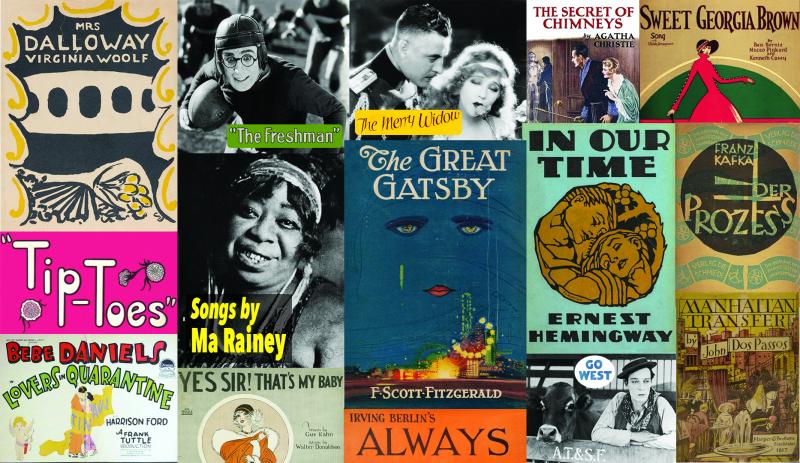
“The year 1925 was a golden moment in literary history,” writes the BBC’s Jane Ciabattari. “Ernest Hemingway’s first book, In Our Time, Virginia Woolf’s Mrs. Dalloway and F. Scott Fitzgerald’s The Great Gatsby were all published that year. As were Gertrude Stein’s The Making of Americans, John Dos Passos’ Manhattan Transfer, Theodore Dreiser’s An American Tragedy and Sinclair Lewis’s Arrowsmith, among others.” In that year, adds Director of Duke’s Center for the Study of the Public Domain Jennifer Jenkins, “the stylistic innovations produced by books such as Gatsby, or The Trial, or Mrs. Dalloway marked a change in both the tone and the substance of our literary culture, a broadening of the range of possibilities available to writers.”
In the year 2021, no matter what area of culture we inhabit, we now find our own range of possibilities broadened. Works from 1925 have entered the public domain in the United States, and Duke University’s post rounds up more than a few notable examples. These include, in addition to the aforementioned titles, books like W. Somerset Maugham’s The Painted Veil and Etsu Inagaki Sugimoto’s A Daughter of the Samurai; films like The Freshman and Go West, by silent-comedy masters Harold Lloyd and Buster Keaton; and music like Irving Berlin’s “Always” and several compositions by Duke Ellington, including “Jig Walk” and “With You.”
These works’ public-domain status means that, among many other benefits to all of us, the Internet Archive can easily add them to its online library. In addition, writes Jenkins, “HathiTrust will make tens of thousands of titles from 1925 available in its digital repository. Google Books will offer the full text of books from that year, instead of showing only snippet views or authorized previews. Community theaters can screen the films. Youth orchestras can afford to publicly perform, or rearrange, the music.” And the creators of today “can legally build on the past — reimagining the books, making them into films, adapting the songs.”
Does any newly public-domained work of 2021 hold out as obvious a promise in that regard as Fitzgerald’s great American novel? Any of us can now make The Great Gatsby “into a film, or opera, or musical,” retell it “from the perspective of Myrtle or Jordan, or make prequels and sequels,” writes Jenkins. “In fact, novelist Michael Farris Smith is slated to release Nick, a Gatsby prequel telling the story of Nick Carraway’s life before he moves to West Egg, on January 5, 2021.” Whatever results, it will further prove what Ciabattari calls the “continuing resonance” of not just Jay Gatsby but all the other major characters created by the novelists of 1925, inhabitants as well as embodiments of a “transformative time” who are “still enthralling generations of new readers” — and writers, or for that matter, creators of all kinds.
Related Content:
Free: The Great Gatsby & Other Major Works by F. Scott Fitzgerald
Duke Ellington’s Symphony in Black, Starring a 19-Year-old Billie Holiday
18 (Free) Books Ernest Hemingway Wished He Could Read Again for the First Time
Based in Seoul, Colin Marshall writes and broadcasts on cities, language, and culture. His projects include the Substack newsletter Books on Cities, the book The Stateless City: a Walk through 21st-Century Los Angeles and the video series The City in Cinema. Follow him on Twitter at @colinmarshall, on Facebook, or on Instagram.
Read More...Antonio Gramsci Writes a Column, “I Hate New Year’s Day” (January 1, 1916)
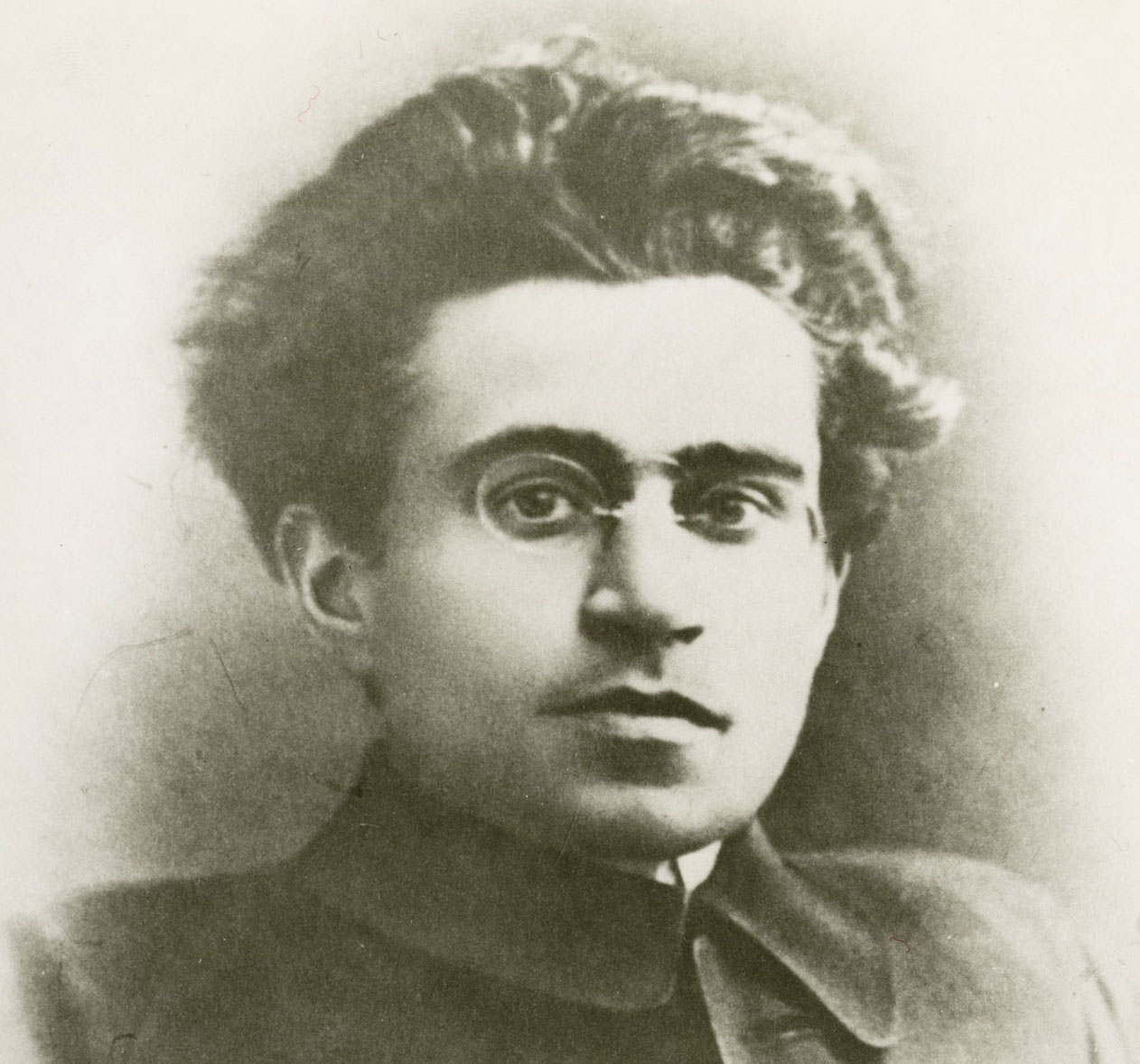
I want every morning to be a new year’s for me. Every day I want to reckon with myself, and every day I want to renew myself. No day set aside for rest. I choose my pauses myself, when I feel drunk with the intensity of life and I want to plunge into animality to draw from it new vigour.
“Everyday is like Sunday,” sang the singer of our mopey adolescence, “In the seaside town that they forgot to bomb.” Somehow I could feel the grey malaise of post-industrial Britain waft across the ocean when I heard these words… the dreary sameness of the days, the desire for a conflagration to wipe it all away….
The call for total annihilation is not the sole province of supervillains and heads of state. It is the same desire Andrew Marvell wrote of centuries earlier in “The Garden.” The mind, he observed, “withdraws into its happiness” and creates “Far other worlds, and other seas; Annihilating all that’s made / To a green thought in a green shade.”
Is not annihilation what we seek each year on New Year’s Eve? To collectively wipe away the bad past by fiat, with fireworks? To welcome a better future in the morning, because an arbitrary record keeping system put in place before Marvell was born tells us we can? The problem with this, argued Italian Marxist party pooper and theorist Antonio Gramsci, is the problem with dates in general. We don’t get to schedule our apocalypses.
On January 1st, 1916, Gramsci published a column titled “I Hate New Year’s Day” in the Italian Socialist Party’s official paper Avanti!, which he began co-editing that year.
Every morning, when I wake again under the pall of the sky, I feel that for me it is New Year’s day.
That’s why I hate these New Year’s that fall like fixed maturities, which turn life and human spirit into a commercial concern with its neat final balance, its outstanding amounts, its budget for the new management. They make us lose the continuity of life and spirit. You end up seriously thinking that between one year and the next there is a break, that a new history is beginning; you make resolutions, and you regret your irresolution, and so on, and so forth. This is generally what’s wrong with dates.
The dates we keep, he says, are forms of “spiritual time-serving” imposed on us from without by “our silly ancestors.” They have become “invasive and fossilizing,” forcing life into repeating series of “mandatory collective rhythms” and forced vacations. But that is not how life should work, according to Gramsci.
Whether or not we find merit in his cranky pronouncements, or in his desire for socialism to “hurl into the trash all of these dates with have no resonance in our spirit,” we can all take one thing away from Gramsci’s critique of dates, and maybe make another resolution today: to make every morning New Year’s, to reckon with and renew ourselves daily, no matter what the calendar tells us to do. Read a full translation of Gramsci’s column at Viewpoint Magazine.
Related Content:
Woody Guthrie’s Doodle-Filled List of 33 New Year’s Resolutions From 1943
Marilyn Monroe’s Go-Getter List of New Year’s Resolutions (1955)
Josh Jones is a writer and musician based in Durham, NC. Follow him at @jdmagness
Read More...Studio Ghibli Makes 1,178 Images Free to Download from My Neighbor Totoro, Spirited Away & Other Beloved Animated Films
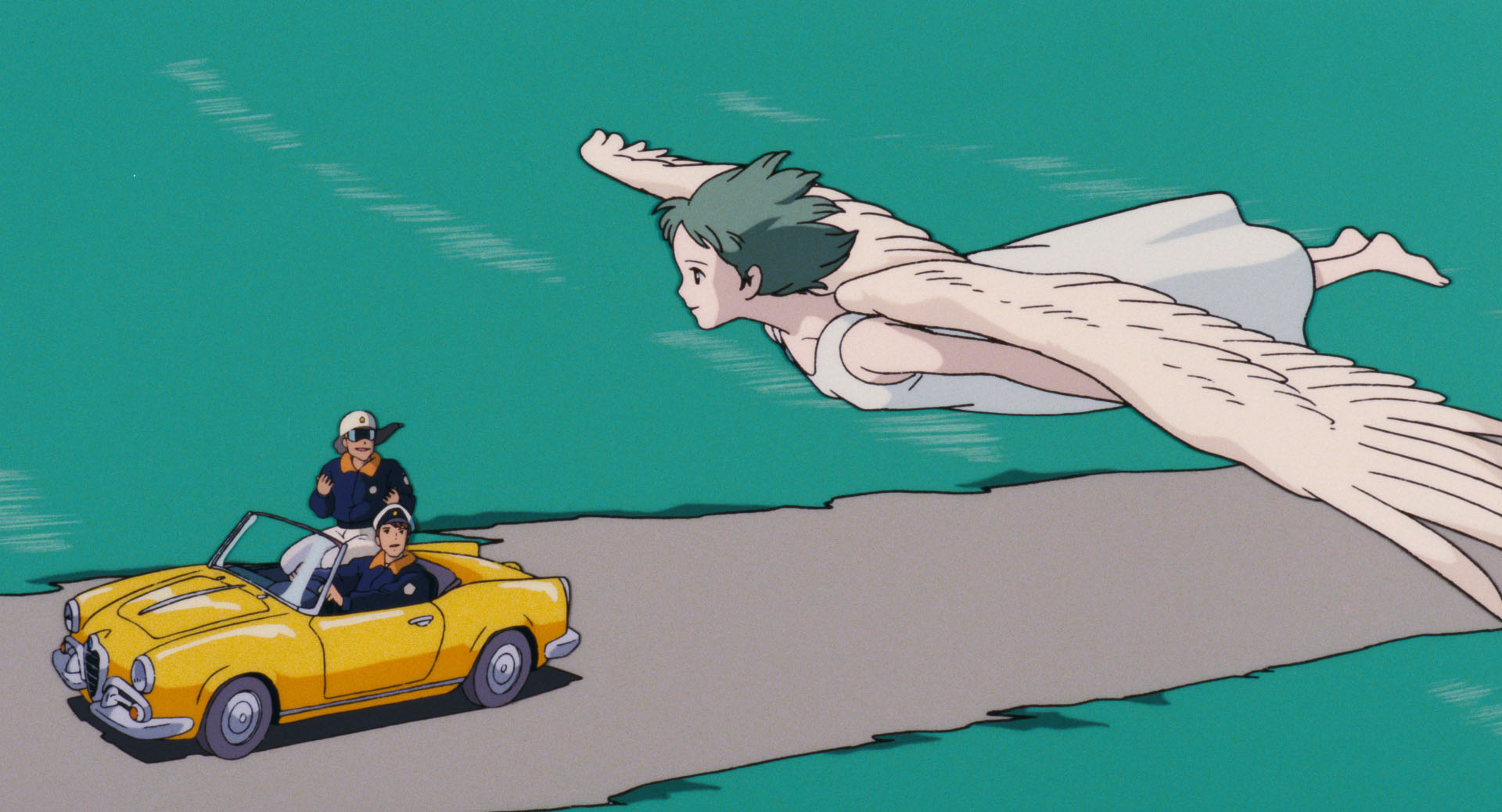
Studio Ghibli make lush and captivating animated films. So, on occasion, do other studios, but of how many of their pictures can we say that each and every still frame constitutes a work of art in itself? As a test, try putting on a Ghibli movie and pausing at random, then doing the same for any other major animated feature of similar vintage: chances are, the former will far more often produce an image you’d like to capture in high resolution and use for your desktop background, or perhaps even print out and hang on your wall.
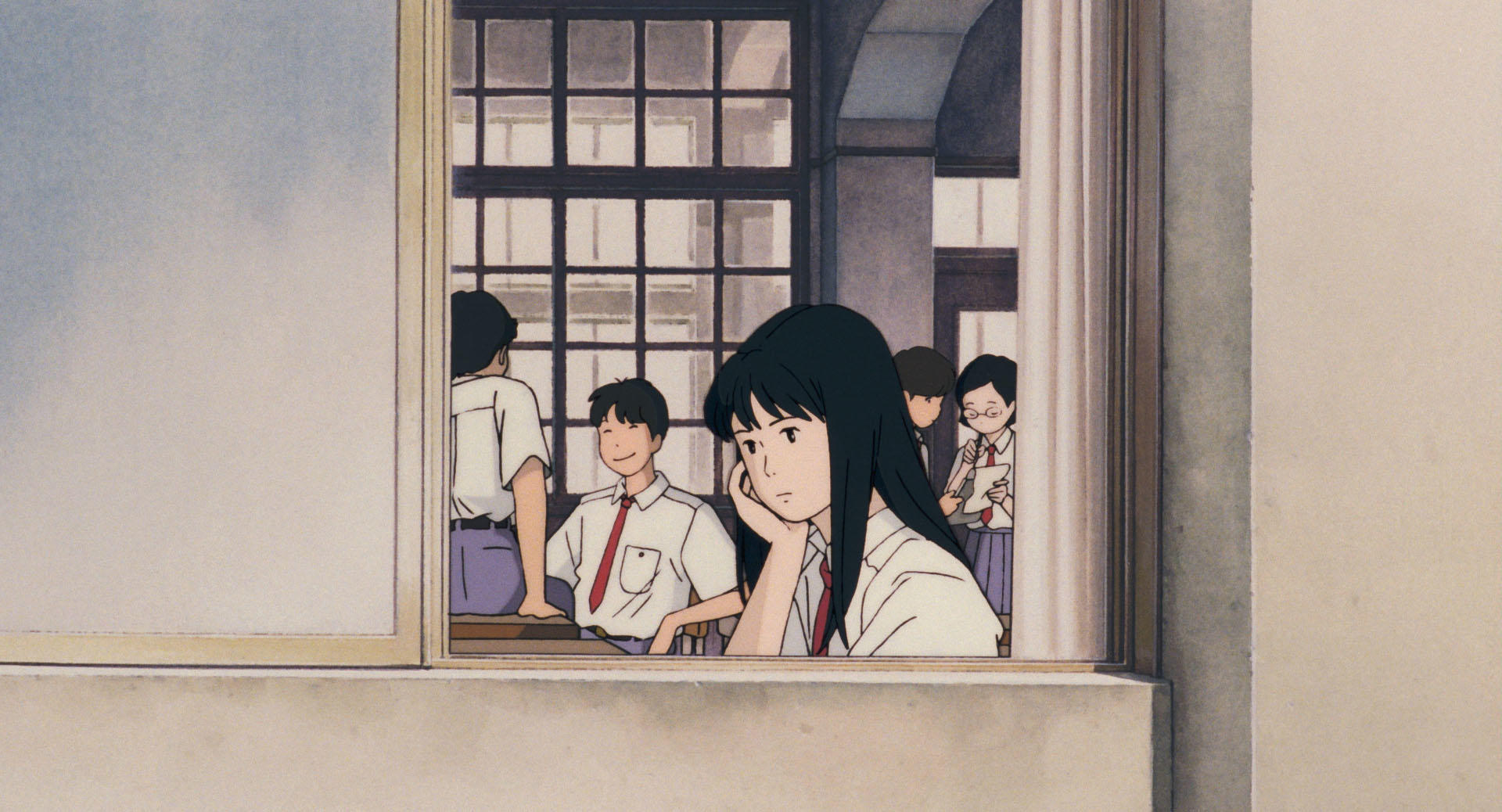
Now, Studio Ghibli have provided such images themselves, in an online collection (click here and scroll down the page) that offers more than 1,100 stills from their films, all free for the download. This trove has grown considerably since we first featured it this past fall here at Open Culture.
In that post, Ted Mills quotes Ghibli producer Toshio Suzuki as instructing visitors to use the images “freely within the scope of common sense.” It was Suzuki, you may recall, who once taught us to draw the eponymous feline-ursine star of My Neighbor Totoro, the most beloved of the studio’s works — downloadable frames from which Ghibli put up only in November.
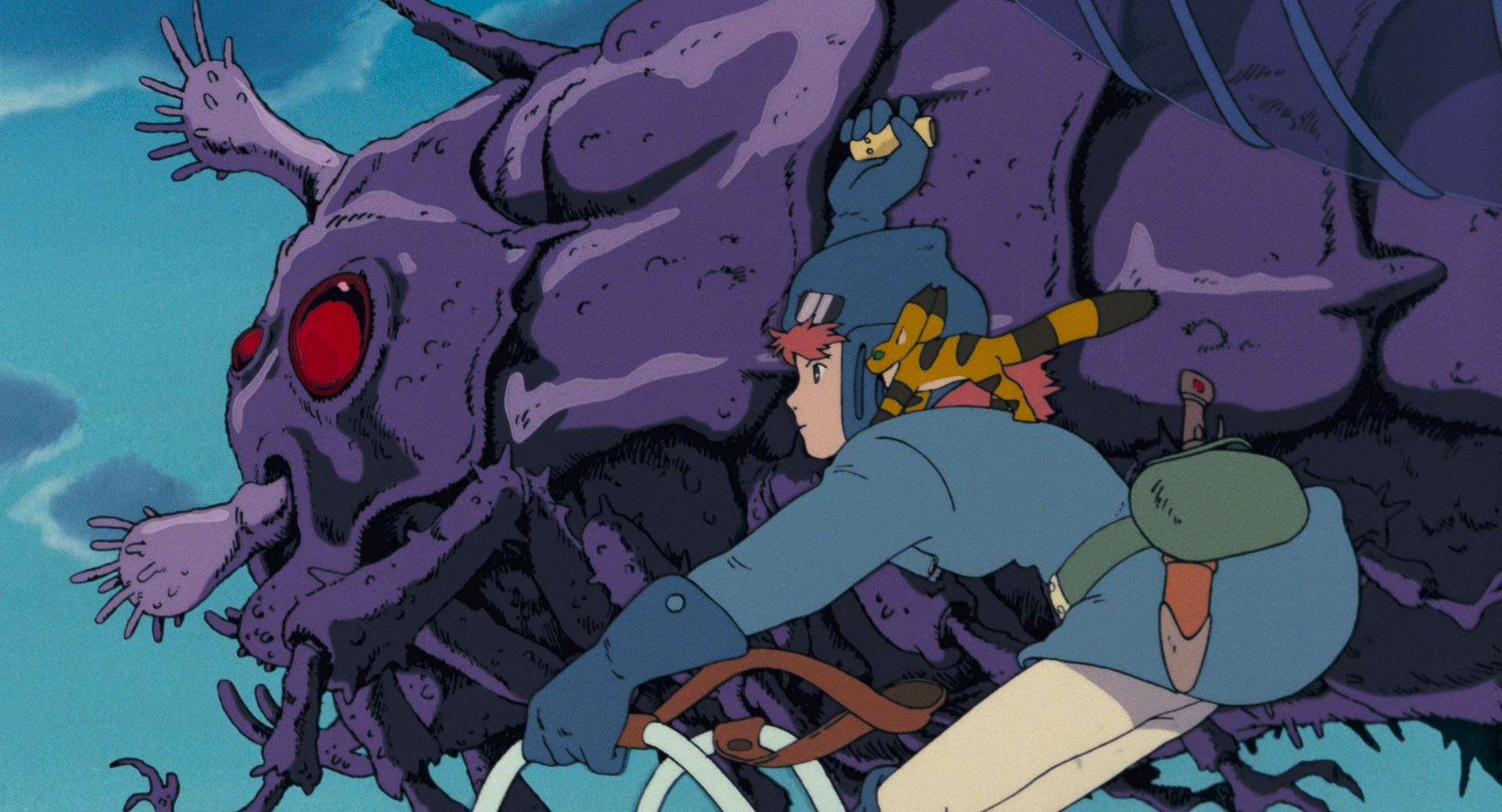
Along with Totoro came images from the acclaimed (and highly successful) likes of Spirited Away and Porco Rosso, as well as its lesser known romantic drama Ocean Waves, made for television by the studio’s younger animators in the early 1990s. The most recent update, made earlier this month, includes images from 1984’s Nausicaä of the Valley of the Wind, which is now considered Ghibli’s honorary first picture, having been directed by co-founder Hayao Miyazaki before the studio’s foundation. There are also stills from 2016’s The Red Turtle, the stark, wordless feature produced by Suzuki but directed by Dutch animator Michaël Dudok de Wit.
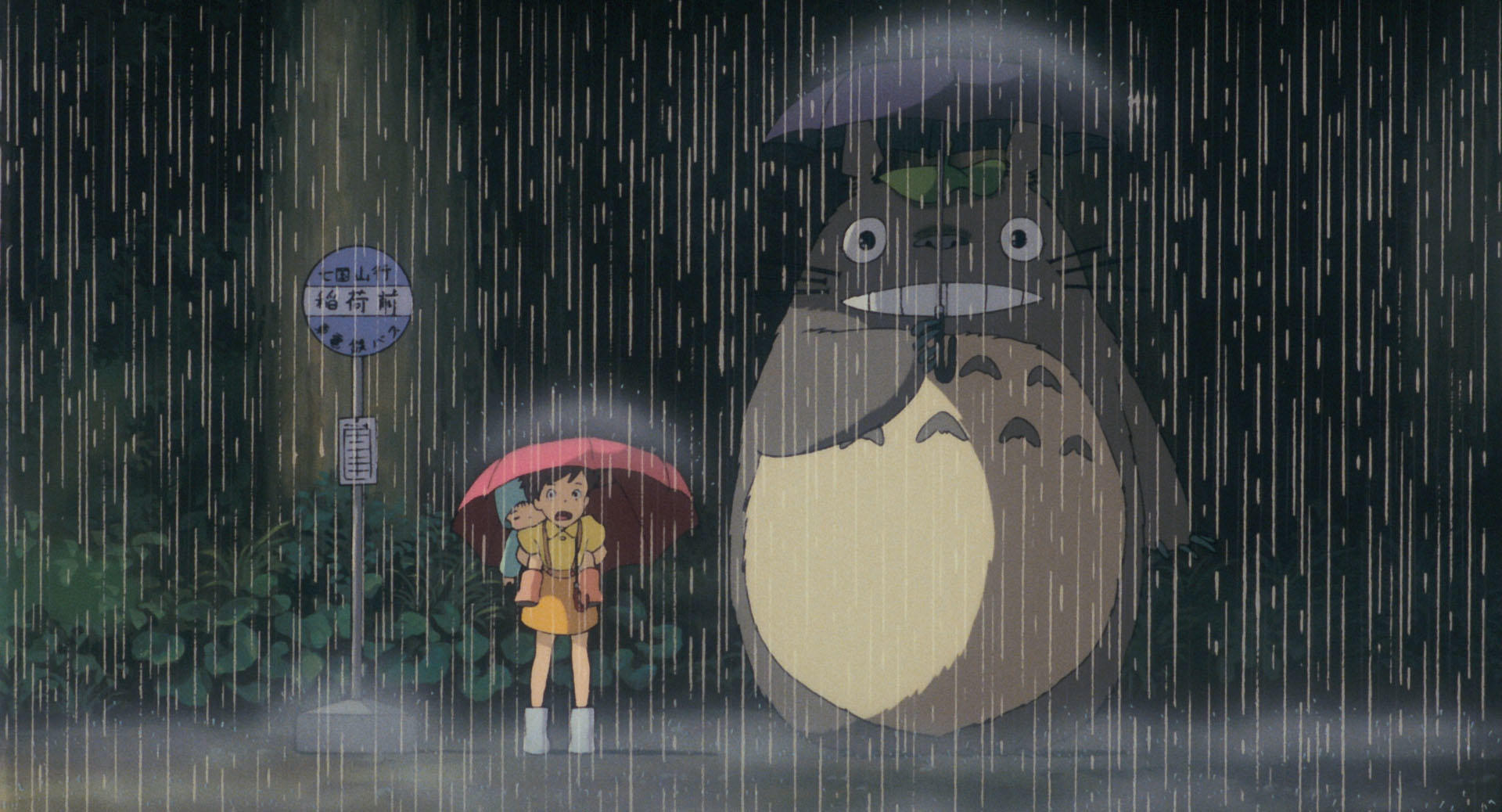
Though the site is only in Japanese, anyone who’s seen at least a few Ghibli movies should have no problem finding their favorites, from the aforementioned residents of greatest-animated-films-of-all-time lists to highly respected but lower-profile works like Only Yesterday by Miyazaki’s Ghibli-founding parter, the late Isao Takahata. There’s also plenty to delight Ghibli fans of a more die-hard persuasion: take, for example, the visual materials from “On Your Mark,” the futuristic, nonlinear animated music video made for rock duo Chage & Aska. Whatever your own level of investment in the work of Studio Ghibli, you’d do well to assume that they’ve only just got started putting up their archives.
Related Content:
Studio Ghibli Producer Toshio Suzuki Teaches You How to Draw Totoro in Two Minutes
Hayao Miyazaki’s Beloved Characters Reimagined in the Style of 19th-Century Woodblock Prints
Software Used by Hayao Miyazaki’s Animation Studio Becomes Open Source & Free to Download
Based in Seoul, Colin Marshall writes and broadcasts on cities, language, and culture. His projects include the Substack newsletter Books on Cities, the book The Stateless City: a Walk through 21st-Century Los Angeles and the video series The City in Cinema. Follow him on Twitter at @colinmarshall, on Facebook, or on Instagram.
Read More...The Essential Bradbury: The 25 Finest Stories by the Beloved Writer
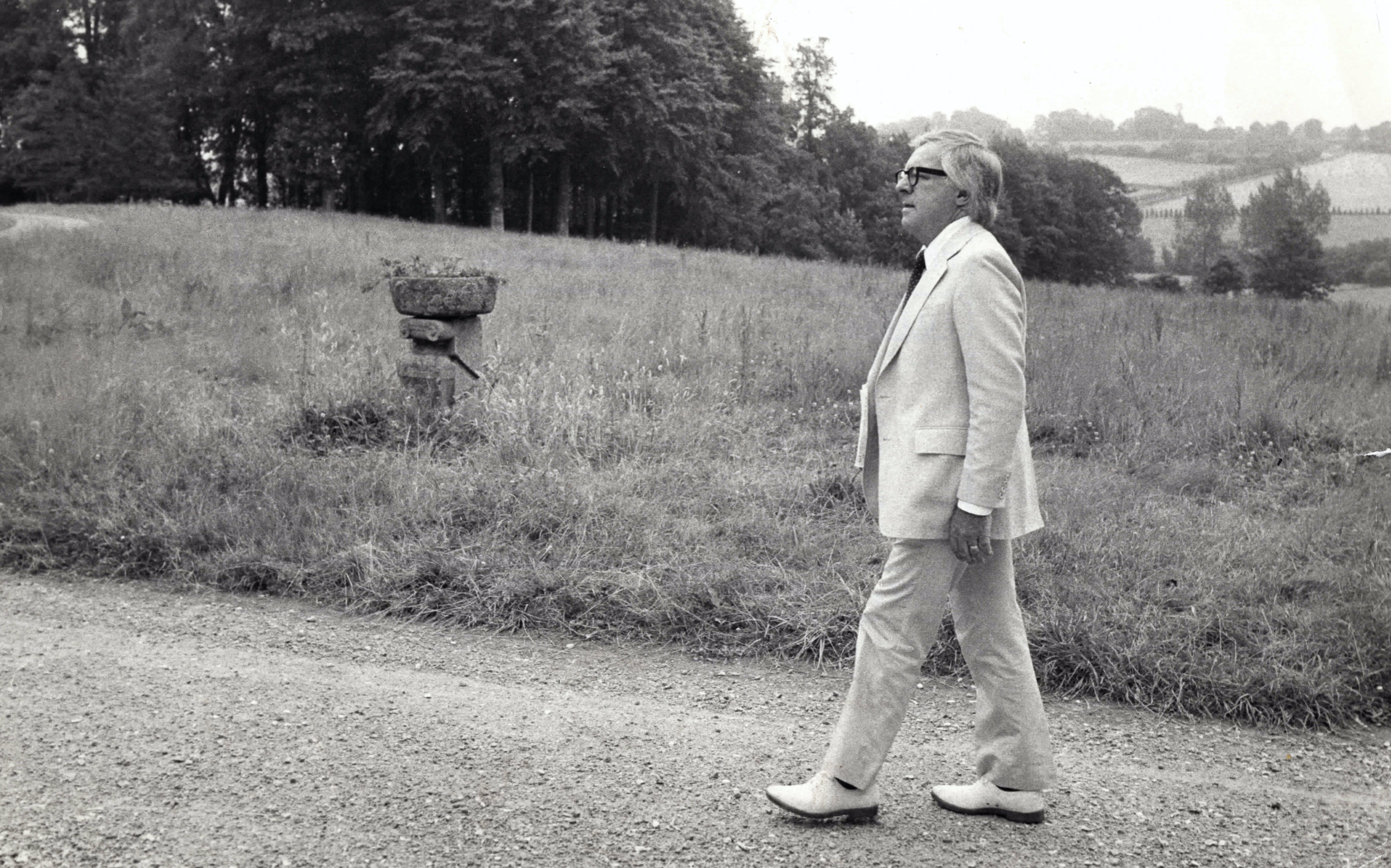
The late Ray Bradbury wrote a dizzying number of short stories over a career that spanned nine decades. Authorized Bradbury biographer Sam Weller, author of the bestselling The Bradbury Chronicles: The Life of Ray Bradbury and the indispensable companion book, Listen to the Echoes: The Ray Bradbury Interviews makes sense of Bradbury’s voluminous short story output by selecting “The Essential Bradbury,” the 25 finest tales by the beloved writer.
Bradbury wrote defiantly across genres: gothic horror, social science fiction, weird tales, fantasy, and contemporary literary fiction. He is, perhaps, best known for his 1953 chef d’oeuvre, Fahrenheit 451, but Weller (and Bradbury’s late wife of 56 years, Marguerite for that matter) argue that Bradbury’s finest work came in the form of the short story.
Weller’s “Essential Bradbury” includes some cool, never-before-seen ephemera, culled from the biographer’s personal archives. Sam Weller worked with Ray Bradbury for 12 years. You can read his “Essential Bradbury” here.
Related Content:
An Animated Ray Bradbury Explains Why It Takes Being a “Dedicated Madman” to Be a Writer
Ray Bradbury Gives 12 Pieces of Writing Advice to Young Authors (2001)
Read More...Archaeologists Discover an Ancient Roman Snack Bar in the Ruins of Pompeii
Have you ever wondered what generations hundreds or thousands of years hence will make of our strip malls, office parks, and sports arenas? Probably not much, since there probably won’t be much left. How much medium-density fibreboard is likely to remain? The colorful structures that make the modern world seem solid, the grocery shelves, fast food counters, and shiny product displays, will return to the sawdust from which they came.
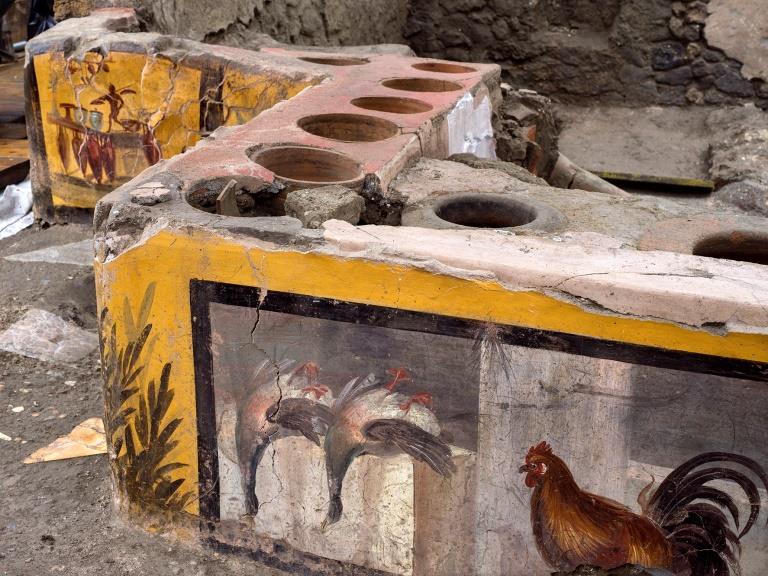
Back in antiquity, on the other hand, things were built to last, even through the fires and devastation of the eruption of Mount Vesuvius in 79 AD. Archaeologists will be discovering for many more years everyday features of Pompeii that survived a historic disaster and the ordinary ravages of time. In 2019, a team fully unearthed what is known as a thermopolium, a fancy Greek word for a snack bar that “would have served hot food and drinks to locals in the city,” the BBC reports. The find was only unveiled this past Saturday.
You can see the excavation in a subtitled virtual tour at the top conducted by Massimo Osanna, Pompeii’s general director and the “mastermind,” Smithsonian writes, behind the Great Pompeii Project, a “$140 million conservation and restoration program launched in 2012.”
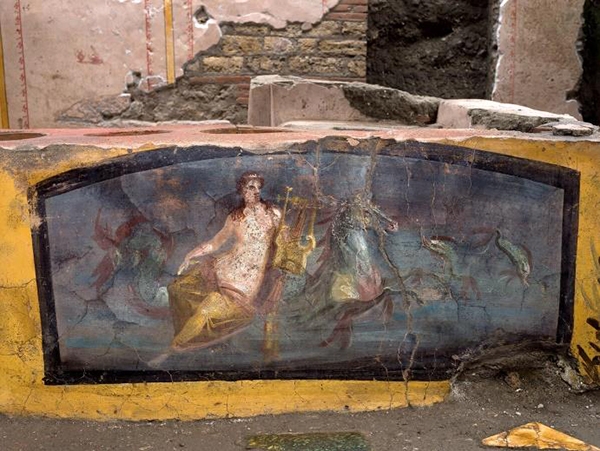
Richly decorated with brightly-colored paintings, preserved by ash, the Thermopolium of Regio V, as it’s known, features a scene of a nereid riding a sea-horse. Surrounding her on all sides of the counter are illustrations of the food for sale, including “two mallard ducks shown upside down, ready to be cooked and eaten,” notes the official Pompeii site, “a rooster,” and “a dog on a lead, the latter serving as a warning in the manner of the famed Cave Canem.”
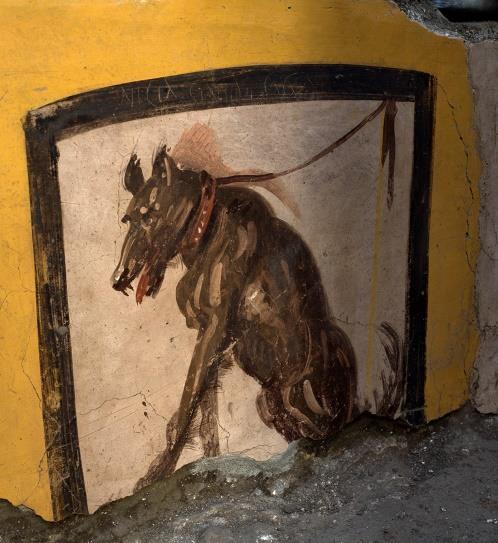
Undeterred and spurred on by the Romans’ famed love of graffiti, someone scratched a “mocking inscription” into the frame around the dog: “NICIA CINAEDE CACATOR—literally ‘Nicias (probably a freedman from Greece) Shameless Shitter!’” The message may have been left by a disgruntled worker, “who sought to poke fun at the owner.” Also found at the site were bone fragments in containers belonging to the animals pictured, as well as human bones and “various pantry and transport materials” such as amphorae, flasks, and other typical Roman containers.
Despite its elaborate design and the excitement of its discoverers, the thermopolium was nothing special in its day. Such counters were like Starbucks, “widespread in the Roman world, where it was typical to consume the prandium (the meal) outside the house. In Pompeii alone there are eighty of them.” Will future archaeologists thrill over the discovery of a Cinnabon in a thousand years’ time? We’ll never know, but somehow I doubt it. Learn much more about this discovery at the official site for Pompeii, which hopes to reopen to visitors in the Spring of 2021. All images come via Pompeiisites.org.
Related Content:
Josh Jones is a writer and musician based in Durham, NC. Follow him at @jdmagness
Read More...How Martin Luther King Jr. Got C’s in Public Speaking–Before Becoming a Straight‑A Student and a World Class Orator
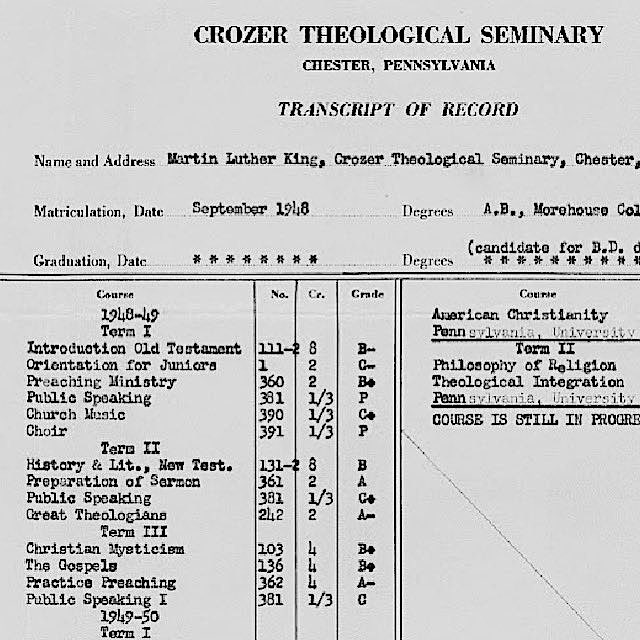
How many Americans have never heard the name of Martin Luther King Jr.? And indeed, gone more than half a century though he may be, how many Americans have never heard his voice, or can’t quote his words? Long though King will doubtless stand as an example of the English language’s greatest 20th-century orators, he once showed scant academic promise in that department. Tweeting out an image of his transcript from Crozer Theological Seminary, where King earned his Bachelor of Divinity, Harvard’s Sarah Elizabeth Lewis notes that King “received two Cs in public speaking,” and “actually went from a C+ to a C the next term.”
Still, that beat the marks King had previously received at Morehouse College. In an article for The Journal of Blacks in Higher Education, Stanford’s Clayborne Carson quotes religion professor George D. Kelsey as describing King’s record there as “short of what may be called ‘good,’ ” but also adding that King came “to realize the value of scholarship late in his college career.” This early underachievement may have been a consequence of King’s entrance into college at the young age of fifteen, which was made possible by Morehouse’s offering its entrance exam to junior high schoolers, its student body having been depleted by enlistment in the Second World War.
But King “probably realized that he would have to become more diligent in his studies if he were to succeed at the small Baptist institution in Chester, Pennsylvania, a small town southwest of Philadelphia,” writes Carson. “Evidently wishing to break with the relaxed attitude he had had toward his Morehouse studies,” he “quickly immersed himself in Crozer’s intellectual environment” and adopted a mien of high seriousness. “If I were a minute late to class, I was almost morbidly conscious of it,” King later recalled. “I had a tendency to overdress, to keep my room spotless, my shoes perfectly shined, and my clothes immaculately pressed.”
The young King eventually rose to the role in which he’d cast himself, thanks in part to the rigor of certain professors who knew what to expect from him. Apart from the sole minus blemishing his grade in “Christianity and Society,” his transcript for 1950–51 shows straight As. “By the time of his graduation,” Carson writes, “King’s intellectual confidence was reinforced by the experience of having successfully competed with white students during his Crozer years.” Named student body president and class valedictorian, “he was also accepted for doctoral study at Boston University’s School of Theology, where he would be able to work directly with the personalist theologians he had come to admire.” Even then, one suspects, King knew the real work lay ahead of him — and well outside the academy, at that.
Related Content:
How Martin Luther King, Jr. Used Nietzsche, Hegel & Kant to Overturn Segregation in America
Albert Einstein’s Grades: A Fascinating Look at His Report Cards
Based in Seoul, Colin Marshall writes and broadcasts on cities, language, and culture. His projects include the Substack newsletter Books on Cities, the book The Stateless City: a Walk through 21st-Century Los Angeles and the video series The City in Cinema. Follow him on Twitter at @colinmarshall, on Facebook, or on Instagram.
Read More...Your 15 Favorite Posts on Open Culture This Year–and What a Year It Has Been
So, it’s been a year. For those of us in parts of the world where the pandemic still rages uncontained, it’s going to be an even longer winter. It may be utterly trivializing to speak of silver linings when it comes to clouds this size, but there’s no reason not to use our time wisely in quarantine, lockdown, cocooning, or whatever we’re calling it these days. For all of the enormous challenges, outrages, sorrows, and horrors of 2020, natural and manmade, we can be grateful for so many opportunities for personal growth.
“Those of us who are not sick, are not frontline workers, and are not dealing with other economic or housing difficulties” Rebecca Solnit writes, are given the task “to understand this moment, what it might require of us, and what it might make possible.” It is a moment, she says (echoing Heidegger’s ruminations on life after the dropping of the atomic bombs), in which “the impossible has already happened.”
Impossibles can be catastrophic and world changing disasters that “begin suddenly and never really end.” They can also be radical responses to disaster that open up possibilities we never imagined:
A disaster (which originally meant “ill-starred”, or “under a bad star”) changes the world and our view of it. Our focus shifts, and what matters shifts. What is weak breaks under new pressure, what is strong holds, and what was hidden emerges. Change is not only possible, we are swept away by it. We ourselves change as our priorities shift, as intensified awareness of mortality makes us wake up to our own lives and the preciousness of life. Even our definition of “we” might change as we are separated from schoolmates or co-workers, sharing this new reality with strangers. Our sense of self generally comes from the world around us, and right now, we are finding another version of who we are.
It is no exaggeration to say we have collectively witnessed the world change in a matter of a few months. Since Solnit wrote in April, we’ve had many more opportunities to meet circumstances wildly beyond our control. We are shaped by events, but how we respond, individually and together, also determines the kind of people we become.
We at Open Culture like to think we’ve contributed in some small way to our readers’ personal growth in the time of coronavirus, to their view of the world and their sense of who “we” are. Our readers responded most to messages of hope, resources for self-improvement and self-understanding, and cultural phenomena that have become sources of delight and inspiration no matter what’s going on. See our 15 top posts of 2020 below.
- Quarantined Italians Send a Message to Themselves 10 Days Ago: What They Wish They Knew Then
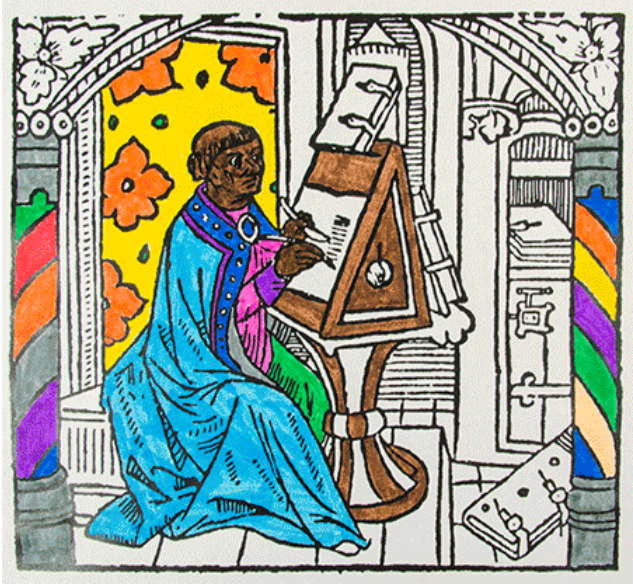
- Download Free Coloring Books from 113 Museums
- Use Your Time in Isolation to Learn Everything You’ve Always Wanted To: Free Online Courses, Audio Books, eBooks, Movies, Coloring Books & More
- Exquisite 2300-Year-Old Scythian Woman’s Boot Preserved in the Frozen Ground of the Altai Mountains
- Hayao Miyazaki’s Studio Ghibli Releases Free Backgrounds for Virtual Meetings: Princess Mononoke, Spirited Away & More
- Google Introduces 6‑Month Career Certificates, Threatening to Disrupt Higher Education with “the Equivalent of a Four-Year Degree”
- Janis Joplin & Tom Jones Bring the House Down in an Unlikely Duet of “Raise Your Hand” (1969)
- The Names of 1.8 Million Emancipated Slaves Are Now Searchable in the World’s Largest Genealogical Database, Helping African Americans Find Lost Ancestors
- Why “The Girl from Ipanema”‘ Is a Richer & Weirder Song Than You Ever Realized
- Watch the Rolling Stones Play “You Can’t Always Get What You Want” While Social Distancing in Quarantine
- Bill Murray Explains How He Was Saved by John Prine
- The Story Behind the Iconic Photograph of 11 Construction Workers Lunching 840 Feet Above New York City (1932)
- The Grateful Dead’s “Ripple” Played By Musicians Around the World (with Cameos by David Crosby, Jimmy Buffett & Bill Kreutzmann)
- Watch Joni Mitchell Sing an Immaculate Version of Her Song “Coyote,” with Bob Dylan, Roger McGuinn & Gordon Lightfoot (1975)
- The 150 Best Podcasts to Enrich Your Mind
Let us know in the comments what other posts that didn’t make the list resonated with you in this time of sweeping change, and why. Perhaps it’s one more cosmic irony that the nightmarish year of 2020 also happens to be the number we use to symbolize perfect hindsight. But also tell us, readers, what did you learn this year, and how did you grow and change in ways you might have thought impossible a year ago?
Related Content:
The 150 Best Podcasts to Enrich Your Mind
1,500 Free Online Courses from Top Universities
Sign Up for Open Culture’s Free Daily Email
Josh Jones is a writer and musician based in Durham, NC. Follow him at @jdmagness.
Read More...Support Us
We're hoping to rely on loyal readers, rather than erratic ads. Please click the Donate button and support Open Culture. You can use Paypal, Venmo, Patreon, even Crypto! We thank you!

About Us

Open Culture scours the web for the best educational media. We find the free courses and audio books you need, the language lessons & educational videos you want, and plenty of enlightenment in between.
Advertise With Us
FREE UPDATES!
GET OUR DAILY EMAIL
Get the best cultural and educational resources on the web curated for you in a daily email. We never spam. Unsubscribe at any time.
FOLLOW ON SOCIAL MEDIA
Open Culture editor Dan Colman scours the web for the best educational media. He finds the free courses and audio books you need, the language lessons & movies you want, and plenty of enlightenment in between.
Advertise With Us

