Documentaries on the Groundbreaking Work & Life of Ursula K. Le Guin & Four Other Trailblazing Artists, Streaming Free this Week
What sort of art will emerge from this unprecedented moment in history, when the global coronavirus pandemic and the Black Lives Matter movement grew exponentially, and synchronously.
And not to presume, but to hope, what will humans think of that literature in 50 or 100 years’ time?
Over the course of a not quite hour-long American Masters episode devoted to author Ursula LeGuin, flux emerges as a major theme of the science fiction pioneer’s life and work.
The youngest child of A.L. Kroeber, the founder of academic anthropology, LeGuin, who died in 2018, criticized herself for having been slow to open her eyes to the injustice around her.
It became a preoccupation in stories like The Ones Who Walk Away from Omelas, a thought experiment in which the reader must consider the ethics of a prosperous happy society, whose good fortune depends on the suffering of a captive child.
The Dispossessed arose from her curiosity as to what “a genuine, working anarchist society (would) be like.”
(Answer: flawed, like every other human society.)
One of her best known books, The Left Hand of Darkness, published in 1969, prefigured the coming battle for gender equality, and so much more, by creating a truly gender fluid world in which the androgynous inhabitants’ monthly periods of sexual activity conferred temporarily male or female biological status at random.
It was hailed as a feminist groundbreaker, but as time went on, LeGuin found herself in hot water for having gone with the masculine pronoun as a default way of referring to her androgynous characters:
At first, I felt a little bit defensive, but, as I thought about it, I began to see my critics were right. I was coming up against how I write about gender equality.
My job is not to arrive at a final answer and just deliver it.
I see my job as holding doors open or opening windows, but who comes in and out the doors? What do you see out the window? How do I know?
The book is still in print, should new generation of readers feel compelled to plumb the text for problematic passages. Why should the many reflections, essays, and think pieces that marked the 50th anniversary of its publication be the last word?
Worlds of Ursula K. Le Guin is available to stream for free on PBS through Monday August 31, along with four other American Masters episodes featuring artists who, like Le Guin, broke the existing molds:
Terrence McNally: Every Act of Life
Over a six-decade career, four-time Tony-winner and outspoken LGBTQ activist Terrence McNally wrote dozens of trailblazing plays, musicals, operas and screenplays about sexuality, homophobia, faith, and the power of art.
Raúl Juliá: The World’s a Stage
The charismatic actor from Puerto Rico was celebrated for the range and versatility he brought to roles on stage and screen, from Shakespearean plays to the “The Addams Family.” Though his career was cut short by his death at age 54, he paved the way for generations of Latinx actors.
Rothko: Pictures Must be Miraculous
One of the most influential artists of the 20th century, Mark Rothko’s signature style helped define Abstract Expressionism. The celebrated painter’s luminous paintings now set records at auction, and are seen by millions in London, Washington, D.C. and at the famous Rothko Chapel in Houston.
Scott Momaday: Words from a Bear
A formative voice of the Native American Renaissance in art and literature, author and poet N. Scott Momaday was the first Native American to win the Pulitzer Prize.
Here’s to ever-evolving worlds, and acknowledging the contributions of those who helped make this change possible.
Stream the five PBS American Masters episodes mentioned above for free through the end of August here.
Related Content:
Ursula K. Le Guin’s Daily Routine: The Discipline That Fueled Her Imagination
Ursula K. Le Guin Names the Books She Likes and Wants You to Read
Ayun Halliday is an author, illustrator, theater maker and Chief Primatologist of the East Village Inky zine. Follow her @AyunHalliday.
Read More...Hear 10 of Bach’s Pieces Played on Original Baroque Instruments
We could say that the music of Johann Sebastian Bach transcends instrumentation. Wendy Carlos did a great deal to prove that with her 1968 album Switched-On Bach, composed entirely (and laboriously) on an early Moog synthesizer. Despite its controversial union of long-revered compositions with practically untested musical technology, that project won high praise, not least from as famed an interpreter of Bach as Glenn Gould. Here at Open Culture we’ve featured many of Gould’s own performances of Bach: of the Keyboard Concerto No. 1 in D minor in his 1960 U.S. television debut, of the cantata BWV 54 on a 1962 CBC special, of The Art of Fugue and the Goldberg Variations as played toward the end of his life in the early 1980s.
Going back to 1959, we find a 27-year-old Gould playing Bach in a National Film Board of Canada documentary, and on “the piano he favors above all others for practicing: a 70-year-old Chickering with a resonant, harpsichord quality recalling the instruments of the time of Bach.” But to truly hear Bach’s music as Bach himself would have heard it, you need to bring out those very same instruments.
That’s the mandate of San Francisco’s Voices of Music, an ensemble dedicated to “renaissance and baroque music, drawing upon the many and varied sources for historical performance practice.” We’ve previously featured their performances of Pachelbel’s Canon and Vivaldi’s The Four Seasons on original instruments; more recently they’ve put together a Youtube playlist of their original-instrument performances of Bach.
The ten selections on Voices of Music’s Bach playlist include the Cello Suite No. 2 in D Minor BWV 1008, Allemande and Courante played on the baroque cello by Eva Lymenstull; the Arioso from Cantata 156 (Sinfonia) with Marc Schachman on the baroque oboe; the Brandenburg Concerto No. 6 in B Flat Major BWV 1051 played by Kati Kyme and Elizabeth Blumenstock on baroque viola (viole da braccio), Elisabeth Reed and William Skeen on the viola da gamba, Tanya Tomkins on the baroque cello, Farley Pearce on the violone, and Hanneke van Proosdij on the harpsichord; and the Sonata No. 3 in C Major for baroque violin BWV 1005 interpreted by August and Georgina McKay Lodge, the former playing the baroque violin and the latter reading Ursula K. Le Guin’s poem “Hymn to Time.”
This isn’t the first time the work of Le Guin, now remembered as an influential author of science fiction and fantasy literature, has been set to music. Just after her death in 2018 we featured Rigel 9, the space rock opera she created in collaboration with avant-garde composer David Bedford in 1985. If Le Guin’s words suited a tale of the future told with high-tech New Wave sounds, they suit an acoustic return to the eighteenth century just as well.
This is a versatility much like Bach’s own, which has guaranteed that, more than 250 years after his death, his music retains its power and depth whether expressed through a piano, a synthesizer, or indeed the instruments of his day — not that the players of percussion tubes or wine glasses have done him great injustice either.
Related Content:
Watch J.S. Bach’s “Air on the G String” Played on the Actual Instruments from His Time
Musicians Play Bach on the Octobass, the Gargantuan String Instrument Invented in 1850
All of Bach for Free! New Site Will Put Performances of 1080 Bach Compositions Online
Based in Seoul, Colin Marshall writes and broadcasts on cities, language, and culture. His projects include the book The Stateless City: a Walk through 21st-Century Los Angeles and the video series The City in Cinema. Follow him on Twitter at @colinmarshall, on Facebook, or on Instagram.
Read More...Hear Musicians Play the Only Playable Stradivarius Guitar in the World: The “Sabionari”
What makes one artisan stand out in a field of highly skilled competitors? When we think of classical instruments, we think of the Stradivari family, famed makers of violins, violas, cellos, and other instruments. But the Stradivarius’ success may owe as much to chance as to superior craftsmanship. A Texas A&M professor emeritus of biochemistry, Joseph Nagyvary (also a violinist and violin maker), discovered that Stradivarius instruments were soaked in chemicals “to protect them from a worm infestation that was sweeping through Italy in the 1700s.”
“By pure accident,” this method of pest control, Texas A&M Today writes, had “the unintended result of producing the unique sounds that have been almost impossible to duplicate in the past 400 years.”
So, there you have it, the secret of the Stradivarius sound: borax and brine. There’s more to it than that, of course, but the chemical bath advantage makes for a fascinating bit of trivia. To the ear, it matters little whether a sound is the result of accident, intention, or some measure of the two.
If it sounds sweet, it is, and Stradivarius instruments (in playable condition, anyway) sound like the voices of angels. Happily, the Stradivarius experiment was repeatable hundreds of times, and not only for the famed orchestral instruments with which we’re familiar, if only by reputation. The family made around 1000 instruments, 960 of which are violins. They also made a couple handfuls of guitars, five of which exist in complete form. These are:
- The ‘Sabionari’ (1679)
- The ‘Giustiniani’ (1681)
- The ‘Hill’ (1688)
- The ‘Rawlings’ (1700)
- The ‘Vuillaume’ (1711?)
The first, and earliest of these instruments, the so-called Sabionari, was made by Antonio Stradivari himself and happens to be the only playable guitar of the five, due to a restoration by three master luthiers. All of the Stradivari guitars are ten-string (five-course) instruments, with doubled notes like a modern 12-string guitar. But, “as with all Stradivari instruments,” The Strad points out, “the ‘Sabionari’ was modernized,” converted to six-string in a process that sounds especially violent in relation to what we now view as a precious museum piece (especially as Andrés Segovia signed the guitar in 1948).
In the early 19th century, Italian luthier Giuseppe Marconcini “changed the neck, peghead and bridge, and added new linings and braces.” The original parts he removed were long gone, so restorers had to fit new ones to the body. Curiously, Marconcini’s 150-year-old parts were “infested by woodworm,” but “the insects spared the original soundboard and bracing wood by Stradivari.” Effective pest control not only preserved the wood; it also contributed to the sound we hear above in these many videos featuring the Sabionari, with players Krishnasol Jimenéz, Ugo Nasrucci, and Rolf Lislevand, who plays a lively Tarantella below and gives us a taste of how the instrument was likely used to accompany dances.
Where it was once “extremely rare” to hear the sound of a Baroque guitar, we can now all, thanks to the internet, enjoy Stradivarius guitar performances. You can see many more here, and learn much more about the 1679 guitar itself, here.
Related Content:
Musician Plays the Last Stradivarius Guitar in the World, the “Sabionari” Made in 1679
Why Stradivarius Violins Are Worth Millions
Josh Jones is a writer and musician based in Durham, NC. Follow him at @jdmagness
Read More...The Japanese Sculptor Who Dedicated His Life to Finishing Gaudí’s Magnum Opus, the Sagrada Família
“Vengo de Japón.” With those words Japanese sculptor Etsuro Sotoo introduces himself to us in “Stone Cut,” the short film from NOWNESS above. Since coming to Barcelona in 1978, Sotoo has not just mastered the Spanish language but converted to Roman Catholicism and dedicated much of his life to laboring on the completion of the most famous building in Spain: Antoni Gaudí’s magnum opus, the Basílica de la Sagrada Família. Not that it was quite so revered when Sotoo first encountered it: “Back in the day, no one really cared about Sagrada Familia,” he says. “There were stones and rubble, but it was mostly an abandoned ruin. This situation lasted many decades.”
Even the young Sotoo himself had no interest in the architect of Sagrada Familia, but “back then it was mandatory to know Gaudí’s name. Slowly, my interest in Gaudí started to grow in me. And today it keeps growing.” As it should: for more than 40 years now, Sotoo has worked to complete what Gaudí left unfinished at the time of his death in 1926, a decade before the outbreak of the Spanish Civil War. That bitter conflict not only put a stop to the construction of Sagrada Familia for nearly two decades, it also damaged what had already been built: the sculptures of its Porta del Rosari, for example, which it has fallen to Sotoo to restore.
Sculptures constitute much of the elaborate decoration of Sagrada Familia’s exterior and interior, both of which present the viewer with nary a straight line nor a flat surface. Even in the incomplete building, the effect is at once organic and otherworldly. “Gaudí is way beyond where we are today,” says Sotoo, and his filmmaking countryman Hiroshi Teshigahara must have shared that sentiment, having paid tribute to the architect with a worshipful 1984 documentary. The project of realizing the architect’s unprecedented aesthetic vision — the result of a conversation “with God about something very big and profound” — continues to this day, 138 years after the commencement of its construction, which moved slowly even during Gaudí’s lifetime. “My client,” history remembers him having said, “is not in a hurry.”
The current push to complete Sagrada Familia has a more pressing deadline: the year 2026, the centenary of Gaudí’s death, at which time less than a quarter of the project was complete. (You can see a 3D rendering of the remainder of the process in this video from the Sagrada Familia Foundation, previously featured here on Open Culture.) But that time frame only covers completion of the structure, including the eighteen spires Gaudí envisioned as representing the Twelve Apostles, the Virgin Mary, the four Evangelists, and Jesus Christ. The decorative elements should be finished by the early 2030s, granting more breathing room to artisans like Sotoo — who, having spent four-decades being reshaped by Gaudí himself, knows that architectural genius can’t be rushed.
via Aeon
Related Content:
A Virtual Time-Lapse Recreation of the Building of Notre Dame (1160)
An Introduction to Hagia Sophia: After 85 Years as a Museum, It’s Set to Become a Mosque Again
The History of Western Architecture: A Free Course Moving from Ancient Greece to Rococo
Based in Seoul, Colin Marshall writes and broadcasts on cities, language, and culture. His projects include the book The Stateless City: a Walk through 21st-Century Los Angeles and the video series The City in Cinema. Follow him on Twitter at @colinmarshall, on Facebook, or on Instagram.
Read More...Nina Simone Writes an Admiring Letter to Langston Hughes: “Brother, You’ve Got a Fan Now!” (1966)
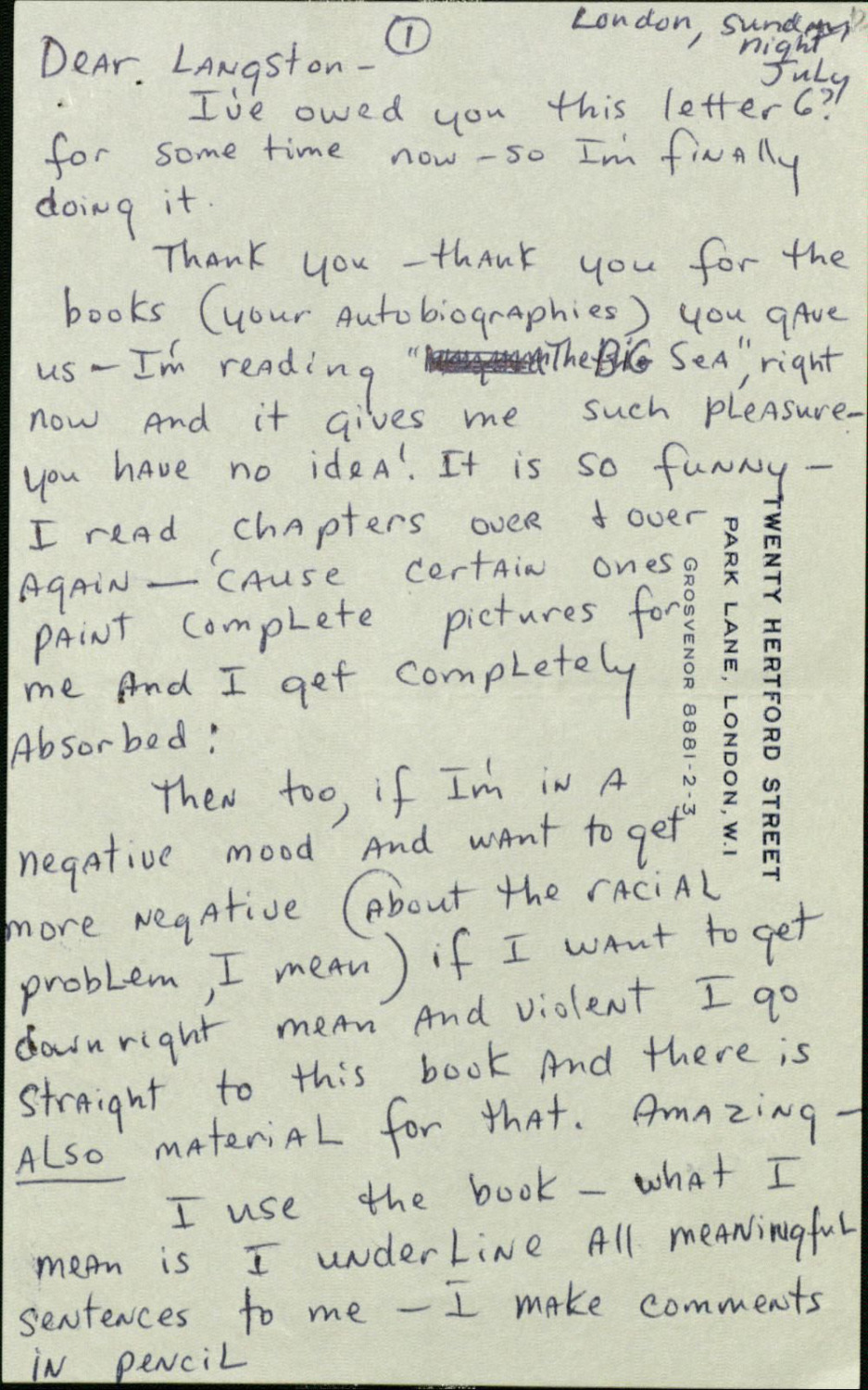
Nina Simone’s creative and political community meant everything to her, and the many losses she suffered in the 60s sent her deeper into the depression of the last decades of her life. “Langston Hughes, James Baldwin, and Lorraine Hansberry [were] prominent,” writes Malik Gaines at LitHub, “among… socially engaged writers and dramatists” whom she considered not only her “political tutors” but also her heroes and closest friends. She never stopped grieving the loss of Hansberry and Hughes and frequently memorialized them in tributes like “Backlash Blues.”
Written by Hughes, and one of Simone’s fiercest and most timely civil rights songs, “Backlash Blues” represents the significant influence the poet had on her and her art. In a live 1967 recording, she sings, “When Langston Hughes died—He told me many months before—Nina keep working until they open up that door.” The two first met when Simone was still Eunice Waymon from Tryon, North Carolina: an aspiring classical pianist, “president of the 11th-grade class and an officer with the school’s NAACP chapter,” explains Andrew J. Fletcher, a board member of the Nina Simone Project in Asheville.
This was 1949, and Hughes had come to Asheville to address Allen High School, the private school for African American girls Simone attended through a scholarship that her music teacher and early champion collected from her hometown. The poet “could not have known,” Maria Popova writes at Brain Pickings, “that [Simone] would soon revolutionize the music canon under her stage name.” But nearly ten years later, he recognized her talent immediately.
On the release of Simone’s first album, Little Girl Blue, Hughes was “so stunned that he lauded it with lyrical ardor” in his column for the Chicago Defender.
She is different. So was Billie Holiday, St. Francis, and John Donne. So in Mort Sahl. She is a club member, a coloured girl, an Afro-American, a homey from Down Home. She has hit the Big Town, the big towns, the LP discs and the TV shows — and she is still from down home. She did it mostly all by herself. Her name is Nina Simone.
They would become close friends and mutual admirers. Hughes sent her “books he thought would inspire her,” including several of his own, and wrote “words for her to set to song.” She wrote to him with earnest expressions of appreciation, especially in the letter here, penned in 1966 just before Hughes’ death.
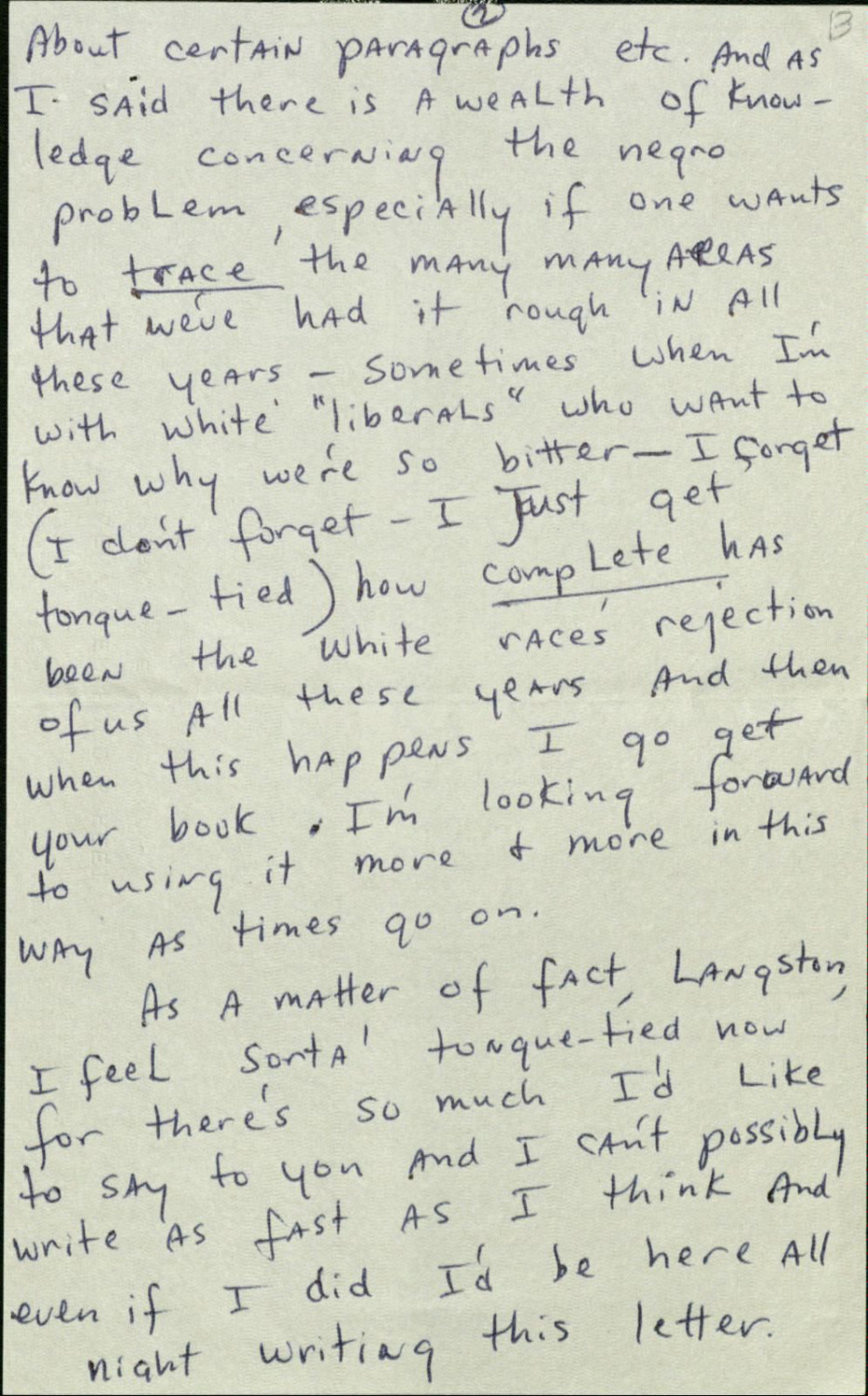
Simone had just read Hughes’ autobiography The Big Sea. The book, she says, “gives me such pleasure—you have no idea! It is so funny.” She also writes, with candor:
Then too, if I’m in a negative mood and want to get more negative (about the racial problem, I mean) if I want to get downright mean and violent I go straight to this book and there is also material for that. Amazing—
I use the book—what I mean is I underline all meaningful sentences to me…. And as I said there is a wealth of knowledge concerning the negro problem, especially if one wants to trace the many many areas that we’ve had it rough in all these years—sometimes when I’m with white “liberals” who want to know why we’re so bitter—I forget (I don’t forget—I just get tongue-tied) how complete has been the white races’ rejection of us all these years and then when this happens I go get your book.
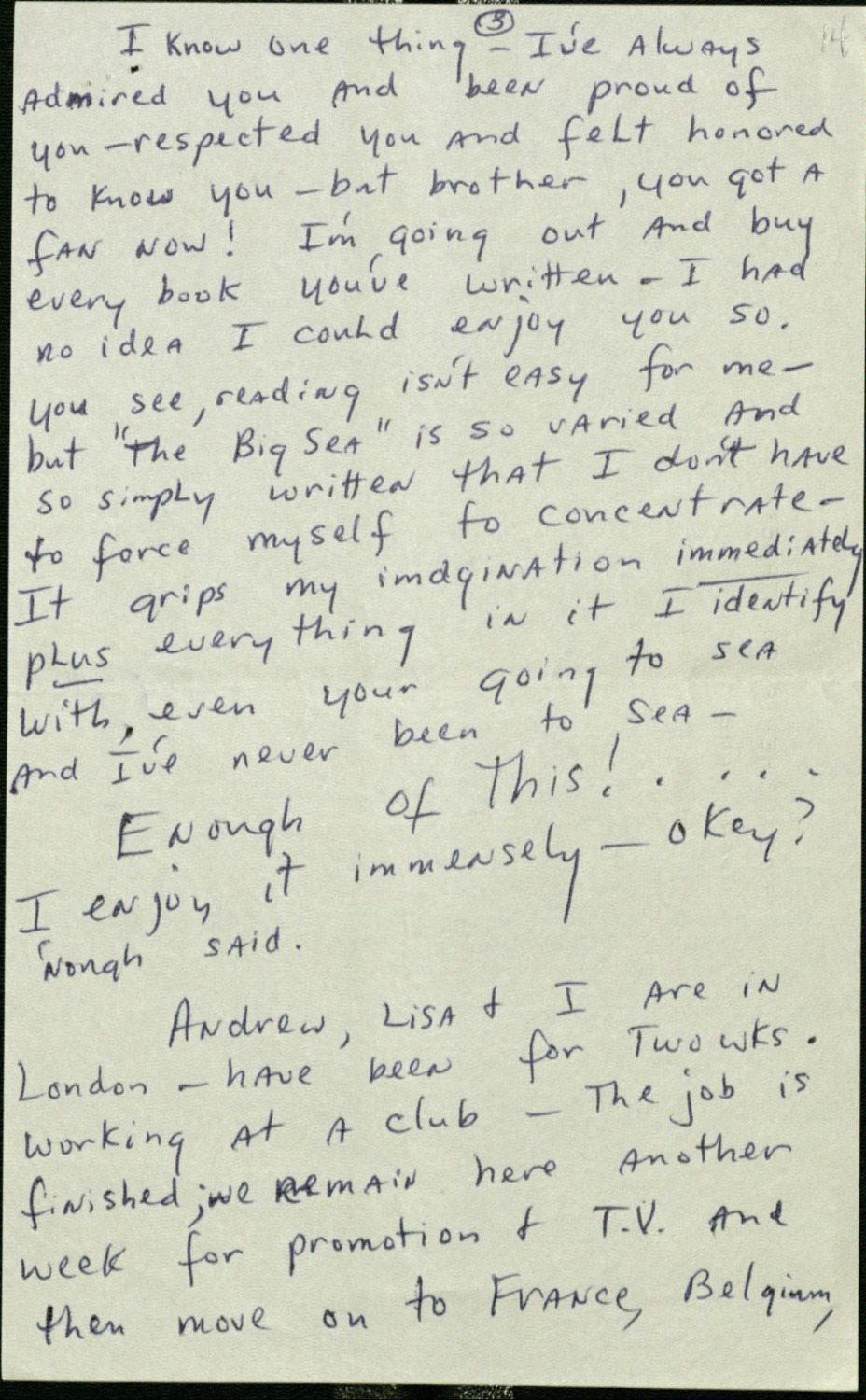
Hughes’ is rarely “mean and violent,” but Simone brought to her reading her own despair and rage and raw sense of rejection, emotions she was never afraid to explore in her work or talk about with humor and fierce ire in her life. “Brother, you’ve got a fan,” she gushes. The Big Sea “grips my imagination immediately plus everything in it I identify with, even your going to sea and I’ve never been to sea.” She had not been to sea, but she had been adrift, “depressed, alienated and low,” as she sang at Morehouse College in 1969 in a performance of her civil rights anthem and tribute to Lorraine Hansberry, “To Be Young, Gifted and Black.”
The adlib framed Simone’s feelings with the same “emotional and political dimensions,” writes Gaines, she found in Hughes’ work. Though she does not mention it in her letter, her annotated copy of The Big Sea surely marks up the passage below, in which Hughes’ describes his early unhappiness and his transformative encounter with art:
When I was in the second grade, my grandmother took me to Lawrence to raise me. And I was unhappy for a long time, and very lonesome, living with my grandmother. Then it was that books began to happen to me, and I began to believe in nothing but books and the wonderful world in books–where if people suffered, they suffered in beautiful language, not in monosyllables, as we did in Kansas.
For Simone, music gave her suffering purpose, but not the music she played for audiences and on record. One of the saddest ironies of her career is that the woman dubbed “The High Priestess of Soul” had little interest in playing soul. She embarked on her popular music career to fund her classical education. However, the opportunities to play the way she wanted to did not arise. “Nina closed her letter on a strangely down note,” writes Nadine Cohodas in Princess Noire: The Tumultuous Reign of Nina Simone. “Her melancholy overwhelmed any excitement about playing for the first time in France and Belgium. ‘No pleasure,’ she told Langston, ‘just work.’”
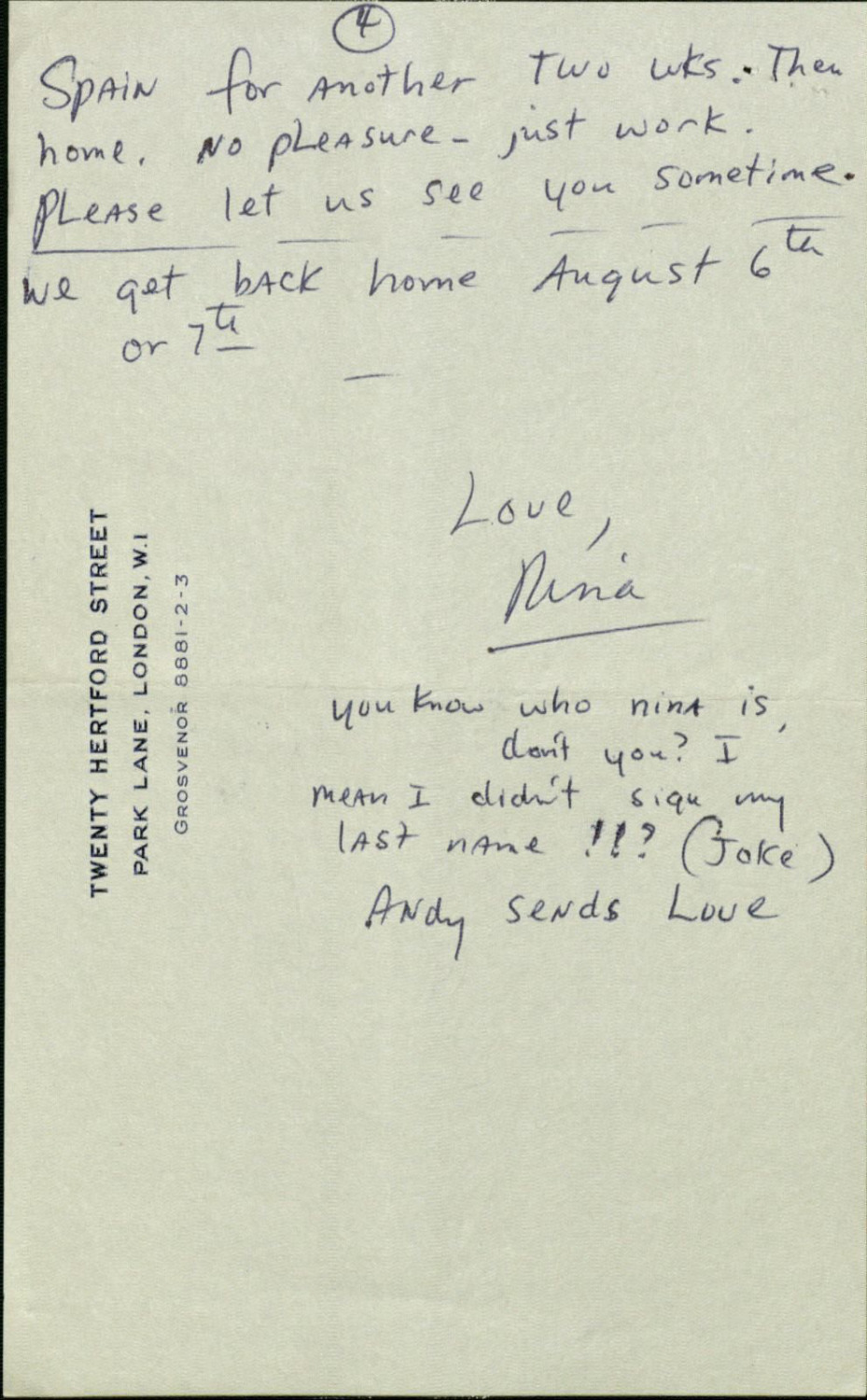
So much of Simone’s frustration and burnout in the music industry came out of a deep sense of alienation from her work. The shy Eunice Waymon had never craved the spotlight, something Hughes must have come to know about her in the years of their acquaintance. In his first note of praise, however, he gets one thing wrong. As she was always the first to point out, Simone did not do it “mostly all by herself.”
The support of her mother, her teacher, and her small “down home” community took her as far as it could. Her relationships with Hansberry, Hughes, and other artists/activists carried her the rest of the way. Until they were gone. But when Hughes died, Popova writes, “a devastated Simone turned her coveted set at the Newport Jazz Festival into a tribute and closed it with an exhortation to the audience: ‘Keep him with you always. He was a beautiful, a beautiful man, and he’s still with us, of course.’” See much more of their correspondence at the Beinecke.
via the Beinecke
Related Content:
Nina Simone’s Live Performances of Her Poignant Civil Rights Protest Songs
Nina Simone Song “Color Is a Beautiful Thing” Animated in a Gorgeous Video
Langston Hughes Reads Langston Hughes
Josh Jones is a writer and musician based in Durham, NC. Follow him at @jdmagness
Read More...Ray Bradbury’s Fahrenheit 451: A Free Reading by Featuring Neil Gaiman, William Shatner, Susan Orlean & More
Today, the world celebrates the 100th anniversary of Ray Bradbury’s birthday. And, to mark the occasion, Neil Gaiman, William Shatner, Susan Orlean & many others will host a reading of Bradbury’s classic book, Fahrenheit 451.
The online special, like the book, is separated into three parts, each introduced by Librarian of Congress Carla Hayden. The voices of librarians, notable authors, actors, scholars, and students are bookended by the opening and closing readings from Neil Gaiman and William Shatner. The special includes commentary by Ann Druyan, director and co-author of Cosmos, an afterword by Susan Orlean, author of The Library Book, and a special appearance and reading by former NASA astronaut and administrator Charles F. Bolden Jr.
You can watch the videos the reading the videos above and below. The videos should be available until September 5th.
Part 2
Part 3
If you would like to support the mission of Open Culture, consider making a donation to our site. It’s hard to rely 100% on ads, and your contributions will help us continue providing the best free cultural and educational materials to learners everywhere. You can contribute through PayPal, Patreon, and Venmo (@openculture). Thanks!
Related Content:
Why Should We Read Ray Bradbury’s Fahrenheit 451? A New TED-Ed Animation Explains
An Asbestos-Bound, Fireproof Edition of Ray Bradbury’s Fahrenheit 451 (1953)
Hear Ray Bradbury’s Classic Sci-Fi Story Fahrenheit 451 as a Radio Drama
Read More...Miles Davis, Herbie Hancock & Other Jazz Musicians Sell Whisky & Spirits in Classic Japanese TV Commercials
I like to think that, when the occasion arises, I can speak passable Japanese. But pride goeth before the fall, and I fell flat on my first attempt to order a whisky in Tokyo. To my request for a Suntory neat the bartender responded only with embarrassed incomprehension. I repeated myself, pushing my Japanified pronunciation to parodic limits: saaan-to-riii nee-to. At some point the man deciphered my linguistic flailing. “Ah,” he said, brightening, “suuu-to-raaay-to?” To think that I could have handled this situation with dignity had I but seen the Suntory commercial above, in which Herbie Hancock suggests having a drink “straight.”
Would even the maddest men of the American advertising industry countenance the idea of putting a jazz musician in a commercial? Japan thinks differently, however, and in its economic-bubble era of the 1970s and 80s thought more differently still.
At that time, Japanese television spots — at least those commissioned by sufficiently deep-pocketed companies — began featuring American celebrities like James Brown, Woody Allen, Nicolas Cage, Paul Newman, and Dennis Hopper. A 1979 Suntory ad that put Francis Ford Coppola alongside Akira Kurosawa would, a quarter-century on, inspire Coppola’s daughter Sofia to dramatize a similar East-meets-West commercial situation in her film Lost in Translation.
Of all the things American embraced (and repurposed) by Japan after its defeat in the Second World War, jazz music has maintained the most intensely enthusiastic fan base. Japanese-made jazz has long been a formidable genre of its own, just as Japanese-made whisky has long held its own with the Western varieties. But when the makers of Japanese whisky made an effort to sell their own product on television to the newly wealthy Japanese people, they looked to American jazzmen to give it a shot of authenticity. Having recruited Hancock to promote drinking their single-malt whisky at room temperature, Suntory got bassist Ron Carter as well as both Branford and Ellis Marsalis to promote drinking it hot.
Could the cultural association between jazz and whisky extend to other liquors? That was the gambit of a 1987 commercial featuring Miles Davis, recently investigated by InsideHook’s Aaron Goldfarb. Its product: shōchū, “a colorless, odorless, yet often challenging spirit typically distilled from rice (known as kome-jochu), barley (mugi-jochu) or sweet potatoes (imo-jochu).” Newly launched with an apparent intent to pitch that staid beverage to moneyed younger people, the brand VAN hired Davis to play a few notes on his trumpet, then take a sip of its shōchū and pronounce it a “miracle.” He also describes himself as “always on the vanguard,” hence, presumably, the name VAN (though its being reminiscent of VAN JACKET, the company that had earlier brought Ivy League style to the same target demographic, couldn’t have been unwelcome).
Though Davis’ brand of cool did its part for the success of Honda scooters and TDK cassette tapes, it proved not to be enough for VAN shōchū. The brand “was a big flop and had a very short life,” Goldfarb quotes an industry expert as saying, “probably because shōchū is so quintessentially Japanese, and a foreign-style shōchū just didn’t make sense to most.” Perhaps the commercial itself also lacked the pleasurable simplicity of Suntory’s many jazz-oriented spots, none of which turned out simpler or more pleasurable than the one with Sammy Davis Jr. performing a cappella just above. In the process of pouring himself a drink Davis plays the part of an entire jazz combo, using only his mouth and the objects at hand, including the ice in his glass. The concept wouldn’t have worked quite so well had he taken his Suntory neat — or rather, straight.
Related Content:
The Best Commercial Ever? James Brown Sells Miso Soup (1992)
Woody Allen Lives the “Delicious Life” in Early-80s Japanese Commercials
Glorious Early 20th-Century Japanese Ads for Beer, Smokes & Sake (1902–1954)
Based in Seoul, Colin Marshall writes and broadcasts on cities, language, and culture. His projects include the book The Stateless City: a Walk through 21st-Century Los Angeles and the video series The City in Cinema. Follow him on Twitter at @colinmarshall, on Facebook, or on Instagram.
Read More...The Face of Bill Murray Adds Some Joy to Classic Paintings
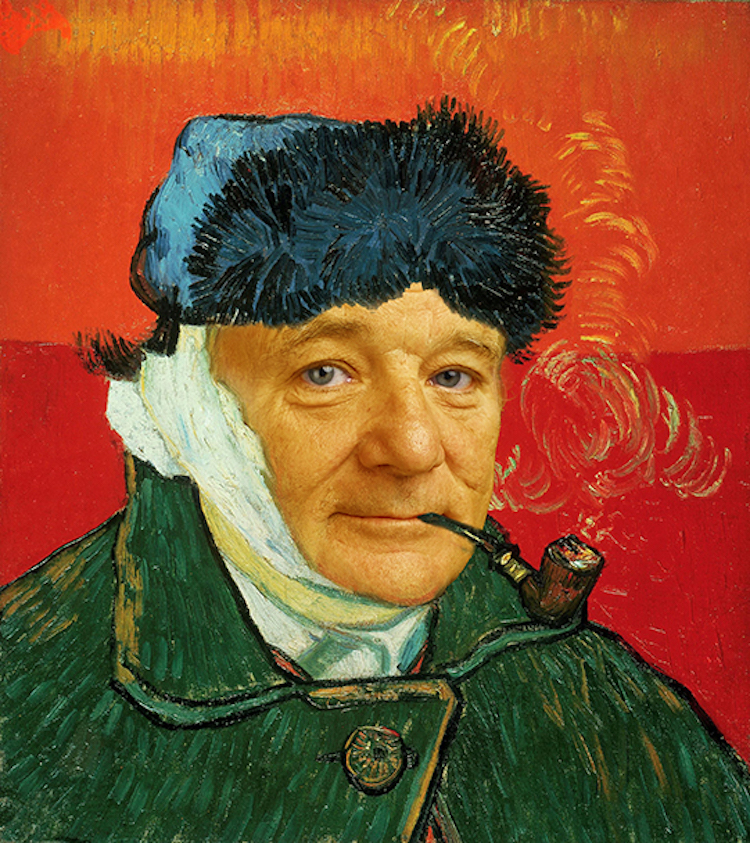
Bill Murray isn’t one of those actors who disappears into a role.
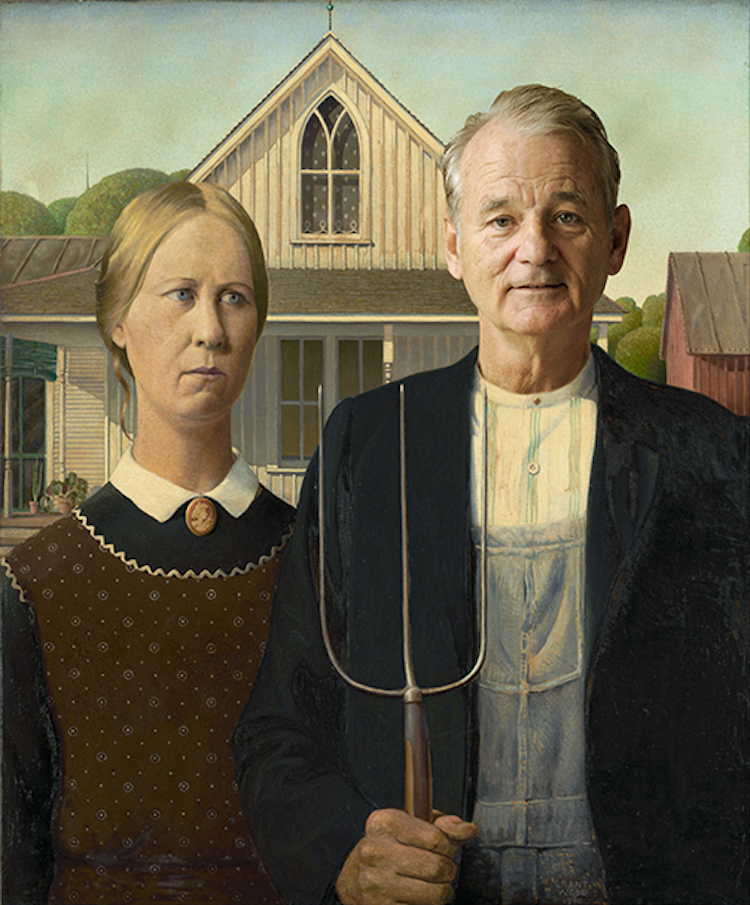
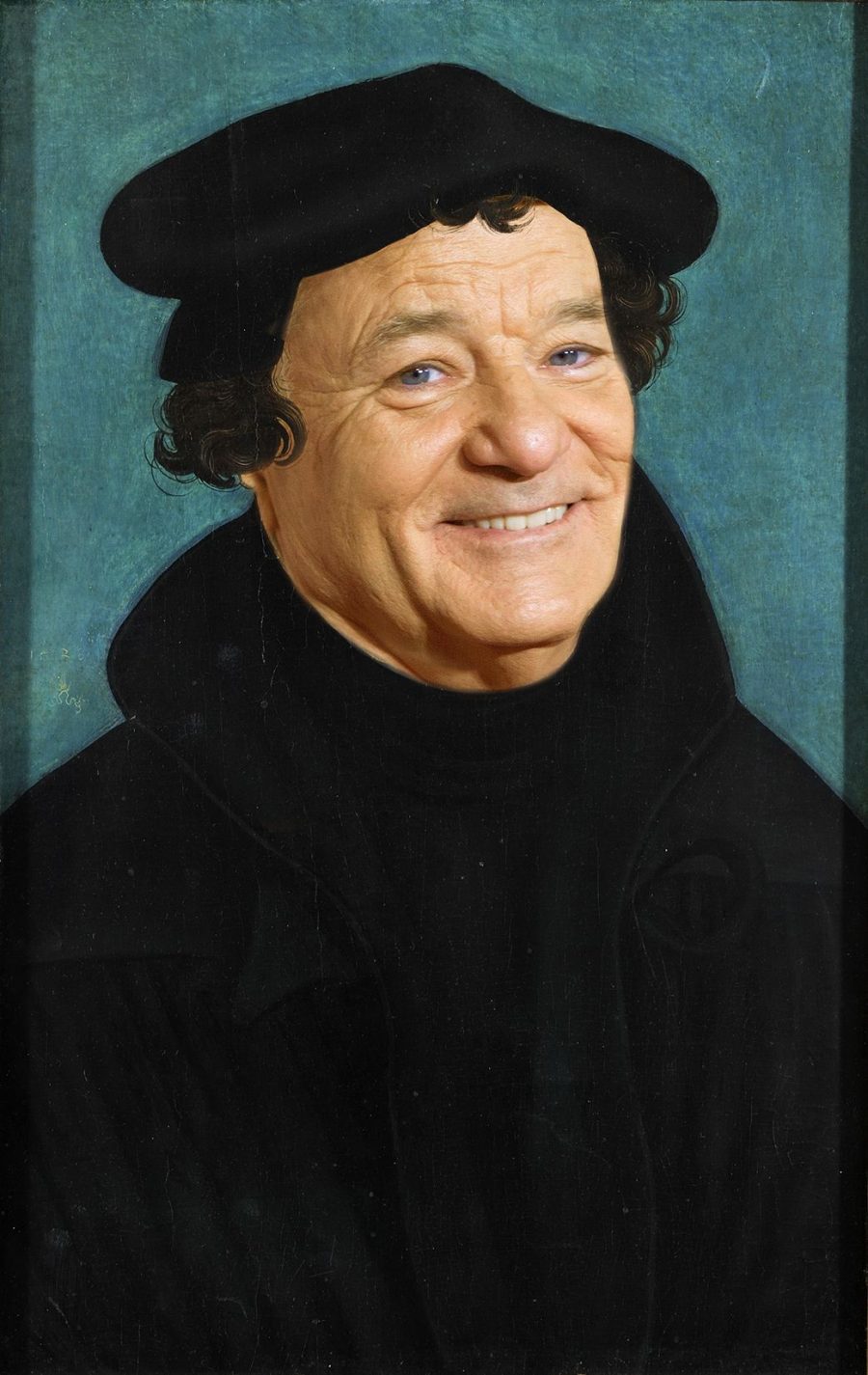
Nor is he much of a chameleon on canvas, however iconic, as artist Eddy Torigoe demonstrates with a series that grafts Murray’s famous mug onto a number of equally well-known paintings.
Torigoe told Digg that he was inspired by accident, when he was struck by the uncanny resemblance between Gilbert Stuart’s Lansdowne portrait of George Washington, and a photo of Murray posted by a Reddit user.
He downloaded both images and busied himself with Photoshop.
The rest is history.
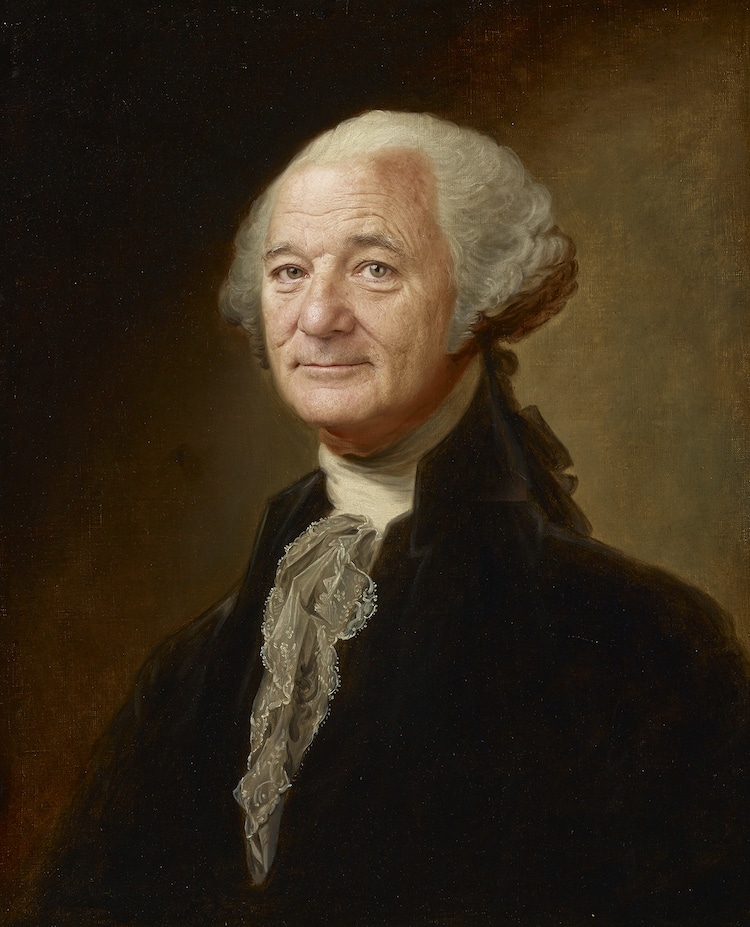
The Presidential update is an improvement in ways. Murray-faced Washington appears kindly, and not averse to a bit of fun. No teeth of enslaved peoples compromising that mouth.
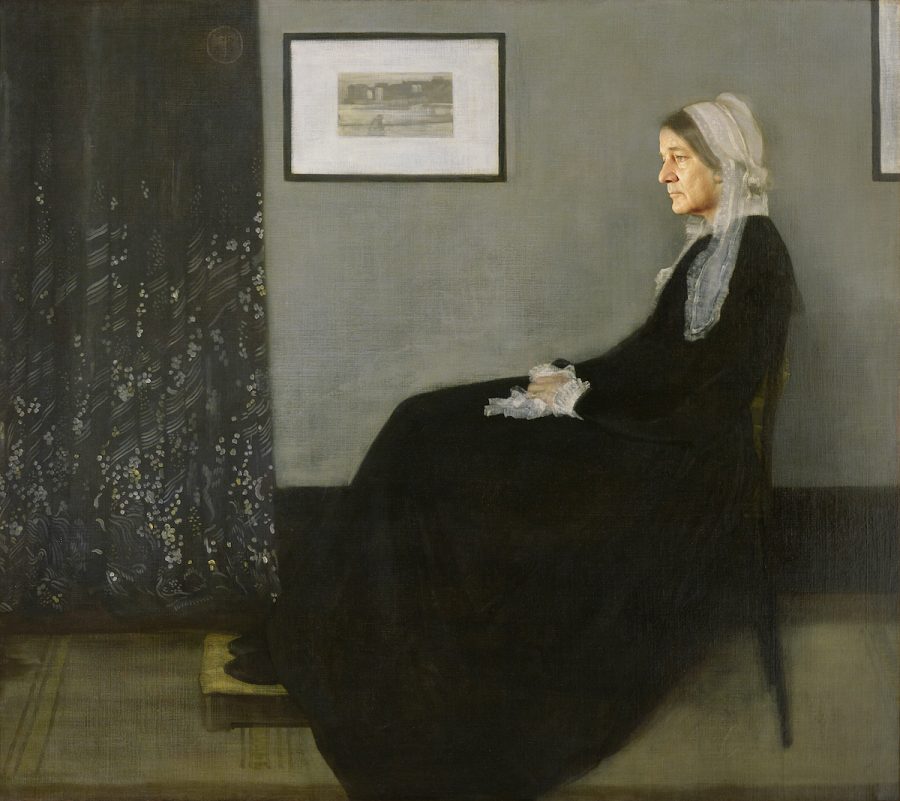
While Murray is capable of maintaining a straight face—witness his work in Lost in Translation, The Razor’s Edge, Hamlet 2000, and Torigoe’s homage to Whistler’s Mother, above—more often than not a certain puckishness shines through.
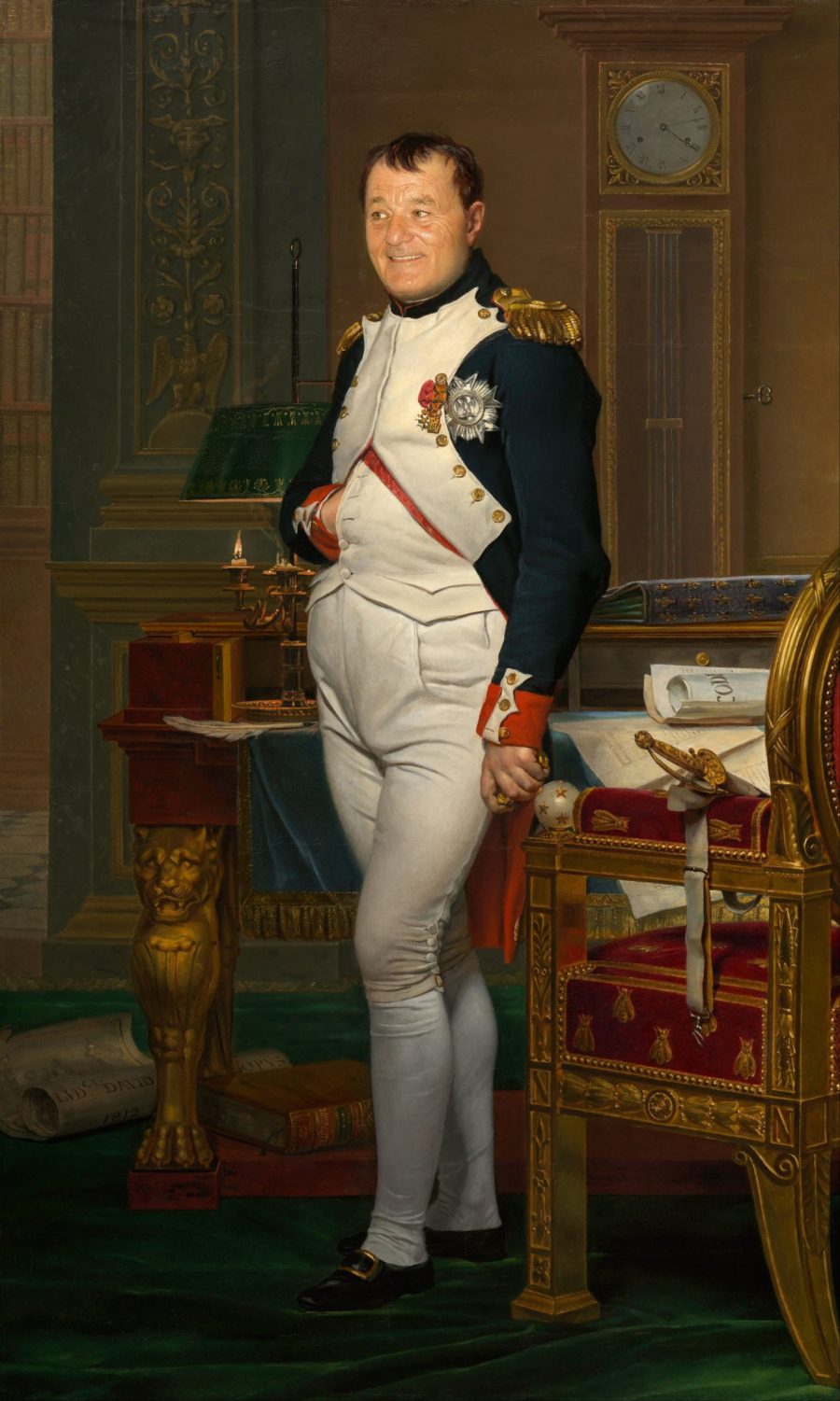
One wonders what would have befallen painter Jacques-Louis David had he bestowed The Emperor Napoleon in His Study at the Tuileries with Murray’s goofy expression.
And it’s well established that a key element of Grant Wood’s oft-parodied American Gothic is the poker faced reserve of its male subject.
Had they been alive today, it’s conceivable that Lucas Cranach the Elder’s portrait of Martin Luther might have depicted a lighter side of his friend, something more Murray-esque. Though given the Reformation and his 95 Theses against Indulgences, maybe not….
Explore more of Eddy Torigoe’s Bill Murray-enriched masterpieces of art, including self-portraits by Rembrandt, Frida Kahlo, and Picasso, on his website.
via My Modern Met
Related Content:
Bill Murray Explains How a 19th-Century Painting Saved His Life
Ayun Halliday is an author, illustrator, theater maker and Chief Primatologist of the East Village Inky zine. Follow her @AyunHalliday.
Read More...The British Museum is Full of Looted Artifacts
As critics and fans wrote excitedly upon its release, Marvel’s Black Panther did an excellent job of creating sympathy for its villain. Many found Erik Killmonger’s radicalism more appealing than the hero’s moderation for some specific reasons, beginning with the heist at the “Museum of Great Britain,” a thinly fictionalized British Museum. “In one scene,” writes gallerist Lise Ragbir at Hyperallergic, “the blockbuster superhero movie touches on issues of provenance, repatriation, diversity, representation, and other debates currently shaping institutional practices.”
As a gallery director who is also black, I was awed by Killmonger’s declaration to an overconfident curator that she was mistaken. When the curator condescendingly informed Killmonger that items in the museum aren’t for sale, my hands began to sweat. And I was downright thrilled when the villain bluntly confronted her: “How do you think your ancestors got these? You think they paid a fair price? Or did they take it like they took everything else?”
He does not exaggerate. The scene “describes a centuries-old truth,” artist Deborah Roberts remarks”—“colonialists robbing black culture to put on display for European consumption.” The issue, in other words, is not only who gets to tell the stories of African and other non-European people, but who gets to see and hear them, since so many non-white people have been excluded from museums and museum culture.
As Casey Haughin wrote in the Hopkins Exhibitionist, the film “presented [the museum] as an illegal mechanism of colonialism, and along with that, a space which does not even welcome those whose culture it displays.” So-called “disputed museum treasures,” the Vox video above shows, are essentially stolen artifacts, with claims of ownership that elide, omit, or fabricate the history of their acquisition.
Some looted treasures have been returned, but when it comes to the majority of the Museum’s “disputed” collections, “so far, it isn’t giving them back,” Vox explains, despite calls from formerly colonized nations. It’s easy to see why. If they were to honor historical claims of ownership, the British Museum would lose some of its most celebrated and significant holdings, like the Rosetta Stone or the Benin Bronzes, “some of the most contentious items in the museum.”
These bronzes, from the wealthy Kingdom of Benin, located in modern-day Nigeria, were “looted by British soldiers during an 1897 raid,” Sarah Cascone writes at Artnet. Faced with calls from Nigeria’s National Commission for Museums and Monuments to return them, the British Museum held meetings that lead to more meetings and a “declaration” that “outlined an intention”—all stalling tactics that have not produced results. Learn why these artifacts are important to Nigerians and how the 19th-century “scramble for Africa” created so much of the museum culture we know today, one still heavily mired in its colonialist roots.
Related Content:
The British Museum Puts 1.9 Million Works of Art Online
Take a Virtual Tour of 30 World-Class Museums & Safely Visit 2 Million Works of Fine Art
Josh Jones is a writer and musician based in Durham, NC. Follow him at @jdmagness
Read More...There Are Only 37 Possible Stories, According to This 1919 Manual for Screenwriters
“Great literature is one of two stories,” we often quote Leo Tolstoy as saying: “a man goes on a journey or a stranger comes to town.” That’s all well and good for the author of War and Peace, but what about the thousands of screenwriters struggling to come up with the next hit movie, the next hit television series, the next hit platform-specific web and/or mobile series? Some, of course, have found in that aphorism a fruitful starting point, but others opt for different premises that number the basic plots at three (William Foster-Harris), six (researchers at the University of Vermont’s Computational Story Lab), twenty (Ronald Tobias), 36 (George Polti) — or, as some struggling screenwriters of a century ago read, 37.
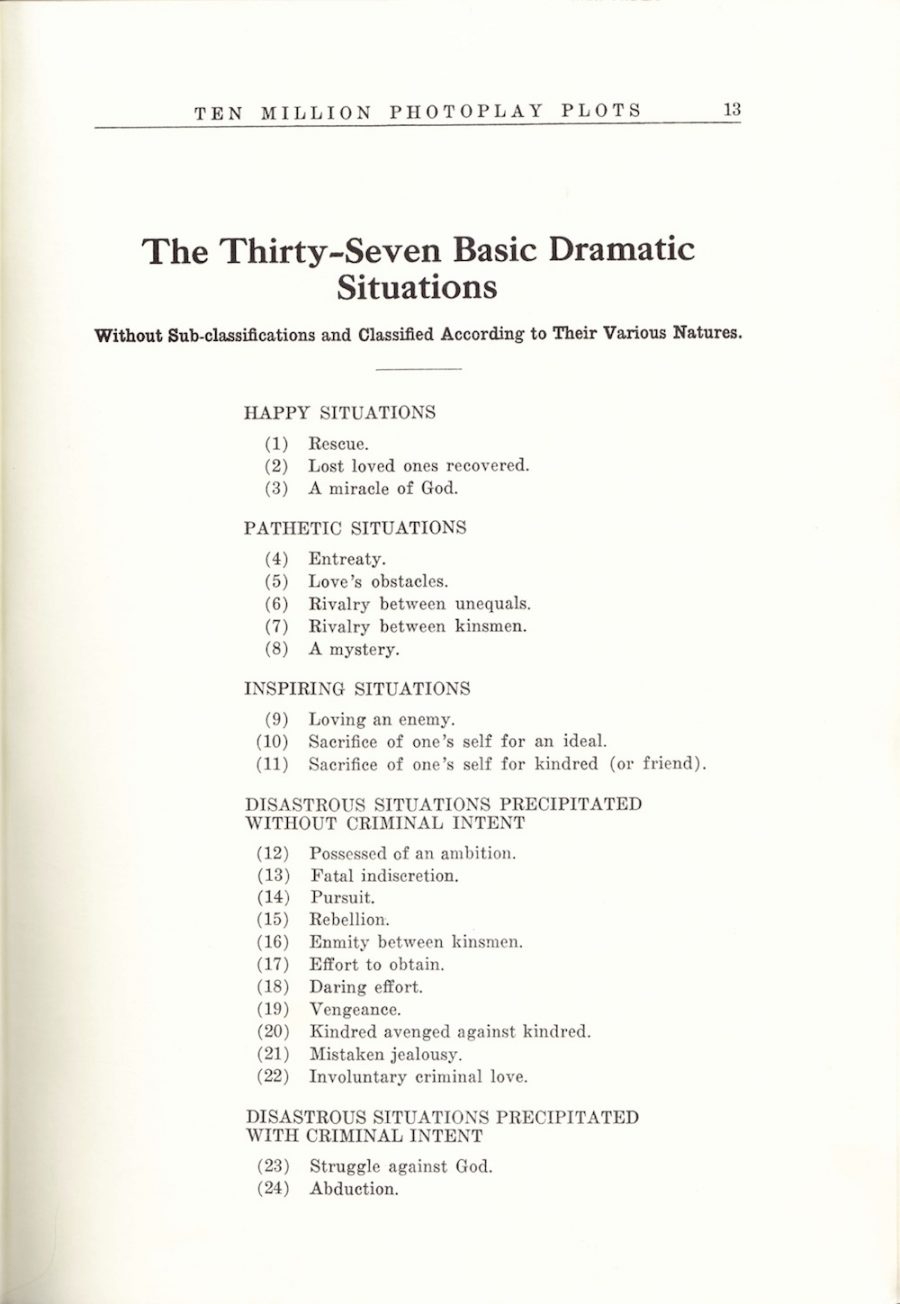
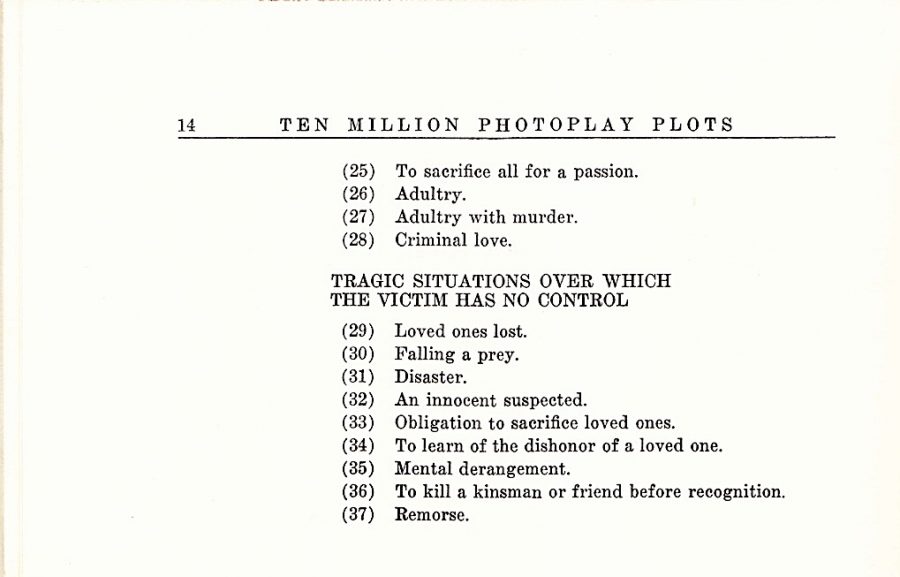
The year was 1919. America’s biggest blockbusters included D.W. Griffith’s Broken Blossoms, Cecil B. DeMille’s Male and Female, and The Miracle Man, which made Lon Chaney into a silver-screen icon. The many aspirants looking to write their way into the ever more celebrated and lucrative movie business could turn to a newly published manual called Ten Million Photoplay Plots by Wycliff Aber Hill. “Hill, who published more than one aid to struggling ‘scenarists,’ positioned himself as an authority on the types of stories that would work well onscreen,” writes Slate’s Rebecca Onion. In this book he provides a “taxonomy of possible types of dramatic ‘situations,’ first running them down in outline form, then describing each more completely and offering possible variations.”
Hill’s 37 basic dramatic situations include such “happy situations” as “rescue,” “loved ones lost and recovered,” and “a miracle of God”; such “pathetic situations” as “love’s obstacles,” “rivalry between unequals,” and “a mystery”; and such “disastrous situations precipitated without criminal intent” as “possessed of an ambition,” “enmity between kinsmen,” and “vengeance.” (Naturally, Hill also includes a separate category involving criminal intent.) These dramatic concepts then break down into more specific scenarios like “rescue by strangers who are grateful for favors given them by the unfortunate one,” “an appeal for refuge by the shipwrecked,” “the sacrifice of happiness for the sake of a loved one where the sacrifice is caused by unjust laws,” and “congenial relations between husband and wife made impossible by the parents-in-law.”
Already more than a few films new and old come to mind whose stories proceed from such dramatic concepts. Indeed, one could think of examples from not just cinema but literature, television, theater, comics, and other forms of narrative art besides. Situations we all know from real life may also follow similar contours, which plays no small part in giving them their impact when properly translated to the screen. Clearly aiming for timelessness, Hill enumerates plots that could have been employed in stories centuries before his time, and will continue to be long after ours. But what, exactly, is the relationship between plot and story? We now quote E.M. Forster on the matter, specifically a line from his Aspects of the Novel — a book for which Ten Million Photoplay Plots’ first readers would have to wait eight more years.
Related Content:
Kurt Vonnegut Diagrams the Shape of All Stories in a Master’s Thesis Rejected by U. Chicago
Raymond Chandler: There’s No Art of the Screenplay in Hollywood
Based in Seoul, Colin Marshall writes and broadcasts on cities, language, and culture. His projects include the book The Stateless City: a Walk through 21st-Century Los Angeles and the video series The City in Cinema. Follow him on Twitter at @colinmarshall, on Facebook, or on Instagram.
Read More...Support Us
We're hoping to rely on loyal readers, rather than erratic ads. Please click the Donate button and support Open Culture. You can use Paypal, Venmo, Patreon, even Crypto! We thank you!

About Us

Open Culture scours the web for the best educational media. We find the free courses and audio books you need, the language lessons & educational videos you want, and plenty of enlightenment in between.
Advertise With Us

FREE UPDATES!
GET OUR DAILY EMAIL
Get the best cultural and educational resources on the web curated for you in a daily email. We never spam. Unsubscribe at any time.
FOLLOW ON SOCIAL MEDIA

Open Culture editor Dan Colman scours the web for the best educational media. He finds the free courses and audio books you need, the language lessons & movies you want, and plenty of enlightenment in between.
Advertise With Us

