Dessert Recipes of Iconic Thinkers: Emily Dickinson’s Coconut Cake, George Orwell’s Christmas Pudding, Alice B. Toklas’ Hashish Fudge & More

Image via Wikimedia Commons
Of all the desserts to attain cultural relevance over the past century, can any hope to touch Alice B. Toklas’ famous hashish fudge? Calling for such ingredients as black peppercorns, shelled almonds, dried figs, and most vital of all Cannabis sativa, the recipe first appeared in 1954’s The Alice B. Toklas Cook Book. (Toklas would read the recipe aloud on the radio in the early 1960s, a time when the fudge’s key ingredient had become an object of much more intense public interest.) More than a how-to on Toklas’ favorite dishes, the book is also a kind of memoir, including recollections of her life with Gertrude Stein — herself the author of the ostensible Autobiography of Alice B. Toklas.
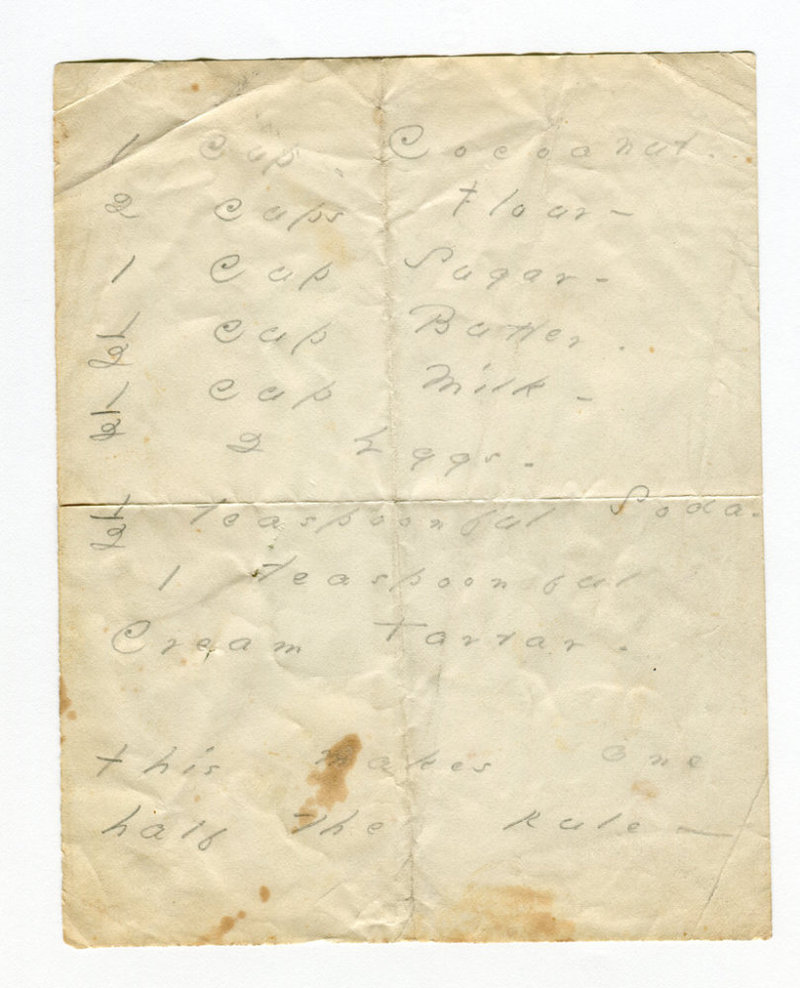
This puts us in the realm of serious literature where sweets, you might assume, are scarcely to be found. But baking constituted a part of the creative process of no less a literary mind than Emily Dickinson, whose handwritten recipe for coconut cake appears above.
That same sheet of a paper’s reverse side, which you can see in our earlier post about it, bears the first lines of her poem “The Things that never can come back, are several.” Dickinson also, as we’ve previously posted here on Open Culture, had her very own recipes for gingerbread, donuts, and something requiring five pounds of raisins called “black cake.”
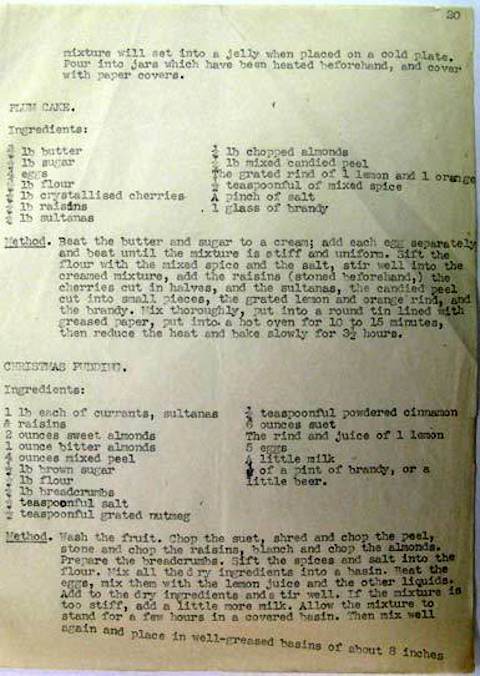
It may seem obvious that women like Toklas and Dickinson, born and raised in the 19th century, would have been expected to learn this sort of thing. But a fair few of the literary men of generations past knew something of their way around the kitchen as well. George Orwell, for instance, wrote an essay on “British cookery,” early in which he states that “in general, British people prefer sweet things to spicy things.” While describing “sweet dishes and confectionery – cakes, puddings, jams, biscuits and sweet sauces” as the “glory of British cookery,” he admits that “the national addiction to sugar has not done the British palate any good.” And so he includes the recipe for a Christmas pudding which, subtle by that standard, calls for only half a pound of the stuff.
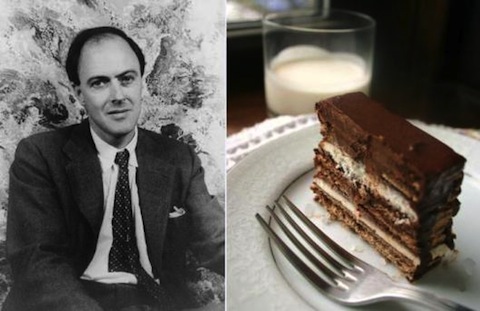
Born a generation after Orwell, Roald Dahl made no secret of his own sugar-addicted British palate. In his book Charlie and the Chocolate Factory Dahl had “dazzled young readers with visions of Cavity-Filling Caramels, Everlasting Gobstoppers, and snozzberry-flavored wallpaper,” writes Open Culture’s own Ayun Halliday. But his own candy of choice was “the more pedestrian Kit-Kat bar. In addition to savoring one daily (a luxury little Charlie Bucket could but dream of, prior to winning that most golden of tickets) he invented a frozen confection called ‘Kit-Kat Pudding,’ ” whose simple recipe is as follows: “Stack as many Kit-Kats as you like into a tower, using whipped cream for mortar, then shove the entire thing into the freezer, and leave it there until solid.”
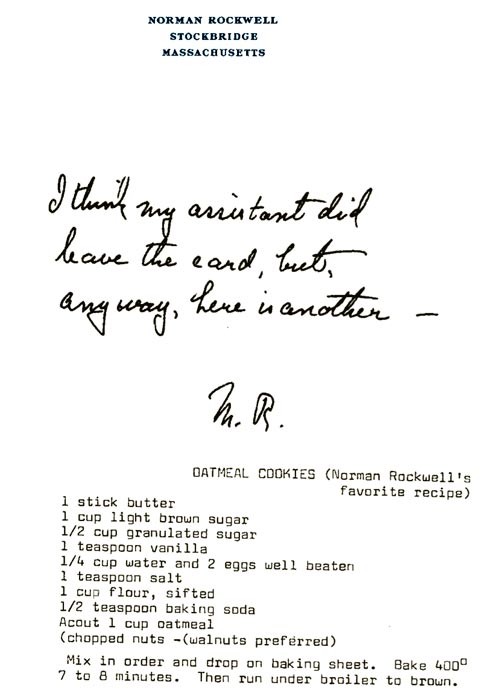
If you’re looking for a slightly more challenging dessert that still comes with a cultural figure’s imprimatur, you might give Normal Rockwell’s favorite oatmeal cookies a try. Going deeper into American history, we’ve also got Thomas Jefferson’s recipe for ice cream, the taste for which he picked up while living in France in the 1780s. That same country’s cuisine also inspired Ernest Hemingway’s fruit pie, meant for summer-camping with one’s pals: “If your pals are Frenchmen,” Hemingway adds, “they will kiss you.” Alas, if anyone has determined the exact recipe for the most famous dessert in all of French literature, Marcel Proust’s memory-triggering madeleines, they haven’t released it to the hungry public.
Related Content:
The Recipes of Iconic Authors: Jane Austen, Sylvia Plath, Roald Dahl, the Marquis de Sade & More
Ernest Hemingway’s Summer Camping Recipes
Wagashi: Peruse a Digitized, Centuries-Old Catalogue of Traditional Japanese Candies
Based in Seoul, Colin Marshall writes and broadcasts on cities, language, and culture. His projects include the book The Stateless City: a Walk through 21st-Century Los Angeles and the video series The City in Cinema. Follow him on Twitter at @colinmarshall, on Facebook, or on Instagram.
Read More...The Wine Windows of Renaissance Florence Dispense Wine Safely Again During COVID-19
Everything old is new again and Tuscany’s buchette del vino—wine windows—are definitely rolling with the times.
As Lisa Harvey earlier reported in Atlas Obscura, buchette del vino became a thing in 1559, shortly after Cosimo I de’ Medici decreed that Florence-dwelling vineyard owners could bypass taverns and wine merchants to sell their product directly to the public. Wealthy wine families eager to pay less in taxes quickly figured out a workaround that would allow them to take advantage of the edict without requiring them to actually open their palace doors to the rabble:
Anyone on the street could use the wooden or metal knocker … and rap on a wine window during its open hours. A well-respected, well-paid servant, called a cantiniere and trained in properly preserving wine, stood on the other side. The cantiniere would open the little door, take the customer’s empty straw-bottomed flask and their payment, refill the bottle down in the cantina (wine cellar), and hand it back out to the customer on the street.

Seventy years further on, these literal holes-in-the-walls served as a means of contactless delivery for post-Renaissance Italians in need of a drink as the second plague pandemic raged.
Scholar Francesco Rondinelli (1589–1665) detailed some of the extra sanitation measures put in place in the early 1630s:
A metal payment collection scoop replaced hand-to-hand exchange
Immediate vinegar disinfection of all collected coins
No exchange of empty flasks brought from home
Customers who insisted on bringing their own reusable bottles could do self-serve refills via a metal tube, to protect the essential worker on the other side of the window.
Sound familiar?
After centuries of use, the windows died out, falling victim to flood, WWII bombings, family relocations, and architectural renovation.
The novel coronavirus pandemic has definitely played a major role in putting wine windows back on the public’s radar, but Babae, a casual year-old restaurant gets credit for being the first to reactivate a disused buchetta del vino for its intended purpose, selling glasses of red for a single hour each day starting in August 2019.
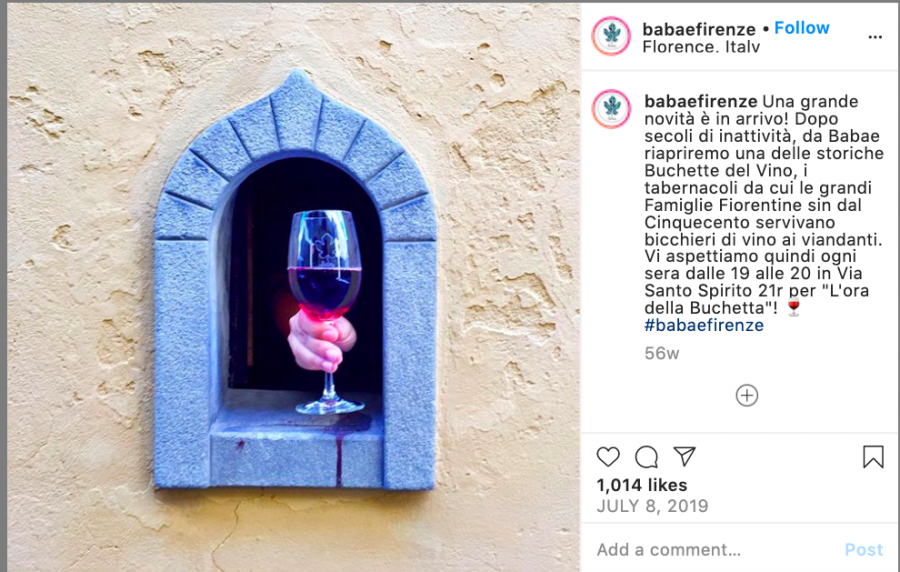
Now several other authentic buchette have returned to service, with menus expanded to accommodate servings of ice cream and coffee.
Given this success, perhaps they’ll take a cue from Japan’s 4.6 million vending machines, and begin dispensing an even wider array of items.
They may even take a page from the past, and send some of the money they take in back out, along with food and yes—wine—to sustain needy members of the community.
The Buchette del Vino Associazi Culturale currently lists 146 active and inactive wine windows in Florence and the surrounding regions, accompanying their findings with photos and articles of historical relevance.
Via Atlas Obscura
Related Content:
Quarantined Italians Send a Message to Themselves 10 Days Ago: What They Wish They Knew Then
A Free Course from MIT Teaches You How to Speak Italian & Cook Italian Food All at Once
Ayun Halliday is an author, illustrator, theater maker and Chief Primatologist of the East Village Inky zine. Follow her @AyunHalliday.
Read More...Classic Punk Rock Sketches from Saturday Night Live, Courtesy of Fred Armisen
Comedian Fred Armisen is best known for his years on Saturday Night Live, his eight seasons of surreal sketch comedy (with Carrie Brownstein) on Portlandia, and his unnerving command of regional accents and impressions. True fans also know that for much of his career he’s also been a musician, primarily a drummer, since college. Starting in high school, he’s been in various bands, including Trenchmouth, the Blue Man Group, and sometimes sitting in with Seth Meyers’ house band.
So the above skit from SNL is fun because Armisen gets to indulge his love of punk music. It’s a basic set-up, a 40-something groom and his best buds “getting the band back together” to play one more song at a wedding. But here the band used to be a political punk band along the lines of Fear, The Dead Kennedys, and Suicidal Tendencies, and the anti-Reagan lyrics (you too, Alexander Haig, you fascist!) have been preserved in amber.
Like most SNL sketches it unfolds kind of how you expect (and just kinda…ends), but man, this must have been fun to shoot. And yes, that’s the Foo Fighters/Nirvana’s Dave Grohl on drums.
If that skit was a tribute to American punk, then this other one is a nod to the Sex Pistols and the steady rightward drift of John Lydon. Armisen plays lead singer Ian Rubbish (you know, of Ian Rubbish and the Bizarros) whose lyrics decry and attack everything…except for Margaret Thatcher. The Queen? She’s useless (and other words we can’t write on Open Culture), but Maggie? Ian has a soft spot.
This 2013 skit came shortly after Thatcher died and Americans were treated to videos of some Britons (not all, but *a lot*) celebrating her death much as you would the death of Hitler or Mussolini. Goodbye, good riddance, and let me know where she’s located so we can pee on her grave. That sorta thing. And if that’s where you’re at, you might find the turn this sketch takes a bit too nice. But kudos to ex-Pistol Steve Jones for turning up and doing the Rutles-like thing. There’s even a nice parody of the infamous Bill Grundy interview.
(Bonus info: Ian Rubbish and the Bizarros played some actual shows.)
Armisen had another crack, by the way, at the reunion joke. In Season 8 of Portlandia, the “Band Reunion” skit brought together Henry Rollins (Black Flag), Krist Novoselic (Nirvana), and Brendan Canty (Fugazi) to bring back Armisen’s character’s band “Riot Spray” and record one more time. (Brownstein only figures a bit in the skit, but her reaction is priceless). The humor is just a little bit more mellow, a bit more empathetic, and hurts just that little bit more.
Related Content:
The Sex Pistols’ 1976 Manchester “Gig That Changed the World,” and the Day the Punk Era Began
The Sex Pistols Play in Dallas’ Longhorn Ballroom; Next Show Is Merle Haggard (1978)
Ian Rubbish (aka Fred Armisen) Interviews the Clash in Spinal Tap-Inspired Mockumentary
Never Mind the Bollocks, Here’s … John Lydon in a Butter Commercial?
Ted Mills is a freelance writer on the arts who currently hosts the Notes from the Shed podcast and is the producer of KCRW’s Curious Coast. You can also follow him on Twitter at @tedmills, and/or watch his films here.
Read More...Winston Churchill Praises the Virtue of “Brevity” in Memos to His Staff: Concise Writing Leads to Clearer Thinking
George Orwell and Winston Churchill didn’t agree on much. For example, while Orwell wrote with deep sympathy about coal miners in The Road to Wigan Pier, Churchill, as home secretary, brutally crushed a miner’s strike in Wales. Orwell’s early years as “an apparatchik in the last days of the empire… left him with a hatred of authority and imperialism,” writes Richard Eilers. Churchill was a committed imperialist all his life, instrumental in prolonging a famine in British India that killed “at least three million people.”
Importantly for history’s sake, they agreed on the need to confront, rather than appease, the Nazis, against both the British left and right of the 1930s. “At a time not unlike today,” says journalist Tom Ricks, “when people were wondering whether democracy was sustainable, when a lot of people thought you needed authoritarian rule, either from the right or the left, Orwell and Churchill, from their very different perspectives, come together on a key point. We don’t have to have authoritarian government.”
Maybe somewhat less important—but strenuously agreed upon nonetheless by these two figures—was the need for clear, concise prose that avoids obfuscation. In Politics and the English Language—an essay routinely taught in college composition classes—Orwell describes politically misleading writing as overstuffed with “pretentious diction” and “meaningless words.” These are, he writes, signs of a “decadent… civilization.” Churchill has had at least as much influence as Orwell on a certain kind of political writing, though not the kind most of us read often.
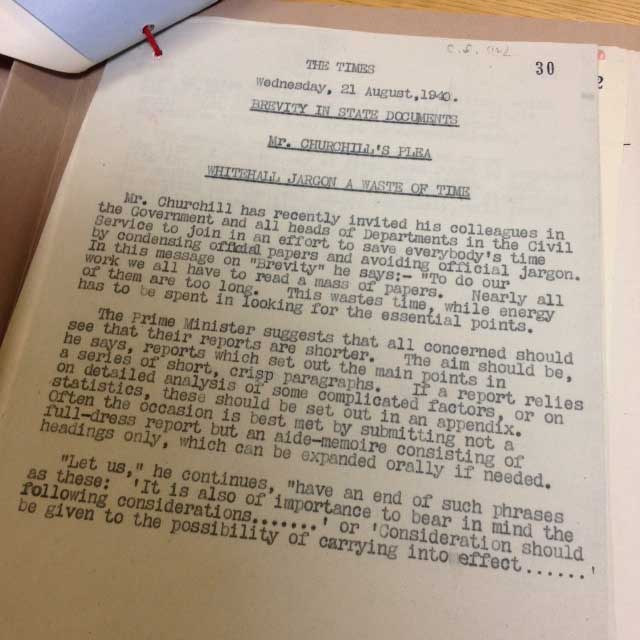
In 1940, Churchill issued a memo to his staff titled “Brevity.” He did not express concerns about creeping fascism in bureaucratic communiques, but decried the problem of wasted time, “while energy has to be spent in looking for the essential points.” He ends up, however, saying some of the same things as Orwell, in fewer words.
I ask my colleagues and their staffs to see to it that their Reports are shorter.
- The aim should be Reports which set out the main points in a series of short, crisp paragraphs.
- If a Report relies on detailed analysis of some complicated factors, or on statistics, these should be set out in an Appendix.
- Often the occasion is best met by submitting not a full-dress Report, but an Aide-memoire consisting of headings only, which can be expanded orally if needed.
- Let us have an end of such phrases as these: “It is also of importance to bear in mind the following considerations…,” or “Consideration should be given to the possibility of carrying into effect….” Most of these woolly phrases are mere padding, which can be left out altogether, or replaced by a single word. Let us not shrink from using the short expressive phrase, even if it is conversational.
Reports drawn up on the lines I propose may at first seem rough as compared with the flat surface of officialese jargon. But the saving in time will be great, while the discipline of setting out the real points concisely will prove an aid to clearer thinking.
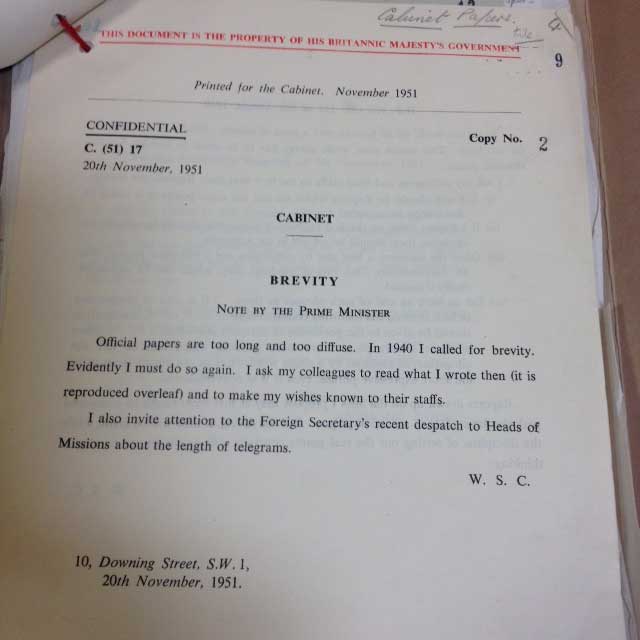
The message “cascaded through the civil service,” writes Laura Cowdry at the UK National Archives. A 1940 article in the Times picked up the story. But the problem persisted, as it does today and maybe will till the end of time (or until machines start to do all our writing for us). Frustrated, Churchill issued another admonition, shorter even than the first, in 1951.
Official papers are too long and too diffuse. In 1940 I called for brevity. Evidently I must do so again. I ask my colleagues to read what I wrote then… and to make my wishes known to their staffs.
These memos, Cowdry notes, “may shed some light onto government communications work of the past,” and on the Churchillian style that may have taken hold for decades in government documents, as well as—of course—far beyond them. His emphatic statements also articulate “key elements of good communication that would resonate with the thinking of any modern communicator,” whether Orwell, Kurt Vonnegut, or Cormac McCarthy, who has become a sought-after scientific editor for his strict minimalism.
Churchill did not seem overly concerned with wordiness as a political problem. Orwell did not approach the problem philosophically. That task fell to the Logical Positivists of the early 20th century. In his attempt to explain the wordiness of both undergraduates and world-renowned thinkers, “neo-Positivist” philosopher David Stove goes so far as to ascribe overwriting to “defects of character… such things as an inability to shut up; determination to be thought deep; hunger for power; fear, especially the fear of an indifferent universe….”
Something to consider, maybe, when you’re looking at your next draft email, Facebook comment, or Slack message, and wondering whether it actually needs to be an essay….
Related Comment:
George Orwell’s Six Rules for Writing Clear and Tight Prose
Kurt Vonnegut Explains “How to Write With Style”
Josh Jones is a writer and musician based in Durham, NC. Follow him at @jdmagness
Read More...Divine Decks: A Visual History of Tarot: The First Comprehensive Survey of Tarot Gets Published by Taschen
The cards of the tarot, first created for play around 600 years ago and used in recent centuries for occult divination of truths about life, the universe, and everything, should by all rights be nothing more than a historical curiosity today. Yet something about the tarot still compels, even to many of us in the ever more digital, ever more data-driven 21st century. Taschen, publisher of lavish art and photo books, know this: hence, as we featured last year here on Open Culture, products like their box-set reissue of the tarot deck designed by Salvador Dalí. (There must be a meaningful overlap between Taschen’s demographic and Dalí’s fans, given that the publisher more recently put out the most complete collection of his paintings between two covers.)
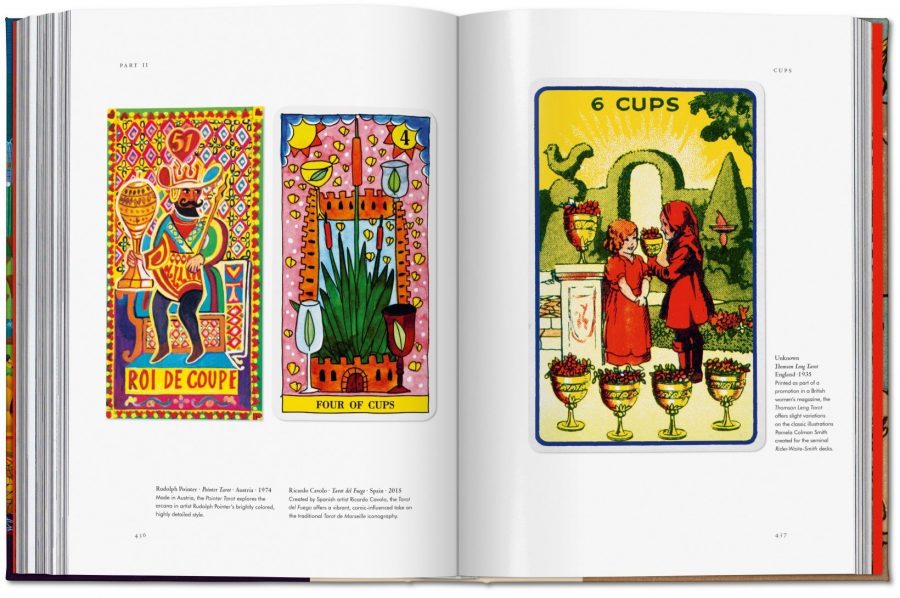
Dalí isn’t the only artist whose interpretations of the Fool, the Hierophant, the Lovers, the Hanged One, and the other arcana have graced a tarot deck. H.R. Giger, the artist responsible for the biomechanical creepiness of Alien, designed one in the 1990s; more recently, we’ve featured decks illustrated with visions inspired by the novels of Philip K. Dick and David Lynch’s Twin Peaks.
But all these together — even including the “Thoth deck” designed by occultist Aleister Crowley and the Sola-Busca deck, the earliest known complete set of tarot cards — represent only a small fraction of the story of tarot’s place in the past six centuries of civilization. That story is told, and more importantly shown, in Taschen’s new book Divine Decks: A Visual History of Tarot.
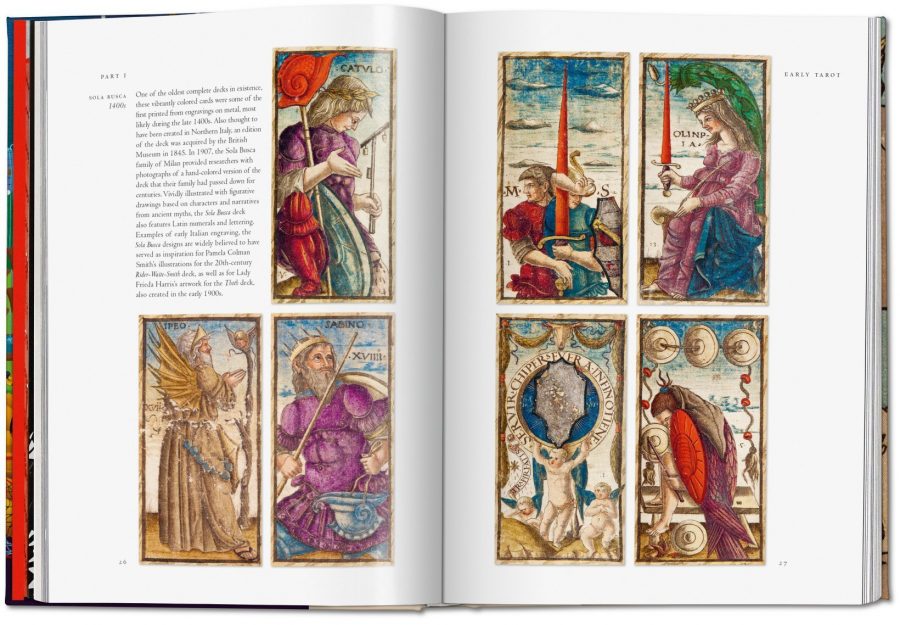
The first volume in Taschen’s “Library of Esoterica,” the book “gathers more than 500 cards and works of original art from around the world in the ultimate exploration of a centuries-old art form.” An image gallery on Taschen’s web site gives a small sampling of the range of tarot decks found within, including ones created in 1930s England, 1970s Italy, and 2010s Brooklyn. One was intended as a promotional item for an American paper company in the 1960s; another, with different purposes, announces itself as the “Black Power Tarot.” This in addition to such well-known examples as Crowley’s Thoth deck and the venerable Sola-Busca, both lushly reproduced in its pages. And the tarot lives on, as I’m reminded whenever I pass one of the many storefronts here in Seoul offering tarot readings. In any case, it’s certainly come a long way from 15th-century Europe. You can get a copy of Divine Decks: A Visual History of Tarot on Taschen’s website.
Related Content:
Behold the Sola-Busca Tarot Deck, the Earliest Complete Set of Tarot Cards (1490)
The Tarot Card Deck Designed by Salvador Dalí
The Thoth Tarot Deck Designed by Famed Occultist Aleister Crowley
Twin Peaks Tarot Cards Now Available as 78-Card Deck
Philip K. Dick Tarot Cards: A Tarot Deck Modeled After the Visionary Sci-Fi Writer’s Inner World
Based in Seoul, Colin Marshall writes and broadcasts on cities, language, and culture. His projects include the book The Stateless City: a Walk through 21st-Century Los Angeles and the video series The City in Cinema. Follow him on Twitter at @colinmarshall, on Facebook, or on Instagram.
Read More...View 250,000 British Paintings & Sculptures Free Online

A little over four years ago, discriminatory and arbitrarily confusing travel bans descended on the U.S., tearing refugee families apart and leaving thousands in diplomatic limbo. This seemed nightmarish enough at the time. But it took a viral pandemic to bring travel bans and restrictions down on the entire world, more or less, with countries appearing on bulletins that vaguely look like lists of enemies on governing bodies’ websites, including the CDC’s.
Likewise, almost all 27 countries that comprise the European Union are currently disallowing U.S. travelers, with the exception of Croatia,” Mary Claire Patton reports. The UK has also kept its ban on U.S. citizens in place. All this is to say, to fellow citizens and residents of any gender, that the days of traipsing around the world for Instagram impressions, or saving and scraping for that vacation honeymoon, or making even more important journeys, may be on hold indefinitely.

Fortunately, art galleries worldwide have been preparing their collections for independent lives online, with ultra-high-resolution photography; materials that rarely appear on view in any form; and more context than visitors typically get on a guided tour.
Would-be visitors keen on public art collections will find their niche online at Art UK, a charity project that is digitizing “more than 150,000 publicly owned sculptures in Great Britain by the end of 2020,” writes Mental Floss, including many sculptures living their lives out in public spaces.

Art UK seem to be lagging a bit behind on the sculpture posts, and they are light on the context, but a few big things have happened since they made the announcement in February 2019. In any case, you will not have to travel to a Nando’s eatery in Harlow to see Rodin’s Eve, originally created for his Gates of Hell in Paris. (Not that one wouldn’t want to go to Harlow, which “also displays works by acclaimed artists such as Henry Moore, Elisabeth Frink, Barbara Hepworth and Lynn Chadwick,” Mark Brown points out at The Guardian.)

The over twenty-five thousand public UK sculptures documented in the database so far are already impressive enough. Oh, and did we mention that the foundation had already previously digitized over two-hundred thousand oil paintings between 2003 and 2012? These are also all paintings owned by the UK public “from over 3,000 locations,” Katey Goodwin writes for Art UK. “This is the only project of its kind in the world to create a complete online catalogue of every oil painting in a national collection.”
These include the requisite doting and revealing portraits of lords, ladies, merchants, worthies, and bureaucrats. They also include brilliant oil paintings like David Hepher’s Night Flats, whose title and faraway lonesomeness evoke Edward Hopper. Furthermore, not all portraits of British worthies fit the stereotype, as Colin Colahan’s 1933 arresting likeness of English actress Marie Ney demonstrates.

You can read more about the process of bringing this work online in Goodwin’s essay, which also lists the national organizations and museums from which the collection draws. These are “located throughout England, Scotland, Wales and Northern Ireland, and the crown dependencies of the Isle of Man and the Channel Islands.” Visit Art UK themselves here to see their photographic archive of publicly-owned painting, sculpture, and other visual media in the UK—now publicly available online around the world to people indefinitely banned from visiting the art in person.
For a wealth of other free art, visit this page on our site: Visit 2+ Million Free Works of Art from 20 World-Class Museums Free Online.
Related Content:
Download 569 Free Art Books from The Metropolitan Museum of Art
The Tate Digitizes 70,000 Works of Art: Photos, Sketchbooks, Letters & More
The British Museum Puts 1.9 Million Works of Art Online
Josh Jones is a writer and musician based in Durham, NC. Follow him at @jdmagness
Read More...Get the Ancient Roman Look: A Hair & Makeup Video Tutorial
Remember early April, when we threw ourselves into the Getty Challenge, turning ourselves into historic art recreations in lieu of climbing the walls?
Seems like ages ago, doesn’t it, that you wrapped a shower curtain around your head and rifled through the button box, rabid to make yourself into a masterpiece.
While it’s not accurate to say we’ve collectively settled into a new normal, many of us have accepted that certain alterations to our everyday lives will be prolonged if our everyday lives are to proceed.
First it was depressing.
Now it’s just boring (with the occasional thrum of anxiety).
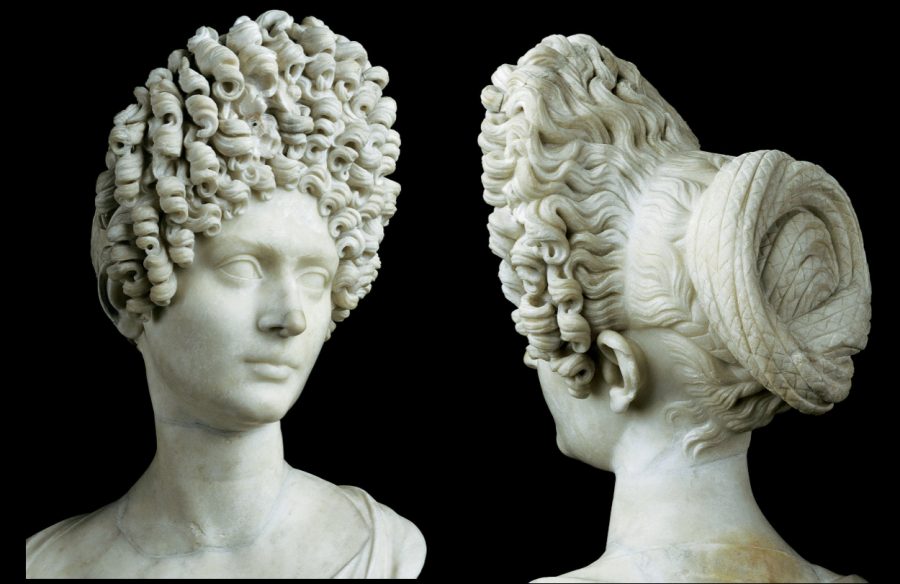
Perhaps it’s time to shake things up a bit, and Crows Eye Productions’ tutorial on achieving an Ancient Roman look using modern hair and beauty products, above, is an excellent place to start.
While Crows Eye specializes in building historically accurate period dress from the unmentionable out, it’s worth noting that stylist Liv Free takes a few liberties, adding a bit of mascara and lipstick despite a dearth of evidence that Roman women enhanced their lips or lashes.
She also uses curling irons, ponytail holders, and a hair donut to create a crown of ringlets and braids.
If you’re a stickler for authenticity who won’t be able to live with yourself if you’re not sewn into your hair style with a bone needle, you may be better off consulting the YouTube channel of hair archeologist Janet Stephens.
But, if your goal is merely to wow your co-workers with a full-on Flavian Dynasty look during your next Zoom call, by all means grab some pale lead-free foundation, some expendable Hot Buns, and some light blush.
Don’t worry that you’ll appear too done up. Free notes that Roman women of both high and low birth were devoted to makeup, but in deference to their men, limited themselves to the natural look.
That’s a tad anachronistic, huh?
These days, anyone who wants to remake themselves in the image of Empress Domitia Longina should feel free to take a crack at it, irrespective of gender, race, or extra hands to help with the parts of the hairstyle you can can’t see in the mirror (or a Zoom window).
Once we have mastered our new look, we can see about another museum challenge. Here’s some inspiration to get us started.
Related Content:
How a Baltimore Hairdresser Became a World-Renowned “Hair Archaeologist” of Ancient Rome
Roman Statues Weren’t White; They Were Once Painted in Vivid, Bright Colors
How to Bake Ancient Roman Bread Dating Back to 79 AD: A Video Primer
Ayun Halliday is an author, illustrator, theater maker and Chief Primatologist of the East Village Inky zine. Follow her @AyunHalliday.
Read More...Roald Dahl Gives a Tour of the Small Backyard Hut Where He Wrote All of His Beloved Children’s Books
Charlie and the Chocolate Factory, The BFG, The Witches, Matilda: Roald Dahl wrote these and all his other beloved children’s books in a hut. Just fifteen feet long and ten feet wide, it served him for 35 years as an office in which no meetings were held and no calls taken. For four hours a day, broken into two-hour morning and afternoon sessions, it was just Dahl in there — Dahl and his paper, his pencils, his sharpener, his coffee, his cigarettes, his increasingly eccentric collection of artifacts from his own life, and here and there the occasional spider web and goat dropping. It was all part of an effort, explains Dahl’s biographer Jeremy Treglown, “not only to recreate his own early childhood but to improve on it.”
“As a boy in the 1920s,” Treglown writes, “Roald used to hide up in a tree in order to write his diary.” But the hut, constructed right behind his Buckinghamshire home, “was a more substantial place to work, where he could commemorate, and fantasize about, his past.”
On his side were items like “his father’s silver and tortoiseshell paper knife,” a “tablet fragment with a cuneiform inscription found in Babylon” — a souvenir from his time in the King’s African Rifles — and, “saved from operations,” pieces of his own femur and spine. In his hut, Dahl wrote “surrounded by these fetishes, snugly wrapped in a sleeping bag, sitting in an old armchair, his feet on a trunk which was filled with blocks and tied to a leg of the chair, to prevent it from slipping.”
“I couldn’t possibly work in the house, especially when there used to be a lot of children around,” says Dahl in the 1982 clip at the top of the post as he approaches his hut. “Even when there aren’t children, there are vacuum cleaners and people bustling about.” He then goes in to demonstrate his writing routine, which involves the pouring of coffee, sharpening of precisely six pencils “to a fierce point” (a step that had its own procrastination value), the brushing away of the previous day’s eraser dust (onto the floor, where it has remained ever since), and the situation with the armchair and sleeping bag. “Finally you get settled, you get into a sort of nest, you get really comfortable,” Dahl says. “And then you’re away.”
The footage also includes views of Dahl’s much more traditionally well-appointed main house, including its billiards table around which he and his local friends would gather for a twice-weekly session. The game had its influence on Dahl’s writing life, and indeed his writing hut. Among his “snooker pals” was builder Wally Saunders, whom Dahl hired to put it up in the first place (and whose formidable stature and ear size would, nearly thirty later, inspire the title character of The BFG). As he explains on the British Children’s program Going Live, he even covered his handmade wooden writing surfaces, which he placed across the armrests of his chair, with green baize, a material he found easy on the eyes.
When Dahl died in 1990, his writing hut went untouched for two decades. But eventually, as explained in this ITV News clip, the simple building couldn’t withstand further exposure to the elements. So began the project to move the interior of the hut, eraser dust and all, to the Roald Dahl Museum and Story Centre in Buckinghamshire. Luckily for Wes Anderson, this happened after he came to Dahl’s home to seek permission to adapt The Fantastic Mr. Fox from the writer’s widow Felicity. So compelling did she find Anderson’s vision that she even allowed him into the “hallowed writing hut,” the ideal space in which to commune with Dahl’s spirit. The hut may now no longer be whole, but that same spirit continues to course through the imaginations of generation after generation of young readers.
Related Content:
The Recipes of Iconic Authors: Jane Austen, Sylvia Plath, Roald Dahl, the Marquis de Sade & More
The Daily Habits of Famous Writers: Franz Kafka, Haruki Murakami, Stephen King & More
Based in Seoul, Colin Marshall writes and broadcasts on cities, language, and culture. His projects include the book The Stateless City: a Walk through 21st-Century Los Angeles and the video series The City in Cinema. Follow him on Twitter at @colinmarshall, on Facebook, or on Instagram.
Read More...A Physicist Examines the Scientific Accuracy of Physics Shown in Major Movies: Batman, Gravity, Contact, Interstellar, Star Trek & More
Ever had a friend who cannot bring themselves suspend disbelief? It’s not a moral failing, but it can be a tedious quality in situations like, say, the movies, or the cinema, or whatever you call it when you’ve paid your day’s wages for a giant tub of carcinogenic popcorn and a three-hour distraction. (These days, maybe, an overpriced streaming new release and Grubhub.) Who doesn’t love a big-screen science fiction epic—science be damned? Who wants to listen to the seatmate who mutters “oh, come on!,” “no way!,” “well, actually, that’s scientifically impossible”? You know they never passed intro to physics….
Dominic Walliman, on the other hand, is a physicist. And he is not the kind of person to ruin a movie by going on about how goofy its scientific ideas sound, though he’s likely to express appreciation for films that get it right. He doesn’t get bent out of shape by artistic license and can appreciate, for example, the creative use of visual effects in Interstellar to represent a black hole, which would otherwise appear onscreen as, well, a black hole. “I’m okay with bad physics in movies,” he says, “because the job of a movie isn’t to be a science documentary, the goal of a movie is to tell an interesting story.”
Even so, if you sit him down and ask him to talk specifically about science in movies, as a friend does in the video above, he’ll tell you what he thinks, and you’ll want to listen to him (after the movie’s over) because he actually knows what he’s talking about. Over the years, Walliman has mapped various domains of science, like chemistry, computer science, biology, mathematics, physics, and his own field, quantum physics. His visual explanations make the relationships between difficult concepts clear and easy to follow. In this video, he comments on some of your favorite science fiction and fantasy films (standouts include the first Batman and Ron Howard’s Angels & Demons) in ways that are equally illuminating.
Big winners for relative accuracy, in Walliman’s opinion, are no surprise. They include Gravity, Contact (written by Carl Sagan), even a clip from the incredibly smart Futurama. It is soon apparent that the use of a folded piece of paper to represent spacetime through a wormhole has “become a bit of a cliché,” although a helpful-enough visual aid. Kubrick’s 2001: A Space Odyssey is “boring” (with apologies), a judgment that might disqualify Walliman as a film critic, in many people’s opinion, but does not tarnish his scientific reputation.
One of the biggest science-in-film fails: 2009’s Star Trek, whose villains have discovered a substance called “red matter.” A single drop can destroy an entire planet, and the idiots seem to have enough onboard their ship to take out the universe with one careless oopsie. Walliman is maybe not qualified to weigh in on the paleobiology of Jurassic Park, but Jeff Goldblum’s explanation of chaos theory fits within his purview. “So, this is not a good description of chaos theory,” he says, “at all.” It is, however, a fabulous plot device.
If you’re interested in more engagingly accessible, non-cinema-related, surveys of scientific ideas, visit any one of Walliman’s many Domain of Science videos here.
Related Content:
Mathematics in Movies: Harvard Prof Curates 150+ Scenes
Arthur C. Clarke Creates a List of His 12 Favorite Science-Fiction Movies (1984)
Josh Jones is a writer and musician based in Durham, NC. Follow him at @jdmagness
Read More...Seriously Awesome Ukulele Covers of “Sultans of Swing,” “Sweet Child O’ Mine,” “Thunderstruck,” and “Smells Like Teen Spirit”
The ukulele has gotten a bad rap, thanks to some well-meaning musicians who turned the small, guitar-like Hawaiian lute into a novelty instrument. Chief among the offenders is Tiny Tim. Exploding into fame in the early sixties with his ukulele version of the ‘20s ditty “Tiptoe Thru’ the Tulips,” he became so famous, wrote Roger Ebert, “The Beatles asked him to sing ‘Nowhere Man’ on a bootleg Christmas recording. He did a night at Royal Albert Hall.” His marriage to Vicki Budinger on Johnny Carson’s Tonight Show is “still one of the top-rated TV shows of all time.”
Tiny Tim played the guileless manchild, the Pee Wee Herman of his day. He was not a serious spokesperson for the instrument he popularized. He died in 1996, doing what he loved, playing his hit to a Women’s Club in Minneapolis. “The last thing he heard was the applause,” his widow said.
Tiny Tim had a good run, but it may not be mere coincidence that since he tiptoed thru’ his last tulip, the ukulele has seen a major pop culture revival, from indie folk singer/songwriters to TV theme songs, an orchestra, and Jake Shimabukuro, “a genre-demolishing artist,” writes NPR, “who plays jazz, blues, funk, classical, bluegrass, flamenco and rock” on his four-string axe.
Joining the ranks of serious ukulele artists are Overdriver Duo, who interpret songs with some very challenging guitar riffs and solos, like Guns ‘n’ Roses’ “Sweet Child O’ Mine,” Dire Straits’ “Sultans of Swing,” and AC/DC’s “Thunderstruck.” One thing these songs all have in common is their melodies in the upper register, where the ukulele, and their vocals, really shine. Nirvana’s “Smells Like Teen Spirit,” on the other hand, depends on power chords and pounding drums for its impact. Leave it to these accomplished players to turn their tiny-bodied instruments into a convincing alt-rock rhythm section.
Contemporary players have more than earned the ukulele the respect it deserves. That’s not to say ukulele lovers of the past, like devoted life-long player George Harrison, did not appreciate the instrument. Harrison played a mean jazz uke, and took it seriously. But even he declared “you can’t play and not laugh!” Players like Shimabukuro and Overdriver Duo tend to inspire more awe than comedy.
Related Content:
Jimi Hendrix’s “Voodoo Child” Shredded on the Ukulele
George Harrison Explains Why Everyone Should Play the Ukulele
Josh Jones is a writer and musician based in Durham, NC. Follow him at @jdmagness
Read More...Support Us
We're hoping to rely on loyal readers, rather than erratic ads. Please click the Donate button and support Open Culture. You can use Paypal, Venmo, Patreon, even Crypto! We thank you!

About Us

Open Culture scours the web for the best educational media. We find the free courses and audio books you need, the language lessons & educational videos you want, and plenty of enlightenment in between.
Advertise With Us

FREE UPDATES!
GET OUR DAILY EMAIL
Get the best cultural and educational resources on the web curated for you in a daily email. We never spam. Unsubscribe at any time.
FOLLOW ON SOCIAL MEDIA

Open Culture editor Dan Colman scours the web for the best educational media. He finds the free courses and audio books you need, the language lessons & movies you want, and plenty of enlightenment in between.
Advertise With Us


