After MLK’s Assassination, a Schoolteacher Conducted a Famous Experiment–“Blue Eyes/Brown Eyes”–to Teach Kids About Discrimination
Getting history across to young students is challenging enough, but what should a teacher do when actual history-making events happen on their watch? They have to be acknowledged, but to what extent do they have to be explained, even “taught”? Of the teachers who have turned history-in-the-making into a lesson, perhaps the most famous is Jane Elliott of Riceville, Iowa. On April 5, 1968, the day after Martin Luther King Jr.‘s assassination, she divided her classroom of third-graders along color lines: blue-eyed and brown-eyed. On the first day she granted the brown-eyed students such special privileges as desks in the front rows, second helpings at lunch, and five extra minutes of recess. The next day she reversed the situation, and the blue-eyed kids had the perks.
What brought serious attention to Elliott’s small-town classroom experiment was the resulting article in the Riceville Recorder, which reported some of what her students wrote in their assignments responding to the experience. The Associated Press picked up the article and soon Elliott received a call from The Tonight Show inviting her to come chat with Johnny Carson about her “Blue Eyes/Brown Eyes” exercise on national television.
“I didn’t know how this exercise would work,” Elliott tells Jimmy Fallon on the clip from the current Tonight Show at the top of the post. “If I had known how it would work, I probably wouldn’t have done it. If I had known that, after I did that exercise, I lost all my friends, no teacher would speak to me where they could be seen speaking to me, because it wasn’t good politics to be seen talking to the town’s only ‘N‑word lover.’ ”
Elliott’s family also experienced severe blowback from her sudden fame, but it didn’t stop her from furthering the clearly resonant idea she had devised. She continued to perform Blue Eyes/Brown Eyes in class: the third time, it was filmed and became the 1970 television documentary The Eye of the Storm. (Some of the language used by her students surely wouldn’t make it to the air today.) Fifteen years later, PBS’ Frontline reunited Elliott’s third-grade class of 1970 for its Emmy Award-winning episode A Class Divided, and a decade thereafter German filmmaker Bertram Verhaag would again film Elliott performing her signature exercise for the documentary Blue Eyed. In a variety of settings across America and the world, Elliott continues, in her late eighties, to make her point. It isn’t always well received, as she reveals in this Frontline follow-up interview, and at times has even drawn threats of violence. “I can be scared, but I won’t be scared to death,” she says. “Or, at my age, of death.”
via Boing Boing
Related Content:
How Martin Luther King, Jr. Used Nietzsche, Hegel & Kant to Overturn Segregation in America
Based in Seoul, Colin Marshall writes and broadcasts on cities, language, and culture. His projects include the book The Stateless City: a Walk through 21st-Century Los Angeles and the video series The City in Cinema. Follow him on Twitter at @colinmarshall, on Facebook, or on Instagram.
Read More...Revisiting The Wire During 2020’s Black Lives Matter Movement
George Floyd’s murder while under arrest for allegedly passing a counterfeit bill of small denomination sparked massive worldwide demonstrations against police brutality and in support of Black Lives Matter.
It also led to the abrupt cancellation of television’s recent hit, Live PD, and its longest-running reality show, Cops.
As Amanda Hess recently observed in The New York Times, public opinion has turned on any show that promotes an image of police officers as universally decent forces for good, “lovable goofballs,” or anti-heroes whose rough edges make a play for viewers’ allegiance by suggesting the characters are realistically flawed and thus, relatable:
The “good cop” trope is a standard of both police procedurals and real-life police tactics, and now crowdsourced video of the protests has given cops a new stage for performing the role. In recent days, supposedly uplifting images of the police have spread wildly across the internet, competing for views with evidence of cops beating, gassing and arresting protesters. In Houston, an officer consoled a young black girl at a rally: “We’re here to protect you, OK?” he told her, enveloping her in a hug. “You can protest, you can party, you can do whatever you want. Just don’t break nothing.” In Nashville, the police tweeted a photo of cops kneeling next to a black boy with a “Black Lives Matter” sign, smiling from behind their riot helmets. And in Atlanta, a line of National Guard soldiers did the Macarena. On the final rump shake, a black rifle slung over one soldier’s back swung to the beat.
These images show cops engaging in a kind of pantomime of protest, mimicking the gestures of the demonstrators until their messages are diluted beyond recognition. They reframe protests against racist police violence into a bland, nonspecific goal of solidarity. These moments are meant to represent the shared humanity between officers and protesters, but cops already rank among the most humanized groups in America; the same cannot be said for the black Americans who live in fear of them. Cops can dance, they can hug, they can kneel on the ground, but their individual acts of kindness can no longer obscure the violence of a system. The good-cop act is wearing thin.
According to Hollywood Reporter critic Inkoo Kang, almost any portrayal of cops on TV right now rankles, even one that was lauded for its realistic portrayal of corruption and abuse on the force, HBO’s critically acclaimed The Wire—Barack Obama’s avowed favorite.
In the first season of The Wire, just about every on-the-ground cop participates in police brutality — often as a kind of professional prerogative. Their violence is meant to add darker streaks to the characters’ otherwise heroic gloss, but it also has the effect of normalizing police brutality as a part, even a perk, of the job.
Her comments touched a nerve with actor Wendell Pierce, whose character was based on a Baltimore homicide detective, Oscar Requer, who achieved his position at a time when black officers routinely faced racial harassment from within the force. Pierce published his response on Twitter:
How can anyone watch “The Wire” and the dysfunction of the police & the war on drugs and say that we were depicted as heroic. We demonstrated moral ambiguities and the pathology that leads to the abuses. Maybe you were reacting to how good people can be corrupted to do bad things.
If The Wire did anything right, it depicted the humanity of the Black lives so easily profiled by police and the destruction of them by the so-called war on drugs; a deliberate policy of mass incarceration to sustain a wealth disparity in America that thrives keeping an underclass.
The Wire, if anything, was the canary-in-the-mine that forecasts the institutional moral morass of politics and policing that lead us to the protests of today. “The bigger the lie, the more they believe” was a line of mine that is so salient and profound in today’s climate.
“The Wire” is a deep dive study of the contributing variables that feed the violence in our culture: in the streets and at the hand of police. Classism, racism, destruction of public education, and moral ambiguity in our leadership all feed this paradigm of American decline.
I know I sound defensive and I probably am, The Wire is personal for me. The Wire is also Art. The role of Art is to ignite the public discourse. Art is where we come together as a community to confront who we are as a society, decide what our values are, and then act on them.
The critique here is that television seems to follow behind the current events of the day. I would ask that you consider that maybe The Wire was a precursor to the discussion that is mandatory now. It was an indicator, a warning light, of the implosion we are feeling today.
At a time when the world is called upon to listen carefully to what black people are saying, and much of the world has shown themselves ready to do so, Pierce’s words carry extra weight.
His assertion that the show, which ran from 2002 to 2008, accurately depicted a system so rotten that collapse was inevitable, is echoed in interview clips with creator and one-time police reporter, David Simon, above.
The video essay was put together by aspirant screenwriter Nehemiah T. Jordan whose Behind the Curtain series aims to provide insights on how celebrated scripts for both the big and small screens—Fight Club, Uncut Gems, The Sopranos, Breaking Bad—come by their aesthetic quality.
Simon’s ambition for The Wire was that it truthfully convey what he had observed as a reporter, as well as the lives of the people he interacted with—both Baltimore cops and those they mostly failed to serve.
In a 2015 White House conversation with then-President Obama, Simon remarks that an emphasis on drug-related offenses led to an epidemic of presumptive police work, and a decline in “competent retroactive investigation of felonies.” A disproportionate number of young black and Latino men were incarcerated during this time, and upon their release, their felony histories meant that few of them were able to secure meaningful employment. America’s problems were compounded.
Whether or not you are moved to watch, or rewatch The Wire, we heartily recommend Where We Go from Here, a recent New York Daily News op-ed by actor Michael K. Williams, who played fan favorite Omar Little, and whose real life counterpart Simon discusses with Omar-fan Obama.
New York native Williams, who has worked to end mass juvenile incarceration, foment collaboration between police and at-risk youth and serves as an ambassador for The Innocent Project, possesses a deep understanding of the New York Police Department’s structure, chain of command, and day to day workings. Stating that tangible action is needed to “shift police culture” and “transform the relationships between law enforcement and communities of color,” he makes a case for six concrete reforms:
- Overhaul CompStat, the NYPD’s crime tracking mechanism.
- Eliminate plainclothes units.
- Create an independent body to investigate “use of force” incidents at the time they occur.
- Reimagine the duties of civilians within the department tasked with community-building.
- Implement ongoing trauma-centered training, education and activities for officers, executives and the communities they serve.
- Make racial justice a core component of NYPD training and education.
Read Michael K. William’s Op-Ed here.
Related Content:
The Wire as Great Victorian Novel
Ayun Halliday is an author, illustrator, theater maker and Chief Primatologist of the East Village Inky zine. Follow her @AyunHalliday.
Read More...Tom Morello Responds to Angry Fans Who Suddenly Realize That Rage Against the Machine’s Music Is Political: “What Music of Mine DIDN’T Contain Political BS?”
“I, Dancing Bear,” a song by an obscure folk artist who goes by the name Birdengine, begins thus:
There are some things that I just do not care to know
It’s a lovely little tune, if maudlin and macabre are your thing, a song one might almost call anti-political. It is the art of solipsism, denial, an inwardness that dances over the abyss of pure self, navel gazing for its own sake. It is Kafka-esque, pathetic, and hysterical. I love it.
My appreciation for this weird, outsider New Romanticism does not entail a belief that art and culture should be “apolitical,” whatever that is.
Or that artists, writers, musicians, actors, athletes, or whomever should shut up about politics and stick to what they do best, talk about themselves.
The idea that artists should avoid politics seems so pervasive that fans of some of the most blatantly political, radical artists have never noticed the politics, because, I guess, they just couldn’t be there.
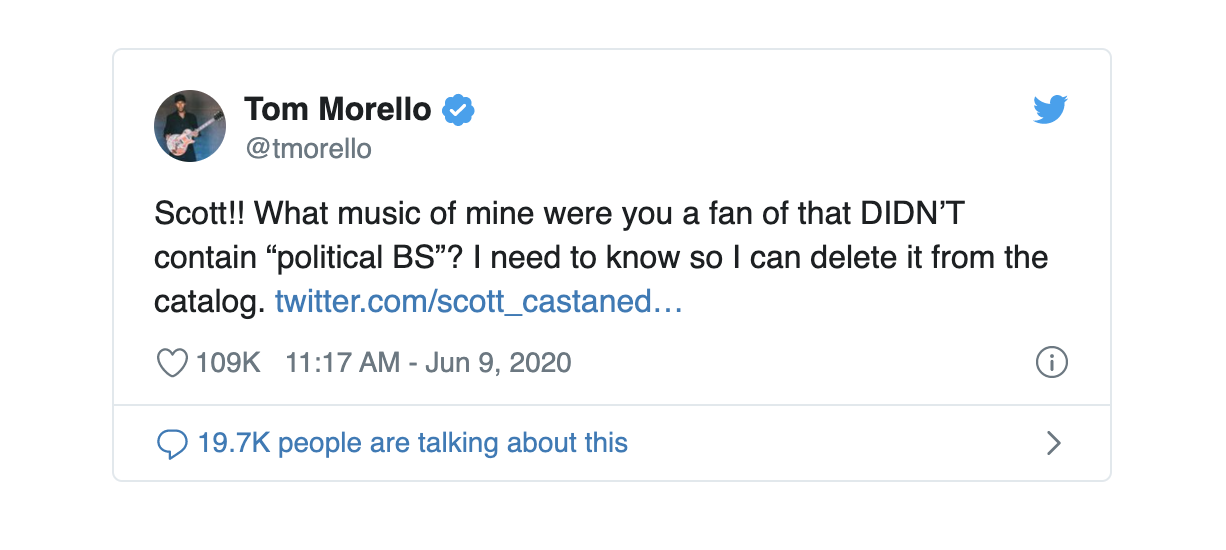
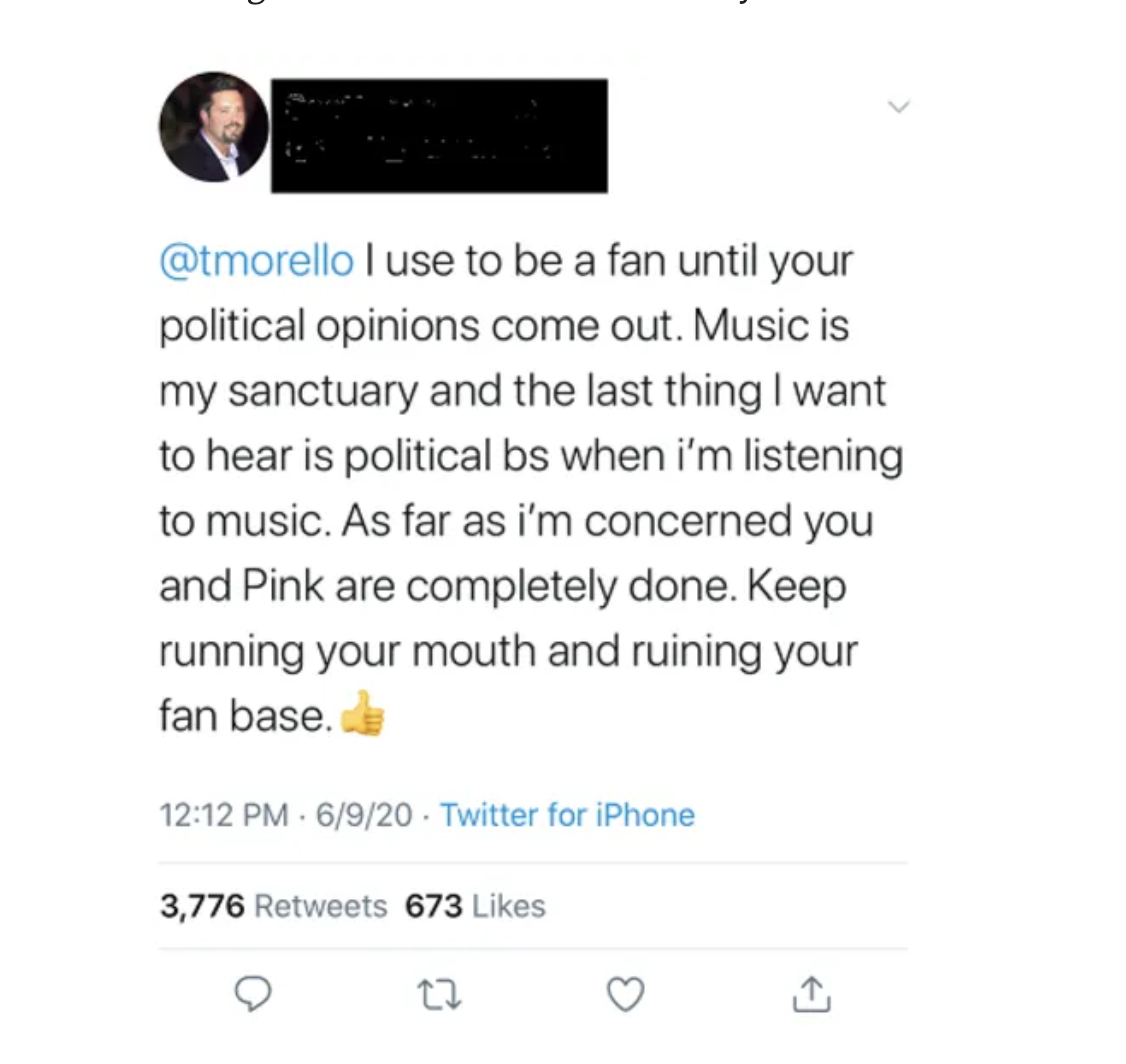
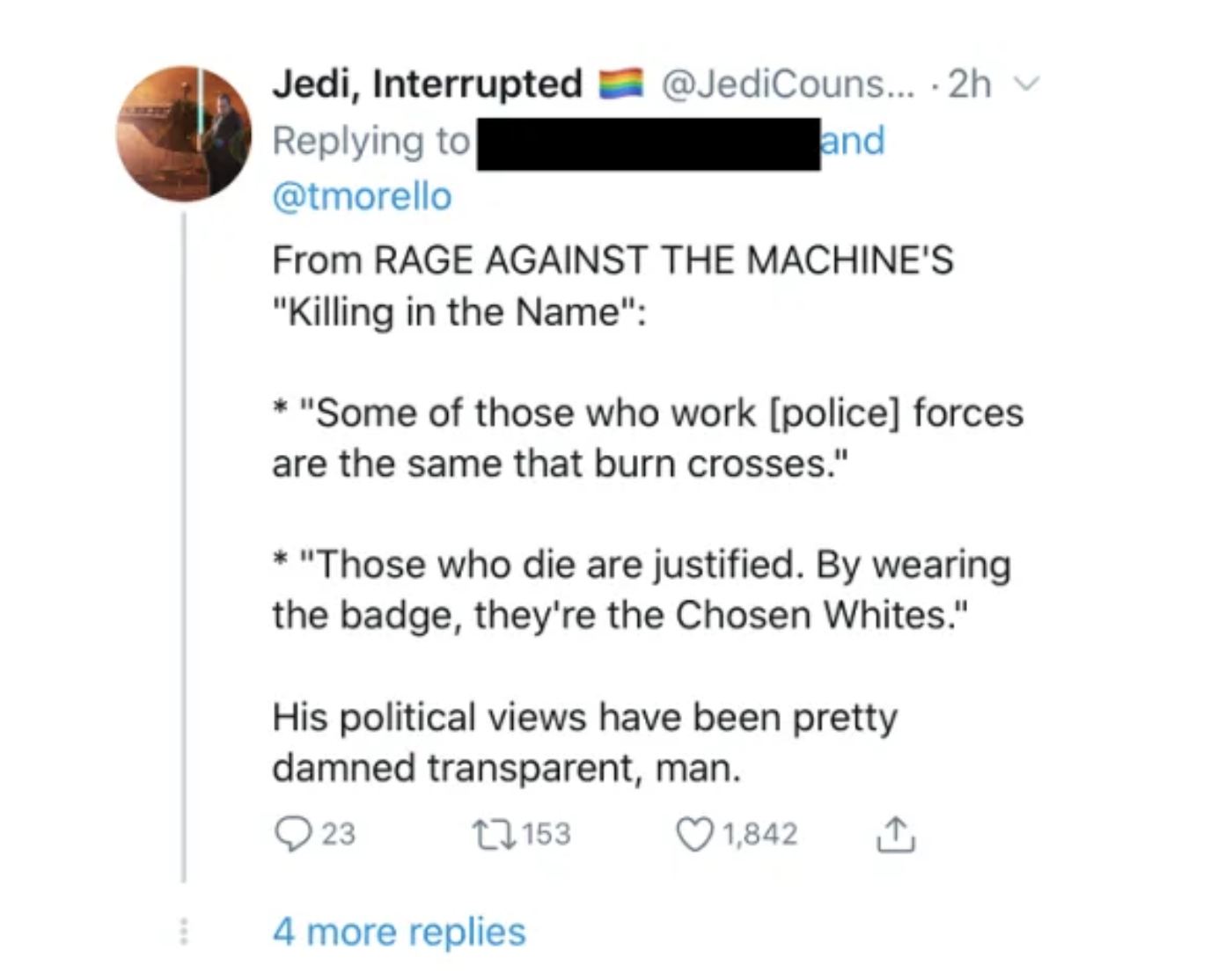
One such fan just got dunked on, as they say, a whole bunch on Twitter when he raged against Tom Morello for the “political bs.”
That’s Tom Morello of Rage Against the Machine, whose debut 1992 album informed us that the police and the Klan work hand in hand, and that cops are the “chosen whites” for state-sanctioned murder. That Rage Against the Machine, who raged against the same Machine on every album: “Bam, here’s the plan; Motherfuck Uncle Sam.”
The poor sod was burned so badly he deleted his account, but the laughs at his expense kept coming. Even Morello responded.
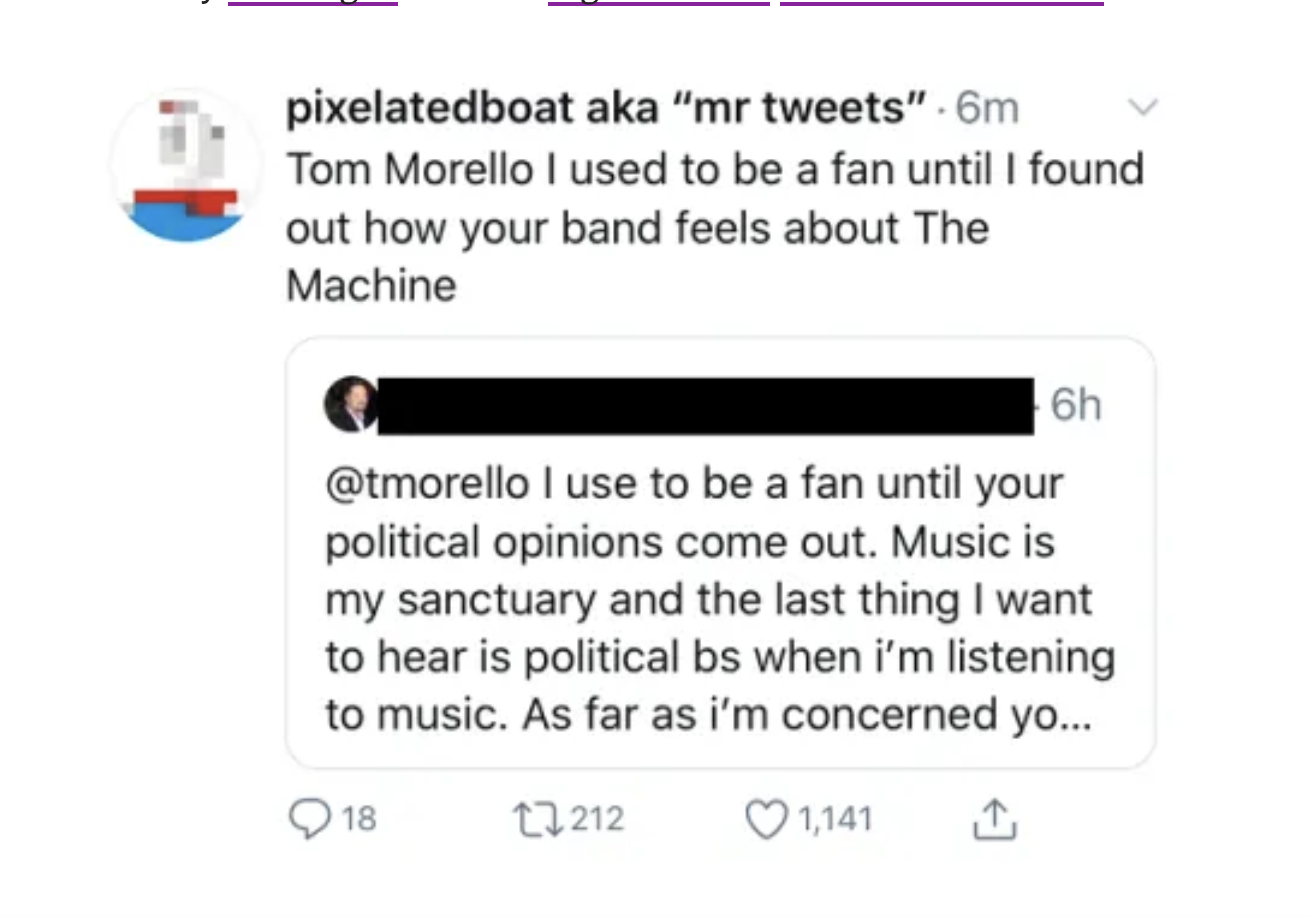
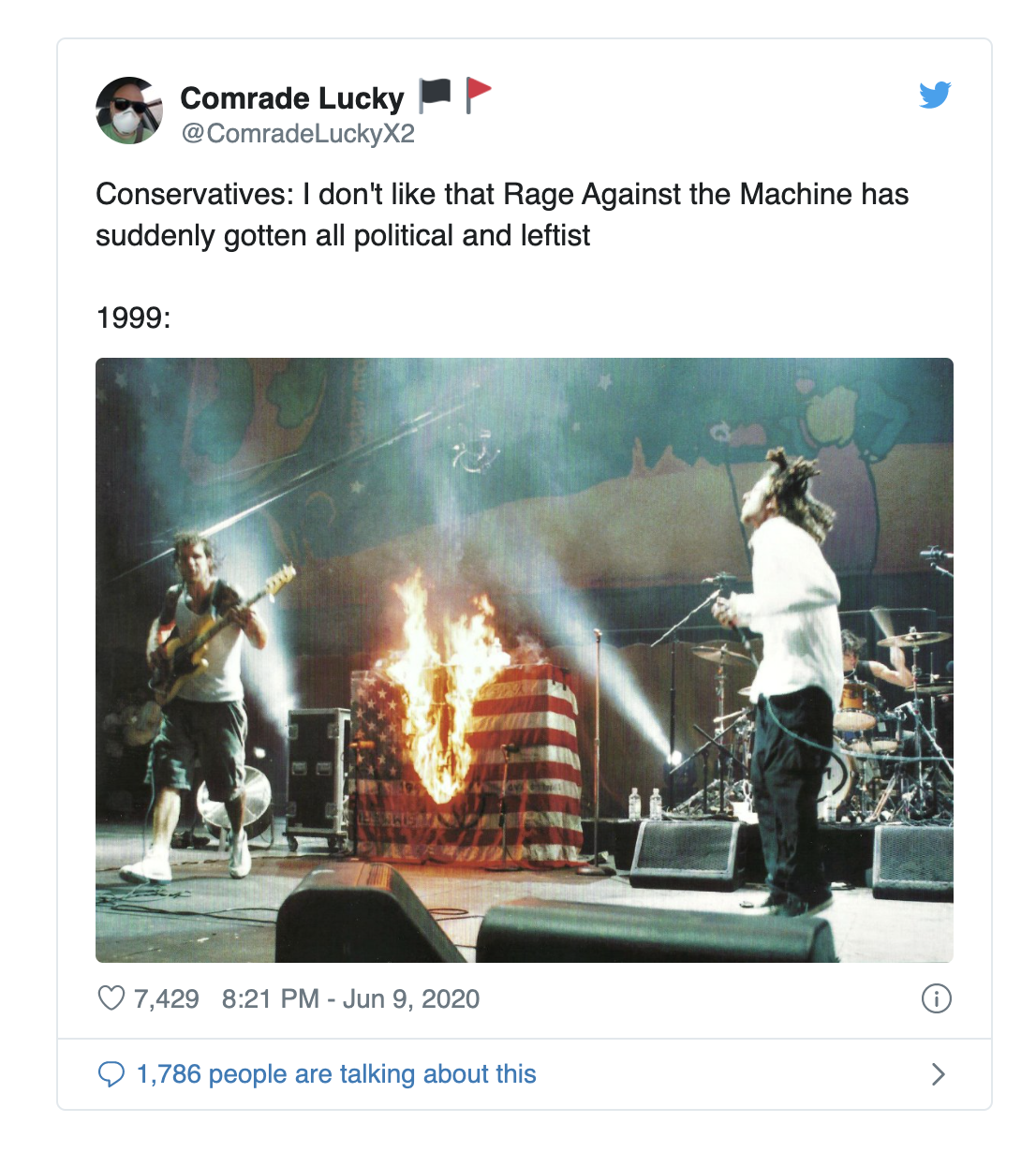
Why? Because the disgruntled former fan is not just one lone crank who didn’t get it. Many people over the years have expressed outrage at finding out there’s so much politics in their culture, even in a band like Rage that could not have been less subtle. Many, like former lever-puller of the Machine, Paul Ryan, seem to have cynically missed the point and turned them into workout music. Morello’s had to point this out a lot. (Ditto Springsteen.)
This uncritical consumption of culture without a thought about icky political issues is maybe one reason we have a separate political class, paid handsomely to do the dirty work while the rest of us go shopping. It’s a recipe for mass ignorance and fascism.
You might think me crazy if I told you that the CIA is partly responsible for our expectation that art and culture should be apolitical. The Agency did, after all, follow the lead of the New Critics, who excluded all outside political and social considerations from art (so they said).
Influential literary editors and writing program directors on the Agency payroll made sure to fall in line, promoting a certain kind of writing that focused on the individual and elevated psychological conflict over social concerns. This influence, writes The Chronicle of Higher Education, “flattened literature” and set the boundaries for what was culturally acceptable. (Still, CIA-funded journals like The Paris Review published dozens of “political” writers like Richard Wright, Gabriel Garcia Marquez, and James Baldwin.)
Then there’s the whole business of Hollywood film as a source of Pentagon-funded propaganda, sold as innocuous, apolitical entertainment….
When it comes to journalism, an ideal of objectivity, like Emerson’s innocent, disembodied transparent eye, became a standard only in the 20th century, ostensibly to weed out political bias. But that ideal serves the interests of power more often than not. If media represents existing power relationships without questioning their legitimacy, it can claim objectivity and balance; if it challenges power, it becomes too “political.”
The adjective is weaponized against art and culture that makes certain people who have power uncomfortable. Saying “I don’t like political bs in my culture” is saying “I don’t care to know the politics are there.”
If, after decades of pumping “Killing in the Name,” you finally noticed them, then all that’s happened is you’ve finally noticed. Culture has always included the political, whether those politics are shaped by monarchs or state agencies or shouted in rap metal songs (just ask Ice‑T) and fought over on Twitter. Maybe now it’s just getting harder to look away.
Related Content:
The Politics & Philosophy of the Bauhaus Design Movement: A Short Introduction
Love the Art, Hate the Artist: How to Approach the Art of Disgraced Artists
Josh Jones is a writer and musician based in Durham, NC. Follow him at @jdmagness
Read More...Why James Baldwin’s Writing Stays Powerful: An Artfully Animated Introduction to the Author of Notes of a Native Son
Every writer hopes to be survived by his work. In the case of James Baldwin, the 32 years since his death seem only to have increased the relevance of the writing he left behind. Consisting of novels, essays, and even a children’s book, Baldwin’s body of work offers different points of entry to different readers. Many begin with with Go Tell it on the Mountain, the semi-autobiographical debut novel in which he mounts a critique of the Pentecostal Church. Others may find their gateway in Baldwin’s fictional treatment of desire and love under adverse circumstances: among men in Paris in Giovanni’s Room, for example, or teenagers in Memphis in If Beale Street Could Talk. But unlike most novelists, Baldwin’s name continues to draw just as many accolades — if not more of them — for his nonfiction.
Those looking to read Baldwin’s essays would do well to start with his first collection of them, 1955’s Notes of a Native Son. In assembling pieces he originally published in magazines like Harper’s and the Partisan Review, the book reflects the importance to the young Baldwin of what would become the major themes of his career, like race and expatriate life.
Though resident at different times in Turkey, Switzerland, and (right up until his dying day) France, he never took his eyes off his homeland of the United States of America for long. Nor, in fact, did the United States of America take its eyes off him. “Over the course of the 1960s,” says Fordham University political science professor Christina Greer in the animated TED-Ed introduction to Baldwin above, “the FBI amassed almost 2,000 documents” as they investigated his background and activities.
That the U.S. government saw Baldwin as so politically dangerous is reason enough to read his books. But as one of America’s most prominent men of letters, he could hardly be written off as a simple firebrand. Though known for his incisive views of white and black America, he believed that everyone, whatever their race, “was inextricably enmeshed in the same social fabric,” that “people are trapped in history, and history is trapped in them.” As he found receptive audiences for his arguments in print and on television, “his faculty with words led the FBI to view him as a threat.” But that very faculty with words — inseparable, as in all the greatest essayists, from the astuteness of the perceptions they express — has assured him a still-growing readership in the 21st century. Contending with the most volatile social and political issues of his time certainly didn’t lower Baldwin’s profile, but any given page of his prose suggests that whatever he’d chosen to write about, we’d still be reading him today.
Related Content:
James Baldwin Bests William F. Buckley in 1965 Debate at Cambridge University
James Baldwin: Witty, Fiery in Berkeley, 1979
Based in Seoul, Colin Marshall writes and broadcasts on cities, language, and culture. His projects include the book The Stateless City: a Walk through 21st-Century Los Angeles and the video series The City in Cinema. Follow him on Twitter at @colinmarshall, on Facebook, or on Instagram.
Read More...David Lynch Posts His Nightmarish Sitcom Rabbits Online–the Show That Psychologists Use to Induce a Sense of Existential Crisis in Research Subjects
If recent world events feel to you like an existential crisis, you may find yourself browsing Youtube for calming viewing material. But there’s also something to be said for fighting fire with fire, so why not plunge straight into the dread and panic with David Lynch’s sitcom Rabbits? Set “in a nameless city deluged by a continuous rain” where a family of three humanoid rabbits live “with a fearful mystery,” the eight-episode web series has, as we’ve previously mentioned here on Open Culture, been used by University of British Columbia psychologists to induce a sense of existential crisis in research subjects. Having originally shot it on a set in his backyard in 2002 (and incorporated pieces of it into his 2006 feature Inland Empire), Lynch has just begun making Rabbits available again on Youtube.
The first episode of Rabbits went up yesterday on David Lynch Theater, the official Youtube channel of the man who directed Eraserhead, Blue Velvet, Mulholland Drive, and other such pieces of Lynchian cinema. Though he hasn’t made a feature film in quite some time, he’s kept busy, as his frequent uploads have documented: take his 2015 animated short Fire (Pozar), which we featured last month, or his daily Los Angeles weather reports.
More recently, Lynch has been posting short videos called “What Is David Working on Today?” These offer just what their title promises: a look at such art projects as and craft projects as “a drain spout for the bottom of my wooden sink,” the “swing-out urinal” installed, and most recently “the incredible checking stick.”
This might at first sound dispiritingly normal — at least until you get to how the checking stick is supposed to work — but those who have long enjoyed Lynch’s films know that normality is what gives them power. David Foster Wallace described the “Lynchian” as “a particular kind of irony where the very macabre and the very mundane combine in such a way as to reveal the former’s perpetual containment within the latter.” There is, of course, nothing macabre (and often nothing mundane) about the wooden objects Lynch builds and repairs in his workshop these days. But Rabbits, too, was also one of his homemade projects, and its “story of modern life,” as Lynch called it on Twitter, still makes for a harrowingly mundane viewing experience.
Related Content:
David Lynch Releases an Animated Film Online: Watch Fire (Pozar)
What Makes a David Lynch Film Lynchian: A Video Essay
Based in Seoul, Colin Marshall writes and broadcasts on cities, language, and culture. His projects include the book The Stateless City: a Walk through 21st-Century Los Angeles and the video series The City in Cinema. Follow him on Twitter at @colinmarshall, on Facebook, or on Instagram.
Read More...Daniel Radcliffe Writes a Thoughtful Response to J.K. Rowling’s Statements about Trans Women

Image by Gage Skidmore, via Wikimedia Commons
There are many more important things happening in the world than the tweets of Harry Potter author J.K. Rowling, but the tweets of J.K. Rowling are nonetheless worthy of attention, for the sake of fans of the series, many of whom are young and do not understand why their parents might suddenly be angry with her, or who are very angry with her themselves. As you have probably heard, Rowling has doubled and tripled down on statements others have repeatedly told her are transphobic, ignorant, and offensive.
Whatever you think of her tweets (and if you agree with her, you’re probably only reading this post to disagree with me), they signal a failure of empathy and humility on Rowling’s part. She could just say nothing and try to listen and learn more. Empathy does not require that we wholly understand another’s lived experience. Only that we can imagine feeling the feelings someone has about it—feelings of marginalization, disappointment, fear, desire for recognition and respect, whatever; and that we trust they know more about who they are than we do.
Rowling is neither a trans woman, nor a doctor, nor an expert on gender identity, a fact that Daniel Radcliffe, Harry Potter himself, points out in his response to her:
Transgender women are women. Any statement to the contrary erases the identity and dignity of transgender people and goes against all advice given by professional health care associations who have far more expertise on this subject matter than either Jo or I. According to The Trevor Project, 78% of transgender and nonbinary youth reported being the subject of discrimination due to their gender identity. It’s clear that we need to do more to support transgender and nonbinary people, not invalidate their identities, and not cause further harm.
While the author has qualified her dogmatic statements by expressing support for the trans community and saying she has many trans friends, this doesn’t explain why she feels the need to offer uninformed opinions about people who face very real harm from such rhetoric: who are routinely victims of violent hate crimes and are far more likely to live in poverty and face employment discrimination.
Radcliffe’s thoughtful, kind response will get more clicks if it’s sold as “Harry Potter Claps Back at J.K. Rowling” or “Harry Potter DESTROYS J.K. Rowling” or “Harry Potter Bites the Hand that Fed Him” or something, but he wants to make it clear “that is really not what this is about, nor is it what’s important right now” and that he wouldn’t be where he is without her. He closes with a lovely message to the series’ fans, one that might apply to any of our troubled relationships with an artist and their work:
To all the people who now feel that their experience of the books has been tarnished or diminished, I am deeply sorry for the pain these comments have caused you. I really hope that you don’t entirely lose what was valuable in these stories to you. If these books taught you that love is the strongest force in the universe, capable of overcoming anything; if they taught you that strength is found in diversity, and that dogmatic ideas of pureness lead to the oppression of vulnerable groups; if you believe that a particular character is trans, nonbinary, or gender fluid, or that they are gay or bisexual; if you found anything in these stories that resonated with you and helped you at any time in your life — then that is between you and the book that you read, and it is sacred. And in my opinion nobody can touch that. It means to you what it means to you and I hope that these comments will not taint that too much.
The statement was posted at the Trevor Project, an organization providing “crisis intervention and suicide prevention services to lesbian, gay, bisexual, transgender, queer & questioning (LGBTQ) young people under 25.” Learn more about resources for young people who might need mental health support at their site.
Update: You can read Rowling’s response, posted today here.
Related Content:
J.K. Rowling Defends Donald Trump’s Right to Be “Offensive and Bigoted”
J.K. Rowling Is Publishing Her New Children’s Novel Free Online, One Chapter Per Day
Josh Jones is a writer and musician based in Durham, NC. Follow him at @jdmagness
Read More...Is This the Most Accurate Fan Cover of the Beatles Ever? Hear a Faithful Recreation of the Abbey Road Medley
I once thought I might be from the last generation to have spent a good part of their youth in front of a pair of speakers, playing their parents’ Beatles records until they memorized every note. Abbey Road was a special favorite in our house. I must have heard the outro medley a hundred thousand times or more. Now that reissue vinyl is everywhere, or something resembling the original records, there are loads of people who can say the same thing—and loads more who have streamed Abbey Road on repeat until it’s seared into their memories.
I ask those people now, young and old and middle-aged, whose familiarity with Paul McCartney’s voice on “Golden Slumbers/Carry that Weight/The End” comes from this kind of obsessive listening: do you think the cover version above posted on YouTube by AndyBoy 63 sounds exactly like the recording made at EMI Studios (renamed Abbey Road after the album) in 1969? Answer before listening to the original “Golden Slumbers,” below. A fair number of YouTube commenters say they mistook this for the album version or an outtake.
DUDE I THOUGHT I WAS LISTENING TO THE REAL THING I DIDNT REALIZE IT WAS A COVER!!! YOU SOUND JUST LIKE PAULIE
By far the most accurate cover ever of any song.
I thought this was the Beatles for about three minutes.… I knew it wasn’t Abbey Road but thought it was some track off the anthology. This is good enough to make me think it’s actually the Beatles!
It sounds to me like a cover version that approximates the timbre of dynamics of the original, impressively so, but is also clearly not The Beatles.
We can hear the differences between Sir Paul’s voice and piano and Andy’s recording in the first few phrases, but it’s not as if Andy has set out to deceive listeners, marking the songs as covers in the description. His intention is to pay tribute. “As a child,” he writes on his YouTube channel, “I always wanted to learn to play guitar, bass, drums and piano so that I could play and sing my favourite Beatles songs.” You’ll find several more, including “Sgt. Pepper’s Lonely Hearts Club Band/With a Little Help from My Friends,” just above. Again, it sounds to me like a faithfully earnest cover created as a labor of love. And again, for many reasons, not the Beatles. (His cover of “Help!” on the other hand is scarily good. I think he does a better Lennon impression.)
You’ve got to hand it to Andy for taking his fandom to this level of imitation. The sincerest form of flattery may not produce the best cover version, but it is an excellent way to show off one’s musicianship. Still, no one does McCartney better than McCartney (see him play himself below).
Other artists playing his songs might sound best doing it as themselves. But as an exercise in studious recreation of Beatles arrangements, AndyBoy 63’s proves he’s even more of a fan than those who can hum every bar of Abbey Road without missing a note. While we warble “Here Comes the Sun” in the shower, he’s single-handedly, persuasively rerecorded some of The Beatles’ most famous songs. He’s also covered Lennon’s solo hits and songs by Buddy Holly and Elvis, as well as releasing original music. Check it out here.
And for an absolutely fab version of the Abbey Road medley, watch the Fab Faux’s pretty impeccable version right below.
Related Content:
Paul McCartney’s Conceptual Drawings For the Abbey Road Cover and Magical Mystery Tour Film
Hear 100 Amazing Cover Versions of Beatles Songs
209 Beatles Songs in 209 Days: Memphis Musician Covers The Beatles’ Songbook
The Band Everyone Thought Was The Beatles: Revisit the Klaatu Conspiracy of 1976
Josh Jones is a writer and musician based in Durham, NC. Follow him at @jdmagness
Read More...Are There Limits for a Sitcom Premise? A Pretty Much Pop Culture Podcast (#47) Discussion and Quiz

Sitcoms provide a form of escapism that doesn’t take one to a magical world of possibility, but instead to a basically unchanging, cozy environment with relatable characters engaged in low-stakes conflicts.
So what are the limits on the type of premise that can ground a sitcom? While most of the longest lasting sitcoms have simple set-ups involving friends or co-workers, streaming has led to more serialization and hence wider plot possibilities.
Does this mean that the era of sitcoms has come to an end? Or has the genre just broadened to admit entries like Ricky Gervais’ After Life and Derek, Harmon & Roiland’s Rick & Morty, Greg Daniels’ Upload and Space Force, and Armando Iannucci’s Avenue 5?
In this low-stakes, feel-good discussion, Mark, Erica, and Brian also touch on the Parks & Recreation reunion special, Curb Your Enthusiasm, It’s Always Sunny in Philadelphia, Community, Modern Family, Red Oaks, The Simpsons, Last Man on Earth, WOOPS!, the stain of Chuck Lorre, and more. Plus a quiz to guess which weird sitcom premises are real and which Mark made up.
Incorporate these articles into your situation:
- “The Best Current Sitcoms” by Ranker TV (note that this was a during-episode search, and I think we were confused that this was listing the most popular instead of the most critically acclaimed)
- “When That Clever Hook Can Kill Your Sitcom” by Steven Shehori
- “How Sitcoms Work” by Winifred Fordham Metz
- “Are Hour-long Comedies Really Comedies?” by Gazelle Emami, et al
- “Cracking the Sitcom Code” by Noah Charney
- “Why the Family Sitcom Genre Can Succeed Even as ‘Modern Family,’ ‘The Big Bang Theory’ End” by Peter Sbledorio
- “‘After Life’ is an Unassuming, Brilliantly Designed Sitcom About Depression” by Max Patten
- “Upload Is Bleak As Hell” by Kathryn VanArendonk
- “31 Worst Sitcoms of All Time: From ‘Mama’s Family’ to ‘Coupling’” by Tony Maglio
- “11 of the Most Out-There TV Shows That We Can’t Quite Believe Got Commissioned” by Ian Sandwell
- “10 of the Most Outlandish TV Concepts Ever” from Television Obscurities
If you enjoy this discussion, check out our previous episodes on Friends and The Good Place.
Learn more at prettymuchpop.com. This episode includes bonus discussion that you can only hear by supporting the podcast at patreon.com/prettymuchpop. This podcast is part of the Partially Examined Life podcast network.
Pretty Much Pop: A Culture Podcast is the first podcast curated by Open Culture. Browse all Pretty Much Pop posts or start with the first episode.
Read More...Al Jaffee, Iconic Mad Magazine Cartoonist, Retires at Age 99 … and Leaves Behind Advice About Living the Creative Life
Apart from Alfred E. Neuman, there is no Al more closely identified with Mad magazine than Al Jaffee. Born in 1921, he was around for more than 30 years before the launch of that satirical magazine turned American cultural phenomenon — and now, at age 99, he’s on track to outlive it. Just this week, the longest-working cartoonist in history and inventor of the Fold-In announced his retirement, and “to mark his farewell,” writes the Washington Post’s Michael Cavna, “Mad’s ‘Usual Gang of Idiots’ will salute Jaffee with a tribute issue next week. It will be the magazine’s final regular issue to offer new material, including Jaffee’s final Fold-In, 65 years after he made his Mad debut.”
Over these past six and a half decades, Jaffee has drawn praise for his wit and versatility. But all throughout his career, he’s also managed to combine those qualities with seemingly unstoppable productivity. “I am essentially a commercial artist,” Jaffee says in this brief two-part interview from OnCreativity. “I will not try to save time, ever, on my work by going through it quickly and just getting it done. I have to be as satisfied with it as the person who’s going to buy it from me.”
When an assignment comes in, he continues, “I will not deliver it until I am satisfied that I would buy it.” This requires a clear understanding of the client’s needs — “you are there to solve their problems,” he emphasizes — as well as the willingness to turn down not-quite-suitable jobs.
Of course Jaffee said all this in his younger days, back when he was only 96. Perhaps it isn’t surprising that a man in his hundredth year would decide to step back from his workaday schedule (his Fold-Ins alone number nearly 500) and focus on the projects from which commercial exigencies might have distracted him. “I do fine art for my own amusement,” he say in this interview. “We should all feel free to amuse ourselves that way and just hang everything we do up on the refrigerator.” But he also expresses the wish to “create a couple more things before I kick the bucket.” This after, as he puts it to Cavna, “living the life I wanted all along, which was to make people think and laugh.” Now Jaffee’s younger readers have the chance to think hard and laugh harder as they catch up on era upon era of his past work — not that, strictly speaking, he has any older readers.
Related Content:
A Gallery of Mad Magazine’s Rollicking Fake Advertisements from the 1960s
When Mad Magazine Ruffled the Feathers of the FBI, Not Once But Three Times
Watch Mad Magazine’s Edgy, Never-Aired TV Special (1974)
Based in Seoul, Colin Marshall writes and broadcasts on cities, language, and culture. His projects include the book The Stateless City: a Walk through 21st-Century Los Angeles and the video series The City in Cinema. Follow him on Twitter at @colinmarshall, on Facebook, or on Instagram.
Read More...How the “First Photojournalist,” Mathew Brady, Shocked the Nation with Photos from the Civil War
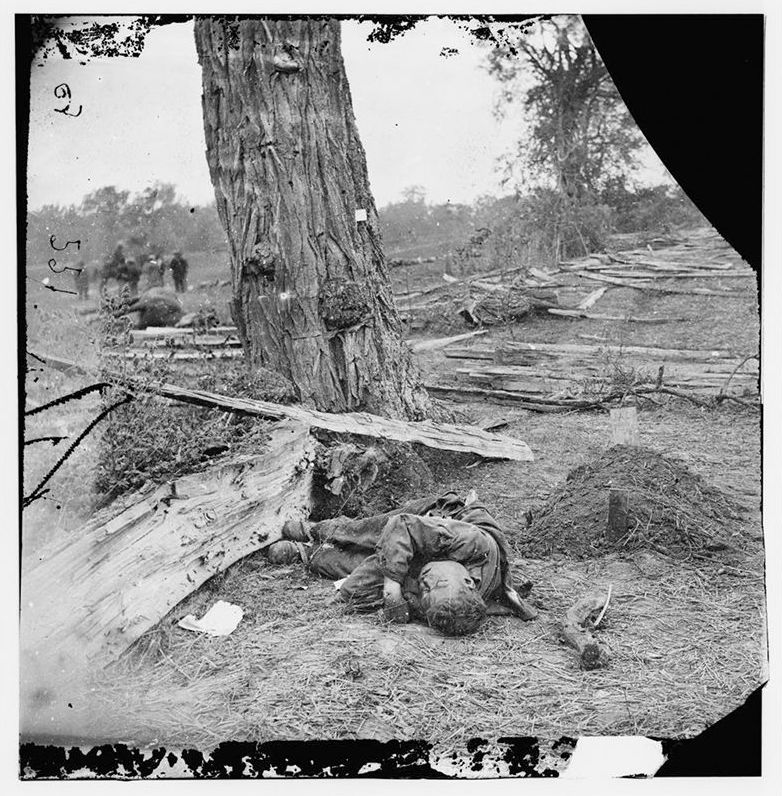
In her 1938 essay “Three Guineas,” Virginia Woolf wondered “whether when we look at the same photographs we feel the same things.” Woolf half-hoped that grisly images of the dead from the Spanish Civil War might help put an end to the spreading global conflict. She recognized, writes Susan Sontag in Regarding the Pain of Others, photography’s ability “to vivify the condemnation of war” and to “bring home, for a spell, a portion of its reality to those who have no experience of war at all.”

Mathew Brady, the man credited as the “father of photojournalism,” had no such lofty ambitions at the beginning of the Civil War. At first, he offered to photograph soldiers before they left for the battlefield, to preserve their pre-war image for posterity should they not return. (He cynically advertised his services with the line, “You cannot tell how soon it may be too late.”) Brady was already a successful photographer and had taken portraits of Abraham Lincoln, Andrew Jackson, Daniel Webster, and Edgar Allan Poe.
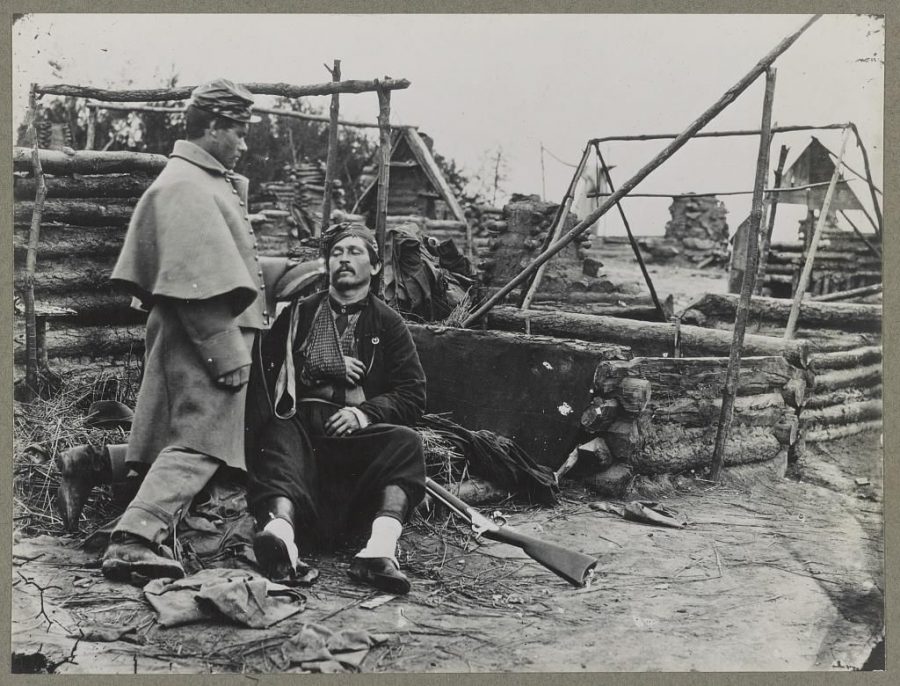
Having studied under Samuel Morse, who brought the daguerreotype technique to the U.S., Brady opened his first studio in New York in 1844 and became highly sought after. He might have safely waited out the war in the city, operating a thriving business, but, as he remembered later, “I had to go. A spirit in my feet said ‘Go,’ and I went.” Brady took his petition all the way to Lincoln, who approved it on the condition that Brady finance the documentation himself. “At his own expense,” notes the American Battlefield Trust, “he organized a group of photographers and staff to follow the troops as the first field-photographers.”
Soon after, “in 1862, Brady shocked the nation when he displayed the first photographs of the carnage of the war in his New York Studio in an exhibit entitled ‘The Dead of Antietam.’ These images, photographed by Alexander Gardner and James F. Gibson, were the first to picture a battlefield before the dead had been removed and the first to be distributed to a mass public.” The New York Times responded as Woolf would seventy-six years later, writing of the photos:
Mr. Brady has done something to bring home to us the terrible reality and earnestness of war. If he has not brought bodies and laid them in our door-yards and along the streets, he has done something very like it.
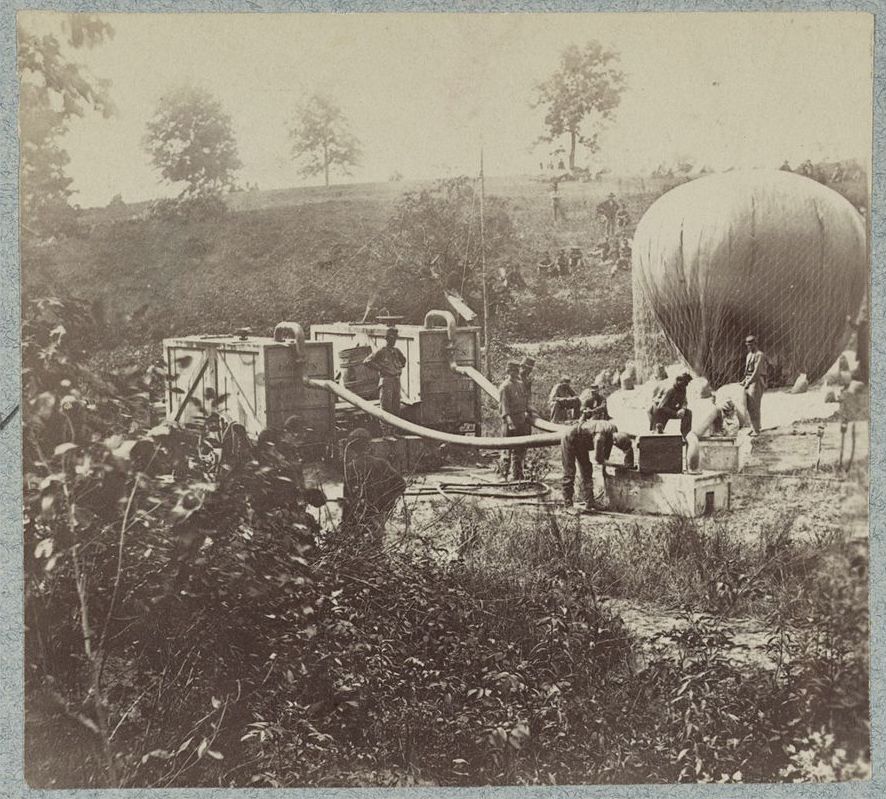
Shocked the nation may have been, but the war dragged on three more years. Brady and his team not only photographed the dead—they captured everything from hot-air balloons to pontoon bridges to breastworks to winter huts and wagon trains. Brady went bankrupt funding the making of over 10,000 plates, many of them harrowing depictions of the war’s brutality, before the U.S. government finally bought them for $25,000.
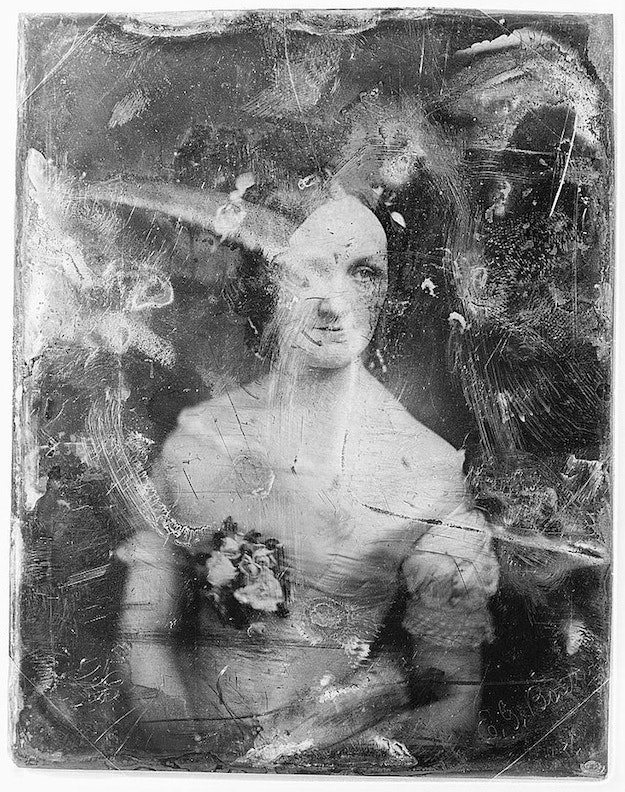
The Public Domain Review has another harrowing collection of Brady’s daguerreotypes—portraits he took before the war that have decayed and distorted, as have a great many of Brady’s photos of the war dead. These images “were extremely sensitive to scratches, dust, hair, etc, and particularly the rubbing of the glass cover if they glue holding it in place deteriorated.” Despite photographers’ promises to the contrary, “this fixing” of the image for posterity “was far from permanent.” See more of Brady’s Civil War photographs at the National Archives.
Related Content:
The Civil War & Reconstruction: A Free Course from Yale University
Josh Jones is a writer and musician based in Durham, NC. Follow him at @jdmagness
Read More...Support Us
We're hoping to rely on loyal readers, rather than erratic ads. Please click the Donate button and support Open Culture. You can use Paypal, Venmo, Patreon, even Crypto! We thank you!

About Us

Open Culture scours the web for the best educational media. We find the free courses and audio books you need, the language lessons & educational videos you want, and plenty of enlightenment in between.
Advertise With Us

FREE UPDATES!
GET OUR DAILY EMAIL
Get the best cultural and educational resources on the web curated for you in a daily email. We never spam. Unsubscribe at any time.
FOLLOW ON SOCIAL MEDIA

Open Culture editor Dan Colman scours the web for the best educational media. He finds the free courses and audio books you need, the language lessons & movies you want, and plenty of enlightenment in between.
Advertise With Us


