Linked Jazz: A Huge Data Visualization Maps the Relationships Between Countless Jazz Musicians & Restores Forgotten Women to Jazz History
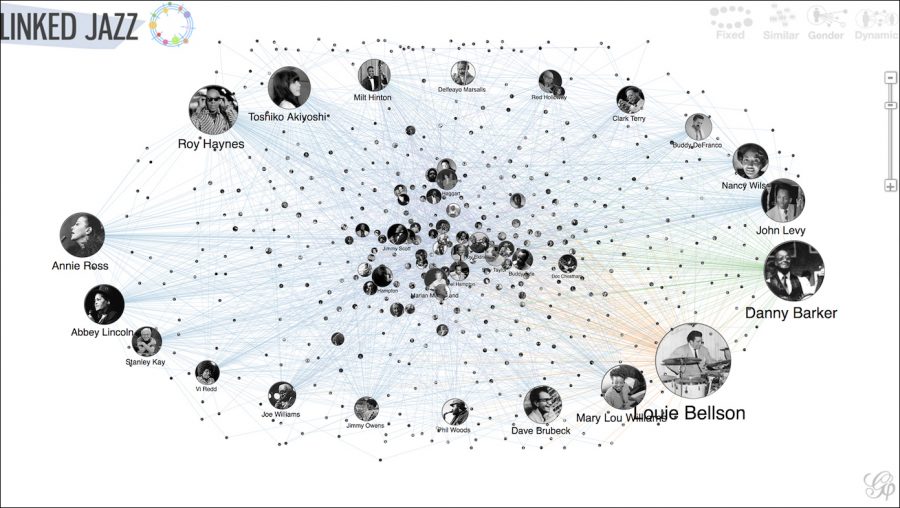
Having watched the development of interactive data visualizations as a writer for Open Culture, I’ve seen my share of impressive examples, especially when it comes to mapping music. Perhaps the oldest such resource, the still-updating Ishkur’s Guide to Electronic Music, also happens to be one of the best for its comprehensiveness and witty tone. Another high achiever, The Universe of Miles Davis, released on what would have been Davis’ 90th birthday, is more focused but no less dense a collection of names, record labels, styles, etc.
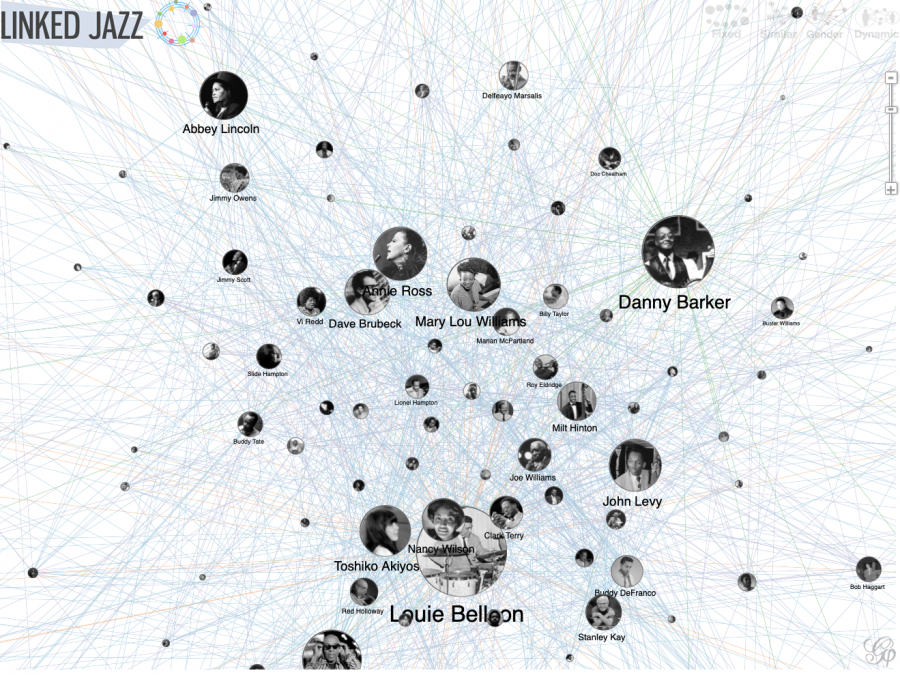
While visualizing the history of any form of music can result in a significant degree of complexity, depending on how deeply one drills down on the specifics, jazz might seem especially challenging. Choosing one major figure pulls up thousands of connections. As these multiply, they might run into the millions. But somehow, one of the best music data visualizations I’ve seen yet—Pratt Institute’s Linked Jazz project—accounts seamlessly for what appears to be the whole of jazz, including obscure and forgotten figures and interactive, dynamic filters that make the history of women in jazz more visible, and let users build maps of their own.
Jazz musicians “are like family,” Zena Latto, one of the musicians the project recovered, told an interviewer in 2015. A multi-racial, transnational, actively multi-generational family that meets all over the world to play together constantly, that is. As a form of music built on ensemble players and journeymen soloists who sometimes form bands for no more than a single album or tour, jazz musicians probably form more relationships across age, gender, race, and nationality than those in any other genre.
That organic, built-in diversity, a feature of the music throughout its history, shows up in every permutation of the Linked Jazz map, and comes through in the recorded interviews, performances, and other accompanying info linked to each musician. Like the Universe of Miles Davis, Linked Jazz leans heavily on Wikipedia for its information. And in using such “linked open data (LOD),” as Pratt notes in a blog post, the project “also reveals archival gaps. While icons such as John Coltrane and Miles Davis have large digital footprints, lesser-known performers may barely have a mention”—despite the fact that most of those players, at one time or another, played with, studied under, or recorded with the greats.
Such was the case with Latto, who was mentored by Benny Goodman and toured throughout the 1940s and 50s with the International Sweethearts of Rhythm, “considered the first integrated all-women band in the United States.” Latto was “part of a network that stretched from New York to New Orleans,” but her name had disappeared entirely until Pratt School of Information professor Cristina Pattuelli found it on a tattered flyer for a Carnegie Hall concert. “Soon, through Linked Jazz, Lotta had a Wikipedia page and her interview was published on the Internet Archive.”
Linked Jazz’s focus on women musicians does not mean gender segregation, but a rediscovery of women’s place in all of jazz. Like all of the other filters, the Linked Jazz data map’s gender view shows both men and women prominently in the little photo bubbles connected by webs of red and blue lines. But as you begin clicking around, you will see the perspective has shifted. “Linked Jazz has concentrated on processing more interviews with women jazz musicians,” writes Pratt, “and these resources have been enhanced by a series of Women of Jazz Wikipedia Edit-a-thons in 2015 and 2017.”
Likewise, the inclusion of these interviews, biographies, and recordings have enhanced the breadth and scope of Linked Jazz, which as a whole represents the best intentions in open data mapping, realized by a design that makes exploring the daunting history of jazz a matter of strolling through a digital library with the entire catalog appearing instantly at your fingertips. The project also shows how thoughtful data mapping can not only replicate the existing state of information, but also contribute significantly by finding and restoring missing links.
via
Related Content:
The Influence of Miles Davis Revealed with Data Visualization: For His 90th Birthday Today
How Dave Brubeck’s Time Out Changed Jazz Music
The Brains of Jazz and Classical Musicians Work Differently, New Research Shows
Josh Jones is a writer and musician based in Durham, NC. Follow him at @jdmagness
Read More...Bruce Springsteen Releases Live Concert Film Online: Watch “London Calling: Live In Hyde Park” and Practice Self Distancing
A message from Bruce: “Practice social distancing & stream ‘London Calling: Live In Hyde Park’ from the comfort of your own home, now on YouTube & Apple Music in its entirety for the 1st time!” Watch it all above.
If you would like to support the mission of Open Culture, consider making a donation to our site. It’s hard to rely 100% on ads, and your contributions will help us continue providing the best free cultural and educational materials to learners everywhere. You can contribute through PayPal, Patreon, and Venmo (@openculture). Thanks!
Read More...“I Will Survive,” the Coronavirus Version for Teachers Going Online
If you’re an academic sprinting to put your course online, this video will make you feel better for a solid two minutes and 44 seconds.
Above we present, “I Will Survive,” the Coronavirus version for teachers going online, with lyrics adapted by Michael Bruening, historian at Missouri State.
At first I was afraid, I was petrified
Kept thinking I could never teach through Canvas all the time
But then I spent so many nights reading the help docs for so long
And I grew strong
And I learned how to get along
And so I’m back
Students are gone
As all my colleagues try to figure out how they’re gonna get along
I should have kept up with the tech, not skipped that class on course design
If I’d known for just one second I’d be teaching all-online
Go on now, go, leave me alone
I’ve got to figure out
Just how to lecture using Panopto
You gave me two days to adjust, to move everything online
Did you think I’d crumble
Did you think I’d lay down and die?
Oh no, not I, I will survive
Oh, as long as I know how to Zoom, I know I’ll be alive
Oh, my students still will learn
And my paychecks I will earn, and I’ll survive
I will survive, hey, hey
It took all the strength I had not to lay down and die
Kept trying hard to mend the pieces of my syllabi
And I spent oh so many nights just feeling sorry for myself
I used to cry
But now I hold my head up high and you’ll see me
Teaching on zoom
But just don’t cough into the mic or every eye will be on you
I can’t hear you, you’re on mute, your camera’s black, are you still there?
We’ve got some glitches to work out, but I know my grading scheme is fair
Oh now, go, walk out the door
Trying to get this lecture done
And I’m already on take four
Now the network has gone down, and I’m all out of wine
Do you think I’ll crumble
Do you think I’ll lay down and die?
Oh no, not I, I will survive
Oh, as long as I know how to zoom, I know I’ll be alive
My students still will learn
And my paychecks I will earn and I’ll survive
I will survive
Hey hey
Read More...Live Performers Now Streaming Shows, from their Homes to Yours: Neil Young, Coldplay, Broadway Stars, Metropolitan Operas & More
You’ve always read books in the comfort of your own home. Though it may not be the full cinematic experience, you can also watch films there, in a pinch. Now that such a pinch has come, in the form of coronavirus pandemic-related quarantines and other forms of isolation, few art forms must be feeling it more than live music and theatre. Though we’ve all watched recorded performances now and again, we know full well that nothing can quite replicate the felt energy of the live experience. Until we can get out and enjoy it once and again, a variety of performers and venues — from rock stars and Broadway luminaries to independent theatre companies and the Metropolitan Opera — have stepped up to provide as much as they can of it online.
“The live music industry has seen an unprecedented fallout in the wake of the coronavirus outbreak,” writes Consequence of Sound’s Lake Schatz. “Highly anticipated tours from Foo Fighters, Billie Eilish, Thom Yorke, and Elton John have all been postponed, and major festivals such as Coachella and South By Southwest have had to drastically change their plans last minute.”
In response, “artists are turning to livestreaming to stay in touch with their fans. Neil Young, Coldplay’s Chris Martin, Death Cab for Cutie frontman Ben Gibbard, and John Legend are streaming intimate concerts live from their very own homes.” Young’s “Fireside Sessions” launched on the Neil Young Archives site last Monday.
That same day Martin, leader of Coldplay, “streamed a mini concert on Monday as part of Instagram’s ‘Together, at Home’ virtual series” (which will continue next week with John Legend). Even more ambitiously, Gibbard has a daily streaming series set to launch next Tuesday on YouTube and Facebook. “Aptly titled ‘Live From Home,’ the daily live sessions will see the indie rocker take requests and even possibly duet with special guests,” writes Schatz. (You can view Gibbard’s first Live from Home session at the top of the post.)
“Additionally, punk rockers Jeff Rosenstock and AJJ are both scheduled to perform a special concert that will be livestreamed on Specialist Subject’s Instagram Stories. That event goes down Tuesday afternoon beginning 7:45 p.m. ET.” Putting the show on by any technological means available is, we can surely agree, very much the punk-rock way. And even apart from broadcasting concerts online, from home or elsewhere, “acts like Deafheaven are releasing live albums (sans any audience).” Deafhaven, if you don’t know them, are a post-metal band out of San Francisco; on the other end of the musical spectrum, country star Keith Urban streamed a live concert on Instagram from his basement this past Tuesday.
Over at the Theatre Development Fund (TDF), Raven Snook rounds up a variety of New York theatre institutions now streaming online. These include 92nd Street Y (whose performance archive we’ve previously featured here on Open Culture); BroadwayWorld, which has come up with “daily Living Room Concerts, a series of one-song performances recorded by Broadway stars in their respective homes”; The Metropolitan Opera, whose nightly streaming of “previously recorded presentations” we mentioned earlier this week.
Other participants in this push include The Actors Fund, with its new “daily performance/talk show Stars in the House” in which “Broadway luminaries will sing and chat from their homes,” and the National Yiddish Theatre Folksbiene, which “kicks off its Folksbiene LIVE!: An Online Celebration of Yiddish Culture” this week, all streamed free on its Facebook page. And be sure to visit the site of New York non-profit arts presenter and producer The Tank, whose new CyberTank series live streams a “weekly, remote, multidisciplinary arts gathering” every Tuesday. Whatever your preferred variety of live performance, you’re sure to be covered until you can get back out to the theatre, the club, the opera houses, or wherever you enjoy your live culture of choice.
Related Content:
The Met Opera Streaming Free Operas Online to Get You Through COVID-19
Going to Concerts and Experiencing Live Music Can Make Us Healthier & Happier, a New Psychology Study Confirms
Based in Seoul, Colin Marshall writes and broadcasts on cities, language, and culture. His projects include the book The Stateless City: a Walk through 21st-Century Los Angeles and the video series The City in Cinema. Follow him on Twitter at @colinmarshall or on Facebook.
Read More...David Bowie’s Rise as Ziggy Stardust Documented in a New 300-Page Photo Book
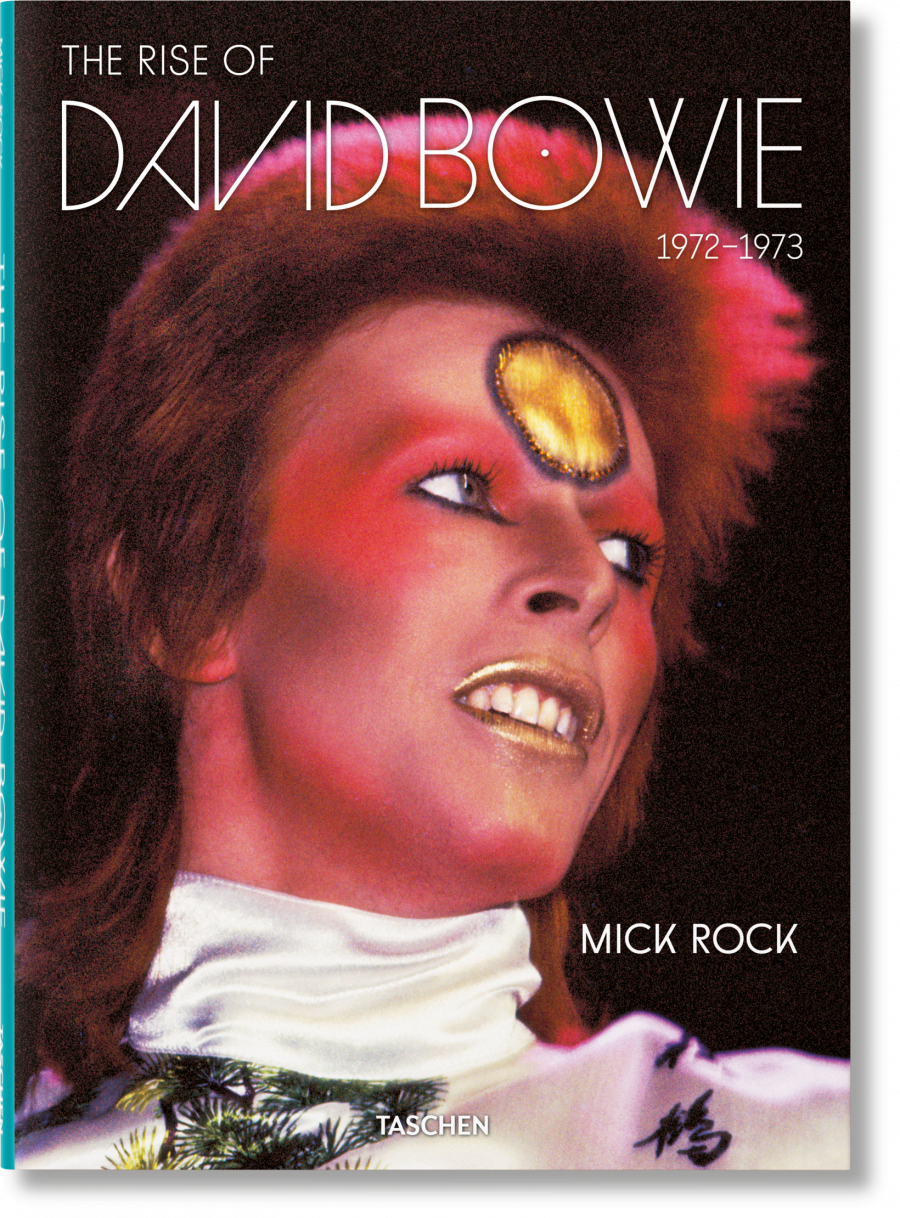
Great rock photographers of the seventies often captured their subjects at their moodiest, as in Pennie Smith’s pensive tour photos of the Clash, or Kevin Cummins’ stark, sometimes explosive photos of Joy Division. These were bands best shot in black and white. Punk looked back to the rock of the fifties in its high-contrast simplicity. But the early seventies belonged to glam—or, more accurately, belonged to Ziggy Stardust, a character who demanded to be captured in full-color.
Mick Rock was just the photographer to frame the alien space rock opera in brilliant reds, greens, and blues. Ziggy was several parts T‑Rex swagger and riffage, Sun Ra outer-space persona, Lindsay Kemp kabuki mime, and Bauhaus-inspired costuming.
Getting all of this in his shots of Bowie as Ziggy earned Rock the nickname “the man who shot the seventies.” His “career took off alongside Bowie’s,” writes Kristen Richard at Mental Floss, “and between 1972 and 1973, Rock was the musician’s go-to photographer and videographer.”
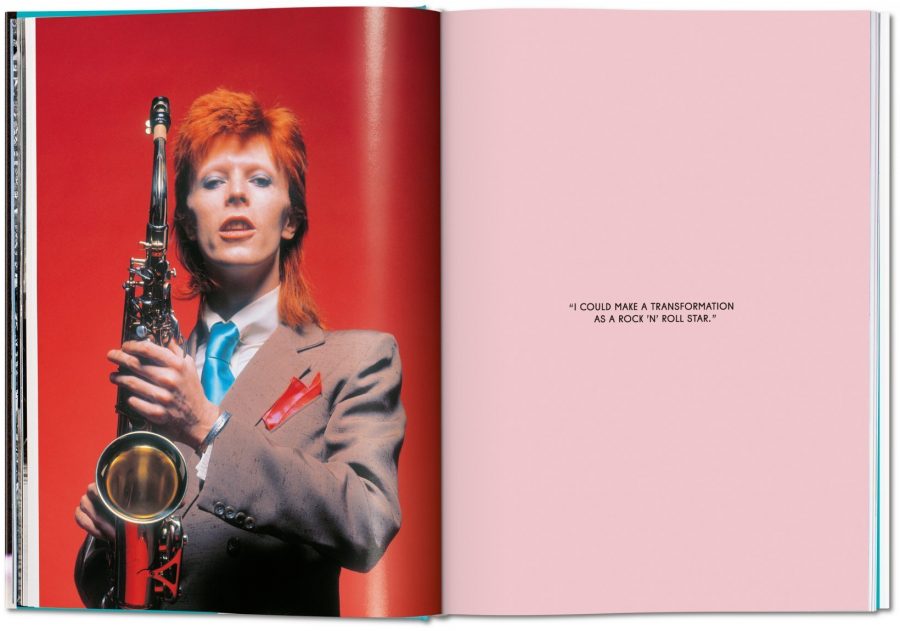
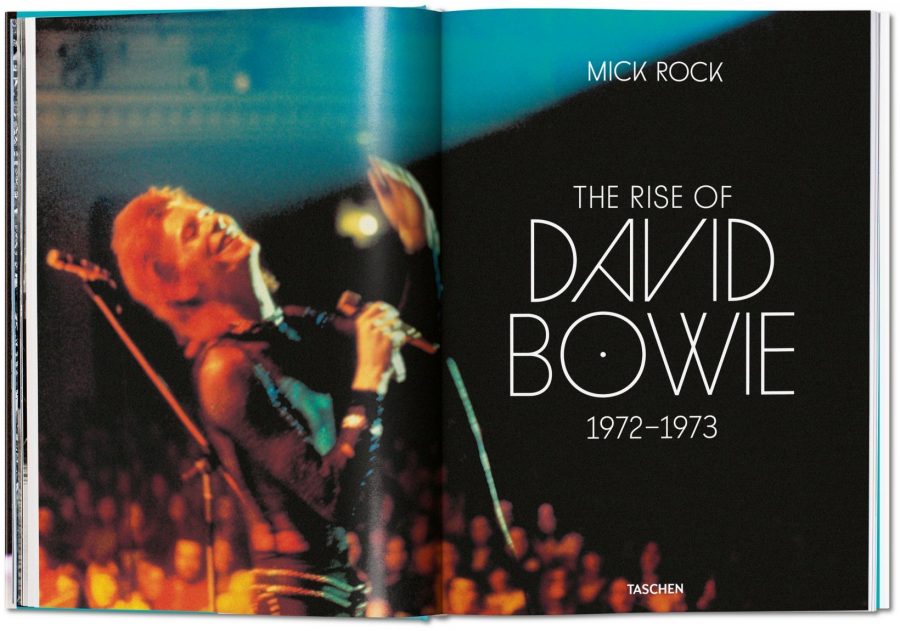
More than that, Rock is almost as responsible for Ziggy Stardust’s rise as Bowie himself, given the way his photos spread the mythos through print media of the time and became iconic digital images that still define Bowie’s career. When we think of Ziggy Stardust, it’s more than likely we are thinking of an image shot by Mick Rock. Bowie’s “creative partner” compiled his photographs in 2015, “with Bowie’s blessing,” and they will soon be published in a new, 300-page book by Taschen.
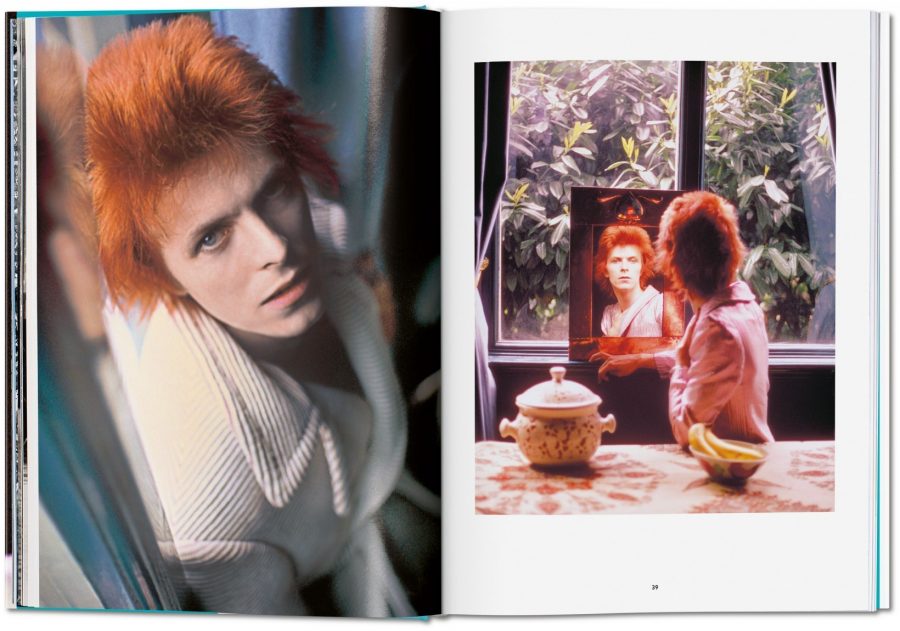
“You’ll find photographs of Bowie both on stage and behind the scenes,” Richard notes, “giving fans an up-close look at the transformative performer’s life on the road as he honed his daring new persona.” That persona upended what it meant to be a rock star, and opened doors for others to push into new performative territory. “Rock’s glam imagery toyed with the idea of masculinity,” writes Christopher Mosley of a recent exhibition in Dallas. For example, the photographer “avoided a tough-guy image with the group Queen by encouraging singer Freddie Mercury to pose in a manner similar to that of an old still of German silent film star, Marlene Dietrich.”
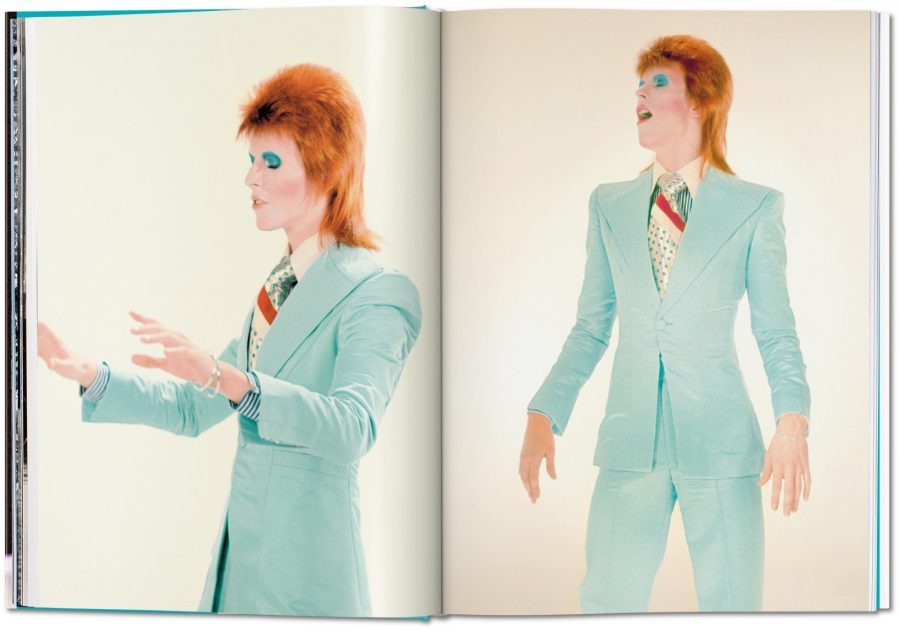
Neither Mercury nor Bowie needed permission to challenge rock’s heteronormativity, but Rock drew out of them the perfect poses to turn their stage personas into superheroes. No rock star before Bowie had ever looked so gorgeously otherworldly, an image we remember thanks in large part to Mick Rock. Order a copy of The Rise of David Bowie, 1972–1973 here.
Related Content:
David Bowie Picks His 12 Favorite David Bowie Songs: Listen to Them Online
David Bowie Became Ziggy Stardust 48 Years Ago This Week: Watch Original Footage
Josh Jones is a writer and musician based in Durham, NC. Follow him at @jdmagness
Read More...Are Video Games an Effective Vehicle for Storytelling? Pretty Much Pop: A Culture Podcast #35 Featuring Don Marshall
Do you play video games for the plot? Given that most people don’t actually finish most games, it would be unexpected if storytelling were the most important element. On this episode of Pretty Much Pop: A Culture Podcast, your hosts Mark Linsenmayer, Erica Spyres, and Brian Hirt are joined by former video game professional (and current TV development executive) Donald E. Marshall to talk through types of plots (linear, “string-of-pearls,” and branching), ways of weaving story into a game, balancing gameplay and narrative, and more.
We touch on Death Stranding, Overwatch, The Last of Us, Skyrim, Fallout, Life Is Strange, Until Dawn, Erica, Bioshock, Telltale Games, Journey, Bandersnatch, Days Gone, Portal, and more. (That casual game Mark jokes about is Simon’s Cat Pop Time.)
Some articles and other sources:
- “When Video Games Tell Stories: A Model of Video Game Narrative Architectures” by Marcello Arnaldo Picucci (2014)
- “The Evolution of Video Games as a Storytelling Medium, and the Role of Narrative in Modern Games” by Chris Stone
- “Writing for Video Games: A Conversation with E. Lily Yu, Yoon Ha Lee, Robert Reed, Seth Dickinson, and Karl Schroeder” by Alvaro Zinos-Amaro
- “How to Write a Video Game Story” by Colin Campbell
- “A Hugo Award for Best Game or Interactive Experience” by Ira Alexandre
- The Dialog Podcast: s1e08 “Video Game Narrative Design and Writing Science Fantasy Novels with Carrie Patel”
You can also read some lists of games that supposedly have the best plots at GamesRadar, Ranker, and The Gamer.
Don is also a podcaster, having previously been a host of GeeksOn and now on The Big Fat Gay Podcast. Here’s info about the Wheel of Time TV show. One relevant GeeksOn episode is #102. Here’s info about the Wheel of Time TV show.
This episode includes bonus discussion that you can only hear by supporting the podcast at patreon.com/prettymuchpop. This podcast is part of the Partially Examined Life podcast network.
Pretty Much Pop: A Culture Podcast is the first podcast curated by Open Culture. Browse all Pretty Much Pop posts or start with the first episode.
Read More...
Why Fighting the Coronavirus Depends on You
A public service announcement from Vox.
It’s worth coupling this with our previous post: Quarantined Italians Send a Message to Themselves 10 Days Ago: What They Wish They Knew Then.
If you would like to support the mission of Open Culture, consider making a donation to our site. It’s hard to rely 100% on ads, and your contributions will help us continue providing the best free cultural and educational materials to learners everywhere. You can contribute through PayPal, Patreon, and Venmo (@openculture). Thanks!
Related Content:
Free Courses on the Coronavirus: What You Need to Know About the Emerging Pandemic
Coursera Providing Free Access to Its Course Catalog to Universities Impacted by COVID-19
Quarantined Italians Send a Message to Themselves 10 Days Ago: What They Wish They Knew Then
Read More...While Away the Hours with a Free H.P. Lovecraft Call of Cthulhu Coloring Book
Unlike his devotee Stephen King, whose novels and stories have spawned more Lovecraftian film and television projects than any writer in the genre, H.P. Lovecraft himself has little cinema credit to his name. Given the abject terror evoked by Cthulhu and other terrifying “primal Great Ones”—as the author called his monsters in the story of the octopus-headed god—we might expect it to be otherwise.
But Lovecraft was not a cinematic writer, nor a fan of any such modern storytelling devices. He preferred the Victorian mode of indirect narration, his prose full of hearsay, reportage, bibliography, and lengthy description of experiences once or twice removed from the teller of the tale.
These qualities (and his extreme racism) make him a poor choice for the plot-driven medium of feature film. Lovecraft’s expansive imagination, like his buried, dreaming monsters, was subterranean and submarine, revealing only the barest glimpse of nightmares we are grateful never to see fully revealed.
The endlessly suggestive psychological terror of Lovecraft has instead become the source of an extended universe that includes fan fiction—written by professionals and amateurs alike—fantasy art, comic books, and RPGs (role-playing games) like the Call of Cthulhu series made by Chaosium, Inc. for over 35 years: “the foremost game of mystery and horror,” the company touts. “For those brave enough to uncover its secrets, the rewards are beyond comprehension!” If this sounds just like the thing to pass the time during these days of social distancing, look over all of the Chaosium Cthulhu offerings here.
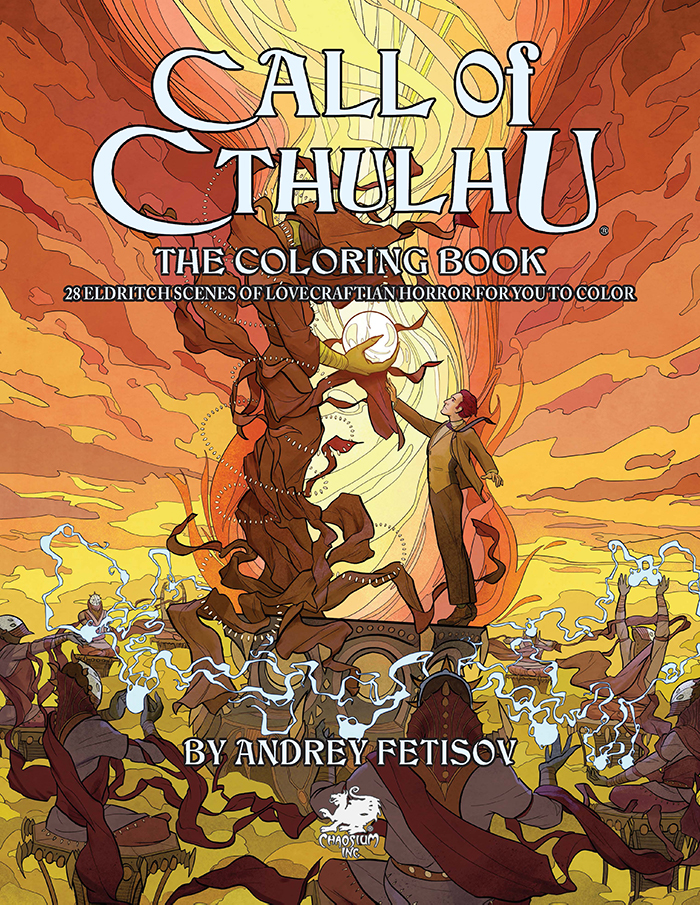
For those who prefer Lovecraftian immersions of a more solitary, meditative nature, allow us to present Call of Cthulhu: The Coloring Book, the first of many “fun and engaging diversions,” the company promises “we can enjoy while staying in, working-from-home, in quarantine, or in self-isolation….. While away the hours in lockdown coloring an amazing array of scenes, with striking images from H.P. Lovecraft’s stories—and the Call of Cthulhu RPG his imagination inspired (Horror on the Orient Express, Masks of Nyarlathotep, The Fungi from Yuggoth and more).”
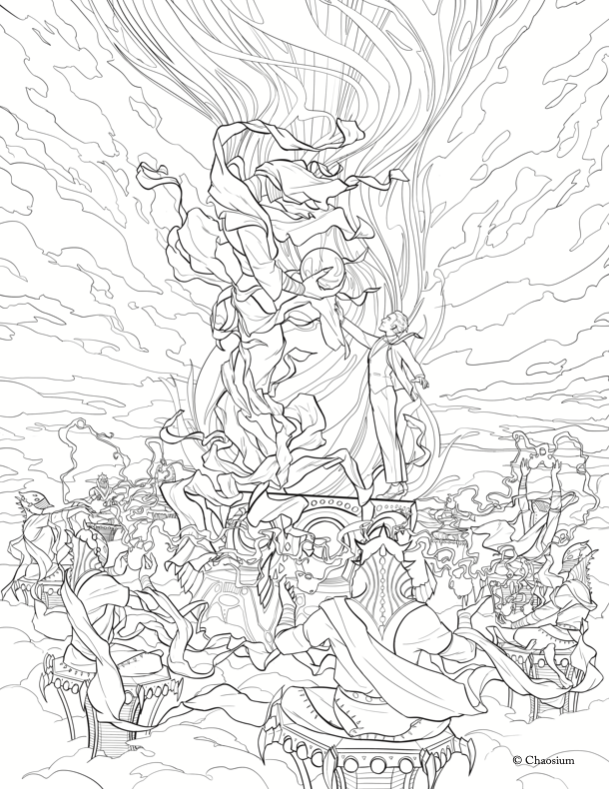
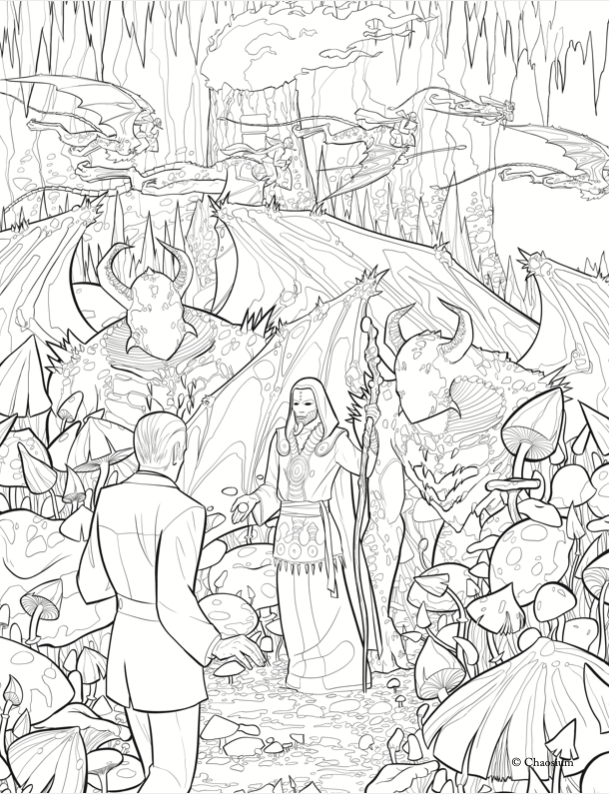
While these many Lovecraft spin-offs may be unfamiliar, hints of their harrowing scenes always lay in the murky depths of Lovecraft’s fiction. See how award-winning artist Andrey Fetisov has imagined these encounters with ancient terrors. Then color his Moebius-like drawings in, and enter your work in a Call of Cthulhu coloring competition by sharing it with the hashtag #homewithchaosium. There will be prizes, sure to be surprises, though we hope the ruthless Elder Gods don’t have a hand in choosing them. Download all 28 eldritch scenes here.
via Boing Boing
Related Content:
H.P. Lovecraft’s Classic Horror Stories Free Online: Download Audio Books, eBooks & More
An Animated Introduction to H.P. Lovecraft and How He Invented a New Gothic Horror
H.P. Lovecraft’s Cthulhu in Anime: A First Glimpse
Josh Jones is a writer and musician based in Durham, NC. Follow him at @jdmagness
Read More...The Met Opera Streaming Free Operas Online to Get You Through COVID-19
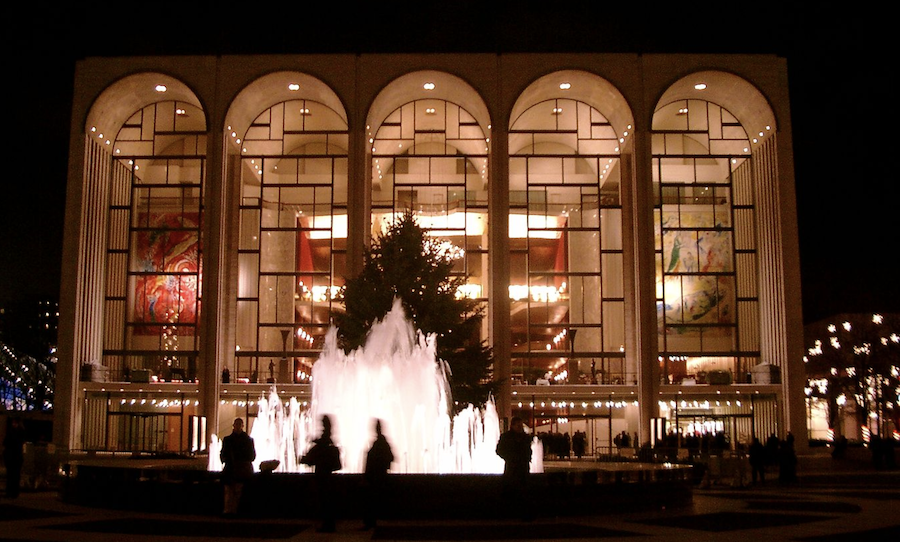
Image by Lechhansl, via Wikimedia Commons
On its website, the Met Opera announced that “effective immediately, all performances have been canceled through March 31 because of coronavirus concerns.” But that doesn’t mean audiences can’t get their fill of opera performances. According to Opera Wire, in an “effort to continue providing opera to its audience members, the Met Opera will host ‘Nightly Met Opera Streams’ on its official website to audiences worldwide.” They add:
These free streams will present encores of past performances from its famed Live in HD series. The encore presentations will begin at 7:30 p.m. each night on the company’s official website and will then be available for an additional 20 hours thereafter. Each showcase will also be viewable on the Met Opera on demand apps.
Head over Met Opera’s site where they’re streaming Carmen now…
If you would like to support the mission of Open Culture, consider making a donation to our site. It’s hard to rely 100% on ads, and your contributions will help us continue providing the best free cultural and educational materials to learners everywhere. You can contribute through PayPal, Patreon, and Venmo (@openculture). Thanks!
Related Content:
Hear Singers from the Metropolitan Opera Record Their Voices on Traditional Wax Cylinders
The Opera Database: Find Scores, Libretti & Synopses for Thousands of Operas Free Online
How a Philip Glass Opera Gets Made: An Inside Look
Read More...Isaac Newton Conceived of His Most Groundbreaking Ideas During the Great Plague of 1665
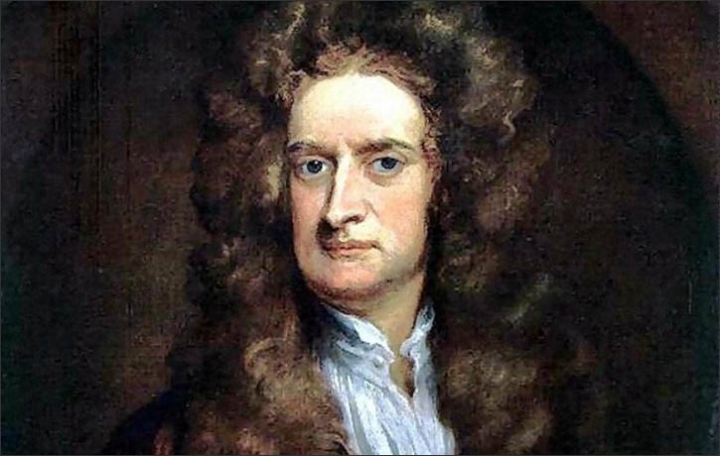
Whether you’ve volunteered to self-quarantine, or have done so from necessity, health experts worldwide say home is the best place to be right now to reduce the spread of COVID-19. For some this means layoffs, or remote assignments, or an anxious and indefinite staycation. For others it means a loss of safety or resources. No matter how much choice we had in the matter, there are those among us who harbor ambitious fantasies of using the time to finally finish labors of love, whether they be crochet, composing symphonies, or writing a contemporary novel about a plague.
Many lifesaving discoveries have been made in the wake of epidemics, and many a novel written, such as Albert Camus’ The Plague, composed three years after an outbreak of bubonic plague in Algeria. Offering even more of a challenge to housebound writers is the example of Shakespeare, who wrote some of his best works during outbreaks of plague in London, when “theaters were likely closed more often than they were open,” as Daniel Pollack-Pelzner writes at The Atlantic, and when it was alleged that “the cause of plagues are plays.”
You can forgive yourself for taking a few days to organize your closets, or—let’s be real—binge on snacks and Netflix series. But if you’re still looking for a role model of productivity in a time of quarantine, you couldn’t aim higher than Isaac Newton. During the years 1665–67, the time of the Great Plague of London, Newton’s “genius was unleashed,” writes biographer Philip Steele. “The precious material that resulted was a new understanding of the world.”
In Shakespeare’s case, only decades earlier, the “plagues may have caused plays”—spurring poetry, fantasy, and the epic tragedies of King Lear, Macbeth, and Antony and Cleopatra. Newton too was apparently inspired by catastrophe.
These years of Newton’s life are sometimes known in Latin as anni mirabilies, meaning “marvelous years.” However, they occurred at the same time as two national disasters. In June 1665, the bubonic plague broke out in London…. As the plague spread out into the countryside, there was panic. Cambridge University was closed. By October, 70,000 people had died in the capital alone.
Newton left Cambridge for his home in Woolsthorpe. The following year, the Great Fire of London devastated the city. As horrifying as these events were for the thousands who lived through them, “some of those displaced by the epidemic,” writes Stephen Porter, “were able to put their enforced break from their normal routines to good effect.” But none more so than Newton, who “conducted experiments refracting light through a triangular prism and evolved the theory of colours, invented the differential and integral calculus, and conceived of the idea of universal gravitation, which he tested by calculating the motion of the moon around the earth.”
Right outside the window of Newton’s Woolsthorpe home? “There was an apple tree,” The Washington Post writes. “That apple tree.” The apple-to-the-head version of the story is “largely apocryphal,” but in his account, Newton’s assistant John Conduitt describes the idea occurring while Newton was “musing in a garden” and conceived of the falling apple as a memorable illustration. Newton did not have Netflix to distract him, nor continuous scrolling through Twitter or Facebook to freak him out. It’s also true he practiced “social distancing” most of his life, writing strange apocalyptic prophesies when he wasn’t laying the foundations for classical physics.
Maybe what Newton shows us is that it takes more than extended time off in a crisis to do great work—perhaps it also requires that we have discipline in our solitude, and an imagination that will not let us rest. Maybe we also need the leisure and the access to take pensive strolls around the garden, not something essential employees or parents of small children home from school may get to do. But those with more free time in this new age of isolation might find the changes forced on us by a pandemic actually do inspire the work that matters to them most.
Related Content:
In 1704, Isaac Newton Predicts the World Will End in 2060
Sir Isaac Newton’s Papers & Annotated Principia Go Digital
Josh Jones is a writer and musician based in Durham, NC. Follow him at @jdmagness
Read More...Support Us
We're hoping to rely on loyal readers, rather than erratic ads. Please click the Donate button and support Open Culture. You can use Paypal, Venmo, Patreon, even Crypto! We thank you!

About Us

Open Culture scours the web for the best educational media. We find the free courses and audio books you need, the language lessons & educational videos you want, and plenty of enlightenment in between.
Advertise With Us

FREE UPDATES!
GET OUR DAILY EMAIL
Get the best cultural and educational resources on the web curated for you in a daily email. We never spam. Unsubscribe at any time.
FOLLOW ON SOCIAL MEDIA

Open Culture editor Dan Colman scours the web for the best educational media. He finds the free courses and audio books you need, the language lessons & movies you want, and plenty of enlightenment in between.
Advertise With Us


