On Its 25th Anniversary, Hear Liz Phair’s Groundbreaking Exile in Guyville Juxtaposed Song-By-Song With the Album That Inspired It, the Rolling Stones’ Exile on Main Street

Images via Wikimedia Commons. Liz Phair left, Mick Jagger right
In 1971, post-Altamont fiasco, the Rolling Stones went into exile… not on some dusty small town drag, but on the French Riviera, where the band decamped for purposes of tax evasion and began recording in Keith Richards’ rented villa near Nice. Everyone knows what happened next—a sloppy, soupy, ragged, glorious hash of country, blues, and country-blues, filtered through a haze of booze and heroin and the Stones’ devotion to rock and roll as macho endurance exercise: Exile on Main Street.
The album, with its cover collage of Americana grotesquerie and kitsch, may have “killed the Rolling Stones,” Jack Hamilton argues at The Atlantic, but it launched a thousand imitators in the ensuing decades, a thousand would-be Keith Richards getting strung out and making dirty, raunchy rock, “pitched perfectly between earnestness and irony.” Fourteen years after the album’s release, darlings of trashy New York noise rock, Pussy Galore, covered the album song-for-song. The effort “sounds like it was recorded in the tank of a Lower East Side toilet,” writes Randall Roberts.
Pussy Galore guitarist Neil Hagerty surely deserves the Richards mantle—taking sex, drugs, rock ’n’ roll, and lo-fi recording to absurd lengths with his later project Royal Trux. But one of the ironies of the testosterone-fueled Exile on Main Street’s influence on these bands is that they featured two of the toughest women in underground music, Julie Cafritz and Jennifer Herrema—women who labored obscurely in a “complicated world of men with guitars,” as Allison Stewart puts it at The Washington Post.
In 1993, Liz Phair stepped into this world with her career-defining Exile in Guyville, “one of the sharpest, boldest rock albums of its era, or any era,” which just happens to be a song-for-song response to the Rolling Stones’ opus. Next to the Stones, the production of Phair’s Exile sounds pristine—you can actually make out the lyrics! Her explosive debut was a defiant conversation, “clearly in a tussle with the sort of male-dominated music scene,” she tells The New York Times.
Using the Rolling Stones’ “Exile on Main St” was sort of like using their avatar. I thought that was the quintessential guy rock band, you know? So I substituted in my head the characters from “Exile” with the characters I knew from around the neighborhood. Sort of talking to them vis-à-vis the conversation I was having with the Rolling Stones.
The exercise began with Phair taking Exile on Main Street as a textbook, of a sort: “I was a visual arts major and I concocted the idea that I needed a template—learn from the greats,” she tells Rolling Stone. After her then-boyfriend sarcastically told her, “you should totally do that,” she became intent on meeting the challenge of writing her own take on the album. But Guyville was about much more than the Stones, who provide an armature for her explorations of “a million Guyvilles,” as she tells Stewart.
“It’s in the studios, where you try to get movies made and cast. It’s anyone being white-privileged, being whatever it is that gives you invisible safety or invisible benefits. ‘Guyville’ could be a catchphrase for any oblivious community that has no idea that they’re shoving people to the side.” Twenty-five years after the album’s debut, Phair’s commentary seems as trenchant as it was then, when she found herself one of a select few women in an industry dominated by a lot of sleazy guys: “The market forces… were gross. It was like, ‘Look hotter! Get more naked!’ Like as if it was a Jell‑O wrestling contest.”
The major difference now, she says, is that women have a significant presence in every genre: “I feel like every day on Twitter I find some new female band I’m interested in, and I can have my entire music diet be female songwriters and musicians.” Though she was then and now a reluctant “feminist spokesmodel,” Phair deserves ample credit for helping to break open the music industry’s Guyville, by taking on one of its most sacred objects. Exile in Guyville was re-released in a box set this month by Matador. In the playlist above, you can hear the conversation in full, with each song on Exile on Main Street followed by Phair’s Exile in Guyville rejoinder.
As you listen, be sure to read her interview at Rolling Stone, where she explains how she translated the early 70s classic into an early 90s idiom. She also tells the story of meeting Mick Jagger, who, she says, gave her a belittling look that said, “Yeah, all right, I’ll let you off the hook this time for completely making a name for yourself off our name, but don’t think I don’t know.” Her response: “I wasn’t mad. He’s Mick!”
Related Content:
Chrissie Hynde’s 10 Pieces of Advice for “Chick Rockers” (1994)
Four Female Punk Bands That Changed Women’s Role in Rock
Josh Jones is a writer and musician based in Durham, NC. Follow him at @jdmagness
Read More...The Cutting-Edge Science That Can Turn Everyday Objects, Like a Bag of Chips, Into a Listening Device
For decades we’ve laughed at the persistent movie and television cliche of “image enhance,” whereby characters — usually detectives of one kind or another in pursuit of a yet-unknown villain — discover just the clue they need by way of technological magic that somehow increases the amount of detail in a piece of found footage. But now, of course, our age of rapidly improving artificial intelligence has brought an algorithm for that. And not only can such technologies find visual data we never thought an image contained, they can find sonic data as well: recovering the sound, in other words, “recorded” in ostensibly silent video.
“When sound hits an object, it causes small vibrations of the object’s surface,” explains the abstract of “The Visual Microphone: Passive Recovery of Sound from Video,” a paper by Abe Davis, Michael Rubinstein, Neal Wadhwa, Gautham Mysore, Fredo Durand, and William T. Freeman. “We show how, using only high-speed video of the object, we can extract those minute vibrations and partially recover the sound that produced them, allowing us to turn everyday objects — a glass of water, a potted plant, a box of tissues, or a bag of chips — into visual microphones.” Or a listening device. You can see, and more impressively hear, this process in action in the video at the top of the post.
The video just above magnifies the sound-caused motion of a bag of chips, to give us a sense of what their algorithm has to work with when it infers the sound present in the bag’s environment. In a way this all holds up to common sense, given that sound, as we all learn, comes from waves that make other things vibrate, be they our eardrums, our speakers — or, as this research reveals, pretty much everything else as well. Though the bag of chips turned out to work quite well as a recording medium, some of their other test subjects, including a brick chosen specifically for its lack of sound-capturing potential, also did better than expected.
The hidden information potentially recoverable from video hardly stops there, as suggested by Rubinstein’s TED Talk just above. “Of course, surveillance is the first application that comes to mind,” he says, to slightly nervous laughter from the crowd. But “maybe in the future we’ll be able to use it, for example, to recover sound across space, because sound can’t travel in space, but light can.” Just one of many scientifically noble possibilities, for which watching what we say next time we open up a bag of Doritos would be, perhaps, a small price to pay.
via Kottke
Related Content:
What Does Sound Look Like?: The Audible Rendered Visible Through Clever Technology
The Geometry of Sound Waves Visualized
Based in Seoul, Colin Marshall writes and broadcasts on cities and culture. His projects include the book The Stateless City: a Walk through 21st-Century Los Angeles and the video series The City in Cinema. Follow him on Twitter at @colinmarshall or on Facebook.
Read More...Zora Neal Hurston Wrote a Book About Cudjo Lewis, the Last Survivor of the Atlantic Slave Trade, and It’s Finally Getting Published 87 Years Later

There are too many things people don’t know about Zora Neale Hurston, renowned primarily for her novel Their Eyes Were Watching God. That’s not to slight the novel or its significant influence on later writers like Toni Morrison and Maya Angelou, but to say that Hurston’s scholarly work deserves equal attention. A student of famed anthropologist Franz Boas while at Barnard College, Hurston became “the first African American to chronicle folklore and voodoo,” notes the Association for Feminist Anthropology. Before turning to fiction, she traveled the Caribbean and the American South, collecting stories, histories, and songs and publishing them in the collections Mules and Men and Tell My Horse.
Hurston’s work in ethnography informed her fiction and opened up the field to other African American scholars. It also produced one of the most important works of American nonfiction in the 20th century, a book that, until now, sat in manuscript form at Howard University’s library, where only academics could access it. Barracoon: The Story of the Last “Black Cargo” tells the story of Cudjo Lewis (1840–1935), the last known survivor of the Atlantic slave trade, in his own words. Hurston met Lewis—born Oluale Kossola in what is today the country of Benin—in 1927. She conducted three months of interviews and published a study, “Cudjo’s Own Story of the Last African Slaver,” that same year.
But when she tried to publish the interviews as a book in 1931, she was told she had to change Lewis’ language. “For at least two publishing houses,” writes Meagan Flynn, “Lewis’s heavily accented dialect was seen as too difficult to read.” Hurston refused. Now, the book has finally been published by HarperCollins, with Lewis’s speech intact as Hurston recorded it. HarperCollins editor Deborah Plant tells NPR, “We’re talking about a language that he had to fashion for himself in order to negotiate this new terrain he found himself in.”
As published excerpts of the book show, his speech is not hard to understand. He describes the kind of bewilderment all enslaved Africans must have felt after arriving on alien shores and forced to toil day in and day out under threat of whipping or worse: “We doan know why we be bring ’way from our country to work lak dis,” he says, “Everybody lookee at us strange. We want to talk wid de udder colored folkses but dey doan know whut we say.”
Lewis tells the story of his capture by the King of Dahomey, whose warriors raided his village of Takkoi and sold the captives to American Captain William Foster, operating an illegal operation (the slave trade had been outlawed for almost 60 years). Forced aboard the ship Clotilda with over 100 other African men and women, Lewis was transported to Mobile, Alabama and sold to a businessman named Timothy Meaher. “Cudjo and his fellow captives were forced to work on Meaher’s mill and shipyard,” Gabe Paoletti writes at All That’s Interesting. “As a slave, he started to go by the name ‘Cudjo,’ a day-named given to boys born on a Monday, as Meaher could not pronounce the name ‘Kossola.’”
Deborah Plant sees the rejection of Hurston’s book in the 30s as akin to Lewis’s loss of his name, country, and culture. “Embedded in his language is everything of his history,” she says. “To deny him his language is to deny his history, to deny his experience, which is ultimately to deny him period, to deny what happened to him.”
87 years after the book’s writing, Lewis’s story offers a timely reminder of the history of slavery. The book arrives just after the discovery of what historians and archaeologists believe to be the wreck of the Clotilda, a vessel owned and operated, says AL.com reporter Ben Raines in the video above, by two already wealthy men who smuggled slaves to prove that they could get away with it, then burned the evidence, the ship, to escape detection.
When police arrived at Meaher’s property to charge him with illegally smuggling enslaved people, he “had hidden away the captives,” writes Paoletti, “and had erased all trace of them having been there.” Thanks to Hurston, we have an invaluable firsthand account of what it was like for one West African man who not only endured war and capture at the hands of a rival tribe, but also sale at a slave market, the middle passage across the Atlantic, and forced labor in the deep South—and who lived through the Civil War, Emancipation, Reconstruction and well into the early 20th Century.
Related Content:
Hear Zora Neale Hurston Sing Traditional American Folk Song “Mule on the Mount” (1939)
Josh Jones is a writer and musician based in Durham, NC. Follow him at @jdmagness
Read More...An Interactive Map Shows Just How Many Roads Actually Lead to Rome

…he went away, and passing through what was called the house of Tiberius, went down into the forum, to where a gilded column stood, at which all the roads that intersect Italy terminate.”
- Plutarch, Life of Galba (XXIV.4)
No one can give you exact directions to Milliarium Aureum (aka the Golden Milestone). Just a few carved marble fragments of the gilded column’s base remain in the Roman Forum, where its original location is somewhat difficult to pinpoint.
But as the image above, from interactive map Roads to Rome, shows (view it here), the motto Emperor Caesar Augustus’ mighty mile marker inspired still holds true.
All roads lead to Rome.
To illustrate, designers Benedikt Groß and Philipp Schmitt worked with digital geographer Raphael Reimann to select 486,713 starting points on a 26,503,452 km² grid of Europe.
From there, they created an algorithm to calculate the best route from each point to Rome.
(It beats typing a street address into Google Maps 486,713 times.)
From afar, the resulting map looks like a delicate piece of sea lettuce or an early exploration in neuroanatomy.

Zoom in as tight as you can and things become more traditionally cartographic in appearance, names and spatial relations of cities asserting themselves. A bold line indicates a busy route.
In a nod to map lovers outside of Europe, the mobility-obsessed team came up with another map, this one geared to stateside users.
Do you know which of the United States’ nine Romes you are closest to?
Now you do, from 312,719 distinct starting points.
To help them in their labor, the creative team made good use of the GraphHopper route optimization tool and the Open Street Map wiki. In their own estimation, the project’s outcome is “somewhere between information visualization and data art, unveiling mobility on a very large scale.”
Buy a poster of the All Roads Lead to Rome map here. Or view the interactive map here.
Related Content:
Watch the History of the World Unfold on an Animated Map: From 200,000 BCE to Today
An Interactive Map of Every Record Shop in the World
Ayun Halliday is an author, illustrator, theater maker and Chief Primatologist of the East Village Inky zine. Join her in NYC on Wednesday, May 16 for another monthly installment of her book-based variety show, Necromancers of the Public Domain. Follow her @AyunHalliday.
Read More...Europe After the Rain: Watch the Vintage Documentary on the Two Great Art Movements, Dada & Surrealism (1978)
“Dada thrives on contradictions. It is creative and destructive. Dada denounces the world and wishes to save it.” So says one narrator of journalist-filmmaker Mick Gold’s Europe After the Rain, a 1978 Arts Council of Great Britain documentary on not just the international avant-garde movement called Dada but the associated currents of surrealism churning around that continent during the first half of the twentieth century. “Dada wanted to replace the nonsense of man with the illogically senseless. Dada is senseless, like nature. Dada is for nature, and against art. Philosophers have less value for Dada than an old toothbrush, and Dada abandons them to the great leaders of the world.”
Of the many bold and often contradictory claims made about Dada, none describe it as easily understood. But Dada has less to do with intellectual, aesthetic, or political coherence than with a certain energy. That energy could fire up the likes of André Breton, Salvador Dalí, René Magritte, Giorgio de Chirico, and many other artists besides, channeling frustrations with the state of post-World War I Europe into a sensibility that demanded ripping everything up and building it all again, beginning with the very foundations of sense.
Gold and his collaborators on Europe After the Rain understand this, audiovisually interpreting the legacy of Dada, which despite its short lifespan left behind a host of still-striking works in text, image, and sculpture, in a variety of ways.
“The movie is full of treasures,” writes Dangerous Minds’ Oliver Hall, including “BBC interviews with Max Ernst and Marcel Duchamp from the Sixties, a reading of Artaud’s ‘Address to the Dalai Lama,’ an account of Freud’s meeting with Dalí.” He adds that its “re-enactment of Breton’s dialogue with an official of the Parti communiste français is illuminating, and complements the other valuable material on the ‘Pope of Surrealism’: his work with shell-shocked soldiers in World War I, trials and expulsions of other Surrealists, collaboration with Leon Trotsky in Mexico, less-than-heroic contributions to the French Resistance, and study of the occult.” But then, the kind of mind that could launch a movement like Dada — which fifty years after its end remained fascinating enough to inspire a documentary that itself holds its fascination forty years on — is capable, one suspects, of anything.
Watch the uncut version of Europe After the Rain above.
Related Content:
The ABCs of Dada Explains the Anarchic, Irrational “Anti-Art” Movement of Dadaism
Three Essential Dadaist Films: Groundbreaking Works by Hans Richter, Man Ray & Marcel Duchamp
Hear the Experimental Music of the Dada Movement: Avant-Garde Sounds from a Century Ago
Based in Seoul, Colin Marshall writes and broadcasts on cities and culture. His projects include the book The Stateless City: a Walk through 21st-Century Los Angeles and the video series The City in Cinema. Follow him on Twitter at @colinmarshall or on Facebook.
Read More...Yale’s Free Course on The Moral Foundations of Political Philosophy: Do Governments Deserve Our Allegiance, and When Should They Be Denied It?
“When do governments deserve our allegiance, and when should they be denied it?” It’s a question that has perhaps crossed your mind lately. And it’s precisely the question that’s at the heart of The Moral Foundations of Political Philosophy, a free course taught by Yale political science professor Ian Shapiro.
In 25 lectures (all available above, on YouTube and iTunes), the course “starts with a survey of major political theories of the Enlightenment—Utilitarianism, Marxism, and the social contract tradition—through classical formulations, historical context, and contemporary debates relating to politics today. It then turns to the rejection of Enlightenment political thinking. Lastly, it deals with the nature of, and justifications for, democratic politics, and their relations to Enlightenment and Anti-Enlightenment political thinking.”
You can find an archived web page that includes a syllabus for the course. Or you can now take the course as a full-blown MOOC. Below find the texts used in the course.
The Moral Foundations of Political Philosophy will be added to our list of Free Political Science Courses, a subset of our collection 1,700 Free Online Courses from Top Universities.
Texts:
Arendt, Hannah. Eichmann in Jerusalem. New York: Viking, 1963.
Bromwich, David. “Introduction” to On Empire, Liberty, and Reform: Speeches and Letters. New Haven: Yale University Press, 2000.
Burke, Edmund. Reflections on the Revolution in France. Oxford: Oxford University Press, 2009.
Hamilton, Alexander, John Jay, and James Madison. The Federalist Papers. Ed. Ian Shapiro. New Haven, CT: Yale University Press, 2009.
Locke, John. Two Treatises of Government and a Letter Concerning Human Understanding. Ed. Ian Shapiro. New Haven, CT: Yale University Press, 1988.
MacIntyre, Alasdair. After Virtue. Notre Dame, IN: University of Notre Dame Press, 2007.
Mill, John Stuart. On Liberty. Ed. David Bromwich and George Kateb. New Haven, CT: Yale University Press, 2003.
Nozick, Robert. Anarchy, State and Utopia. New York: Basic Books, 1974.
Rawls, John. A Theory of Justice. 2nd edition. Cambridge, MA: Harvard University Press, 1999.
Shapiro, Ian. Democratic Justice. New Haven, CT: Yale University Press, 1999.
Shapiro, Ian. Moral Foundations of Politics. New Haven, CT: Yale University Press, 2003.
Tucker, Robert C., ed. The Marx-Engels Reader. 2nd ed. New York: W.W. Norton, 1978.
Read More...Visit an Online Collection of 64,259 Musical Instruments from Across the World

The study of musical instruments opens up vast histories of sound reverberating through the centuries. Should we embark on a journey through halls of Europe’s musical instrument museums, for example, we should soon discover how limited our appreciation for music history has been, how narrowed by the relative handful of instruments allowed into orchestras, ensembles, and bands of all kinds. The typical diet of classical, romantic, modern, jazz, pop, rock, R&B, or whatever, the music most of us in the West grow up hearing and studying, has resulted from a careful sorting process that over time chose certain instruments over others.

Some of those historic instruments—the violin, cello, many wind and brass—remain in wide circulation and produce music that can still sound relevant and contemporary. Others, like the Mellotron (above) or barrel organs (like the 1883 Cylinderpositiv at the top), remain wedded to their historical periods, making sounds that might as well have dates stamped on them.
You could—and many an historian has, no doubt—travel the world and pay a personal visit to the museums housing thousands of musical instruments humans have used—or at least invented—to carry melodies and harmonies and keep time. Such a tour might constitute a life’s work.
But if you’re on a budget or your grant doesn’t come through, you can still tour Europe’s musical instrument museums, and two museums in Africa, from the comfort of your home, office, or library thanks to MIMO, Musical Instrument Museums Online, a “consortium of some of Europe’s most important musical instrument museums” offering “the world’s largest freely accessible database for information on musical instruments held in public collections.”

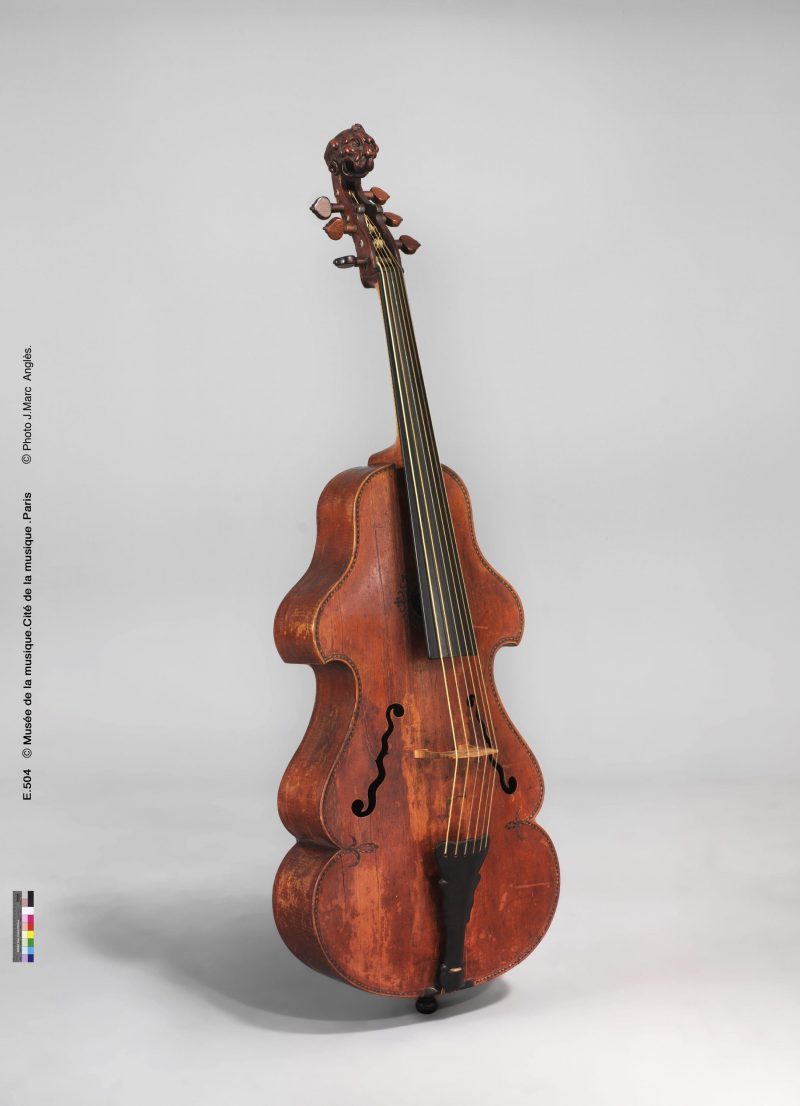
The enormous online collection houses, virtually, tens of thousands of instruments from over two dozen regions around the globe. (There are 64,259 instruments in total.) Find an Italian Basse de Viole (above) from 1547 or an ornate Egyptian darabukka (below). And, of course, plenty of iconic—and rare—electric guitars and basses.

You can search instruments by maker, country, city, or continent, time period, museum, and type. (Wind, Percussion, Stringed, Zithers, Rattles, Bells, Lamellaphones, etc….) Researchers may encounter a few language hurdles—MIMO’s about page mentions “searching in six different languages,” and the site actually lists 11 language categories in tabs at the top. But users may still need to plug pages into Google translate unless they read French or German or some of the other languages in which descriptions have been written. Refreshingly consistent, the photographs of each instrument conform to a standard set by the consortium that provides “detailed guidelines on how to set up a repository to enable the harvesting of digital content.”
But enough about the site functions, what about the sounds? Well, in a physical museum, you wouldn’t expect to take a three-hundred-year-old flute out of its case and hear it played. Just so, most of the instruments here can be seen and not heard, but the site does have over 400 sound files, including the enchanting recording of Symphonion Eroica 38a (above), as played on a mechanical clock from 1900.

As you discover instruments you never knew existed—such as the theramin-like Croix Sonore (Sonorus Cross), created by Russian composer Nicolas Obukhov between 1926 and 1934—you can undertake your own research to find sample recordings online, such as “The Third and Last Testament,” below, Obukhov’s composition for 5 voices, organ, 2 pianos, orchestra, and croix sonore. Obukhov’s experiments with instruments of his own invention prompted his experiments in 12-tone composition, in which, he declared, “I forbid myself any repetition.” Just one example among many thousands demonstrating how instrument design forms the basis of a wildly proliferating variety of musical expressions that can start to seem endless after a while.
via @dark_shark
Related Content:
Watch a Musician Improvise on a 500-Year-Old Music Instrument, The Carillon
Musician Plays the Last Stradivarius Guitar in the World, the “Sabionari” Made in 1679
Josh Jones is a writer and musician based in Durham, NC. Follow him at @jdmagness
Read More...Visit a Gallery of 300 Striking Posters from the May 1968 Uprising in Paris

Among the many other 50ths commemorated this year, one will largely go unnoticed by the U.S. press, given that it happened in France, a country we like to ignore as much as possible, and concerned the politics of anarchists and communists, people we like to pretend don’t exist except as caricatures in scare-mongering cartoons. But the French remember May 1968, and not only on its fiftieth. The wildcat strikes, student marches, and barricades in the Latin Quarter haunt French politics. “We’re slightly prisoners of a myth,” laments historian Danielle Tartakowsky.

The international historical events surrounding the strikes and marches are well-known or should be. The founding ethos of the movement, Situationism, perhaps less so. Reading Guy Debord’s Society of the Spectacle and the 1968 movement’s other essential texts can feel like looking into a funhouse mirror.
The 1966 pamphlet manifesto that began the student agitation—“On the Poverty of Student Life”—might sound mighty familiar: it has no kind words for consumerist student radicals who “convert their unconscious contempt into a blind enthusiasm.” Yet they have been attacked, it clarifies, “from the wrong point of view.”

Since we seem to be, in some denatured way, reliving events of fifty years ago, the thinking of that not-so-distant moment illuminates our circumstances. “If there’s one thing in common between 1968 and today,” remarks Antoine Guégan, whose father Gérard staged Paris campus sit-ins, “it’s young people’s despair. But it’s a different kind of despair…. Today’s youth is facing a moment of stagnation, with little to lean on.” Despite the riotous, bloody nature of the times, a global movement then found reason for hope.

We see it reflected in the defiant art and cinema of the time, from revolutionary work by a 75-year-old Joan Miró to vérité film by 20-year-old wunderkind Philippe Garrel. And we see it, especially, in the huge number of posters printed to advertise the movement, radical graphic designs that illustrate the exhilaration and defiance of the loose collective of Marxists-Leninists, Trotskyites, Maoists, Anarchists, Situationists, and so on who propelled the movement forward.

Last year, we featured a gallery of these arresting images from the Atelier Populaire, a group of artists and students, notes Dangerous Minds, which “occupied the École des Beaux-Arts and dedicated its efforts to producing thousands of silk-screened posters using bold, iconic imagery and slogans as well as explicitly collective/anonymous authorship.” Today, we bring you a huge gallery of more than 300 such images, housed online at Victoria University in the University of Toronto.

Some of the images are downloadable. You can request downloads of others from the university library for private use or publication. These posters represent a movement confronting an oppressive society with its own logic, a society of which Debord wrote just the previous year, “the spectacle is not a collection of images; it is a social relation between people that is mediated by images.” There is no understanding of the events of May 1968 without an understanding of its visual culture as, Debord wrote, “a means of unification.” Enter the gallery of posters and prints here.
Related Content:
A Gallery of Visually Arresting Posters from the May 1968 Paris Uprising
Bed Peace Revisits John Lennon & Yoko Ono’s Famous Anti-Vietnam Protests
Josh Jones is a writer and musician based in Durham, NC. Follow him at @jdmagness
Read More...How Master Japanese Animator Satoshi Kon Pushed the Boundaries of Making Anime: A Video Essay
To casual viewers, most Japanese animation (at least apart from the elegant work of Hayao Miyazaki and his collaborators at Studio Ghibli) can look like a pretty unsophisticated and even disreputable affair, characterized by crude flashiness, convoluted storylines, and bizarre, sophomoric humor. All those things do, of course, exist in the realm of anime, but only because everything does: if Japan’s version of animation often rises above those of other cultures, it does so as a result of that culture regarding animation as simply cinema by other means. And any cinematic form will inevitably produce diverse virtuosity: to see how a master Japanese animator can have a sensibility completely different from that of Miyazaki, look no further than Satoshi Kon.
“Even if you don’t know his work, you have certainly seen some of these images,” says Every Frame a Painting’s Tony Zhou in the series’ video essay on Kon’s work, which includes the internationally acclaimed films Perfect Blue, Tokyo Godfathers, and Paprika.
“He is an acknowledged influence on both Darren Aronofsky and Christopher Nolan, and he has a fan base that includes just about everyone who loves animation.” The essay shows us how those two Western live-action auteurs, among Kon’s other fans, have borrowed his images for their own stories, just as Kon, in turn, drew a great deal of inspiration from a similarly unlikely source: George Roy Hill’s 1972 cinematic adaptation of Kurt Vonnegut’s novel Slaughterhouse-Five.
More specifically, Kon drew inspiration from the film’s inventive and surprising cuts from one scene to another, a formal reflection of its chronology-and-geography-jumping protagonist’s state of being “unstuck in time.” Throughout his decade-long feature filmmaking career, Kon “was constantly showing one image and then revealing that it wasn’t what you thought it was.” Kon died in 2010, having “pushed animation in ways that aren’t really possible in live action, not just elastic images but elastic editing, a unique way of moving from image to image, scene to scene.” His accomplishments live on not just in his own work, but in all the ways the creators who admire it continue to adapt his innovations for their own, even in the traditionally “respectable” forms of cinema.
Related Content:
The Art of Hand-Drawn Japanese Anime: A Deep Study of How Katsuhiro Otomo’s Akira Uses Light
How the Films of Hayao Miyazaki Work Their Animated Magic, Explained in 4 Video Essays
Based in Seoul, Colin Marshall writes and broadcasts on cities and culture. His projects include the book The Stateless City: a Walk through 21st-Century Los Angeles and the video series The City in Cinema. Follow him on Twitter at @colinmarshall or on Facebook.
Read More...Stephen Hawking’s Final Theory of the Cosmos Now Published & Available Online

Image by NASA, via Wikimedia Commons
In the weeks before he died, Stephen Hawking wrote what would be his final theory of the cosmos. Co-written with Belgian physicist Thomas Hertog, and now published in the Journal of High Energy Physics, “A smooth exit from eternal inflation?” asserts that “reality may be made up of multiple universes, but each one may not be so different to our own.” Or so that’s how the theory gets translated into colloquial English by The Guardian. You can read an abstract of the theory here, or the complete published version here.
If you would like to support the mission of Open Culture, consider making a donation to our site. It’s hard to rely 100% on ads, and your contributions will help us continue providing the best free cultural and educational materials to learners everywhere. You can contribute through PayPal, Patreon, and Venmo (@openculture). Thanks!
Related Content:
The Big Ideas of Stephen Hawking Explained with Simple Animation
Stephen Hawking’s Lectures on Black Holes Now Fully Animated with Chalkboard Illustrations
The Map of Physics: Animation Shows How All the Different Fields in Physics Fit Together
Read More...Support Us
We're hoping to rely on loyal readers, rather than erratic ads. Please click the Donate button and support Open Culture. You can use Paypal, Venmo, Patreon, even Crypto! We thank you!

About Us

Open Culture scours the web for the best educational media. We find the free courses and audio books you need, the language lessons & educational videos you want, and plenty of enlightenment in between.
Advertise With Us

FREE UPDATES!
GET OUR DAILY EMAIL
Get the best cultural and educational resources on the web curated for you in a daily email. We never spam. Unsubscribe at any time.
FOLLOW ON SOCIAL MEDIA

Open Culture editor Dan Colman scours the web for the best educational media. He finds the free courses and audio books you need, the language lessons & movies you want, and plenty of enlightenment in between.
Advertise With Us


