A Cinematic Journey Through Paris, As Seen Through the Lens of Legendary Filmmaker Éric Rohmer: Watch Rohmer in Paris
Note: The film starts around the 30 second mark.
Site of so many historic screenings, cradle of so many innovative auteurs, setting of so many memorable scenes: does any city have a more central place in the cinephile’s consciousness than Paris? Filmmaker-professor Richard Misek calls it “the city where cinephilia itself began.” It certainly has a place in his own cinephilic journey, beginning with a chance encounter, 24 years ago in the district of Montmartre, with one of the luminaries of French New Wave film: Éric Rohmer, who was then in the middle of shooting his picture Rendezvous in Paris. “I only realized this fourteen years later, when I saw the film late one night on television,” Misek says. “It was the first Rohmer film I’d ever seen — and I was in it.”
He tells this story early in Rohmer in Paris, his hour-long video essay on all the ways the auteur used the city in the course of his prolific, more than fifty-year-long filmmaking career. Misek describes Rohmer’s characters, “always glancing at each other: on trains, on streets, in parks, in the two-way shop windows of cafes where they can see and be seen,” as flâneurs, those observant strollers through the city whose type has its origins in the Paris of the 19th century. “But their walks are restricted to lunch hours and evenings out. They form detours from less leisurely trajectories: the lines of a daily commute.” With ever-increasing rigor, the director “traces every step of his characters’ journeys through the city with topographic precision. His characters follow actual paths through Paris, paths that can be drawn as lines on the city’s map.”
Though Rohmer did have his differences, aesthetically as well as politically, with his colleagues in the French New Wave, “in one way, at least, he always stayed faithful to the spirit of the nouvelle vague: throughout his life, Rohmer didn’t just film Paris, he documented it.” Cutting up and deliberately re-arranging thousands of pieces of image and sound in Rohmer’s dozens of shorts and features, placing side-by-side shots of the same Parisian spaces years and even decades apart, Misek shows us how Rohmer cinematically illustrates “one of the basic truths about urban existence: in cities, humans’ lives intersect every day. But most of these intersections are transitory, crossed paths between two people following different trajectories.”
Rohmer didn’t always film in Paris. As his career went on, he told more stories that depart from the city, but then, those stories also usually return to it: ultimately, almost all of his characters find that “Paris cannot be transcended.” Watch just one of Rohmer’s films, and you’ll see how little interest he has in romanticizing the City of Light, yet the words of one character in Full Moon in Paris might also be his own: “The air is foul, but I can breathe,” he declares. “I need to be at the center, in the center of a country, in a city center that’s almost the center of the world.”
Just as Rohmer demonstrates the inexhaustibility of Paris with his filmography, Misek demonstrates the inexhaustibility of that filmography with Rohmer in Paris, which he has recently released into the public domain and made free to watch online. It provides real insight into the work of Éric Rohmer, the city in which he became a cinephile and then a filmmaker, and how the two repeatedly intersect with one another over the second half of the 20th century and the beginning of the 21st. But it also implies an answer, in the affirmative, to another, more general proposition that Misek raises early in the essay: “I can’t help but wonder if cinephilia is a journey without end.”
Related Content:
Tuileries: The Coen Brothers’ Short Film About Steve Buscemi’s Very Bad Day in the Paris Metro
Portland, the City in Cinema: See the City of Roses as it Appears in 20 Different Films
Vancouver Never Plays Itself
Based in Seoul, Colin Marshall writes and broadcasts on cities and culture. His projects include the book The Stateless City: a Walk through 21st-Century Los Angeles and the video series The City in Cinema. Follow him on Twitter at @colinmarshall or on Facebook.
Read More...Igor Stravinsky Remembers the “Riotous” Premiere of His Rite of Spring in 1913: “They Were Very Shocked. They Were Naive and Stupid People.”
It can be a little hard to take the word “riot” seriously when applied to a contentious ballet performance, given how regularly we now see police with machine guns, shields, and tanks rolling down city streets to overpower protesting citizens. But that is the word that has come down to us for the fracas that greeted the debut of Serge Diaghilev and Igor Stravinsky’s Rite of Spring in Paris in 1913. The idea of a riot seems all the more incongruous, and funny, when considered in the light of Jean Cocteau’s description of the crowd:
The smart audience in tails and tulle, diamonds and ospreys, was interspersed with the suits and bandeaux of the aesthetic crowd. The latter would applaud novelty simply to show their contempt for the people in the boxes… Innumerable shades of snobbery, super-snobbery and inverted snobbery were represented.
This Parisian smart set came together on that evening of May 29th expecting “something potentially outrageous,” writes The Telegraph’s classical critic Ivan Hewett. Diaghilev’s Ballet Russes had previously “entranced and shocked Paris.”
Stravinsky was acquiring a reputation as a musical provocateur, having built his score for 1910’s The Firebird around the dissonant “Devil’s Interval.” Nonetheless, as the Rocketboom video below, “The Riot of Spring,” explains, audiences packed into the Théâtre des Champs-Élysées had no preparation for what they would see, and hear, when the curtain arose.
And what was that? A “high, almost strangled bassoon melody,” Hewett writes, “soon draped with fluttering, twittering woodwind sounds” set to “pulsating rhythms.” Choreographer Vaslav Nijinsky’s dancers “seemed pulled down to earth. Their strange, jerky movements and awkward poses defied every canon of gracefulness.” The audience reacted immediately, shouting and attacking one another: “canes were brandished like menacing implements of combat all over the theater.” Stravinsky himself remembers the theatergoers reactions with disdain in a short interview excerpt at the top.
“The storm broke,” he says, once the curtain opened on a group of “knock-kneed… Lolitas jumping up and down.” The audience “came for Scheherazade or Cleopatra, and they saw Le Sacre du Printemps. They were very shocked. They were very naïve and stupid people.” Did Stravinsky really not anticipate the degree of unrest his weird, dissonant ballet might provoke? It seems not. He hoped it would be a bigger hit than his widely-praised Petrushka of three years earlier. “From all indications,” he had written to set designer Nicholas Roerich, “I can see that this piece is bound to ‘emerge’ in a way that rarely happens.” This proved true, but not at all in the way he meant it.
For his part, writes Hewett, Diaghilev “was hoping for something more than an emergence. He wanted a scandal.” James Wolcott, in his account of the evening, Wild in the Seats, argues that the Russian impresario had “a genius for publicity that wouldn’t be matched until the advent of Andy Warhol and the pop cult of celebrity.” He knew he needed to rattle the “jaded elegants,” who “weren’t going to be stimulated by the same melting, yearning pantomime in pointe shoes.” The Rite of Spring premiere remains the most infamous scandal in the history of ballet to this day.
But while the sophisticates battled it out in the aisles, screaming over the orchestra, pulling down each other’s top hats, it’s said, and challenging each other to duels, a few spectators, Cocteau included, sat entranced by the performance. The work, he later wrote, “is, and will remain, a masterpiece: a symphony impregnated with wild pathos, with earth in the throes of birth, noises of farm and camp, little melodies that come to us out of the depths of the centuries, the panting of cattle, profound convulsions of nature, prehistoric georgics.”
See the opening movements performed above by the Joffrey Ballet in 1987, and imagine yourself in the midst of Paris’s highest society convulsing in a riotous outcry. What was so upsetting? “Perhaps the riot was a sign of disquiet,” Hewett speculates, “a feeling that that the world had lost its moorings, and that barbarism was about to be let loose in the streets.” According to eyewitnesses, some disturbed spectators even called in the police. You can learn much more about this fascinating history at the free Harvard edX course, “Stravinsky’s Rite of Spring: Modernism, Ballet, and Riots.”
Related Content:
Stravinsky’s The Rite of Spring, Visualized in a Computer Animation
Stravinsky’s “Illegal” Arrangement of “The Star Spangled Banner” (1944)
Josh Jones is a writer and musician based in Durham, NC. Follow him at @jdmagness
Read More...Chess Grandmaster Garry Kasparov Relives His Four Most Memorable Games
FYI: If you sign up for a MasterClass course by clicking on the affiliate links in this post, Open Culture will receive a small fee that helps support our operation.
Many consider Garry Kasparov one of the greatest chess players of all time. And for good reason. In 1985, at the age of 22, Kasparov defeated the reigning champion Anatoly Karpov. From that moment, until his retirement in 2005, he dominated. For the next 225 out of 228 months, he was the #1 ranked player in the game. Above, in a video created by The New Yorker, Kasparov “replays some of his most unforgettable games,” and “relives the happiest and the most painful moments of his career,” including:
- Garry Kasparov vs. Anatoly Karpov: World Championship Match 1985
- Garry Kasparov vs. Anatoly Karpov: World Championship Match 1987
- Garry Kasparov vs. Viswanathan Anand: PCA-GP Credit Suisse Rapid Final Blitz Playoff 1996
- Garry Kasparov vs. Deep Blue: I.B.M. Man vs. Machine 1997
In recent months, Kasparov has also created an online course for Masterclass, Garry Kasparov Teaches Chess, which–in 29 video lessons–offers a deeper exploration of his chess theory, tactics, and strategy.
If you would like to support the mission of Open Culture, consider making a donation to our site. It’s hard to rely 100% on ads, and your contributions will help us continue providing the best free cultural and educational materials to learners everywhere. You can contribute through PayPal, Patreon, and Venmo (@openculture). Thanks!
Related Content:
A Free 700-Page Chess Manual Explains 1,000 Chess Tactics in Plain English
Claymation Film Recreates Historic Chess Match Immortalized in Kubrick’s 2001: A Space Odyssey
A Human Chess Match Gets Played in Leningrad, 1924
Play Chess Against the Ghost of Marcel Duchamp: A Free Online Chess Game
Watch Bill Gates Lose a Chess Match in 79 Seconds to the New World Chess Champion Magnus Carlsen
Read More...The Science of Beer: A New Free Online Course Promises to Enhance Your Appreciation of the Timeless Beverage

The brewing of beer is as old as agriculture, which is to say as old as settled civilization. The oldest recipe we know of dates to 1800 B.C. Over centuries, beer moved up and down the class ladder depending on its primary consumers. Medieval monks brewed many fine varieties and were renowned for their technique. Beer descended into pubs and rowdy beer halls, whetting the whistles not only of farmers, soldiers, sailors, and pilgrims, but also of burghers and a budding industrial workforce. During the age of modern empire, beer became, on both sides of the Atlantic, the beverage of working-class sports fans in bleachers and La-Z-Boys.
A craft beer Renaissance at the end of last century brought back a monkish mystique to this most ancient beverage, turning beer into wine, so to speak, with comparable levels of connoisseurship. Beer bars became galleries of fine polished brass, pungent, fruity aromas, dark and serious wood appointments. Craft beer is fun—with its quirky names and labels—it is also intimidating, in the breadth of complicated concoctions on offer. (Hipsters and penurious revelers revolted, made a fetish of Pabst Blue Ribbon, Milwaukee’s Best, and ye olde malt liquor.)
“Has craft beer peaked?” wonders The Washington Post’s Rachel Siegel. You can probably guess from the question that most trends point to “yes.” But as long as there is wheat, barley, and hops, we will have beer, no matter who is drinking it and where. One lasting effect of beer’s highbrow few decades remains: a popular scholarly appreciation for its culture and composition. You can study the typography of beer, for example, as Print magazine has done in recent years. A new online course applies the tools of empirical and sociological research to beer drinking.
“The Science of Beer,” taught by a cadre of student teachers from Wageningen University in Holland, explores “how [beer is] made, the raw materials used, its supply chain, how it’s marketed and the effect of beer consumption on your body.” (This last point—in a world turned against sugar, carbs, and gluten—being partly the reason for craft beer’s decline.) Should your voice quaver when you approach the upscale reclaimed walnut bar and survey unfamiliar lagers, ales, stouts, bocks, porters, and hefeweizens… should you hesitate at Whole Foods when faced with a wall of beverages with names like incantations, this free class may set you at ease.
Not only will you learn about the different types of beer, but “after this course, tasting a beer will be an entirely new sensation: you will enjoy it even more since you will better understand what’s inside your drink.” Enrollment for the 5‑week course began this past Monday and the class is currently open and free. (Make sure you select the “Audit” option for the free version of the course.) You should expect to devote 2 to 4 hours per week to “The Science of Beer.” Please, study responsibly.
Related Content:
Discover the Oldest Beer Recipe in History From Ancient Sumeria, 1800 B.C.
The First Known Photograph of People Sharing a Beer (1843)
Josh Jones is a writer and musician based in Durham, NC. Follow him at @jdmagness
Read More...200+ Films by Indigenous Directors Now Free to View Online: A New Archive Launched by the National Film Board of Canada
The struggles of First Nations peoples in Canada have loomed large in the news, showing a far harsher side of a country Americans tend to caricature as a land of bland niceness, hockey fandom, and socialized medicine. Huge numbers of missing and murdered indigenous women, high rates of suicide, a multitude of health crises, and—as in the U.S.—the ongoing encroachment onto Indigenous lands by toxic pipelines and oilsands development…..
As with issues affecting other beleaguered communities across the globe, suffering from the continued depredations of colonialism and capitalism, these problems can seem so overwhelming that we don’t know how to begin to understand them. As always, the arts offer a way in—through humanizing portraits and intimate revelations, through detailed and compassionate stories, through creativity, humor, and beauty.
In March of this year, the National Film Board of Canada launched an “extensive online library of over 200 films by Indigenous directors,” reports the CBC, “part of a three-year Indigenous Action Plan to ‘redefine’ the NFB’s relationship with Indigenous peoples.” You can read the NFB’s plan here, a response to “the work and recommendations of the Truth and Reconciliation Commission of Canada.”
Their free online film collection is searchable by subject, director, or Indigenous people or nation, writes Native News Online, and “many of the films in this collection are currently being screened in communities right across Canada as part of the #Aabiziingwashi (#WideAwake) Indigenous cinema screening series.”
Some of the highlights of the collection include Alanis Obomsawin’s The People of the Kattawapiskak River (top), a 2012 documentary that Judith Schuyler, of the Toronto-based ImagineNATIVE film organization, describes as “highlighting the government, the diamond mines and the skyrocketing freight costs as the contributing factors keeping the [Kattawapiskak] community in impoverished third world conditions.” Below it, see Lumaajuuq, a beautifully-animated short 2010 film by Alethea Arnaquq-Baril that tells the Inuit story of “The Blind Man and the Loon.”
Further up, see First Stories—Two Spirited, a 2007 film by Sharon A. Desjarlais that filmmaker Bretten Hannam describes as “a message of hope and healing not only for two-spirit people, but for all indigenous people,” and, just above, Dennis Allen’s CBQM, a documentary about a radio station in Fort McPherson, Northwest Territories, which ImagineNative’s Jason Ryle describes as “a tender, intimate portrait of a northern community.”
Native News Online and the CBC list several other recommendations from the collection, or you can simply dive in and start watching here. Also, check out this crash course on rising Indigenous filmmakers. And if at any point you feel inspired to don the garb of a First Nations people and hit the clubs or music festivals, well, maybe heed the ultra-short public service announcement, “Naked Island—Hipster Headdress,” below, and “Just Don’t Do It.”
Related Content:
265 Free Documentaries Online
1,150 Free Movies Online: Great Classics, Indies, Noir, Westerns, etc.
An Archive of 20,000 Movie Posters from Czechoslovakia (1930–1989)
Martin Scorsese Create a List of 38 Essential Films About American Democracy
Josh Jones is a writer and musician based in Durham, NC. Follow him at @jdmagness
Read More...Watch Life on the Streets of Tokyo in Footage Recorded in 1913: Caught Between the Traditional and the Modern
What cities have, over the past century, defined in our imaginations the very concept of the city? Obvious choices include New York and London, and here on Open Culture we’ve featured historic street-level footage of both (New York in 1911, London between 1890 and 1920) that vividly reveals how, even over a hundred years ago, they’d already matured as commercially, technologically, and demographically impressive metropolises. At the turn of the 20th century, the 6.5 million-strong London ranked as the most populous city on Earth, and New York had overtaken it within a few decades. But by the mid-1960s, a new contender had suddenly risen to the top spot: Tokyo.
Historically speaking, of course, the word “new” doesn’t quite apply to the Japanese capital, since as a settled area it goes back to the third millennium BC. But Tokyo didn’t become the capital, effectively, until 1869 (not that even today’s denizens of Kyoto, the country’s previous capital, seem ever to have ceded the distinction in their own minds), around the same time that the previously closed-off island nation opened up to the rest of the world. Provided by Amsterdam’s EYE Filmmuseum, the footage at the top of the post dates from less than half a century thereafter and conveys something of what it must have felt like to live in not just a country zealously engaged in the project of modernization, but in the very center of that project.
These clips were shot on the streets of Tokyo in 1913 and 1915, just after the death of Emperor Meiji, who since 1868 had presided over the so-called Meiji Restoration. That period saw not just a re-consolidation of power under the Emperor, but an assimilation of all things Western — or at least an assimilation of all things Western that official Japan saw as advantageous in its mission to “catch up” with the existing world powers. For the citizens of Tokyo, these, most benignly, included urban parks: “Japanese enjoy to the fullest the pleasures afforded by the numerous parks of the Empire,” says one of the film’s title cards. “Uyeno Park, Tokio, is a very popular place, especially on Sunday afternoons.” But then, going by what we see in the footage, every place in Tokyo seems popular.
On the brink of thoroughgoing urbanization, the cityscape includes shrines, woodblock prints, signs and banners filled to bursting with text (and presumably color), and hand-painted advertisements for the then-novelty of the motion picture. The Tokyoites inhabiting it wear traditional kimono as well as the occasional Western suit and hat. Young men pull rickshaws and ride bicycles (those latter having grown much more numerous since). Peripatetic merchants sell their wares from enormous wooden frames strapped to their backs. Countless children, both in and out of school uniform, stare curiously at the camera. None, surely, could imagine the destruction soon to come with the 1923 Kanto Earthquake, let alone the firebombing of World War II — nor the astonishingly fast development thereafter that would, by the time of the reborn city’s 1964 Olympic Games, make it the largest in the world.
Related Content:
Immaculately Restored Film Lets You Revisit Life in New York City in 1911
The Oldest Known Footage of London (1890–1920) Features the City’s Great Landmarks
Berlin Street Scenes Beautifully Caught on Film (1900–1914)
Download Hundreds of 19th-Century Japanese Woodblock Prints by Masters of the Tradition
Based in Seoul, Colin Marshall writes and broadcasts on cities and culture. His projects include the book The Stateless City: a Walk through 21st-Century Los Angeles and the video series The City in Cinema. Follow him on Twitter at @colinmarshall or on Facebook.
Read More...Enter an Online Interactive Documentary on M.C. Escher’s Art & Life, Narrated By Peter Greenaway
Despite their enormous popularity, the enigmatic works of Dutch artist M.C. Escher have not, perhaps, received their due in the high art world. But he is beloved by college-dorm-room-decorators, Haight-Ashbury hippies, mathematicians, doctors, and dentists, who put his art on their walls, says Micky Pillar, former curator of the Escher Museum in The Hague, because “they think it’s a great way of getting people engaged and forgetting about reality.” Mathematical giants Roger Penrose and HSM Coxeter “were dazzled by Escher’s work as students in 1954,” notes The Guardian’s Maev Kennedy. Mick Jagger was a huge fan, though Escher turned him down when asked to draw an album cover, annoyed at being addressed by his first name (Maurits).
Escher, says Ian Dejardin—director of the Dulwich Picture Gallery in London—“may have been the only person in the world who had never heard of the Rolling Stones.” It wasn’t that he ignored the world around him, but that he focused his career on inventing another one, taking inspiration first from the Italian countryside and cityscapes, after settling in Rome, and later turning to what he called “mental imagery”: the paradoxical portraits, fantastical shifting shapes, and mind-bending patterns, so absorbing that people in waiting rooms forget their discomfort and anxiety when looking at them.
One of the most famous of such works, 1939’s Metamorphosis II, owes its creation to the historical pressures of Italian fascism and the geometric fascinations of Islamic art. After leaving Rome in 1935 as political tensions rose, Escher found himself inspired by his second visit to The Alhambra in Spain. Its “lavish tile work,” as the National Gallery of Art writes, “suggested new directions in the use of color and the flattened patterning of interlocking forms.” So intricate and technically dazzling is the four-meter-long print that it merits an in-depth look at its context and composition.

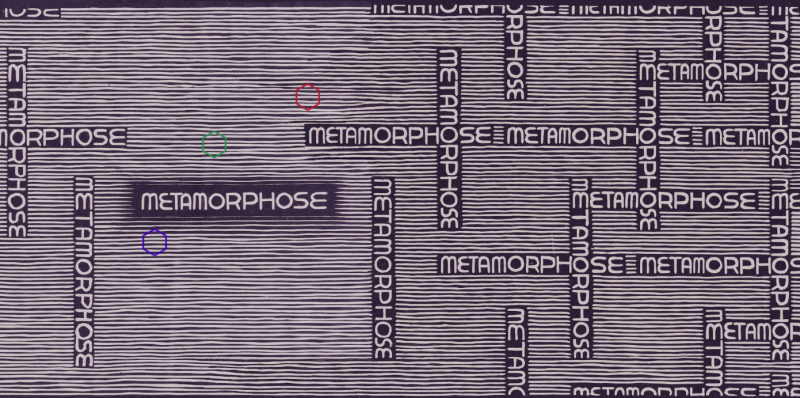
That’s exactly what you’ll find at a new “interactive documentary” on Metamorphosis II, by the makers of a similar feature on Hieronymus Bosch’s Garden of Earthly Delights. The online resource lets users scroll across the print, zooming in to an extraordinary level of detail, or zooming out to see how it transitions section by section, from the word “metamorphose,” to a checkerboard pattern, to lizards, honeycombs, bees, hummingbirds, fish, etc.. Along the way, you can click on little colored hexagons (that transform into cubes) and bring up short articles on Escher’s life and aspects of the work at hand. Each of these featurettes is narrated (in the English version) by British filmmaker and artist Peter Greenaway. Once you open one of these explanatory windows, a navigation tool (above) appears at the bottom of the screen.
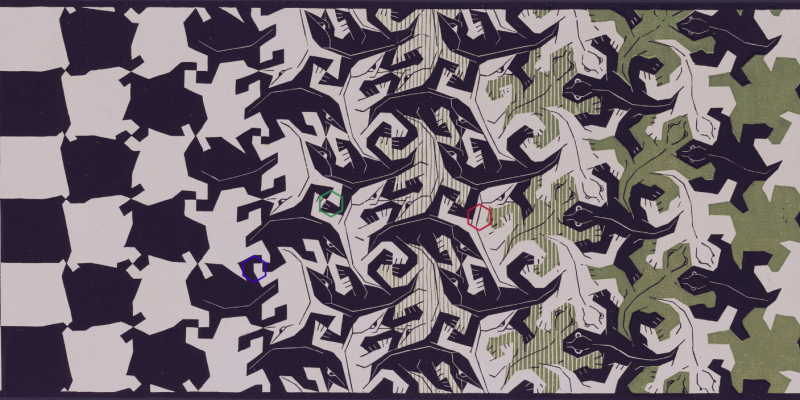
We see how the various animals in Escher’s “systematic tessellations,” as he called them, were chosen by virtue of their shape as well as Escher’s interest in their life cycles and methods of organization. “Nature was a source of wondrous beauty for Escher,” the documentary explains. “In his journals and letters, he often wrote about what surprised, amazed or moved him” in the natural world. Some of the Metamorphosis II sections appeared in later works like 1943’s Reptiles. Escher drew attention both to the natural world’s variety and its genius for repeated patterns. But the movement from one animal to the next has nothing to do with zoology.
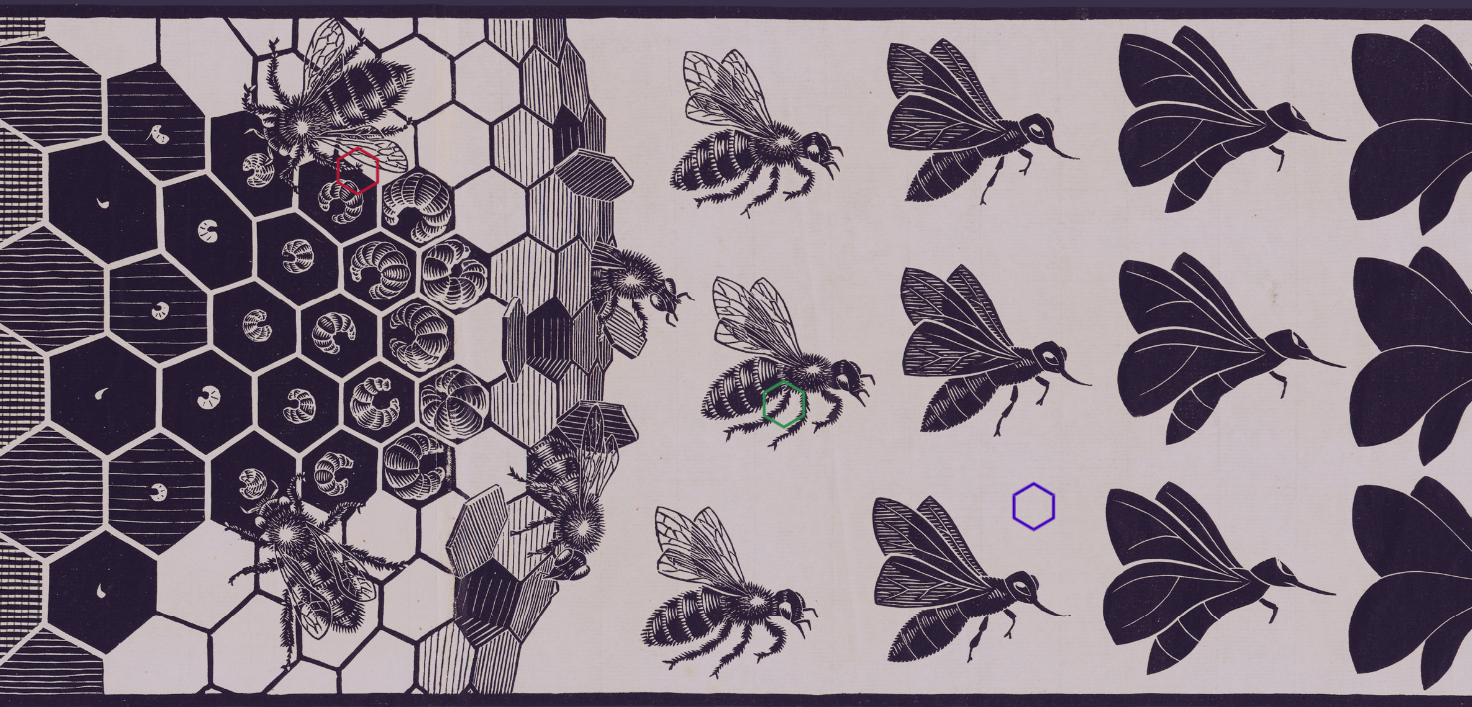
Escher delighted in playing “mind association games.” We learn that as a child, “he would lie in bed and think of two subjects for which he had to create a logical connection.” In one example he gave, he would attempt to find his way from “a tram conductor to a kitchen chair.” Metamorphosis II gives us a visual representation of such games, mental leaps that challenge our sense of the order of things. The documentary situates this fascinating work in a historical and aesthetic context that allows us to make sense of it while adding to our appreciation for its strangeness, offering several different ways of approaching the work, as well as an invitation to make your own.
One feature, the “Metamorphosis Machine,” lets you choose from a selection of starting and ending patterns. Then it fills in the transformation in the middle. The results are hardly Escher-quality, but they are a fun and accessible way of understanding the work of an artist whose vision can seem forbidding, with its impossible spaces and disorienting transformations. Enter the Metamorphosis II interactive documentary here.
Related Content:
M.C. Escher Cover Art for Great Books by Italo Calvino, George Orwell & Jorge Luis Borges
Josh Jones is a writer and musician based in Durham, NC. Follow him at @jdmagness
Read More...Watch the Trailer for a Stunning New 70-Millimeter Print of Stanley Kubrick’s 2001: A Space Odyssey, Released by Christopher Nolan on the Film’s 50th Anniversary
Sure, you’ve probably seen 2001: A Space Odyssey. But have you experienced 2001: A Space Odyssey? That particular verb no doubt implies different conditions to different people. Maybe it means having seen the film during its initial 1968 release. Maybe it means having seen it at a certain… height of consciousness. Maybe it means having seen it in the large-format Cinerama screenings that happened again when it was re-released during the actual year 2001 — as I did, not having been born yet in 1968. Neither was Christopher Nolan, who, perhaps for that reason, has struck a brand new 70-millimeter print of Stanley Kubrick and Arthur C. Clarke’s singular vision of a humanity thrust into previously unimaginable encounters with intelligences both extraterrestrial and artificial.
“The film took for granted a broad cultural tolerance, if not an appetite, for enigma, as well as the time and inclination for parsing interpretive mysteries,” writes Dan Chiasson in a recent New Yorker piece on 2001’s 50th anniversary. “If the first wave of audiences was baffled, it might have been because 2001 had not yet created the taste it required to be appreciated. Like Ulysses, or The Waste Land, or countless other difficult, ambiguous modernist landmarks, 2001 forged its own context. You didn’t solve it by watching it a second time, but you did settle into its mysteries.”
Half a century later, 2001 stands as one of the most firmly driven pillars of cinematic culture — a monolith, you might say — and one of the most successful film directors alive has invited us all to share in his worship at its base.
“One of my earliest memories of cinema is seeing Stanley Kubrick’s 2001: A Space Odyssey, in 70mm, at the Leicester Square Theatre in London with my father,” Nolan says in the press materials for the release of the new print. “This is a true photochemical film recreation. There are no digital tricks, remastered effects, or revisionist edits. This is the unrestored film — that recreates the cinematic event that audiences experienced fifty years ago. ” You can see its trailer at the top of the post, and if you’ll happen to be at the Cannes Film Festival next month, you might consider catching its premiere screening on May 12th. If not, its wider release begins in American theaters on May 18th, so do keep an eye on your local art-house listings, especially for those art houses equipped to screen in 70-millimeter, a format that makes “the ultimate trip,” as 2001’s late-60s posters hastily re-branded it, that much more so.
Related Content:
Kubrick’s 2001: A Space Odyssey Gets a Brand New Trailer to Celebrate Its Digital Re-Release
1966 Film Explores the Making of Kubrick’s 2001: A Space Odyssey (and Our High-Tech Future)
James Cameron Revisits the Making of Kubrick’s 2001: A Space Odyssey
Did Stanley Kubrick Invent the iPad in 2001: A Space Odyssey?
Based in Seoul, Colin Marshall writes and broadcasts on cities and culture. His projects include the book The Stateless City: a Walk through 21st-Century Los Angeles and the video series The City in Cinema. Follow him on Twitter at @colinmarshall or on Facebook.
Read More...The Salvador Dalí Action Figure
First came the Frida Kahlo Action Figure, the Edvard Munch Scream Action Figure, and the Vincent Van Gogh Action Figure, Complete with Detachable Ear. And soon they can all pal around with the Salvador Dalí Action Figure.
With six days to go, 693 backers have pledged $15,676 to a Kickstarter campaign that’s hoping to raise a total of $26,158. Should they reach that goal, a company called Today Is Art Day will put into production a charming Dali figure. Standing five inches tall, the figure “comes with 3 sets of wacky interchangeable mustaches” and “deluxe mustaches made of stainless steel.” The Dalí figure “holds his signature melting clock,” and there are five Dalí masterpieces to display on a miniature easel. Apparently endorsed by the Gala-Salvador Dalí Foundation, the figure should go into production this August. Help Kickstart things here.
Related Content:
The Edvard Munch Scream Action Figure
The Frida Kahlo Action Figure
The Vincent Van Gogh Action Figure, Complete with Detachable Ear
Read More...Immaculately Restored Film Lets You Revisit Life in New York City in 1911
Other than one or two of the world’s supercentenarians, nobody remembers New York in 1911. Plenty of living historians and enthusiasts of the city have paid intensive attention to that booming time period when the city’s population fast approached five million, but none experienced it first-hand. They, and we, can get no closer to it than watching the footage above, originally shot by a Swedish documentary team which set out to capture the most celebrated places in the world at the time, a list also including Niagara Falls, Paris, Monte Carlo, and Venice. The practically immaculate condition of the film highlights both the similarities and differences between the street life of New York over a century ago and of New York today.
Take a look at the tailored or tailored-looking clothing on nearly everyone, even the one-legged man making his deliberate way past the Chinese grocery. Then as now, most New Yorkers got around on foot, and since the city’s first subway line had opened just seven years before, the dominant public transit options remained streetcars and elevated trains.
In the realm of private vehicles, horse-drawn carriages had only just begun to give way to motorcars. (Since 1911 was still the age of silent film, the ambient sound of all this was added later.) “Take note of the surprising and remarkably timeless expression of boredom exhibited by a young girl filmed as she was chauffeured along Broadway in the front seat of a convertible limousine,” says the Museum of Modern Art’s notes.
MoMA, which exhibited the footage last year, also points out familiar landmarks: “Opening and closing with shots of the Statue of Liberty, the film also includes New York Harbor; Battery Park and the John Ericsson statue; the elevated railways at Bowery and Worth Streets; Broadway sights like Grace Church and Mark Cross; the Flatiron Building on Fifth Avenue; and Madison Avenue.” Any modern New Yorker halfway interested in the city will know all those places, and even if the city has changed in countless other ways, they’ll sense the very same characteristic vitality in these clips that they feel there today. Will New Yorkers of the future have the same reaction, to, say, the Japanese high-definition video demo footage shot on those very same streets in the 1990s? It’ll take about eighty years to find out. We probably won’t be here by then, but New York certainly will.
Related Content:
1905 Video Shows New York City Subway Traveling From 14th St. to 42nd Street
The Oldest Known Footage of London (1890–1920) Features the City’s Great Landmarks
Berlin Street Scenes Beautifully Caught on Film (1900–1914)
New York City: A Social History (A Free Online Course from N.Y.U.)
Based in Seoul, Colin Marshall writes and broadcasts on cities and culture. His projects include the book The Stateless City: a Walk through 21st-Century Los Angeles and the video series The City in Cinema. Follow him on Twitter at @colinmarshall or on Facebook.
Read More...Support Us
We're hoping to rely on loyal readers, rather than erratic ads. Please click the Donate button and support Open Culture. You can use Paypal, Venmo, Patreon, even Crypto! We thank you!

About Us

Open Culture scours the web for the best educational media. We find the free courses and audio books you need, the language lessons & educational videos you want, and plenty of enlightenment in between.
Advertise With Us

FREE UPDATES!
GET OUR DAILY EMAIL
Get the best cultural and educational resources on the web curated for you in a daily email. We never spam. Unsubscribe at any time.
FOLLOW ON SOCIAL MEDIA

Open Culture editor Dan Colman scours the web for the best educational media. He finds the free courses and audio books you need, the language lessons & movies you want, and plenty of enlightenment in between.
Advertise With Us

