Ernest Hemingway Creates a Reading List for a Young Writer (1934)
In the spring of 1934, a young man who wanted to be a writer hitchhiked to Florida to meet his idol, Ernest Hemingway.
Arnold Samuelson was an adventurous 22-year-old. He had been born in a sod house in North Dakota to Norwegian immigrant parents. He completed his coursework in journalism at the University of Minnesota, but refused to pay the $5 fee for a diploma. After college he wanted to see the country, so he packed his violin in a knapsack and thumbed rides out to California. He sold a few stories about his travels to the Sunday Minneapolis Tribune.
In April of ’34 Samuelson was back in Minnesota when he read a story by Hemingway in Cosmopolitan, called “One Trip Across.” The short story would later become part of Hemingway’s fourth novel, To Have and Have Not. Samuelson was so impressed with the story that he decided to travel 2,000 miles to meet Hemingway and ask him for advice. “It seemed a damn fool thing to do,” Samuelson would later write, “but a twenty-two-year-old tramp during the Great Depression didn’t have to have much reason for what he did.”
And so, at the time of year when most hobos were traveling north, Samuelson headed south. He hitched his way to Florida and then hopped a freight train from the mainland to Key West. Riding on top of a boxcar, Samuelson could not see the railroad tracks underneath him–only miles and miles of water as the train left the mainland. “It was headed south over the long bridges between the keys and finally right out over the ocean,” writes Samuelson. “It couldn’t happen now–the tracks have been torn out–but it happened then, almost as in a dream.”
When Samuelson arrived in Key West he discovered that times were especially hard there. Most of the cigar factories had shut down and the fishing was poor. That night he went to sleep on the turtling dock, using his knapsack as a pillow. The ocean breeze kept the mosquitos away. A few hours later a cop woke him up and invited him to sleep in the bull pen of the city jail. “I was under arrest every night and released every morning to see if I could find my way out of town,” writes Samuelson. After his first night in the mosquito-infested jail, he went looking for the town’s most famous resident.
When I knocked on the front door of Ernest Hemingway’s house in Key West, he came out and stood squarely in front of me, squinty with annoyance, waiting for me to speak. I had nothing to say. I couldn’t recall a word of my prepared speech. He was a big man, tall, narrow-hipped, wide-shouldered, and he stood with his feet spread apart, his arms hanging at his sides. He was crouched forward slightly with his weight on his toes, in the instinctive poise of a fighter ready to hit.
“What do you want?” said Hemingway. After an awkward moment, Samuelson explained that he had bummed his way from Minneapolis just to see him. “I read your story ‘One Trip Across’ in Cosmopolitan. I liked it so much I came down to have a talk with you.” Hemingway seemed to relax. “Why the hell didn’t you say you just wanted to chew the fat? I thought you wanted to visit.” Hemingway told Samuelson he was busy, but invited him to come back at one-thirty the next afternoon.
After another night in jail, Samuelson returned to the house and found Hemingway sitting in the shade on the north porch, wearing khaki pants and bedroom slippers. He had a glass of whiskey and a copy of the New York Times. The two men began talking. Sitting there on the porch, Samuelson could sense that Hemingway was keeping him at a safe distance: “You were at his home but not in it. Almost like talking to a man out on a street.” They began by talking about the Cosmopolitan story, and Samuelson mentioned his failed attempts at writing fiction. Hemingway offered some advice.
“The most important thing I’ve learned about writing is never write too much at a time,” Hemingway said, tapping my arm with his finger. “Never pump yourself dry. Leave a little for the next day. The main thing is to know when to stop. Don’t wait till you’ve written yourself out. When you’re still going good and you come to an interesting place and you know what’s going to happen next, that’s the time to stop. Then leave it alone and don’t think about it; let your subconscious mind do the work. The next morning, when you’ve had a good sleep and you’re feeling fresh, rewrite what you wrote the day before. When you come to the interesting place and you know what is going to happen next, go on from there and stop at another high point of interest. That way, when you get through, your stuff is full of interesting places and when you write a novel you never get stuck and you make it interesting as you go along.”
Hemingway advised Samuelson to avoid contemporary writers and compete only with the dead ones whose works have stood the test of time. “When you pass them up you know you’re going good.” He asked Samuelson what writers he liked. Samuelson said he enjoyed Robert Louis Stevenson’s Kidnapped and Henry David Thoreau’s Walden. “Ever read War and Peace?” Hemingway asked. Samuelson said he had not. “That’s a damned good book. You ought to read it. We’ll go up to my workshop and I’ll make out a list you ought to read.”
His workshop was over the garage in back of the house. I followed him up an outside stairway into his workshop, a square room with a tile floor and shuttered windows on three sides and long shelves of books below the windows to the floor. In one corner was a big antique flat-topped desk and an antique chair with a high back. E.H. took the chair in the corner and we sat facing each other across the desk. He found a pen and began writing on a piece of paper and during the silence I was very ill at ease. I realized I was taking up his time, and I wished I could entertain him with my hobo experiences but thought they would be too dull and kept my mouth shut. I was there to take everything he would give and had nothing to return.
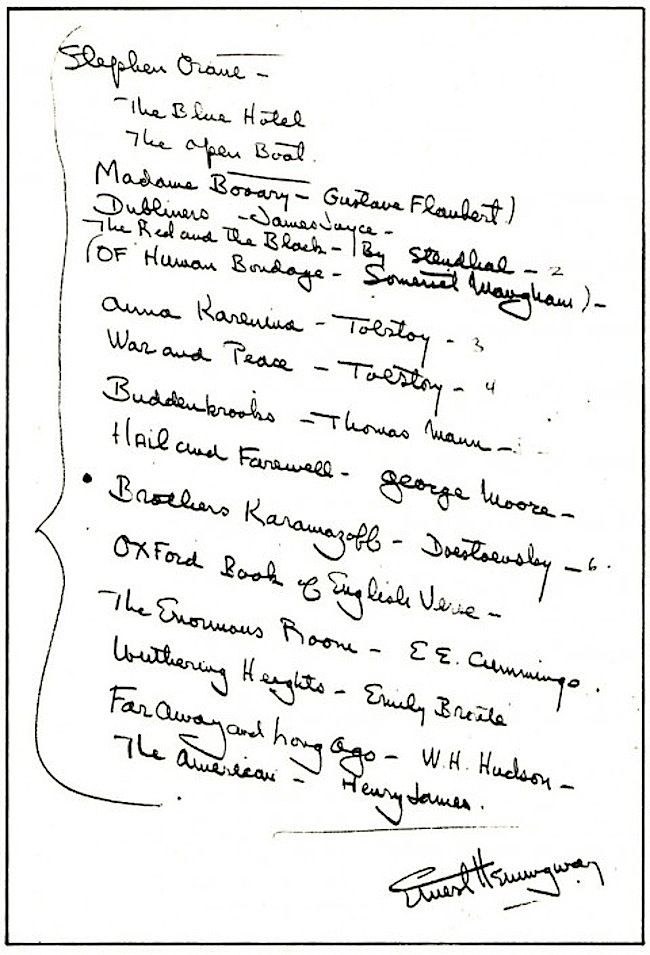
Hemingway wrote down a list of two short stories and 14 books and handed it to Samuelson. Most of the texts you can find in our collection, 800 Free eBooks for iPad, Kindle & Other Devices. If the texts don’t appear in our eBook collection itself, you’ll find a link to the text directly below.
- “The Blue Hotel” by Stephen Crane
- “The Open Boat” by Stephen Crane
- Madame Bovary by Gustave Flaubert
- Dubliners by James Joyce
- The Red and the Black by Stendhal
- Of Human Bondage by Somerset Maugham
- Anna Karenina by Leo Tolstoy
- War and Peace by Leo Tolstoy
- Buddenbrooks by Thomas Mann
- Hail and Farewell by George Moore
- The Brothers Karamazov by Fyodor Dostoyevsky
- The Oxford Book of English Verse
- The Enormous Room by E.E. Cummings
- Wuthering Heights by Emily Bronte
- Far Away and Long Ago by W.H. Hudson
- The American by Henry James
Hemingway reached over to his shelf and picked up a collection of stories by Stephen Crane and gave it to Samuelson. He also handed him a copy of his own novel, A Farewell to Arms. “I wish you’d send it back when you get through with it,” Hemingway said of his own book. “It’s the only one I have of that edition.” Samuelson gratefully accepted the books and took them back to the jail that evening to read. “I did not feel like staying there another night,” he writes, “and the next afternoon I finished reading A Farewell to Arms, intending to catch the first freight out to Miami. At one o’clock, I brought the books back to Hemingway’s house.” When he got there he was astonished by what Hemingway said.
“There is something I want to talk to you about. Let’s sit down,” he said thoughtfully. “After you left yesterday, I was thinking I’ll need somebody to sleep on board my boat. What are you planning on now?”
“I haven’t any plans.”
“I’ve got a boat being shipped from New York. I’ll have to go up to Miami Tuesday and run her down and then I’ll have to have someone on board. There wouldn’t be much work. If you want the job, you could keep her cleaned up in the mornings and still have time for your writing.”
“That would be swell,” replied Samuelson. And so began a year-long adventure as Hemingway’s assistant. For a dollar a day, Samuelson slept aboard the 38-foot cabin cruiser Pilar and kept it in good condition. Whenever Hemingway went fishing or took the boat to Cuba, Samuelson went along. He wrote about his experiences–including those quoted and paraphrased here–in a remarkable memoir, With Hemingway: A Year in Key West and Cuba. During the course of that year, Samuelson and Hemingway talked at length about writing. Hemingway published an account of their discussions in a 1934 Esquire article called “Monologue to the Maestro: A High Seas Letter.” (Click here to open it as a PDF.) Hemingway’s article with his advice to Samuelson was one source for our February 19 post, “Seven Tips From Ernest Hemingway on How to Write Fiction.”
When the work arrangement had been settled, Hemingway drove the young man back to the jail to pick up his knapsack and violin. Samuelson remembered his feeling of triumph at returning with the famous author to get his things. “The cops at the jail seemed to think nothing of it that I should move from their mosquito chamber to the home of Ernest Hemingway. They saw his Model A roadster outside waiting for me. They saw me come out of it. They saw Ernest at the wheel waiting and they never said a word.”
Note: An earlier version of this post originally appeared on our site in May, 2013.
Related Content
18 (Free) Books Ernest Hemingway Wished He Could Read Again for the First Time
Seven Tips From Ernest Hemingway on How to Write Fiction
Christopher Hitchens Creates a Reading List for Eight-Year-Old Girl
Neil deGrasse Tyson Lists 8 (Free) Books Every Intelligent Person Should Read
Ernest Hemingway’s Favorite Hamburger Recipe
Read More...See The Iliad Performed as a One-Woman Show in a Montreal Bar by McGill University Classics Professor Lynn Kozak
Homer’s Iliad staged as a one-woman show? IN A BAR! It’s an outrage. A desecration of a founding work of Western Civilization™. A sure sign of cultural decline.
But wait…. What if McGill University classics professor Lynn Kozak’s performance returns the epic Greek poem to its origins, as a dramatic oral presentation for small audiences who were, quite possibly, inebriated, or at least a little tipsy? Kozak’s Previously on… The Iliad, described as “Happy Hour Homer,” presents its intimate audience with “a new, partially improvised English translation of a bit of The Iliad, all the way through the epic.”
The performances take place every Monday at 6 at Montreal’s Bar des Pins. Like the story itself, Kozak begins in medias res—in the middle, that is, of a chattering crowd of students, who quiet down right away and give the story their full attention.
Ancient Greek poetry was performed, not studied in scholarly editions in academic departments. It was sung, with musical accompaniment, and probably adapted, improvised, and embellished by ancient bards to suit their audiences. Granted, Kozak doesn’t sing (though some performances involve music); she recites in a manner both casual and dramatically gripping. She reminds us that the stories we find in the text are distant kin to the bloody serialized TV soap operas that occupy so much of our day-to-day conversation, at home, on social media, and at happy hour.
The liberties Kozak takes recreate the poem in the present as a living work. This is classics education at its most engaging and accessible. Like any poetic performer, Kozak knows her audience. The Iliad is a lot like Game of Thrones, “because of the number of characters that you have to keep up with,” Kozak tells the CBC’s As It Happens, “and also because of the fact that there’s not always clean-cut kind of villains or who you’re supposed to be rooting for in any major scene—especially in battle scenes.”
The performance of the “anger of Achilles” (top, with beer pong) conveys the moral complexity of the Greek hero. “He must be brutal and ready to risk brutality,” as UNC professor of philosophy CDC Reeve writes. “At the same time, he must be gentle to his friends and allies, and able to join with them in group activities both military and peaceful.” Is Achilles a tool of the gods or a man driven to extremes by rage? Homer suggests both, but the action is set in motion by divine agency. “Apollo was pissed at King Agamemnon,” Kozak paraphrases, then summarizes the nature of the insult and checks in with the young listeners: “everyone still with me?”
The story of The Iliad, many scholars believe, existed as an oral performance for perhaps 1,000 years before it was committed to writing by the scribe or scribes identified as Homer. But the poem “isn’t really a theatre piece,” says Kozak, despite its musical nature. “It’s really a story. It’s really a one-person show. And for me it’s just important to be in a place that’s casual and where I’m with the audience.” It’s doubtful that the poem was performed in its entirely in one sitting, though the notion of “serialization” as we know it from 19th century novels and modern-day television shows was not part of the culture of antiquity.
“We’re not really sure how The Iliad was broken up originally,” Kozak admits. Adapting the poem to contemporary audience sensibilities has meant “thinking about where or if episodes exist in the epic,” in the way of Game of Thrones. Each performance is styled differently, with Kozak holding court as various characters. “Sometimes there are cliffhangers. Sometimes they have resolutions. It’s been an interesting mix so far.” That “so far” extends on YouTube from Week 1 (Book 1, lines 1–487) to Week 14 (Book 11, line 461 to Book 12, line 205). Check back each week for new “episodes” to come online, and watch Weeks One through Four above and the other ten at the Previously on… The Iliad YouTube channel.
Related Content:
Hear What Homer’s Odyssey Sounded Like When Sung in the Original Ancient Greek
Hear Homer’s Iliad Read in the Original Ancient Greek
Josh Jones is a writer and musician based in Durham, NC. Follow him at @jdmagness
Read More...Hear the Famously Controversial Concert Where Leonard Bernstein Introduces Glenn Gould & His Idiosyncratic Performance of Brahms’ First Piano Concerto (1962)
Something highly unusual happened during the New York Philharmonic’s concert of April 6, 1962. After the intermission, just before starting the second half with the First Piano Concerto of Johannes Brahms featuring Glenn Gould, conductor Leonard Bernstein stepped onto the podium and said a few words to prepare the audience for what would come next:
You are about to hear a rather, shall we say, unorthodox performance of the Brahms D Minor Concerto, a performance distinctly different from any I’ve ever heard, or even dreamt of for that matter, in its remarkably broad tempi and its frequent departures from Brahms’ dynamic indications. I cannot say I am in total agreement with Mr. Gould’s conception and this raises the interesting question: “What am I doing conducting it?” I’m conducting it because Mr. Gould is so valid and serious an artist that I must take seriously anything he conceives in good faith and his conception is interesting enough so that I feel you should hear it, too.
You can hear Bernstein’s remarks in full in the concert recording just above. “Why do I not make a minor scandal,” he asks rhetorically, “get a substitute soloist, or let an assistant conduct?” Because he was “glad to have the chance for a new look at this much-played work,” because “there are moments in Mr. Gould’s performance that emerge with astonishing freshness and conviction,” and because “we can all learn something from this extraordinary artist, who is a thinking performer.”
Just as Bernstein didn’t agree with the famously (and sometimes infamously) individualistic Gould’s much-slowed-down interpretation of Brahms (though the decades of Brahms scholarship since have given it more support), many critics didn’t agree with Bernstein’s decision to introduce it that way. “I think that even though the conductor made this big disclaimer, he should not be allowed to wiggle off the hook that easy,” wrote the New York Times’ Harold C. Schonberg, who approved of neither the presentative choices of the conductor nor the artistic choices of the pianist. “I mean, who engaged the Gould boy in the first place? Who is the musical director? Somebody has to be responsible.”
“At the time I felt that saying something like this before a performance was not the right thing to do,” says famed conductor Seiji Ozawa in Absolutely on Music, his book of conversations with novelist Haruki Murakami. He happened to be there at Carnegie Hall on April 6, 1962, in his capacity as Bernstein’s assistant conductor: “When Lenny said in his speech that he could have let an assistant conduct it — that’s me!” Listening to the recording again, Ozawa describes Gould (who would retire from live performance two years thereafter) as having “an absolutely solid grasp of the flow of the music,” and adds that “Lenny’s got it absolutely right, too. He’s putting his heart and soul into it.” Ozawa still disapproves of Bernstein’s introductory remarks, but acknowledges the special quality of the man who introduced him to America: “From Lenny, people were willing to accept it.”
Related Content:
Leonard Bernstein’s First “Young People’s Concert” at Carnegie Hall Asks, “What Does Music Mean?”
Spheres Dance to the Music of Bach, Performed by Glenn Gould: An Animation from 1969
Watch a 27-Year-Old Glenn Gould Play Bach & Put His Musical Genius on Display (1959)
Watch Leonard Bernstein Conduct the Vienna Philharmonic Using Only His Eyebrows
Based in Seoul, Colin Marshall writes and broadcasts on cities and culture. His projects include the book The Stateless City: a Walk through 21st-Century Los Angeles and the video series The City in Cinema. Follow him on Twitter at @colinmarshall or on Facebook.
Read More...Hear the Very First Pieces of Ambient Music, Erik Satie’s Furniture Music (Circa 1917)
Who invented ambient music? Many fans of the genre might say Brian Eno, though Brian Eno himself makes no such claim. Still, the records he labeled with the word “ambient” in the 1970s and 80s did much to popularize not just the term, but a certain conception of the form itself. “For me, the central idea was about music as a place you go to,” he said in an interview about his recent ambient album Reflection. “Not a narrative, not a sequence that has some sort of teleological direction to it — verse, chorus, this, that, and the other. It’s really based on abstract expressionism: Instead of the picture being a structured perspective, where your eye is expected to go in certain directions, it’s a field, and you wander sonically over the field.”
Did the 19th and early 20th-century French composer Erik Satie have the same idea? The Guardian’s Nick Shave calls Satie (whom you’ll at the very least know for Gymnopédie No.1) “the maverick who invented ‘furniture music,’ sounds that were designed to be heard but not listened to.”
F.D. Leone of Musica Kaleidoskopea describes Satie’s musique d’ameublement as “music which had no set form and sections could be re-arranged as a performer or conductor wished, much like furniture in a room, and to act as part of the ambiance or furnishings.” And Satie started on it in back in 1917, composing for the delivery system of not records, and certainly not (as Eno has used in recent years) generative smartphone apps, but live performance.
Though Satie would continue writing furniture music until just a couple of years before his death in 1925, much of it was never performed during his lifetime. Its revival came a few decades later, thanks to the arrival into the music world of a young composer intent on taking his art to places it had seldom gone before: John Cage. “He’s indispensable,” Cage once said of the still oft-derided Satie. Shave also describes Eno’s 1978 album Ambient 1: Music for Airports a direct answer to Satie’s call for “music that would be a part of the surrounding noises.” You can hear all of Satie’s furniture music (selections of which appear embedded here) performed by the Ars Nova Ensemble at Ubuweb. “It seems to have swollen to accommodate some quite unexpected bedfellows,” Eno has written of the genre of ambient music today. But would would Satie hear it all as just an expansion of furniture music?
Related Content:
The Velvet Underground’s John Cale Plays Erik Satie’s Vexations on I’ve Got a Secret (1963)
The “True” Story Of How Brian Eno Invented Ambient Music
Based in Seoul, Colin Marshall writes and broadcasts on cities and culture. His projects include the book The Stateless City: a Walk through 21st-Century Los Angeles and the video series The City in Cinema. Follow him on Twitter at @colinmarshall or on Facebook.
Read More...A Big Choir Sings Patti Smith’s “Because the Night”
Five years ago, Choir!Choir!Choir!, a large amateur choir from Toronto, got a rare chance to perform with Patti Smith, joining her onstage to sing her 1978 hit “Because the Night.” Still inspired by that experience, the group recently revisited the song during one of their weekly sessions. “The feeling in the room was electric, everyone was leaning in hard, and the end result is so powerful,” Choir!Choir!Choir! writes on their YouTube channel. You can watch the end result above.
In case you missed it, you can also watch them perform David Bowie’s “Heroes” with the great David Byrne. See the first item in the Relateds below.
If you would like to support the mission of Open Culture, consider making a donation to our site. It’s hard to rely 100% on ads, and your contributions will help us continue providing the best free cultural and educational materials to learners everywhere. You can contribute through PayPal, Patreon, and Venmo (@openculture). Thanks!
Related Content:
Watch David Byrne Lead a Massive Choir in Singing David Bowie’s “Heroes”
Read More...100 Years of Drag Queen Fashion in 4 Minutes: An Aesthetic Journey Moving from the 1920s Through Today
Drag superstar RuPaul’s Drag Race program can be credited with bringing his subculture to a much wider audience.
For ten seasons, viewers outside the major metropolitan areas and select holiday destinations where drag has flourished have tuned in to root for their favorite competitors.
As a result, mainstream America has developed a much more nuanced appreciation for the labor and artistry behind successful drag performance and personae.
Vanity Fair’s “100 Years of Drag Queen Fashion,” above, is not so much an evolutionary history of the form as a salute to some of its pioneers, practitioners, and patron saints.
Each decade opens with a Drag Race alum facing the makeup mirror in a relatively naked state. Shangela Laquifa Wadley, Raja, and Detox all appear sans fard. Kim Chi’s heavily made up eyes are eyelash-free.
The 70’s spin on the late, great Divine is more reminiscent of cis-gender disco queen Donna Summer than the outrageous plus-sized muse director John Waters referred to as “the most beautiful woman in the world, almost.”
As portrayed in the video below, there’s a strong echo of 1930’s Pansy Performer Jean Malin in RuPaul’s glamorous presentation.
In reality, the resemblance is not quite so strong. Although Malin got dolled up in Mae West drag in 1933’s Arizona to Broadway, above, left to his own devices his stage presence was that of an openly effeminate gay man, or “pansy.” As Professor George Chauncey, director of Columbia University’s Research Initiative on the Global History of Sexualities observes in his book, Gay New York:
His very presence on the club floor elicited the catcalls of many men in the club, but he responded to their abuse by ripping them to shreds with the drag queen’s best weapon: his wit. ‘He had a lisp, and an attitude, but he also had a sharp tongue,’ according to one columnist. ‘The wise cracks and inquiries of the men who hooted at his act found ready answer.’ And if hostile spectators tried to use brute force to take him on after he had defeated them with his wit, he was prepared to humble them on those terms as well. ‘He was a huge youth,’ one paper reported, ‘weighing 200, and a six footer. Not a few professional pugilists sighed because Jean seemed to prefer dinner rings to boxing rings.’ Although Malin’s act remained tame enough to safeguard its wide appeal, it nonetheless embodied the complicated relationship between pansies and ‘normal’ men. His behavior was consistent with their demeaning stereotype of how a pansy should behave, but he demanded their respect; he fascinated and entertained them, but he also threatened and infuriated them.
We’ve come a long way, baby.
Other legendary figures honored by Vanity Fair include Francis Renault (1893–1955), Lavern Cummings (1925–1991), and Danny LaRue (1927–2009).
Also some gender bending lad by the name David Bowie, though if Vanity Fair’s skinny Divine causes a slight sense of unease, the hideous vinyl raincoat sported by its snarling, whip-wielding Bowie facsimile may send fans scuttling for torches and pitchforks.
As to the future, Joan Jetson collars and pink wedding cake wigs appear to be part of drag’s fashion forecast.
Cis-male skeletal structures may not always lend themselves to period-appropriate female silhouettes, but the towering heels on display are faithful to the art of the drag queen, above all else.
Related Content:
Different From the Others (1919): The First Gay Rights Movie Ever … Later Destroyed by the Nazis
Ayun Halliday is an author, illustrator, theater maker and Chief Primatologist of the East Village Inky zine. Follow her @AyunHalliday.
Read More...The Diderot Effect: Enlightenment Philosopher Denis Diderot Explains the Psychology of Consumerism & Our Wasteful Spending

In pointing out the clear and present dangers posed by out-of-control consumerism, there is no need for Marxism 101 terms like “commodity fetishism.” Simply state in plain terms that we revere cheaply-mass-produced goods, made for the sake of endless growth and consumption, for no particular reason other than perpetual novelty and the creation of wealth for a few. Everyone nods in agreement, then gets back to scrolling through their social media feeds and inboxes, convincing themselves, as I convince myself, that targeted advertising in digital networks—what Jaron Lanier calls “mass behavior-modification regimes”—could not possibly have any effect on me!
While 18th-century French philosophe Denis Diderot in no way predicted (as Lanier largely did) the mass behavior-modification schemes of the internet, he understood something critically important about human behavior and the nascent commodity culture taking shape around him, a culture of anxious disquiet and games of one-upmanship, played, if not with others, then with oneself. Renowned, among other things, for co-founding the Encyclopédie (the first Wikipedia!), Diderot has also acquired a reputation for the insights in his essay “Regrets on Parting with My Old Dressing Gown,” which inspired the concept of the “Diderot Effect.”
This principle states that modern consumption requires us to “identify ourselves using our possessions,” as Esther Inglis-Arkell writes at io9. Thus, when persuaded by naked lust or the enticements of advertising to purchase something new and shiny, we immediately notice how out of place it looks amongst our old things. “Once we own one thing that stands out, that doesn’t fit our current sense of unity, we go on a rampage trying to reconstruct ourselves” by upgrading things that worked perfectly well, in order to maintain a coherent sense of who we are in relation to the first new purchase.
The phenomenon, “part psychological, and part deliberate manipulation,” drives heedless shopping and creates needless waste. Diderot describes the effect in terms consistent with the tastes and prejudices of an educated gentleman of his time. He does so with perspicacious self-awareness. The essay is worth a read for the rich hyperbole of its rhetoric. Beginning with a comparison between his old bathrobe, which “molded all the folds of my body” and his new one (“stiff, and starchy, makes me look stodgy”), Diderot builds to a near-apocalyptic scenario illustrating the “ravages of luxury.”
The purchase of a new dressing gown spoiled his sense of himself as “the writer, the man who works.” The new robe strikes a jarring, dissociative note. “I now have the air of a rich good for nothing. No one knows who I am…. All now is discordant,” he writes, “No more coordination, no more unity, no more beauty.” Rather than get rid of the new purchase, he feels compelled to become the kind of person who wears such a thing, by means of further purchases which he could only newly afford, after receiving an endowment from Catherine the Great. Before this windfall, points out James Clear, he had “lived nearly his entire life in poverty.”
Clear gives several examples of the Diderot effect that take it out of the realm of 18th century aesthetics and into our modern big-box/Amazon reality. “We are rarely looking to downgrade, to simplify,” he writes, “Our natural inclination is always to accumulate.” To counter the tendency, he recommends corrective behaviors such as making sure new purchases fit in with our current possessions; setting self-imposed limits on spending; and reducing exposure to “habit triggers.” This may require admitting that we are susceptible to the ads that clutter both our physical and digital environments, and that limiting time spent on ad-driven platforms may be an act not only of self-care, but of social and environmental care as well. Algorithms now perform Diderot effects for us constantly.
Is the Diderot effect universally bad? Inglis-Arkell argues that “it’s not pure evil… there’s a difference between an Enlightenment screed and real life.” So-called green consumerism—“replacing existing wasteful goods with more durable, cleaner, more responsibly-made goods”—might be a healthy use of Diderot-like avarice. Besides, she says, “there’s nothing wrong with wanting to communicate one’s sense of self through aesthetic choices” or craving a unified look for our physical spaces. Maybe, maybe not, but we can take responsibility for how we direct our desires. In any case, Diderot’s essay is hardly a “screed,” but a light-hearted, yet candid self examination. He is not yet so far gone, he writes: “I have not been corrupted…. But who knows what will happen with time?”
Related Content:
Bertrand Russell & Buckminster Fuller on Why We Should Work Less, and Live & Learn More
How Information Overload Robs Us of Our Creativity: What the Scientific Research Shows
Josh Jones is a writer and musician based in Durham, NC. Follow him at @jdmagness
Read More...Doc Martens Boots Adorned with Hieronymus Bosch’s “Garden of Earthly Delights”

As in cuisine, where peasant food can become trendy and expensive overnight, so it is in fashion: how else to explain the way a humble working-class boot went from the factory floor to stylistic statement.
The original 1960’s Dr. Martens boot, the one with the cushioned sole, fancy tread, and yellow stitching, was designed to be affordable. That’s why the punks loved it, that’s why the ska/Two Tone guys and gals loved it, and that’s why rich rockers like Pete Townshend showed his solidarity by wearing them along with his boiler suit.
But that was then, and this is…the Tate Gallery of London’s specially commissioned series of arty Docs. The “1460” boot above shows details from Hieronymus Bosch’s “Garden of Earthly Delights” (the hellish third panel), which you have to admit is pretty cool. For the lover not the fighter among us, you can also go for the more debauched second panel from “Garden” printed on a “1461” style shoe.
If Bosch isn’t your style, the Tate Gallery also commissioned ones featuring Giannicola Di Paolo, William Hogarth, and Biagio Di Antonio. Trouble is, all of these have already sold out, though you can still get versions sporting art by William Blake and JMW Turner. I guess you might want to bookmark Dr. Martens Artist Series’ page. We’re here to expand your cultural knowledge on Open Culture, not to provide daily deals!

So, yes, these limited edition boots are just slightly more than the original “smooth” style and not exactly cheap. But, on the other hand, this new phase of the company is a celebration of skirting complete obsolescence. While marketers love to say these brands “never go out of style,” they in fact did. According to their own website, Dr. Martens had such declining sales at the turn of the millennium that all but one factory closed. It was by commissioning artists to rebrand the boot in similar ways as the Tate Gallery that the company was able to turn things around and, best of all, keep manufacturing the boots in Britain.
Whether you should wear your high culture so low to the ground is for you to figure out once you get your hands on a pair. Again, there are still versions by William Blake and JMW Turner in steady supply.
Related Content:
Hieronymus Bosch Figurines: Collect Surreal Characters from Bosch’s Paintings & Put Them on Your Bookshelf
Hieronymus Bosch’s Medieval Painting, “The Garden of Earthly Delights,” Comes to Life in a Gigantic, Modern Animation
Ted Mills is a freelance writer on the arts who currently hosts the artist interview-based FunkZone Podcast and is the producer of KCRW’s Curious Coast. You can also follow him on Twitter at @tedmills, read his other arts writing at tedmills.com and/or watch his films here.
Read More...An Archive of 8,000 Benjamin Franklin Papers Now Digitized & Put Online

Let me quickly pass along some good news from the Library of Congress: “The papers of American scientist, statesman and diplomat Benjamin Franklin have been digitized and are now available online for the first time.… The Franklin papers consist of approximately 8,000 items mostly dating from the 1770s and 1780s. These include the petition that the First Continental Congress sent to Franklin, then a colonial diplomat in London, to deliver to King George III; letterbooks Franklin kept as he negotiated the Treaty of Paris that ended the Revolutionary War; drafts of the treaty; notes documenting his scientific observations, and correspondence with fellow scientists.” Find the digitized collection of papers here.
If you would like to support the mission of Open Culture, consider making a donation to our site. It’s hard to rely 100% on ads, and your contributions will help us continue providing the best free cultural and educational materials to learners everywhere. You can contribute through PayPal, Patreon, and Venmo (@openculture). Thanks!
Related Content:
Ben Franklin’s List of 200 Synonyms for “Drunk”: “Moon-Ey’d,” “Hammerish,” “Stew’d” & More (1737)
Read More...Braille Neue: A New Version of Braille That Can Be Simultaneously Read by the Sighted and the Blind

Photo via Kosuke Takahashi
To those of us who’ve never had reason to learn it, the Braille alphabet can have an appealingly retro-futuristic look, not least because Braille signage in America seems most often installed in pre-2000s public buildings. But it must smack of the past to many of the visually impaired as well, who these days have a host of ever higher-tech reading devices available to them (thanks to which, of course, they can read sites like this one). And though public support for producing materials in Braille exists, the educational programs needed to spread Braille literacy in the first place have fewer champions. Braille itself, perhaps, needs an upgrade for the 21st century.
Kosuke Takahashi may be just the graphic designer to provide that upgrade. He’s come up with Braille Neue, “a universal typeface that combines braille with existing characters. This typeface communicates to both the sighted and blind people in the same space.” He has, in other words, designed a readable alphabet that allows for the overlaying of English with the corresponding raised Braille dots, keeping both legible at a glance — or at a touch, as the case may be. Other designers have tried their hand at the same project, but unlike Takahashi, none of their alphabets support phonetic Japanese characters as well. “Our aim is to use this universal typeset for [the] Tokyo Olympics and Paralympics 2020 to create a truly universal space where anyone can access information,” says Takahashi’s Braille Neue page.

Photo via Kosuke Takahashi
Based on the existing Helvetica Neue font, Braille Neue — whose designer, according to My Modern Met, “is still experimenting with cost-effective printing and is refining the font prior to final release” — has the potential to spread not just awareness but literacy of Braille, given that it essentially shows sighted non-Braille readers a key every time they read it. As any non-Japanese person who has lived in Takahashi’s native land knows, even if you start with no idea of how to read a character in an unknown writing system, you’ll start to get a sense of it almost automatically if you see it often enough in context with your own. They’ll also know that if any country can implement retrofuturistic design in a way that fascinates the world, it’s Japan.
Related Content:
Helen Keller Had Impeccable Handwriting: See a Collection of Her Childhood Letters
How to Write Like an Architect: Short Primers on Writing with the Neat, Clean Lines of a Designer
Jorge Luis Borges, After Going Blind, Draws a Self-Portrait
Based in Seoul, Colin Marshall writes and broadcasts on cities and culture. His projects include the book The Stateless City: a Walk through 21st-Century Los Angeles and the video series The City in Cinema. Follow him on Twitter at @colinmarshall or on Facebook.
Read More...Support Us
We're hoping to rely on loyal readers, rather than erratic ads. Please click the Donate button and support Open Culture. You can use Paypal, Venmo, Patreon, even Crypto! We thank you!

About Us

Open Culture scours the web for the best educational media. We find the free courses and audio books you need, the language lessons & educational videos you want, and plenty of enlightenment in between.
Advertise With Us

FREE UPDATES!
GET OUR DAILY EMAIL
Get the best cultural and educational resources on the web curated for you in a daily email. We never spam. Unsubscribe at any time.
FOLLOW ON SOCIAL MEDIA

Open Culture editor Dan Colman scours the web for the best educational media. He finds the free courses and audio books you need, the language lessons & movies you want, and plenty of enlightenment in between.
Advertise With Us

