Google’s DeepMind AI Teaches Itself to Walk, and the Results Are Kooky, No Wait, Chilling
In 2014, Google acquired DeepMind, a company which soon made news when its artificial intelligence software defeated the world’s best player of the Chinese strategy game, Go. What’s DeepMind up to these days? More elemental things–like teaching itself to walk. Above, watch what happens when, on the fly, DeepMind’s AI learns to walk, run, jump, and climb. Sure, it all seems a little kooky–until you realize that if DeepMind’s AI can learn to walk in hours, it can take your job in a matter of years.
Watch a primer explaining how DeepMind works here. And find more AI resources in the Relateds below.
Related Content:
Artificial Intelligence: A Free Online Course from MIT
Artificial Intelligence Program Tries to Write a Beatles Song: Listen to “Daddy’s Car”
Read More...Director Michel Gondry Makes a Charming Film on His iPhone, Proving That We Could Be Making Movies, Not Taking Selfies
What’s director Michel Gondry up to these days? Apparently, trying to show that you can do smart things–like make serious movies–with that smartphone in your pocket. The director of Eternal Sunshine of the Spotless Mind and the Noam Chomsky animated documentary Is the Man Who Is Tall Happy? has just released “Détour,” a short film shot purely on his iPhone 7 Plus. Subtitled in English, “Détour” runs about 12 minutes and follows “the adventures of a small tricycle as it sets off along French roads in search of its young owner.” Watch it, then ask yourself, was this really not made with a traditional camera? And then ask yourself, what’s my excuse for not getting out there and making movies?
According to Europe 1, the film took about two weeks to make, during which Gondry used the video software Filmic Pro, which costs $14.99 in Apple’s app store.
“Détour” will be added to our collection, 4,000+ Free Movies Online: Great Classics, Indies, Noir, Westerns, Documentaries & More.
If you would like to support the mission of Open Culture, consider making a donation to our site. It’s hard to rely 100% on ads, and your contributions will help us continue providing the best free cultural and educational materials to learners everywhere. You can contribute through PayPal, Patreon, and Venmo (@openculture). Thanks!
Related Content
Michel Gondry’s Finest Music Videos for Björk, Radiohead & More: The Last of the Music Video Gods
Noam Chomsky Talks About How Kids Acquire Language & Ideas in an Animated Video by Michel Gondry
French Filmmaker Michel Gondry Creates a Steamy New Music Video for The White Stripes
Read More...How Aristotle Invented Computer Science
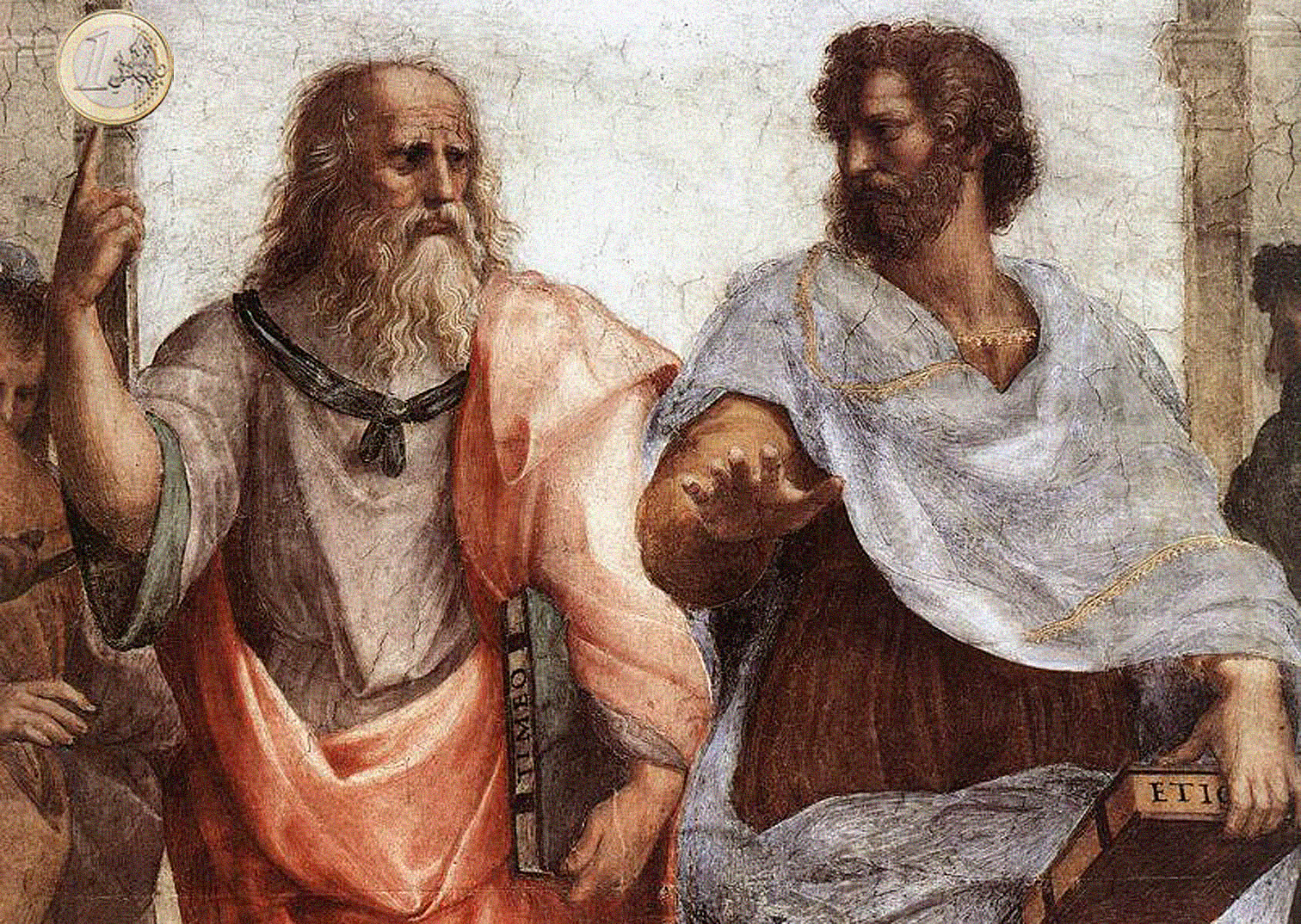
In popular conceptions, we take the computer to be the natural outcome of empirical science, an inheritance of the Enlightenment and subsequent scientific revolutions in the 19th and 20th centuries. Of course, modern computers have their ancient precursors, like the Antikythera Mechanism, a 2,200-year-old bronze and wood machine capable of predicting the positions of the planets, eclipses, and phases of the moon. But even this fascinating artifact fits into the narrative of computer science as “a history of objects, from the abacus to the Babbage engine up through the code-breaking machines of World War II.” Much less do we invoke the names of “philosopher-mathematicians,” writes Chris Dixon at The Atlantic, like George Boole and Gottlob Frege, “who were themselves inspired by Leibniz’s dream of a universal ‘concept language,’ and the ancient logical system of Aristotle.” But these thinkers are as essential, if not more so, to computer science, especially, Dixon argues, Aristotle.
The ancient Greek thinker did not invent a calculating machine, though they may have existed in his lifetime. Instead, as Dixon writes in his recent piece, “How Aristotle Created the Computer,” Aristotle laid the foundations of mathematical logic, “a field that would have more impact on the modern world than any other.”
The claim may strike historians of philosophy as somewhat ironic, given that Enlightenment philosophers like Francis Bacon and John Locke announced their modern projects by thoroughly repudiating the medieval scholastics, whom they alleged were guilty of a slavish devotion to Aristotle. Their criticisms of medieval thought were varied and greatly warranted in many ways, and yet, like many an empiricist since, they often overlooked the critical importance of Aristotelian logic to scientific thought.
At the turn of the 20th century, almost three hundred years after Bacon sought to transcend Aristotle’s Organon with his form of natural philosophy, the formal logic of Aristotle could still be “considered a hopelessly abstract subject with no conceivable applications.” But Dixon traces the “evolution of computer science from mathematical logic” and Aristotelian thought, beginning in the 1930s with Claude Shannon, author of the groundbreaking essay “A Symbolic Analysis of Switching and Relay Circuits.” Shannon drew on the work of George Boole, whose name is now known to every computer scientist and engineer but who, in 1938, “was rarely read outside of philosophy departments.” And Boole owed his principle intellectual debt, as he acknowledged in his 1854 The Laws of Thought, to Aristotle’s syllogistic reasoning.
Boole derived his operations by replacing the terms in a syllogism with variables, “and the logical words ‘all’ and ‘are’ with arithmetical operators.” Shannon discovered that “Boole’s system could be mapped directly onto electrical circuits,” which hitherto “had no systematic theory governing their design.” The insight “allowed computer scientists to import decades of work in logic and mathematics by Boole and subsequent logicians.” Shannon, Dixon writes, “was the first to distinguish between the logical and the physical layer of computers,” a distinction now “so fundamental to computer science that it might seem surprising to modern readers how insightful it was at the time.” And yet, the field could not move forward without it—without, that is, a return to ancient categories of thought.
Since the 1940s, computer programming has become significantly more sophisticated. One thing that hasn’t changed is that it still primarily consists of programmers specifying rules for computers to follow. In philosophical terms, we’d say that computer programming has followed in the tradition of deductive logic, the branch of logic discussed above, which deals with the manipulation of symbols according to formal rules.
Dixon’s argument for the centrality of Aristotle to modern computer science takes many turns—through the quasi-mystical thought of 13th-century Ramon Llull and, later, his admirer Gottfried Leibniz. Through Descartes, and later Frege and Bertrand Russell. Through Alan Turing’s work at Bletchley Park. Nowhere do we see Aristotle, wrapped in a toga, building a circuit board in his garage, but his modes of reasoning are everywhere in evidence as the scaffolding upon which all modern computer science has been built. Aristotle’s attempts to understand the laws of the human mind “helped create machines that could reason according to the rules of deductive logic.” The application of ancient philosophical principles may, Dixon concludes, “result in the creation of new minds—artificial minds—that might someday match or even exceed our own.” Read Dixon’s essay at The Atlantic, or hear it read in its entirety in the audio above.
Related Content:
Free Online Computer Science Courses
The Books on Young Alan Turing’s Reading List: From Lewis Carroll to Modern Chromatics
How Arabic Translators Helped Preserve Greek Philosophy … and the Classical Tradition
Josh Jones is a writer and musician based in Durham, NC. Follow him at @jdmagness
Read More...
Archaeologists Discover the World’s First “Art Studio” Created in an Ethiopian Cave 43,000 Years Ago

If you want to see where art began, go to a cave. Not just any cave, but not just one cave either. You’ll find the best-known cave paintings at Lascaux, an area of southwestern France with a cave complex whose walls feature over 600 images of animals, humans, and symbols, all of them more than 17,000 years old, but other caves elsewhere in the world reveal other chapters of art’s early history. Some of those chapters have only just come into legibility, as in the case of the cave near the Ethiopian city of Dire Dawa recently determined to be the world’s oldest “art studio.”
“The Porc-Epic cave was discovered by Pierre Teilhard de Chardin and Henry de Monfreid in 1929 and thought to date to about 43,000 to 42,000 years ago, during the Middle Stone Age,” writes Sarah Cascone at Artnet.
There, archaeologists have found “a stash of 4213 pieces, or nearly 90 pounds, of ochre, the largest such collection ever discovered at a prehistoric site in East Africa.” The “ancient visitors to the site processed the iron-rich ochre stones there by flaking and grinding the raw materials to produce a fine-grained and bright red powder,” a substance useful for “symbolic activities, such as body painting, the production of patterns on different media, or for signalling.”

In other words, those who used this ochre-rich cave over its 4,500 years of service used it to produce their tools, which functioned like proto-stamps and crayons. You can read about these findings in much more detail in the paper “Patterns of change and continuity in ochre use during the late Middle Stone Age (MSA) of the Horn of Africa: The Porc-Epic Cave record” by Daniela Eugenia Rosso of the University of Barcelona and Francesco d’Errico and Alain Queffelec of the University of Bordeaux. In it, the authors “identify patterns of continuity in ochre acquisition, treatment and use reflecting both persistent use of the same geological resources and similar uses of iron-rich rocks by late MSA Porc-Epic inhabitants.”
The Ethiopian site contains so much ochre, in fact, that “this continuity can be interpreted as the expression of a cohesive cultural adaptation, largely shared by all community members and consistently transmitted through time.” The more evidence sites like the Porc-Epic cave provide, the greater the level of detail in which we’ll be able to piece together the story of not just art, but culture itself. Culture, as Brian Eno so neatly defined it, is everything you don’t have to do, and though drawing in ochre might well have proven useful for the prehistoric inhabitants of modern-day Ethiopia, one of them had to give it a try before it had any acknowledged purpose. Little could they have imagined what that action would lead to over the next few tens of thousands of years.
Related Content:
Was a 32,000-Year-Old Cave Painting the Earliest Form of Cinema?
We Were Wanderers on a Prehistoric Earth: A Short Film Inspired by Joseph Conrad
Hear the World’s Oldest Instrument, the “Neanderthal Flute,” Dating Back Over 43,000 Years
Based in Seoul, Colin Marshall writes and broadcasts on cities and culture. He’s at work on the book The Stateless City: a Walk through 21st-Century Los Angeles, the video series The City in Cinema, the crowdfunded journalism project Where Is the City of the Future?, and the Los Angeles Review of Books’ Korea Blog. Follow him on Twitter at @colinmarshall or on Facebook.
Read More...How Insomnia Shaped Franz Kafka’s Creative Process and the Writing of The Metamorphosis: A New Study Published in The Lancet
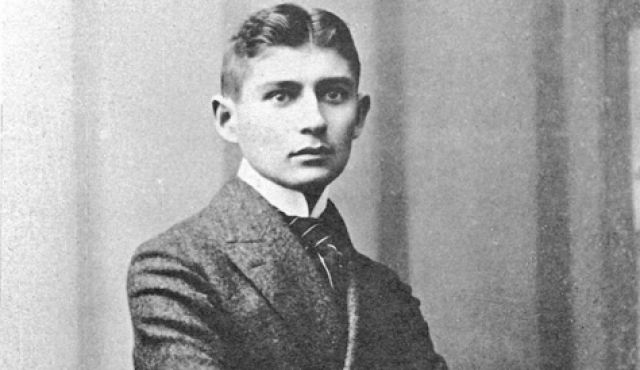
Whatever else we take from it, Franz Kafka’s nightmarish fable The Metamorphosis offers readers an especially anguished allegory on troubled sleep. Filled with references to sleep, dreams, and beds, the story begins when Gregor Samsa awakens to find himself (in David Wylie’s translation) “transformed in his bed into a horrible vermin.” After several desperate attempts to roll off his back, Gregor begins to agonize, of all things, over his stressful working hours: “’Getting up early all the time,’ he thought, ‘it makes you stupid. You’ve got to get enough sleep.” Realizing that he has overslept and missed his five o’clock train, he agonizes anew over the frantic workday ahead, and we can hear in his thoughts the complaints of their author. “Sleep and lack thereof,” writes The Independent’s Christopher Hooten, “is of course a central theme in Kafka’s best known work…. It seems there was a strong dose of autobiography at play.”
Chronically insomniac, Kafka wrote at night, then rose early each morning for his hated job at an insurance office. Though he made good use of restlessness, Kafka characterized his insomnia as much more than an inconvenient physical ailment. He thought of it in metaphysical terms, as a kind of soul-sickness. “Sleep,” he wrote in his diaries, “is the most innocent creature there is and sleepless man the most guilty.”
Insomnia transformed Kafka into an unclean thing, quivering in fear of death. “Perhaps I am afraid that the soul, which in sleep leaves me, will not be able to return,” he confessed in a letter to German writer Milena Jesenská. Anxious expressions like this, writes Theresa Fisher, have led researchers to “speculate that Kafka’s pathological traits… indicate borderline personality disorder.” This posthumous diagnosis may be a leap too far. “Unearthing his insomnia, however,” and its effects on his life and work, “requires less speculation.”
Kafka’s descriptions of his anxious insomniac writing habits have led Italian doctor Antonio Perciaccante and his wife and co-author Alessia Coralli to argue in a recent paper published in The Lancet that the writer composed much of his fiction in a state of something like lucid dreaming. In one diary entry, Kafka writes, “it was the power of my dreams, shining forth into wakefulness even before I fall asleep, which did not let me sleep.” Perciaccante and Coralli note that “this seems to be a clear description of a hypnagogic hallucination, a vivid visual hallucination experienced just before the sleep onset.” It’s something we’ve all experienced. Kafka, fearing sleep, stayed there as long as he could. Lest we think of his writing as therapeutic in some way, he gives no indication that it was so. Indeed, it seems that writing introduced more pain: “When I don’t write,” he told Jesenská, “I am merely tired, sad, heavy; when I do write, I am torn by fear and anxiety.”
Kafka made many similar statements about sleep deprivation bringing him to “a depth almost inaccessible at normal conditions.” The visions he encountered, he wrote, “shape themselves into literature.” Through surveying the literature, biographies, interpretations, and the author’s diaries and letters to Jesenská and Felice Bauer, Perciaccante and Coralli pieced together a “psychophysiological” account of Kafka’s dream logic. As Perciaccante told ResearchGate in an interview, his study concerned itself less with the causes of Kafka’s sleeplessness. He admits “it’s difficult to classify Kafka’s insomnia.” Instead the authors concerned themselves with the effects of remaining in a hypnagogic state (a word, notes Drake Baer, that etymologically means “being abducted into sleep”), as well as Kafka’s awareness of his insomnia’s magical and debilitating power.
Metamorphosis, says Perciaccante, in addition to a work about social and familial alienation, “may also represent a metaphor for the negative effects that poor quality sleep, short sleep duration, and insomnia may have on mental and physical health.” Had Kafka overcome his malady, he may never have written his best-known work. Indeed, he may not have written at all. “Perhaps there are other forms of writing,” he told Max Brod in 1922, “but I know only this kind, when fear keeps me from sleeping, I know only this kind.” Perciaccante and Coralli see Kafka’s insomniac torment as a primary theme in his work, but two dissenting voices, writer Saudamini Deo and forensic doctor and anthropologist Philippe Charlier, disagree. Writing into The Lancet to express their view, they assert that despite Kafka’s persistent laments and the squirmy fate of the autobiographical Gregor Samsa, the writer’s “insomnia was not at all dehumanizing… but the exact opposite—ie, humanizing the self by bringing to surface elements of unconscious that guide most actions of our waking life.”
Related Content:
Franz Kafka’s Kafkaesque Love Letters
How a Good Night’s Sleep — and a Bad Night’s Sleep — Can Enhance Your Creativity
Josh Jones is a writer and musician based in Durham, NC. Follow him at @jdmagness
Read More...Interactive Periodic Table of Elements Shows How the Elements Actually Get Used in Making Everyday Things

Keith Enevoldsen, a software engineer at Boeing, has created an Interactive Periodic Table of Elements. As you might expect, the table shows the name, symbol, and atomic number of each element. But even better, it illustrates the main way in which we use, or come into contact with, each element in everyday life. For example, Cadmium you will find in batteries, yellow paints, and fire sprinklers. Argon you’ll encounter in light bulbs and neon tubes. And Boron in soaps, semiconductors and sports equipment.
The Interactive Periodic Table of Elements (click here to access it) is a handy tool for chemistry teachers and students, but also for anyone interested in how the elements make a chemical contribution to our world. Also worth noting: Enevoldsen has released his Interactive Table under a Creative Commons Attribution-ShareAlike 4.0 International License.
If you would like to support the mission of Open Culture, consider making a donation to our site. It’s hard to rely 100% on ads, and your contributions will help us continue providing the best free cultural and educational materials to learners everywhere. You can contribute through PayPal, Patreon, and Venmo (@openculture). Thanks!
Related Content:
The Periodic Table of Elements Scaled to Show The Elements’ Actual Abundance on Earth
Periodic Table Battleship!: A Fun Way To Learn the Elements
“The Periodic Table Table” — All The Elements in Hand-Carved Wood
World’s Smallest Periodic Table on a Human Hair
“The Periodic Table of Storytelling” Reveals the Elements of Telling a Good Story
Chemistry on YouTube: “Periodic Table of Videos” Wins SPORE Prize
Free Online Chemistry Courses
Read More...Infinite Escher: A High-Tech Tribute to M.C. Escher, Featuring Sean Lennon, Nam June Paik & Ryuichi Sakamoto (1990)
When television appeared in Japan in the 1950s, most people in that still-poor country could only satisfy their curiosity about it by watching the display models in store windows. But by the 1980s, the Japanese had become not just astonishingly rich but world leaders in technology as well. It took something special to make Tokyoites stop on the streets of Akihabara, the city’s go-to district for high technology, but stop they did in 1990 when, in the windows of Sony Town, appeared Infinite Escher.
Produced by Sony HDVS Soft Center as a showcase for the company’s brand new high-definition video technology, this short film caused passersby, according to the video description, to “gasp in amazement at the clarity and sharp crisp focus of the picture.”
Running seven and a half minutes, it tells the story of a bespectacled New York City teenager (played by a young Sean Lennon, son of John Lennon and Yoko Ono) who steps off the school bus one afternoon to find M.C. Escher-style visual motifs in the urban landscape all around him: a jigsaw puzzle piece-shaped curbside puddle, a transparent geometrically patterned basketball.
When he goes home to sketch a few artistic-mathematical ideas of his own, he looks into an awfully familiar-looking reflecting sphere and gets sucked into a completely Escherian realm. This sequence demonstrates not just the look of Sony’s high-definition video, but the then-state-of-the-art techniques for dropping real-life characters into computer-generated settings and vice versa. In addition to the visions of the Dutch graphic designer who not just imagined but rendered the impossible, Sony also brought in two of the other powerful creative minds, Japanese musician Ryuichi Sakamoto to create the score and Korean video artist Nam June Paik to do the art direction.
Watching Infinite Escher today may first underscore just how far high-definition video and computer graphics have come over the past 27 years, but it ultimately shows another example of how Escher’s visions, even after the artist’s death in 1972, have remained so compelling that each era — with its own technological, cultural, and aesthetic trends — pays its own kind of tribute to them.
Related Content:
Metamorphose: 1999 Documentary Reveals the Life and Work of Artist M.C. Escher
Inspirations: A Short Film Celebrating the Mathematical Art of M.C. Escher
David Bowie Sings in a Wonderful M.C. Escher-Inspired Set in Jim Henson’s Labyrinth
62 Psychedelic Classics: A Free Playlist Created by Sean Lennon
Based in Seoul, Colin Marshall writes and broadcasts on cities and culture. He’s at work on the book The Stateless City: a Walk through 21st-Century Los Angeles, the video series The City in Cinema, the crowdfunded journalism project Where Is the City of the Future?, and the Los Angeles Review of Books’ Korea Blog. Follow him on Twitter at @colinmarshall or on Facebook.
Read More...An Archive of Iconic Photos from the Golden Age of Jazz: William Gottlieb’s Portraits of Dizzy, Thelonious, Billie, Satchmo & More

If you’ve seen the most famous photographs of Billie Holiday, Dizzy Gillespie, Thelonious Monk, Frank Sinatra, Django Reinhardt, or nearly any other jazz legend from the mid-20th century, you’ve seen the work of William P. Gottlieb. His photos have graced many a classic album cover, magazine spread, and poster. “Between 1938 and 1948,” writes Maria Popova, Gottlieb “documented the jazz scene in New York City and Washington, D.C., and created what eventually became some of history’s most iconic portraits of jazz greats.” He initially did so as a self-taught amateur, a jazz columnist whose photography was “an afterthought,” notes Gottlieb’s 2006 Washington Post obituary,” mere visual accompaniment to his regular work.”
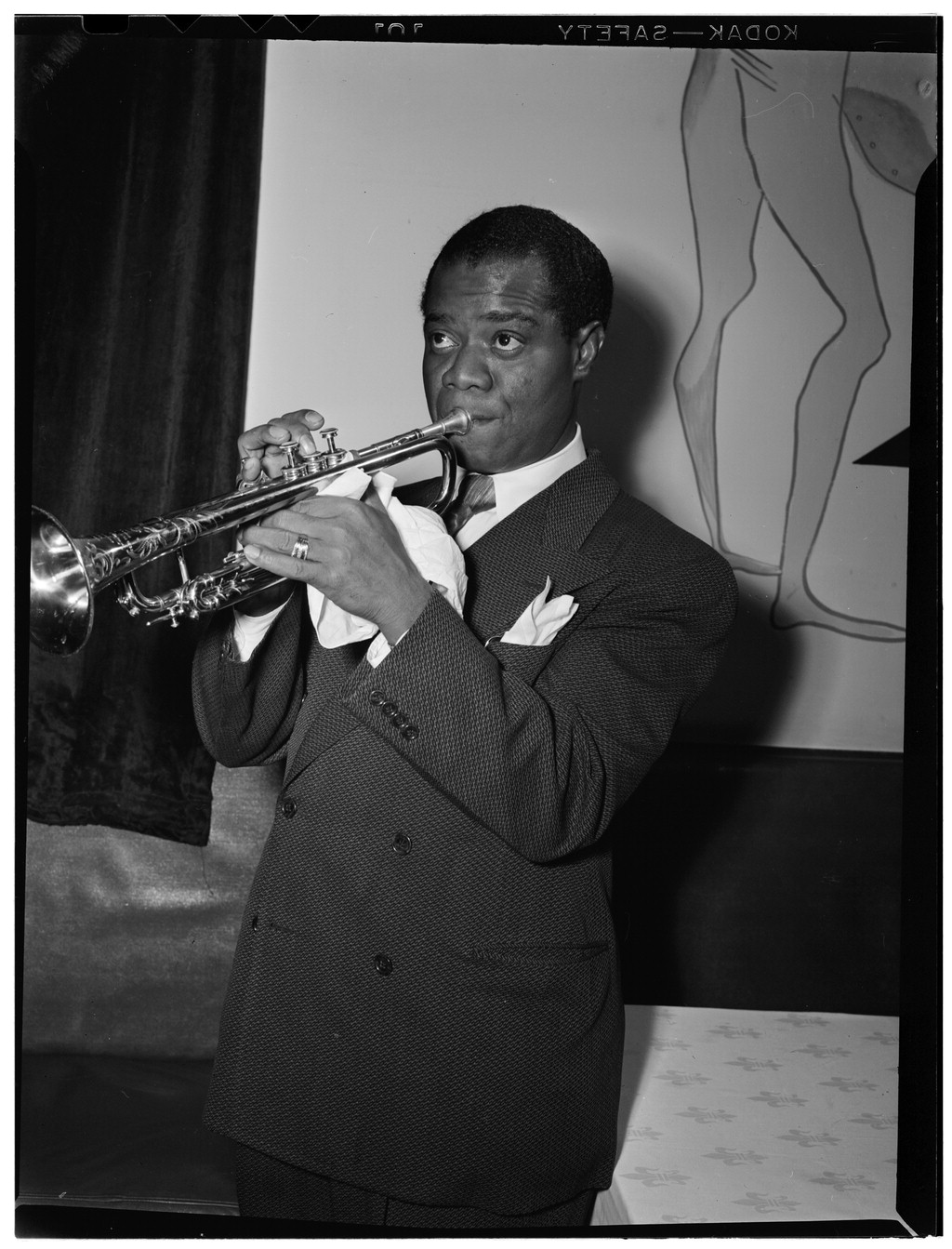 As Gottlieb once told The New York Times, “I got into photography because The Post was stingy and wouldn’t pay photographers to cover my 11 o’clock concerts.” But he developed an undeniably keen eye for performance.
What’s more, his work is deeply informed by affection and empathy. Gottlieb was an artist who had warm relationships with his subjects. He took the photo at the top, perhaps the most famous image of Billie Holiday, in 1947, when the singer “was at her peak,” he wrote, “musically and physically”—two years clean and sober after her time in a federal prison.

“Regrettably,” he writes, “Billie regressed.” Gottlieb tells the heartbreaking story of the last time he went to see her. The “audience waited… and waited.” The photographer, “playing a hunch,” went backstage to find her “pretty much ‘out of it.’”
I helped her finish dressing, then led her to the microphone. She looked horrible. She sounded worse. I replaced my notebook in my pocket, put a lens cap on my camera, and walked away, choosing to remember this remarkable woman as she once was.
Most of Gottlieb’s stories are not nearly so tragic. Take his last run-in with Louis Armstrong, at their dentist office’s waiting room. “After small talk,” he wrote, “Satchmo looked me over, deciding I, too, had been gaining weight. He reached into his jacket pocket, pulled out a printed diet (that he kept for friends-in-need), and handed me a copy. ‘Pops,’ he said, ‘try this.’ I quickly noted that it featured Pluto Water [a laxative]. But I thanked him, anyway.”

Gottlieb retired from photography and jazz writing in the fifties and made a career as a children’s book author and educational film producer. In 1979, he published 219 of his best photographs in a book called The Golden Age of Jazz, and in 2010, much of Gottlieb’s work entered the public domain, according to The Library of Congress (LOC). You can see hundreds of his photographs—famous images like those of Sarah Vaughan, further up, Thelonious Monk, above, Buddy Rich, below, and so many more—at the Library of Congress’s online William P. Gottlieb Collection. The LOC describes the collection thus:
The online collection provides access to digital images of all sixteen hundred negatives and transparencies, approximately one hundred annotated contact prints, and over two hundred selected photographic prints that show Gottlieb’s cropping, burning, and dodging preferences. One can follow the artist’s work process by examining first a raw negative, then an annotated contact print, and finally a finished, published product. The Web site also includes digital images of Down Beat magazine articles in which Gottlieb’s photographs were first published. Other special features of the online presentation are audio clips of Gottlieb discussing specific photographs, articles about the collection from Civilization magazine and the Library of Congress Information Bulletin, an essay describing Gottlieb’s life and work, and a “Gottlieb on Assignment” section that showcases Down Beat articles about Thelonious Monk, Dardanelle, Willie “the Lion” Smith, and Buddy Rich.
You can also download high resolution versions of nearly every image in the archive. (To purchase prints, see Gottlieb’s online gallery, Jazz Photos.) There may be no better way, short of actually being there and meeting the stars, to witness the golden age of jazz than through the eyes and ears of such a sympathetic observer as William P. Gottlieb. Enter the collection here.

Related Content:
Hear 2,000 Recordings of the Most Essential Jazz Songs: A Huge Playlist for Your Jazz Education
Stanley Kubrick’s Jazz Photography and The Film He Almost Made About Jazz Under Nazi Rule
How “America’s First Drug Czar” Waged War Against Billie Holiday and Other Jazz Legends
Josh Jones is a writer and musician based in Durham, NC. Follow him at @jdmagness
Read More...Hunter S. Thompson Chillingly Predicts the Future, Telling Studs Terkel About the Coming Revenge of the Economically & Technologically “Obsolete” (1967)

Image via Wikimedia Commons
Half a century ago, Hunter S. Thompson got his big journalistic break with a book called Hell’s Angels: The Strange and Terrible Saga of the Outlaw Motorcycle Gangs. In it he provided a curious and fearful public with a look into the inner workings of one of the most outwardly menacing social movements of the day, based on knowledge gained not by merely observing the Hell’s Angels but by getting on a hog and spending a year as a quasi-member himself. This gave him opportunity both to develop what would become his style of “gonzo journalism” in the long form and to catch an early glimpse of bigger trouble ahead in America.
“To see the Hell’s Angels as caretakers of the old ‘individualist’ tradition ‘that made this country great’ is only a painless way to get around seeing them for what they really are,” Thompson writes in that book, calling them “the first wave of a future that nothing in our history has prepared us to cope with. The Angels are prototypes. Their lack of education has not only rendered them completely useless in a highly technical economy, but it has also given them the leisure to cultivate a powerful resentment… and to translate it into a destructive cult which the mass media insists on portraying as a sort of isolated oddity” destined for extinction.
Studs Terkel, after reading that passage out loud in a 1967 interview with Thompson (stream it online here), calls it “the key” to the entire book. “Here we have technology, we have the computer, we have labor-saving devices,” he says to Thompson, but we also “have the need for more and more college education for almost any kind of job, and we have this tremendous mass of young who find themselves obsolete.” But Thompson replies that the real consequences have only started to manifest: “The people who are being left out and put behind won’t be obvious for years. Christ only knows what’ll happen in, say, 1985 — a million Hell’s Angels. They won’t be wearing the colors; they’ll be people who are just looking for vengeance because they’ve been left behind.”
The Angels, wrote Susan McWilliams in a much-circulated Nation piece late last year, “were clunky and outclassed and scorned, just like the Harley-Davidsons they chose to drive.” And “just as there was no rational way to defend Harleys against foreign-made choppers, the Angels saw no rational grounds on which to defend their own skills or loyalties against the emerging new world order of the late 20th century.” The result? An “ethic of total retaliation. The Angels, rather than gracefully accepting their place as losers in an increasingly technical, intellectual, global, inclusive, progressive American society, stuck up their fingers at the whole enterprise. If you can’t win, you can at least scare the bejeesus out of the guy wearing the medal.”
Six years later, Terkel invited Thompson back into his studio for another interview (click here to listen) that followed straight on from the first. Ostensibly there to talk about Thompson’s book Fear and Loathing on the Campaign Trail ’72 (which followed his best-known work, Fear and Loathing in Las Vegas), the two, having cracked open a beer, get into what the Studs Terkel Radio Archive blog describes as “the sense of surrealism in ‘real’ life,” which becomes “a very serious conversation about the direction in which our country was heading. After Thompson recounted his experience of talking to Richard Nixon about football” — the only subject permitted — “Studs responds, ‘Isn’t this what we’re faced with now? … That fantasy and fact become one.’ ”
What’s a reporter to do in such an environment? Terkel seems to see in Thompson the perfect kind of “subjective” journalist, one “who can make literal what is psychic in our lives,” for a time that has lost its own objectivity. “Has there ever been any such thing as objective journalism?” he asks. “It’s probably the highest kind of journalism, if you can do it.” Thompson replies. “Nobody I know has ever done it, and I don’t have time to learn it.” But the distinctive suite of journalistic skills he did possess primed him to perceive certain realities — and perceive them with a distinctive vividness — that have only become more real in the decades since. What, for instance, did he learn from covering the 1972 presidential campaign? “Power corrupts… but it’s also a fantastic high.”
Related Content:
Hunter S. Thompson Gets Confronted by The Hell’s Angels: Where’s Our Two Kegs of Beer? (1967)
Read 18 Lost Stories From Hunter S. Thompson’s Forgotten Stint As a Foreign Correspondent
Read 11 Free Articles by Hunter S. Thompson That Span His Gonzo Journalist Career (1965–2005)
Based in Seoul, Colin Marshall writes and broadcasts on cities and culture. He’s at work on the book The Stateless City: a Walk through 21st-Century Los Angeles, the video series The City in Cinema, the crowdfunded journalism project Where Is the City of the Future?, and the Los Angeles Review of Books’ Korea Blog. Follow him on Twitter at @colinmarshall or on Facebook.
Read More...Historical Plaque Memorializes the Time Jack Kerouac & William S. Burroughs Came to Blows Over the Oxford Comma (Or Not)
Maybe it doesn’t take much to get a grammar nerd in a state of agitation, or even, perhaps, violent rage. While I generally avoid the term “grammar nazi,” it does bluntly convey the severe intolerance of certain grammarians. One of the most popular recent books on grammar, Lynn Truss’s Eats, Shoots & Leaves, announces itself in its subtitle as a “Zero Tolerance Approach to Punctuation.” And sure enough, the main title of the entertaining guide comes from a violent joke, in which a panda enters a bar, eats a sandwich, then shoots up the joint. Asked why, he tells the bartender to look up “panda” in the dictionary: “Panda. Large black-and-white bear-like mammal, native to China. Eats, shoots and leaves.”
Truss’s example illustrates not a grammatical point of contention, but a mistake, a misplaced comma that completely changes the meaning of a sentence. But we might refer to many technically correct examples involving the absence of the Oxford comma, the final comma in a series that sets off the last item.
Many people have argued, with particular vehemence, that the “and” at the end of a series satisfies the comma’s function. No, say other strict grammarians, who point to the confusing ambiguity between, say, “I went to dinner with my sister, my wife, and my friend” and “I went to dinner with my sister, my wife and my friend.” We could adduce many more potentially embarrassing examples.
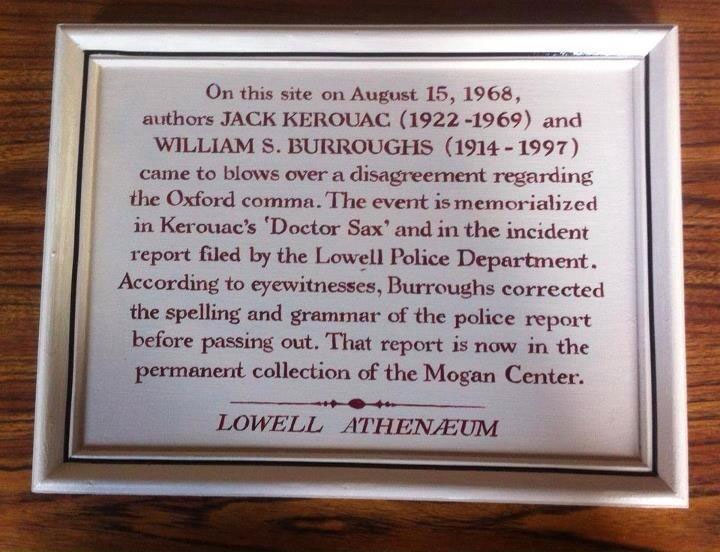
The Oxford comma is so contentious a grammatical issue that it supposedly provoked a drunken fistfight between Beat writers Jack Kerouac and William S. Burroughs. At least, that is, according to a plaque at Mill No. 5 in Lowell, Massachusetts, a historic textile mill built in 1873 and since revitalized into a performance space with shops and a farmer’s market. “On this site on August 15, 1968,” the plaque reads, Kerouac and Burroughs “came to blows over a disagreement regarding the Oxford comma. The event is memorialized in Kerouac’s ‘Doctor Sax’ and in the incident report filed by the Lowell Police Department.” The next line should give us a clue as to how seriously we should take this historical tidbit: “According to eyewitnesses, Burroughs corrected the spelling and grammar of the police report.”
The plaque is a hoax, the fight never happened. (And it is one of many such joke historical markers at the mill.) Doctor Sax was written nine years earlier, in 1959, and Kerouac and Burroughs hadn’t even met at the time of that novel’s events. But it’s a great story. “We imagine Burroughs grabbing the policemen’s pen,” writes Alexis Madrigal at The Atlantic, “lucid as a shaman, and then plopping onto the grass, out cold.” (The Anarchist’s Guide to Historic House Museums calls the spurious plaque “an act of historic vandalism.”) We like the story not only because it’s a juicy bit of lore involving two legendary writers, but also because the Oxford comma, for whatever reason, is such a weirdly inflammatory issue. The TED-Ed video above calls it “Grammar’s great divide.” (The comma acquired its name, points out Mental Floss, “because the Oxford University Press style guidelines require it.”)
If it isn’t already evident, I seriously favor the Oxford comma, perhaps enough to defend it in pitched battle. But if you need convincing by gentler means, you might heed the wisdom of The New Yorker’s resident “comma queen,” who, in the video above, serves up another humorous instance of a serial comma faux pas involving strippers, JFK, and Stalin (or “the strippers, JFK and Stalin”). For a much more serious Oxford comma kerfuffle, we might refer to a class action lawsuit involving overtime pay for truckers, a case that “hinged entirely” on the serial comma, “a debate that has bitterly divided friends, families and foes,” writes Daniel Victor at The New York Times, in a sentence that puckishly, or contrarily, leaves out the last comma, and sets the grammar intolerant among us grinding our teeth. But the Oxford comma is no joke. Its lack may cost Maine company Oakhurst millions of dollars, or their employees millions in pay. “The debate over commas is often a pretty inconsequential one,” writes Victor. Until it isn’t, and someone gets sued, shot, or punched in the face. So snub the Oxford comma, I say, at your peril.
Related Content:
Jack Kerouac Lists 9 Essentials for Writing Spontaneous Prose
Josh Jones is a writer and musician based in Durham, NC. Follow him at @jdmagness
Read More...Support Us
We're hoping to rely on loyal readers, rather than erratic ads. Please click the Donate button and support Open Culture. You can use Paypal, Venmo, Patreon, even Crypto! We thank you!

About Us

Open Culture scours the web for the best educational media. We find the free courses and audio books you need, the language lessons & educational videos you want, and plenty of enlightenment in between.
Advertise With Us

FREE UPDATES!
GET OUR DAILY EMAIL
Get the best cultural and educational resources on the web curated for you in a daily email. We never spam. Unsubscribe at any time.
FOLLOW ON SOCIAL MEDIA

Open Culture editor Dan Colman scours the web for the best educational media. He finds the free courses and audio books you need, the language lessons & movies you want, and plenty of enlightenment in between.
Advertise With Us


