Stream Loads of “City Pop,” the Electronic-Disco-Funk Music That Provided the Soundtrack for Japan During the Roaring 1980s
News about Japan today tends to focus on the country’s long economic stagnation and population decline, but in the 1980s it looked like the world’s next superpower. Harvard social scientist Ezra Vogel had just published the bestselling warning Japan as Number One. Postwar reconstruction had turned into rapid growth, then into a kind of financial gigantism. International consumers drove Japanese cars and filled their homes with Japanese electronics. Japanese conglomerates went on a worldwide spending binge, snapping up other countries’ real estate, their manufacturers, and even their movie studios. Camera-wielding Japanese tourists replaced the “ugly American” as the boorish wealthy tourist of stereotype.
What went on back in Tokyo as the rest of the developed world looked on in amazement (and a kind of horror)? Outside of Japan’s infamously rigorous work culture — itself part of the reason for all the growth — its boom and consequently enormous asset bubble gave rise to new lifestyles and cultures, and the soundtrack of the party was “city pop.” Mixing English lyrics in with Japanese, drawing influences from Western disco, funk, and R&B, and using the latest sonic technologies mastered nowhere more than in Japan itself, this new, slickly produced subgenre offered a cosmopolitanism, according to Mori-ra at Electronic Beats, that “appealed to those who benefited from the so-called post-war ‘economic miracle.’ ” While outside Japan “city pop might be viewed as general 1980s Japanese music, now that Japanese music has become trendy, city pop has begun to be uncovered and even reissued.”
What’s more, city pop has become a subculture again in our internet era, and a global one at that. Its current enthusiasts, many of them not Japanese or in any case born too late to benefit from the boom, create and share their own city pop mixes, carefully curating the tracks (sometimes even supplying visuals gathered from sources like the Japanese animation of the era, often with a Blade Runner aesthetic) to perfectly evoke the high life in 1980s Tokyo as they imagine it. (Friends who actually lived in Japan then describe it as an environment of unalloyed new-money obnoxiousness, but city pop, like all pop, sells fantasy, not reality.) You get a taste of that high life by sampling the many city pop mixes freely available on the internet. At the top of this post you’ll find the one posted to Youtube by a user called Van Paugam, whose channel also features a 24-hour city pop radio stream (complete with nighttime Tokyo driving footage).
Below that, we have a 45-minute “Mixtape from Japan” whose creator goes by Starfunkel. It features not just city pop tracks but, for transitional material, vintage recordings and movie clips to do with the Land of the Rising Sun. (Keep your ears open for the voice of Bill Murray.) Then, the vinyl-only mix by I’mmanuel in Amsterdam simply titled “音楽 Ongaku #1” — Japanese for “music” — places city pop in a context with other Japanese grooves of the era. You’ll find much more curated city pop on Soundcloud, from the ever-growing “High School Mellow” series to Brazilian funk musician Ed Motta’s 70s-oriented mix to Mori-Ra’s own maximally mellow “Japanese Breeze” collection. Get too deep, though, and you’ll end up like me, making trips to Japan to go city pop-shopping and even (slowly) reading Japanese books on the subject. The bubble may have long since burst, but the beat goes on.
Related Content:
Blade Runner Spoofed in Three Japanese Commercials (and Generally Loved in Japan)
Based in Seoul, Colin Marshall writes and broadcasts on cities and culture. He’s at work on a book about Los Angeles, A Los Angeles Primer, the video series The City in Cinema, the crowdfunded journalism project Where Is the City of the Future?, and the Los Angeles Review of Books’ Korea Blog. Follow him on Twitter at @colinmarshall or on Facebook.
Read More...
Watch Janis Joplin’s Breakthrough Performance at the Monterey Pop Festival: “One of the Great Concert Performances of all Time” (1967)
“No one to that point had seen a White girl sing the blues like she sang it. And she was a tough Texas girl, she lived really tough, she drank tough, she did drugs, too many and too tough. But as a vocalist, her performance at Monterey was also one of the great concert performances of all time.”
That’s famed music and film producer Lou Adler talking in 2007 about Janis Joplin and her performance 40 years before at the Monterey International Pop Festival. After those three days of music (June 16-June 18, 1967) in the Summer of Love, many of the acts catapulted to fame.
The Who exploded stateside, The Jimi Hendrix Experience essentially launched their career from that stage, Ravi Shankar got introduced to Americans, and Otis Redding played to a mostly white audience for the first time. Laura Nyro and Canned Heat became famous overnight.
And then there was Big Brother and the Holding Company, fronted by a 24 year-old Janis Joplin. Their first album wasn’t due until August, and most of the crowd had not heard of this blues band when they took the stage on Saturday afternoon, June 17. Five songs later, and finishing with “Ball and Chain,” the crowd had gone wild. They knew they had seen something special.
But D.A. Pennebaker, the documentarian behind Dylan’s Don’t Look Back and Bowie’s “Ziggy Stardust” concert films, had not filmed the set. In an unprecedented move, Joplin and band were invited back to recreate the set the following evening–the only band to do two sets at the festival–and that is the footage seen above. Joplin’s performance is just as good, maybe even better, though the Sunday performance does not feature James Gurley’s extended guitar solo. That version can be found here.
Not only did Monterey Pop launched several careers, it legitimized the idea that rock music was mature and important enough to have its own festival, just like the worlds of jazz and folk. For organizers Adler, along with John Phillips of the Mamas & the Papas, Alan Pariser, and Beatles publicist Derek Taylor, it was a huge success. Two years later a little gathering called Woodstock went even further. And the rest as they say is…whoever’s headlining Coachella this year.
If you enjoy this footage, you will want to pick up a copy of the film, The Complete Monterey Pop Festival, from the Criterion Collection.
Related Content:
Watch Janis Joplin’s Final Interview Reborn as an Animated Cartoon
Woodstock Revisited in Three Minutes
Dick Cavett’s Epic Woodstock Festival Show (August, 1969)
Ted Mills is a freelance writer on the arts who currently hosts the artist interview-based FunkZone Podcast and is the producer of KCRW’s Curious Coast. You can also follow him on Twitter at @tedmills, read his other arts writing at tedmills.com and/or watch his films here.
Read More...Hitler Was ‘Blitzed’ On Cocaine & Opiates During World War II: Hear a Wide-Ranging Interview with Best-Selling Author Norman Ohler
Historians have written an extraordinary amount about Hitler, the Third Reich, and World War II–so much, that it’s hard to imagine anyone could find something novel to say about this dark period of history. But German journalist Norman Ohler has done just that. In his new book, Blitzed: Drugs in the Third Reich, Ohler looks at how Hitler became increasingly dependent on a mixture of cocaine and opiates during the wartime years, all of which could have influenced his decision making. Meanwhile, despite Nazi propaganda against “degenerate” culture, German troops consumed large quantities of crystal meth during major military operations. Some 35 million meth tablets were ingested during the 1940 invasion of France alone.
Ohler gathered much of his evidence while reviewing the papers of Hitler’s private physician, Dr. Theodor Morell. And while some scholars have criticized Ohler’s account, Ian Kershaw, arguably the world’s leading authority on Hitler and Nazi Germany, has called Blitzed “a serious piece of scholarship” and “very well researched.”
Below you can hear Ohler talk about Nazi drug use in a 35-minute interview with Terry Gross.
If you want to download Blitzed as a free audiobook, you could always get it through Audible.com’s 30-day free trial. Find more details on that here. Audiobooks.com also offers a similar deal.
Related Content:
The Nazi’s Philistine Grudge Against Abstract Art and The “Degenerate Art Exhibition” of 1937
The Nazis’ 10 Control-Freak Rules for Jazz Performers: A Strange List from World War II
Read More...How Orson Welles’ F for Fake Teaches Us How to Make the Perfect Video Essay
If you don’t understand what makes Citizen Kane so important, just watch a few movies made before it. In his first outing as a filmmaker, Orson Welles, whether by ignorance or other virtues, pioneered so many aesthetic and narrative techniques that we can now hardly imagine how the medium ever did without. If you don’t understand what makes Welles’ last picture, the quasi-documentary on fact and falsehood F for Fake so important, just compare it to all the video essays proliferating on the internet today.
If Citizen Kane was just slightly ahead of its time in 1940, F for Fake, which came out in 1973, now looks more than three decades ahead of the curve. Nobody knows that better than Tony Zhou, creator of the popular cinema-focused video essay series Every Frame a Painting.
“I’ve stolen more ideas from this film than from any other,” he admits at the beginning of his tribute to F for Fake. “Everything I know about editing” — and he knows a lot — “I’ve learned from this film.”
The first lesson it teaches has to do with how to structure, or rather, how not to structure: instead of making cuts that feel like a repetitive series of “and then“s, make cuts that, in the words of South Park co-creator Trey Parker, stands for “either the word therefore or but.” In other words, whether making a video essay, a feature film, or anything in between, build the structure not out of simple, unordered list-like sequences, but out of causes, effects, and contradictions. Throughout F for Fake, “Orson Welles does the exact same thing, except he doesn’t connect scenes; he connects thoughts. Even though this movie is an essay, each moment has the connective logic of a South Park episode.”
This leads into the second lesson: “Have more than one story moving in parallel,” so that whenever one “reaches peak interest,” you can oscillate to the other. (No less an editing master than Alfred Hitchcock also subscribed to this principle, describing it with the phrase “Meanwhile, back at the ranch…”) Welles’ bravura performance, however, rotates between no fewer than six stories: of art forger Elmyr de Hory, of “hoax-biographer” Clifford Irving, of Irving’s subject Howard Hughes, of Welles’ girlfriend Oja Kodar, of Welles himself (and his infamous War of the Worlds broadcast), and even of the making of F for Fake itself.
Technical points aside, Zhou draws from all this a perspective on his work: “It’s not about what you get. It’s about how you cut it, and what comes out the other end. Remember, video essays aren’t essays, they’re films, so you want to structure and pace them like a filmmaker would.” And in this final major work that he himself describes as a “film about trickery and fraud,” Welles presents that and everything else he’d learned about filmmaking over the past forty years doing it. Even if some say we live a “post-fact” era — a term that would have endlessly amused Welles, or at least the “charlatan” version of himself he plays in F for Fake — the laws of cinema retain their truth.
Related Content:
F for Fake: Orson Welles’ Short Film & Trailer That Was Never Released in America
Orson Welles Explains Why Ignorance Was His Major “Gift” to Citizen Kane
Alfred Hitchcock’s 7‑Minute Master Class on Film Editing
Based in Seoul, Colin Marshall writes and broadcasts on cities and culture. He’s at work on a book about Los Angeles, A Los Angeles Primer, the video series The City in Cinema, the crowdfunded journalism project Where Is the City of the Future?, and the Los Angeles Review of Books’ Korea Blog. Follow him on Twitter at @colinmarshall or on Facebook.
Read More...Introduction to Philosophy: A Free Online Course
From John Sanders, Professor of Philosophy at the Rochester Institute of Technology, comes Introduction to Philosophy. In 10 lectures, Sanders’ course covers the following ground:
Philosophy is about the rigorous discussion of big questions, and sometimes small precise questions, that do not have obvious answers. This class is an introduction to philosophical thinking where we learn how to think and talk critically about some of these challenging questions. Such as: Is there a single truth or is truth relative to different people and perspectives? Do we have free will and, if so, how? Do we ever really know anything? What gives life meaning? Is morality objective or subjective, discovered or created? We’ll use historical and contemporary sources to clarify questions like these, to understand the stakes, to discuss possible responses, and to arrive at a more coherent, more philosophically informed, set of answers.
Thinkers covered include Aristotle, Plato, and Descartes, among others. And along the way, the course introduces you to empiricism, rationalism, ontological and teleological arguments–essentially the nitty gritty of philosophy.
You can stream all the lectures above, or find them all on this YouTube playlist.
Sanders has also made other courses available on YouTube, including Social and Political Philosophy, Philosophy of Science, Professional Ethics, and Symbolic Logic.
They’ve all been added to our list of Free Philosophy Courses, a subset of our meta collection, 1,700 Free Online Courses from Top Universities.
Related Content:
Introduction to Political Philosophy: A Free Yale Course
Oxford’s Free Course A Romp Through Ethics for Complete BeginnersWill Teach You Right from Wrong
The History of Philosophy Without Any Gaps – Peter Adamson’s Podcast Still Going Strong
Read More...Albert Camus Explains Why Happiness Is Like Committing a Crime—“You Should Never Admit to it” (1959)
Note: You can read a translation below.
Happiness, as it has been conceived for at least the past couple thousand years in Western philosophy, is a problem. For the Greeks, happiness was only one component of Eudaimonia, a general human flourishing that must be developed along with ethics, personal growth, and social and civic duty in order for a life to have purpose and meaning. “Positive psychology speaker” Dr. Nico Rose reminds us that the concept contrasts with Hedonia (as in “hedonism”), which relates solely to personal pleasure and enjoyment, such as the kind famously indulged in by many an ancient tyrant.
These are not mutually exclusive categories. “Meaningful experiences can certainly bring about pleasure,” writes Rose, “and taking care of ourselves can certainly add meaning to our lives.” We should, he cautions “refrain from equating the pursuit of hedonia with shallowness.”
The problem, as the Greeks understood it—and as proponents of positive psychology like Jonathan Haidt and founder Martin Seligman recognize as well—is that subjective happiness for some can mean deep unhappiness, or tyranny, for others. It can mean pettiness, apathy, and emotional immaturity, qualities that may not necessarily be immoral but are certainly unpleasant and socially corrosive.
But we might refer to the difference between Hedonia and Eudaimonia another way. Matthew Pianalto at Philosophy Now discusses the contrast as one between “psychological and philosophical concepts of happiness.”
When happiness is equated with subjective well-being, the vast majority of people turn out to be relatively happy. Aristotle and the other Greeks, however, were not concerned with relative or subjective happiness – they wanted to know what the objective features of a truly happy life would be. Greek inquiries into the nature of the good life were really inquiries into the nature of the best life. Thus, when the various Greek philosophers recommended the cultivation of virtue in order to live happily, and since the word we translate as ‘virtue’ really means ‘excellence’, the Greeks were basically telling us that the happiest (and the best) life is the most excellent life.
Is this moralization really necessary for human flourishing, and does it actually promote a superior form of happiness? Or does it simply introduce a means for controlling other people’s behavior and shaming them for their supposed lack of virtue? If you were to ask Albert Camus this question, he might have suggested the latter, and anyone who has read The Stranger and thought about the social coercion the novel portrays will hardly be surprised. In the video above, Camus strongly implies his own view with an imagined Stranger-like dialogue, in French. A translation (generously provided by @TOS1892) roughly reads:
“Today happiness is like a crime—never admit it. Don’t say ‘I’m happy’ otherwise you will hear condemnation all around.”
“’So you’re happy, young man? What do you do with orphans from Kashmir? Or the New Zealand lepers who aren’t “happy” as you say?’”
“Yes what to do with the lepers? How to get rid of them as Ionesco would say? And all of a sudden, we are sad as toothpicks.”
As Maria Popova points out at Brain Pickings, Camus considered this kind of labored, almost rigorous, kind of unhappiness a “self-imposed prison,” writing in a 1956 letter that “those who prefer their principles over their happiness… refuse to be happy outside the conditions they seem to have attached to their happiness. If they are happy by surprise, they find themselves disabled, unhappy to be deprived of their unhappiness.” (I can’t help but think of these lines: “And if the day came when I felt a natural emotion / I’d get such a shock I’d probably jump in the ocean.”)
Camus recognized emotions not as abstract principles, but as deeply connected to “the solidarity of our bodies, unity at the center of the mortal and suffering flesh.” The corrective to a shallow hedonism that might override our ethics is not a striving after philosophical notions of “excellence,” but another emotion, unhappiness, which we should also not be ashamed to feel. “No,” wrote Camus, “it is not humiliating to be unhappy.” The philosopher wrote these words to a hospitalized friend who was suffering physically, a condition, he admits, that is “sometimes humiliating.” But the more existential “suffering of being cannot be” a humiliation. “It is life,” and it forces us to see things we would rather not see.
Do these alternations of happiness and unhappiness point toward something larger than the fleeting whims of physical pain or personal satisfaction? Yes, Camus thought, but the fact that we need them does not speak especially well of people in what he called a “servile century.” In his notebooks, Camus considered how, through sorrow, Oscar Wilde came to understand art as something that “must blend with all” rather than transcend ordinary life. “It is the culpability of this era,” he writes, “that it always needed sorrow… to catch a glimpse of a truth also found in happiness.”
It is entirely possible to be happy and virtuous, authentic, and truthful, Camus suggests, “when the heart is worthy.” In some ways, it seems, he reframed the ancient Greeks’ idea of Eudaimonia from an abstract philosophical principle to a subjective psychological state, since there is no clear, objective way in an absurd universe, he thought, to know what an “excellent” life should look like. Still, like Aristotle, Camus suggests that pursuing meaningful happiness is a “moral obligation” writes Popova. But he understands this pursuit as perilous and potentially devastating, necessitating “an equal capacity for contact with absolute despair.”
via @pbkauf
Related Content:
Hear Albert Camus Read the Famous Opening Passage of The Stranger (1947)
Albert Camus Talks About Nihilism & Adapting Dostoyevsky’s The Possessed for the Theatre, 1959
Josh Jones is a writer and musician based in Durham, NC. Follow him at @jdmagness
Read More...Pink Floyd’s “Echoes” Provides a Soundtrack for the Final Scene of Kubrick’s 2001: A Space Odyssey
What happens when you cue up The Wizard of Oz (1939) and Pink Floyd’s Dark Side of the Moon (1973), and play them together? You get something magical. Or, to be more precise, you get “Dark Side of the Rainbow,” a mashup that first began circulating in 1995, back when the internet first went commercial. Watch “Dark Side of the Rainbow” (here) and you could believe that Floyd wrote Dark Side as a stealth Wizard of Oz soundtrack–though that’s something the band firmly denies. And, we believe them.
But bury one rumor, and another takes its place. The Vimeo caption accompanying the other mashup above reads as follows:
It has long been rumoured that Pink Floyd set ‘Echoes’ to the final sequence of Stanley Kubrick’s, ‘2001: A Space Odyssey’. Two years before producing their album ‘Meddle’, featuring the 23 minute piece ‘Echoes’, Pink Floyd worked on the ‘More’ French film soundtrack, where they worked with film synchronisation equipment. From there the rumours blossomed, with Roger Waters being misquoted as saying the band were originally offered to do the soundtrack (they in fact turned down an offer to feature the ‘Atom Heart Mother’ suite in ‘A Clockwork Orange’). Whether or not the rumours have any basis in fact, there is an undeniable beauty when watching the combination of Kubrick’s intricate stop-motion universe, coupled with the psychedelic wonders of Pink Floyd.
This last thought is seconded by philosophy professor Joe Steiff, who, writing in the edited collection, Pink Floyd and Philosophy, adds this:
A lesser-known mashup is the syncing of “Echoes” (from Meddle) with the final twenty minutes of Stanley Kubrick’s 1968 film 2001: A Space Odyssey (beginning with “Jupiter and Beyond the Infinite”)… [T]he mashup is coherent and cohesive. The emotional tone of the music and the images work in near-harmony, resulting in a mashup that stands up to repeated viewings.… Both the movie and the music feed into and expand the sense of mystery and unknowability that each explores independently.
Watch “Echoes Odyssey” above and see for yourself.
If you would like to support the mission of Open Culture, consider making a donation to our site. It’s hard to rely 100% on ads, and your contributions will help us continue providing the best free cultural and educational materials to learners everywhere. You can contribute through PayPal, Patreon, and Venmo (@openculture). Thanks!
Related Content:
Dark Side of the Rainbow: Pink Floyd Meets The Wizard of Oz in One of the Earliest Mash-Ups
Pink Floyd’s David Gilmour Sings Shakespeare’s Sonnet 18
Read More...Download Russian Futurist Book Art (1910–1915): The Aesthetic Revolution Before the Political Revolution
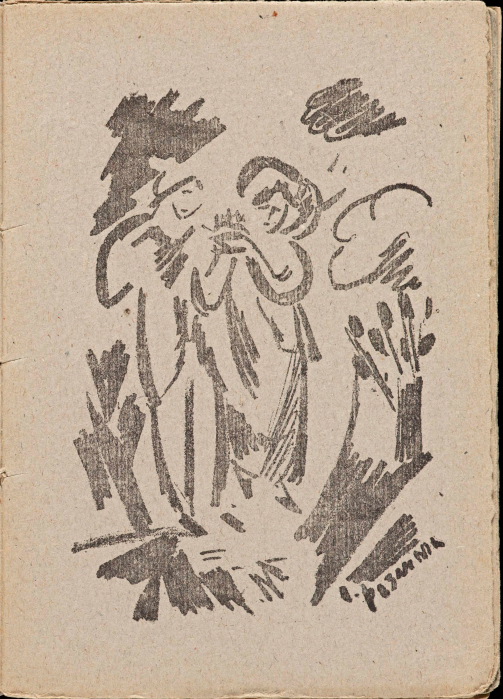
Given the image of Communist Russia we’ve mostly inherited from Cold War Hollywood propaganda and cherry-picked TV documentaries, we tend to think of Communist art as sterile, brutalist, devoid of expressive emotion and experiment. But this has never been entirely so. While Party-approved social realism dominated in certain decades, experimental Russian animation, film, design, and literature flourished, even under extremely harsh conditions one wouldn’t wish on any artist.
In the early days of the Revolution, one of the most influential forms of expression, Russian Futurism, brought its avant-gardism to the masses, and praised the Revolution while formally challenging every received idea or doctrine. Beginning in the early 20th century and working until the Soviet Union was formed and Trotsky banished, Futurist poets and artists like Vladimir Mayakovsky, Kazimir Malevich, Nalia Goncharova, and Velimir Khlebnikov contributed to a style called “Zaum,” a word, as we noted in a previous post, that can mean “transreason” or “beyond sense.” (A very unscientific, bourgeois approach, it would later be alleged by the Central Committee.)
Like modernist movements all over Europe, Russian Futurism took risks in every medium, but took a much more Dadaist approach than the Italian Futurists who had partly inspired them. They published prolifically—creating hundreds of books and journals between 1910 and 1930. A new book from Getty Research Institute curator Nancy Perloff, Explodity: Sound, Image, and Word in Russian Futurist Book Art, covers the first five years of that period—pre-Revolutionary but no more nor less radical. Her book is accompanied by an “interactive companion,” a site that allows users to see the publications and poems Perloff examines. If you scroll down to the bottom of the page, you’ll find a link to “digitized Russian avant-garde books from the Getty Research Institute.”
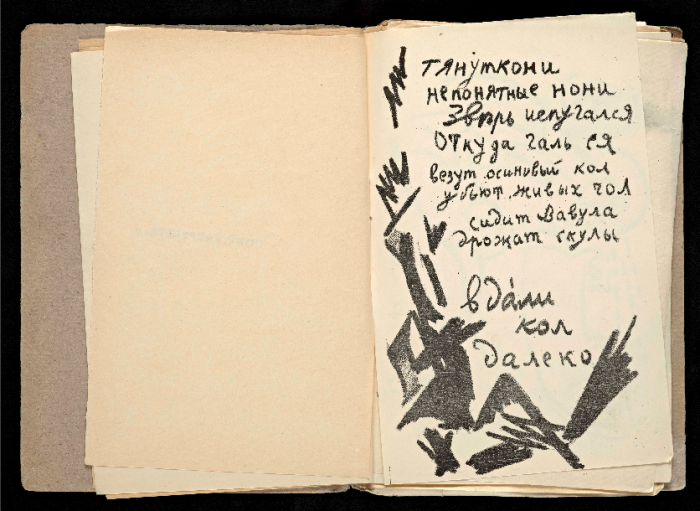
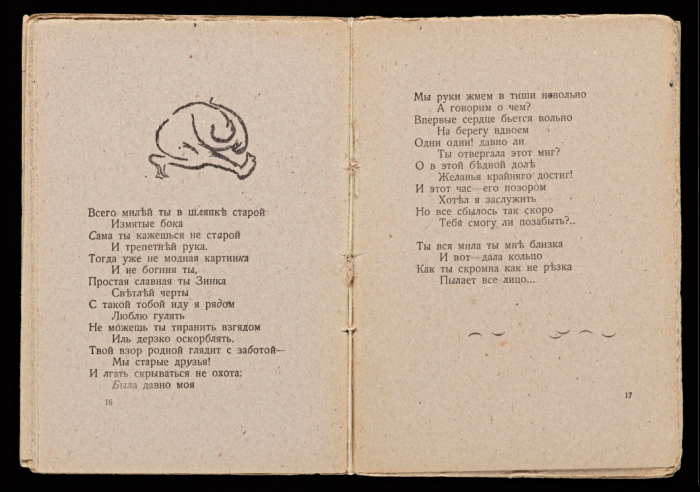
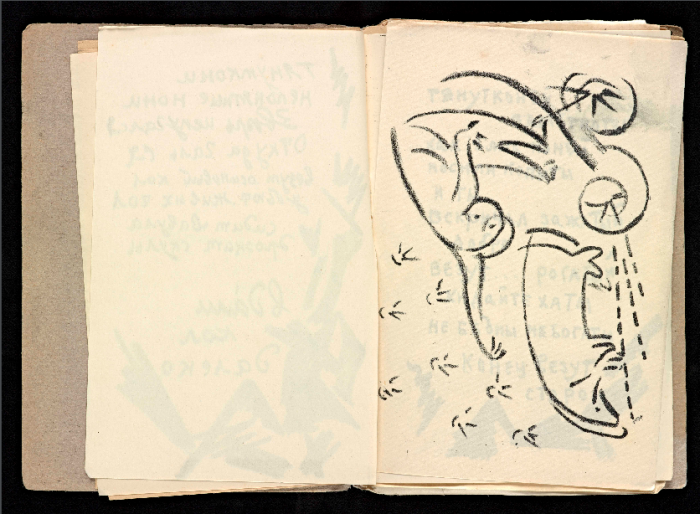
This archive contains about four dozen books by artist/poets like Khlebnikov whose 1914 Old-Fashioned Love; Forestly Boom, you can see pages from at the top of the post. Further up and just above, we see excerpts from Alexei Kruchenykh’s 1913 Vzorval’ (Explodity), a mostly hand-lettered publication with whimsical, dynamic drawings alternating with and surrounding the text. You’ll find over four dozen of these books at the Getty Research Institute. As you browse or search their catalogue, then click on an entry, you’ll want to click on the “View Online” button to see scanned images.
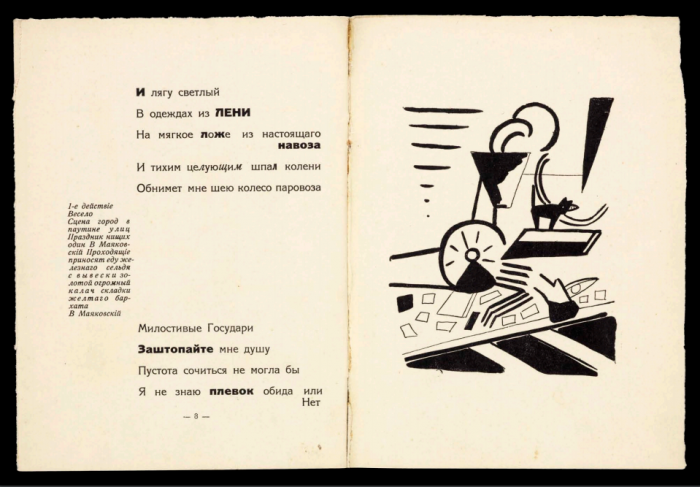
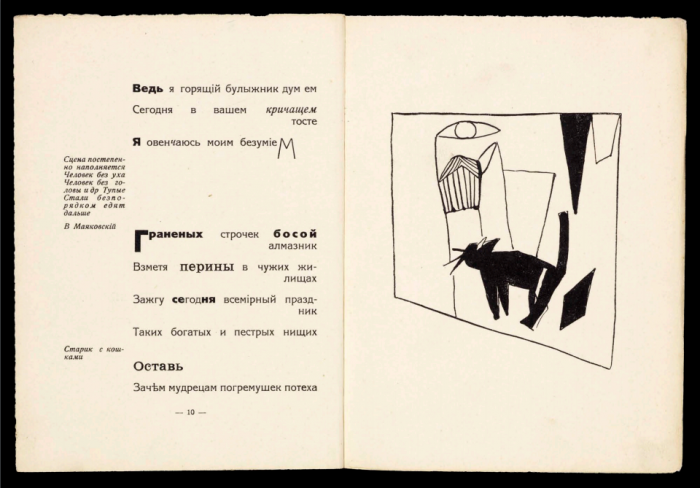
Each of these books—like Vladimir Mayakovsky’s 1913 play, Vladimir Mayakovsky: A Tragedy, above and below—makes a forceful visual impression even if we cannot understand the text. But in many ways, this is beside the point. Zaum poetry was meant to be heard as sound, not sense, and looked at as a physical artifact. Perloff’s book, writes the Getty, “uncovers a wide-ranging legacy in the midcentury global movement of sound and concrete poetry (the Brazilian Noigandres group, Ian Hamilton Finlay, and Henri Chopin), contemporary Western conceptual art, and the artist’s book.” In many ways, these artists represent a parallel tradition in modernism to the one we generally learn of in Western Europe and the U.S., and one just as rich and fascinating.
Related Content:
Hear Russian Futurist Vladimir Mayakovsky Read His Strange & Visceral Poetry
Hear the Experimental Music of the Dada Movement: Avant-Garde Sounds from a Century Ago
Josh Jones is a writer and musician based in Durham, NC. Follow him at @jdmagness
Read More...Every Page of Depero Futurista, the 1927 Futurist Masterpiece of Graphic Design & Bookmaking, Is Now Online
You can try to dismantle your e‑reader, but you can’t unscrew an eBook. Despite having cast his artistic mind, as did his fellow 20th-century Italian Futurists, forcefully into the world to come, could Fortunato Depero have imagined that such a question would arise in the 21st? The Trentino-born painter, writer, sculptor, and graphic designer, led a highly creative life, producing no work more enduring than the instantly recognizable Campari Soda bottle. But just last year, a group of enthusiasts successfully raised more than $250,000 on Kickstarter to bring back into print Depero’s second-best-known creation: Depero Futurista, also known as “The Bolted Book.”
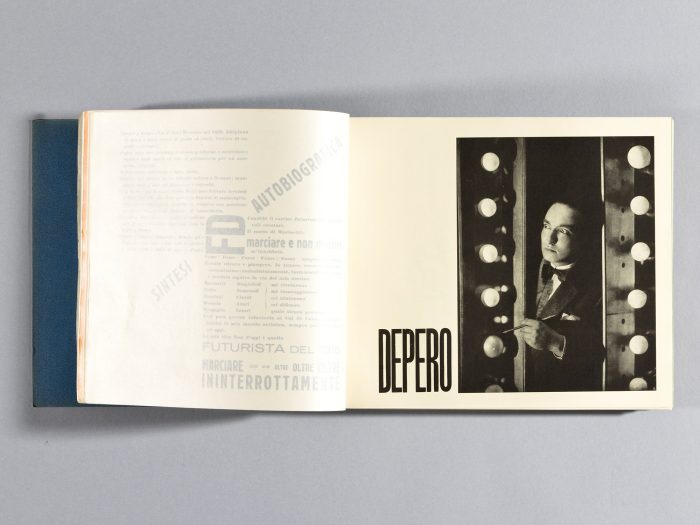
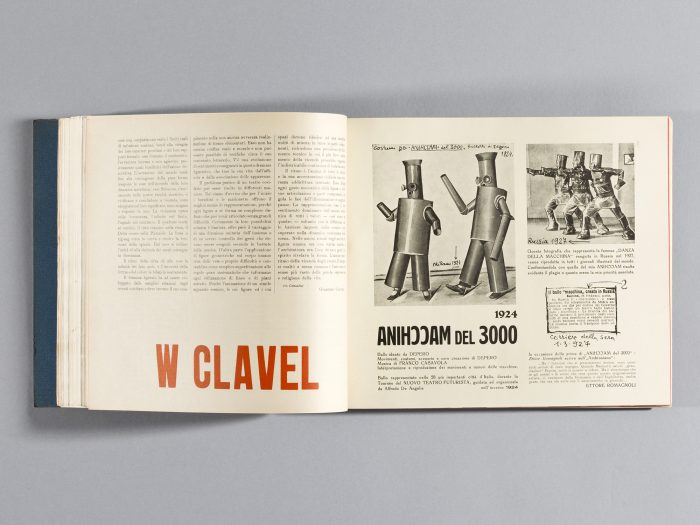
Designed by Depero as “a kind of portable museum or calling card, a portfolio of his career to date — including paintings, sculptures, textile and architectural designs, theater and advertising work, wordplays, manifestoes, and reviews he received in many different languages,” Depero Futurista, as described by the reprint project’s web site, also shows off his “skills as a designer and typographical wizard.”
These impress as much in 2017 as they must have at the time of the book’s first publication ninety years ago in Milan, and the binding method remains as distinctive: “Comprising 240 pages, the book is secured by two large industrial aluminum bolts that when removed allow for the pages to be removed, rearranged, or exhibited individually.”
You may never have heard of Depero, but today’s most respected designers certainly have, and some of them appear in the project’s Kickstarter promo video giving testimonials not just to the importance of Depero’s aesthetic achievements in general but The Bolted Book in particular. It offers a “bridge between the past and the future” in design, an innovative, ironic, and playful use of the “machine aesthetic,” and evidence that “Depero, despite his idiosyncrasies, was one of the most creative of the Futurists.” (It also, of course, holds the title of the first-ever book “bolted by two giant clasps.”) But perhaps the most compelling comes from Stefan Sagmeister: “This book contains the favorite packaging of my favorite drink, Campari Soda. For this alone, it should be contributed at properly — Kickstarted.”
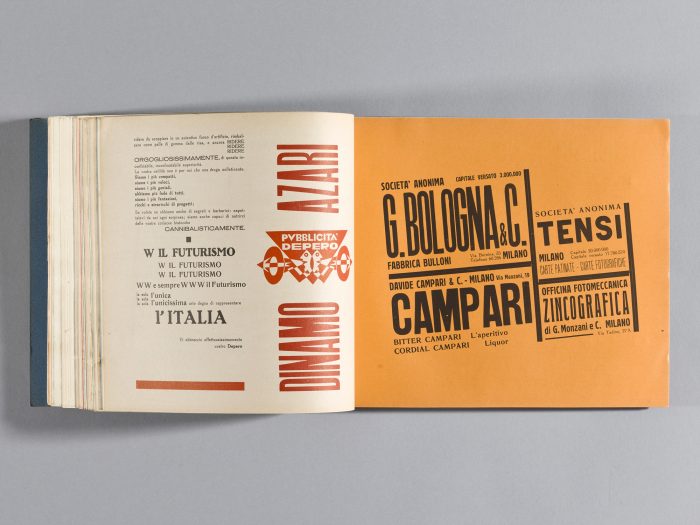
Successfully Kickstarted, the new and 100 percent faithful reprint of Depero Futurista (whose few surviving originals sit mostly in institutional collections) should arrive in July of this year. Even if you can’t get your hands on a real, bolted copy just yet, you can view each and every one of its pages on the reprint project’s site. All the brilliance on display does make one regret that the Futurist movement ended with the tarnish of Fascism. But now that references to the latter seems to have re-entered the public conversation, maybe the time has come to bring back the vigorous, forward-looking artistic inventiveness of the former as a kind of countervailing inspiration.
Related Content:
Download 20 Free eBooks on Design from O’Reilly Media
Based in Seoul, Colin Marshall writes and broadcasts on cities and culture. He’s at work on a book about Los Angeles, A Los Angeles Primer, the video series The City in Cinema, the crowdfunded journalism project Where Is the City of the Future?, and the Los Angeles Review of Books’ Korea Blog. Follow him on Twitter at @colinmarshall or on Facebook.
Read More...How to Tell a Good Story, as Explained by George Saunders, Ira Glass, Ken Burns, Scott Simon, Catherine Burns & Others
All of us instinctively respond to stories. This has both positive and negative effects, but if we don’t understand it about ourselves, we’ve won’t fully understand why people believe what they believe and do what they do. Even given the deep human attachment to narrative, can we clearly explain what a story is, or how to tell one? Acclaimed author George Saunders has given the subject a great deal of thought, some of which he lets us in on in the short film above, which Josh Jones previously wrote about here on Open Culture. “A good story,” he tells us, says “at many different levels, ‘We’re both human beings. We’re in this crazy situation called life that we don’t really understand. Can we put our heads together and confer about it at a very high, non-bullshitty level?’ ”
At this point in his career, Saunders has tried out that approach to story using numerous different techniques and in a variety of different contexts, most recently in his new novel Lincoln in the Bardo, which takes place in the aftermath of the assassination of the titular sixteenth President of the United States. Few living creators understand the appeal of American history as a trove of story material better than Ken Burns, author of long-form documentaries like Jazz, Baseball, and The Civil War, who finds that its “good guys have serious flaws and the villains are very compelling.”
And though he ostensibly works with only the facts, he acknowledges that “all story is manipulation,” some of it desirable manipulation and some of it not so much, with the challenge of telling the difference falling to the storyteller himself.
“The common story,” Burns says, “is ‘one plus one equals two.’ We get it. But all stories — the real, genuine stories — are about one and one equaling three.” Where his mathematical formula for storytelling emphasizes the importance of the unexpected, the one offered by Andrew Stanton, director of Pixar films like Finding Nemo, WALL‑E, and John Carter, emphasizes the importance of a “well-organized absence of information.” In the TED Talk just above (which opens with a potentially NSFW joke), he suggests always giving the audience “two plus two” instead of four, encouraging the audience to do the satisfying work of putting the details of the story together themselves while never letting them realize they’re doing any work at all.
“Drama is anticipation mingled with uncertainty,” said the playwright William Archer. Stanton quotes it in his talk, and the notion also seems to underlie the views on storytelling held by This American Life creator Ira Glass. In the interview above, he describes the process of telling a story as recounting a sequence of actions, of course, but also continually throwing out questions and answering them all along the way, oscillating between actions in the story and moments of reflection on those actions which cast a little light on their meaning — a form surely familiar to anyone who’s heard so much as a segment of his radio show. And how do you become as skilled as he and his team at telling stories? Do what he did: tell a huge number of them, telling and telling and telling until you develop the killer instinct to mercilessly separate the truly compelling ones from the rest.
Glass illustrates the benefits of his lessons by playing some tape of a news report he produced early in his career, highlighting all the ways in which he failed to tell its story properly. He turned out to be cut out for something slightly different than straight-up reporting, a job of which reporters like Scott Simon of National Public Radio’s Weekend Edition have made an art. Simon takes his storytelling process apart in three and a half minutes in the video just above: beyond providing such essentials as a strong beginning, vivid details, and a point listeners can take away, he says, you’ve also got to consider the way you deliver the whole package. Ideally, you’ll tell your story in “short, breathable sections,” which creates an overall rhythm for the audience to follow, whether they’re sitting on the barstool beside you or tuned in on the other side of the world.
What else does a good story need? Conflict. Tension. The feeling of “seeing two opposing forces collide.” Honesty. Grace. The ring of truth. All these qualities and more come up in the Atlantic’s “Big Question” video above, which asks a variety of notables to name the most important element of a good story. Responders include House of Cards writer and producer Beau Willimon, The Moth artistic director Catherine Burns, PBS president Paula Kerger, and former Disney CEO Michael Eisner. Since humans have told stories since we first began, as Saunders put it, conferring about this crazy situation called life, all manner of storytelling rules, tips, and tricks have come and gone, but the core principles have remained the same. As to whether we now understand life any better… well, isn’t that one of those unanswered questions that keeps us on the edge of our seats?
Related Content:
George Saunders Demystifies the Art of Storytelling in a Short Animated Documentary
Ira Glass, the Host of This American Life, Breaks Down the Fine Art of Storytelling
Ken Burns on the Art of Storytelling: “It’s Lying Twenty-Four Times a Second”
Kurt Vonnegut’s 8 Tips on How to Write a Good Short Story
Kurt Vonnegut Diagrams the Shape of All Stories in a Master’s Thesis Rejected by U. Chicago
Pixar & Khan Academy Offer a Free Online Course on Storytelling
John Berger (RIP) and Susan Sontag Take Us Inside the Art of Storytelling (1983)
Based in Seoul, Colin Marshall writes and broadcasts on cities and culture. He’s at work on a book about Los Angeles, A Los Angeles Primer, the video series The City in Cinema, the crowdfunded journalism project Where Is the City of the Future?, and the Los Angeles Review of Books’ Korea Blog. Follow him on Twitter at @colinmarshall or on Facebook.
Read More...Support Us
We're hoping to rely on loyal readers, rather than erratic ads. Please click the Donate button and support Open Culture. You can use Paypal, Venmo, Patreon, even Crypto! We thank you!

About Us

Open Culture scours the web for the best educational media. We find the free courses and audio books you need, the language lessons & educational videos you want, and plenty of enlightenment in between.
Advertise With Us

FREE UPDATES!
GET OUR DAILY EMAIL
Get the best cultural and educational resources on the web curated for you in a daily email. We never spam. Unsubscribe at any time.
FOLLOW ON SOCIAL MEDIA

Open Culture editor Dan Colman scours the web for the best educational media. He finds the free courses and audio books you need, the language lessons & movies you want, and plenty of enlightenment in between.
Advertise With Us

