Chuck Berry (RIP) Reviews Punk Songs by The Ramones, Sex Pistols, The Clash, Talking Heads & More (1980)
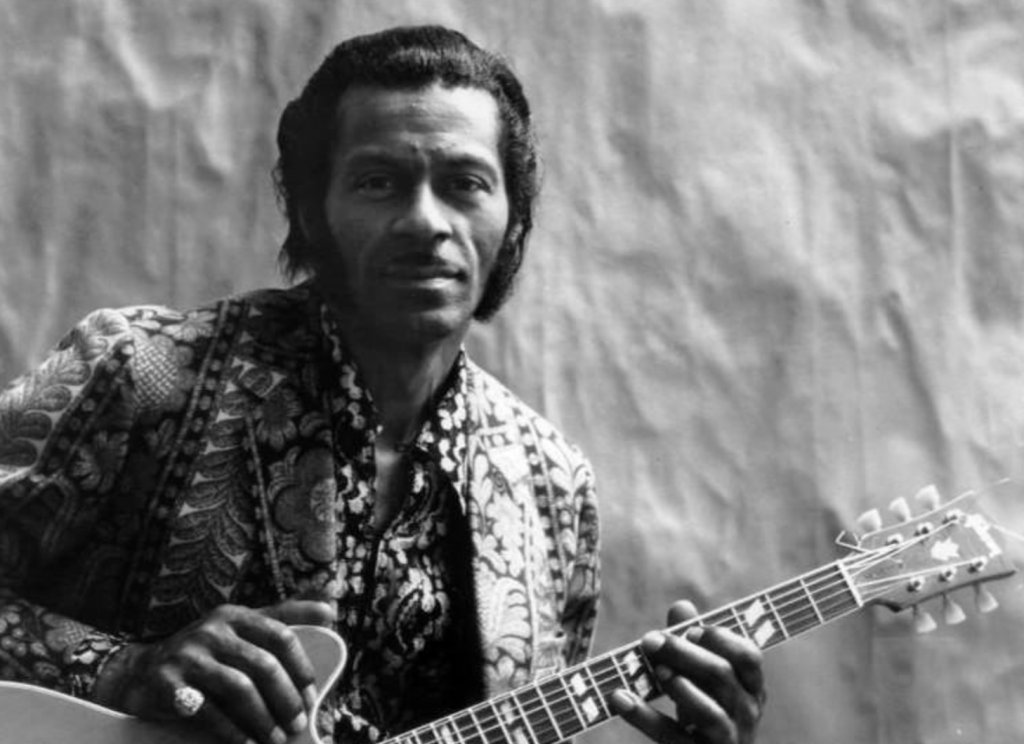
Image via Wikimedia Commons
When the punk wave broke in the UK and the States in the mid-1970s, it threatened to leave behind the established rock bands that once seemed so rebellious. Pete Townshend, the guitar-smashing songwriter of The Who, said: “I kind of welcomed [the arrival of punk], challenged it, and wanted it to happen, and then I realized that the person they wanted to shoot was me.” And indeed Sid Vicious, of the Sex Pistols, would say, “I don’t have any heroes. They’re all useless to me.”
And yet despite the posturing, punk remained rooted in the rock tradition, paying tribute, whether they knew it or not, to their musical fathers (The Beatles, The Who, The Stones) and even the grandfathers (Chuck Berry and Buddy Holly). In Please Kill Me: The Uncensored Oral History of Punk (a book I completely recommend) editor Legs McNeil writes:
Then the Ramones came back, and counted off again, and played their best eighteen minutes of rock n roll that I had ever heard. You could hear the Chuck Berry in it, which was all I listened to, that and the Beatles second album with all the Chuck Berry covers on it.
It all goes back to Chuck Berry, and Berry knew it. In a 1980 interview with the zin Jet Lag, Berry shared his thoughts on the punk anthems of the day and spotted his influence in many of them.
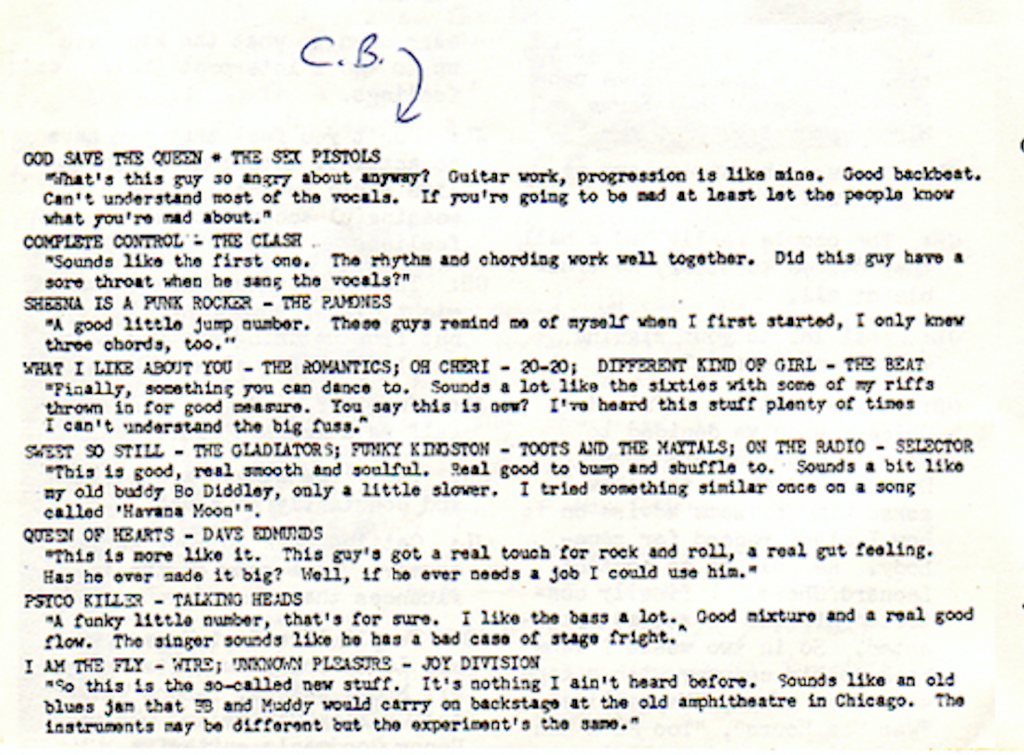
The Sex Pistols’ “God Save the Queen”:
“What’s this guy so angry about anyway? Guitar work and progression is like mine. Good backbeat. Can’t understand most of the vocals. If you’re going to be mad at least let the people know what you’re mad about.”
The Clash’s “Complete Control”:
“Sounds like the first one. The rhythm and chording work well together. Did this guy have a sore throat when he sang the vocals?”
The Ramones’ “Sheena is a Punk Rocker”:
“A good little jump number. These guys remind me of myself when I first started, I only knew three chords too.”
The Romantics’ “What I Like About You”:
“Finally something you can dance to. Sounds a lot like the sixties with some of my riffs thrown in for good measure. You say this is new? I’ve heard this stuff plenty of times. I can’t understand the big fuss.”
Talking Heads’ “Psycho Killer”:
“A funky little number, that’s for sure. I like the bass a lot. Good mixture and a real good flow. The singer sounds like he has a bad case of stage fright.”
Wire’s “I Am the Fly” and Joy Division’s Unknown Pleasures:
“So this is the so-called new stuff. It’s nothing I ain’t heard before. It sounds like an old blues jam that BB and Muddy would carry on backstage at the old amphitheatre in Chicago. The instruments may be different but the experiment’s the same.”
Chuck Berry passed away today, still unsurpassed, at age 90. Long live Chuck.
via Dangerous Minds and h/t @alyssamilano and @austinkleon
Related Content:
Chuck Berry Takes Keith Richards to School, Shows Him How to Rock (1987)
Four Female Punk Bands That Changed Women’s Role in Rock
Read More...Professional Ethics: A Free Online Course
From John Sanders, Professor of Philosophy at the Rochester Institute of Technology, comes a 10-lecture course on Professional Ethics, which examines ethical issues that arise in professional life. You can watch the lectures, or find them all listed on YouTube here.
Professional Ethics will be added to our list of Free Business Courses, a subset of our list, 1,700 Free Online Courses from Top Universities.
Read More...An Introduction to the Philosophy of Science: A Free Online Course
From John Sanders, Professor of Philosophy at the Rochester Institute of Technology, comes An Introduction to the Philosophy of Science. In 11 lectures, Sanders probes the nature of the scientific enterprise, the logic of science, its claims to reliability, and its relationships to society and to problems of human values. You can stream all the lectures above, or find them all on this YouTube playlist.
An Introduction to the Philosophy of Science will be added to our list of Free Philosophy Courses, a subset of our collection, 1,700 Free Online Courses from Top Universities
Hear Prince’s Personal Playlist of Party Music: 22 Tracks That Will Bring Any Party to Life
Many years ago, I took a job as a wedding DJ for a few months to knit ends together in college. Whatever you picture about the job of a wedding DJ, I can assure you that it’s even less glamorous than that. But among the late hours, low pay, and endless schlepping lay at least one pearl-like perk—at every function, when the mood began to ebb along with my sanity, I would put on Prince’s “Controversy,” turn up the speakers as loud as I could, and for the next seven minutes, all would be well. (See him play the song in 2010, above, to an audience in Antwerp.)
For the rest of the night and the rest of the week, I’d be lost in mid-nod to that perfect distillation of funk, the greatest distillation of funk to include the Lord’s Prayer that was ever put to tape.
Prince wrote perfect party songs—dozens of them, including the definitive party song, “1999,” which Martin Schneider at Dangerous Minds calls “a supreme signifier for a Sixteen Candles level blowout celebration”… for a certain cohort at least.
An entire mixtape of Prince tunes would do right by any party, but what would the man himself put on? Surely he didn’t just play his own music, although… why not? We do know he kept it raw and funky for Paisley Park gatherings. In a playlist he provided to the TV show The New Girl in 2013 for an episode featuring a fictional Prince party, he opens with the midtempo stomp of The Staples Singers’ 1974 Stax Recording “City in the Sky.” Before long we’re onto the stone cold groove of Stevie Wonder’s “Higher Ground” and the dirty funk of Ohio Player’s “Skin Tight” a song about a “bad, bad missus” in “skin tight britches.”
The Prince party playlist (available on Spotify, YouTube, or stream it all below) has just the right mix of erotic, romantic, and spiritual—with the psychedelic funk of Shuggie Otis thrown in, naturally—some of the most finely-tuned soul the seventies produced. One of the latest recordings on the playlist, Chaka Khan’s “I Was Made to Love Him” came out in 1978, the same year as Prince’s first album, so we can take a fairly good guess at what he was listening to when he made his debut. In fact, we might look at the playlist as a snapshot of the funk-rock-soul genius from Minneapolis’ original inspirations, which still resonate like cosmic radiation in his late digital-era recordings.
With the Prince vault opened and hundreds of never-before-heard songs set for release, we’ll have years of opportunity to play spot-the-influence. In the meantime, get some people over and put on the mix above. If you sense a lull, drop “Controversy” and watch the most awkward guests come alive with moves they never knew they had.
Related Content:
Read Prince’s First Interview, Printed in His High School Newspaper (1976)
The Life of Prince in a 24-Page Comic Book: A New Release
Josh Jones is a writer and musician based in Durham, NC. Follow him at @jdmagness
Read More...Marshall McLuhan in Two Minutes: A Brief Animated Introduction to the 1960s Media Theorist Who Predicted Our Present
Marshall McLuhan, writes novelist and artist Douglas Coupland, entered the zeitgeist in the 1960s as “a guru or as a villain – as a harbinger of the flowering of culture, or of its death,” a “fuddy-duddy fiftysomething English lit professor from Toronto” whose distinctive research interests and even more distinctive habits of mind empowered him to come up with still-resonant insights into the modern media landscape. He knew “that the point of much of technology, TV, for instance, wasn’t the content of the shows you were watching on it. Rather, what mattered was merely the fact that you were watching TV. The act of analyzing the content of TV – or of other mediums – is either sentimental or it’s beside the point.” The medium, in other words, is the message.
That best-known of McLuhan’s prophetic one-liners (on which he expands in the ABC Radio National talk below) remains as true now as it was when it first appeared in his book Understanding Media: The Extensions of Man in 1964.
Coupland emphasizes that different kinds of media, then as now, “force you to favor certain parts of your brain over others,” which we denizens of the 21st century know from intensive daily experience: “that hour you spent on Facebook came at the expense of some other way of using your brain, most likely TV viewing or book-reading, though as books and TV recede, ever more web-mediated activities will replace each other to the point where we’ll have long forgotten what the pre-electronic mind was to begin with.”
Coupland once wrote a kind of biography of McLuhan that distilled the thinker’s life, work, and current relevance into less than 250 pages, but the video at the top of the post, commissioned by Al Jazeera from animator Daniel Savage and narrated by Hong Kong activist Alex Chow, does it in just over two minutes. Chow reminds us that, even today, “if you don’t understand the medium, you don’t fully understand the message,” looking back to the invention of the printing press, and thus of mass media, and how its forms “changed our collective experience. It informed our collective identity, how we imagined ourselves.” In what McLuhan called the “electric environment,” where “everything happens at once. There’s no continuity, there’s no connection, there’s no follow-through. It’s just all now,” we will experience the end of secrecy, and with it “the end of monopolies of knowledge.”
55 years ago, McLuhan wrote that “the next medium, whatever it is – it may be the extension of consciousness – will include television as its content, not as its environment. A computer as a research and communication instrument could enhance retrieval, obsolesce mass library organization, retrieve the individual’s encyclopedic function and flip it into a private line to speedily tailored data of a salable kind.” As we’ve since discovered, these developments have both their upsides and downsides. But as Coupland writes, consider that passage seriously and “see if it doesn’t give you a chill.”
Related Content:
The Visionary Thought of Marshall McLuhan, Introduced and Demystified by Tom Wolfe
Marshall McLuhan on the Stupidest Debate in the History of Debating (1976)
McLuhan Said “The Medium Is The Message”; Two Pieces Of Media Decode the Famous Phrase
Hear Marshall McLuhan’s The Medium is the Massage (1967)
Based in Seoul, Colin Marshall writes and broadcasts on cities and culture. He’s at work on a book about Los Angeles, A Los Angeles Primer, the video series The City in Cinema, the crowdfunded journalism project Where Is the City of the Future?, and the Los Angeles Review of Books’ Korea Blog. Follow him on Twitter at @colinmarshall or on Facebook.
Read More...Tears for Fears Sings “Everybody Wants to Rule the World” with Musician Who Created Divine Dulcimer Version of Their Song
The website Twisted Sifter sets the stage for the delightful video above:
Last year, musician Ted Yoder uploaded a hammered dulcimer rendition of “Everybody Wants to Rule the World” by Tears for Fears on YouTube. [Watch it below.]
Then last month, he did a Facebook live broadcast of the song and both videos have since been viewed million of times. That’s when singer Curt Smith and drummer Jamie Wollam decided to drop by Yoder’s orchard for an unforgettable encore.
It’s worth noting that Mr. Yoder is a National Hammered Dulcimer champion, and considered by many “the Bela Fleck of the hammered dulcimer.” Over on YouTube you can hear him play dulcimer versions of “While My Guitar Gently Weeps,” “Don’t Stop Believing,” Bach’s Prelude to Cello Suite, “Scarborough Fair,” and more.
For anyone not familiar with the original 1985 version of “Everybody Wants to Rule the World,” have a listen here.
If you would like to support the mission of Open Culture, consider making a donation to our site. It’s hard to rely 100% on ads, and your contributions will help us continue providing the best free cultural and educational materials to learners everywhere. You can contribute through PayPal, Patreon, and Venmo (@openculture). Thanks!
Read More...Every Front Page of The New York Times in Under a Minute: Watch the Evolution of “The Gray Lady” from 1852 to Present
Buckling under information overload?
The long view can be soothing, as filmmaker Josh Begley proves in just under a minute, above. The data artist reduced 165 years worth of chronologically ordered New York Times front pages—every single one since 1852—to a grid of inky rectangles flashing past at lightning speed.
You won’t be able to make out the headlines as the front page news whips past to the somewhat ominous strains of composer Philip Glass’ ”Dead Things.”
Instead the impression is of watching something—or someone—steadily bearing witness.
Obviously, any reputable new source does more than simply note the unfolding of events. Its readers look to it as a source of analysis and critique, in addition to well-researched factual information.
The Gray Lady, as the Times has long been known, has recently weathered an uptick in slings and arrows from both the left and the right, yet her longevity is not easily dismissed.
Blogger Jason Kottke watched the video with an eye toward some of the paper’s most notable design changes. His findings also remind us of some of the historic events to appear on the Times’ front page—Lincoln’s assassination, Nixon’s resignation, and the election of our first Black president, which it described as a “national catharsis—a repudiation of a historically unpopular Republican president and his economic and foreign policies.”
How many of the over 50,000 front pages featured above were deemed personally significant enough to squirrel away in a trunk or an attic?
Have digital archives decreed that this practice will soon gasp its last, along with the print media that inspired it?
What will we use to wrap our fish and line our bird cages?
Read the New York Times 2012 (non-front page) coverage of Apple’s rejection of Josh Begley’s Drone+ app here.
Related Content:
Ayun Halliday is an author, illustrator, and theater maker in New York City. Her play Zamboni Godot is playing at The Brick in Brooklyn through tomorrow night. Follow her @AyunHalliday.
Read More...New Interactive Map Visualizes the Chilling History of Lynching in the U.S. (1835–1964)
Whether we like to admit it or not, the history of the U.S. is in great degree a history of genocide and racist terror. As Roxanne Dunbar-Ortiz has demonstrated in An Indigenous Peoples’ History of the United States, the phrase “Manifest Destiny”—which we generally associate with the second half of the 19th century—accurately describes the nation’s ethos since well before its founding. The idea that the entire continent belonged by right of “Providence” to a highly specific group of European settlers is what we often hear spoken of now of as “white nationalism,” an ideology that has been as violent and bloody as certain other nationalisms, and in many ways much more so.
“Somehow,” writes Dunbar-Ortiz, “even ‘genocide’ seems an inadequate description for what happened” to the Native American nations. Martin Luther King, Jr. recognized this history as inseparable from the struggles of African-Americans and other groups, writing in 1963’s Why We Can’t Wait, “our nation was born in genocide when it embraced the doctrine that the original American, the Indian, was an inferior race. Even before there were large numbers of Negroes on our shores, the scar of racial hatred had already disfigured colonial society. From the sixteenth century forward, blood flowed in battles of racial supremacy.”
One striking commonality—or rather continuity—in the histories Dunbar-Ortiz and King tell is that a huge number of violent attacks on Native and Black people, slave and free, were carried out by ordinary settlers and citizens, unofficially deputized by the state as irregular enforcers of white supremacy. Especially in the century after the Civil War, white nationalism took the form of lynchings: brutal vigilante hangings, burnings, and mutilations meant to terrorize communities of color and enact the kind of frontier “justice” pioneered on the actual frontier. Most of the recorded victims were African-American, but “Native Americans, as well as Mexican, Chinese, and Italian workers were brutalized and murdered” as well, writes Laura Bliss at Citylab, and “although the rural South was by far the bloodiest region nationally, no area was really safe.”

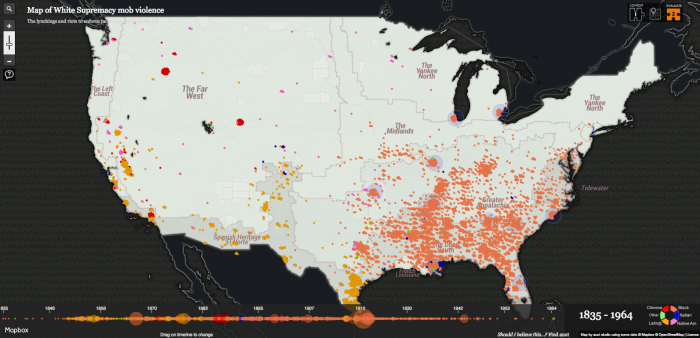
Now, a new interactive map—named Monroe Work Today after the early 20th century historian (Monroe Nathan Work) who gathered much of the data—“aims to be the most comprehensive catalogue of proven lynchings that took place in the United States from 1835 to 1964.” The site calls its impressive map “a rebirth of one piece” of Monroe Work’s legacy, expanded to include many more sources and the post WWII period. “In the century after the Civil War,” write the map’s creators, “as many as 5000 people of color were executed—not by courts, but by mobs on the street who believed the cause of white supremacy.”
Lynchings became widespread in the early 1800s, “as a form of self-appointed justice in local communities… when townspeople made grave accusations first, but never bothered to gather proof.” In the postbellum U.S., such killings became more exclusively racialized in “very real crusades to change the United States to a place only for whites.” Local leaders “encouraged people to carry that idea onto the streets.” As you can see in the screenshots here from particularly violent periods in history, most, but by no means all of these extrajudicial killings took place in the South against African Americans.
In other areas of density in the Southwest, “Far West,” and “Left Coast” (as the project refers to these areas) the victims tended to be Latino/a, Chinese, or Native American. In New Orleans, a deep pool of blue marks the many Sicilian victims of lynching in the late 19th century.

For a number of reasons discussed on the site, the map’s creators caution against using their tool “to decide that some places suffered ‘more racism’ than others.” Many other forms of racist violence, from intimidation to rape, redlining, criminalization, and job discrimination have been widespread around the country and are not shown on the map. In anticipation of accusations of bias, Monroe Work Today encourages users to evaluate the source for themselves. (“You should always do this with anything you read online.”) A good place to start would be their extensive bibliography. As you scroll through the site, you’ll find other questions answered as well.
Writing at The Smithsonian, Danny Lewis calls the map “an important endeavor to help mark these dark parts of American history and make it more visible and accessible for all.” But Monroe Work Today is more than a research tool. The site bears witness to a continuing story. “The threat of violence for Americans of color is alive and real,” writes Bliss, “This is a good time to revisit its history.”
Related Content:
Visualizing Slavery: The Map Abraham Lincoln Spent Hours Studying During the Civil War
75 Years of CIA Maps Now Declassified & Made Available Online
Josh Jones is a writer and musician based in Durham, NC. Follow him at @jdmagness
Read More...How Ridley Scott’s Blade Runner Illuminates the Central Problem of Modernity
Of all the societal debates now going on in the West, many have to do with identity: who belongs in which group? Which groups belong in which places? And what if who we are changes according to context? In its own deep concern with identity, Ridley Scott’s Blade Runner, one of the most enduring cinematic visions of the 20th century, has come to look even more prescient than it already did. The video essayist Evan Puschak, better known as Nerdwriter, finds out what the film understands about the problems of social life in its future — our present — in a chapter of his “Understanding Art” series called “Blade Runner: The Other Side of Modernity.”
Blade Runner tells the story of Rick Deckard, a retired police detective called back to work to hunt down a group of slave androids, known as “replicants,” who have escaped their confinement in an off-world mining camp and arrived on Earth. “In that process,” says Puschak, “we are confronted with an avalanche of big ideas: what it means to be human, how our memories create who we are, themes of love, exploitation, post-colonialism, social hierarchy, and social decay.”
It all takes place in an imagined Los Angeles of 2019, a rainy, darkly sublime urban realm whose “upper world is crisp, clean, and predominantly Caucasian,” and whose “street-level world is dirty, chaotic, and multicultural, paralleling the ‘white flight’ of the mid-20th century.”
The vision of modernity at work in Blade Runner “finds its expression, necessarily, in moments between developments of the plot,” in its glimpses, deliberately offered by Scott and his collaborators, into the built and social environment at the margins of the action. The overall effect is “to produce a world the keynote of which is malaise.” And though enthusiasts have written a great deal about the film’s exploration of humanity itself — arguments still erupt, after all, over the issue of whether Deckard is a replicant himself, even after Scott himself has tried to settle it — “the central problem of modernity isn’t humanity; it’s identity.”
In Puschak’s view, Blade Runner diagnoses the condition that “all the freedom of modern society, all its secularism and egalitarianism and choice, conceals a darker side to the coin: the side on which human identity isn’t determined by society, but by the individual, making its formation, by definition, problematic.” Indeed, we could see the shift from societally determined identity to individually determined identity — framed positively, the long march toward freedom — as one of the main threads of the past few centuries of human history, here represented by Deckard’s struggle with “the gradual breakdown of the only identity he’s ever had.”
The essay highlights one especially poignant but little-acknowledged scene where Deckard, having just slain one of his assigned targets, instinctively goes to buy a drink, but “what he really needs is some kind of connection, some place where the rules of interaction are still solid and knowable.” Ultimately, even after Deckard has dispatched all of the rogue replicants, no “satisfactory answer to the puzzle of modernity” emerges, but “Blade Runner doesn’t seek to give answers.” Instead, it seems to have known what questions we would soon ask ourselves about “the consequences of a society that, for all its members, is as limitless as the vast architecture of a city, yet as indifferent as the rain.”
Related Content:
Watch an Animated Version of Ridley Scott’s Blade Runner Made of 12,597 Watercolor Paintings
Blade Runner Gets Re-Created, Shot for Shot, Using Only Microsoft Paint
Blade Runner is a Waste of Time: Siskel & Ebert in 1982
Based in Seoul, Colin Marshall writes and broadcasts on cities and culture. He’s at work on a book about Los Angeles, A Los Angeles Primer, the video series The City in Cinema, the crowdfunded journalism project Where Is the City of the Future?, and the Los Angeles Review of Books’ Korea Blog. Follow him on Twitter at @colinmarshall or on Facebook.
Read More...What Did the Voice of Neanderthals, Our Distant Cousins, Sound Like?: Scientists Demonstrate Their “High Pitch” Theory
Scholars have made informed, educated guesses at what Shakespeare sounded like in the original pronunciation. The same applies to what Old Norse sounded like from the 9th through the 13th centuries. And even to Beowulf read in Old English, Homer’s Odyssey read in the original Ancient Greek, and The Epic of Gilgamesh read in Akkadian.
But could we push back much further in time? How about 40,000 years into deep history when our close cousins, the Neanderthals, populated the planet?
Above, you can watch a segment of a BBC documentary, Neanderthal: The Rebirth, where a team of scientists “examine the first full skeleton of a neanderthal ever to be discovered and uncover insights into the most likely sound our primitive cousins would have made.” Anatomists, biometric specialists, paleoanthropologists, and vocal experts–they all worked together to analyze the Neanderthal’s vocal apparatus and came to this conclusion: Homo neanderthalensis likely had a surprisingly high-pitched voice (the original High Pitch). It’s on display above.
If you would like to support the mission of Open Culture, consider making a donation to our site. It’s hard to rely 100% on ads, and your contributions will help us continue providing the best free cultural and educational materials to learners everywhere. You can contribute through PayPal, Patreon, and Venmo (@openculture). Thanks!
Related Content:
What Ancient Greek Music Sounded Like: Hear a Reconstruction That is ‘100% Accurate’
Hear What Shakespeare Sounded Like in the Original Pronunciation
Learn What Old Norse Sounded Like, with UC Berkeley’s “Cowboy Professor, Dr. Jackson Crawford
Hear What Homer’s Odyssey Sounded Like When Sung in the Original Ancient Greek
Hear Beowulf Read In the Original Old English: How Many Words Do You Recognize?
Hear The Epic of Gilgamesh Read in the Original Akkadian and Enjoy the Sounds of Mesopotamia
Read More...Support Us
We're hoping to rely on loyal readers, rather than erratic ads. Please click the Donate button and support Open Culture. You can use Paypal, Venmo, Patreon, even Crypto! We thank you!

About Us

Open Culture scours the web for the best educational media. We find the free courses and audio books you need, the language lessons & educational videos you want, and plenty of enlightenment in between.
Advertise With Us

FREE UPDATES!
GET OUR DAILY EMAIL
Get the best cultural and educational resources on the web curated for you in a daily email. We never spam. Unsubscribe at any time.
FOLLOW ON SOCIAL MEDIA

Open Culture editor Dan Colman scours the web for the best educational media. He finds the free courses and audio books you need, the language lessons & movies you want, and plenty of enlightenment in between.
Advertise With Us


