An Animated Introduction to Voltaire: Enlightenment Philosopher of Pluralism & Tolerance
Gottfried Wilhelm Leibniz has the distinction of holding prominent places in both mathematics and philosophy. A contemporary of Isaac Newton, a rival, and Baruch Spinoza, an acquaintance, Leibniz will forever be associated with Enlightenment Rationalism. But thanks to French philosopher and writer Voltaire, he will also be associated with a strain of thought generally taken much less seriously: the philosophy of Optimism.
In the Theodicy, the only philosophical book he published in his lifetime, Leibniz attempts to reconcile divine providence, human freedom, and the nature of evil. He concludes, more or less, that the world is a perfect balance between the three. As “an absolutely perfect being,” God must have made the best possible world, he reasoned, and many conservative theologians then and now have agreed. But not Voltaire.
Drawing on a diverse body of genres—travel narrative, Bildungsroman, picaresque novel—the French writer’s rollicking satirical novella Candide, or the Optimist presents us with a comically grotesque and hyperbolic world that is nonetheless much more like the violent, chaotic one we actually experience than like Leibniz’s idealization. The novel’s hero, a gullible naïf, traipses through Europe and the Americas with his mentor, Professor Pangloss, “the greatest philosopher of the Holy Roman Empire.” A broad caricature of Leibniz, Pangloss insists—as the two run into devastating earthquakes, war, torture, cannibalism, venereal disease, and yet more earthquakes—that they live in “the best of all possible worlds.”
The assertion comes to seem increasingly, outrageously absurd and willfully obtuse. In the end, the various characters come around to the idea that their grand metaphysical questions have no real purchase on human existence, and that they would do best to practice a kind of quietism, settling down to small farms to, as Candide says, “cultivate our garden.” The response does not enjoin us to passivity, but rather to the use of our abilities for purposeful work rather than contentious speculation or in the service of blind faith. From his start as a writer, Voltaire fiercely attacked “fanaticism, idolatry, superstition,” as Alain de Botton says in the School of Life introduction to Voltaire above, as the basis of people killing each other “to defend some bit of religious doctrine which they scarcely understand.”
Voltaire found the phenomenon of religious war “repellant,” and his age had seen its share of war. In the historical background of Candide’s composition were the Seven Years’ War, the global imperial conflict that claimed the lives of eight million, and the Thirty Years’ War: the 17th century religious conflict that spread violent death, famine, and disease all over the European continent. In addition to these appalling events, Voltaire and his contemporaries were left reeling from the 1755 Lisbon earthquake, which historians estimate may have killed upwards of 100,000 people. This natural evil was wholly unrelated to any kind of human misbehavior—as Voltaire bitterly argued in his “Poem on the Lisbon Disaster”—and so made Optimistic philosophy and theology seem cruel and ridiculous.
The bawdy, bloody, and hilarious Candide has remained the most incisive literary representation of disillusionment in “best of all possible worlds” theodicy. It is by far Voltaire’s most popular work—a bestseller from the day that it appeared in 1759—and is still given to students to help them understand the philosophical Enlightenment, or what is often called, as de Botton says, “The Age of Voltaire.” With more clarity than even Jonathan Swift’s satires, Voltaire helps us grasp and remember the major historical, religious, and philosophical conflicts of the time. A “master at popularizing difficult material,” Voltaire also used literary techniques to explain the ideas of contemporary thinkers like Locke and Newton.
The anecdote of the apple falling on Newton’s head, for example, “is due entirely to Voltaire,” who heard it from Newton’s niece and included it in his Letters Concerning the English Nation. This work, composed during his two-year stay in England, implicitly critiques the intolerance of French society—causing the book to be banned—and makes the case for some of the philosopher’s most cherished values: pluralism, religious toleration, mutual respect, and free inquiry. We find these ideals all throughout the works of Enlightenment philosophers from all over the continent, but nowhere do we find them articulated with such forceful wit and vivid style as in the work of Voltaire.
Related Content:
Voltaire: “Those Who Can Make You Believe Absurdities, Can Make You Commit Atrocities”
Voltaire & the Lisbon Earthquake of 1755
Philosophers Drinking Coffee: The Excessive Habits of Kant, Voltaire & Kierkegaard
Josh Jones is a writer and musician based in Durham, NC. Follow him at @jdmagness
Read More...Tuileries: The Coen Brothers’ Short Film About Steve Buscemi’s Very Bad Day in the Paris Metro
All around the world, each public transit system has its own rules. These come in both the official and unspoken varieties, the former basically consistent from place to place, and the latter usually reflecting the mores of the society each system serves. The acceptability of talking to one’s fellow passengers, for instance, tends to vary, and in some countries even making eye contact counts as a no-no. You certainly won’t try it in Paris after witnessing the consequences when Steve Buscemi breaks that rule in Tuileries, this short directed by the Coen brothers that first appeared in the anthology film Paris, je t’aime.
“Paris is known as the City of Lights,” Buscemi’s apparent tourist reads in his guidebook as he sits awaiting a train in the station from which the film takes its name. “A city of culture… of fine dining and magnificent architecture. Paris is a city for lovers: lovers of art, lovers of history, lovers of food, lovers of… love.”
Though he seems to be having a somewhat less than lovely time there, including getting pelted by a passing child’s spitballs, he endures. Not five seconds after reading about the no-eye-contact custom on Paris’ “reasonably clean” subway (a laugh line for any Parisian) does he look fatefully up, catching the eye of a girl across the tracks and sending her boyfriend into a jealous rage.
Foreigners have long felt as intimidated by Paris as they’ve admired it, a mixture of emotions the Coen Brothers play on without leaving the Tuileries platform, as does Alexander Payne in the altogether different experience of the American alone in the City of Lights he essays at the end of Paris, je t’aime. In the decade since the movie came out, we’ve seen a few other city-themed anthology films, including New York, I Love You, Rio, Eu Te Amo, and the unrelated Tokyo!, albeit none with a second contribution by the Coen brothers or a second appearance by Buscemi — whose character may have yet to recover from from his trip to Paris anyway.
Related Content:
How the Coen Brothers Storyboarded Blood Simple Down to a Tee (1984)
Watch the Coen Brothers’ TV Commercials: Swiss Cigarettes, Gap Jeans, Taxes & Clean Coal
World Cinema: Joel and Ethan Coen’s Playful Homage to Cinema History
4,000+ Free Movies Online: Great Classics, Indies, Noir, Westerns, Documentaries & MoreBased in Seoul, Colin Marshall writes and broadcasts on cities and culture. He’s at work on a book about Los Angeles, A Los Angeles Primer, the video series The City in Cinema, the crowdfunded journalism project Where Is the City of the Future?, and the Los Angeles Review of Books’ Korea Blog. Follow him on Twitter at @colinmarshall or on Facebook.
Read More...Watch David Bowie & Marianne Faithfull Rehearse and Sing Sonny & Cher’s “I Got You Babe” (1973)
It was October 1973 and three months earlier David Bowie had stood before his fans at the Hammersmith Odeon and announced–to the surprise of his band–that he was effectively ending Ziggy Stardust and the Spiders from Mars. His alter-ego was done, and he had to break up the band.
But there would be one final swan song, a live special featuring Bowie, set in a futuristic cabaret, to be called The 1980 Floor Show (a pun on Orwell’s 1984, which the singer was trying to adapt into a concept album, and which would later morph into Diamond Dogs). The location would be the famous London nightclub the Marquee, but the show would be shot for American television and a late-night rock and pop variety show called The Midnight Special, airing on NBC Friday nights after Johnny Carson’s The Tonight Show.
British fans who couldn’t make the filming were annoyed, and to this day, the full broadcast has not been shown in the UK, and is still not officially available.
Invitation only, the audience comprised members of the David Bowie fan club, the rock press, musicians, and other lucky people. This would turn out to be the very last time that Mick Ronson and Trevor Bolder would play with Bowie as the Spiders. Joining the band was pianist Mike Garson, who had been a part of the Ziggy tour and the recently released Aladdin Sane, and whose sound is unmistakable here. Bowie also has three black back-up singers, a first sign of the sounds he would explore in Young Americans. And he invited The Troggs to play their hit, “Wild Thing.”
Unlike a concert run-through, the three days of filming featured each number rehearsed separately and filmed multiple times. For one thing, it allowed Bowie the chance to change costumes for each song, wearing some of the most outlandish outfits of his Ziggy era, designed by Freddie Burretti.
By 1973, Marianne Faithfull had gone from Mick Jagger’s girlfriend and pop chanteuse to a heroin addict, but Bowie’s invitation to join him helped her on her road to recovery. She sang “As Tears Go By” solo for the show wearing an angelic white dress and then “20th Century Blues” dressed in a red dress, wearing a towering purple feather hat and backed by male dancers.
For the finale, Bowie joined her onstage. (You can watch their ultimate performance here.) Dressed as decadent nun with a fully exposed back, Faithfull stood next to Bowie, dressed as “the Angel of Death” according to him, and had a go at the 1965 Sonny and Cher song “I Got You Babe.” The two really hadn’t rehearsed the song until that day. Faithfull’s voice was already heading towards the low, Nico-esque tones she’d develop later in the decade. The video contains two full rehearsals of the song, a non-”Wild Thing” number from the Troggs, and once again Bowie with “Space Oddity” and “I Can’t Explain.”
Also on the tape are introductions from one Amanda Lear, a velvet-voiced blonde who had a very intriguing career–Salvador Dali protege, Rolling Stone groupie, David Bowie lover, Italo-disco star, nude model, possible transsexual. So yes, a perfect host for what was at that time both a high-water mark for glam rock and a visit to the future.
As we approach the one year anniversary of David Bowie’s death, which seemed to send the Grim Reaper on a killing spree, there’s plenty of the Starman’s career to discover and re-discover…and to be released.
Related Content:
Jean-Luc Godard Shoots Marianne Faithfull Singing “As Tears Go By” (1966)
The Story of Ziggy Stardust: How David Bowie Created the Character that Made Him Famous
David Bowie Remembers His Ziggy Stardust Days in Animated Video
Lego Video Shows How David Bowie Almost Became “Cobbler Bob,” Not “Aladdin Sane”
Ted Mills is a freelance writer on the arts who currently hosts the FunkZone Podcast. You can also follow him on Twitter at @tedmills, read his other arts writing at tedmills.com and/or watch his films here.
Read More...Watch a Young Carrie Fisher (RIP) Audition for Star Wars (1975)
Carrie Fisher, the actress who played Princess Leia in Star Wars, has died. She was only 60 years old.
Last week, she suffered a massive heart attack on a flight from London to LA. News reports initially indicated that her condition was improving. But alas fate then moved things in another direction.
Above, you can watch a young Carrie Fisher–only 19 years old–audition for the part that made her famous. (On YouTube, see other audition footage featuring Mark Hamill, Harrison Ford, and Kurt Russell.) Last month, while promoting her brand new memoir The Princess Diarist, Fisher talked with NPR’s Terry Gross about the challenge of making that first Star Wars film. “I think I sort of felt isolated. I didn’t really have anyone. I didn’t confide in men. [The cast and filmmakers were all men.] I didn’t confide in anyone then.” “I was so insecure.” But she kept it well hidden. Only poise and confidence are on display here.
Note: You can download The Princess Diarist as a free audiobook from Audible.com if you take part in their no-strings-attached free trial program. Get more details on that here.
If you would like to support the mission of Open Culture, consider making a donation to our site. It’s hard to rely 100% on ads, and your contributions will help us continue providing the best free cultural and educational materials to learners everywhere. You can contribute through PayPal, Patreon, and Venmo (@openculture). Thanks!
Related Content:
Learn to Code with Star Wars: The Force Awakens and Minecraft
How Star Wars Borrowed From Akira Kurosawa’s Great Samurai Films
Read More...When Ayn Rand Collected Social Security & Medicare, After Years of Opposing Benefit Programs
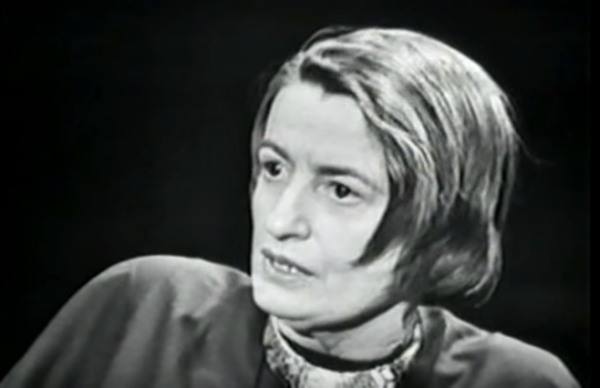
Image via YouTube, 1959 interview with Mike Wallace
A robust social safety net can benefit both the individuals in a society and the society itself. Free of the fear of total impoverishment and able to meet their basic needs, people have a better opportunity to pursue long-term goals, to invent, create, and innovate. Of course, there are many who believe otherwise. And there are some, including the acolytes of Ayn Rand, who believe as Rand did: that those who rely on social systems are—to use her ugly term—“parasites,” and those who amass large amounts of private wealth are heroic supermen.
Rand disciple Alan Greenspan, for example, initiated the era of “Reaganomics” in the early 1980s by engineering “an increase in the most regressive tax on the poor and middle class,” writes Gary Weiss, “the Social Security payroll tax—combined with a cut in benefits.” For Greenspan, “this was no contradiction. Social Security was a system of altruism at its worst. Its beneficiaries were looters. Raising their taxes and cutting their benefits was no loss to society.”
One problem with Rand’s reasoning is this: whether “parasite” or titan of industry, none of us is anything more than human, subject to the same kinds of cruel twists of fate, the same existential uncertainty, the same illness and disease. Suffering may be unequally distributed to a great degree by human agency, but nature and circumstance often have a way of evening the odds. Rand herself experienced such a leveling effect in her retirement. After undergoing surgery in 1974 for lung cancer caused by her heavy smoking, she found herself in straitened circumstances.
Two years later, she was paired with social worker Evva Pryor, who gave an interview in 1998 about their relationship. “Rarely have I respected someone as much as I did Ayn Rand,” said Pryor. When asked about their philosophical disagreements, she replied, “My background was social work. That should tell you all you need to know about our differences.” Pryor was tasked with persuading Rand to accept Social Security and Medicare to help with mounting medical expenses.
I had read enough to know that she despised government interference, and that she felt that people should and could live independently. She was coming to a point in her life where she was going to receive the very thing she didn’t like.… For me to do my job, she had to recognize that there were exceptions to her theory.… She had to see that there was such a thing as greed in this world.… She could be totally wiped out by medical bills if she didn’t watch it. Since she had worked her entire life and had paid into Social Security, she had a right to it. She didn’t feel that an individual should take help.
Finally, Rand relented. “Whether she agreed or not is not the issue,” said Pryor, “She saw the necessity for both her and [her husband] Frank.” Or as Weiss puts it, “Reality had intruded upon her ideological pipedreams.” That’s one way of interpreting the contradiction: that Rand’s philosophy, Objectivism, “has no practical purpose except to promote the economic interests of the people bankrolling it”—the sole function of her thought is to justify wealth, explain away poverty, and normalize the sort of Hobbesian war of all against all Rand saw as a societal ideal.
Rand taught “there is no such thing as the public interest,” that programs like Social Security and Medicare steal from “creators” and illegitimately redistribute their wealth. This was a “sublimely enticing argument for wealthy businessmen who had no interest whatever in the public interest.… Yet the taxpayers of America paid Rand’s and Frank O’Connor’s medical expenses.” Randians have offered many convoluted explanations for what her critics see as sheer hypocrisy. We may or may not find them persuasive.
In the simplest terms, Rand discovered at the end of her life that she was only human and in need of help. Rather than starve or drop dead—as she would have let so many others do—she took the help on offer. Rand died in 1982, as her admirer Alan Greenspan had begun putting her ideas into practice in Reagan’s administration, making sure, writes Weiss, that the system was “more favorable to the creators and entrepreneurs who were more valuable to society,” in his Randian estimation, “than people lower down the ladder of success.” After well over three decades of such policies, we can draw our own conclusions about the results.
Related Content:
Ayn Rand Helped the FBI Identify It’s A Wonderful Life as Communist Propaganda
Free Audio: Ayn Rand’s 1938 Dystopian Novella Anthem
In Her Final Speech, Ayn Rand Denounces Ronald Reagan, the Moral Majority & Anti-Choicers (1981)
Flannery O’Connor: Friends Don’t Let Friends Read Ayn Rand (1960)
Josh Jones is a writer and musician based in Durham, NC. Follow him at @jdmagness
Read More...Watch the First Surf Movie Ever Made: A 1906 Thomas Edison Film Shot in Hawaii
Above you can watch what was arguably the first surf movie ever made–the very beginning of a long cinematic tradition that gave us Gidget in 1959, and The Endless Summer in 1966. And lest you think the surf movie reached its zenith during those halcyon days, some would argue that the best surf films were later produced during the aughts–Thicker Than Water (2000), Blue Crush (2002), Step Into Liquid (2003), Riding Giants (2004), etc. And don’t forget this great little short, “Dark Side of the Lens.”
In 1906, smack in the middle of the aughts of last century, Thomas Edison sent the pioneering cinematographer Robert K. Bonine to shoot an ‘Actuality’ documentary about life in the Polynesian islands. The blurb accompanying this video describes the scene above: “The first moving pictures of surfers riding waves — Surf Riders, Waikiki Beach, Honolulu — shows a minute of about a dozen surfers on alaia boards in head-high, offshore surf at what is probably Canoes. These surfers are shot too far away to detail what they were wearing, but they all appear to be in tanksuits.”
If you’re interested in taking a deep dive into Hawaii’s surfing scene, I’d definitely recommend pickup up a copy of Barbarian Days: A Surfing Life, the memoir by New Yorker writer William Finnegan. It won the 2016 Pulitzer Prize.
Related Content:
Thomas Edison’s Silent Film of the “Fartiste” Who Delighted Crowds at Le Moulin Rouge (1900)
Dark Side of the Lens: A Poetic Short Film by Surf Photographer Mickey Smith
Watch the Very First Feature Documentary: Nanook of the North by Robert J. Flaherty (1922)
Read More...Watch Nina Simone Sing the Black Pride Anthem, “To Be Young, Gifted and Black,” on Sesame Street (1972)
In her brief 34 years, Lorraine Hansberry left a formidable legacy as the first African-American and the youngest playwright to win the coveted New York Critics’ Circle Award for A Raisin in the Sun. (It was also the first play by a black writer to be produced on Broadway.) What’s more, Hansberry was a committed civil rights campaigner, from a family who had fought housing segregation in the Supreme Court. She herself organized with Martin Luther King, Jr., Harry Belafonte, Lena Horne, James Baldwin, and many others; wrote for Paul Robeson’s Freedom; and joined the first lesbian civil rights organization, the Daughters of Bilitis, contributing to their magazine, The Ladder.
Hansberry was indeed “Young, Gifted, and Black,” which also happens to be the title of an autobiography published after her death from pancreatic cancer in 1965, and of a posthumously produced play. But the title has maybe most famously lived on in a tribute to Hansberry by her friend, the prodigiously gifted Nina Simone. Among Simone’s many mentors, Hansberry “offered her a special bond,” writes Claudia Roth Pierpont at The New Yorker, and pushed her into activism. “We never talked about men or clothes,” Simone wrote in her memoir, I Put a Spell on You, “It was always Marx, Lenin and revolution—real girls’ talk.” After the 1963 Baptist Church bombing in Birmingham, Simone dedicated herself to the movement with a passion for justice and liberation.
And yet, “for every lyric about lynchings and the struggle for equality,” notes the Blanton Museum, “Simone would write another about freedom and black pride, reinforcing her belief that African American men and women should know the beauty of their blackness.” As she put it in an interview, “My job is to somehow make [black people] curious enough, or persuade them, by hook or crook, to get them more aware of themselves and where they came from and what is already there.” What was already there included the work of friends like James Baldwin and Lorraine Hansberry, from whom Simone drew “To Be Young, Gifted and Black,” one of the “most triumphant anthems of the black pride movement of the 1970s.”
At the top of the post, you can see Simone sing the song to four young kids on a 1972 episode of Sesame Street, bringing them the news: “There’s a world waiting for you.” As she announces in the song itself, “We must begin to tell our young” the importance of their culture and history. The young responded with gratitude for Simone’s advocacy. In the short Sesame Street clip, the four adorable kids look on admiringly, and one girl sings along. The inspiration for the song came not only from Hansberry’s influence on Simone’s political consciousness, but also from a photograph of Hansberry she saw in the New York Times.
The picture, “caught hold of me,” Simone says in the brief interview clip above, “I remember getting a feeling in my body.… I knew what I wanted it to say in essence.… I really think that she gave it to me.” After the short interview, you can see Simone perform the song in a 1969 session at Morehouse College, to rapturous applause from the audience. “To Be Young, Gifted and Black” has been covered by duo Bob & Marcia, Donny Hathaway, Aretha Franklin, and—most recently, Solange Knowles. Though none of these artists have had the intimate, personal connection to the lyrics and their inspiration that Nina Simone did, all of them have helped transmit her message. Even in the face of gross injustice and seemingly implacable opposition to equality and civil rights, “There’s a world waiting for you / This is a quest that’s just begun.”
Related Content:
Nina Simone Sings Her Breakthrough Song, ‘I Loves You Porgy,’ in 1962
Watch a New Nina Simone Animation Based on an Interview Never Aired in the U.S. Before
Josh Jones is a writer and musician based in Durham, NC. Follow him at @jdmagness
Read More...Edward Hopper’s Iconic Painting Nighthawks Explained in a 7‑Minute Video Introduction
If any one painting stands for mid-twentieth-century America, Nighthawks does. In fact, Edward Hopper’s 1942 canvas of four figures in a late-night New York City diner may qualify as the most vivid evocation of that country and time in any form. For Evan Puschak, better known as the video essayist Nerdwriter, the experience of Nighthawks goes well beyond the visual realm. “I’ve always thought of him in a sort of aromatic way,” says Puschak of the artist, “because his paintings evoke the same kinds of feelings and memories that I get from the sense of smell, as if he was channeling directly into my limbic system, excavating moments that were stored deeply away.”
But Puschak wouldn’t have experienced the early 1940s first-hand, much less the turn-of-the-century period in which Hopper grew up. Nor would have most of the people captivated by Nighthawks today, much less those countless appreciators as yet unborn. How does Hopper, in his most famous painting and many others, at once capture a time and a place while also resonating on a deeper, more universally human level?
Puschak takes up that question in “Look through the Window,” a video essay that examines the power of Hopper’s art, “clean, smooth, and almost too real,” through a breakdown of Nighthawks, an expression of all of the artist’s themes: “loneliness, alienation, voyeurism, quiet contemplation, and more.”
The effectiveness of the painting’s composition, in Puschak’s analysis, comes from such elements as the ambiguity of the relationships between its characters, the strong diagonal lines of the diner’s architecture, the use of light in the darkness, and the windows so clear as to look “as if they’re not even there,” all so memorably realized by Hopper’s painstaking dedication to his work. (His long and involved process, which we’ve previously featured here, even included a kind of storyboarding.) “As slowly and deliberately as he painted,” Puschak says, “he wanted us to look — really look, and to be made vulnerable, as a viewer always is.”
Many Americans must have felt such vulnerability with a special acuteness at the time Hopper finished painting Nighthawks, “the weeks and days following the bombing of Pearl Harbor, when everyone in New York City was paranoid about another attack.” Everyone, that is, except Edward Hopper, who kept his studio light on and kept on painting beneath it. “The future was very uncertain at this moment in time, as uncertain as the darkness that frames the patrons of this diner, a darkness they’re launched into by Hopper’s composition and our gaze.” Some might say that times, in America and elsewhere, haven’t become much more certain since. We, like Hopper, could do much worse than continuing to create ever more deliberately, and to see ever more clearly.
Related Content:
How Edward Hopper “Storyboarded” His Iconic Painting Nighthawks
Painters Painting: The Definitive Documentary Portrait of the New York Art World (1940–1970)
Whitney Museum Puts Online 21,000 Works of American Art, By 3,000 Artists
The Museum of Modern Art (MoMA) Puts Online 65,000 Works of Modern Art
Based in Seoul, Colin Marshall writes and broadcasts on cities and culture. He’s at work on a book about Los Angeles, A Los Angeles Primer, the video series The City in Cinema, the crowdfunded journalism project Where Is the City of the Future?, and the Los Angeles Review of Books’ Korea Blog. Follow him on Twitter at @colinmarshall or on Facebook.
Read More...Hemingway, Fitzgerald, Faulkner: A Free Yale Course
This course taught by Yale professor Wai Chee Dimock examines major works by three iconic American authors–Ernest Hemingway, F. Scott Fitzgerald, and William Faulkner. Along the way, Dimock explores these authors’ “interconnections on three analytic scales: the macro history of the United States and the world; the formal and stylistic innovations of modernism; and the small details of sensory input and psychic life.” You can access the 24 lectures in Hemingway, Fitzgerald, Faulkner on YouTube, or on iTunes in video and audio. Texts discussed in the course include:
Faulkner, William. As I Lay Dying.
Faulkner, William. Light in August.
Faulkner, William. The Sound and the Fury.
Fitzgerald, F. Scott. The Great Gatsby.
Fitzgerald, F. Scott. The Short Stories of F. Scott Fitzgerald: A New Collection.
Fitzgerald, F. Scott. Tender is the Night.
Hemingway, Ernest. For Whom the Bell Tolls.
Hemingway, Ernest. In Our Time.
Hemingway, Ernest. To Have and Have Not.
Find more information about this course, including the syllabus, over at this Yale site.
Hemingway, Fitzgerald, Faulkner has been added to our list of Free Online Literature courses, a subset of our meta collection, 1,700 Free Online Courses from Top Universities.
If you would like to support the mission of Open Culture, consider making a donation to our site. It’s hard to rely 100% on ads, and your contributions will help us continue providing the best free cultural and educational materials to learners everywhere. You can contribute through PayPal, Patreon, and Venmo (@openculture). Thanks!
Read More...How Leo Tolstoy Became a Vegetarian and Jumpstarted the Vegetarian & Humanitarian Movements in the 19th Century
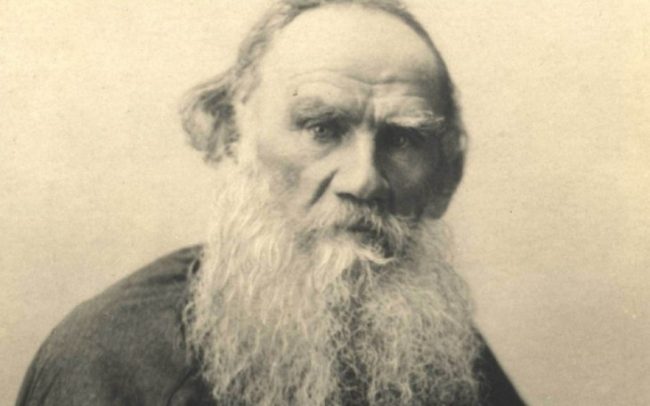
Leo Tolstoy is remembered as both a towering pinnacle of Russian literature and a fascinating example of Christian anarchism, a mystical version of which the aristocratic author pioneered in the last quarter century of his life. After a dramatic conversion, Tolstoy rejected his social position, the favored vices of his youth, and the dietary habits of his culture, becoming a vocal proponent of vegetarianism in his ascetic quest for the good life. Thousands of his contemporaries found Tolstoy’s example deeply compelling, and several communes formed around his principles, to his dismay. “To speak of ‘Tolstoyism,’” he wrote, “to seek guidance, to inquire about my solution of questions, is a great and gross error.”
“Still,” writes Kelsey Osgood at The New Yorker, “people insisted on seeking guidance from him,” including a young Mahatma Gandhi, who struck up a lively correspondence with the writer and in 1910 founded a community called “Tolstoy Farm” near Johannesburg.
Though uneasy in the role of movement leader, the author of Anna Karenina invited such treatment by publishing dozens of philosophical and theological works, many of them in opposition to a contrary strain of religious and moral ideas developing in the late nineteenth century. Often called “muscular Christianity,” this trend responded to what many Victorians thought of as a crisis of masculinity by emphasizing sports and warrior ideals and railing against the “feminization” of the culture.
Tolstoy might be said to represent a “vegetable Christianity”—seeking harmony with nature and turning away from all forms of violence, including the eating of meat. In “The First Step,” an 1891 essay on diet and ethical commitment, he characterized the prevailing religious attitude toward food:
I remember how, with pride at his originality, an Evangelical preacher, who was attacking monastic asceticism, once said to me “Ours is not a Christianity of fasting and privations, but of beefsteaks.” Christianity, or virtue in general—and beefsteaks!
While he confessed himself “not horrified by this association,” it is only because “there is no bad odor, no sound, no monstrosity, to which man cannot become so accustomed that he ceases to remark what would strike a man unaccustomed to it.” The killing and eating of animals, Tolstoy came to believe, is a horror to which—like war and serfdom—his culture had grown far too accustomed. Like many an animal rights activist today, Tolstoy conveyed his horror of meat-eating by describing a slaughterhouse in detail, concluding:
[I]f he be really and seriously seeking to live a good life, the first thing from which he will abstain will always be the use of animal food, because, to say nothing of the excitation of the passions caused by such food, its use is simply immoral, as it involves the performance of an act which is contrary to the moral feeling—killing.
[W]e cannot pretend that we do not know this. We are not ostriches, and cannot believe that if we refuse to look at what we do not wish to see, it will not exist.… [Y]oung, kind, undepraved people—especially women and girls—without knowing how it logically follows, feel that virtue is incompatible with beefsteaks, and, as soon as they wish to be good, give up eating flesh.
The idea of vegetarianism of course preceded Tolstoy by hundreds of years of Hindu and Buddhist practice. And its growing popularity in Europe and America preceded him as well. “Tolstoy became an outspoken vegetarian at the age of 50,” writes Sam Pavlenko, “after meeting the positivist and vegetarian William Frey, who, according to Tolstoy’s son Sergei Lvovich, visited the great writer in the autumn of 1885.” Tolstoy’s dietary stance fit in with what Charlotte Alston describes as an “increasingly organized” international vegetarian movement taking shape in the late nineteenth century.
Like Tolstoy in “The First Step,” proponents of vegetarianism argued not only against cruelty to animals, but also against “the brutalization of those who worked in the meat industry, as butchers, slaughtermen, and even shepherds and drovers.” But vegetarianism was only one part of Tolstoy’s religious philosophy, which also included chastity, temperance, the rejection of private property, and “a complete refusal to participate in violence or coercion of any kind.” This marked his dietary practice as distinct from many contemporaries. Tolstoy and his followers “made the link between vegetarianism and a wider humanitarianism explicit.”
“How was it possible,” Alston summarizes, “to regard the killing of animals for food as evil, but not to condemn the killing of men through war and capital punishment? Not all members of the vegetarian movement agreed.” Some saw “no connection between the questions of war and diet.” Tolstoy’s philosophical argument against all forms of violence was not original to him, but it resonated all over the world with those who saw him as a shining example, including his two daughters and eventually his wife Sophia, who all adopted the practice of vegetarianism. A book of their recipes was published in 1874, and adapted by Pavlenko for his Leo Tolstoy: A Vegetarian’s Tale. (See one example here—a family recipe for macaroni and cheese.)
In her study Tolstoy and His Disciples, Alston details the Russian great’s wide influence through not only his diet but the totality of his spiritual practices and unique political and religious views. Interestingly, unlike many animal rights activists of his day and ours, Tolstoy refused to endorse legislation to punish animal cruelty, believing that punishment would only result in the perpetuation of violence. “Non-violence, non-resistance and brotherhood were the principles that lay at the basis of Tolstoyan vegetarianism,” she observes, “and while these principles meant that Tolstoyans cooperated closely with vegetarians, they also kept them in many ways apart.”
Related Content:
Leo Tolstoy’s Family Recipe for Macaroni and Cheese
Watch Glass Walls, Paul McCartney’s Case for Going Vegetarian
Leo Tolstoy’s Masochistic Diary: I Am Guilty of “Sloth,” “Cowardice” & “Sissiness” (1851)
Leo Tolstoy Creates a List of the 50+ Books That Influenced Him Most (1891)
Josh Jones is a writer and musician based in Durham, NC. Follow him at @jdmagness
Read More...Support Us
We're hoping to rely on loyal readers, rather than erratic ads. Please click the Donate button and support Open Culture. You can use Paypal, Venmo, Patreon, even Crypto! We thank you!

About Us

Open Culture scours the web for the best educational media. We find the free courses and audio books you need, the language lessons & educational videos you want, and plenty of enlightenment in between.
Advertise With Us

FREE UPDATES!
GET OUR DAILY EMAIL
Get the best cultural and educational resources on the web curated for you in a daily email. We never spam. Unsubscribe at any time.
FOLLOW ON SOCIAL MEDIA

Open Culture editor Dan Colman scours the web for the best educational media. He finds the free courses and audio books you need, the language lessons & movies you want, and plenty of enlightenment in between.
Advertise With Us

