How to Make a Replica of 1900-Year-Old Glass Fish: A Brilliant Video from the British Museum
All due respect to the British Museum, but the title of its “How to Make a Glass Fish Replica” video, above is a tad misleading.
I’m sure no malice was intended, but “making” a DIY fish-shaped vessel reminiscent of some 22 found in the ancient Kushan storerooms at Begram, Afghanistan is no one’s definition of an easy craft project. (Unless you’re willing to fudge with some Elmer’s, some blue felt, and an empty peanut butter jar…)
Glass Specialist Bill Gudenrath of the Corning Museum of Glass is an historian of glassworking techniques from ancient Egypt through the Renaissance and clearly expert at his craft, but he doesn’t appear to be too keen on supplying explanatory blow-by-blows. Nor would I be, bustling around a red hot glass oven, without so much as a Johnny Tremain-style leather apron to protect me. I’m not even sure I’d want the distraction of a video camera in my face.
But if, as the title implies, the goal is to produce a duplicate of this whimsical 1900-year-old guppy, the process must be broken down.
From what this casual viewer was able to piece together, the steps would go something like:
1. Twirl a red hot metal pipe in the forge until you have a healthy glob of molten glass. Apparently it’s not so different from making cotton candy.
2. Roll the glass blob back and forth on a metal tray.
3. Blow into the pipe’s non-glowing end to form a bubble.
4. Repeat steps 1–3
5. Roll the pipe back and forth on a metal sawhorse while seated, applying pinchers to taper the blob into a recognizably fishy-shape.
(Don’t worry about its proximity to your bare forearms and khaki-covered thighs! What could possibly go wrong?)
6. Twirl it like a baton.
(Depending on the length of your arms, your nascent glass fish may come dangerously close to the cement floor. Try not to sweat it.)
7. Use scissors and pinchers to tease out a nipple-shaped appendage that will become the fish’s lips.
8. Use another poker to apply various bloops of molten glass. (Novices may want to practice with a hot glue gun to get the hang of this — it’s trickier than it looks!) Pinch, prod and drape these bloops into eye and fin shapes. A non-electric crimping iron will prove handy here.
9. Use blue glass, tweezers and crimping iron to personalize your fish-shaped vessel’s distinctive dorsal and anal fins.
10. Tap on the pipe to crack the fish loose. (Careful!)
11. Score the distal end with a glass cutting tool.
(This step should prove a cinch for anyone who ever used a craft kit to turn empty beer and soda bottles into drinking glasses!)
12. Smooth rough edges with another loop of molten glass and some sort of electric underwater grinding wheel.
Optional 13th step: Read this description of a furnace session, to better acquaint yourself with both best glassblowing practices and the proper names for the equipment. Or get the jump on Christmas 2017 with this true how-to guide to producing hand blown glass ornaments.
Not planning on blowing any glass, fish-shaped or otherwise, any time soon?
Explore the somewhat mysterious history of the 1900-year-old fish-shaped original here, compliments of the British Museum’s St John Simpson, senior curator for its pre-Islamic collections from Iran and Arabia.
Related Content:
Modern Artists Show How the Ancient Greeks & Romans Made Coins, Vases & Artisanal Glass
Glass: The Oscar-Winning “Perfect Short Documentary” on Dutch Glassmaking (1958)
How to Bake Ancient Roman Bread Dating Back to 79 AD: A Video Primer
Ayun Halliday is an author, illustrator, theater maker and Chief Primatologist of the East Village Inky zine. Her play Zamboni Godot is opening in New York City in March 2017. Follow her @AyunHalliday.
Read More...Fill Your New Kindle, iPad, iPhone, eReader with Free eBooks, Audio Books, Online Courses & More

Santa left a new Kindle, iPad, Kindle Fire or other media player under your tree. He did his job. Now we’ll do ours. We’ll tell you how to fill those devices with free intelligent media — great books, movies, courses, and all of the rest. And if you didn’t get a new gadget, fear not. You can access all of these materials right on a computer. Here we go:
Free eBooks: You have always wanted to read the great works. And now is your chance. When you dive into our Free eBooks collection you will find 800 great works by some classic writers (Dickens, Dostoevsky, Austen, Shakespeare and Tolstoy) and contemporary writers (Philip K. Dick, Isaac Asimov, and Kurt Vonnegut). The collection also gives you access to the 51-volume Harvard Classics.
If you’re an iPad/iPhone user, the download process is super easy. Just click the “iPad/iPhone” links and you’re good to go. Kindle and Nook users will generally want to click the “Kindle + Other Formats links” to download ebook files, but we’d suggest watching these instructional videos (Kindle – Nook) beforehand.
Free Audio Books: What better way to spend your free time than listening to some of the greatest books ever written? This page contains a vast number of free audio books — 700 works in total — including texts by Arthur Conan Doyle, James Joyce, Jane Austen, Edgar Allan Poe, George Orwell and more recent writers — Italo Calvino, Vladimir Nabokov, Raymond Carver, etc. You can download these classic books straight to your gadgets, then listen as you go.
[Note: If you’re looking for a contemporary book, you can download one free audio book from Audible.com. Find details on Audible’s no-strings-attached deal here.]
Free Online Courses: This list brings together over 1150 free online courses from leading universities, including Stanford, Yale, MIT, UC Berkeley, Oxford and beyond.
These full-fledged courses range across all disciplines — history, physics, philosophy, psychology, business, and beyond. Most all of these courses are available in audio, and roughly 75% are available in video. You can’t receive credits or certificates for these courses (click here for courses that do offer certificates). But the amount of personal enrichment you will derive is immeasurable.
Free Movies: With a click of a mouse, or a tap of your touch screen, you will have access to 725 great movies. The collection hosts many classics, westerns, indies, documentaries, silent films and film noir favorites. It features work by some of our great directors (Alfred Hitchcock, Orson Welles, Andrei Tarkovsky and more) and performances by cinema legends: John Wayne, Jack Nicholson, Audrey Hepburn, Charlie Chaplin, and beyond. On this one page, you will find thousands of hours of cinema bliss.
Free Language Lessons: Perhaps learning a new language is high on your list of New Year’s resolutions. Well, here is a great way to do it. Take your pick of 46 languages, including Spanish, French, Italian, Mandarin, English, Russian, Dutch, even Finnish, Yiddish and Esperanto. These lessons are all free and ready to download.
Free Textbooks: And one last item for the lifelong learners among you. We have scoured the web and pulled together a list of 200 Free Textbooks. It’s a great resource particularly if you’re looking to learn math, computer science or physics on your own. There might be a diamond in the rough here for you.
Thank Santa, maybe thank us, and enjoy that new device.…
Read More...
A History of Philosophy in 81 Video Lectures: A Free Course That Explores Philosophy from Ancient Greece to Modern Times
Above, you can watch 81 video lectures tracing the history of philosophy, moving from Ancient Greece to modern times. Arthur Holmes presented this influential course at Wheaton College for decades, and now it’s online for you. The lectures are all streamable above, or available through this YouTube playlist.
Philosophers covered in the course include: Plato, Aquinas, Hobbes Descartes, Spinoza, Hume, Kant, Hegel, Nietzsche, Sartre and more.
A History of Philosophy has been added to our list of Free Online Philosophy courses, a subset of our meta collection, 1,700 Free Online Courses from Top Universities.
If you would like to support the mission of Open Culture, consider making a donation to our site. It’s hard to rely 100% on ads, and your contributions will help us continue providing the best free cultural and educational materials to learners everywhere. You can contribute through PayPal, Patreon, and Venmo (@openculture). Thanks!
Related Content:
Oxford’s Free Course Critical Reasoning For Beginners Teaches You to Think Like a Philosopher
Introduction to Political Philosophy: A Free Online Course from Yale University
Free Online Philosophy Courses
Michael Sandel’s Free Course on Justice, the Most Popular Course at Harvard, Is Now Online
Read More...
Death: A Free Philosophy Course from Yale
This course taught by Yale professor Shelly Kagan deals with something we’re all going to face–death. Here’s how the course description reads:
There is one thing I can be sure of: I am going to die. But what am I to make of that fact? This course will examine a number of issues that arise once we begin to reflect on our mortality. The possibility that death may not actually be the end is considered. Are we, in some sense, immortal? Would immortality be desirable? Also a clearer notion of what it is to die is examined. What does it mean to say that a person has died? What kind of fact is that? And, finally, different attitudes to death are evaluated. Is death an evil? How? Why? Is suicide morally permissible? Is it rational? How should the knowledge that I am going to die affect the way I live my life?
Major texts used in this course include Plato’s Phaedo, Tolstoy’s The Death of Ivan Ilych, and John Perry’s A Dialogue on Personal Identity and Immortality.
You can watch the 26 lectures above. Or find them on YouTube and iTunes in video and audio formats. For more information on this course, including the syllabus, please visit this Yale site.
This course has been added to our list of Free Online Philosophy courses, a subset of our meta collection, 1,700 Free Online Courses from Top Universities.
If you would like to support the mission of Open Culture, consider making a donation to our site. It’s hard to rely 100% on ads, and your contributions will help us continue providing the best free cultural and educational materials to learners everywhere. You can contribute through PayPal, Patreon, and Venmo (@openculture). Thanks!
Related Content:
Introduction to Political Philosophy: A Free Online Course from Yale University
Oxford’s Free Course Critical Reasoning For Beginners Teaches You to Think Like a Philosopher
Free Online Philosophy Courses
Michael Sandel’s Free Course on Justice, the Most Popular Course at Harvard, Is Now Online
Read More...The Employment: A Prize-Winning Animation About Why We’re So Disenchanted with Work Today
What did Argentine filmmaker Santiago Grasso have in mind when he created the prize-winning animation El Empleo (The Employment) five years ago? Was it something about the dehumanizing quality of many jobs in the modern service economy? Or the grim shift towards menial labor after the great recession of 2007-08? Or, nowadays in 2016, could you see a commentary on the work that will be left once automation finishes displacing living, breathing employees–everyone from burger flippers to hedge fund managers? Robots will do the work, people will be the doormats, and maybe (as Elon Musk suggests) the government can pay us all a bare minimum wage?
The Employment will be added to our collection of Free Animations, a subset of our larger meta list, 4,000+ Free Movies Online: Great Classics, Indies, Noir, Westerns, Documentaries & More.
If you would like to support the mission of Open Culture, consider making a donation to our site. It’s hard to rely 100% on ads, and your contributions will help us continue providing the best free cultural and educational materials to learners everywhere. You can contribute through PayPal, Patreon, and Venmo (@openculture). Thanks!
Related Content:
Bertrand Russell & Buckminster Fuller on Why We Should Work Less, and Live & Learn More
Charles Bukowski Rails Against 9‑to‑5 Jobs in a Brutally Honest Letter (1986)
William Faulkner Resigns From His Post Office Job With a Spectacular Letter (1924)
Read More...Bill Murray & Gilda Radner Deliver the Laughs in Two 1970s Skits for National Lampoon
Bill Murray is America’s kindliest, most eccentric, best known secular elf, spreading joy throughout the year, as he treats strangers to impromptu birthday serenades, poetry readings, and bachelor party toasts.
How will younger fans, who’ve never been exposed to the brash Murray of yore, react to his late 70s Santa, above, for the “National Lampoon Radio Hour”? This Grinch is a spiritual forefather of such department store baddies as Billy Bob Thornton and that guy from A Christmas Story.
Forget about Flexy the Pocket Monkey… Murray’s sham-Claus gleefully denies even the humblest of sweet-voiced little Gilda Radner’s requests — a Nerf Ball and a Pez dispenser.
Saturday Night Live fans of a certain vintage may detect more than a hint of Lisa Loopner’s boyfriend Todd De LaMuca in Murray’s vocal characterization. Instead of Noogies, he sends Radner giggling through “the trap door.”
Man, these two had chemistry!
They revisited the scenario in a holiday sketch for Saturday Night Live’s 3rd season, with Santa downgraded from “evil” to “drunken.”
Murray’s “Kung Fu Christmas” for the National Lampoon Radio Hour’s 1974 Christmas show, above, makes a smooth vintage chaser.
In addition to Radner, collaborators here include Paul Shaffer, Christopher Guest, and Bill’s brother Brian Doyle-Murray, a lily white line up unthinkable in 2016.
The lyrics and silky vocal stylings conjure visions of a disco-gritty yuletide New York, where “every race has a smile on its face.”
This time Radner gets to do the rejecting, in an extended spoken word interlude that finds Christopher Guest showering her with offers ranging from a house in the South of France to a glass-bottomed boat. (“Didn’t you like that Palomino horse I bought you last year?”)
Murray who continued to explore his musical urges with his SNL character, Nick the Lounge Singer, was replaced by David Hurdon when “Kung Fu Christmas” was recorded for 1975’s Good-bye Pop album.
Related Content:
Watch Bill Murray, the Struggling New SNL Cast Member, Apologize for Not Being Funny (1977)
Bill Murray Reads Great Poetry by Billy Collins, Cole Porter, and Sarah Manguso
Ayun Halliday is an author, illustrator, theater maker and Chief Primatologist of the East Village Inky zine. Her play Zamboni Godot is opening in New York City in March 2017. Follow her @AyunHalliday.
Read More...Hear Jorge Luis Borges Read 30 of His Poems (in the Original Spanish)
In a recent post on the mathematical-minded Dutch graphic artist M.C. Escher, Colin Marshall referred to David Auerbach’s short “Inquest on Left-Brained Literature.” Here, Auerbach situates Jorge Luis Borges among writers like Richard Powers, Umberto Eco, David Mitchell, Haruki Murakami and others, who exist “on a parallel track of literature that is popular specifically among engineers.” From his observations, Auerbach draws only “one obvious conclusion… that engineers tend to like novelists that deal in math and science material.”
Auerbach’s list seems legitimate (he mentions “another scholar who also works amongst engineers” and who “produced near-duplication of this list”). But it prompts one important question for me: How do these writers see themselves? As primarily literary authors? Genre writers? Engineers themselves, of a sort?
In the case of Borges, we have an eloquent self-description from the author in his introduction to the Selected Poems 1923–1967. “First and foremost,” writes Borges, “I think of myself as a reader, then as a poet, then as a prose writer.”
While Borges may hold tremendous appeal for left-brain thinkers like programmer Jamie Zawinski, he began his career as a very right-brained poet, and continued to see his work as primarily “addressed to the imagination” rather than “to the reason.”
I cannot say whether my work is poetry or not; I can only say that my appeal is to the imagination. I am not a thinker. I am merely a man who has tried to explore the literary possibilities of metaphysics and of religion.
Borges is inordinately modest. His work is poetry, especially, of course, his actual poetry—volumes of it, written over six decades of his life— from his first published collection in 1923, Fervor de Buenos Aires, to his last, Los conjurados in 1985. It has always seemed to me something of a tragedy that Borges is not better-known as a poet among his English-speaking readers. It’s not for lack of excellent translations, most of them guided by the multi-lingual Borges himself.
The situation is much different, in my experience, among Spanish-speakers. There is indeed a Latin-American—and specifically Argentine—resonance in some of Borges’ verse that is impossible to translate. For those who can appreciate Borges in his original language, we bring you the album above, 30 poems read by the author himself. You can hear one of those readings, “Arte Poetica,” in the video at the top of the post, with English subtitles. The director, Neels Castillon, describes the short film as “a journey around Argentina and Uruguay to illustrate words of Jorge Luis Borges.”
English speakers can also sample translations of Borges’ poetry here and here. Or dive into the translation of “Arte Poetica,” or “The Art of Poetry” here.
Related Content:
Hear the Enchanting Jorge Luis Borges Read “The Art of Poetry”
Jorge Luis Borges’ 1967–8 Norton Lectures On Poetry (And Everything Else Literary)
Borges Explains The Task of Art
Josh Jones is a writer and musician based in Durham, NC. Follow him at @jdmagness
Read More...A Crash Course in Existentialism: A Short Introduction to Jean-Paul Sartre & Finding Meaning in a Meaningless World
Very broadly speaking, all philosophy contains within it dialectical tensions: some ideas seem ennobling and consoling, others unsettling and alienating. Every school, movement, and individual thinker deals in some measure of both. Sometimes we feel unsettled because of historical and cultural distance. When Socrates talks about slavery or censorship in matter-of-fact ways, for example, we might be startled, but his audience didn’t see things the way we do. When it comes, however, to the Existentialists, the cultural and political milieu of these thinkers may resemble our own closely enough that statements which shocked their readers still shock most people today.
Take one of the bigger questions like, oh, the meaning of life. “We understand our lives as being meaningful,” says Hank Green above—brother of John Green, the other half of the Crash Course educational team. We might find purpose and fulfillment in a number of things, from religion to art, sports, careers, and politics.
Existentialists, Green tells us, would say that “any or all of these things can give your life meaning.” Consoling, eh? “But at the same time,” and here comes the downer, “they say none of them can.” These thinkers may be spread out over time and space—from the 19th century Denmark and Germany of Kierkegaard and Nietzsche to the 1950s France of Sartre, De Beauvoir, and Camus. But Existentialist thinkers share at least one common trait: anti-essentialism.
As Green explains, classical philosophy offered the comforting explanation that everything contained an essence: “a certain set of core principles that are necessary or essential for a thing to be what it is.” Not only do chairs and tables have essences but so do human beings, they thought, and “your essence gives you a purpose.” Still a very widespread and commonplace belief, we can probably agree, and one people rarely think about critically unless they’re having… well, an existential crisis. So far so good when it comes to grasping the essence (sorry) of Existentialist thinking.
Green goes astray however, when he gets to Nietzsche, whom he claims embraced Nihilism, “the belief in the ultimate meaninglessness of life.” Not only did Nietzsche vehemently oppose nihilism as self-defeating, but he feared the consequences of its spread, even if he sometimes saw it as an inevitable product of modernity. Another important consideration when studying so-called Existentialist thinkers is that they themselves were deeply troubled by their troubling insights. Kierkegaard turned to a radical form of Christianity, Camus to an introspective individualism… and perhaps the most famous Existentialist, Jean Paul Sartre, came to embrace doctrinaire Marxism.
But first, he formulated the most quotable maxim of Existentialist thought: “Existence precedes Essence.” From this, he drew a conclusion both troubling and consoling: “It’s up to each of us to determine who we are. We have to write our own essence through the way we choose to live.” But this liberated condition is absurd: it means we are ultimately responsible for everything we do, even when we have no idea what’s going to happen when we do it, or any larger purpose for doing it at all. Whether ardently religious like Kierkegaard or ardently atheist like Nietzsche and Sartre, Existentialist philosophers who stared into the void found there all of the boundless freedom and terrifying vertigo we came to associate with the neurosis of the modern human condition.
Related Content:
Free Online Philosophy Courses
What Is an “Existential Crisis”?: An Animated Video Explains What the Expression Really Means
Existentialism with Hubert Dreyfus: Four Free Philosophy Courses
Josh Jones is a writer and musician based in Durham, NC. Follow him at @jdmagness
Read More...Radio Garden Lets You Instantly Tune into Radio Stations Across the Entire Globe
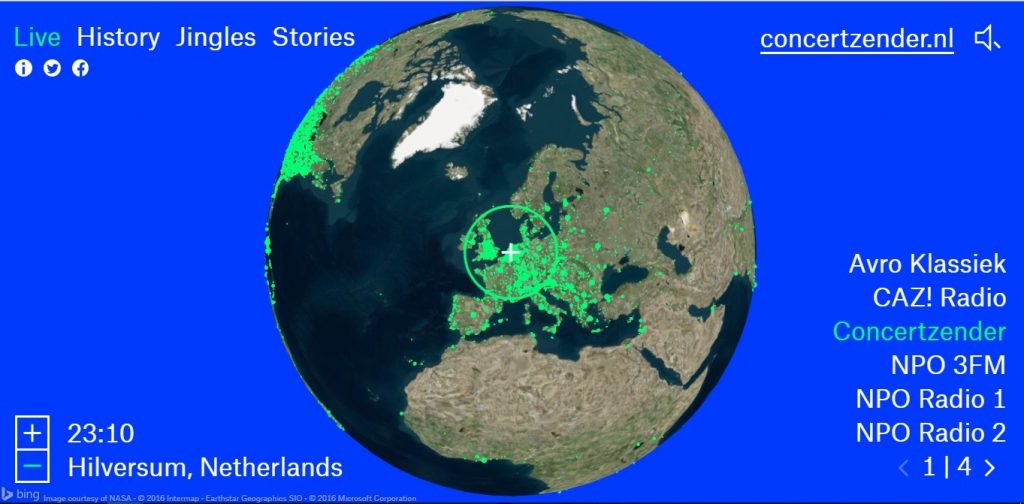
A pretty cool project.
Pick a place on the globe. Any place. Then tune in and hear what’s playing on the radio in that location.
The service is called Radio Garden, and here’s what it’s essentially all about:
By bringing distant voices close, radio connects people and places. Radio Garden allows listeners to explore processes of broadcasting and hearing identities across the entire globe. From its very beginning, radio signals have crossed borders. Radio makers and listeners have imagined both connecting with distant cultures, as well as re-connecting with people from ‘home’ from thousands of miles away – or using local community radio to make and enrich new homes.
While Radio Garden lets you tune into broadcasts across different geographies, another service previously featured here on OC–Radiooooo–lets you hear radio broadcasts across time. That is, historical broadcasts.
Between the two services, you’ll be covered spatially and temporally. What more could you want?
Update: Radio Garden is now apparently available as an app on Google and Apple.
If you would like to support the mission of Open Culture, consider making a donation to our site. It’s hard to rely 100% on ads, and your contributions will help us continue providing the best free cultural and educational materials to learners everywhere. You can contribute through PayPal, Patreon, and Venmo (@openculture). Thanks!
Read More...Watch a 2‑Year-Old Solve Philosophy’s Famous Ethical “Trolley Problem” (It Doesn’t End Well)
“A runaway train is heading towards five workers on a railway line. There’s no way of warning, but you’re standing near a lever that operates some points. Switch the points, and the train goes down a spur. Trouble is, there’s another worker on that bit of track too, but it’s one fatality instead of five. Should you do that?” Here we have the trolley problem, which since its first articulation in 1967 by Philippa Foot has become the classic example of an ethical dilemma as well as perhaps the best known thought experiment in all of philosophy.
This explanation of the trolley problem comes from one of the Harry Shearer-narrated BBC- and Open University-made animations previously featured here on Open Culture. The short video above takes a different approach, not just using a children’s train set to illustrate it but then putting the famous question to the child himself.
“Uh oh, Nicholas,” says the two-year-old’s father from behind the camera, “this train is going to crash into these five people! Should we move the train to go this way, or should we let it go that way?” The elegance of the toddler’s solution, implemented without hesitation, must be seen to be appreciated.
The father, E. J. Masicampo of Wake Forest University, researches “the effortful mental processes that seem to separate humans from other animals: resisting temptations and impulses, reasoning and decision making, thinking about and simulating non-present events, and making plans for the future.” Among his professional goals, he lists working toward “a theory of the human consciousness” by uncovering “how conscious thought contributes to human functioning in light of its apparent limitations.” He’s taken on a problem even harder than the one with the trolleys; perhaps young Nicholas, what with his demonstrated gift of “thinking outside the box,” invaluable in the philosophical disciplines, can offer some assistance.
Related Content:
Free Online Philosophy Courses
9‑Year-Old Philosopher Ponders the Meaning of Life and the Universe
Are You a Psychopath? Take the Test (And, If You Fail, It’s Not All Bad News)
The Epistemology of Dr. Seuss & More Philosophy Lessons from Great Children’s Stories
Based in Seoul, Colin Marshall writes and broadcasts on cities and culture. He’s at work on a book about Los Angeles, A Los Angeles Primer, the video series The City in Cinema, the crowdfunded journalism project Where Is the City of the Future?, and the Los Angeles Review of Books’ Korea Blog. Follow him on Twitter at @colinmarshall or on Facebook.
Read More...Support Us
We're hoping to rely on loyal readers, rather than erratic ads. Please click the Donate button and support Open Culture. You can use Paypal, Venmo, Patreon, even Crypto! We thank you!

About Us

Open Culture scours the web for the best educational media. We find the free courses and audio books you need, the language lessons & educational videos you want, and plenty of enlightenment in between.
Advertise With Us

FREE UPDATES!
GET OUR DAILY EMAIL
Get the best cultural and educational resources on the web curated for you in a daily email. We never spam. Unsubscribe at any time.
FOLLOW ON SOCIAL MEDIA

Open Culture editor Dan Colman scours the web for the best educational media. He finds the free courses and audio books you need, the language lessons & movies you want, and plenty of enlightenment in between.
Advertise With Us

