Fyodor Dostoyevsky’s Life & Literature Introduced in a Monty Python-Style Animation
“You know how earlier we were talking about Dostoyevsky?” asks David Brent, Ricky Gervais’ iconically insecure paper-company middle-manager central to the BBC’s original The Office. “Oh, yeah?” replies Ricky, the junior employee who had earlier that day demonstrated a knowledge of the influential Russian novelist apparently intimidating to his boss. “Fyodor Mikhailovich Dostoyevsky. Born 1821. Died 1881,” recites Brent. “Just interested in him being exiled in Siberia for four years.” Ricky admits to not knowing much about that period of the writer’s life. “All it is is that he was a member of a secret political party,” Brent continues, drawing upon research clearly performed moments previous, “and they put him in a Siberian labour camp for four years, so, you know…”
We here at Open Culture know that you wouldn’t stoop to such tactics in an attempt to establish intellectual supremacy over your co-workers — nor would you feel any shame in not having yet plunged into the work of that same Fyodor Mikhailovich Dostoyevsky, born 1821, died 1881, and the author of such much-taught novels as Crime and Punishment, The Idiot, and The Brothers Karamazov (as well as a prolific doodler). “His first major work,” in the posturing words of David Brent, “was Notes from the Underground, which he wrote in St Petersburg in 1859. Of course, my favorite is The Raw Youth. It’s basically where Dostoyevsky goes on to explain how science can’t really find answers for the deeper human need.”
An intriguing position! To hear it explained with deeper comprehension (but just as entertainingly, and also in an English-accented voice), watch this 14-minute, Monty Python-style animated primer from Alain de Botton’s School of Life and read the accompanying article from The Book of Life. Even apart from those years in Siberia, the man “had a very hard life, but he succeeded in conveying an idea which perhaps he understood more clearly than anyone: in a world that’s very keen on upbeat stories, we will always run up against our limitations as deeply flawed and profoundly muddled creatures,” an attitude “needed more than ever in our naive and sentimental age that so fervently clings to the idea – which this great Russian loathed – that science can save us all and that we may yet be made perfect through technology.”
After The School of Life gets you up to speed on Dostoyevsky, you’ll no doubt find yourself able to more than hold your own in any water-cooler discussion of the man whom James Joyce credited with shattering the Victorian novel, “with its simpering maidens and ordered commonplaces,” whom Virginia Woolf regarded as the most exciting writer other that Shakespeare, and whose work Hermann Hesse tantalizingly described as “a glimpse into the havoc.” You may well also find yourself moved even to open one of Dostoyevsky’s intimidatingly important books themselves, whose assessments of the human condition remain as devastatingly clear-eyed as, well, The Office’s.
Related Content:
Fyodor Dostoevsky Draws Elaborate Doodles In His Manuscripts
Dostoevsky Draws a Picture of Shakespeare: A New Discovery in an Old Manuscript
Albert Camus Talks About Nihilism & Adapting Dostoyevsky’s The Possessed for the Theatre, 1959
Based in Seoul, Colin Marshall writes and broadcasts on cities, language, and style. He’s at work on a book about Los Angeles, A Los Angeles Primer, the video series The City in Cinema, the crowdfunded journalism project Where Is the City of the Future?, and the Los Angeles Review of Books’ Korea Blog. Follow him on Twitter at @colinmarshall or on Facebook.
Read More...R. Crumb Illustrates Genesis: A Faithful, Idiosyncratic Illustration of All 50 Chapters
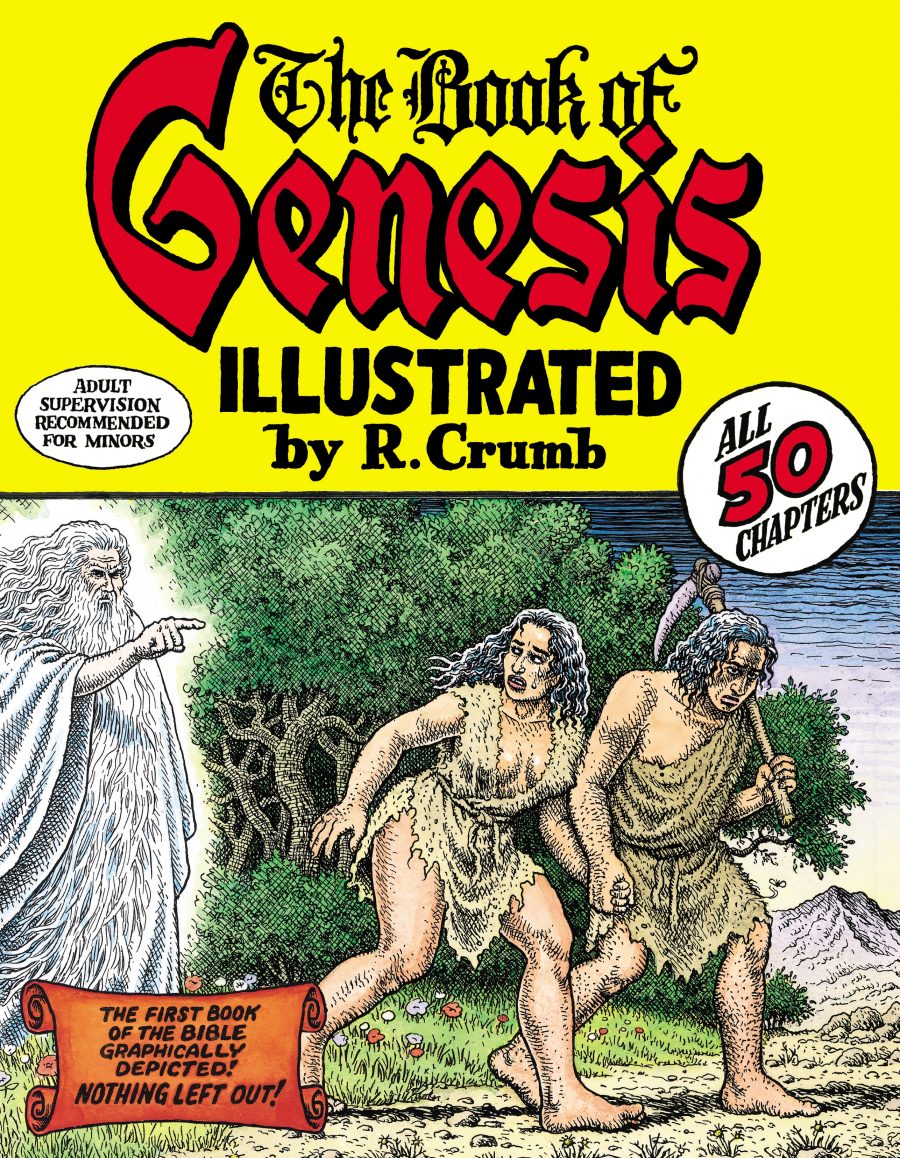
It is widely accepted among scholars that the first few books of the Bible—including, of course, Genesis, with its creation myths and flood story—are a patchwork of several different sources, pieced together by so-called redactors. This “documentary hypothesis” identifies the literary characteristics of each source, and attempts to reconstruct their different theological and political contexts. Primarily refined by German scholars in the late nineteenth century, the theory is very persuasive, but can also seem pretty schematic and dry, robbing the original texts of much of their liveliness, rhetorical power, and ancient strangeness.

Another German scholar, Hermann Gunkel, approached Genesis a little differently. “Everyone knows”—write the editors of a scholarly collection on the foundational Biblical text—Gunkel’s “motto”: “Genesis ist eine Sammlung von Sagen”—“Genesis is a collection of popular tales.” Rather than reading the various stories contained within as historical narratives or theological treatises, Gunkel saw them as redacted legends, myths, and folk tales—as ancient literature. “Legends are not lies,” he writes in The Legends of Genesis, “on the contrary, they are a particular form of poetry.”
Such was the approach of cartoonist and illustrator Robert Crumb, who took on illustrating the entire book of Genesis, “a text so great and so strange,” he says, “that it lends itself readily to graphic depictions.” In the short video above, Crumb describes the creation narrative in the ancient Hebrew book as “an archetypal story of our culture, such a strong story with all kinds of metaphorical meaning.” He also talks about his genuine respect and admiration for the stories of Genesis and their origins. “You study ancient Mesopotamian writings,” says Crumb, “and there’s all of these references in the oldest Sumerian legends about the tree of knowledge” and other elements that appear in Genesis, mixed up and redacted: “That’s how folk legends and all that shit evolve over centuries.”
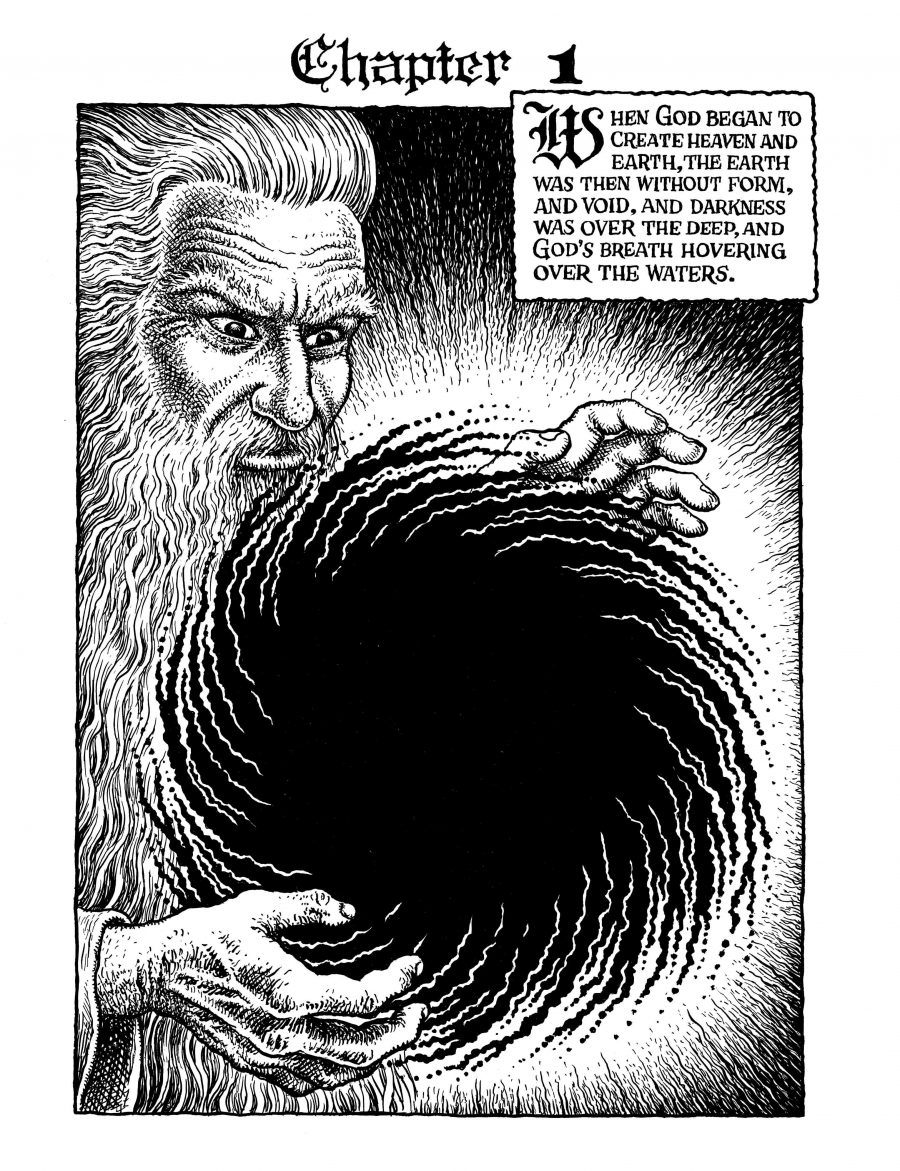
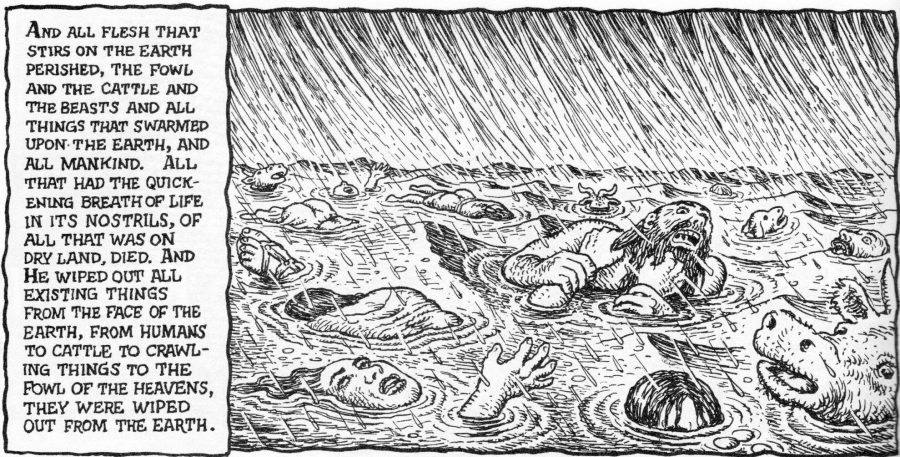
The Biblical book first struck Crumb as “something to satirize,” and his initial approach leans on the irreverent, scatological tropes we know so well in his work. But he instead decided to produce a faithful visual interpretation of the text just as it is, illustrating each chapter, all 50, word for word. The result, writes Colin Smith at Sequart, is “idiosyncratic, tender-hearted and ultimately inspiring.” It is also a critical visual commentary on the text’s central character: Crumb’s God “is regularly, if not exclusively, portrayed as an unambiguously self-obsessed and bloodthirsty despot, terrifying in his demands, terrifying in his brutality.” Arguably, these traits emerge from the stories unaided, yet when we’re told, for example, that “The Lord regretted having made man on Earth and it grieved him in his heart,” Crumb “shows us nothing of regret and grief, but rather a furious old dictator apparently tottering on the edge of madness.”
“It’s not the evil of men that Crumb’s concerned with,” writes Smith, “so much as the psychology of a creature who’d slaughter an entire world.” In that interpretation, he echoes critics of the Bible’s theology since the Enlightenment, from Voltaire to Christopher Hitchens. But he doesn’t shy away from graphic depictions of human brutality, either. Crumb’s move away from satire and decision to “do it straight,” as he told NPR, came from his sense that the sweeping, violent mythology and “soap opera” relationships already lend themselves “to lurid illustration”—his forté. Originally intending to do just the first couple chapters “as a comic story,” he soon found he had a market for all 50 and “stupidly said, ‘okay, I’ll do it.’” The work—undertaken over four years—proved so exhausting, he says he “earned every penny.”
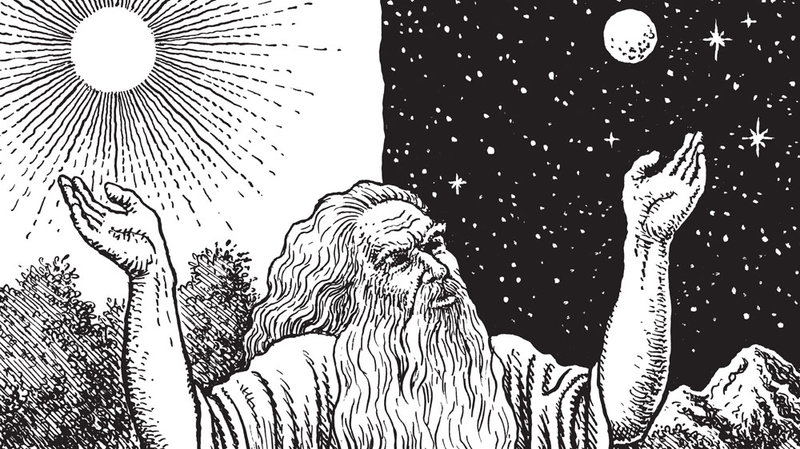
Does Crumb himself identify with the religious traditions in Genesis? Raised a Catholic, he left the church at 16: “I have my own little spiritual quest,” Crumb says, “but I don’t associate it with any particular traditional religion. I think that the traditional Western religions all are very problematic in my view.” That said, like many nonreligious people who read and respect religious texts, he knows the Bible well—better, it turned out, than his editor, a self-described expert. “I just illustrate it as it’s written,” said Crumb, “and the contradictions stand.”
When I first illustrated that part, the creation, where there’s basically two different creation stories that do contradict each other, and I sent it to the editor at Norton, the publisher, who told me he was a Bible scholar. And he read it, and he said wait a minute, this doesn’t make sense. This contradicts itself. Can we rewrite this so it makes sense? And I said that’s the way it’s written. He said, that’s the way it’s written? I said, yeah, you’re a Bible scholar. Check it out.
Crumb invites us all to “check it out”—this collection of archetypal legends that inform so much of our politics and culture, whether the bizarre and costly creation of a fundamentalist “Ark Park” (“dinosaurs and all”), or the Biblical epics of Cecil B. DeMille or Darren Aronofsky, or the poetry of John Milton, or the interpretive illustrations of William Blake. Whether we think of it as history or myth or some patchwork quilt of both, we should read Genesis. R. Crumb’s illustrated version is as good—or better—a way to do so as any other. See more of his illustrations at The Guardian and purchase his illustrated Genesis here.
Related Content:
A Short History of America, According to the Irreverent Comic Satirist Robert Crumb
R. Crumb’s Vibrant, Over-the-Top Album Covers (1968–2004)
R. Crumb Describes How He Dropped LSD in the 60s & Instantly Discovered His Artistic Style
Josh Jones is a writer and musician based in Durham, NC. Follow him at @jdmagness
Read More...Ayn Rand Issues 13 Commandments to Filmmakers for Making Good Capitalist Movies (1947)
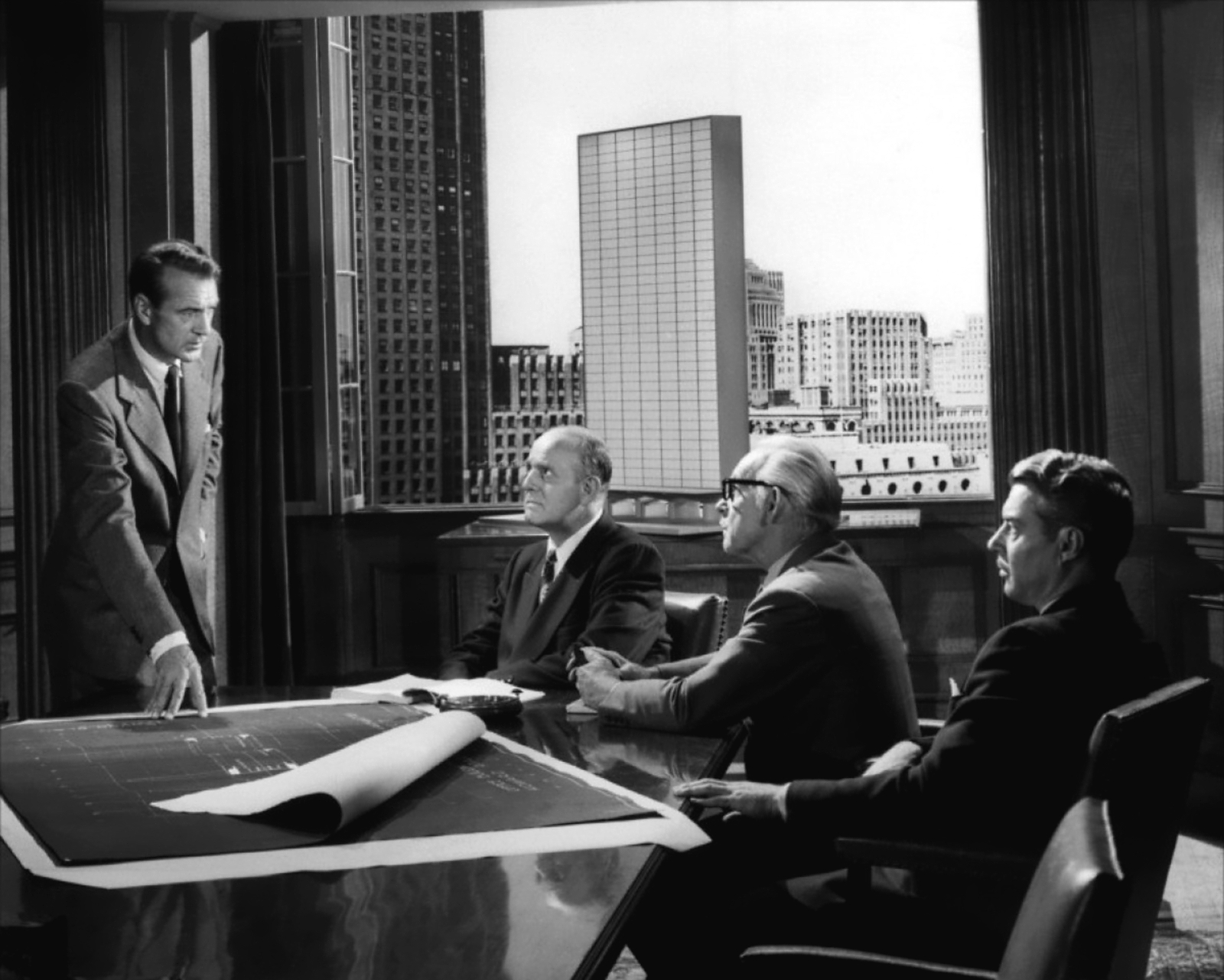
A couple Christmases ago, we featured the story of how Ayn Rand helped the FBI “identify” It’s a Wonderful Life as a piece of communist propaganda, which does make one wonder: what kind of movie would she have America watch instead? We know exactly what kind, since, in 1947, the author of The Fountainhead and Atlas Shrugged, never one to shrink from the task of explaining her ideas, wrote the “Screen Guide for Americans,” according to Paleofuture, a pamphlet meant for distribution to Hollywood producers in order to make them aware of what she saw as a communist push to poison the movies with anti-American ideology.
“The purpose of the Communists in Hollywood, Rand writes, “is not the production of political movies openly advocating Communism. Their purpose is to corrupt our moral premises by corrupting non-political movies — by introducing small, casual bits of propaganda into innocent stories — thus making people absorb the basic premises of Collectivism by indirection and implication.” And so, to counteract the subtly propagandistic power of It’s a Wonderful Life and its ilk, she proposes fighting fire with fire, issuing these thirteen corrective filmmaking commandments:
- Don’t take politics lightly. “To hire Communists on the theory that ‘they won’t put over any politics on me’ and then remain ignorant and indifferent to the subject of politics, while the Reds are trained propaganda experts — is an attitude for which there can be no excuse.”
- Don’t smear the free enterprise system. “Don’t preach or imply that all publicly-owned projects are noble, humanitarian undertakings by grace of the mere fact that they are publicly-owned—while preaching, at same time, that private property or the defense of private property rights is the expression of some sort of vicious greed, of anti-social selfishness or evil.”
- Don’t smear industrialists. “You, as a motion picture producer, are an industrialist. All of us are employees of an industry which gives us a good living. There is an old fable about a pig who filled his belly with acorns, then started digging to undermine the roots of the oak from which the acorns came. Don’t let’s allow that pig to become our symbol.”
- Don’t smear wealth. “If the villain in your story happens to be rich—don’t permit lines of dialogue suggesting that he is the typical representative of a whole social class, the symbol of all the rich. Keep it clear in your mind and in your script that his villainy is due to his own personal character—not to his wealth or class.”
- Don’t smear the profit motive. “Don’t give to your characters — as a sign of villainy, as a damning characteristic, a desire to make money. Nobody wants to, or should, work without payment, and nobody does — except a slave.”
- Don’t smear success. “It is the Communists’ intention to make people think that personal success is somehow achieved at the expense of others and that every successful man has hurt somebody by becoming successful. It is the Communists’ aim to discourage all personal effort and to drive men into a hopeless, dispirited, gray herd of robots who have lost all personal ambition, who are easy to rule, willing to obey and willing to exist in selfless servitude to the State.”
- Don’t glorify failure. “While every man meets with failure somewhere in his life, the admirable thing is his courage in overcoming it — not the fact that he failed.”
- Don’t glorify depravity. “Don’t drool over weaklings as conditioned ‘victims of circumstances’ (or of ‘background’ or of ‘society’) who ‘couldn’t help it.’ You are actually providing an excuse and an alibi for the worst instincts in the weakest members of your audiences.”
- Don’t deify “the common man.” “No self-respecting man in America is or thinks of himself as ‘little,’ no matter how poor he might be. That, precisely, is the difference between an American working man and a European serf.”
- Don’t glorify the collective. “If you preach that it is evil to be different — you teach every particular group of men to hate every other group, every minority, every person, for being different from them; thus you lay the foundation for race hatred.”
- Don’t smear an independent man. “Remember that America is the country of the pioneer, the non-conformist, the inventor, the originator, the innovator. Remember that all the great thinkers, artists, scientists were single, individual, independent men who stood alone, and discovered new directions of achievement — alone.”
- Don’t use current events carelessly. “It is a sad joke on Hollywood that while we shy away from all controversial subjects on the screen, in order not to antagonize anybody — we arouse more antagonism throughout the country and more resentment against ourselves by one cheap little smear line in the midst of some musical comedy than we ever would by a whole political treatise.”
- Don’t smear American political institutions. “It is true that there have been vicious Congressmen and judges, and politicians who have stolen elections, just as there are vicious men in any profession. But if you present them in a story, be sure to make it clear that you are criticizing particular men — not the system. The American system, as such, is the best ever devised in history. If some men do not live up to it — let us damn these men, not the system which they betray.”
Have any real motion pictures passed Rand’s pro-capitalist test? (Read her full pamphlet here.) The film adaptation of The Fountainhead came out in 1949, and Rand herself at first praised it as “more faithful to the novel than any other adaptation of a novel that Hollywood has ever produced.” But later she turned against it, claiming to have “disliked the movie from beginning to end” and swearing never again to sell her novels without reserving the right to pick the director and screenwriter as well as to edit the film herself. She didn’t live to exercise those rights on Atlas Shrugged the movie, which came out as a trilogy between 2011 and 2014, so we’ll never know for sure if the movie met her stringent ideological standards — but with Metacritic scores of 28%, 26%, and 9%, we can safely assume they wouldn’t meet her cinematic ones.
via Paleofuture
Related Content:
Ayn Rand Helped the FBI Identify It’s a Wonderful Life as Communist Propaganda
The Outspoken Ayn Rand Interviewed by Mike Wallace (1959)
A Free Cartoon Biography of Ayn Rand: Her Life & Thought
Žižek Blames the US Government Shutdown on Ayn Rand’s Acolytes Who Caused the 2008 Collapse
Ayn Rand’s Reviews of Children’s Movies: From Bambi to Frozen
Based in Seoul, Colin Marshall writes and broadcasts on cities, language, and style. He’s at work on a book about Los Angeles, A Los Angeles Primer, the video series The City in Cinema, the crowdfunded journalism project Where Is the City of the Future?, and the Los Angeles Review of Books’ Korea Blog. Follow him on Twitter at @colinmarshall or on Facebook.
Read More...The Art Market Demystified in Four Short Documentaries
Spend an hour or two at MoMA, Tate Modern, or some other world class museum and inevitably you’’ll overhear some variation of “my seven-year-old could paint that.”
Mayhaps, Madam, but how much would it fetch at auction?
As a new documentary series, the Art Market (in Four Parts), makes clear, the monetary value of art is tricky to assign.
There are exceptions, of course, such as in the irresistible Picasso anecdote cited in the trailer, above.
Usually however, even the experts must resort to an educated guess, based on a number of factors, none of which can tell the whole story.
As journalist and former director of New York’s White Columns gallery, Josh Baer, points out in the series’ first episode below, even art market indices are an unreliable tool for assessing worth. A portrait of actress Elizabeth Taylor by Andy Warhol failed to attract a single bid at auction, though artnet Price Database reported sales of between $27 million and $31.5 million for other “Liz” paintings by the same artist.
I’d have thought a signature as famous as Warhol’s would confer the same sort of insta-worth Picasso claimed his John Hancock did.
The unpredictability of final sales figures has led auction houses to issue guarantees in return for a split of the profits, a practice Sotheby’s North and South America chairman, Lisa Dennison, likens to an insurance policy for the seller.
With the exception of the ill-fated Warhol’s great big goose egg, the numbers batted around by the series’ influential talking heads are pretty staggering. Snappy editing also lends a sense of art world glamour, though gallerist Michele Maccarone betrays a certain weariness that may come closer to the true energy at the epicenter of the scene.
As for me, I couldn’t help thinking back to my days as a receptionist in a commercial gallery on Chicago’s tourist friendly Magnificent Mile. I was contemptuous of most of the stuff on our walls, which ran heavily to pastel garden parties and harlequins posed in front of recognizable landmarks. One day, a couple who’d wandered in on impulse dropped a ridiculous sum on a florid beach scene, complete with shimmering rainbows. Rich they may have been, but their utter lack of taste was appalling, at least until the wife excitedly confided that the painting’s setting reminded them of their long ago Hawaiian honeymoon. That clarified a lot for me as to art’s true value. I hope that the couple is still alive and enjoying the most for their money’s worth, every single day.
The Art Market’s other three parts, “Galleries,” “Patrons,” and “Art Fairs,” will be released weekly through mid-June. And we’ll try to add them to this post, as they roll out.
Related Content:
Warhol: The Bellwether of the Art Market
Braque in Bulk: Costco Gets Back into the Fine Art Market
Ayun Halliday is an author, illustrator, and Chief Primatologist of the East Village Inky zine. She wrote about her brief stint as a gallery receptionist in her third book, Job Hopper: The Checkered Career of a Down-Market Dilettante. Follow her @AyunHalliday
Read More...Watch the Three Original Wizard of Oz Feature Films, Produced by L. Frank Baum Himself
As a film, The Wizard of Oz of 1939 is so iconic, so well known, that any sequel has been treated as an affront to American culture. Just see for example, the reviled Return to Oz and the mediocre response to Oz the Great and Powerful. However, spin-offs and recontextualized works, like The Wiz (the musical) and Wicked (the other musical, based on a novel), do really well as long as they remain tied to Victor Fleming’s film.
Even before the days of Judy Garland, the Oz stories made for popular cinema. We already told you about the 1910 silent short film version of The Wizard of Oz, which confusingly packs much of the original children’s book and the stage play adaptation (from 1902) into 13 crazed minutes, redolent of Georges Méliès’ sci-fi films and filled with beauties on parade and a very active mule character called Hank.
Meanwhile, the prolific author of the Oz series, L. Frank Baum, reeling from taking a loss on the stage play version of his story, decided to make some money in cinema. In 1914, he and some friends from the Los Angeles Athletic Club (who called themselves the Uplifters) started their own production house, Oz Film Manufacturing Company, based in Los Angeles. Baum thought he had plenty of material to work with, making good-natured children’s films to compete with the more popular westerns.
All three of Baum’s features are now available on YouTube, with Baum’s first film, The Patchwork Girl of Oz, from 1914, at the top of this page. Adapting his 1913 book, Baum changed plot devices, adding in vaudeville routines and stop-motion animation. A French acrobat called Pierre Couderc played the Patchwork Girl in the stunt sequences, and the film is also noticeable for an early appearance by Hal Roach and Harold Lloyd, who became such fast friends on the production that they went on to make their own films.
After that His Majesty, the Scarecrow of Oz, was released in 1914, and retells the Wizard of Oz story in its own way, but gives the Scarecrow a new origin story. Hank the Mule returns, as do some more pantomime animals. This time, the movie was made as promotion for the upcoming book of a similar name, but did not help sales in the end.
The final film produced was The Magic Cloak of Oz, based on a non-Oz Baum book called Queen Zixi of Ix, but Baum knew that anything with Oz in the title could sell. Paramount didn’t however, and delayed release for two years. This surviving version is missing a reel, and British distributors divided it up into two separate films.
Shot all at the same time, Baum was hoping to quickly make his investors’ money back, but this didn’t happen and the Oz Film Manufacturing Company shuttered soon after, with Baum dying in 1919 at age 62, with no idea how influential his one book would become.
These original Oz films will be added to our collection, 4,000+ Free Movies Online: Great Classics, Indies, Noir, Westerns, Documentaries & More.
Related Content:
The Complete Wizard of Oz Series, Available as Free eBooks and Free Audio Books
Dark Side of the Rainbow: Pink Floyd Meets The Wizard of Oz in One of the Earliest Mash-Ups
Heartless: The Story of the Tin Man
Ted Mills is a freelance writer on the arts who currently hosts the FunkZone Podcast. You can also follow him on Twitter at @tedmills, read his other arts writing at tedmills.com and/or watch his films here.
Read More...The Influence of Miles Davis Revealed with Data Visualization: For His 90th Birthday Today

Miles Davis would have celebrated his 90th birthday today. And though he’s been gone for 25 years (hard to believe), he remains arguably the most influential figure in jazz. How influential? Glad you asked. A new website called “The Universe of Miles Davis” has tried to quantify and visualize Davis’ influence by combing through Wikipedia, and finding every English-language Wikipedia page (2,452 in total ) that links to the main Miles Davis entry on Wikipedia. Turning those links into graphics, the site visualizes Miles’ relationships and associations, revealing the far-reaching influence of Miles Davis in a novel way. You can enter “The Universe of Miles Davis” here.
This interactive site was produced by Polygraph, “an experimental publication devoted to complex topics and discourse.”
Related Content:
Miles Davis’ Entire Discography Presented in a Stylish Interactive Visualization
Miles Davis’ “South Side Chicago Chili Mack” Recipe Revealed
Read More...The British Library’s “Sounds” Archive Presents 80,000 Free Audio Recordings: World & Classical Music, Interviews, Nature Sounds & More
Online archives, galleries, and libraries offer Vegas-sized buffets for the senses (well two of them, anyway). All the art and photography your eyes can take in, all the music and spoken word recordings your ears can handle. But perhaps you’re still missing something? “Geordies banging spoons” maybe? Or “Tawang lamas blowing conch shell trumpets… Tongan tribesmen playing nose flutes…,” the sound of “the Assamese woodworm feasting on a window frame in the dead of night”?
No worries, the British Library’s got you covered and then some. In 2009, it “made its vast archive of world and traditional music available to everyone, free of charge, on the internet,” amounting to roughly 28,000 recordings and, The Guardian estimates “about 2,000 hours of singing, speaking, yelling, chanting, blowing, banging, tinkling and many other verbs associated with what is a uniquely rich sound archive.”
But that’s not all, oh no! The complete archive, titled simply and authoritatively “Sounds,” also houses recordings of accents and dialects, environment and nature, pop music, “sound maps,” oral history, classical music, sound recording history, and arts, literature, and performance (such as J.R.R. Tolkien’s short discourse on “Wireless,” animated in the video below).
The 80,000 recordings available to stream online represent just a selection of the British Library’s “extensive collections of unique sound recordings,” but what a selection it is. In the short video at the top of the post, The Wire Magazine takes us on a mini-tour of the physical archive’s meticulous digitization methods. As with all such wide-ranging collections, it’s difficult to know where to begin.
One might browse the range of unusual folk sounds on aural display in the World & Traditional music section, covering every continent and a daunting metacategory called “Worldwide.” For a more specific entry point, Electronic Beats recommends a collection of “around 8,000 Afropop tracks” from Guinea, recorded on “the state-supported Syliphone label” and “released between 1958 and 1984.”
Other highlights include “Between Two Worlds: Poetry & Translation,” an ongoing project begun in 2008 that features readings and interviews with “poets who are bilingual or have English as a second language, or who otherwise reflect the project’s theme of dual cultures.” Or you may enjoy the extensive collection of classical music recordings, including “Hugh Davies experimental music,” or the “Oral History of Jazz in Britain.”
The category called “Sound Maps” organizes a diversity of recordings—including regional accents, interviews with Holocaust survivors, wildlife sounds, and Ugandan folk music—by reference to their locations on Google maps.
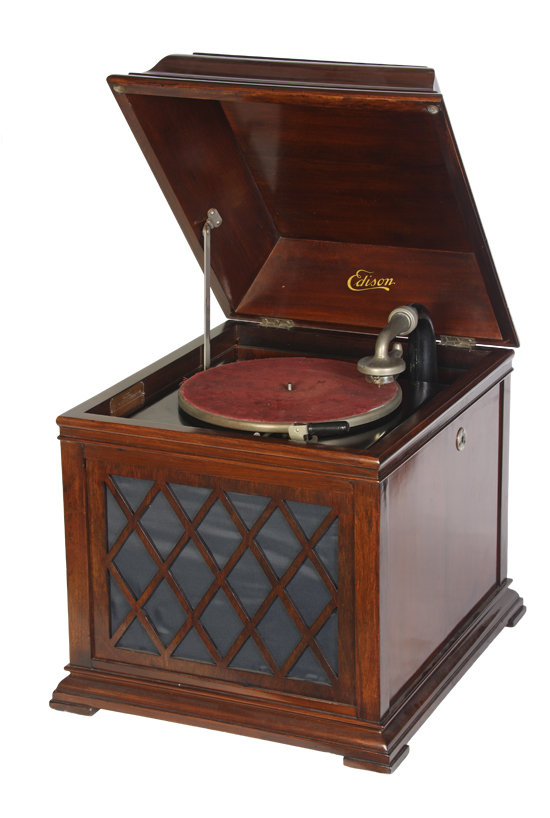
Not all of the material in “Sounds” is sound-based. Recording and audio geeks and historians will appreciate the large collection of “Playback & Recording Equipment” photographs (such as the 1912 Edison Disc Phonograph, above ), spanning the years 1877 to 1992. Also, many of the recordings—such as the wonderful first version of “Dirty Old Town” by Alan Lomax and the Ramblers, with Ewan MacColl and Peggy Seeger (below)—feature album covers, front and back, as well as disc labels.
The recordings in the Archive are unfortunately not downloadable (unless you are a licensed member of a UK HE/FE institution), but you can stream them all online and share any of them on your favorite social media platform. Perhaps the British Library will extend download privileges to all users in the future. For now, browsing through the sheer volume and variety of sounds in the archive should be enough to keep you busy.
Related Content:
The Alan Lomax Sound Archive Now Online: Features 17,000 Blues & Folk Recordings
Josh Jones is a writer and musician based in Durham, NC. Follow him at @jdmagness
Read More...Wake Up & Smell the Coffee: The New All-in-One Coffee-Maker/Alarm Clock is Finally Here!
Last year, British designer Josh Renouf announced plans to build the Barisieur, a combination alarm clock/coffee brewer that will wake you up, then serve you a nice hot cup of coffee, as you open your eyes and greet the new day. Here’s how Engadget described it at the time:
Using induction heating and stainless steel ball bearings, the Barisieur boils water for pour-over brew, giving off the aroma of your favorite beans as you rise to start the day. There’s even a cooled slot for a spot of milk and storage for sugar and extra grounds.
Today, we’re pleased to announce that the first orders for the Barisieur can be placed through Kickstarter. They’re looking to raise $555,000 through their Kickstarter campaign. (Watch the video above for information on that.) The first 300 backers will be able to pre-order their Barisieur at a low price ($292).
Note: The updated version can now be purchased on Amazon.
If you would like to support the mission of Open Culture, consider making a donation to our site. It’s hard to rely 100% on ads, and your contributions will help us continue providing the best free cultural and educational materials to learners everywhere. You can contribute through PayPal, Patreon, and Venmo (@openculture). Thanks!
Related Content
The Birth of London’s 1950s Bohemian Coffee Bars Documented in a Vintage 1959 Newsreel
The Curious Story of London’s First Coffeehouses (1650–1675)
“The Vertue of the COFFEE Drink”: London’s First Cafe Creates Ad for Coffee in the 1650s
The History of Coffee and How It Transformed Our World
Read More...Wynton Marsalis Takes Louis Armstrong’s Trumpet Out of the Museum & Plays It Again
Louis Armstrong’s beloved trumpet sits in the Smithsonian–a relic of a grand tradition of American music. When it first became a museum piece, the brass-and-gold instrument, made in Paris after World War II, wasn’t in working condition. Dwandalyn Reece, the culture curator at The Smithsonian, notes: “It wasn’t playable when it got here… There was a lacquer coating on it to help prevent tarnish. We looked to see if there were any spots where the lacquer impacted the valves. There were areas where the valves were a little sticky so we wanted to make sure they would flow freely.” Once restored, they put the instrument in the right hands. Above, watch Wynton Marsalis, the nine-time Grammy winner, playing Satchmo’s Selmer trumpet last fall.
Marsalis later commented, “It sounded better than I thought it would sound.” Apparently, it’s the first time an historic instrument from the Smithsonian’s collection has been put back into real service.
via The Smithsonian/@TedGioia
Related Content:
The Cleanest Recordings of 1920s Louis Armstrong Songs You’ll Ever Hear
Louis Armstrong Plays Historic Cold War Concerts in East Berlin & Budapest (1965)
Read More...Daily Meditation Boosts & Revitalizes the Brain and Reduces Stress, Harvard Study Finds
I don’t mean to sound dramatic, but meditation may have saved my life. During a particularly challenging time of overwork, underpay, and serious family distress, I found myself at dangerous, near-stroke levels of high cholesterol and blood pressure, and the beginnings of near-crippling early-onset arthritis. My doctors were alarmed. Something had to change. Unable to make stressful outer circumstances disappear, I had to find constructive ways to manage my responses to them instead. Yoga and meditation made the difference.
I’m hardly alone in this journey. The leading cause of death in the U.S. is heart disease, followed closely by stroke, diabetes, and depression leading to suicide—all conditions exacerbated by high levels of stress and anxiety. In my own case, a changed diet and daily exercise played a crucial role in my physical recovery, but those disciplines would not even have been possible to adopt were it not for the calming, centering effects of a daily meditation practice.
Anecdotes, however, are not evidence. We are bombarded with claims about the miracle magic of “mindfulness,” a word that comes from Buddhism and describes a kind of meditation that focuses on the breath and body sensations as anchors for present-moment awareness. Some form of “mindfulness based stress reduction” has entered nearly every kind of therapy, rehabilitation, corporate training, and pain management, and the word has been a marketing totem for at least a solid decade now. No one ever needs to mention the B‑word in all this meditation talk. As one meditation teacher tells his beginner students, “Buddhism cannot exist without mindfulness, but mindfulness can exist perfectly well without Buddhism.”
So, no need to believe in reincarnation, renunciation, or higher states of consciousness, fine. But does meditation really change your brain? Yes. Academic researchers have conducted dozens of studies on how the practice works, and have nearly all concluded that it does. “There’s more than an article a day on the subject in peer-reviewed journals,” says University of Toronto psychiatrist Steven Selchen, “The research is vast now.” One research team at Harvard, led by Harvard Medical School psychology instructor Sara Lazar, published a study in 2011 that shows how mindfulness meditation results in physical changes to the brain.
The paper details the results of MRI scans from 16 subjects “before and after they took part in the eight-week Mindfulness-Based Stress Reduction (MBSR) Program at the University of Massachusetts Center for Mindfulness,” reports the Harvard Gazette. Each of the participants spent “an average of 27 minutes each day practicing mindfulness exercises.” After the program, they reported significant stress reduction on a questionnaire, and analysis of their MRIs “found increased gray-matter density in the hippocampus, known to be important for learning and memory, and in structures associated with self-awareness, compassion, and introspection.”
The Harvard Business Review points to a another survey study in which scientists from the University of British Columbia and the Chemnitz University of Technology “were able to pool data from more than 20 studies to determine which areas of the brain are consistently affected. They identified at least eight different regions.” Highlighting two areas “of particular concern to business professionals,” the HBR describes changes to the anterior cingulate cortex (ACC), an area of the frontal lobe associated with self-regulation, learning, and decision-making. The ACC “may be particularly important in the face of uncertain and fast-changing conditions.” Like Lazar’s Harvard study, the researchers also identified “increased amounts of gray matter” in the hippocampus, an area highly subject to damage from chronic stress.
These studies and many others bring mindfulness together with another current psychological buzzword that has proven to be true: neuroplasticity, the idea that we can change our brains for the better—that we are not “hardwired” to repeat patterns of behavior despite our best efforts. In the TEDx Cambridge talk at the top of the post, Lazar explains her results, and connects them with her own experiences with meditation. She is, you’ll see right away, a skeptic, not inclined to accept medical claims proffered by yoga and meditation teachers. But she found that those practices worked in her own life, and also had “scientifically validated benefits” in reducing stress, depression, anxiety, and physical pain. In other words, they work.
None of the research invalidates the Buddhist and Hindu traditions from which yoga and meditation come, but it does show that one needn’t adopt any particular belief system in order to reap the health benefits of the practices. For some secular introductions to meditation, you may wish to try UCLA’s free guided meditation sessions or check out the Meditation 101 animated beginner’s guide above. If you’re not too put off by the occasional Buddhist reference, I would also highly recommend the Insight Meditation Center’s free six-part introduction to mindfulness meditation. Chronic stress is literally killing us. We have it in our power to change the way we respond to circumstances, change the physical structure of our brains, and become happier and healthier as a result.
Related Content:
Free Guided Meditations From UCLA: Boost Your Awareness & Ease Your Stress
Meditation 101: A Short, Animated Beginner’s Guide
David Lynch Explains How Meditation Enhances Our Creativity
Josh Jones is a writer and musician based in Durham, NC. Follow him at @jdmagness
Read More...Support Us
We're hoping to rely on loyal readers, rather than erratic ads. Please click the Donate button and support Open Culture. You can use Paypal, Venmo, Patreon, even Crypto! We thank you!

About Us

Open Culture scours the web for the best educational media. We find the free courses and audio books you need, the language lessons & educational videos you want, and plenty of enlightenment in between.
Advertise With Us

FREE UPDATES!
GET OUR DAILY EMAIL
Get the best cultural and educational resources on the web curated for you in a daily email. We never spam. Unsubscribe at any time.
FOLLOW ON SOCIAL MEDIA

Open Culture editor Dan Colman scours the web for the best educational media. He finds the free courses and audio books you need, the language lessons & movies you want, and plenty of enlightenment in between.
Advertise With Us

