How Marcel Marceau Used Mime to Save Children During the Holocaust
In 1972, Jerry Lewis made the ill-considered decision to write, direct, and star in a film about a German clown in Auschwitz. The result was so awful that he never allowed its release, and it quickly acquired the reputation—along with disasters like George Lucas’ Star Wars Holiday Special—as one of the biggest mistakes in movie history. Somehow, this cautionary tale did not dissuade the bold Italian comedian Roberto Benigni from making a film with a somewhat similar premise, 1997’s Life Is Beautiful, in which he plays a father in a concentration camp who entertains children with comic stunts and antics to distract them from the horrors all around them.
That film, by contrast, was a commercial and critical success and went on to win the Grand Prix at Cannes in 1998 and three Academy Awards the following year, a testament to Benigni’s sensitivity to his subject, in a screenplay partly based on the memoirs of Rubino Romeo Salmoni. It’s a wonder that another real-life story of a comic genius who used his talents not only to entertain children during WWII, but to save them from the Nazis has somehow never been made into a feature film—and especially surprising given the stature of the man in question: Marcel Marceau, the most famous mime in history.
As we learn in the Great Big Story video above, Marceau was 16 years old in 1940 when German soldiers marched into France. His “childhood ended all at once,” says Shawn Wen, author of a recent book about Marceau. His father died in Auschwitz and both Marceau and his brother “were involved in the war effort against the Nazis.” In one story, Marceau dressed a group of children from an orphanage as campers and walked them into Switzerland, entertaining them all the way, “to the point where they could pretend as if they were going on vacation rather than fleeing for their lives.”
In another story, Marceau somehow convinced a group of German soldiers to surrender to him. “It seems as if this natural knack for acting,” says Wen, “ended up becoming a part of his involvement in the war effort.” During the war, Marceau was “miming for his life,” and the lives of others. Mime has been the butt of many jokes over the years, but Wen sees in Marceau’s silent performances a means of bringing humanity together with an art that transcends language and nationality. Learn more about how Marceau began his mime career during the Nazi occupation at our previous post here.
Note: An earlier version of this post appeared on our site in 2018.
Related Content:
How Marcel Marceau Started Miming to Save Children from the Holocaust
Marcel Marceau Mimes the Progression of Human Life, From Birth to Death, in 4 Minutes
Josh Jones is a writer and musician based in Durham, NC. Follow him at @jdmagness
Read More...Explore the Newly-Launched Public Domain Image Archive with 10,000+ Free Historical Images
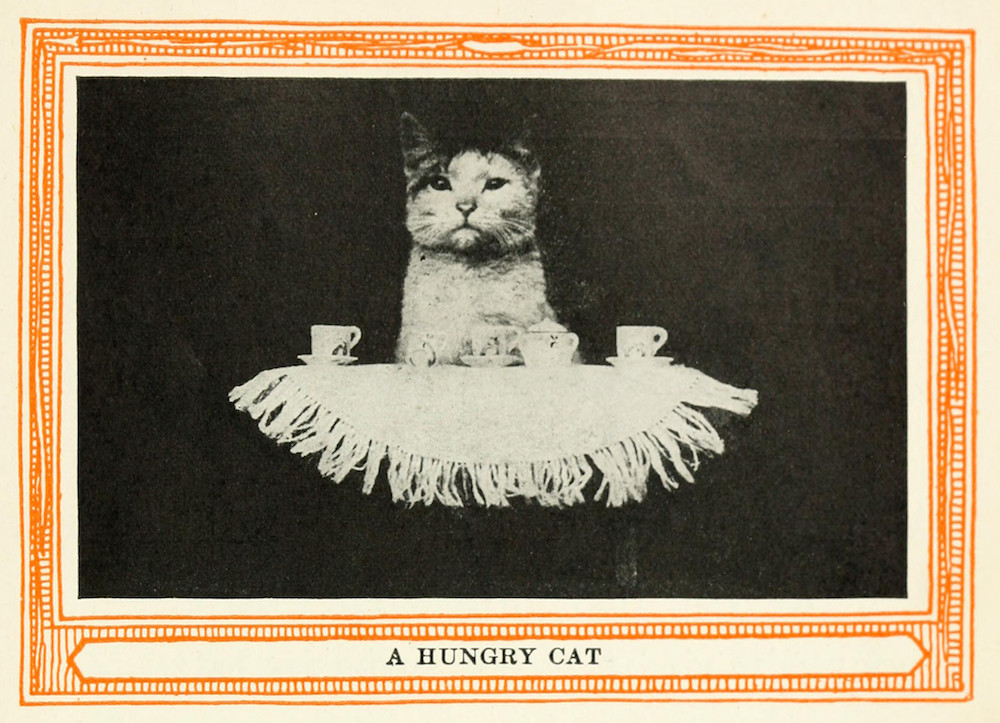
We’ve often featured the work of the Public Domain Review here on Open Culture, and also various searchable copyright-free image databases that have arisen over the years. It makes sense that those two worlds would collide, and now they’ve done so in the form of the just-launched Public Domain Image Archive (PDIA). The Public Domain Review invites us to use the site to “explore our hand-picked collection of 10,046 out-of-copyright works, free for all to browse, download, and reuse” — and note that the number will grow, given that “this is a living database with new images added every week.”

As with any portal of this kind, you can browse by category tags, the selection of which includes everything from architecture to decorations to occultism to war. But if you’d like to get a sense of the sheer formal, aesthetic, cultural, and historical variety of the PDIA, you might consider taking a first look through its “infinite view,” which allows you to scroll in all directions through a limitless labyrinth of copyright-free wonders: advertisements, Biblical scenes, old-time sportsmen, outer-space photos, mushrooms, medieval musical creatures, letterforms, and, well, labyrinths.
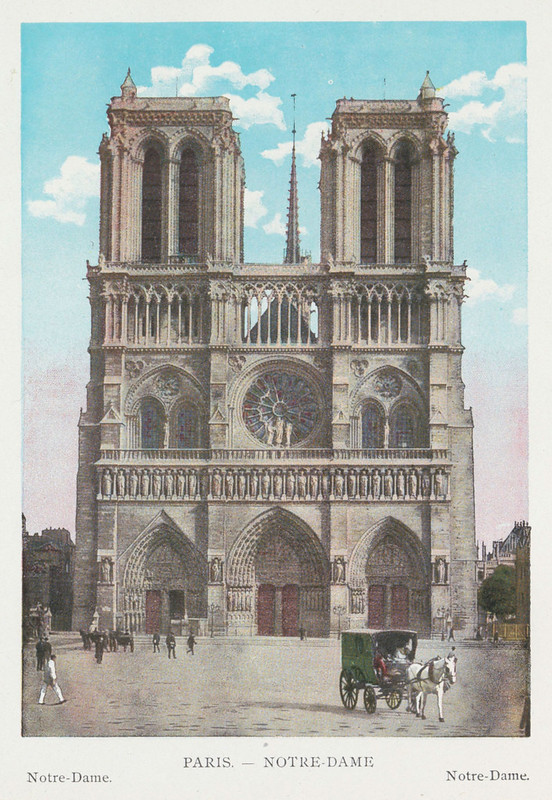
You might also recognize items you’ve seen here on Open Culture before, like the nature drawings of Ernst Haeckel, the modern art-lampooning children’s book The Cubies’ ABC, or the ghosts and monsters illustrated by ukiyo‑e master Hokusai. The PDIA provides more context than some public-domain image archives, even linking to relevant Public Domain Review posts, where you can read about such topics as Emily Noyes Vanderpoel’s color analysis charts (which also inspired a post of ours), the end of books (as predicted in 1894), and even “Cats and Captions before the Internet Age.” Having fallen into the public domain, all this material is, of course, available to use for any purpose you like — including just satisfying your own curiosity.
Related comments:
A Search Engine for Finding Free, Public Domain Images from World-Class Museums
Public.Work: A Smoothly Searchable Archive of 100,000+ “Copyright-Free” Images
Sea-Serpents, Vampires, Pirates & More: The Public Domain Review’s Second Book of Essays
Based in Seoul, Colin Marshall writes and broadcasts on cities, language, and culture. His projects include the Substack newsletter Books on Cities and the book The Stateless City: a Walk through 21st-Century Los Angeles. Follow him on the social network formerly known as Twitter at @colinmarshall.
Read More...The Night When Miles Davis Opened for the Grateful Dead (1970)
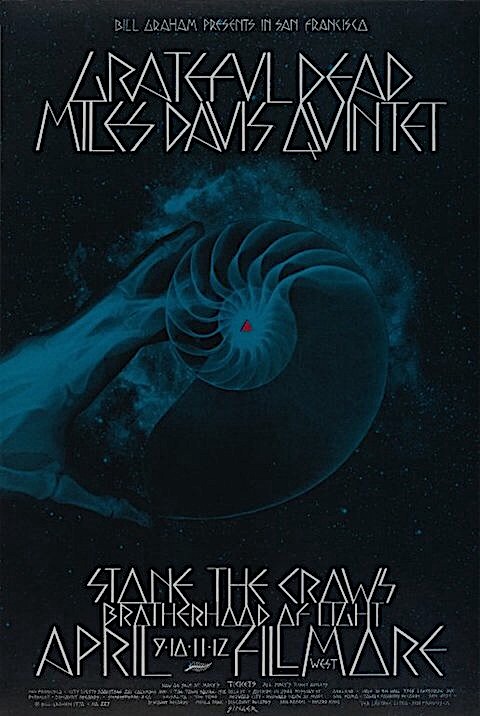
What’s that, you ask? Did Miles Davis open for the Grateful Dead at the Fillmore West? In what world could such a thing happen? In the world of the late sixties/early seventies, when jazz fused with acid rock, acid rock with country, and pop culture took a long strange trip. The “inspired pairing” of the Dead with Davis’ electric band on April 9–12, 1970, “represented one of [promoter] Bill Graham’s most legendary bookings,” writes the blog Cryptical Developments. I’ll say. Davis had just released the groundbreaking double-LP Bitches Brew and was “at somewhat of an artistic and commercial crossroads,” experimenting with new, more fluid compositions.
Aggressive and dominated by rock rhythms and electric instruments, the album became Davis’ best seller and brought him before young, white audiences in a way his earlier work had not. The band that Davis brought into the Fillmore West, comprising [Chick] Corea, [Dave] Holland, soprano sax player Steve Grossman, drummer Jack Dejohnette, and percussionist Airto Moreira, was fully versed in this new music, and stood the Fillmore West audiences on their ears.
I can only imagine what it would have been like to see that performance live. But we don’t have to imagine what it sounded like. You can hear Davis’s set below.
In his autobiography, Davis described it as “an eye-opening concert for me.” “The place was packed with these real spacy, high white people,” he wrote, “and when we first started playing, people were walking around and talking.” Once the band got into the Bitches Brew material, though, “that really blew them out. After that concert, every time I would play out there in San Francisco, a lot of young white people showed up at the gigs.”
Did the Dead become a crossover hit with jazz fans? Not exactly, but Davis really hit it off with them, especially with Jerry Garcia. “I think we all learned something,” Davis wrote: “Jerry Garcia loved jazz, and I found out that he loved my music and had been listening to it for a long time.” In his autobiography, the Dead’s Phil Lesh remembered having his mind blown by Davis and band: “As I listened, leaning over the amps with my jaw hanging agape, trying to comprehend the forces that Miles was unleashing onstage, I was thinking What’s the use. How can we possibly play after this? […] With this band, Miles literally invented fusion music. In some ways it was similar to what we were trying to do in our free jamming, but ever so much more dense with ideas – and seemingly controlled with an iron fist, even at its most alarmingly intense moments.” You can stream the Dead’s full performance from that night below. Think what must have been running through their minds as they took the stage after watching Miles Davis invent a new form of music right before their eyes.
Note: An earlier version of this post appeared on our site in 2014.
Related Content:
Miles Davis Opens for Neil Young and “That Sorry-Ass Cat” Steve Miller at The Fillmore East (1970)
When the Grateful Dead Played at the Egyptian Pyramids, in the Shadow of the Sphinx (1978)
In 1969 Telegram, Jimi Hendrix Invites Paul McCartney to Join a Super Group with Miles Davis
Josh Jones is a writer and musician based in Durham, NC. Follow him at @jdmagness
Read More...Compare the “It Ain’t Me Babe” Scene from A Complete Unknown to the Real Bob Dylan & Joan Baez Performance at the Newport Folk Festival
A Complete Unknown, the new movie about Bob Dylan’s rise in the folk-music scene of the early nineteen-sixties and subsequent electrified break with it, has been praised for not taking excessive liberties, at least by the standards of popular music biopics. Its conversion of a real chapter of cultural history has entailed various conflations, compressions, and rearrangements, but you’d expect that from a Hollywood director like James Mangold. What many viewers’ judgment will come down to is less historical veracity than whether they believe Timothée Chalamet as the young Bob Dylan — or rather, as the young Bob Dylan they’ve always imagined.
Still, much depends on the rest of the cast, who portray a host of major folk- and folk-adjacent figures including Pete Seeger, Woody Guthrie, Johnny Cash, Alan Lomax, and the late Peter Yarrow. No performance apart from Chalamet’s has received as much attention as Monica Barbaro’s Joan Baez. In those characters’ key scene together they take the stage at the 1964 Newport Folk Festival and sing “It Ain’t Me Babe,” a Dylan song that Baez also recorded. Their rendition conveys the depth of their romantic and artistic connection not just to the audience, but also to Dylan’s girlfriend, played by Elle Fanning, watching just offstage.
“That idea of the secret is really what I needed to drive the scene,” says Mangold, using the language of his trade, in the Variety video at the top of the post. “Ultimately, I’ve got to get it to where Elle is driven away by whatever she’s seen on stage. But it wouldn’t have worked as well if Chalamet and Barbaro hadn’t nailed the performance, just one of many in the film shot 100 percent live. If you’d like to compare them to the real thing, have a look at the footage of Dylan and Baez singing “It Ain’t Me Babe” at the actual 1964 Newport Folk Festival just above. After that, you may want to go back to the previous year’s festival and watch their performance of “With God on Our Side” — and, while you’re at it, listen to Dylan’s entire catalog all over again.
Related content
Joan Baez Live in 1965: Full Concert
Bob Dylan’s Historic Newport Folk Festival Performances, 1963–1965
Watch Joan Baez Endearingly Imitate Bob Dylan (1972)
A Massive 55-Hour Chronological Playlist of Bob Dylan Songs: Stream 763 Tracks
Based in Seoul, Colin Marshall writes and broadcasts on cities, language, and culture. His projects include the Substack newsletter Books on Cities and the book The Stateless City: a Walk through 21st-Century Los Angeles. Follow him on the social network formerly known as Twitter at @colinmarshall.
Read More...Why the Tavern Scene in Quentin Tarantino’s Inglourious Basterds Is a Master Class in Filmmaking
Ideally, a viewer should be able to identify the work of a particular auteur from any one scene that the auteur has directed. In reality, it’s not always possible to do so, even in the work of filmmakers with highly idiosyncratic styles. But in the case of Quentin Tarantino, it would probably be more difficult not to recognize his scenes. Some of them have propagated so far through popular culture that they have a life apart from the films themselves: the dance in Pulp Fiction, say, or more recently, the opening of Inglourious Basterds, a picture that, to video essayists looking to explicate Tarantino’s distinctive genius, offers a particular abundance of material.
In the new video above, YouTuber Lancelloti selects a different scene from Inglourious Basterds to declare a “modern masterpiece” in itself. It takes place in a basement tavern in Nazi-occupied northern France, where three of the titular black-ops “Basterds,” disguised as German officers, meet Bridget von Hammersmark, a German movie star turned undercover Allied agent.
As one might expect, the tension starts high, gets higher, and eventually explodes in a chaotic bloodbath: not an easy sequence to pull off effectively, but one that Tarantino and his collaborators arrange with consummate skill, using a host of techniques not necessarily visible on the first viewing — or even the first few viewings.
Lancelloti highlights how the scene gradually reveals its tight space and the many figures who occupy it; uses dialogue to reflect core themes of identity and nationality; creates sympathy even for villain-coded German soldiers; keeps shifting the balance of power; injects unpredictability into the action; foreshadows the ways in which events will eventually go wrong; and hints in many ways at the presence of the character who will light up the tinder box. Of course, no director could make all this happen single-handedly, and few directors would be conscious of all these elements at work in the first place. But given all we’ve learned about Tarantino over the years, he’s surely one of them.
Related Content:
A Deep Study of the Opening Scene of Quentin Tarantino’s Inglourious Basterds
An Analysis of Quentin Tarantino’s Films Narrated (Mostly) by Quentin Tarantino
How Quentin Tarantino Remixes History: A Brief Study of Once Upon a Time… in Hollywood
Quentin Tarantino’s World War II Reading List
Based in Seoul, Colin Marshall writes and broadcasts on cities, language, and culture. His projects include the Substack newsletter Books on Cities and the book The Stateless City: a Walk through 21st-Century Los Angeles. Follow him on the social network formerly known as Twitter at @colinmarshall.
Read More...Radio Caroline, the Pirate Radio Ship That Rocked the British Music World (1965)
Nowadays musicians can reach hundreds, thousands, sometimes millions of listeners with a few, usually free, online services and a minimal grasp of technology. That’s not to say there aren’t still economic barriers aplenty for the struggling artist, but true independence is not an impossible prospect.
In the 1950s and 60s, on the other hand, as popular music attained newfound commercial value, musicians found themselves completely beholden to record companies and radio stations in order to have their music heard by nearly anyone. And those entities schemed together to promote certain recordings and ignore or marginalize others. Payola, in a word, ruled the day.
In the UK, a different but no less impregnable order presented itself to the aspiring obscurity. Rather than corporate interests and well-bribed DJs, the BBC and British government, writes the Modesto Radio Museum, “were increasingly hostile toward any competition for their radio monopoly.” (After WWII, the British Broadcasting Service maintained a monopoly on radio, and later television, broadcasting in the UK.) Enter the pirates.
While the phrase now denotes a class of freebooters who work from their terminals, the original music pirates actually took to the seas. The first, Radio Mercur, “established by a group of Danish businessmen” in 1958, “transmitted from a small ship anchored off Copenhagen, Denmark.” Mercur inspired Radio Nord in 1960, anchored off the Swedish Coast, then the Dutch Radio Veronica that same year.
Then, in 1962, Irish manager Ronan O’Rahilly met Australian businessman Allan Crawford. O’Rahilly had previously attempted to launch the career of musician Georgie Fame, but to no avail. Record companies wouldn’t record him, and when O’Rahilly funded an album, the BBC refused to play it—he wasn’t on their favored labels, EMI and Decca. So O’Rahilly and Crawford conspired to create their own pirate station, Radio Caroline (named after the daughter of John F. Kennedy).
They purchased their first ship, the MV Mi Amigo, in 1963, then set about securing funds and rigging up the vessel with two 10 Kilowatt AM transmitters and a 13-ton, 165 foot antenna mast. Broadcasting from 6am to 6pm daily, Radio Caroline managed to break the BBC monopoly (and launch Georgie Fame to… well actual, chart-topping fame). In 1965, a British Pathé film crew visited the ship, noting in their narration that “for over a year,” Radio Caroline had “given pop music to something like 20 million listeners,” changing British pop culture “with the connivance of almost every teenager in Southeast England.”
The station kicked off their first broadcast, which you can hear above, on Easter Sunday, March 1964, with the announcement, “This is Radio Caroline on 199, your all day music station.” The very first tune they played was the Rolling Stones’ cover of Buddy Holly’s “Not Fade Away” (one of the band’s first major hits). In the mid-60s pirate radio, particularly Radio Caroline, helped break a number of bands, introducing eager young listeners to The Who’s first four singles, for example. (The band returned the favor by attempting to give 1967’s The Who Sell Out the raw sound and feel of a pirate radio broadcast.)
Learn more about Radio Caroline’s long and storied existence in the documentary segment further up, Part 6 of DMC World’s comprehensive The History of DJ. The Modesto Radio Museum’s thorough, multipart essay series, complete with photographs, offers a rich history, as does Ray Clark’s book, Radio Caroline: The True Story of the Boat that Rocked. “The world’s most famous offshore radio station,” is still on the air today (even though the original ship sank in 1980) or rather, on the web, with streaming programs and “gadgets and widgets” for Android devices, iPhones, iPads, and browsers.
It’s something of an irony that they’ve ended up just one of hundreds of online streaming stations vying for listeners’ attention, but it’s safe to say that without their exploits in the 60s and beyond, pop music as we know it—with all its legal and not-so-legal means of dissemination—may never have spread and evolved into the myriad forms we now take for granted.
Note: An earlier version of this post appeared on our site in 2016.
Related Content:
How to Listen to the Radio: The BBC’s 1930 Manual for Using a New Technology
“Joe Strummer’s London Calling”: All 8 Episodes of Strummer’s UK Radio Show Free Online
Jimi Hendrix Wreaks Havoc on the Lulu Show, Gets Banned From BBC (1969)
Josh Jones is a writer and musician based in Durham, NC. Follow him at @jdmagness
Read More...The Skeleton Dance, Voted the 18th Best Cartoon of All Time, Is Now in the Public Domain (1929)
The July 17, 1929 issue of Variety carried a notice about a laugh-filled new short film in which “skeletons hoof and frolic,” the peak of whose hilarity “is reached when one skeleton plays the spine of another in xylophone fashion, using a pair of thigh bones as hammers.” The final lines of this strong recommendation add that “all takes place in a graveyard. Don’t bring your children.” The review amusingly reflects shifts in public taste over the past near-century — unless the sight of skeletons playing each other like xylophones is more comically enduring than I imagine — but those final words add a note of breathtaking irony, for the short under review is The Skeleton Dance, produced and directed by Walt Disney.
Despite the power of Disney’s name, this particular film is better understood as the work of Ub Iwerks, who animated most of it by himself in about six weeks. He and Disney had been working together since at least the early nineteen-twenties, when they launched the short-lived Laugh-O-Gram Studio in Kansas City.
It was Iwerks, in fact, who refined a rough sketch by Disney into the figure we now know as Mickey Mouse — but whom audiences in the twenties first came to know as Steamboat Willie, whose eponymous cartoon debut entered the public domain last year. The Skeleton Dance, the first of Disney’s “Silly Symphonies,” was similarly liberated from copyright on this year’s Public Domain Day, along with a variety of other 1929 Disney shorts (many of them featuring Mickey Mouse).
The great technical innovation on display isn’t synchronized sound itself, which had been used even before Steamboat Willie, but the relationship between the images and the sound. According to animation historian Charles Solomon, “having to underscore the action in the first Mickey Mouse picture,” composer Carl Stalling “suggested that the reverse could be done: adding animated action to a musical score,” perhaps featuring skeletons, trees, and suchlike moving around in rhythm. There we have the genesis of this cartoon danse macabre, which was a leap forward in the ever-closer union of animation and music as well as a revelation to its audiences, who wouldn’t have experienced anything quite like it before. Even today, the most natural response to a sufficiently miraculous-seeming technological development is, perhaps, laughter.
The Skeleton Dance was voted the 18th best cartoon of all time by 1,000 animation professionals in a 1994 book called The 50 Greatest Cartoons. Find a copy here.
Related Content:
The Evolution of Animation, 1833–2017: From the Phenakistiscope to Pixar
How Walt Disney Cartoons Are Made: 1939 Documentary Gives an Inside Look
Celebrate The Day of the Dead with The Classic Skeleton Art of José Guadalupe Posada
An Early Version of Mickey Mouse Enters the Public Domain on January 1, 2024
Based in Seoul, Colin Marshall writes and broadcasts on cities, language, and culture. His projects include the Substack newsletter Books on Cities and the book The Stateless City: a Walk through 21st-Century Los Angeles. Follow him on the social network formerly known as Twitter at @colinmarshall.
Read More...Bertrand Russell’s Message to People Living in the Year 2959: “Love is Wise, Hatred is Foolish”
Bertrand Russell, the great British philosopher and social critic, appeared on the BBC program Face-to-Face in 1959 and was asked a closing question: What would you tell a generation living 1,000 years from now about the life you’ve lived and the lessons you’ve learned? His answer is short, but pithy. You can read a transcript below:
I should like to say two things, one intellectual and one moral:
The intellectual thing I should want to say to them is this: When you are studying any matter or considering any philosophy, ask yourself only what are the facts and what is the truth that the facts bear out. Never let yourself be diverted either by what you wish to believe or by what you think would have beneficent social effects if it were believed, but look only and solely at what are the facts. That is the intellectual thing that I should wish to say.
The moral thing I should wish to say to them is very simple. I should say: Love is wise, hatred is foolish. In this world, which is getting more and more closely interconnected, we have to learn to tolerate each other. We have to learn to put up with the fact that some people say things that we don’t like. We can only live together in that way, and if we are to live together and not die together we must learn a kind of charity and a kind of tolerance which is absolutely vital to the continuation of human life on this planet.
No truer words have been spoken. You can watch the complete 1959 episode below.
If you would like to support the mission of Open Culture, consider making a donation to our site. It’s hard to rely 100% on ads, and your contributions will help us continue providing the best free cultural and educational materials to learners everywhere. You can contribute through PayPal, Patreon, and Venmo (@openculture). Thanks!
Related Content:
Benedict Cumberbatch Reads Kurt Vonnegut’s Letter of Advice to People Living in the Year 2088
Bertrand Russell’s Improbable Appearance in a Bollywood Film (1967)
Bertrand Russell & Other Big Thinkers in BBC Lecture Series (Free)
Bertrand Russell & Buckminster Fuller on Why We Should Work Less, and Live and Learn More
Read More...Laurie Anderson’s Mind-Blowing Performance of C. P. Cavafy’s Poems “Waiting for the Barbarians” & “Ithaca”
In the video above, Laurie Anderson describes C. P. Cavafy’s poem “Waiting for the Barbarians” as being “set in ancient Rome.” That’s a reasonable interpretation, given that it contains an emperor, senators, and orators, though Cavafy himself said that none of them are necessarily Roman. The universality of the situation the poem describes, in which a state’s elite turn out in their finery despite having nothing to do but await the titular barbarian invasion, certainly hasn’t been lost on its interpreters. J. M. Coetzee, for example, set his novel Waiting for the Barbarians on the edge of an unnamed “Empire.”
Anderson also mentions thinking, while considering the poem’s evocation of government deadlock, “Hang on, this sounds familiar” — and none can deny that comparisons between the United States and the declining Roman Empire have been in the air lately. That, in part, inspired the performance that follows, in which Anderson and a veritable Greek chorus interpret both “Waiting for the Barbarians,” which Cavafy wrote in 1904, and the Odyssey-based “Ithaca” (which you can also hear read by Sean Connery with a Vangelis score) from seven years later. “Ithaca” is Cavafy’s best-known work, thanks not least to its being read at the funeral of former first lady of the United States Jacqueline Kennedy Onassis.
It was, in fact, the Alexander S. Onassis Foundation, established by Aristotle Onassis in the name of his late son, that sponsored this event, which took place in New York City’s Saint Thomas Church in November of 2023. The occasion was the opening of the Cavafy Archive in Athens, on whose website classicist Gregory Jusdanis declares that the poet’s “greatness lies in his talent to predict our own world one hundred years ago.” Cavafy might well have understood that some political conditions are inevitable, but he couldn’t have known how Anderson’s performance of his words, in English translation with the right instrumental and electronic backing, would sound like something right out of her Big Science era.
via Metafilter
Related content:
Hear Laurie Anderson Read from The Tibetan Book of the Dead on New Album Songs from the Bardo
Laurie Anderson’s Top 10 Books to Take to a Desert Island
Sean Connery (RIP) Reads C.P. Cavafy’s Epic Poem “Ithaca,” Set to the Music of Vangelis
Is America Declining Like Ancient Rome?
Based in Seoul, Colin Marshall writes and broadcasts on cities, language, and culture. His projects include the Substack newsletter Books on Cities and the book The Stateless City: a Walk through 21st-Century Los Angeles. Follow him on the social network formerly known as Twitter at @colinmarshall.
Read More...Leonard Cohen’s “Hallelujah” Performed by a Choir of 4,000 Singers
Throughout the years, we’ve featured performances of Choir!Choir!Choir!–a large amateur choir from Toronto that meets weekly and sings their hearts out. You’ve seen them sing Prince’s “When Doves Cry,” Soundgarden’s “Black Hole Sun” (to honor Chris Cornell), and Patti Smith’s “People Have the Power.” In their latest video, they revisit an old favorite: Leonard Cohen’s “Hallelujah,” a song released on the 1984 album Various Positions. Originally overlooked, Cohen’s “Hallelujah” has since become deeply woven into our cultural fabric. Over the past 40 years, some 300 musicians have covered “Hallelujah,” with Jeff Buckley offering perhaps the most celebrated version. Above, you can watch 4,000 singers come together and pay their own tribute to the song. This performance took place last year at the National Arts Centre in Ottawa, Canada. Enjoy!
Related Content
Leonard Cohen’s “Hallelujah” Played on Korean Instrument Dating Back to 6th Century
Watch David Byrne Lead a Massive Choir in Singing David Bowie’s “Heroes”
Street Artist Plays Leonard Cohen’s “Hallelujah” With Crystal Glasses
Patti Smith Sings “People Have the Power” with a Choir of 250 Fellow Singers
A Choir with 1,000 Singers Pays Tribute to Sinéad O’Connor & Performs “Nothing Compares 2 U”
Read More...Support Us
We're hoping to rely on loyal readers, rather than erratic ads. Please click the Donate button and support Open Culture. You can use Paypal, Venmo, Patreon, even Crypto! We thank you!

About Us

Open Culture scours the web for the best educational media. We find the free courses and audio books you need, the language lessons & educational videos you want, and plenty of enlightenment in between.
Advertise With Us

FREE UPDATES!
GET OUR DAILY EMAIL
Get the best cultural and educational resources on the web curated for you in a daily email. We never spam. Unsubscribe at any time.
FOLLOW ON SOCIAL MEDIA

Open Culture editor Dan Colman scours the web for the best educational media. He finds the free courses and audio books you need, the language lessons & movies you want, and plenty of enlightenment in between.
Advertise With Us

