How Did David Fincher Become the Kubrick of Our Time? A New, 3.5 Hour Series of Video Essays Explains
Most film-lovers must long for the next Stanley Kubrick, a new thematically adventurous, aesthetically rigorous, big budget-commanding, and take-after-take perfectionistic cinematic visionary for our time. But some film-lovers believe our time already has its own Stanley Kubrick in David Fincher, director of such highly acclaimed pictures as Fight Club, Zodiac, The Social Network, The Game, and Seven — excuse me, Se7en. And just like Kubrick, Fincher didn’t start off at that level of the game. No, his career first gathered momentum with commercials, a bunch of music videos for the likes of The Motels, Paula Abdul, and Rick Springfield, and of course, Alien 3 — excuse me, Alien3.
So what exactly went wrong with that critically savaged yet (we now realize) auteur-directed chapter of the Alien franchise? That question gets addressed in detail early on in the latest multi-part video essay from Cameron Beyl’s Directors Series.
You may remember that we featured the Directors Series’ previous essay in April, but if you don’t, it shouldn’t surprise you to learn that it examined the Kubrick oeuvre. Beyl ended it with a declaration of his own membership in the aforementioned Fincher-Is-Our-Kubrick club, and cinephiles all over the internet thrilled to his announcement of Fincher as his next object of analysis.
To date, five episodes of The Directors Series: David Fincher have come out, which deal with Fincher’s career as follows:
- “Baptism By Fire” (Rick Springfield’s music videos and The Beat of the Life Drum, assorted music videos and commercials, Alien 3)
- “Redemption & Triumph” (assorted commercials, Se7en)
- “Capturing the Zeitgeist” (The Game, Fight Club, Panic Room)
- “Into the Digital Realm” (various commercials and music videos, Zodiac, The Curious Case of Benjamin Button)
- “The Bleeding Edge”
Even though the series hasn’t yet reached The Social Network, The Girl with the Dragon Tattoo, and Gone Girl, you won’t come away from the case Beyl has assembled so far unconvinced of Fincher’s influences, preferences, and obsessions: crime, decay, punk, obsolete technology, architecture, surveillance, corporate and personal wealth, unusual illustrative visual effects, colors like blue and orange in high contrast, nihilism, predecessors like Ridley and Tony Scott — the list goes on, and will go on as long as Fincher’s career does. It says a great deal about his filmmaking skill and style that his work has become so widely known for both its overwhelmingly “gritty, grimy” and overwhelmingly “cold, clinical” look and feel. But if any director can ever arrive at this sort of towering, contradictory reputation, Fincher can, and if any video essays can explain how he did, the Directors Series can.
Related Content:
The Filmmaking Craft of David Fincher Demystified in Two Video Essays
Discover the Life & Work of Stanley Kubrick in a Sweeping Three-Hour Video Essay
Colin Marshall writes elsewhere on cities, language, Asia, and men’s style. He’s at work on a book about Los Angeles, A Los Angeles Primer, the video series The City in Cinema, and the crowdfunded journalism project Where Is the City of the Future? Follow him on Twitter at @colinmarshall or on Facebook.
Read More...M.C. Escher’s Perpetual Motion Waterfall Brought to Life: Real or Sleight of Hand?
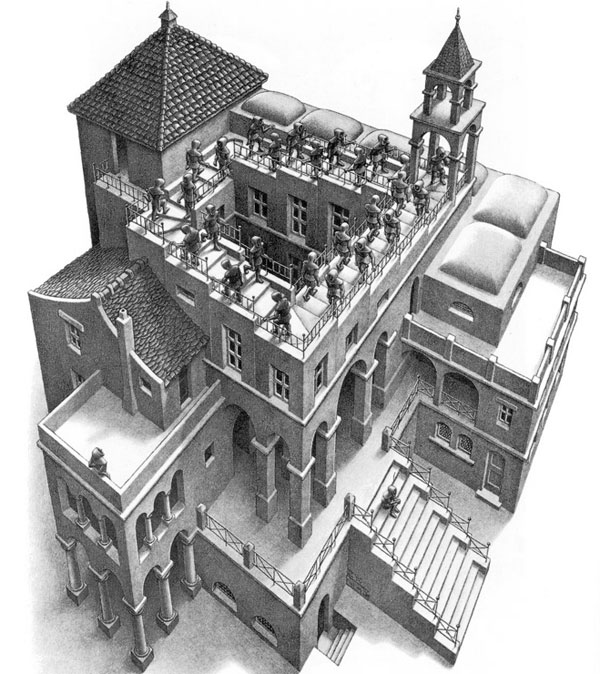
Since M.C. Escher bent minds in the 20th century with his Möbius strips, metamorphoses, and impossible objects, other artists have been trying to bring his creations to life. And the advent of computer illustration, then animation, has made it all the more possible.
In the real, “meatspace” world of organic things, it’s a little bit harder. In January 2011, a YouTuber by the name of “mcwolles” posted the video above. In it, a man pours water in a scale model of Escher’s 1961 Waterfall. The contraption, using blue water, actually seems to work. The water runs uphill through several sharp angles and finishes by tumbling off the top into the paddlewheel below, where its begins its journey again. “Mcwolles” ends the video staring into the camera as he tries to find the off switch…but also dares viewers to figure out how he did it.

Creative Commons image via Wikipedia
The Internet had a viral freakout—check out the 9.3 million views—and promptly set about trying to offer solutions. “Look how the shadows fall!” several people pointed out. The locked-down camera was another clue.
In May of 2011, “mcwolles” offered a 360 tour of the creation in his garage that offered some suggestions, and that was all that was needed for user “LookingMercury3D” to offer their explanation of how the trick was done. (Hint: editing).
Since then, “mcwolles” has only posted two more videos: one of him losing weight and one of a dog having its way with a stuffed animal. Maybe he’s busy working on his next piece of Escher-inspired art.
Related content:
Metamorphose: 1999 Documentary Reveals the Life and Work of Artist M.C. Escher
The Genius of J.S. Bach’s “Crab Canon” Visualized on a Möbius Strip
Inspirations: A Short Film Celebrating the Mathematical Art of M.C. Escher
Ted Mills is a freelance writer on the arts who currently hosts the FunkZone Podcast. You can also follow him on Twitter at @tedmills, read his other arts writing at tedmills.com and/or watch his films here.
Read More...The Inspiring Story of Ronald E. McNair, the Astronaut Who Endured Racism & Became One of the First African Americans in Space
On January 28, 1986, NASA Challenger mission STS-51‑L exploded in the sky, into a twisting plume of smoke, a mere 73 seconds after takeoff. It left a nation stunned, and seven astronauts dead. Among them was the pilot, physicist and MIT grad Ronald McNair, who, in 1984, had become only the second African-American to travel into outer space.
As this animation narrated by his own brother explains, McNair’s path to becoming an astronaut wasn’t easy. Born and raised in the Jim Crow South (in Lake City, South Carolina, to be precise) McNair encountered racism in his everyday life. One touching story helps crystallize what his experience was like. As a nine-year-old, McNair tried to check out books from the “public” library — only to discover that “public” meant books were for whites, not blacks. The video tells the rest of the story. And I’ll just flag one important detail mentioned at the very end: On January 28, 2011, exactly 25 years after his death, the library was renamed The Dr. Ronald E. McNair Life History Center. You’ll also find a Ronald E. McNair Building on MIT’s campus too. And deservedly so.
Related Content:
Nichelle Nichols Explains How Martin Luther King Convinced Her to Stay on Star Trek
How Martin Luther King, Jr. Used Hegel, Kant & Nietzsche to Overturn Segregation in America
Professor Ronald Mallett Wants to Build a Time Machine in this Century … and He’s Not Kidding
Free Online Astronomy Courses
Read More...Rock-Loving Kid Records a Spat with His Parents During the 1980s & Animates It 30 Years Later
Certainly for me, and perhaps for many of you, there’s something eerily familiar about the scene that plays out in this animation. Here’s the backstory: Starting when he was 12, Mike Cohen, a kid growing up in Buffalo, began recording the arguments he had with his parents (unbeknownst to them). At least one of the tapes, recorded in 1985, recently ended up in the hands of Rodd Perry, a first time animator, who created the cartoon above. By the looks of things, Brother Mike is still part of the music scene today.
Related Content:
I Met the Walrus: An Animated Film Revisiting a Teenager’s 1969 Interview with John Lennon
1980s Metalhead Kids Are All Right: New Study Suggests They Became Well-Adjusted Adults
Shel Silverstein’s The Giving Tree: The Animated Film Narrated by Shel Himself (1973)
Read More...Classics Stories by Edgar Allan Poe Narrated by James Mason in a 1953 Oscar-Nominated Animation & 1958 Decca Album
Some enthusiasts of 19th-century American psychological horror master (or, in a very real sense, 19th-century American psychological horror inventor) Edgar Allan Poe find his work best read aloud. Thus we’ve previously featured Poe delivered in the gravitas-filled voices of such noted thespians as Vincent Price, Basil Rathbone, Christopher Walken, Christopher Lee, and James Mason. Mason did the reading (above) as a narration for a 1953 animated short The Tell-Tale Heart, adapting Poe’s 1843 story of the same name, which drew both an Academy Award nomination for Best Animated Short Film and — perhaps more in line with the Poe sensibility — a rating of “X” from the British Board of Film Censors.
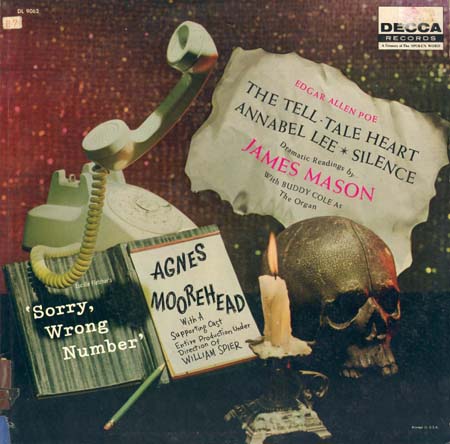
WFMU managed to dig up even more Poe as read by Mason, three tracks of which they posted to their blog one Halloween, all with “creepy and dramatic organ stylings by Buddy Cole, who no doubt wore an Inverness cape for the occasion.” They come from a 1958 release from Decca Records, featuring Mason’s readings of not just “The Tell-Tale Heart” [MP3] but Poe’s cryptic fable “Silence” [MP3—below] and haunting final poem “Annabel Lee” [MP3—bottom]. (The flip side of the album offers something completely different, in the form of Agnes Moorehead “and a supporting cast” performing Lucille Fletcher’s radio play “Sorry, Wrong Number.”)
Opinions on who reads Poe most effectively will differ from listener to listener, but if you’d like to make a partial but direct comparison for yourself, simply line up Mason’s rendition of “The Tell-Tale Heart” on a playlist with the ones we’ve previously posted by Christopher Lee, Basil Rathbone — and of course, Iggy Pop. It may have become Poe’s best-known story in the first place by having retained its impact over all these 172 years, but having such a range of performative personalities interpret it can’t hurt in keeping it as eerie as ever.
Related Content:
Iggy Pop Reads Edgar Allan Poe’s Classic Horror Story, “The Tell-Tale Heart”
5 Hours of Edgar Allan Poe Stories Read by Vincent Price & Basil Rathbone
Edgar Allan Poe’s “The Raven,” Read by Christopher Walken, Vincent Price, and Christopher Lee
Hear Orson Welles Read Edgar Allan Poe on a Cult Classic Album by The Alan Parsons Project
Edgar Allan Poe Animated: Watch Four Animations of Classic Poe Stories
Download The Complete Works of Edgar Allan Poe on His Birthday
Colin Marshall writes elsewhere on cities, language, Asia, and men’s style. He’s at work on a book about Los Angeles, A Los Angeles Primer, the video series The City in Cinema, and the crowdfunded journalism project Where Is the City of the Future? Follow him on Twitter at @colinmarshall or on Facebook.
Read More...Donald Deconstructs Citizen Kane
If there is any contemporary figure out there that resembles Charles Foster Kane, it is that real estate mogul and unlikely GOP front runner, Donald Trump. Like Kane, Trump was educated in, and thrown out of, some of the most elite private schools out there. Both have huge, larger-than-life personalities that readily turned them into media icons. Both had tumultuous relationships with women that ended up tabloid fodder. Both ostentatiously flaunted their wealth. And both have grandiose political ambitions.
Above you can watch The Donald expound on Orson Welles’s masterpiece in a clip directed by none other than master documentary filmmaker Errol Morris. Trump is remarkably thoughtful in this piece compared to the campaign trail where he often sounds like a WWE barker channeling Mussolini. He comes to the movie from a vantage point that most of us just don’t have; namely, he knows what it’s like being obscenely wealthy.
Citizen Kane is really about accumulation. And at the end of the accumulation, you see what happens. And it’s not necessarily all positive. I think you learn in Kane that maybe wealth isn’t everything. He had the wealth; he just didn’t have the happiness. The table getting larger and larger and larger with he and his wife getting further and further apart as he got wealthier and wealthier, perhaps I can understand that…. Wealth isolates you from other people.
At the end of the piece, Morris asks Trump to give Kane some advice. His response, delivered with a smirk, is pure Trump – i.e. bombastic and misogynist. “Get yourself a different woman.”
The segment comes from an aborted project by Morris called Movie Movie, where he envisioned putting modern figures into the films they most admire. So imagine Trump actually in a re-enactment of Kane. Or, as also almost happened, imagine Mikhail Gorbachev starring in a reenactment of Dr. Strangelove. It’s a damned shame that Movie Movie never got made.
Below you can see more of Trump along with Gorbachev, Lou Reed, Walter Cronkite and others talking about their favorite movies in a video made for the 2002 Academy Awards.
via Kottke
Related Content:
Listen to Orson Welles’ Classic Radio Performance of 10 Shakespeare Plays
Listen to Eight Interviews of Orson Welles by Filmmaker Peter Bogdanovich (1969–1972)
Watch Orson Welles’ The Stranger Free Online, Where 1940s Film Noir Meets Real Horrors of WWII
Orson Welles Explains Why Ignorance Was His Major “Gift” to Citizen Kane
Jonathan Crow is a Los Angeles-based writer and filmmaker whose work has appeared in Yahoo!, The Hollywood Reporter, and other publications. You can follow him at @jonccrow. And check out his blog Veeptopus, featuring lots of pictures of vice presidents with octopuses on their heads. The Veeptopus store is here.
Read More...U.S. Detonates Nuclear Weapons in Space; People Watch Spectacle Sipping Drinks on Rooftops (1962)
In 1962, during the height of the Cold War, the United States launched nuclear weapons (bigger than the ones dropped on Hiroshima and Nagasaki) into space and detonated them. Ostensibly, the goal was to see what these high altitude nuclear blasts might do to the Earth’s magnetic field.
The explosions took place some 400 kilometers (250 miles) above Johnston Island in the Pacific Ocean. And, as the NPR video above describes it, folks living in the Pacific watched the light show while gathered on rooftops and blithely sipping drinks. Below, you can view arresting footage of the tests — without having to worry about getting radioactive fallout in your cocktail.
Related Content:
53 Years of Nuclear Testing in 14 Minutes: A Time Lapse Film by Japanese Artist Isao Hashimoto
Haunting Unedited Footage of the Bombing of Nagasaki (1945)
How a Clean, Tidy Home Can Help You Survive the Atomic Bomb: A Cold War Film from 1954
80 Free Online History Courses
Read More...The British Library Puts Over 1,000,000 Images in the Public Domain: A Deeper Dive Into the Collection

Every year for the past decade or so, we‘ve seen new, dire pronouncements of the death of print, along with new, upbeat rejoinders. This year is no different, though the prognosis has seemed especially positive of late in robust appraisals of the situation from entities as divergent as The Onion’s A.V. Club and financial giant Deloitte. I, for one, find this encouraging. And yet, even if all printed media were in decline, it would still be the case that the history of the modern world will mostly be told in the history of print. And ironically, it is online media that has most enabled the means to make that history available to everyone, in digital archives that won’t age or burn down.
One such archive, the British Library’s Flickr Commons project, contains over one million images from the 17th, 18th, and 19th centuries. As the Library wrote in their announcement of these images’ release, they cover “a startling mix of subjects. There are maps, geological diagrams, beautiful illustrations, comical satire, illuminated and decorative letters, colourful illustrations, landscapes, wall-paintings and so much more that even we are not aware of.” Microsoft digitized the books represented here, and then donated them to the Library for release into the Public Domain.
One of the quirky features of this decidedly quirky assemblage is the Mechanical Curator, a bot-run blog that generates “randomly selected small illustrations and ornamentations, posted on the hour.” At the time of writing, it has given us an ad for the rather culturally dated artifact “Oriental Tooth Paste,” a product “prepared by Jewsbury & Brown.” Many of the other selections have considerably less frisson. Nonetheless, writes the Library, often “our newest colleague,” the Mechanical Curator, “plucks from obscurity, places all before you, and leaves you to work out the rest. Or not.”
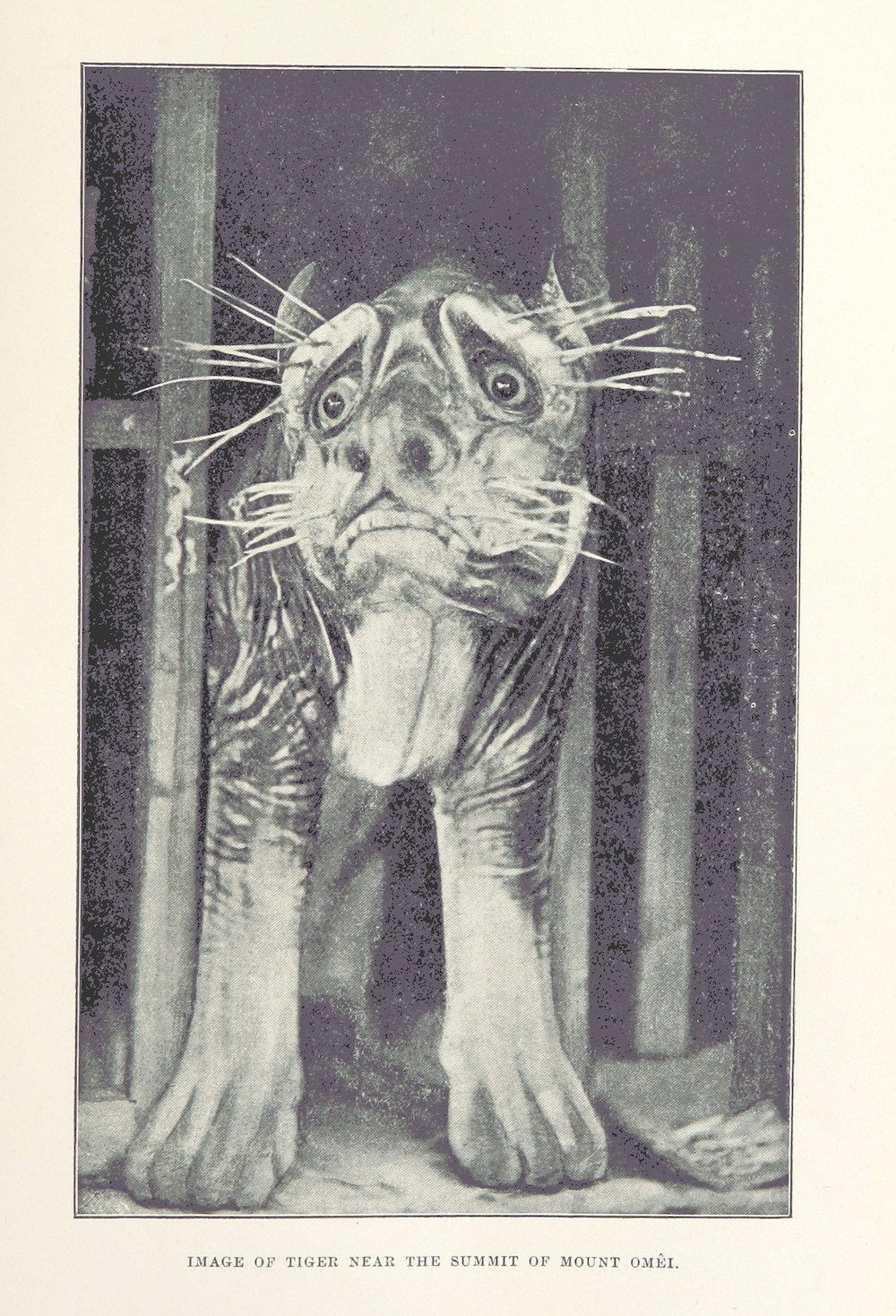
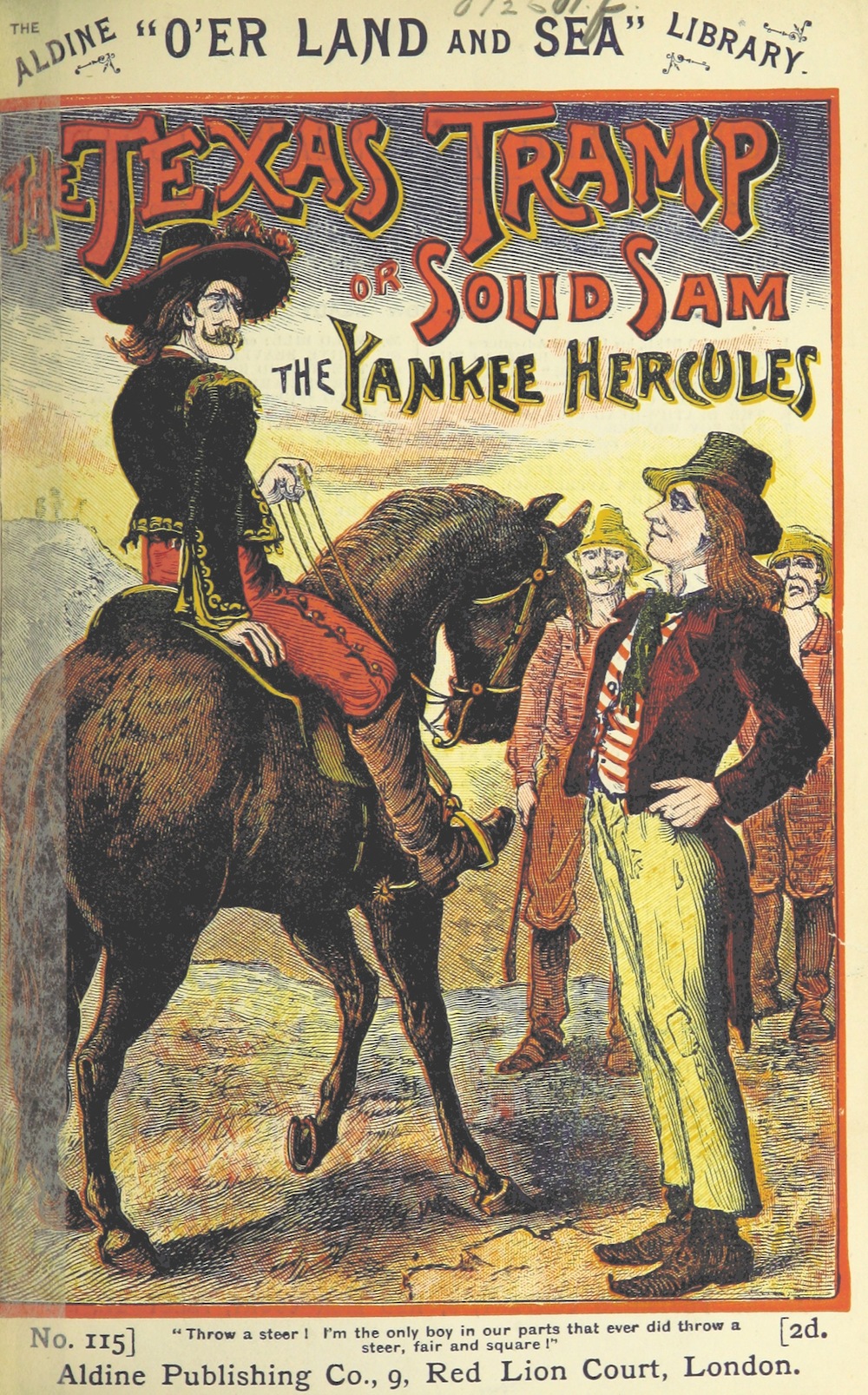
The Flickr Commons site itself gives us a much more conventional organization, with images—most of them discovered by the Mechanical Curator—grouped into several dozen themed albums. We have “Book covers found by the community from the Mechanical Curator Collection,” featuring images like that of The Texas Tramp or Solid Sam the Yankee Hercules, a pulpy title published in 1890 by the Aldine Library’s “O’er Land and Sea” series. And just above, see an illustration from the 1892 publication To the Snows of Tibet through China…With Illustrations and a Map. Each image’s page offers links to other illustrations in the book and those of other books published in the same year.
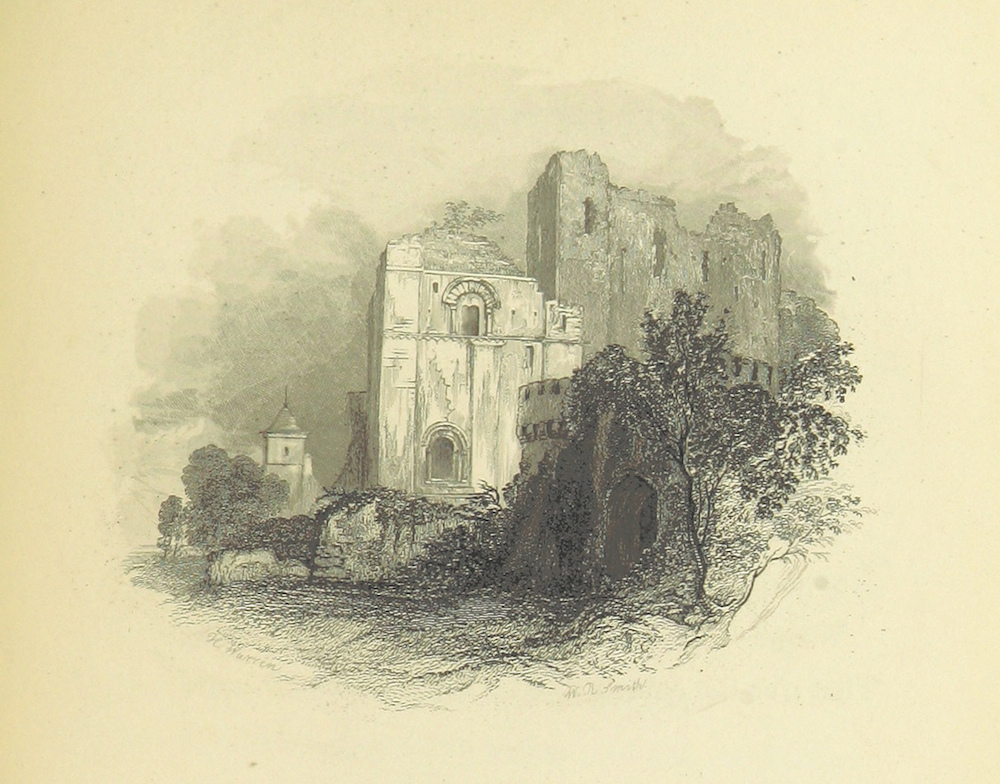
Here, we have a striking illustration from an 1841 edition of The Cottager’s Sabbath, a poem… with … vignettes… by H. Warren. This image comes from “Architecture, found by the community from the Mechanical Curator Collection.”
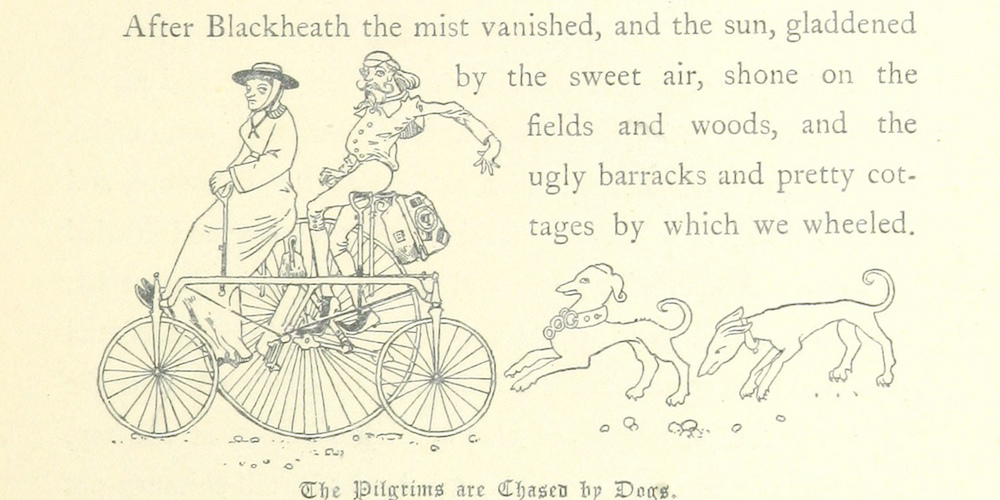
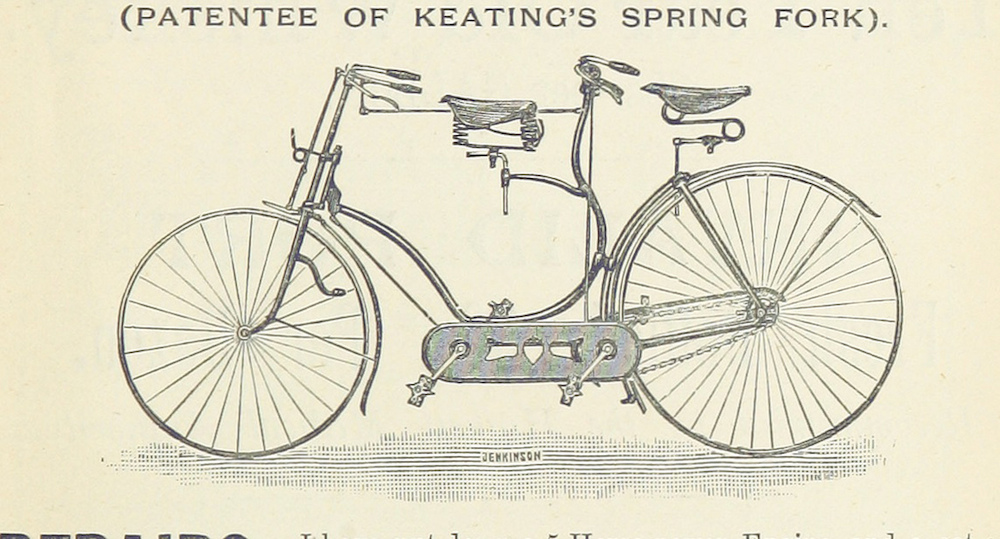
We also have oddities like the illustration above, from 1885’s “A Canterbury Pilgrimage, ridden, written, and illustrated by J. and E.R.P.” This is to be found in “Cycling, found by the community from [you guessed it] the Mechanical Curator Collection,” which also contains plenty of more commercial illustrations like the 1893 “Patentee of Keating’s Spring Fork.”
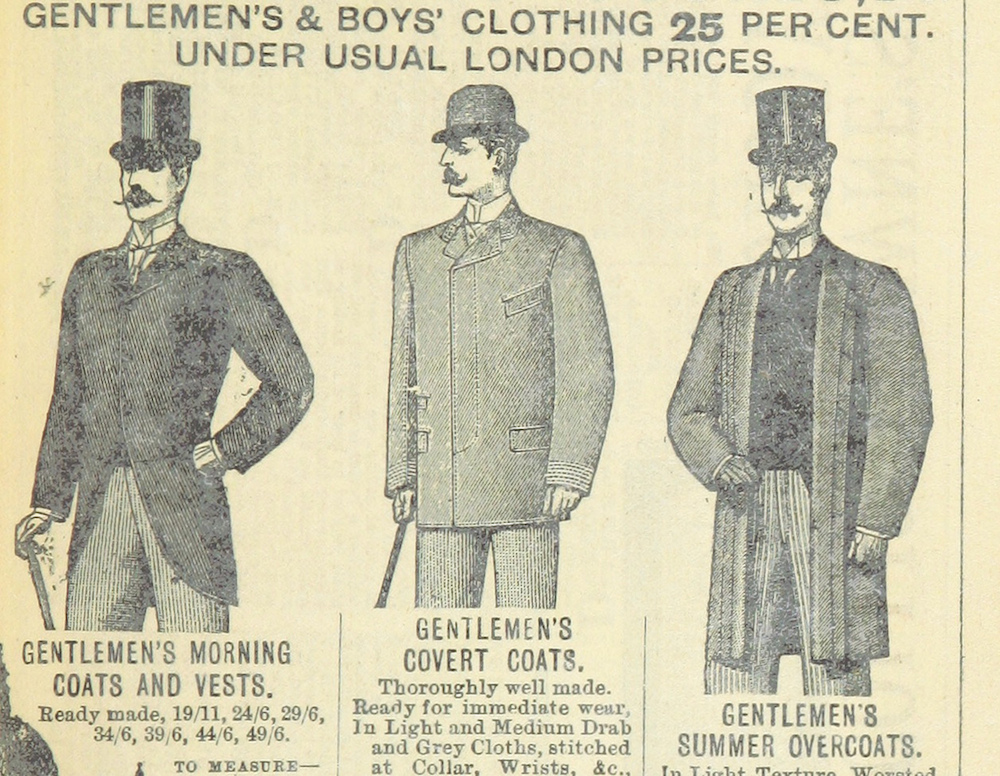
Speaking of commerce, we also have an album devoted to advertisements, found by the community from, yes, the Mechanical Curator Collection. Here you will discover ads like “Oriental Tooth Paste” or that below for “Gentlemen’s & Boy’s Clothing 25 Per Cent. Under Usual London Prices” from 1894. Our conception of Victorian England as excessively formal gets confirmed again and again in these ads, which, like the random choice at the top of the post, contain their share of awkward or humorous historical notions.
Doubtless none of the proto-Mad Men of these very English publications foresaw such a marvel as the Mechanical Curator. Much less might they have foreseen such a mechanism arising without a monetizing scheme. But thanks to this free, newfangled algorithm’s efforts, and much assistance from “the community,” we have a digital record that shows us how public discourse shaped print culture, or the other way around. A fascinating, and at times bewildering, feature of this phenomenal archive is the requirement that we ourselves supply most of the cultural context for these austerely presented images.
Related Content:
2,200 Radical Political Posters Digitized: A New Archive
Yale Launches an Archive of 170,000 Photographs Documenting the Great Depression
Download for Free 2.6 Million Images from Books Published Over Last 500 Years on Flickr
Download 100,000 Free Art Images in High-Resolution from The Getty
Josh Jones is a writer and musician based in Durham, NC. Follow him at @jdmagness
Read More...Maurice Sendak Sent Beautifully Illustrated Letters to Fans — So Beautiful a Kid Ate One
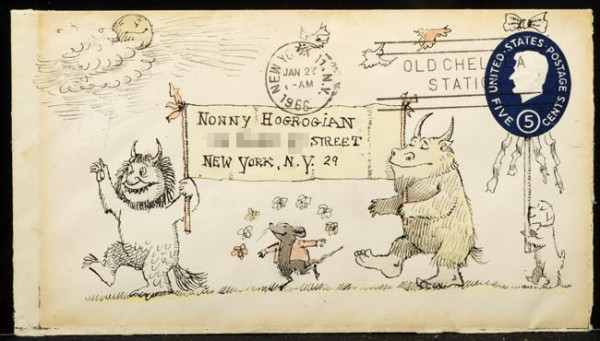
I remember thrilling, as a kid, to the envelope illustrations that the magazines I read ran on their letters pages. Not only would some of these readers (usually readers my age, with a lot of time on their hands) go to the trouble of writing and mailing a physical letter to their periodical of choice, they’d actually get as artistic as possible with the envelope as well. Some even did pretty impressive jobs, though as the envelope-illustrators of our time go, few rank up there with the likes of Maurice Sendak.
“This is how Maurice Sendak sometimes sent his letters,” wrote Letters of Note, tweeting out the image above. “Just imagine getting one.” The author of Where the Wild Things Are and In the Night Kitchen
 wrote the letter contained in this particular envelope to his fellow children’s book writer-illustrator Nonny Hogrogian, author of One Fine Day
 and The Contest
 . Sendak’s close colleagues might have got used to receiving such unconventionally illuminated correspondence, but he also wrote back to each and every one of his young readers, sometimes with similarly prepared correspondence.
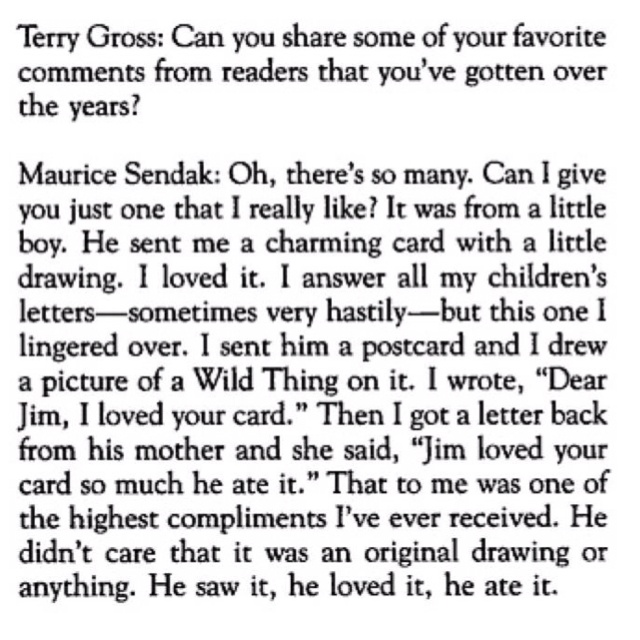
Letters of Note also tweeted a quote from a Fresh Air interview with Sendak in which Terry Gross asked for his favorite comments from his fans. Sendak told the story of a boy from whom he received “a charming card with a little drawing. I loved it.” In reply, he sent the child a postcard of appreciation and drew a Wild Thing on it, just as he did on the envelope of his letter to Hogrogian. The boy’s mother then wrote back to say her son “Jim loved your card so much he ate it,” which Sendak considered “one of the highest compliments I’ve ever received. He didn’t care that it was an original drawing or anything. He saw it, he loved it, he ate it.”
Related Content:
Maurice Sendak’s Bawdy Illustrations For Herman Melville’s Pierre: or, The Ambiguities
The Only Drawing from Maurice Sendak’s Short-Lived Attempt to Illustrate The Hobbit
An Animated Christmas Fable by Maurice Sendak (1977)
Colin Marshall writes on cities, language, Asia, and men’s style. He’s at work on a book about Los Angeles, A Los Angeles Primer, and the video series The City in Cinema. Follow him on Twitter at @colinmarshall or on Facebook.
Read More...A Last Glimpse Inside the Okura, Tokyo’s Modernist Masterpiece Hotel
In late August, one of Tokyo’s grandest hotels, Hotel Okura closed its doors and its main wing will be demolished to make way for a $980 million reconstruction. The new hotel will open in 2019.
The move was met with howls of protest around the world. The original hotel was hailed as a modernist treasure. “It’s a masterpiece,” lamented noted architecture writer Hiroshi Matsukuma. “It has a cultural and historical value that can never be reproduced again.”
The hotel first opened its doors in 1962 at a pivotal time in Japanese history. Eager to distance itself from its militaristic past, the country put on a new internationalist face to the world. The 1964 Tokyo Olympics were meant to be a sort of coming out party for a new, thoroughly modern nation. The Hotel Okura was designed in this same optimistic spirit.
Architect Yoshio Taniguchi said that he intended the hotel to be crisply modern though imbued with “a firm dignity impervious to fleeting fashion.” Five decades later, the hotel’s interiors still seem striking, elegant and wonderfully atmospheric. Taniguchi recruited master artisans Hideo Kosaka, Shiko Munakata and Kenkichi Tomimoto to craft the hotel’s look. The hotel’s murals, furniture, exterior facing, even the light fixtures, all draw upon elements of traditional Japanese design, re-imagined for the jet age.
“It’s the lighting fixtures, the furniture. What’s exciting is that you see this concept of Japanese design history play out across the lobby,” said Don Choi, professor of architecture at Cal Poly San Luis Obispo. “You wouldn’t see that in Paris or New York. That attention to detail makes it a complete work of art.”
Hotel Okura has played host to several US Presidents, from Ford to Obama, along with other international luminaries from the Dalai Lama to Mikhail Gorbachev. Even James Bond spent the night there in You Only Live Twice. Haruki Murakami later featured the place prominently in his beloved tome 1Q84.
For 50 years, the hotel has continued to operate largely unchanged. Even the menu for the hotel’s restaurant, the Orchid Room, serves up the same fare they had back in 1964 — from crepes suzette to wiener schnitzel. The place was the Kennedy era dipped in amber. For the 21st century visitor, that was no doubt much of its charm.
Monocle Magazine has produced a lovely video elegy to the hotel, which you can watch above.
Via Devour
Related Content:
Hōshi: A Short Film on the 1300-Year-Old Hotel Run by the Same Family for 46 Generations
The History of Western Architecture: From Ancient Greece to Rococo (A Free Online Course)
The Modernist Gas Stations of Frank Lloyd Wright and Mies van der Rohe
A Photographic Tour of Haruki Murakami’s Tokyo, Where Dream, Memory, and Reality Meet
Take a 360° Virtual Tour of Taliesin, Frank Lloyd Wright’s Personal Home & Studio
Jonathan Crow is a Los Angeles-based writer and filmmaker whose work has appeared in Yahoo!, The Hollywood Reporter, and other publications. You can follow him at @jonccrow. And check out his blog Veeptopus, featuring lots of pictures of vice presidents with octopuses on their heads. The Veeptopus store is here.
Read More...Support Us
We're hoping to rely on loyal readers, rather than erratic ads. Please click the Donate button and support Open Culture. You can use Paypal, Venmo, Patreon, even Crypto! We thank you!

About Us

Open Culture scours the web for the best educational media. We find the free courses and audio books you need, the language lessons & educational videos you want, and plenty of enlightenment in between.
Advertise With Us

FREE UPDATES!
GET OUR DAILY EMAIL
Get the best cultural and educational resources on the web curated for you in a daily email. We never spam. Unsubscribe at any time.
FOLLOW ON SOCIAL MEDIA

Open Culture editor Dan Colman scours the web for the best educational media. He finds the free courses and audio books you need, the language lessons & movies you want, and plenty of enlightenment in between.
Advertise With Us