Get Three Free Audiobooks from Audiobooks.com


Readers take note! If you sign up for a 30-day trial with Audiobooks.com, you can get access to three professionally-read books in the Audiobooks.com library for free.
You can cancel before your trial period is over and you won’t be charged.
After the trial period ends, and if you don’t cancel, your full membership will begin and you will be charged $14.95 per month for one credit, applicable towards any audiobook in their library.
Click here or on the image above to start your free trial and download your free audiobooks today.
Read More...
An 18-Hour Playlist of Readings by the Beats: Kerouac, Ginsberg & Even Bukowski Too

Plenty of us get tuned in to the Beats through print — maybe a yellowed copy of Howl, a mass-market Naked Lunch, a fifth- or sixth-hand On the Road — but sometimes the verse or prose that so thrills us on those pages fairly demands to be spoken aloud, preferably by the Beat in question. That may have proven a tricky desire to fulfill in decades past, but now Spotify has made it nearly effortless to hear the Beats whenever we like: you can find over eighteen hours of material on a playlist called, straightforwardly enough, The Beats.
These 249 tracks include not just figures like the previously alluded to Allen Ginsberg, William S. Burroughs, and Jack Kerouac, but other beloved Beats such as Gregory Corso, Peter Orlovsky — and Charles Bukowski, not a figure one necessarily associates closely with that movement. Some Bukowski and/or Beat enthusiasts will tell you that each would have nothing to do with the other. Yet the hard-living poet and self-confessed “dirty old man” occasionally admitted to something approaching fondness for certain members of the supposedly higher-minded counterculture: “He’s better to have around than not to have around,” Bukowski once said of Ginsberg. “Without his coming through, none of us would be writing as well as we are doing now, which is not well enough, but we hang on.”
Related Content:
Listen to Charles Bukowski Poems Being Read by Bukowski Himself & the Great Tom Waits
Hear 130 Minutes of Charles Bukowski’s First-Ever Recorded Readings (1968)
Colin Marshall writes on cities, language, Asia, and men’s style. He’s at work on a book about Los Angeles, A Los Angeles Primer, and the video series The City in Cinema. Follow him on Twitter at @colinmarshall or on Facebook.
Read More...Wes Anderson & Yasujiro Ozu: New Video Essay Reveals the Unexpected Parallels Between Two Great Filmmakers
At first blush, Yasujiro Ozu and Wes Anderson would seem to be miles apart. Ozu is the “most Japanese” of all directors. His films are small, quiet, finely calibrated works that document the slow reordering of the family unit in the face of Japan’s rapid modernization. Anderson’s movies are twee and whimsical, filled with wry humor and a shocking amount of violence against dogs.
Yet video essayist Anna Catley in her piece Wes Anderson & Yasujiro Ozu: A Visual Essay makes a pretty compelling case that these two auteurs are more similar than you might think. Both filmmakers have a clear and highly stylized manner of constructing their movies: Ozu’s films are characterized by symmetrical compositions and an unmoving camera that remains about two and a half feet off of the ground. Anderson’s movies are marked by symmetrical compositions, long complex camera moves and lots of overhead shots. Both Ozu and Anderson have a stable of actors that they work with repeatedly — Chishu Ryu and Setsuko Hara for Ozu, Jason Schwartzman and Bill Murray for Anderson. Both filmmakers’ movies are about the complex, often fraught, relationships between parents and children. And both directors often employed the point of view of children to highlight adult hypocrisy and disappointment.
Ozu’s movies, however, were relatively free of Cat Stevens songs.
You can watch the full video above. It might just make you watch a double feature of Ohayo and Moonrise Kingdom.
Related Content:
Watch 7 New Video Essays on Wes Anderson’s Films: Rushmore, The Royal Tenenbaums & More
Watch Wes Anderson’s Charming New Short Film, Castello Cavalcanti, Starring Jason Schwartzman
Wes Anderson’s First Short Film: The Black-and-White, Jazz-Scored Bottle Rocket (1992)
Jonathan Crow is a Los Angeles-based writer and filmmaker whose work has appeared in Yahoo!, The Hollywood Reporter, and other publications. You can follow him at @jonccrow. And check out his blog Veeptopus, featuring lots of pictures of vice presidents with octopuses on their heads. The Veeptopus store is here.
Read More...Venice in Beautiful Color Images 125 Years Ago: The Rialto Bridge, St. Mark’s Basilica, Doge’s Palace & More
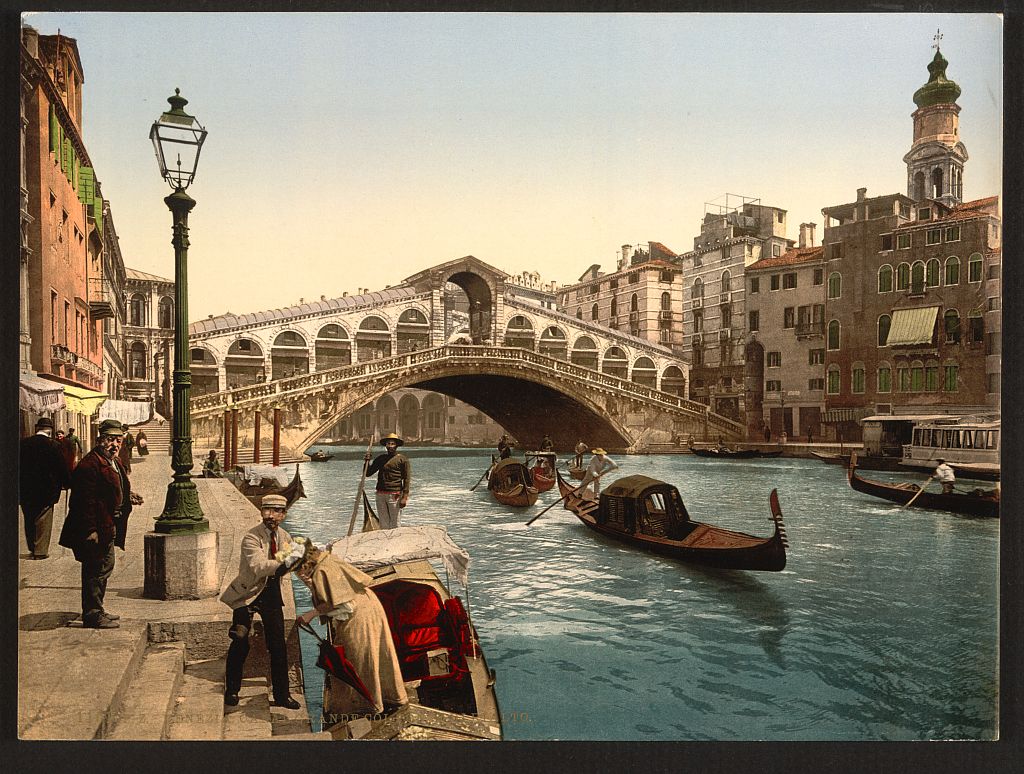
A few months ago, Mental Floss put up a post of “Fantastic 120-Year-Old Color Pictures of Ireland.” Fantastic pictures indeed, although the nature of the technology that produced them seems as interesting to me as the 19th-century Irish life captured in the images themselves. They came from the Library of Congress’ geographically organized archive of photocrom prints, a method perhaps known only to die-hard historical photography enthusiasts. For the rest of us, the Library of Congress’ page on the photocrom process explains it: “Photochrom prints are ink-based images produced through ‘the direct photographic transfer of an original negative onto litho and chromographic printing plates.’ ”
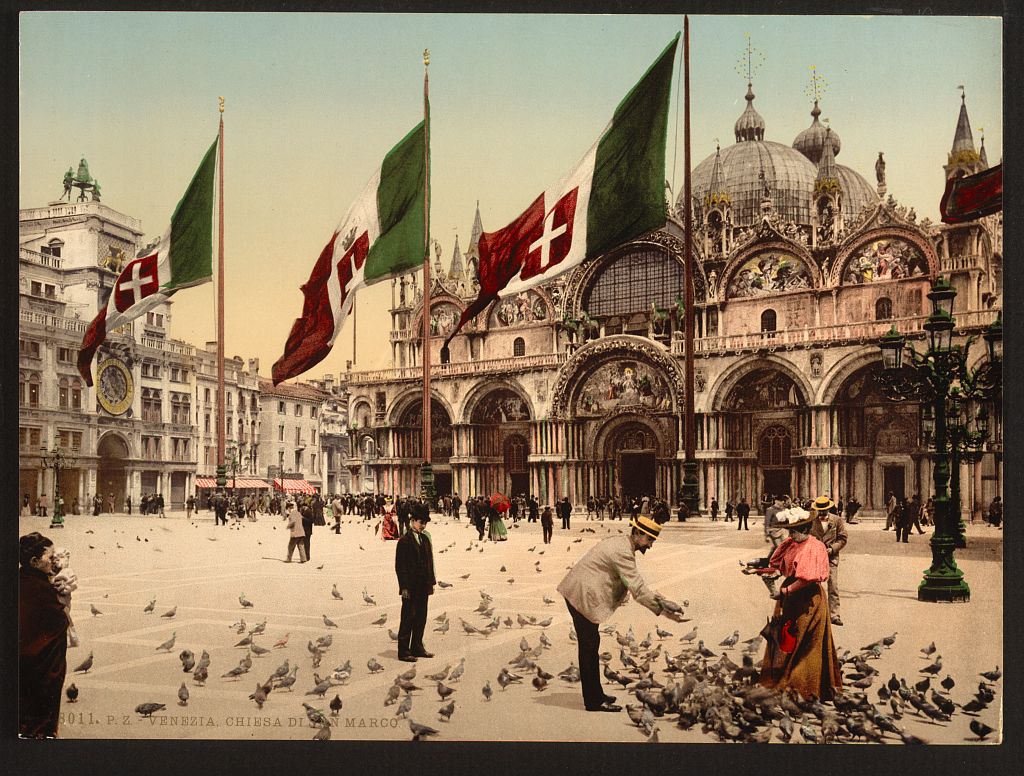
Its inventor Hans Jakob Schmid came up with the technique in the 1880s, a decade that began with color photography consigned to the realm of theory. While Photocrom prints may look an awful lot like color photographs, look at them through a magnifying glass and “the small dots that comprise the ink-based photomechanical image are visible.” “The photomechanical process permitted mass production of the vivid color prints,” each color requiring “a separate asphalt-coated lithographic stone, usually a minimum of six stones and often more than ten stones.”
But that unwieldy-sounding technology and laborious-sounding process has given us, among other striking pieces of visual history, these lush images of fin de siècle Venice, which the writer of place Jan Morris once described as “less a city than an experience.”
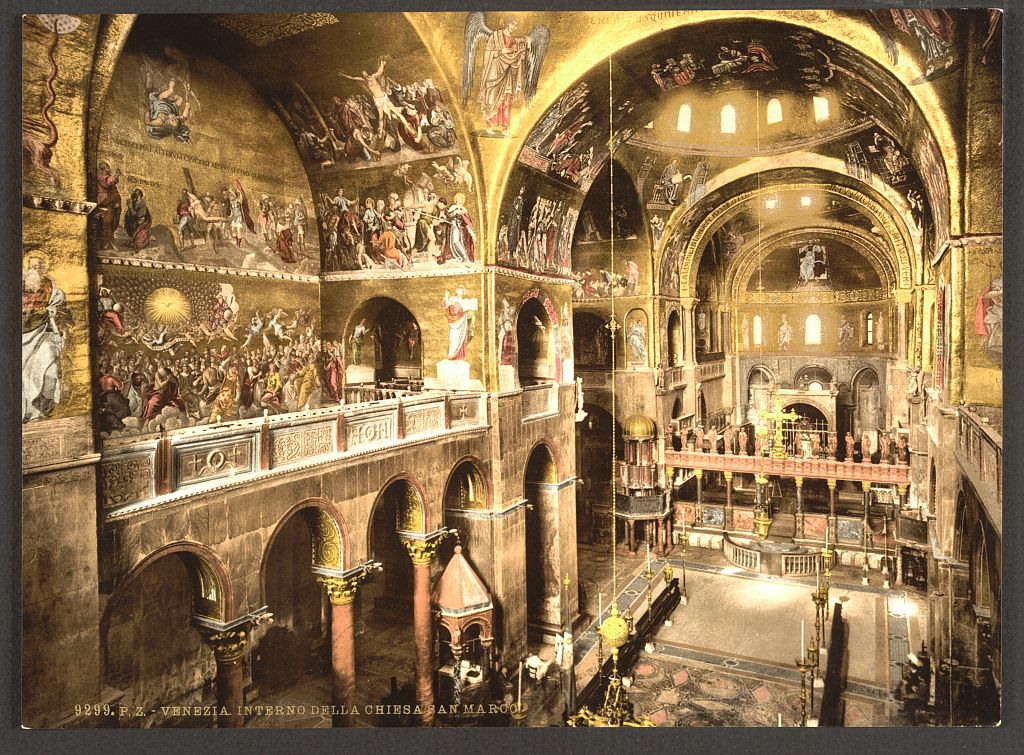
At the top of the post, we have a view of the Rialto Bridge, which spans one of the city’s famous canals; below that a scene of pigeon-feeding in St. Mark’s Piazza; the image just above leaves the pigeons behind to view the interior of St. Mark’s Basilica.
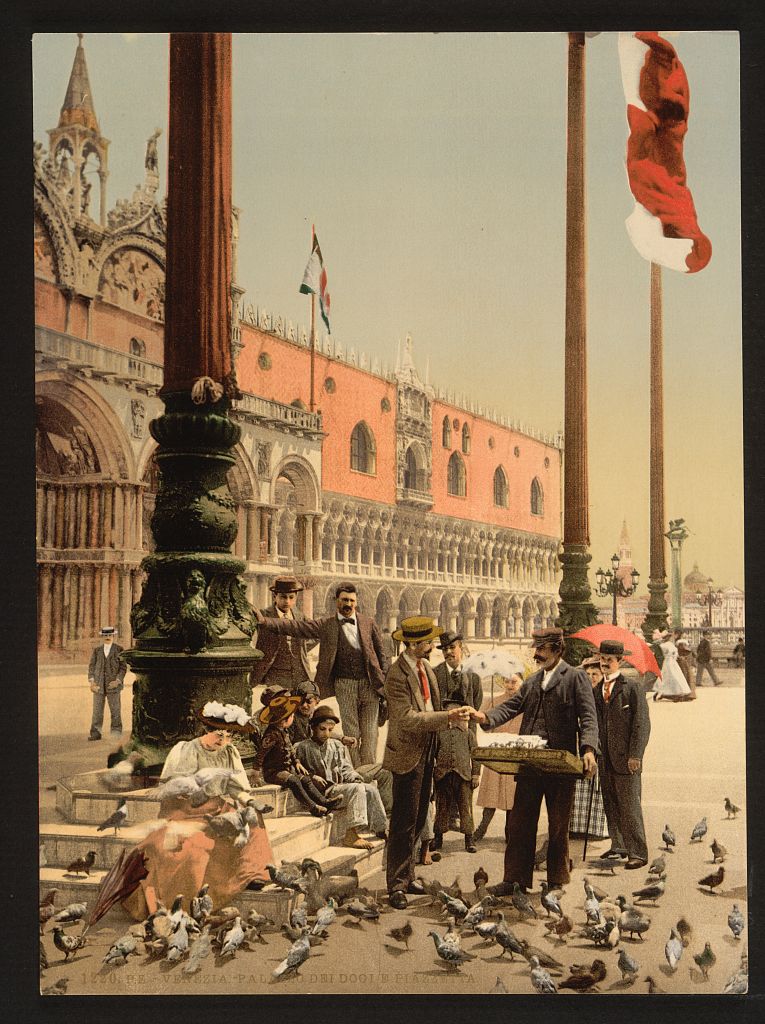
The photos below, all also taken between 1890 and 1900, depict the exterior and interior of the Doge’s Palace, as well as its view of San Giorgio Island by moonlight.
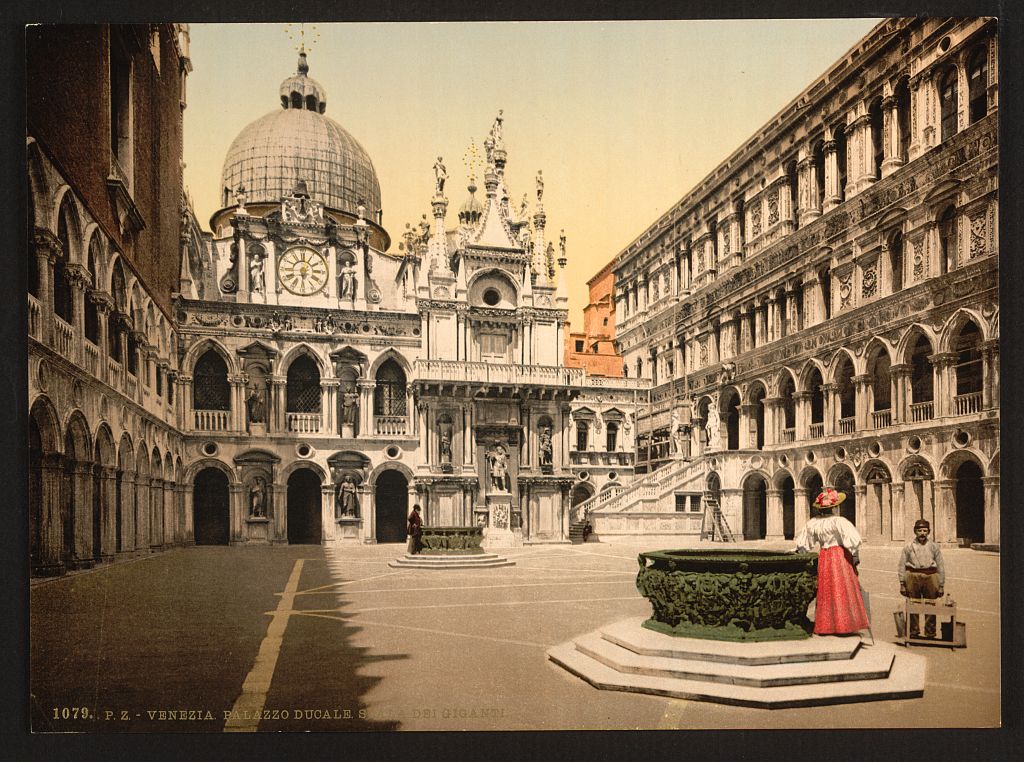
We may not consider these “real” color photographs, but the colors they present, vividly applied in the printing process, somehow more accurately represent the spirit of late 19th-century Europe — one of history’s truly vivid periods, in one of its enduringly vivid human environments. More color images of fin-de-siecle Venice can be viewed here.
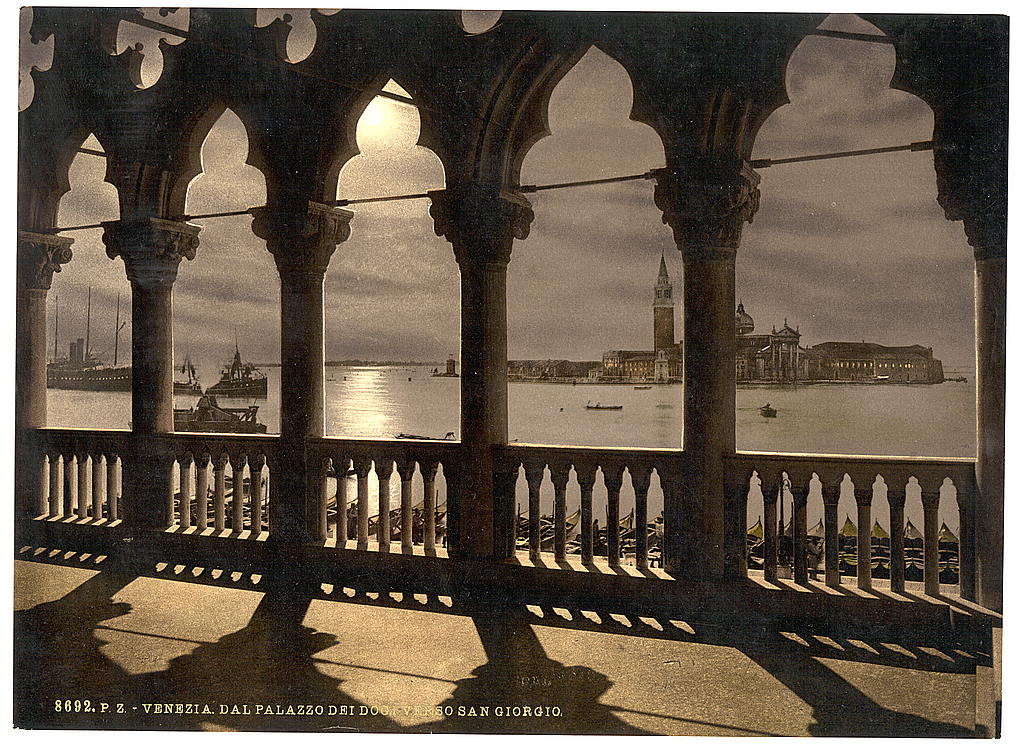
Related Content:
Take a Virtual Tour of Venice (Its Streets, Plazas & Canals) with Google Street View
How Venice Works: A Short Film
Venice in a Day: From Daybreak to Sunset in Timelapse
Hand-Colored Photographs of 19th Century Japan
The First Color Photos From World War I: The German Front
The Oldest Color Movies Bring Sunflowers, Exotic Birds and Goldfish Back to Life (1902)
Colin Marshall writes on cities, language, Asia, and men’s style. He’s at work on a book about Los Angeles, A Los Angeles Primer, and the video series The City in Cinema. Follow him on Twitter at @colinmarshall or on Facebook.
Read More...Two Documentaries Introduce Delia Derbyshire, the Pioneer in Electronic Music
With her buttoned-up style, work with the UN, and name like a plucky character in a certain English wizard series, Delia Derbyshire may not seem a likely pioneer of experimental electronic music. But her work in the sixties and seventies indeed made her a forerunner of so much contemporary electronic music that most every current legend in the business—from Aphex Twin and the Chemical Brothers to Paul Hartnoll of Orbital, who calls her work “quite amazing” and “timeless”—credits her in some way or another. If you’ve never heard of Derbyshire, you can learn about her life and work in the 2010 BBC Radio 4 documentary above, “Sculptress of Sound.”
As we recently noted in an earlier post, Derbyshire occupies a prominent place in the history of women in the field. She has also worked with everyone from Doctor Who composer Ron Grainer (who took sole credit for their work together) to Paul McCartney. Well almost. McCartney—a huge fan of Derbyshire’s work with the BBC’s Radiophonic Workshop—considered collaborating with her on an early version of “Yesterday,” then went with strings instead. But her near hit with the Beatles showed just how far she had come since joining the BBC as a trainee studio manager in 1960. The previous year, Decca records rejected her application, telling her point blank that they did not hire women for studio work.
For contractual reasons, Derbyshire made many of her radio compositions under pseudonyms, and she may have been frustrated by her near-obscurity. She did withdraw from music in the mid-seventies, not to reappear until a few years before her death in 2001. But perhaps her departure had nothing to do with lack of fame. Derbyshire had the highest of technical standards and a mathematical approach to making music. Once commercial synthesizers became available, she felt that making electronic music had become too easy and her enthusiasm waned. The new music bored her, and instead of trying to hold on to her relevance, she made a graceful exit.
It’s only in recent years that Derbyshire has become recognized for the pioneer she was. See her above profiled in a 2009 short documentary, “The Delian Mode,” by Kara Blake. Featured are Derbyshire’s innovative techniques with manipulated tape machines and found sounds for her TV and film scores and her original compositions under her own name and with influential early electro-pop band White Noise. The Guardian called Derbyshire’s way of making music “an analytical approach to synthesiz[ing] complex sounds from electronic sources.” Her degree in mathematics informed her way of working, as did her conception of herself not primarily as a composer, but also as a scientist. “I suppose in a way,” she said of her painstakingly-created scores, “I was experimenting in psycho-acoustics.” Many of her experiments sound as fresh today as they did at the time, ready to inspire several more generations of composers and musicians.
You can dip into an archive of Derbyshire’s music over at UBU.com.
Related Content:
Hear Seven Hours of Women Making Electronic Music (1938- 2014)
Josh Jones is a writer and musician based in Durham, NC. Follow him at @jdmagness.
Read More...New Archive Offers Free Access to 22,000 Literary Documents From Great British & American Writers
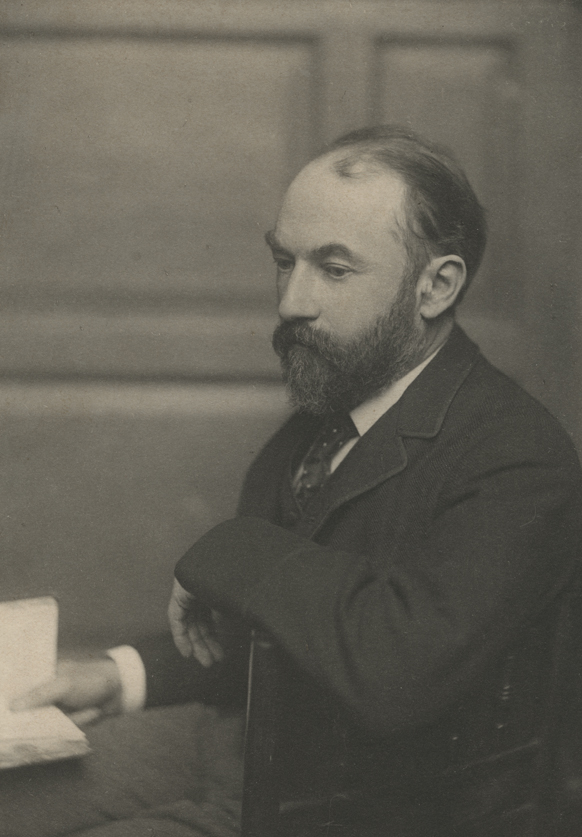
Thomas Hardy—architect, poet, and writer (above)—gave us the fierce, stormy romance Far From the Madding Crowd, currently impressing critics in a film adaptation by Thomas Vinterberg. He also gave us Tess of the D’Urbervilles, The Return of the Native, and Jude the Obscure, books whose persistently grim outlook might make them too depressing by far were it not for Hardy’s engrossing prose, unforgettable characterization, and, perhaps most importantly, unshakable sense of place. Hardy set most of his novels in a region he called Wessex, which—much like William Faulkner’s Yoknapatawpha—is a thinly fictionalized recreation of his rural hometown of Dorchester and its surrounding counties.
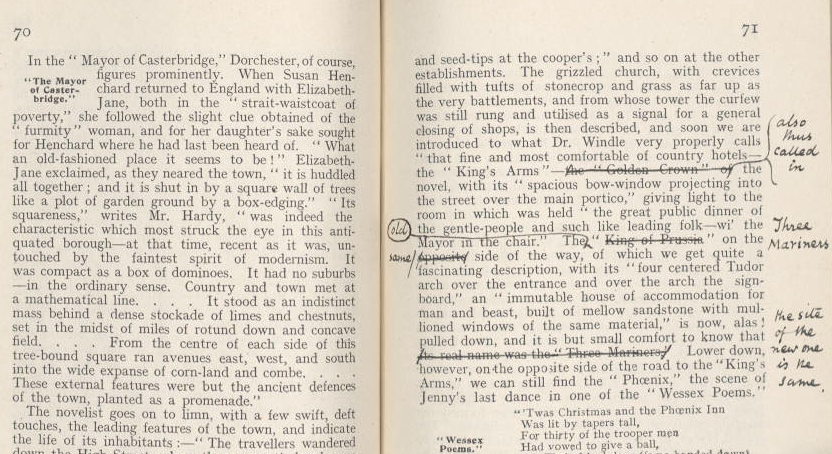
Now, thanks to the University of Texas at Austin’s Harry Ransom Center, we can learn all about this ancient region in South West England, and Hardy’s transmutation of it, through Hardy’s own proof copy of a 1905 book by Frank R. Heath called Dorchester (Dorset) and its Surroundings, with revisions in Hardy’s hand. In the excerpt above, for example, from page 36 of this scholarly work, the author discusses Hardy’s use of Dorchester in The Mayor of Casterbridge and the so-called “Wessex Poems.” In the margins on the right, we see Hardy’s corrections and glosses. Though this may not seem the most exciting piece of Hardy memorabilia, for students of the author and his investment in a rural corner of England, it is indeed a treasure.

The Hardy archive also contains scans of the author’s correspondence, manuscripts and signed typescripts, and architectural drawings, like that of St. Juliot’s Church in Cornwall, above. This extensive digital Hardy collection is but one of many housed in the Ransom Center’s Project Reveal, an acronym for “Read and View English & American Literature.” Read and view you can indeed, through the intimacy of first drafts, manuscripts, personal writing, and other ephemera.
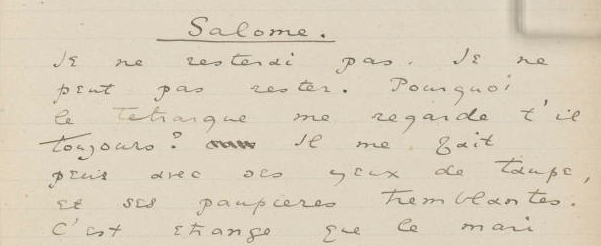
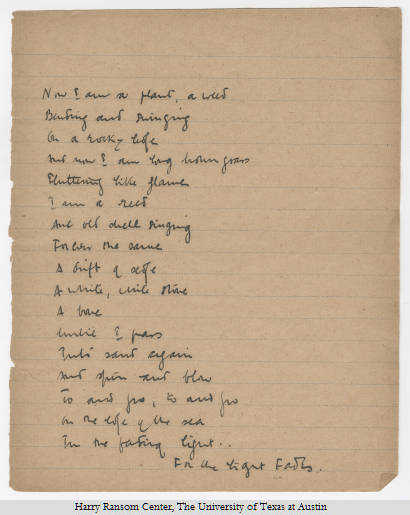
See, for example, a handwritten draft of Oscar Wilde’s Salome, in French, (excerpt above). Below, we have a handwritten list of Robert Louis Stevenson’s favorite books, and further down, a manuscript draft of Katherine Mansfield’s “Now I am a plant, a weed” from her personal poetry notebook.
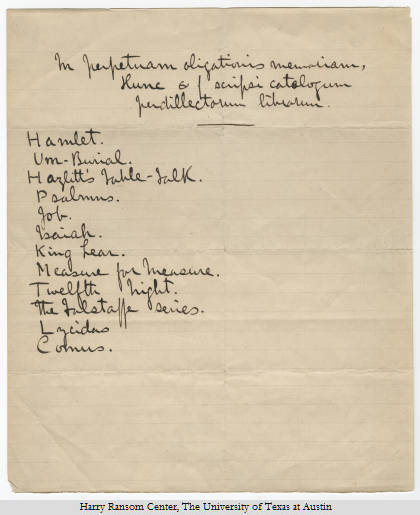
Other authors included in the Project Reveal archive include Charlotte Perkins Gilman, Hart Crane, Henry James, Joseph Conrad, and William Thackeray. The project, writes the Ransom Center in a press release, generated more than 22,000 high-resolution images, available for use by anyone for any purpose without restriction or fees” (but with attribution). The literary storehouse on display here only adds to an already essential collection of artifacts the Ransom Center houses, such as the papers of Gabriel Garcia Marquez, syllabi, annotated books, and manuscripts from David Foster Wallace, scrapbooks of Harry Houdini, and the first known photograph ever taken. See a complete list of contents of the Ransom Center’s Digital Collections here, and learn more about this amazing library in the heart of Texas at their main site.
Related Content:
Yale Launches an Archive of 170,000 Photographs Documenting the Great Depression
Literary Remains of Gabriel García Márquez Will Rest in Texas
David Foster Wallace’s Love of Language Revealed by the Books in His Personal Library
Josh Jones is a writer and musician based in Durham, NC. Follow him at @jdmagness
Read More...Watch a Needle Ride Through LP Record Grooves Under an Electron Microscope
Last year, we highlighted a 1956 video from RCA Victor which demonstrated how vinyl records were made back in the good old days. If you have 23 free minutes, you can get a pretty good look at the production process — the live audio recording, the making of a master disc, the production of a mold, the eventual mass production of vinyl records, etc.
Almost 60 years later, vinyl is making a comeback. So why not let Ben Krasnow, a hardware engineer at Google X, give us a much more modern perspective on the LP? Above, watch Krasnow’s stop motion animation, made with an electron microscope, which shows us a phonograph needle riding through grooves on an LP. Much of the 9‑minute video offers a fairly technical primer on what went into making this stop motion clip in the first place. So if you want to get to the action, fast forward to the 4:20 mark.
If you hang with Krasnow’s video, you can also see him take some microscopic looks at other media formats — CD-ROMs, early forms of DVDs, and more.
Follow us on Facebook, Twitter, Google Plus and LinkedIn and share intelligent media with your friends. Or better yet, sign up for our daily email and get a daily dose of Open Culture in your inbox.
Related Content:
How Vinyl Records Are Made: A Primer from 1956 (That’s Relevant in 2014)
How to Clean Your Vinyl Records with Wood Glue
World Records: New Photo Exhibit Pays Tribute to the Era of Vinyl Records & Turntables
Read More...Andrei Tarkovsky’s Solaris Shot by Shot: A 22-Minute Breakdown of the Director’s Filmmaking
“What is Bresson’s genre? He doesn’t have one. Bresson is Bresson,” wrote master filmmaker Andrei Tarkovsky in his seminal book Sculpting in Time. “The very concept of genre is as cold as the tomb.”
Nonetheless, Tarkovsky made two of the most praised, best-regarded science fiction films in cinema. Stalker (watch it online) is a metaphysical riddle wrapped in the trappings of a sci-fi thriller. In the verdant area called the Zone, ringed off by miles of barbed wire and armed soldiers, pilgrims come to behold an uncanny landscape ruled by a powerful, otherworldly intelligence. The film seemed to prefigure the Chernobyl disaster that happened years later and proved to be the unlikely inspiration for a video game.
Adapted from a novel by Stanislaw Lem, Solaris (watch online) is about a space station that orbits a sentient planet that causes hallucinations in the cosmonauts. The hyper-rational protagonist, Kris Kelvin, is thrown for a loop when he is confronted by a doppelganger of his dead wife who killed herself years earlier. The logical side of him knows that this is a hallucination but he falls in love anyway, only to lose her again. Kelvin is caught in a hell of repeating the mistakes of his past.
Solaris was seen as a Cold War-era response to Stanley Kubrick’s 2001: A Space Odyssey. Both movies are mind-altering deep-space epics that raise more questions than they answer. Yet Tarkovsky hated 2001’s ostentatious use of cutting-edge special effects. “For some reason, in all the science-fiction films I’ve seen, the filmmakers force the viewer to examine the details of the material structure of the future,” he told Russian film journalist Naum Abramov in 1970. “More than that, sometimes, like Kubrick, they call their own films premonitions. It’s unbelievable! Let alone that 2001: A Space Odyssey is phony on many points, even for specialists. For a true work of art, the fake must be eliminated.”
Indeed, Tarkovsky seemed to deliberately half-ass the generic elements of film. He used leisurely shots of tunnels and highways of 1971 Tokyo to depict the city of the future. He devoted only a couple minutes of the film’s nearly three hour running time to things like spaceships. And you have to love the fact that the space station in Solaris has such distinctly unfuturistic design elements as a chandelier and a wood-paneled library.
Tarkovsky, of course, isn’t interested in science. He’s interested in art and its way to evoke the divine. And his primary way of doing this is with long takes; epic shots that resonate profoundly even if the meaning of those images remains elusive. Solaris opens with a shot of water flowing in a brook and then, later in the scene, there is a sudden downpour. The camera presses into a shot of a teacup filling with rain. It’s a beautiful, memorable, evocative shot. Maybe the image means something. Maybe its beauty is, in and of itself, its meaning. Either way, Tarkovsky forces you to surrender to his deliberate cinematic rhythm and his pantheistic view of the world.
In a piece called Tarkovsky Shot by Shot, video essayist Antonios Papantoniou dissects a few scenes from Solaris, breaking down each according to camera angle, shot type and duration while pointing out recurring visual motifs. “Diametrically different from Hollywood’s extravagant moviemaking Tarkovsky’s Solaris is in a cinematic universe of its own,” writes Papantoniou in one of the video’s copious intertitles. “Symbolic images and metaphysical manifestations are created and expressed in a poetic way where every visual detail matters.” Watching Shot by Shot, you get a real sense of just how beautifully his films unfold with those gorgeously choreographed long takes. You can watch the full video above.
Related Content:
Tarkovsky Films Now Free Online
Watch Stalker, Andrei Tarkovsky’s Mind-Bending Masterpiece Free Online
The Masterful Polaroid Pictures Taken by Filmmaker Andrei Tarkovsky
Tarkovsky’s Advice to Young Filmmakers: Sacrifice Yourself for Cinema
A Poet in Cinema: Andrei Tarkovsky Reveals the Director’s Deep Thoughts on Filmmaking and Life
Jonathan Crow is a Los Angeles-based writer and filmmaker whose work has appeared in Yahoo!, The Hollywood Reporter, and other publications. You can follow him at @jonccrow. And check out his blog Veeptopus, featuring lots of pictures of vice presidents with octopuses on their heads. The Veeptopus store is here.
Read More...Dr. Seuss’ World War II Propaganda Films: Your Job in Germany (1945) and Our Job in Japan (1946)
Most of us come to know the work of Theodor “Dr. Seuss” Geisel through his children’s books (I, for instance, remember Hop on Pop as the first book I could read whole), and while he remains most famous as a prolific teller and illustrator of surreally didactic tales for youngsters, his productivity entered other cultural areas as well. Perhaps the most surprising chapter of his career happened during the Second World War, when Seuss, who had already demonstrated his strong anti-Hitler, anti-Mussolini, and pro-Roosevelt sentiments in political cartoons, went to work scripting propaganda films.
Having joined the U.S. Army in 1943 as a Captain, Seuss went on to take charge of the Animation Department of the Air Force’s First Motion Picture Unit. Working under Frank Capra toward the end of the war, he wrote the short films Your Job in Germany and Our Job in Japan, both intended to get American soldiers into the right mindset for the occupations of those defeated countries. “With your conduct and attitude while inside Germany, you can lay the groundwork of a peace that could last forever,” says the narrator of the former, “Or just the opposite.”
Unlike the similarly G.I.-targeted Private Snafu cartoons we featured last year, nothing of Seuss’ fanciful style comes through in these films, which use all-too-real footage to illustrate to “our boys” as vividly as possible what could go wrong if they let their guard down in these only-just-former enemy territories. “The German lust for conquest is not dead,” the narrator warns, “it’s merely gone undercover.” The German people, he insists, “must prove they have been cured beyond the shadow of a doubt before they ever again are allowed to take their place among respectable nations.”
Our Job in Japan also holds out the prospect of a prolonged peace — “peace, if we can solve the problem of 70 million Japanese people.” But this short doesn’t have quite as damning a tone as Your Job in Germany; instead, it focuses on how best to rehabilitate an “old, backward, superstitious country” full of impressionable people “trained to follow blindly wherever their leaders led them.” According to the script, the eminently teachable and adaptable “Japanese brain” just happened to fall under the sway of warlords who decided it could “be hopped up to fight with fanatical fury.” Patronizing, certainly, but a far cry from the popular conception in the west at the time of the Japanese as a cruel, power-mad race inherently bent on bloodshed.
Seuss himself had a history of anti-Japanese cartooning (also featured on our site), but it seems his views had already begun to turn by the time of Our Job in Japan, which argues only for setting an example demonstrating that “what we like to call the American Way, or democracy, or just plain old Golden Rule common sense is a pretty good way to live.” As a result, no less a player in the Pacific theater than Douglas MacArthur found the film excessively sympathetic to the Japanese and tried to have it suppressed, a kind of controversy that never erupted around the likes of Hop on Pop. But as far as the actual winning of Japanese hearts and minds goes, I suspect Seuss’ children’s books have done a better job.
Related Content:
Dr. Seuss Draws Anti-Japanese Cartoons During WWII, Then Atones with Horton Hears a Who!
Donald Duck’s Bad Nazi Dream and Four Other Disney Propaganda Cartoons from World War II
“The Ducktators”: Loony Tunes Turns Animation into Wartime Propaganda (1942)
200 Ansel Adams Photographs Expose the Rigors of Life in Japanese Internment Camps During WW II
Colin Marshall writes on cities, language, Asia, and men’s style. He’s at work on a book about Los Angeles, A Los Angeles Primer, and the video series The City in Cinema. Follow him on Twitter at @colinmarshall or on Facebook.
Read More...Free: Listen to John Rawls’ Course on “Modern Political Philosophy” (Recorded at Harvard, 1984)
Some of the most-referenced Western political thinkers—like Thomas Hobbes, John Locke, and Thomas Jefferson—have taken hierarchies of class, race, or both, for granted. Not so some of their more radical contemporaries, like Jean-Jacques Rousseau and Thomas Paine, who made forceful arguments against inequality. A strain of utopianism runs through more egalitarian positions, and a calculating pragmatism through more libertarian. Rarely have these two threads woven neatly together.
In the work of 20th century political philosopher John Rawls, they do, with maybe a knot or a kink here and there, in a unique philosophy first articulated in his 1971 book A Theory of Justice, a novel attempt at reconciling abstract principles of liberty and equality (recently turned into a musical.)
Like the Enlightenment philosophers before him, Rawls’ system of distributive justice invokes a thought experiment as the ground of his philosophy, but it is not an original myth, like the state of nature in nearly every early modern thinker, but an original position, as he calls it, of a society that lives behind a “veil of ignorance.” In this condition, wrote Rawls:
No one knows his place in society, his class position or social status, nor does anyone know his fortune in the distribution of natural assets and abilities, his intelligence, strength, and the like. I shall even assume that the parties do not know their conceptions of the good or their special psychological propensities. The principles of justice are chosen behind a veil of ignorance.
Clearly, then, this idea presupposes the opposite of a meritocracy built on labor, conquest, or natural superiority. In fact, some of Rawls’ critics suggested, the “original position” presupposes a kind of nothingness, a state of incoherent nonexistence. What does it mean, after all, to exist without histories, differences, attributes, or aspirations? And how can we visualize an equality of conditions when no one experiences anything like it? What kind of position can possibly be “original”?
To clarify his theory and answer reasonable objections, Rawls followed A Theory of Justice with a 1985 essay called “Justice as Fairness: Political not Metaphysical.” This rethinking coincided with a series of lecture classes he taught at Harvard in the 80s, which were eventually published in a 2001 book also titled Justice as Fairness, a promised “restatement” of the original position.
Now we can hear these lectures, or most of them, with the rest to come, on Youtube. Get started with the first lecture in his 1984 seminar “Philosophy 171: Modern Political Philosophy,” at the top, with lectures two and three above and below. There are six additional classes on the Harvard Philosophy Department’s Youtube channel, with a final two more to follow. (Get them all here.)
In these talks, Rawls explains and expands on his core principles: equality of opportunity and the “difference principle,” which states that any and all inequality should benefit the least well-off members of a society. Rawls’ brand of political liberalism (also a title of one of his books) has influenced presidents, judges, and legislators with arguments directly contrary to some of the right’s ideological architects, many of whom in fact wrote in reaction to Rawls. We are free to accept his claims or not, but Rawls’ significant contribution to the terms of modern political discourse is inarguable.
This set of lectures will be added to our collection of 140 Free Online Philosophy Courses, a subset of our meta collection: 1,700 Free Online Courses from Top Universities.
via Daily Nous
Related Content:
Justice: Putting a Price Tag on Life & How to Measure Pleasure
Josh Jones is a writer and musician based in Durham, NC. Follow him at @jdmagness
Read More...
Support Us
We're hoping to rely on loyal readers, rather than erratic ads. Please click the Donate button and support Open Culture. You can use Paypal, Venmo, Patreon, even Crypto! We thank you!

About Us

Open Culture scours the web for the best educational media. We find the free courses and audio books you need, the language lessons & educational videos you want, and plenty of enlightenment in between.
Advertise With Us

FREE UPDATES!
GET OUR DAILY EMAIL
Get the best cultural and educational resources on the web curated for you in a daily email. We never spam. Unsubscribe at any time.
FOLLOW ON SOCIAL MEDIA

Open Culture editor Dan Colman scours the web for the best educational media. He finds the free courses and audio books you need, the language lessons & movies you want, and plenty of enlightenment in between.
Advertise With Us

