Take Big History: A Free Short Course on 13.8 Billion Years of History, Funded by Bill Gates
Last month, The New York Times Magazine published a long piece called “So Bill Gates Has This Idea for a History Class …”, which begins with these very words:
In 2008, shortly after Bill Gates stepped down from his executive role at Microsoft, he often awoke in his 66,000-square-foot home on the eastern bank of Lake Washington and walked downstairs to his private gym in a baggy T‑shirt, shorts, sneakers and black socks yanked up to the midcalf. Then, during an hour on the treadmill, Gates, a self-described nerd, would pass the time by watching DVDs from the Teaching Company’s “Great Courses” series. On some mornings, he would learn about geology or meteorology; on others, it would be oceanography or U.S. history.
As Gates was working his way through the series, he stumbled upon a set of DVDs titled “Big History” — an unusual college course taught by a jovial, gesticulating professor from Australia named David Christian. Unlike the previous DVDs, “Big History” did not confine itself to any particular topic, or even to a single academic discipline. Instead, it put forward a synthesis of history, biology, chemistry, astronomy and other disparate fields, which Christian wove together into nothing less than a unifying narrative of life on earth.
Captivated by Dr. Christian’s ability to connect big and complex ideas, Gates thought to himself, “God, everybody should watch this thing!” And, soon enough, the philanthropist contacted the professor and suggested making “Big History” available as a course in high schools across the US (with Bill footing the bill.)
In 2011 the Big History Project, a course with a significant digital component, was piloted in five high schools. Now, a few years later, it’s being made freely available, says the Times, “to more than 15,000 students in some 1,200 schools, from the Brooklyn School for Collaborative Studies in New York to Greenhills School in Ann Arbor, Mich., to Gates’s alma mater, Lakeside Upper School in Seattle. And if all goes well, the Big History Project will be introduced in hundreds of more classrooms by next year and hundreds, if not thousands, more the year after that, scaling along toward the vision Gates first experienced on that treadmill.”
Why do I tell you this? Partly because the Big History Project is open to you as well. On the Big History website, you will find a public course, offering a four-to-six hour tour of Big History. It’s an abbreviated introduction to 13.8 billion years of history. I could think of less efficient ways to spend an afternoon.
After you’re done, if you want to fill in a few gaps, don’t miss our collection: 1,700 Free Online Courses from Top Universities. It covers history, biology, physics and all of the rest.
Related Content:
The History of the World in 46 Lectures From Columbia University
Free Download of The History Manifesto: Historians New Call for Big-Picture Thinking
Download 78 Free Online History Courses: From Ancient Greece to The Modern World
Read More...Photos of Hiroshima by Hiroshima Mon Amour Star Emmanuelle Riva (1958)

Hiroshima Mon Amour, Alain Resnais’s landmark 1960 meditation on war and memory, was Emmanuelle Riva’s first starring role. She plays a married actress (catch a scene here) who, while making a movie in Japan, has an affair with a Japanese architect played by Eiji Okada. Screenwriter Marguerite Duras chisels away at the actress’s Gallic reserve over the course of the film as memories of the war, not to mention guilt over the affair, overwhelm her. Resnais lingers on Riva’s face as she comes apart. Her performance is as brave as it is exact. French film critic Jean Domarchi once stated, “Hiroshima is a documentary on Emmanuelle Riva.”

As it turns out, Riva was documenting Hiroshima too. While filming on location, she took a series of photographs of everyday life of a city still recovering from the war. They are a fascinating slice of life from a Japan that has long disappeared. The Hiroshima Riva captured was still dominated by dirt roads and wooden buildings. People still regularly wore traditional geta wooden shoes.

Children seemed to be a favorite subject for Riva. She photographs a flock of elementary school students walking to school; a pair of boys fishing before the genbaku dome – ground zero for the bomb; and a gaggle of kids staring agog into the lens, no doubt curious at the sight of a stylish French woman with an expensive camera.

Years later, Riva’s pictures were collected into a book called Hiroshima 1958, which, sadly, seems to be available only in Japan. Riva, of course, went on to a celebrated acting career, including an Oscar-nominated turn in Michael Haneke’s harrowing love story Amour.
 via RocketNews24
Related Content:
Watch Alain Resnais’ Short, Evocative Film Toute la mémoire du monde (1956)
Haunting Unedited Footage of the Bombing of Nagasaki (1945)
Jonathan Crow is a Los Angeles-based writer and filmmaker whose work has appeared in Yahoo!, The Hollywood Reporter, and other publications. You can follow him at @jonccrow. And check out his blog Veeptopus, featuring lots of pictures of vice presidents with octopuses on their heads. The Veeptopus store is here.
Read More...The Distortion of Sound: A Short Film on How We’ve Created “a McDonald’s Generation of Music Consumers”
It’s an old joke at this point—the hipster’s retro-obsession with vinyl is an affectation as bogus as louvered sunglasses and high-waisted acid washed jeans, right? Well, there are plenty of people who buy records and listen to them, too. There are even people who buy and listen to cassette tapes, imagine that! You can count me in both camps, and it isn’t because—or only because—I love the look and feel of these analog cultural artifacts or that I’m nostalgic for simpler times. It’s because I love the sound. Even cheapo cassette tapes can often sound better to me than the medium of music we’ve all grown so accustomed to over the last decade or so—the MP3.
Beginning in the CD era, the so-called “Loudness Wars” more or less killed the dynamics of recorded music, pushing every sound to the absolute limit—from the most delicately plucked acoustic guitar string to a black metal singer’s most demonic roar. Without the pleasing push-pull of musical dynamics, songs lose their depth and power. Once the music is released as product, it suffers another indignity in the data compression of MP3s and streaming services, formats that—according to high-end audio company Harmon—“have diminished the quality and flattened the emotion” of music. In the short film above, The Distortion of Sound, Harmon brings together a number of engineers, producers, and musicians, including big names like Quincy Jones, Slash, Hans Zimmer, and Snoop Dogg to discuss what Harmon acoustic engineer Dr. Sean Olive, calls “the valley of sound quality” we’ve supposedly reached in the last five years.
Harmon’s Chief Engineer Chris Ludwig claims that data compression (not audio compression—a different technology), “removes up to 90% of the original song.” With our low-quality MP3s and cheap, tinny earbuds and laptop speakers, says Zimmer, we’ve become “a McDonald’s generation of music consumers.” It’s a depressing reality for audiophiles and musicians, but Harmon has the solution and Distortion of Sound is essentially an advertisement for it. Whether or not you buy in is your call, but along the way, you’ll get an interesting introduction to the recording process and the history of recorded music. Scroll down to the bottom of the “Distortion of Sound” page to see how Harmon is “bringing sound quality back.” They aren’t doing it with tape decks and turntables.
Related Content:
Neil Young Reveals the New Killer Gadget That Will Save Music
Josh Jones is a writer and musician based in Durham, NC. Follow him at @jdmagness.
Read More...What Happens When You Take a Nobel Prize Through Airport Security
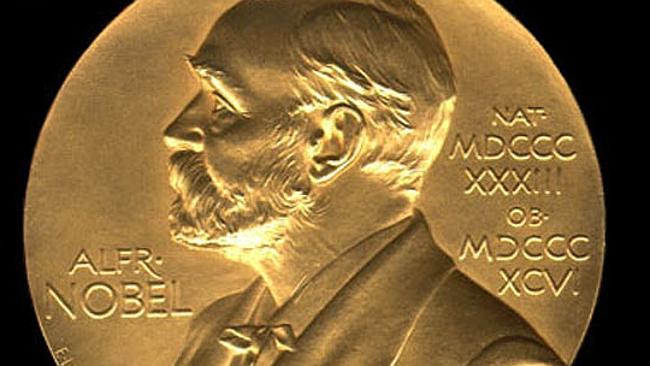
Winning a Nobel Prize has its perks. When you talk, people listen. And you end up doing a lot of talking. And travelling.
Reflecting on how the Nobel Prize changed his life, Walter Gilbert (1980 winner in Chemistry) commented, “You can find yourself spending years travelling and talking right after winning.”
And what if you want to take your Nobel Prize on the road with you? According to astrophysicist Brian Schmidt (winner of the 2011 Nobel Prize in Physics), that can present its own challenges. He recently told an audience in New York:
‘There are a couple of bizarre things that happen. One of the things you get when you win a Nobel Prize is, well, a Nobel Prize. It’s about that big, that thick [about the size of an Olympic medal], weighs a half a pound, and it’s made of gold.”
“When I won this, my grandma, who lives in Fargo, North Dakota, wanted to see it. I was coming around so I decided I’d bring my Nobel Prize. You would think that carrying around a Nobel Prize would be uneventful, and it was uneventful, until I tried to leave Fargo with it, and went through the X‑ray machine. I could see they were puzzled. It was in my laptop bag. It’s made of gold, so it absorbs all the X‑rays—it’s completely black. And they had never seen anything completely black.”
“They’re like, ‘Sir, there’s something in your bag.’
I said, ‘Yes, I think it’s this box.’
They said, ‘What’s in the box?’
I said, ‘a large gold medal,’ as one does.
So they opened it up and they said, ‘What’s it made out of?’
I said, ‘gold.’
And they’re like, ‘Uhhhh. Who gave this to you?’
‘The King of Sweden.’
‘Why did he give this to you?’
‘Because I helped discover the expansion rate of the universe was accelerating.’
At which point, they were beginning to lose their sense of humor. I explained to them it was a Nobel Prize, and their main question was, ‘Why were you in Fargo?’”
So just a word of caution to Jean Tirole, who won the Nobel Prize in Economics today, if you’re ever visiting grand-mère…
Related Content:
Read 18 Short Stories From Nobel Prize-Winning Writer Alice Munro Free Online
Jean-Paul Sartre Rejects the Nobel Prize in Literature in 1964: “It Was Monstrous!”
Hear Albert Camus Deliver His Nobel Prize Acceptance Speech (1957)
Read More...Watch the Rare Reunions of Pink Floyd: Concerts from 2005, 2010 & 2011
How many reunions will it take before we’ve finally seen the end of Pink Floyd? I’m not complaining, mind you, but marveling at how durable an outfit the band has been for their fifty-year, on again, off again history. Yet aside from the occasional charity show, they’ve mostly been off, having supposedly called it quits after 1994’s Division Bell. As the A.V. Club reminds us, “Pink Floyd has not really existed since Pulp Fiction was in theaters.” Now, after twenty years of dormancy, they’re back with a new album, The Endless River—David Gilmour and Nick Mason’s reworking of Division Bell sessions—due out November 10th (see a tracklist and hear teasers here). “It’s a shame,” Gilmour tells Rolling Stone, “but this [album] is the end.”
Yeah, we’ve heard that before. This time, it’ll probably stick. Keyboardist Richard Wright died in 2008 (the new album is a tribute to him), Gilmour and Roger Waters have had a mostly icy relationship, and drummer Nick Mason has channeled his passion, and fortune, into classic cars. But it does seem likely that they’ll take the stage again, at least for a one-off performance, as they have a handful of times throughout the years.
Today in tribute to their longevity, or their refusal to fade away, we bring you a few of those reunion shows, beginning at the top with their Live 8 reunion concert in London’s Hyde Park in 2005, a benefit organized by their old friend Bob Geldof to coincide with the G8 summit. This concert is the last time all four members would play on stage together, joined by a host of guest musicians, and they sound amazing. Gilmour ruled out any further shows after this, but then two years later, he joined Waters onstage at an event for the Hoping Foundation to benefit Palestinian children. See them play for an intimate crowd of just 200 in the video above.
While Roger Waters officially left the band in 1985 on acrimonious terms, he has continued to tour both his solo material and his Floyd music, performing a solo version of the The Wall Live to huge audiences in North America and Europe since 2010. At one of those shows, in 2011 at London’s O2 Arena, Gilmour joined him onstage—atop the wall—for “Comfortably Numb” (above), then returned with a mandolin, and Nick Mason with a tambourine, for “Outside the Wall” (below).
It seems cynical to call the remaining members’ occasional appearances together opportunistic since they generally only occur at charity events. But given how long it’s been since they’ve released anything new, we might well ask, as the title of their 2011 remaster project has it, “Why Pink Floyd?” Why new music, and why now? Since their spaced-out psychedelic debut, they’ve made increasingly thoughtful, finely-crafted albums for very patient listeners, veering into rock opera, stretching out into space opera, becoming more and more cinematic in scope. It’s those long, complex arrangements (like Wish You Were Here and 1977’s Animals), tied together by Gilmour’s soaring guitar lines and Wright’s moody keyboards, that hold up best, I think, at least for devoted fans, and that’s exactly what we can expect from The Endless River. See Gilmour and Mason discuss the new album, and hear some stunning audio samples, at the band’s website.
Related Content:
Pink Floyd Plays With Their Brand New Singer & Guitarist David Gilmour on French TV (1968)
Watch Documentaries on the Making of Pink Floyd’s Dark Side of the Moon and Wish You Were Here
Josh Jones is a writer and musician based in Durham, NC. Follow him at @jdmagness.
Read More...Quentin Tarantino Directs a 1995 Episode of ER: Brings Cinematic Virtuosity to TV
Just as no list of the most 1990s-defining filmmakers could do without Quentin Tarantino, no list of the most 1990s-defining television shows could do without ER. The long-running, award-laden medical drama made more than a few daring moves over its fifteen years, not least its choices of guest directors. Early in its very first season (which premiered a month before the release of Pulp Fiction), ER snagged Tarantino to direct the episode “Motherhood,” which aired on May 11, 1995 — three days before Mother’s Day. “The ratings for ER, which are usually through the roof, should be through the moon tonight,” wrote the Baltimore Sun’s David Zurawik, “And there is enough Tarantino to warrant a bit of a buzz. One weird scene involving a fight between female gang members as they are being wheeled into the emergency room might even be considered inspired when judged against the usual standards of doctor drama. But be warned: It’s ultra-bloody.”
That quote comes from a roundup of contemporary write-ups of the episode at Chronological Snobbery, which gets into impressive detail on the story behind, the plot of, the hype surrounding, and the Tarantinian imagery in “Motherhood,” and it also offers a brief interview with former child actor Abraham Verduzco, who “played Palmer, one of the eight Ranger Scouts with diarrhea.” Tarantino fans of the type who would frequent the Quentin Tarantino Archive will have recognized Verduzco from his earlier appearance in Robert Rodriguez’s Tarantino-featuring Desperado. “The episode boasts the usual intertwined stories of bleeding gangsters, relationship trouble, family drama, pregnancies, drug abuse and forbidden love,” says the QTA. “What makes this episode so interesting to Tarantino fans are all the QT trademarks that one can spot through the episode.” Some of these, aside from a penchant for vintage shades (“Quentin picked out the sunglasses and was adamant we wear them,” said actress Julianna Marguiles), include:
- Dr. Lewis wears a Yosemite Sam t‑shirt
- Pulp Fiction’s Angela Jones appears as Michelle
- A Beatles song (“Blackbird”) accompanies a birth
- The Ranger Scouts act like the Three Stooges, and Dr. Carter calls the constellation of the stars by the names Moe, Larry, and Curly
- A girl cuts another girl’s ear off
And a more than bit of cinematic virtuosity comes right up front in the form of the episode’s much-discussed (as recently as last week, on Metafilter) single-take opening. You can see a couple segments of the episode right here, and for the whole thing — not to mention video quality superior to that which you get above, and for which we apologize — you need only to find disc four of the ER season one DVD collection. It makes me wish 1990s television had done as much to bring auteurs into the fold at 21st-century television has; what I wouldn’t give for a Hal Hartley-directed episode of Seinfeld, say, or a Kevin Smith X‑Files.
Related Content:
My Best Friend’s Birthday, Quentin Tarantino’s 1987 Debut Film
Quentin Tarantino Explains The Art of the Music in His Films
The Power of Food in Quentin Tarantino’s Films
Colin Marshall hosts and produces Notebook on Cities and Culture and writes essays on cities, language, Asia, and men’s style. He’s at work on a book about Los Angeles, A Los Angeles Primer. Follow him on Twitter at @colinmarshall or on Facebook.
Read More...Bill Murray, the Struggling New SNL Cast Member, Apologizes for Not Being Funny (1977)
In 1977, after a few underwhelming months as the first new guy in Saturday Night Live’s then-brief history, a 26-year-old Bill Murray reached out to home viewers with the emotional equivalent of a Kickstarter campaign. The audience expected the Not Ready for Prime Time Players to be funny, and in everyday life, Murray claims above, he was. It just wasn’t coming together in front of the cameras yet.
It didn’t help that he was replacing audience favorite, Chevy Chase.
He was also an unknown quantity in the eyes of the writers. Rather than entrust their precious material to a guy who’d yet to prove himself, they saved their plum assignments for the likes of John Belushi and Dan Aykroyd.
Murray was relegated to the sort of pallid supporting roles that require no particular talent—“the second cop, the second FBI agent, the guy holding the mop…” is how he described them to Howard Stern in an interview last week. It’s a story that’s also recounted in the book, Live From New York: The Complete, Uncensored History of Saturday Night Live as Told by Its Stars, Writers, and Guests.
Back in ’77, he wisely chose not to blame the material.
Instead he curried favor with references to his late father, his hard working mom, and his nine siblings, one of whom was a nun. (Another had polio, but he left that out. Apparently, some things are sacred.)
Later in his career, he’d become celebrated for his smirking insincerity, but his direct appeal, as producer Lorne Michaels dubbed it, had none of that.
He wasn’t looking for viewers to write in on his behalf, just an assurance that they’d root for him (and his large, fatherless Catholic family) during his tenure at Rockefeller Plaza (“New York City, New York 10020”).
It’s doubtful whether a similar gambit would’ve paid off for Garrett Morris or Laraine Newman. Comedy, like life, is not fair.
Now that he’s rich and famous, he advises people who dream of similar glories to check if the first part alone won’t be sufficient to cover the bulk of their fantasies.
But we, the public, need Bill Murray to be famous, too, in order to crash our parties, and help us understand Shakespeare, and read poetry to construction workers.
Turns out he’s not the only one to reap long term medicinal benefits from those two “tablespoons of humility” he swallowed live on air, all those years ago.
Related Content:
Bill Murray Sings the Poetry of Bob Dylan: Shelter From the Storm
Bill Murray Gives a Delightful Dramatic Reading of Twain’s Huckleberry Finn (1996)
Watch Bill Murray Perform a Satirical Anti-Technology Rant (1982)
Ayun Halliday is the creator of The Mermaid’s Legs, a trauma-filled Hans Christian Andersen reboot debuting in the shadow of Rockefeller Center in less than two weeks. See it! And follow her @AyunHalliday
Read More...2nd Graders Eat at Fancy French Restaurant, Daniel; Acclaimed Director Captures Their Reactions
For its fall Food issue, The New York Times magazine took six second graders from Brooklyn to dinner at Daniel, the fancy French restaurant located on the Upper East Side of Manhattan. There, the kids each enjoyed a $220, seven-course tasting menu, which included Maine Lobster Salad, Squash Ravioli with Pork Belly, Smoked Paprika Cured Hamachi, Crispy Japanese Snapper, and Wagyu Beef Rib-Eye. Jeffrey Blitz fittingly captured the kids’ reactions. He’s the director of the Oscar-nominated documentary Spellbound, which followed eight teenagers on their quest to win the 1999 National Spelling Bee. These young kids have style, and certainly not the most finicky taste I’ve ever seen.
Follow us on Facebook, Twitter and Google Plus and share intelligent media with your friends. Or better yet, sign up for our daily email and get a daily dose of Open Culture in your inbox.
Related Content:
Foodie Alert: New York Public Library Presents an Archive of 17,000 Restaurant Menus (1851–2008)
The Right and Wrong Way to Eat Sushi: A Primer
What Prisoners Ate at Alcatraz in 1946: A Vintage Prison Menu
Michelangelo’s Handwritten 16th-Century Grocery List
Read More...Coleman Hawkins’ Landmark Recording of “Body and Soul” Turns 75 This Week
The jazz standard “Body and Soul” was first performed live in London by singer Gertrude Lawrence in 1930, and then recorded later that year by the great Louis Armstrong. But Coleman Hawkins cut the most historic version on October 11, 1939 — exactly 75 years ago today. The Missouri-born musician made the recording almost by accident, on a spur-of-the-moment-decision, and he had no inkling that he had created the first commercial hit of a pure jazz recording.
He later mused,“It’s funny how it became such a classic.” “Even the ordinary public is crazy about it. It’s the first and only record I ever heard of that all the squares dig as well as the jazz people, and I don’t understand how and why, because I was making notes all the way. I wasn’t making a melody for the squares. I thought nothing of it. I didn’t even bother to listen to it afterwards.”
For jazz historians, the song is recognized as one of the “early tremors of bebop.” That’s largely because “Hawkins hints at the song’s melody during his first six bars, but he is improvising right from the start, never actually stating the theme,” writes Kenny Berger in The Oxford Companion to Jazz.
In 2004, the Library of Congress placed Hawkin’s recording into the National Recording Registry. Above, you can listen to the landmark 1939 version and also watch Hawkins perform “Body and Soul” live in 1967 at Norman Granz’s Jazz at the Philharmonic.
A special thanks goes to Michael for flagging this anniversary for us.
Related Content:
10 Great Performances From 10 Legendary Jazz Artists: Django, Miles, Monk, Coltrane & More
Haruki Murakami’s Passion for Jazz: Discover the Novelist’s Jazz Playlist, Jazz Essay & Jazz Bar
Read More...The Empire Strikes Back Uncut: A New Fan-Made, Shot-for-Shot Remake of the 1980 Sci-Fi Classic
In 2010, devoted Star Wars fans released Star Wars Uncut, a mashup, scene-by-scene remake of the very first Star Wars movie.
Now comes The Empire Strikes Back Uncut. Here’s the gist:
With more than 480 fan-made segments culled from over 1,500 submissions, The Empire Strikes Back Uncut (also known as ESB Uncut) features a stunning mash-up of styles and filmmaking techniques, including live action, animation, and stop-motion. The project launched in 2013, with fans claiming 15-second scenes to reimagine as they saw fit – resulting in sequences created with everything from action figures to cardboard props to stunning visual effects. Helmed by Casey Pugh, who oversaw 2010’s Emmy-winning Star Wars Uncut, the new film has a wonderful homemade charm, stands as an affectionate tribute to The Empire Strikes Back, and is a testament to the talent, imagination, and dedication of Star Wars fans.
ESB Uncut was just released yestery, right in time for the weekend. Below we have some more creative takes on the Star Wars films to keep you entertained.
Related Content:
Star Wars Uncut: The Epic Fan Film
Fans Reconstruct Authentic Version of Star Wars, As It Was Shown in Theaters in 1977
Star Wars Gets Dubbed into Navajo: a Fun Way to Preserve and Teach a Fading Language
Read More...Support Us
We're hoping to rely on loyal readers, rather than erratic ads. Please click the Donate button and support Open Culture. You can use Paypal, Venmo, Patreon, even Crypto! We thank you!

About Us

Open Culture scours the web for the best educational media. We find the free courses and audio books you need, the language lessons & educational videos you want, and plenty of enlightenment in between.
Advertise With Us

FREE UPDATES!
GET OUR DAILY EMAIL
Get the best cultural and educational resources on the web curated for you in a daily email. We never spam. Unsubscribe at any time.
FOLLOW ON SOCIAL MEDIA

Open Culture editor Dan Colman scours the web for the best educational media. He finds the free courses and audio books you need, the language lessons & movies you want, and plenty of enlightenment in between.
Advertise With Us

