Watch Quentin Tarantino Fave The Street Fighter, The First Movie To Get an X‑Rating for Violence (NSFW)
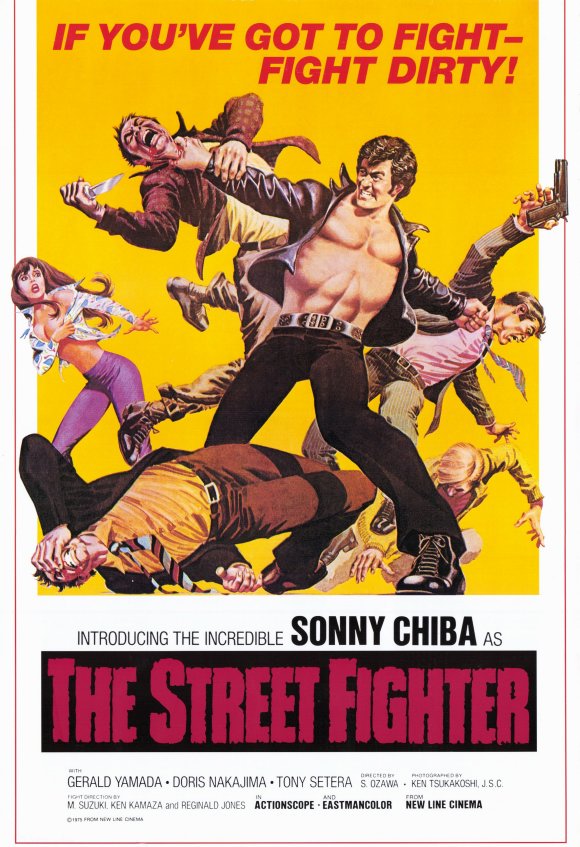
Bruce Lee died in 1973 just before the premiere of Enter the Dragon — the highest grossing movie of that year. Lee’s sudden and mysterious death left a huge void that studios scrambled to fill. Some shady Hong Kong producers started cranking out kung fu flicks starring deceptively named actors like Bruce Li, Bruce Le, Bruce Lai or, combining two ‘70s tough guys in one name, Bronson Lee. American studios started making movies like Black Belt Jones starring Enter the Dragon co-star Jim Kelly. It was in this context that American producers acquired the Japanese karate thriller Gekitotsu! Satsujin Ken starring Shinichi Chiba and renamed it The Street Fighter. The movie became notorious for earning an X‑rating solely for violence, and it turned its lead, rechristened Sonny Chiba, into a cult idol. You can watch The Street Fighter above, poorly dubbed and in the wrong aspect ratio. Just as it was probably screened at your local grindhouse theater back during the Ford administration. (The film, by the way, is in the public domain.)
The movie’s story is a typical tale of manly honor, revenge and betrayal, where men settle their differences with their fists and women — the “good” women, anyway – simper on the sidelines. Chiba plays Terry Tsurugi, a badass street thug. Sure, he might be a world-class jerk, especially after he sells one deadbeat client into prostitution, but he’s a jerk with a code of honor. Of course, you don’t watch martial arts movies – or almost any Japanese movie from the 1970s, really – for its progressive stance on gender relations. You watch them for the ass kicking. And on that front, The Street Fighter delivers. So when Tsuguri gets hired to protect the beautiful daughter of a dead oil tycoon from a nefarious band of gangsters, you know he will do just that, even if it involves throwing punches, delivering gory eye gouges and, in one memorable scene, ripping the testicles clean off of a rapist. The movie’s relentless violence and general nihilism made The Street Fighter a hit, spawning a handful of sequels – Return of the Street Fighter, Sister Street Fighter and Street Fighter’s Last Revenge. The movie also made at least one major fan: Quentin Tarantino.
Tarantino loved the movie in a way that only the reigning uber-nerd of ’70s exploitation movies could: he made references to it in his works. Clarence and Alabama watched The Street Fighter and its sequels in True Romance. Tarantino even cast Chiba as Hanzo, the ace katana maker in Kill Bill. In the run up to his 2007 double bill with Robert Rodriguez, Grindhouse, Tarantino placed The Street Fighter 13th on his list of favorite exploitation flicks, above Dario Argento’s giallo classic Suspiria but below the absolutely bonkers Master of the Flying Guillotine.
You can find The Street Fighter listed in our collection, 4,000+ Free Movies Online: Great Classics, Indies, Noir, Westerns, Documentaries & More.
Related Content:
Bruce Lee: The Lost TV Interview
Watch 10-Year-Old Bruce Lee in His First Starring Role (1950)
Bruce Lee Auditions for The Green Hornet (1964)
Jonathan Crow is a Los Angeles-based writer and filmmaker whose work has appeared in Yahoo!, The Hollywood Reporter, and other publications. You can follow him at @jonccrow. And check out his blog Veeptopus, featuring one new drawing of a vice president with an octopus on his head daily.
Read More...Robin Williams & Bobby McFerrin Sing Fun Cover of The Beatles’ “Come Together”
In 1998, legendary Beatles’ producer George Martin—all set to “hang up his earphones” and retire— brought together the most unusual assortment of people for In My Life, a tribute album composed entirely of Martin-produced Beatles’ songs performed primarily by actors and comedians. Goldie Hawn gives a “giggly nightclub chanteuse” reading of “A Hard Day’s Night,” Billy Connolly does a slightly cracked version of “Being for the Benefit of Mr. Kite,” Jim Carrey covers “I Am the Walrus” (in a musical performance surprisingly subdued next to, for example, his rendition of ”Somebody to Love”), and Sean Connery closes things out with a somber reading of “In My Life.”
But the album’s opening track is its best: Robin Williams and Bobby McFerrin’s duet of “Come Together” redeems many of the record’s weakest moments. Just above, hear the track over a fan-made slideshow of Williams highlights. Williams and McFerrin had teamed up before in the wonderfully silly video for “Don’t Worry Be Happy.” Here, with ample help from Martin’s lush production, they manage to evoke the slinky, seductive weirdness of the original song while simultaneously having a goofy old time of it. Popmatters editor Sarah Zupko, a self-confessed Beatlemaniac who otherwise found the album a supreme disappointment, calls Williams’ “leering” through the song “a hoot,” and I’m sure you’ll agree.
Just above, watch a one-hour BBC documentary on the making of In My Life. At 9:30, see Williams, Martin, and McFerrin in the hysterical recording sessions for their “Come Together” cover. Martin admits that he asked Williams to join the project “with some trepidation,” then realized that “it was with some trepidation” that Williams accepted. It was Williams who suggested “bringing along a mate,” McFerrin, whom he calls “a one-man accompaniment.” Among many other charms, the short doc features Martin throughout explaining not only the process of recording In My Life, but also his memories of the original recording sessions for these songs, clearly so dear to him and his proudest legacy. But of course, given our national period of mourning for the warm, brilliantly funny, deeply humane, and tragically sad Robin Williams, the real joy is seeing him here in much happier times, encouraging and praising the talents of others even as he shines so brightly alongside them.
Related Content:
Robin Williams (1951–2014) Performs Unknown Shakespeare Play in 1970s Standup Routine
Bobby McFerrin Shows the Power of the Pentatonic Scale
George Martin, Legendary Beatles Producer, Shows How to Mix the Perfect Song Dry Martini
Jim Carrey Sings a Pretty Damn Good Cover of The Beatles “I Am the Walrus”
Josh Jones is a writer and musician based in Durham, NC. Follow him at @jdmagness
Read More...
Tap Into Timeless Wisdom: Download 36 Free Courses in Ancient History, Literature & Philosophy

I know, it’s a dated reference now, but since I still watch the remade Battlestar Galactica series on Netflix, the mystical refrain—“All of this has happened before and will happen again”–still seems fresh to me. At any rate, it’s fresher than the clichéd “history repeats itself.” However you phrase it, the truism looks more and more like a genuine truth the more one studies ancient history, literature, and philosophy. The conflicts and concerns that feel so of the moment also occupied the minds and lives of people living hundreds, and thousands, of years ago, and whatever you make of that, it certainly helps put the present into perspective. Can we benefit from studying the wisdom, and the folly, of the ancients? To this question, I like to turn to an introductory essay C.S. Lewis penned to the work of a certain church father:
Every age has its own outlook. It is specially good at seeing certain truths and specially liable to make certain mistakes. We all, therefore, need the books that will correct the characteristic mistakes of our own period. And that means the old books. […] If we read only modern books […] where they are true they will give us truths which we half knew already. Where they are false they will aggravate the error with which we are already dangerously ill. The only palliative is to keep the clean sea breeze of the centuries blowing through our minds, and this can be done only by reading old books.
I may disagree with Lewis about many things, including that “clean sea breeze” of history, but I take to heart his point about reading the ancients to mitigate our modern biases and shine light on our blind spots. To that end, we present links to several excellent online courses on the ancients from institutions like Yale, NYU, and Stanford, free to peruse or take in full. See our master list—Free Courses in Ancient History, Literature & Philosophy—for 36 quality offerings. As always, certain courses provide more resources than others, and a few only offer their lectures through iTunes. These are decisions course administrators have made, not us! Even so, these free resources are invaluable to those wishing to acquaint, or reacquaint, themselves with the study of ancient humanities.
You can, for example, take a course on Ancient Israel from NYU’s Daniel Fleming (Free Online Video & Course Info — Free Online Video), study Plato’s Laws with the renowned Leo Strauss from the University of Chicago (Free Online Audio) or Socrates ( Free Online Audio) with that university’s equally renowned Alan Bloom. Take a course called “Ancient Wisdom and Modern Love” (Syllabus - Free iTunes Video — Free Online Video) with Notre Dame’s David O’Connor or study Virgil’s Aeneid ( Free iTunes Audio) with Susanna Braund, whose lectures were recorded at Stanford Continuing Studies. You’ll find many more ancient history, lit, and philosophy classes—36 in all, including five more Leo Strauss Plato seminars—on our meta list: Free Courses in Ancient History, Literature & Philosophy. Read, study, repeat.
Related Content:
Download 55 Free Online Literature Courses: From Dante and Milton to Kerouac and Tolkien
Learn 47 Languages Online for Free: Spanish, Chinese, English & More
Italo Calvino Offers 14 Reasons We Should Read the Classics
Josh Jones is a writer and musician based in Durham, NC. Follow him at @jdmagness
Read More...Watch the First Episode of Osamu Tezuka’s Astro Boy, Of Which Stanley Kubrick Became a Big Fan
Osamu Tezuka is one of the great creative forces of the 20th century. Known in his native Japan as the “god of manga,” Tezuka was mind-bogglingly productive, cranking out around 170,000 pages of comics in his 60 years of life. He almost single-handedly made manga respectable to read for adults, creating tales that were both universal and emotionally complex. And he worked in pretty much every genre you can imagine from horror, to girly fantasy, to an epic series about the life of the Buddha. Yet of all of Tezuka’s many volumes of comics, his best beloved work was Tetsuwan Atomu, otherwise known as Astro Boy.
In 1962, Tezuka fulfilled a childhood dream by opening an animation studio. One of his first projects was to adapt was Astro Boy. The television series premiered in 1963 and proved to be hugely popular in Japan. It wasn’t long before American TV started airing dubbed versions of the show. You can see the very first episode, “Birth of Astro Boy,” above.
After his son dies in a freak car accident, scientist Dr. Astor Boynton is driven mad by grief. He develops an insane laugh and, with it, an equally insane plan to build a robot who looks just like his dead son. After a Frankenstein-esque montage, Astro Boy is born. All seems well for the adorable, sweet-natured robot, until Boynton freaks out over Astro Boy’s lack of growth. “I’ve been a good father to you, haven’t I?” he whines. “Well then, why can’t you be a good son to me and grow up to be a normal human adult?” How’s that for a parental guilt trip?
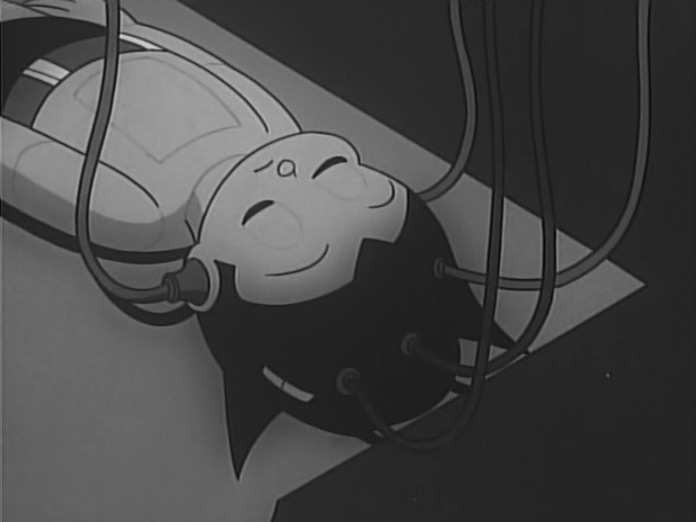
So Dr. Boynton casts Astro Boy out, selling him into slavery to The Great Cacciatore, an evil circus ringleader who forces him to be the world’s cutest robot gladiator. Fortunately, Dr. Elefun, a colleague of Dr. Boynton, takes pity on Astro Boy and works to free him from his bondage.
The whole story plays out as if Mary Shelley and Fritz Lang collaborated to make Dumbo. Tezuka throws in a lot of wacky slapstick comedy, which just barely takes the edge off the story’s Dickensian melodrama, which relentlessly mines all those primal fears you thought you got over. In short, it’s brilliant.
The series ran for two years in the States and then continued on re-runs thoughout the decade. One of the shows fans was apparently Stanley Kubrick. During the mid-60s, Kubrick sent Tezuka a letter asking if he would be interested in helping with the art direction and design of his new movie 2001: A Space Odyssey. The offer would have required that Tezuka spend a year or more in London. Though greatly flattered, Tezuka turned the offer down. The workaholic artist simply couldn’t spend that much time away from his studio. One has to wonder what Kubrick’s masterpiece would have looked like seen through the prism of Tezuka.
In 2001, Steven Spielberg premiered a movie that was a long gestating project of Kubrick’s – the wildly underrated A.I. Artificial Intelligence. The parallels between that movie, about a robot child cast out by his parents into a cruel world, and Astro Boy are striking. Kubrick, as it turns out, might have been even a bigger fan of the God of Manga than previously thought.
Here’s the trailer for A.I. Artificial Intelligence.
Related Content:
Kafka’s Nightmare Tale, ‘A Country Doctor,’ Told in Award-Winning Japanese Animation
Japanese Cartoons from the 1920s and 30s Reveal the Stylistic Roots of Anime
How to Make Instant Ramen Compliments of Japanese Animation Director Hayao Miyzaki
Jonathan Crow is a Los Angeles-based writer and filmmaker whose work has appeared in Yahoo!, The Hollywood Reporter, and other publications. You can follow him at @jonccrow. And check out his blog Veeptopus, featuring one new drawing of a vice president with an octopus on his head daily.
Read More...Read 12 Stories By Haruki Murakami Free Online
 Image by wakarimasita, via Wikimedia Commons
In her New York Times review of Haruki Murakami’s latest, Colorless Tsukuru Tazaki and His Years of Pilgrimage, Patti Smith writes that the novelist has two modes, “the surreal, intra-dimensional side” and the “more minimalist, realist side.” These two Murakamis often coexist within the same work of fiction, as the fantastic or the supernatural invades the real, or the other way around. Like one of his literary heroes, Franz Kafka, Murakami’s work doesn’t so much create alternate realities as it alters reality, with all its mundane details and humdrum daily routines. As Ted Gioia put it in a review of Murakami’s Kafka on the Shore, “this ability to capture the phantasmagorical in the thick of commuter traffic, broadband Internet connections and high-rise architecture is the distinctive calling card of Murakami”—he “mesmerizes us by working his legerdemain in places where reality would seem to be rock solid.”
In Colorless Tsukuru Tazaki Murakami works this same magic, as you can see in this excerpt published in Slate last month. Textured with granular realist details and straightforward narration, the scene slowly builds into a captivating supernatural tale that slides just as easily back into the weft and warp of waking life. In one piece of dialogue, Murakami sums up one way we might read all of his “surreal, intra-dimensional” flights: “It wasn’t an issue of whether or not he believed it. I think he totally accepted it as the weird tale it was. Like the way a snake will swallow its prey and not chew it, but instead let it slowly digest.” Given the jittery, distracted state of most modern readers in a technological landscape that pushes us to make hasty judgments and snappy, ill-considered replies, it is surprising how many of Murakami’s fans are willing to take the time. And it is no subset of cloistered devotees either, but, in Patti Smith’s words, “the alienated, the athletic, the disenchanted and the buoyant.”
Murakami finds readers across this broad spectrum for many reasons; his prose is accessible even when his narratives are baffling. (Gioia notes that “when the Japanese publisher of Kafka on the Shore set up a website allowing readers to ask questions of the author, some 8,000 were submitted.”) His perennial preoccupation with, and immersion in, the worlds of jazz, rock, and classical music, baseball, and running, draw in those who might normally avoid the Kafka-esque. But when we come to Murakami, Kafka-esque is very often what we find, as well as Salinger-esque, Vonnegut-esque, Pynchon-esque, even Philip K. Dick-esque, as well as the –esque of realist masters like Raymond Carver. Whether you’re new to Murakami or a longtime fan of his work, you’ll find all of these tendencies, and much more to love, in the four short stories we present below, all free to read at The New Yorker for a limited time (the magazine will go behind a paywall in the fall).
Take advantage of this brief reprieve and enjoy the many riches of Haruki Murakami’s fictive worlds, which so deceptively impersonate the one most of us live in that we feel right at home in his work until it jolts us out of the familiar and into a “weird tale.” Whether you believe them or not, they’re sure to stay with you awhile.
“Kah0” (July 1, 2024)
“Kino” (February 23, 2015)
“A Walk to Kobe” (August 6, 2013)
“Samsa in Love” (October 28, 2013)
“Yesterday” (June 9, 2014)
“Scheherazade” (October 13, 2014)
“Town of Cats,” translated from the Japanese by Jay Rubin (September 5, 2011)
“U.F.O. in Kushiro” (March 28, 2011; originally published March 19, 2001)
“Cream” (January 28, 2019)
“With the Beatles” (February 10, 2020)
“Confessions of a Shinagawa Monkey” (June 1, 2020)
“The Kingdom That Failed” (August 13, 2020)
And last but surely not least, we bring you “The Folklore of Our Times” from The Guardian (published August 1, 2003), one of Murakami’s involved realist coming-of-age narratives notable for the mature, almost world-weary insights he draws from the seemingly unexceptional fabric of ordinary experience.
Related Content:
Haruki Murakami’s Passion for Jazz: Discover the Novelist’s Jazz Playlist, Jazz Essay & Jazz Bar
Josh Jones is a writer and musician based in Durham, NC. Follow him at @jdmagness
Read More...Free Classics Courses
Get free Classics courses online from the world’s leading universities. For more online courses, visit our complete collection, 1,700 Free Online Courses from Top Universities.
- Ancient Greece: City and Society – Free iTunes Audio – Dr Gillian Shepherd, La Trobe University, Australia
- Ancient Greece: Myth, Art & War – Free iTunes Audio – Dr Gillian Shepherd, La Trobe University – Australia
- Ancient Greek History – Free Online Course – Donald Kagan, Yale
- Ancient Israel – Free Online Course – Daniel Fleming, NYU
- Ancient Philosophy – Free Online Audio – David Ebrey, UC Berkeley
- Epics of Rome – Free iTunes Audio – Rhiannon Evans, LaTrobe University-Australia
- Hannibal – Free Online Audio– Patrick Hunt, Stanford
- Roman Architecture – Free Online Course – Diana E. E. Kleiner, Yale
- The Ancient Greek Hero — Massive Open Online Course (MOOC) — Gregory Nagy, Harvard
- The Ancient Greeks — Massive Open Online Course (MOOC) — Wesleyan
- The Philosophy of Tragedy – Free Online Video – Prof. Michael Davis, Sarah Lawrence College
- The Roman World – Free iTunes Audio – Rhiannon Evans, La Trobe University – Australia
- Virgil’s Aeneid: Anatomy of a Classic – Free iTunes Audio – Susanna Braund, Stanford University
For a complete list of online courses, please visit our complete collection, 1,700 Free Online Courses from Top Universities.
For a list of online certificate programs, visit 200 Online Certificate & Microcredential Programs from Leading Universities & Companies, which features programs from our partners Coursera, Udacity, FutureLearn and edX.
And if you’re interested in Online Mini-Masters and Master’s Degrees programs from universities, see our collection: Online Degrees & Mini Degrees: Explore Masters, Mini Masters, Bachelors & Mini Bachelors from Top Universities.
Read More...Jim Jarmusch’s Anti-MTV Music Videos for Talking Heads, Neil Young, Tom Waits & Big Audio Dynamite
Jim Jarmusch is the anti-MTV filmmaker. Most music videos, from the dawn of MTV in 1981 on, are slick and facile, long on visual spectacle and short on things like depth or, you know, coherence. Jarmusch, who started making movies in the East Village in the 1970s when the DIY-spirit of the No Wave movement was at its zenith, made movies that were deliberately slow and spare, recalling Bertolt Brecht and Yasujiro Ozu.
“I don’t generally like music videos because they provide you images to go with the songs rather than you providing your own,” he said in an interview with Film Comment back in 1992. “You lose the beauty of music by not bringing your own mental images or recollections or associations. Music videos obliterate that.”
Yet he did direct a handful of videos. As much as he dislikes the medium, Jarmusch gets music in a way that few other directors do. It is an integral element of all Jarmusch’s work. Check out the opening to his third feature Down By Law:
He uses Tom Waits’s “Jockey Full of Bourbon” to animate those gorgeous tracking shots of New Orleans to set up the characters and evoke a mood of retro-cool. Jarmusch’s brilliant editing and camera work create new associations with the music. I can’t listen to Tom Waits’ song now without thinking of Down By Law.
The problem that Jarmusch really had with music videos, it seems, is the end purpose. The music in Down By Law serves the story. A music video serves commerce. Jarmusch admitted as much when he butted heads with Waits over making a video for “It’s All Right By Me,” which you can see above.
“I had a big fight years ago with Tom Waits,” he recalled in an interview with The Guardian. “He said: ‘Look, it’s not your film. It’s a promo for my song.’ It was after Down By Law, and it was about the editing. But he was right….I remember I locked him outside in the parking lot, and he’s hammering at the door, and he’s shouting through ‘Jim! I’m gonna glue your head to the wall!’ He didn’t glue my head to the wall. But they’re not really films of mine, they’re films for a song. I learned that a long time ago.”
Jarmusch’s first music video was “The Lady Don’t Mind” by the Talking Heads off, of their album Little Creatures. It features some lonely shots of New York City and an empty apartment that looks very reminiscent of Jarmusch’s early ‘80s works.
Here’s a music video for Neil Young’s “Dead Man” which is essentially a montage of shots from Jarmusch’s same-named 1996 masterpiece. One suspects he had less trouble with this video than the others.
Finally, over at Dangerous Minds, you can see a video that Jarmusch shot for Big Audio Dynamite’s song “Sightsee M.C.!.” BAD was, of course, the band formed by the guitarist and singer of the Clash, Mick Jones.
If you would like to support the mission of Open Culture, consider making a donation to our site. It’s hard to rely 100% on ads, and your contributions will help us continue providing the best free cultural and educational materials to learners everywhere. You can contribute through PayPal, Patreon, and Venmo (@openculture). Thanks!
Related Content:
Jim Jarmusch: The Art of the Music in His Films
Hear the Earliest Known Talking Heads Recordings (1975)
Tim Burton Shoots Two Music Videos for The Killers
Watch the Uncensored Andy Warhol-Directed Video for The Cars’ Hit “Hello Again” (NSFW)
Jonathan Crow is a Los Angeles-based writer and filmmaker whose work has appeared in Yahoo!, The Hollywood Reporter, and other publications. You can follow him at @jonccrow. And check out his blog Veeptopus, featuring one new drawing of a vice president with an octopus on his head daily.
Read More...Jorge Luis Borges, Film Critic, Reviews King Kong (1933)
Yesterday we featured Jorge Luis Borges’ review of Citizen Kane. But as a film critic, the writer of such influential short fictions as “The Aleph,” “The Garden of Forking Paths,” and “Pierre Menard, Author of the Quixote” didn’t start there, with perhaps the most influential motion picture ever produced. Flicker has more on the movies that caught Borges’ critical eye:
He was a passionate admirer of Charlie Chaplin. In a wonderful sentence that typifies his writing style, Borges writes, “Would anyone dare ignore that Charlie Chaplin is one of the established gods in the mythology of our time, a cohort of de Chirico’s motionless nightmares, of Scarface Al’s ardent machine guns, of the finite yet unlimited universe of Greta Garbo’s lofty shoulders, of the goggled eyes of Gandhi?”
Borges’ film reviews were often quite humorous. When discussing Josef von Sternberg’s version of Crime and Punishment (1935), he writes, “Indoctrinated by the populous memory of The Scarlet Empress, I was expecting a vast flood of false beards, miters, samovars, masks, surly faces, wrought-iron gates, vineyards, chess pieces, balalaikas, prominent cheekbones, and horses. In short, I was expecting the usual von Sternberg nightmare, the suffocation and the madness.”
But the film-reviewing Borges’ masterpiece of dismissal takes on King Kong, Merian C. Cooper and Ernest B. Schoedsack’s most iconic giant-ape disaster movie of them all:
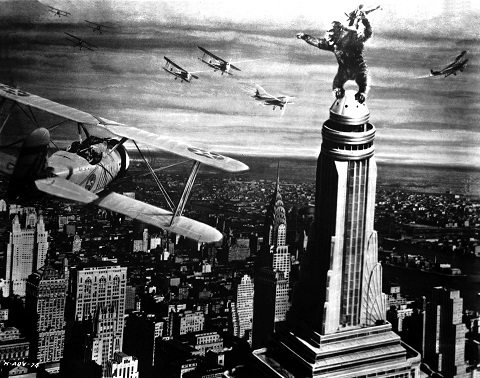
A monkey, forty feet tall (some fans say forty-five) may have obvious charms, but those charms have not convinced this viewer. King Kong is no full-blooded ape but rather a rusty, desiccated machine whose movements are downright clumsy. His only virtue, his height, did not impress the cinematographer, who persisted in photographing him from above rather than from below — the wrong angle, as it neutralizes and even diminishes the ape’s overpraised stature. He is actually hunchbacked and bowlegged, attributes that serve only to reduce him in the spectator’s eye. To keep him from looking the least bit extraordinary, they make him do battle with far more unusual monsters and have him reside in caves of false cathedral splendor, where his infamous size again loses all proportion. But what finally demolishes both the gorilla and the film is his romantic love — or lust — for Fay Wray.
As Mourdaunt Hall’s contemporary New York Times review of this “Fantastic Film in Which a Monstrous Ape Uses Automobiles for Missiles and Climbs a Skyscraper” put it, “Through multiple exposures, processed ‘shots’ and a variety of angles of camera wizardry the producers set forth an adequate story and furnish enough thrills for any devotee of such tales,” but “it is when the enormous ape, called Kong, is brought to this city that the excitement reaches its highest pitch. Imagine a 50-foot beast with a girl in one paw climbing up the outside of the Empire State Building, and after putting the girl on a ledge, clutching at airplanes, the pilots of which are pouring bullets from machine guns into the monster’s body.” That sight must have struck the (still not overly thrilled) Hall as more impressive than it did Borges, but then, Borges, that visionary of dizzying labyrinths, eternities, and infinitudes, had already seen true visions of enormousness — and enormity.
Related Content:
Jorge Luis Borges, Film Critic, Reviews Citizen Kane — and Gets a Response from Orson Welles
Jorge Luis Borges’ Favorite Short Stories (Read 7 Free Online)
Colin Marshall hosts and produces Notebook on Cities and Culture and writes essays on cities, language, Asia, and men’s style. He’s at work on a book about Los Angeles, A Los Angeles Primer. Follow him on Twitter at @colinmarshall or on Facebook.
Read More...Lauren Bacall (1924–2014) and Humphrey Bogart Pal Around During a 1956 Screen Test
“With deep sorrow, yet with great gratitude for her amazing life, we confirm the passing of Lauren Bacall.” So tweeted The Humphrey Bogart Estate today, letting cinephiles everywhere know that Hollywood lost yet another great one this week. She was 89.
Bacall, of course, met Humphrey Bogart on the set of To Have and Have Not in 1943. And they became one of Hollywood’s legendary couples, starring together in The Big Sleep (1946), Dark Passage (1947), and Key Largo (1948). Above you can watch Bogie and Bacall share some light moments together during a costume test for Melville Goodwin, USA, a film the couple never ultimately made. The footage was shot on February 20, 1956, just after Bogart learned that he had esophageal cancer. He passed away less than a year later, on January 14, 1957. May Bogie & Bacall rest in peace.
Note: The costume test, like many from the period, doesn’t have sound. As you’ll see, you hardly need sound to appreciate the scene that unfolds. Don’t miss the part where the camera zooms in.
Read More...Jorge Luis Borges Reviews Citizen Kane — and Gets a Response from Orson Welles
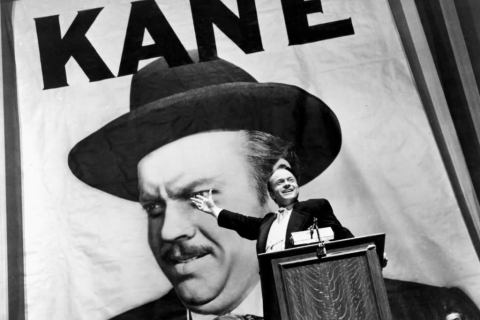
When we discover Jorge Luis Borges, we usually discover him through his short stories — or at least through his own highly distinctive uses of the short story form. Those many of us who thereupon decide to read everything the man ever wrote sooner or later find that he ventured into other realms of short text as well. Borges spent time as a poet, an essayist, and even as something of a film critic, a period of his career that will delight the sizable cinephilic segment of his readership. “I’m almost a century late to this party,” writes one such fan, Brendan Kiley at The Stranger, “but I recently stumbled into the movie reviews of Jorge Luis Borges (in his Selected Non-Fictions) and they’re fantastic: gloomy, sometimes bitchy, hilarious.” He first highlights Borges’ 1941 assessment of Citizen Kane, which Interrelevant provides in its incisive, unsparing, referential, and very brief entirety:
AN OVERWHELMING FILM
Citizen Kane (called The Citizen in Argentina) has at least two plots. The first, pointlessly banal, attempts to milk applause from dimwits: a vain millionaire collects statues, gardens, palaces, swimming pools, diamonds, cars, libraries, man and women. Like an earlier collector (whose observations are usually ascribed to the Holy Ghost), he discovers that this cornucopia of miscellany is a vanity of vanities: all is vanity. At the point of death, he yearns for one single thing in the universe, the humble sled he played with as a child!
The second plot is far superior. It links the Koheleth to the memory of another nihilist, Franz Kafka. A kind of metaphysical detective story, its subject (both psychological and allegorical) is the investigation of a man’s inner self, through the works he has wrought, the words he has spoken, the many lives he has ruined. The same technique was used by Joseph Conrad in Chance (1914) and in that beautiful film The Power and the Glory: a rhapsody of miscellaneous scenes without chronological order. Overwhelmingly, endlessly, Orson Welles shows fragments of the life of the man, Charles Foster Kane, and invites us to combine them and to reconstruct him.
Form of multiplicity and incongruity abound in the film: the first scenes record the treasures amassed by Kane; in one of the last, a poor woman, luxuriant and suffering, plays with an enormous jigsaw puzzle on the floor of a palace that is also a museum. At the end we realize that the fragments are not governed by any secret unity: the detested Charles Foster Kane is a simulacrum, a chaos of appearances. (A possible corollary, foreseen by David Hume, Ernst Mach, and our own Macedonio Fernandez: no man knows who he is, no man is anyone.) In a story by Chesterton — “The Head of Caesar,” I think — the hero observes that nothing is so frightening as a labyrinth with no center. This film is precisely that labyrinth.
We all know that a party, a palace, a great undertaking, a lunch for writers and journalists, an atmosphere of cordial and spontaneous camaraderie, are essentially horrendous. Citizen Kane is the first film to show such things with an awareness of this truth.
The production is, in general, worthy of its vast subject. The cinematography has a striking depth, and there are shots whose farthest planes (like Pre-Raphaelite paintings) are as precise and detailed as the close-ups. I venture to guess, nonetheless, that Citizen Kane will endure as a certain Griffith or Pudovkin films have “endured”—films whose historical value is undeniable but which no one cares to see again. It is too gigantic, pedantic, tedious. It is not intelligent, though it is the work of genius—in the most nocturnal and Germanic sense of that bad word.
“A kind of metaphysical detective story,” “a labyrinth with no center,” “the work of a genius” — why, if I didn’t know better, I’d think Borges here describes his own work. Welles himself didn’t go ignorant of his film’s Borgesian nature, or at least of the tendency of others to point out its Borgesian nature, not always in a positive light. “Some people called it warmed-over Borges,” Welles recalled in a conversation 42 years later with the filmmaker Henry Jaglom. Nor did he forget Borges’ own critique: “He said that it was pedantic, which is a very strange thing to say about it, and that it was a labyrinth. And that the worst thing about a labyrinth is that there’s no way out. And this is a labyrinth of a movie with no way out. Borges is half-blind. Never forget that. But you know, I could take it that he and Sartre” — who thought the film’s image “too much in love with itself” — “simply hated Kane. In their minds, they were seeing— and attacking — something else. It’s them, not my work.” Defensive though this may sound, it identifies the impulse that had the author of Labyrinths seeing all those labyrinths in the movie: to quote Anaïs Nin, a writer contemporary though not often brought into the same context with Borges, “We don’t see things as they are, we see them as we are.”
You can also read Borges’ 1933 review of King Kong here.
Related Content:
Orson Welles Explains Why Ignorance Was His Major “Gift” to Citizen Kane
Two Drawings by Jorge Luis Borges Illustrate the Author’s Obsessions
Jorge Luis Borges: “Soccer is Popular Because Stupidity is Popular”
Jorge Luis Borges’ 1967–8 Norton Lectures On Poetry (And Everything Else Literary)
Jorge Luis Borges’ Favorite Short Stories (Read 7 Free Online)
Colin Marshall hosts and produces Notebook on Cities and Culture and writes essays on cities, language, Asia, and men’s style. He’s at work on a book about Los Angeles, A Los Angeles Primer. Follow him on Twitter at @colinmarshall or on Facebook.
Read More...Support Us
We're hoping to rely on loyal readers, rather than erratic ads. Please click the Donate button and support Open Culture. You can use Paypal, Venmo, Patreon, even Crypto! We thank you!

About Us

Open Culture scours the web for the best educational media. We find the free courses and audio books you need, the language lessons & educational videos you want, and plenty of enlightenment in between.
Advertise With Us

FREE UPDATES!
GET OUR DAILY EMAIL
Get the best cultural and educational resources on the web curated for you in a daily email. We never spam. Unsubscribe at any time.
FOLLOW ON SOCIAL MEDIA

Open Culture editor Dan Colman scours the web for the best educational media. He finds the free courses and audio books you need, the language lessons & movies you want, and plenty of enlightenment in between.
Advertise With Us

