Italo Calvino Offers 14 Reasons We Should Read the Classics

Image by Marie Maye, via Wikimedia Commons
In a previous post, we brought you the voice of Italian fantasist Italo Calvino, reading from his Invisible Cities and Mr. Palomar. Both of those works, as with all of Calvino’s fiction, make oblique references to wide swaths of classical literature, but Calvino is no show-off, dropping in allusions for their own sake, nor is it really necessary to have read as widely as the author to truly appreciate his work, as in the case of certain modernist masters. Instead, Calvino’s fiction tends to cast a spell on readers, inspiring them to seek out far-flung ancient romances and strange folktales, to immerse themselves in other worlds contained within the covers of other books. Not the least bit pedantic, Calvino possesses that rare gift of the best of teachers: the ability to make Literature capital “L”—an intimidating domain for many—become wondrous and approachable all over again, as in our early years when books were magical portals to be entered, not onerous tasks to be checked off a list.
Calvino’s short essay, “Why Read the Classics?” (published in The New York Review of Books in 1986), resounds with this sense of wonder, as well as with the author’s friendly, unpretentious attitude.
He lays out his reasoning in 14 points—slightly abridged below—beginning with the frank admission that all of us feel some sense of shame for the gaps in our reading, and thus often claim to be “re-reading” when in fact we’re reading, for example, Moby Dick, Anna Karenina, or King Lear, for the first time. Calvino states plainly the nature of the case;
The reiterative prefix before the verb “read” may be a small hypocrisy on the part of people ashamed to admit they have not read a famous book. To reassure them, we need only observe that, however vast any person’s basic reading may be, there still remain an enormous number of fundamental works that he has not read.
Point one, then, goes on to argue for reading—for the first time—classic works of literature we may have only pretended to in the past. The remainder of Calvino’s case follows logically:
1) ….to read a great book for the first time in one’s maturity is an extraordinary pleasure, different from (though one cannot say greater or lesser than) the pleasure of having read it in one’s youth.
2) We use the word “classics” for those books that are treasured by those who have read and loved them; but they are treasured no less by those who have the luck to read them for the first time in the best conditions to enjoy them.
3) There should therefore be a time in adult life devoted to revisiting the most important books of our youth.
4) Every rereading of a classic is as much a voyage of discovery as the first reading.
5) Every reading of a classic is in fact a rereading.
6) A classic is a book that has never finished saying what it has to say.
7) The classics are the books that come down to us bearing upon them the traces of readings previous to ours, and bringing in their wake the traces they themselves have left on the culture or cultures they have passed through.
Calvino introduces his last 7 points with the observation that any formal literary education we receive often does more to obscure our appreciation of classic works than to enhance it. “Schools and universities,” he writes, “ought to help us to understand that no book that talks about a book says more than the book in question, but instead they do their level best to make us think the opposite.”
Part of the reason many people come to literary works with trepidation has as much to do with their perceived difficulty as with the scholarly voice of authority that speaks from on high through “critical biographies, commentaries, and interpretations” as well as “the introduction, critical apparatus, and bibliography.” Though useful tools for scholars, these can serve as means of communicating that certain professional readers will always know more than you do. Calvino recommends leaving such things aside, since they “are used as a smoke screen to hide what the text has to say.” He then concludes:
8) A classic does not necessarily teach us anything we did not know before.
9) The classics are books that we find all the more new, fresh, and unexpected upon reading, the more we thought we knew them from hearing them talked about.
10) We use the word “classic” of a book that takes the form of an equivalent to the universe, on a level with the ancient talismans.
11) Your classic author is the one you cannot feel indifferent to, who helps you to define yourself in relation to him, even in dispute with him.
12) A classic is a book that comes before other classics; but anyone who has read the others first, and then reads this one, instantly recognizes its place in the family tree.
Finally, Calvino adds two points to explain why he thinks we should read old books, when we are so constantly overwhelmed “by the avalanche of current events.” To this question he says:
13) A classic is something that tends to relegate the concerns of the moment to the status of background noise […]
14) A classic is something that persists as a background noise even when the most incompatible momentary concerns are in control of the situation.
In other words, classic literature can have the salutary effect of tempering our high sensitivity to every breaking piece of news and distracting piece of trivia, giving us the ballast of historical perspective. In our current culture, in which we live perpetually plugged into information machines that amplify every signal and every bit of noise, such a remedy seems indispensable.
via The New York Review of Books
Related Content:
Josh Jones is a writer and musician based in Durham, NC. Follow him at @jdmagness
Read More...
Patti Smith Reviews Haruki Murakami’s New Novel, Colorless Tsukuru Tazaki and His Years of Pilgrimage
Haruki Murakami’s 13th novel, Colorless Tsukuru Tazaki and His Years of Pilgrimage: A Novel, was first published last April in Japan, and, within the first month, it sold one million copies. This week, the novel (translated by Philip Gabriel) finally arrives in bookstores in the U.S. If you’re wondering where this novel will take readers, you can read an excerpt of Murakami’s novel recently published in Slate, and then Patti Smith’s book review in The New York Times. Smith, the “Godmother of Punk,” won the National Book Award for her 2010 memoir Just Kids. She knows something about writing, and she’s clearly no stranger to Murakami’s body of work. While planning to go on tour, Smith once wondered what books to take along, and wrote on her personal web site:
The worse part, besides saying goodbye to my daughter Jesse, is picking out what books to take. I decide this will be essentially a Haruki Murakami tour. So I will take several of his books including the three volume IQ84 to reread. He is a good writer to reread as he sets your mind to daydreaming while you are reading him. thus i always miss stuff.
Smith’s review of Murakami’s latest begins here. The book itself can be purchased online at Amazon, iTunes, or at your favorite bookstore.
h/t @holdengraber
Related Content:
Haruki Murakami’s Passion for Jazz: Discover the Novelist’s Jazz Playlist, Jazz Essay & Jazz Bar
Haruki Murakami Translates The Great Gatsby, the Novel That Influenced Him Most
Patti Smith’s Cover of Nirvana’s “Smells Like Teen Spirit” Strips the Song Down to its Heart
Read More...Werner Herzog’s Rogue Film School: Apply & Learn the Art of Guerilla Filmmaking & Lock-Picking

Image by Erinç Salor
No Eli Roth gorefest or low-budget video nasty, no Hubert Selby or Thomas Hardy adaptation, no Michael Hanecke gutpunch nor the bleakest noir can compare with the work of Werner Herzog when it comes to existential dread. His documentaries and absurdist tragicomedies reach into the heart of human darkness and doomed obsessive weirdness. Even his turns as an actor and producer take him into shadowy, amoral places where grim, sure death awaits. Do you, dear reader, dare follow him there?
If so, you must first brave the application for Herzog’s Rogue Film School. Lessons include “the art of lock-picking, traveling on foot, the exhilaration of being shot at unsuccessfully, the athletic side of filmmaking, the creation of one’s own shooting permits, the neutralization of bureaucracy, and guerilla filmmaking.” Have technical questions? “For this purpose,” Herzog writes in his 12-point description of Rogue, “please enroll at your local film school.” This is no beginner’s workshop; it is “about a way of life. It is about a climate, the excitement that makes film possible.” This being Herzog, “excitement” likely involves death-defying danger. Prepare for the worst.
But you who are applying for the Rogue Film School know this already. You are up for the challenge. You also know that Herzog doesn’t put himself bodily and psychologically close to—and over—the edge of civilization just for the sake of a thrill. This is art—raw, confrontational, and utterly uncompromising. And so, Rogue Film School will also “be about poetry, films, music, images, literature.” There is a required, eclectic reading list: J.A. Baker’s document of hawk life, The Peregrine, Hemingway’s The Short Happy Life of Francis Macomber & Other Stories, Virgil’s Georgics. Suggested readings include The Poetic Edda, The Conquest of New Spain by Bernal Diaz del Castillo, and—somewhat unexpectedly—The Warren Report.
And of course, there is film, “which could include your submitted films,” but will also include a required viewing list: John Huston’s The Treasure of the Sierra Madre, Elia Kazan’s Viva Zapata, Gillo Pontecorvo’s The Battle of Algiers, Satyajit Ray’s The Apu Trilogy, and Abbas Kiarostami’s Where is the Friend’s Home? (if available, he writes—watch it here)—an Iranian coming-of-age movie on BFI’s “Top fifty films for children up the age of 14” list. You will discover ways to “create illumination and an ecstasy of truth.” But do not for a moment think this will involve some middlebrow New Age brand of self-discovery. “Censorship will be enforced,” Herzog warns, “There will be no talk of shamans, of yoga classes, nutritional values, herbal teas, discovering your Boundaries, and Inner Growth.” You will probably eat meat raw from a predatory beast you’ve killed with your bare hands.
Alternately, you may have canapés and drinks at a secluded bar in the UK while Herzog chats you up about your latest project and his. So began the orientation to Rogue Film School for filmmaker and sound designer Marcelo de Oliveira, who chronicled his experience as a Herzog apprentice in a two-part write up on the Scottish Documentary Institute’s Blog. On day one, Herzog advised his pupils to “be prepared to step across the borders.” De Oliveira quotes the master saying “Film school will not teach you that we have a natural right as filmmakers to steal a camera or steal certain documents.” And though Herzog does not explicitly advocate such activities, he strongly implies they may be justified, referring to his own act of stealing a camera from the Munich Film School—the same camera with which he shot the crazed and visionary Fitzcarraldo. The theft, Herzog has said, was no crime, but “a necessity.”
Herzog is not a guru, transmitting instructions for enlightenment to cross-legged disciples. He is a catalyst, encouraging his students to “go absolutely and completely wild” for the sake of their individual vision. His film school sounds like the kind of opportunity no daring filmmaker should pass up, but should you apply and get rejected, you can still learn a thing or two from the great German director. Just watch the video above, “Werner Herzog’s Masterclass.” Herzog shared his wisdom and experience with a rapt audience at last year’s Locarno Film Festival. Among the many pieces of advice were the following, compiled by Indiewire. See their post for more essential highlights from this fascinating session.
- It’s a very dangerous thing to have a video village, a video output. Avoid it. Shut it down. Throw it into the next river. You have an actor, and people that close all staring at the monitor gives a false feeling; that ‘feel good’ feeling of security. It’s always misleading. You have to avoid it.
- I always do the slate board; I want to be the last one from the actors on one side and the technical apparatus on the other side. I’m the last one and then things roll. You don’t have to be a dictator.
- Never show anyone in a documentary, rushes. They’ll become self-conscious. Never ever do that.
- Sometimes it’s good to leave your character alone so no one can predict what is going to happen next. Sometimes these moments are very telling and moving.
- Dismiss the culture of complaint you hear everywhere.
- You should always try to find a way deep into someone.
Related Content:
Werner Herzog Picks His 5 Favorite Films
Portrait Werner Herzog: The Director’s Autobiographical Short Film from 1986
Werner Herzog Gets Shot During Interview, Doesn’t Miss a Beat
Josh Jones is a writer and musician based in Durham, NC. Follow him at @jdmagness
Read More...Klaus Nomi’s Ad for Jägermeister (Circa 1980)
 If the gender-defying German performer Klaus Nomi (above) was an acquired taste, so is Jägermeister, the hangover-defying (some say inducing) German 70-proof herbal liqueur.
Synergies aside, it’s still surprising that any company big enough to have shareholders would elect to have as bizarre a scenemaker as Nomi to endorse their product.
Apparently they knew their audience. The ad was part of a series that ran in New York magazine in the late 1970s and early 1980s. (Nomi died of AIDS in 1983. You can see his last performance here.)
The other spokespeople are unknown to me, but I wouldn’t be surprised if they all knew each other.
And pledging their allegiance to the bitter beverage may well have covered a couple months rent on an East Village walk up.
As one Tumblr wag commented: “Klaus Nomi drinking Jägermeister is like Laurie Anderson drinking Bud Light.”
If you can identify any of Nomi’s fellow Jägermeister fans, please let us know in the comments. Not every wonderful creature gets the documentary he or she deserves, but Andrew Horn’s 2004 The Nomi Song can hip you to the creature who came from outer space to save the human race. Watch it for free here.





Related Content:
Klaus Nomi: The Brilliant Performance of a Dying Man
Salvador Dalí Goes Commercial: Three Strange Television Ads
Beat Writer William S. Burroughs Spreads Counterculture Cool on Nike Sneakers, 1994
David Lynch’s Surreal Commercials
Ayun Halliday is an author, and the Chief Primatologist of the award-winning East Village Inky zine. Follow her @AyunHalliday
Read More...Finnish Musicians Play Bluegrass Versions of AC/DC, Iron Maiden & Ronnie James Dio
Europeans do weird things with American folk music. Sometimes they do horrible things, like the 1994 techno rendition of traditional country song “Cotton-Eyed Joe” by a Swedish act who called themselves “Rednex” and who dressed up like cartoonish hillbillies in a parody only slightly less offensive than their music. In the video above, we have three continents colliding for another Scandinavian appropriation of Appalachian tropes, by way of a cover of “Thunderstruck” by Aussies AC/DC. The Finnish bluegrass band Steve ‘N’ Seagulls has achieved viral notoriety with their most recent release, which features banjo, mandolin, upright bass, accordion, a drummer who plays the spoons, and an anvil. Oh, and of course a wardrobe of overalls and suspenders without shirts. And the accordion player arrives on the scene on a riding mower.
Offensive? I don’t know—where Rednex was clearly minstrelsy, this has the feel of a fond tribute to a culture whose musical traditions Steve ‘N’ Seagulls clearly adores, though their wearing of Native headdress (below) would not sit well with certain music festival organizers.
As for their take on AC/DC; I almost prefer it to the original, though one Metafilter user pointed out that being able to hear the lyrics with such clarity does confirm one’s suspicion that they’re completely inane. And lest you think Steve ‘N’ Seagulls is some one-cover-hit wonder, check out their covers of Iron Maiden’s “The Trooper” above and Dio’s “Holy Diver” below.
via Metafilter
Related Content:
A Bluegrass Version of Metallica’s Heavy Metal Hit, “Enter Sandman”
Pakistani Musicians Play Amazing Version of Dave Brubeck’s Jazz Classic, “Take Five”
Watch Jimi Hendrix’s ‘Voodoo Chile’ Performed on a Gayageum, a Traditional Korean Instrument
Josh Jones is a writer and musician based in Durham, NC. Follow him at @jdmagness
Read More...Hear Inventive Stories from Ursula LeGuin & J.G. Ballard Turned Into CBC Radio Dramas
If you read the novels and stories of Ursula K. LeGuin and J.G. Ballard, you drop yourself into invented realities both overwhelmingly alien and unsettlingly familiar. And if you heard them on the radio — That Most Intimate of All Media, so they say — wouldn’t those qualities take on a new intensity? Thanks to CBC Radio’s Vanishing Point, a science-fiction anthology series which ran from the mid-1980s to the early 90s, you can do just that and find out for yourself what it feels like to have them piped more or less directly into your mind’s eye. Fans of both LeGuin and Ballard may take exception to the straight labeling of them as “science fiction” authors, and rightly so. The former’s work belongs as much to the tradition of fantasy as to that of sci-fi, and in both modes does a lot of detailed sociological world-building; the latter’s dark psychological dimension and near-nonfictional use of the modern world always prevented easy categorization. Still, I suspect that the makers of Vanishing Point not just knew all this, but understood its appeal.
They must also have realized that neither LeGuin nor Ballard had grown famous for their adaptability. LeGuin’s The Lathe of Heaven got made twice for television, to varying opinions; opinions varied even more when her Earthsea books more recently became a Sci Fi Channel miniseries and a film from Hayao Miyazaki’s animation studio. Ballard’s novel of auto-wreck-eroticism Crash became a cult favorite in the hands of David Cronenberg, but usually his work crosses into other media in a more bizarre fashion (such as the television short of Crash we featured last year). But radio can handle pretty much anything such imaginative writers can throw at it, as you’ll hear in Vanishing Point’s six-part adaptation of LeGuin’s The Dispossessed at the top of the post, or in the Internet Archive playlist of its six adapted Ballard stories just above. History, alas, hasn’t recorded the reaction that LeGuin, always outspoken about others’ treatments of her worlds, had to these CBC dramas. When Rick McGrath of jgballard.ca sent Ballard himself CDs of all the productions in 2004, he received “a great note from him explaining he’d love to listen to them, but he has yet to buy a CD player.” And if I had to make a guess, I’d say that visionary of our alienated, fragmented technological future never got around to picking one up.
Find more sci-fi radio dramatizations in the relateds below.
Related Content:
X Minus One: More Classic 1950s Sci-Fi Radio from Asimov, Heinlein, Bradbury & Dick
Aldous Huxley Reads Dramatized Version of Brave New World
Free: Isaac Asimov’s Epic Foundation Trilogy Dramatized in Classic Audio
The Very First Film of J.G. Ballard’s Crash, Starring Ballard Himself (1971)
1,000 Free Audio Books: Download Great Books for FreeColin Marshall hosts and produces Notebook on Cities and Culture and writes essays on cities, language, Asia, and men’s style. He’s at work on a book about Los Angeles, A Los Angeles Primer. Follow him on Twitter at @colinmarshall or on Facebook.
Read More...A Serious Stephen Colbert Gives Advice on Love & Life to Teenage Girls
Rookie’s never less than worthy “Ask a Grown Man” series provides a forum for mature males like actor Jon Hamm and radio personality Ira Glass to offer thoughtful, straightforward advice and explanations, born of personal experience, to teenage girls (and other interested parties).
The most recent edition adds depth, and could just as accurately be titled “Ask a Level-Headed 50-Year-Old Father of Three, Who’s Been Happily Married to His Children’s Mother for Years.”
Lurking just beneath Stephen Colbert’s hawkish Colbert Report persona is a fair-minded, serious fellow, who’s unembarrassed to weigh in in favor of parental authority when a 19-year-old fan complains of her dad’s opposition to sleepovers at her boyfriend’s place while she’s still living at home. Perhaps she should’ve asked a grown man whom experience hadn’t equipped to see things from the other side of the fence, as Colbert foresees that his answer won’t “go over great with everyone.”
Surely, though, his late mother would approve.
Perhaps this segment should be called “Ask a Grown Man Whose Unequivocating Moral Compass Is Inconveniently Close to Your Dad’s, But Whose Position Allows Him to Offer Insights Without Losing His Temper or Going Off Message.”
Colbert’s children’s extremely low profile in the media’s line up of celebrity offspring reflects well on those charged with their upbringing. Were his 18-year-old daughter to take issue with the old man’s musings on Twitter or Snapchat, she’d have the luxury of doing so in the way of the average Rookie reader, rather than some obsessively observed nearly-grown baby bump.
As to how to tell whether a boy—or anyone—likes you, Colbert says “they want to hear your stories.”
As one viewer noted, “ask a grown-up, get grown-up answers.” Word.
Related Content:
Radiohead’s Thom Yorke Gives Teenage Girls Endearing Advice About Boys (And Much More)
Student Asks Noam Chomsky for Dating Advice
Nietzsche Dispenses Dating Advice in a Short Screwball Film, My Friend Friedrich
Ayun Halliday is an author, zine publisher, and mother of a teenage Rookie reader. Follow her @AyunHalliday
Read More...The Story of Oedipus Retold with Vegetables in Starring Roles
Sophocles and Aeschylus may be spinning in their graves. Or, who knows, they may be taking some delight in this bizarre twist on the Oedipus myth. Running 8 minutes, Jason Wishnow’s 2004 film puts vegetables in the starring roles. One of the first stop-motion films shot with a digital still camera, Oedipus took two years to make with a volunteer staff of 100. But the hard work paid off.
The film has since been screened at 70+ film festivals and was eventually acquired by the Sundance Channel. Separate videos show you the behind-the-scenes making of the film (middle), plus the storyboards used during production (bottom). This video first appeared on our site in 2011, and, stellar as it is, we’re delighted to bring it back for readers who have joined us since. Hope you enjoy.
Related Content:
The Harvard Classics: A Free, Digital Collection
Download 78 Free Online History Courses: From Ancient Greece to The Modern World
Ancient Greek classics can be found in our twin collections: 800 Free eBooks for iPad, Kindle & Other Devices and 1,000 Free Audio Books: Download Great Books for Free
Read More...
John Lennon Writes Eric Clapton an 8‑Page Letter Asking Him to Join the Plastic Ono Band for a World Tour on a Cruise Ship
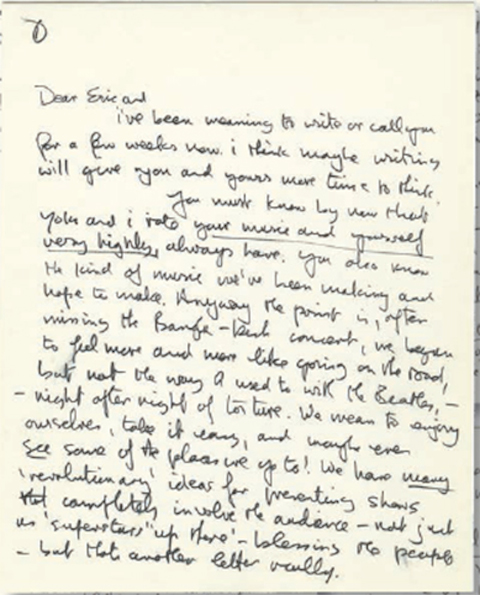
Most everyone who comments on the phenomenon of the supergroup will feel the need to point out that such bands rarely transcend the sum of their parts, and this is mostly true. But it does seem that for a certain period of time in the late sixties, many of the best bands were supergroups, or had at least two or more “super” members. Take the Yardbirds, for example, which contained, though not all at once, Jimmy Page, Jeff Beck, and Eric Clapton. Or Cream, with Clapton, Jack Bruce, and Ginger Baker. Or Blind Faith—with Clapton, Baker, and Steve Winwood…. Maybe it’s fair to say that every band Clapton played in was “super,” including, for a brief time, John Lennon and Yoko Ono’s Plastic Ono Band.
It started with the one-off performance above in Toronto, which led to an undated eight-page letter Lennon wrote Clapton, either in 1969, according to Booktryst, or 1971, according to Michael Schumacher’s Clapton bio Crossroads. The letter we have–well over a thousand words–is a draft. Lennon’s revised copy has not surfaced, and, writes Booktryst, “the content of the final version is unknown.” In this copy (first page at top), Lennon praises Clapton’s work and details his and Yoko’s plans for a “revolutionary” project quite unlike Lennon’s former band. As he puts it, “we began to feel more and more like going on the road, but not the way I used to with the Beatles—night after night of torture. We mean to enjoy ourselves, take it easy, and maybe even see some of the places we go to!”
Lennon explicitly states that he does not want the band to be a supergroup, even as he recruits super members like Clapton and Phil Spector: “We have many ‘revolutionary’ ideas for presenting shows that completely involve the audience—not just as ‘Superstars’ up there—blessing the people.” While Lennon and Ono don’t expect their recruits to “ratify everything we believe politically,” they do state their intention for “’revolutionizing’ the world thru music.” “We’d love to ‘do’ Russia, China, Hungary, Poland, etc.,” writes Lennon. Later in the missive, he explains his detailed plan for the Plastic Ono Band tour he had in mind—involving a cruise ship, film crew, and the band’s “families, children whatever”:
How about a kind of ‘Easy Rider’ at sea. I mean we get EMI or some film co., to finance a big ship with 30 people aboard (including crew)—we take 8 track recording equipment with us (mine probably) movie equipment—and we rehearse on the way over—record if we want, play anywhere we fancy—say we film from L.A. to Tahiti […] The whole trip could take 3–4‑5–6 months, depending how we all felt.
It sounds like an outlandish proposal, but if you’re John Lennon, I imagine nothing of this sort seems beyond reach—though how he expected to get to Eastern Europe from the Pacific Rim on his ship isn’t quite clear. The problem for Clapton, biographer Michael Schumacher speculates, would have had nothing to do with the music and everything to do with his addiction: “after all his problems with securing drugs in the biggest city in the United States, Clapton couldn’t begin to entertain the notion of spending lengthy periods at sea and trying to obtain heroin in foreign countries.” In any case, “in the end, Lennon’s proposal, like so many of his improbable but compelling ideas, fell through.” This may have had some relation to the fact that Lennon had a heroin problem of his own at the time.
The clip of Clapton performing with the band comes from Sweet Toronto, a 1971 film made by D.A. Pennebaker of the band’s performance at the 1969 Toronto Rock and Roll Revival Festival (see the full film above). That event had a wholly improbable lineup of ‘50s stars like Chuck Berry, Little Richard, Jerry Lee Lewis, and Bo Diddley alongside bands like Alice Cooper, Chicago, and The Doors. As the title opening of the film states, “John could at last introduce Yoko to the heroes of his childhood.” Pennebaker gives us snippets of the performance from each of Lennon’s heroes—opening with Diddley, then Lewis, Berry, and Little Richard—before the Plastic Ono Band with Clapton appear at 16:43. (This performance also produced their first album.) The Beatles Bible has a full rundown of the festival and the band’s somewhat shambolic, bluesy—and with Yoko, screechy—show.
Read the full transcript and see more scans of Lennon’s draft letter to Clapton over at Booktryst, who also explain the cryptic references to “Eric and,” “you both,” and “you and yours”—part of the “soap opera” affair involving Clapton, George Harrison’s (and later Clapton’s) wife Pattie Boyd, and her 17-year-old sister Paula.
Related Content:
In 1969 Telegram, Jimi Hendrix Invites Paul McCartney to Join a Super Group with Miles Davis
John Lennon Plays Basketball with Miles Davis and Hangs Out with Allen Ginsberg & Friends
Josh Jones is a writer and musician based in Durham, NC. Follow him at @jdmagness
Read More...
Hear Michel Foucault’s Lecture “The Culture of the Self,” Presented in English at UC Berkeley (1983)
Michel Foucault’s time in the United States in the last years of his life, particularly his time as a lecturer at UC Berkeley, proved to be extraordinarily productive in the development of his theoretical understanding of what he saw as the central question facing the contemporary West: the question of the self. In his 1983 Berkeley lectures in English on “The Culture of the Self,” Foucault stated and restated the question in a variety of ways—“What are we in our actuality?,” “What are we today?”—and his investigations amount to “an alternative to the traditional philosophical questions: What is the world? What is man? What is truth? What is knowledge? How can we know something? And so on.” So write the editors of the posthumously published 1988 essay collection Technologies of the Self, titled after a lecture Foucault delivered at the University of Vermont in 1982.
In that talk, Foucault notes that “the hermeneutics of the self has been confused with theologies of the soul—concupiscence, sin, and the fall from grace.” The technique of confession, central even to secular psychoanalysis, informs a subjectivity that, for Foucault, always develops under the ever-watchful eyes of normalizing institutions. But in “The Culture of the Self,” Foucault reaches back to ancient Greek conceptions of “care of the self” (epimelieia beautou) to locate a subjectivity derived from a different tradition—a counterpoint to religious confessional and Freudian subjectivities and one he has discussed in terms of the technique of “self writing.” (The Care of the Self also happens to be the subtitle of the third volume of Foucault’s History of Sexuality, and “The Culture of the Self” the title of its second chapter.)
The notion that one is granted selfhood through the ministrations of others comes in for ridicule in the first few minutes of his “Culture of the Self” lecture above. Foucault relates a story by second century Greek satirist Lucian to illustrate a humorous point about “those guys who nowadays regularly visit a kind of master who takes their money from them in order to teach them how to take care of themselves.” He identifies the ancient version of this dubious authority as the philosopher, but it seems that he intends in modern times to refer more broadly to psychiatrists, psychologists, and all manner of religious figures and self-help gurus.
Foucault sets up the joke to introduce his first entrée into the pursuit of “the historical ontology of ourselves,” a consideration of Kant’s essay “What is Enlightenment?” In that work, the most prominent German Enlightenment philosopher describes “man’s emergence from his self-imposed nonage,” a term he defines as “the inability to use one’s own understanding without another’s guidance.” From there, Foucault opens up his investigation to an analysis of “three sets of relations: our relations to truth, our relations to obligation, our relations to ourselves and to the others.” You’ll have to listen to the full set of lectures, above in all five parts, to follow Foucault’s inquiry through its many passages and divergences and learn how he arrives at this conclusion: “The self is not so much something hidden and therefore something to be excavated but as a correlate of the technologies of self that it co-evolves with over millennium.”
The Q&A session, above, was held on a different day and is also well worth a listen. Foucault addresses several queries about his own methodology, issues of disciplinary boundaries, and other clarifying (or not) concerns related to his main lecture. See this site for a transcript of the questions from the audiences and Foucault’s insightful, and sometimes quite funny, answers.
Related Content:
Michel Foucault and Alain Badiou Discuss “Philosophy and Psychology” on French TV (1965)
Watch a “Lost Interview” With Michel Foucault: Missing for 30 Years But Now Recovered
Download 100 Free Philosophy Courses and Start Living the Examined Life
Josh Jones is a writer and musician based in Durham, NC. Follow him at @jdmagness
Read More...Support Us
We're hoping to rely on loyal readers, rather than erratic ads. Please click the Donate button and support Open Culture. You can use Paypal, Venmo, Patreon, even Crypto! We thank you!

About Us

Open Culture scours the web for the best educational media. We find the free courses and audio books you need, the language lessons & educational videos you want, and plenty of enlightenment in between.
Advertise With Us

FREE UPDATES!
GET OUR DAILY EMAIL
Get the best cultural and educational resources on the web curated for you in a daily email. We never spam. Unsubscribe at any time.
FOLLOW ON SOCIAL MEDIA

Open Culture editor Dan Colman scours the web for the best educational media. He finds the free courses and audio books you need, the language lessons & movies you want, and plenty of enlightenment in between.
Advertise With Us


