David Lynch’s Unlikely Commercial for a Home Pregnancy Test (1997)
Visionary director David Lynch has created some of the most terrifying, surreal images in cinema, from a dancing dream dwarf in Twin Peaks to that severed ear in a field in Blue Velvet. So he might seem like an unlikely choice to direct a series of commercials for Clear Blue Easy One Minute home pregnancy tests, but that’s exactly what he did in 1997.
The moody, black and white ad shows a nervous-looking woman waiting for the results of the test. In those agonizing moments, the face of her watch reads ‘yes’ and ‘no’ instead of numbers – reflecting her anxiety.
While this commercial might seem tame for Lynch, it is thematically similar to his other work. His early masterpiece Eraserhead is a bizzaro fever dream about the abject terror of parenthood.
“The client was a little nervous that the spot would be eerie and scary,” David Cohen, executive producer of the ad, said to Entertainment Weekly’s A.J. Jacob. “But on the set, Lynch was constantly making sure the client was happy.”
In fact, Lynch has had a whole second career as a commercial director, making ads for Nissan, PlayStation and one incredibly freaky PSA about the evils of littering. He also directed a surprisingly literary series of commercials for Calvin Klein using text penned by such luminaries as F. Scott Fitzgerald and D.H. Lawrence. We’ll post something about those next week.
Jonathan Crow is a Los Angeles-based writer and filmmaker whose work has appeared in Yahoo!, The Hollywood Reporter, and other publications. You can follow him at @jonccrow.
Related Content:
David Lynch Teaches You to Cook His Quinoa Recipe in a Weird, Surrealist Video
David Lynch Lists His Favorite Films & Directors, Including Fellini, Wilder, Tati & Hitchcock
What David Lynch Can Do With a 100-Year-Old Camera and 52 Seconds of Film
Read More...Jeremy Irons Reads T.S. Eliot’s Four Quartets
In 1914, T.S. Eliot moved from his birth country, the United States, to England at the age of 25 and soon thereafter established himself as one of the most influential poets of this generation, writing some of the best known poems of the 20th century including The Love Song of J. Alfred Prufrock (1915), The Waste Land (1922) and The Hollow Men (1925).
Yet Eliot considered his Four Quartets cycle to be his finest. Published individually over the course of six years, the series consists of four poems – Burnt Norton (1936), East Coker (1940), The Dry Salvages (1941) and Little Gidding (1942) – that are profound mediations on time, the cosmos and the divine.
Eliot discussed the cycle with the Paris Review in 1959. “I’d like to feel that they get better as they go on. The second is better than the first, the third is better than the second, and the fourth is the best of all. At any rate, that’s the way I flatter myself.”
The BBC has produced an audio version of Eliot’s Four Quartets with none other than Oscar-winning actor Jeremy Irons serving as a reader. The video above is a clip of that reading, taken from Burnt Norton.
You can read along to Iron’s leonine narration:
Footfalls echo in the memory
Down the passage which we did not take
Towards the door we never opened
Into the rose-garden.
My words echo
Thus, in your mind.
But to what purpose
Disturbing the dust on a bowl of rose-leaves I do not know.
Other echoes
Inhabit the garden.
Shall we follow?
Quick, said the bird, find them, find them,
Round the corner.
Through the first gate,
Into our first world, shall we follow
The deception of the thrush?
Into our first world.
There they were, dignified, invisible,
Moving without pressure, over the dead leaves,
In the autumn heat, through the vibrant air,
And the bird called, in response to
The unheard music hidden in the shrubbery,
And the unseen eyebeam crossed, for the roses
Had the look of flowers that are looked at.
There they were as our guests, accepted and accepting.
So we moved, and they, in a formal pattern,
Along the empty alley, into the box circle,
To look down into the drained pool.
Dry the pool, dry concrete, brown edged,
And the pool was filled with water out of sunlight,
And the lotos rose, quietly, quietly,
The surface glittered out of heart of light,
And they were behind us, reflected in the pool.
Then a cloud passed, and the pool was empty.
Go, said the bird, for the leaves were full of children,
Hidden excitedly, containing laughter.
Go, go, go, said the bird: human kind
Cannot bear very much reality.
The complete cycle read by Irons is on the BBC website for a limited time. (If you want to skip the program’s lengthy introduction, start at the 7:45 marker.)
And if you want to hear the Four Quartets read by T.S. Eliot himself, check out the video below. More readings can be found in our collection of Free Audio Books.
Jonathan Crow is a Los Angeles-based writer and filmmaker whose work has appeared in Yahoo!, The Hollywood Reporter, and other publications. You can follow him at @jonccrow.
Related Content:
Listen to T.S. Eliot Recite His Late Masterpiece, the Four Quartets
Bob Dylan Reads From T.S. Eliot’s Great Modernist Poem The Waste Land
T.S. Eliot Reads The Waste Land
Read More...A List of Nelson Mandela’s Possessions Upon Leaving Prison: Surfboard, Exercise Bike & White Cardboard Hat
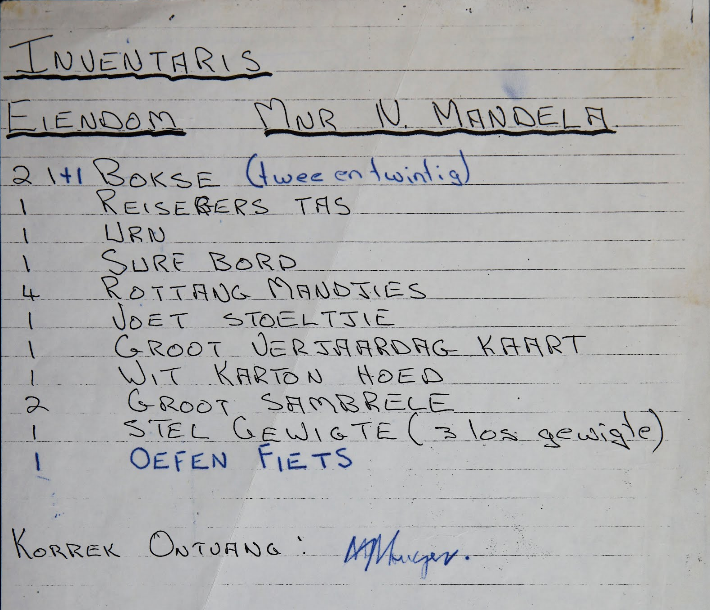
Nelson Mandela, who passed away late last year, spent more than a quarter of his life in prisons. For the first twenty years, beginning with his 1962 incarceration in Johannesburg’s Marshall Square Prison when Mandela was 44 years old, there was little hope of clemency from the apartheid regime. By the 1980s, however, international pressure was bearing down on the reigning National Party. Multinational banks stopped investing in South Africa, and several of them, alongside British PM Margaret Thatcher, demanded that Mandela be released. Internally, the country’s tensions were becoming difficult to control, and the regime attempted to enforce order by declaring a state of emergency. The crackdown resulted in further anti-government attacks by the anti-apartheid African National Congress. Eventually, the pressure proved insurmountable, and the 72 year old Mandela was released from Victor Verster prison in 1990.
Upon walking out of Victor Verster, Mandela received the personal property he had relinquished during his time in jail. Above is a photograph of the handwritten list of his personal effects. (Click the image to read it in a larger format.) Our resident Afrikaans expert (i.e., Google Translate) provides an English translation below:
Inventory
Property Mr. Mandela
21 +1 boxes
1 Reisegers* Bag
1 Urn
1 Surf Board
4 Rattan Baskets
1 footstool
1 Large Birthday Card
1 White Cardboard Hat
2 Big Umbrellas
1 Set Weights
1 Exercise Bike
Correct Ontavang:* [illegible]
Urns and rattan baskets are all well and good, but I was most impressed that the great anti-apartheid leader counted an exercise bike and a set of weights among his possessions. Don’t even get me started on the surfboard. Then again, Mandela took his fitness more seriously than most during his lifetime, as he noted in his autobiography:
“I enjoyed the discipline and solitariness of long-distance running, which allowed me to escape from the hurly-burly of school life.”
“On Monday through Thursday, I would do stationary running in my cell in the morning for up to forty-five minutes. I would also perform one hundred fingertip push-ups, two hundred sit-ups, fifty deep knee-bends, and various other calisthenics.”
“Exercise was unusual for African men of my age and generation… I know that some of my younger comrades looked at me and said to themselves, ‘if that old man can do it, why can’t I?’ They too began to exercise.”
“I attended the gym for one and a half hours each evening from Monday through Thursday… We did an hour of exercise, some combination of roadwork, skipping rope, calisthenics, or shadow boxing, followed by fifteen minutes of body work, some weight lifting, and then sparring.”
To learn more about Nelson Mandela and view other original documents, head over to the Nelson Mandela Foundation’s Digital Archives.
And if you can help us figure out what “Reisegers bag” and “Correct Ontavang” mean and write the translation in the comment section, we’d appreciate it!
Ilia Blinderman is a Montreal-based culture and science writer. Follow him at @iliablinderman.
Related Content:
Nelson Mandela’s First-Ever TV Interview (1961)
Morgan Freeman Masterfully Recites Nelson Mandela’s Favorite Poem, “Invictus”
U2 Releases a Nelson Mandela-Inspired Song, “Ordinary Love”
Read More...How Cooking Can Change Your Life: A Short Animated Film Featuring the Wisdom of Michael Pollan
Michael Pollan, the bestselling author who describes himself jokingly as a “liberal foodie intellectual,” published Food Rules in 2009, a handbook that offers “straightforward, memorable rules for eating wisely.” The one I remember best is Rule #2. “Don’t eat anything your great-grandmother wouldn’t recognize as food.” That’s because it’s likely processed and “designed to get us to buy and eat more by pushing our evolutionary buttons, our inborn preferences for sweetness and fat and salt.” A few other noteworthy suggestions and assertions include:
Rule #6: “Avoid foods that contain more than five ingredients.”
Rule #20: “It’s not food if it arrived through the window of your car.”
Rule #37: “The whiter the bread, the sooner you’ll be dead.”
Rule #17: “Eat only foods that have been cooked by humans.”
That last rule gets taken up again in How Cooking Can Change Your Life, a short animated film just released by the Royal Society of the Arts (RSA). The audio in the clip is an outtake from a longer talk that Pollan gave at RSA in London, last May. Listen to the talk in full here. Below, we’ve also posted another RSA video that takes more Food Rules by Pollan and renders them in stop motion animation. This second clip first appeared on our site back in 2012. (For a more sustained intellectual experience, see our previous post: Michael Pollan Presents an Edible Education, A Free Online Course From UC Berkeley.)
Related Content:
MIT Teaches You How to Speak Italian & Cook Italian Cuisine All at Once (Free Online Course)
Science & Cooking: Harvard Profs Meet World-Class Chefs in Unique Online Course
Read More...Albert Einstein Holding an Albert Einstein Puppet (Circa 1931)
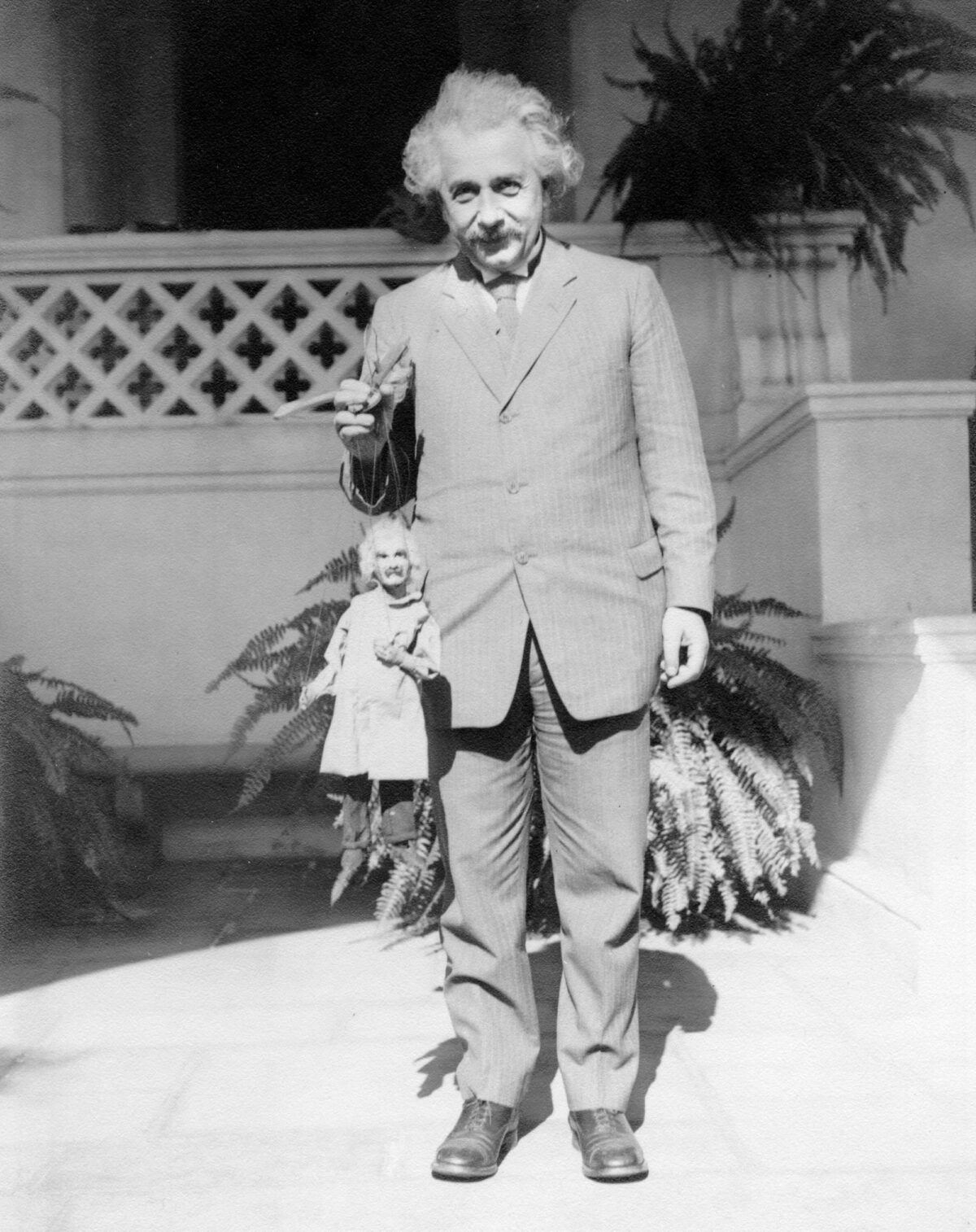
The Yale Puppeteers, consisting of Forman Brown, Harry Burnett, and Roddy Brandon, came together in the 1920s and spent almost the next seven decades touring the United States, putting on satirical performances that featured puppets in starring roles. They also staged performances at the Turnabout Theater from 1941 to 1956, turning it into a Hollywood institution.
In 1965, while speaking to the Los Angeles Times, Harry Burnett reflected on his career and recalled how the puppet troupe “entertained Charles Chaplin, Greta Garbo, Lionel Barrymore,” and even “presented a special show for Dr. Albert Einstein when he visited the street while teaching at Caltech.” That’s likely the origin of the early 1930s photo above, which features Einstein posing with an Einstein marionette. The website Retronaut provides a little more background on the photo:
Einstein saw the puppet perform at the Teatro Torito [a predecessor to the Turnabout Theater] and was quite amused. He reached into his jacket’s breast pocket, pulled out a letter and crumpled it up. Speaking in German, he said, ‘The puppet wasn’t fat enough!’ He laughed and stuffed the crumpled letter up under the smock to give the puppet a fatter belly. This is a wonderful photograph that Harry treasured. Harry Burnett also kept the letter in a frame and loved to retell the story and at the end give his pixish laugh.
The story of Burnett and his comrades was told in a 1993 documentary, Turnabout: The Story of the Yale Puppeteers. Unfortunately it’s not available online.
Related Content:
Listen as Albert Einstein Reads ‘The Common Language of Science’ (1941)
“Do Scientists Pray?”: A Young Girl Asks Albert Einstein in 1936. Einstein Then Responds.
Einstein for the Masses: Yale Presents a Primer on the Great Physicist’s Thinking
The Musical Mind of Albert Einstein: Great Physicist, Amateur Violinist and Devotee of Mozart
Free Physics Courses in our Collection of 825 Free Online Courses
Read More...Sonic Youth Guitarist Thurston Moore Teaches a Poetry Workshop at Naropa University: See His Class Notes (2011)
It’s not unusual for introspective indie songwriters to make forays into poetry. Some do it rather successfully, like Silver Jews’ Dave Berman; some, like Will Oldham, stir up the poetry world by turning against poetry. Then there are indie stars like the indefatigably youthful Thurston Moore—formerly of Sonic Youth, currently of Chelsea Light Moving—who was asked to teach at the Jack Kerouac School of Disembodied Poetics at Naropa University. Better known for his numerous ventures in the New York experimental art world, Moore led a three-day poetry workshop at the Boulder, Colorado school’s summer writing program in 2011.
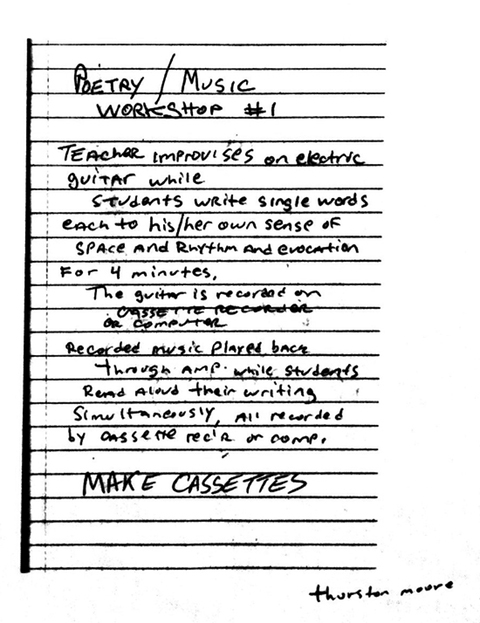
Moore was very much in demand. Anne Waldman, co-founder of Naropa’s writing program with Allen Ginsberg, said at the time, “We’ve been trying to get him for a while. We need him.” (Poetry teacher Kenneth Goldsmith recalls that the only one who wasn’t impressed with Moore was the recently departed Amiri Baraka, who said “he needs to work on those poems.”) Thanks to some very chatty students, we have detailed descriptions of Moore’s teaching style, as well as scans of his class notes. See the first page of Moore’s notes to himself for “Poetry / Music Workshop #1” at the top and a transcription of his elliptical, idiosyncratic method below:
Teacher improvises on electric
guitar while
students write single words
each to his/her own sense of
space and Rhythm and evocation
For 4 minutes
the guitar is recorded on
cassette recorder
or computer
Recorded music played back
through amp. while students
Read aloud their writing
Simultaneously, All recorded
by cassette rec’r or comp.
MAKE CASSETTES
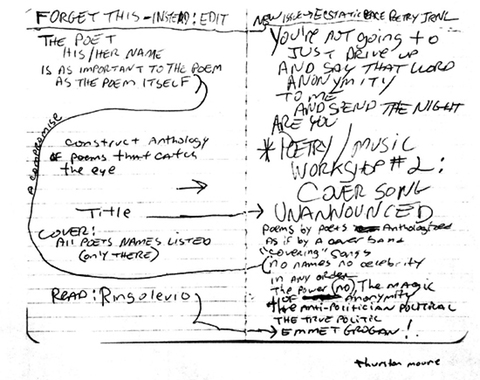
Student Katie Ingegneri, who interviewed Moore, brings us the page of text as well as the video above of Moore reading at Naropa. According to another one of Moore’s former students with the unlikely name Thorin Klosowski, the first day of the workshop consisted of a “rambling, three-hour introduction” during which Moore “revealed that when he initially moved to New York in the ’70s, it was not to make music, but rather to be a writer.” Klosowski’s piece includes additional pages of Moore’s notes, like that above, which cites countercultural hero Emmett Grogan’s autobiography, Ringolevio. Klosowski tells us that once things loosened up, Moore “did a better job of teaching than when he was pretending to be a lecturer.” The workshop also included some “gossipy tidbits”:
For instance, did you now that Kim Gordon had a texting relationship with James Franco? That Stephen Malkmus hates slam poetry? Or that even after years of being out of print, Moore’s list of ten essential free jazz records he wrote for Grand Royale was still brought into record stores (Twist & Shout and Wax Trax included)?
Moore had visited Naropa once before. In 2006 at a benefit for Burma Life and La Casa de la Esperanza, he read from his books Alabama Wildman, What I Like About Feminism, and Nice War and played some songs from Sonic Youth’s Rather Ripped. Hear the audio of that event above.
Related Content:
Fear of a Female Planet: Kim Gordon (Sonic Youth) on Why Russia and the US Need a Pussy Riot
“Expansive Poetics” by Allen Ginsberg: A Free Course from 1981
William S. Burroughs’ Short Class on Creative Reading
Josh Jones is a writer and musician based in Durham, NC. Follow him at @jdmagness
Read More...Download Over 300+ Free Art Books From the Getty Museum
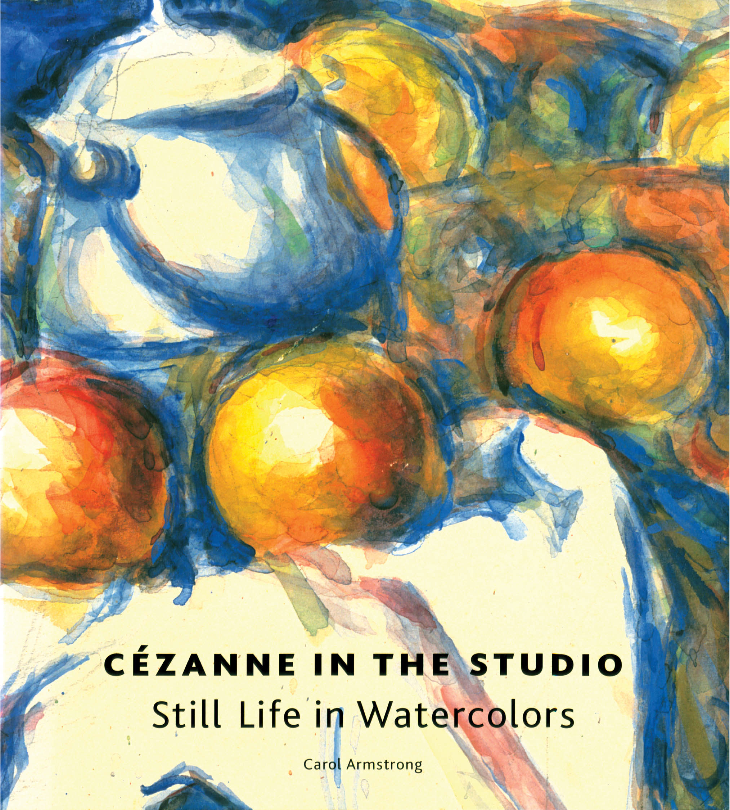
Yesterday, we wrote about the Wellcome Library’s opening up of its digital archives and making over 100,000 medical images freely available online. If you’ve already made your way through this choice selection (or if the prospect of viewing a 19th century leg amputation doesn’t quite pique your curiosity) have no fear. Getty Publications just announced the launch of its Virtual Library, where readers can freely browse and download over 250 art books from the publisher’s backlist catalogue.
The Virtual Library consists of texts associated with several Getty institutions. Readers can view extensively researched exhibition catalogues from the J. Paul Getty Museum, including Paul Cézanne’s late-life watercolours, when the painter raised the still life to a high art (Cézanne in the Studio: Still Life in Watercolors, 2004), as well as the woefully underappreciated Flemish illustrations of the 15th and 16th centuries (Illuminating the Renaissance: The Triumph of Flemish Manuscript, 2003). The collection also contains detailed treatises on art conservation from the Getty Conservation Institute, and scholarly works from the Getty Research Institute, both of which include a multitude of books on specialized topics. Fancy reading about the relationship between Peter Paul Rubens and Jan Brueghel the Elder, the two legendary 17th century painters who lived in the Netherlands’ city of Antwerp? There’s a book on that. Intrigued by all the prostitutes in French impressionism? Try Painted Love: Prostitution in French Art of the Impressionist Era (2003). Perhaps you’re partial to ancient vases, and have already read The Colors of Clay (2006), Pots & Plays (2007), and Greek Vases (1983)? Don’t worry, the Getty’s virtual library has at least 8 more vase-oriented books.
All of the Getty’s virtual library volumes are available in PDF format, and can be added to your Google Books library. If you’re looking for more free art books, don’t miss our post from last year: The Metropolitan Museum of Art and the Guggenheim Offer 474 Free Art Books Online.
Ilia Blinderman is a Montreal-based culture and science writer. Follow him at @iliablinderman.
Related Content:
The Getty Puts 4600 Art Images Into the Public Domain (and There’s More to Come)
The National Gallery Makes 25,000 Images of Artwork Freely Available Online
Read 700 Free eBooks Made Available by the University of California Press
Read More...Alice B. Toklas Reads Her Famous Recipe for Hashish Fudge (1963)
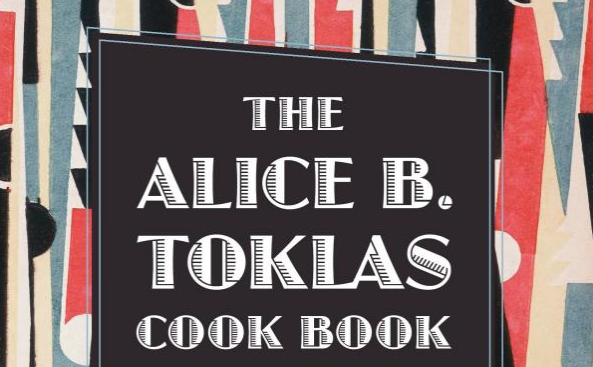
Alice Babette Toklas met Gertrude Stein in 1907, the day she arrived in Paris. They remained together for 39 years until Stein’s death in 1946. While Stein became the center of the avant-garde art world, hosting an exclusive salon that welcomed the likes of Ernest Hemingway, Pablo Picasso, James Joyce, Ezra Pound and F. Scott Fitzgerald, Toklas largely preferred to stay in Stein’s shadow, serving as her secretary, editor and assistant.
That changed in 1933 when Stein wrote The Autobiography of Alice B. Toklas (read it online) – a retelling of the couple’s life together with Toklas serving as narrator. The book is Stein’s most accessible and best-selling work. It also turned the shy, self-effacing Toklas into a literary figure.
After Stein’s death, Toklas published The Alice B. Toklas Cookbook in 1954, which combined personal recollections of her time with Stein along with recipes and musings about French cuisine. Yet it wasn’t her stories about tending to the wounded during WWI or her opinions on mussels that made the book famous. Instead, it was the inclusion of a recipe given to her by Moroccan-based artist Brion Gysin called “Hashish Fudge.”
In this 1963 recording from Pacifica Radio, Toklas reads her notorious recipe. The snack “might provide an entertaining refreshment for a Ladies’ Bridge Club or a chapter meeting of the DAR,” Toklas notes in her reedy, dignified voice. Then she gets on to the recipe itself:
Take one teaspoon black peppercorns, one whole nutmeg, four average sticks of cinnamon, one teaspoon coriander. These should all be pulverized in a mortar. About a handful each of stoned dates, dried figs, shelled almonds and peanuts: chop these and mix them together. A bunch of Cannabis sativa can be pulverized. This along with the spices should be dusted over the mixed fruit and nuts, kneaded together. About a cup of sugar dissolved in a big pat of butter. Rolled into a cake and cut into pieces or made into balls about the size of a walnut, it should be eaten with care. Two pieces are quite sufficient.
Toklas concedes that getting the key ingredient “can present certain difficulties” and recommends finding the stuff in the wild, which might have been possible to do in the early 1960s. Nowadays, the best course of action is to move to Washington, Colorado or Uruguay.
In the recording, Toklas then goes on to recall how hashish fudge came to be included into her book.
“The recipe was innocently included without my realizing that the hashish was the accented part of the recipe,” she says without a trace of facetiousness. “I was shocked to find that America wouldn’t accept it because it was too dangerous.”
“It never went into the American edition,” she says. “The English are braver. We’re not courageous about that sort of thing.”
Jonathan Crow is a Los Angeles-based writer and filmmaker whose work has appeared in Yahoo!, The Hollywood Reporter, and other publications. You can follow him at @jonccrow.
Related Content:
Find The Autobiography of Alice B. Toklas in our collection of 500 Free eBooks
Gertrude Stein Gets a Snarky Rejection Letter from Publisher (1912)
Hear Gertrude Stein Read Works Inspired by Matisse, Picasso, and T.S. Eliot (1934)
Gertrude Stein Recites ‘If I Told Him: A Completed Portrait of Picasso’
Read More...Download 100,000+ Images From The History of Medicine, All Free Courtesy of The Wellcome Library
The Wellcome Library, in London, specializes in the history of medicine. While the institution has long offered a good digital collection for browsing, the library announced yesterday that they are making more than 100,000 historical images free to download under a Creative Commons CC-BY license. (Users can distribute, edit, or remix at will; the license even allows for commercial use, with attribution.)
The Wellcome’s holdings represent the institution’s long-term interest in collecting art related to medicine, the body, public health, and medical science. The drop-down menu labeled “Technique” in the standard search box returns a staggering array of types of visual culture, from aquatint to carving to fresco to X‑ray. The library reports that the earliest image available is from 400 AD: a fragment of papyrus from an illustrated herbal manuscript, featuring a faded color drawing of a plant.
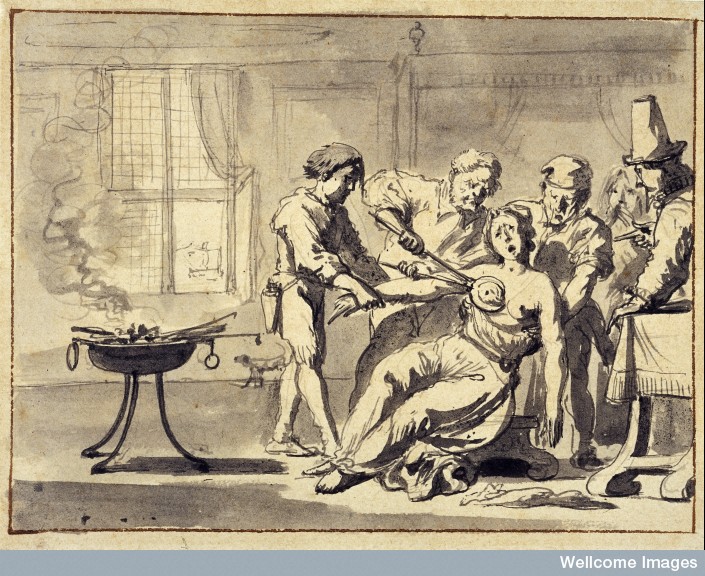
Some images in the collection are, perhaps unsurprisingly, squirm-inducing (an 1851 Japanese woodcut showing an amputation of the lower leg; a Dutch etching depicting a 17th-c mastectomy; a German illustration showing 17th-century monks performing eye surgery). But there is plenty of beauty here, as well. I loved an a 19th-c woodcut of a sumo match, and a Tibetan illustrated manuscript used in the production of medicines.
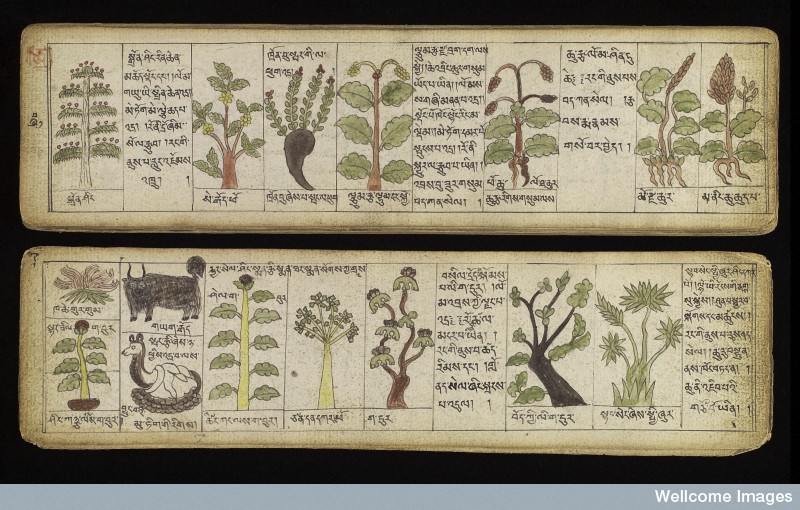
Browsers interested in dipping a toe into the stream of images may try out the galleries listed on the Images homepage. The “Olympic Sports” gallery offers an 1829 engraving of the famous conjoined twins Chang and Eng holding badminton rackets, and an 1870 illustration of recommended ring exercises for lady gymnasts. The “Witchcraft” collection (under the “Favourites” tab) contains many illustrations from historical books covering witchcraft in Europe and the American colonies, along with a more surprising 19th-century Malayan black-magic charm.
Rights-managed images are marked as such in the thumbnail results that appear after a search. Although the archive requires you to enter a CAPTCHA to access the free images, you can select several thumbnails on the search-results page in order to bulk-download files for many images at the same time. The sample files I requested arrived on my desktop at 300 dpi.
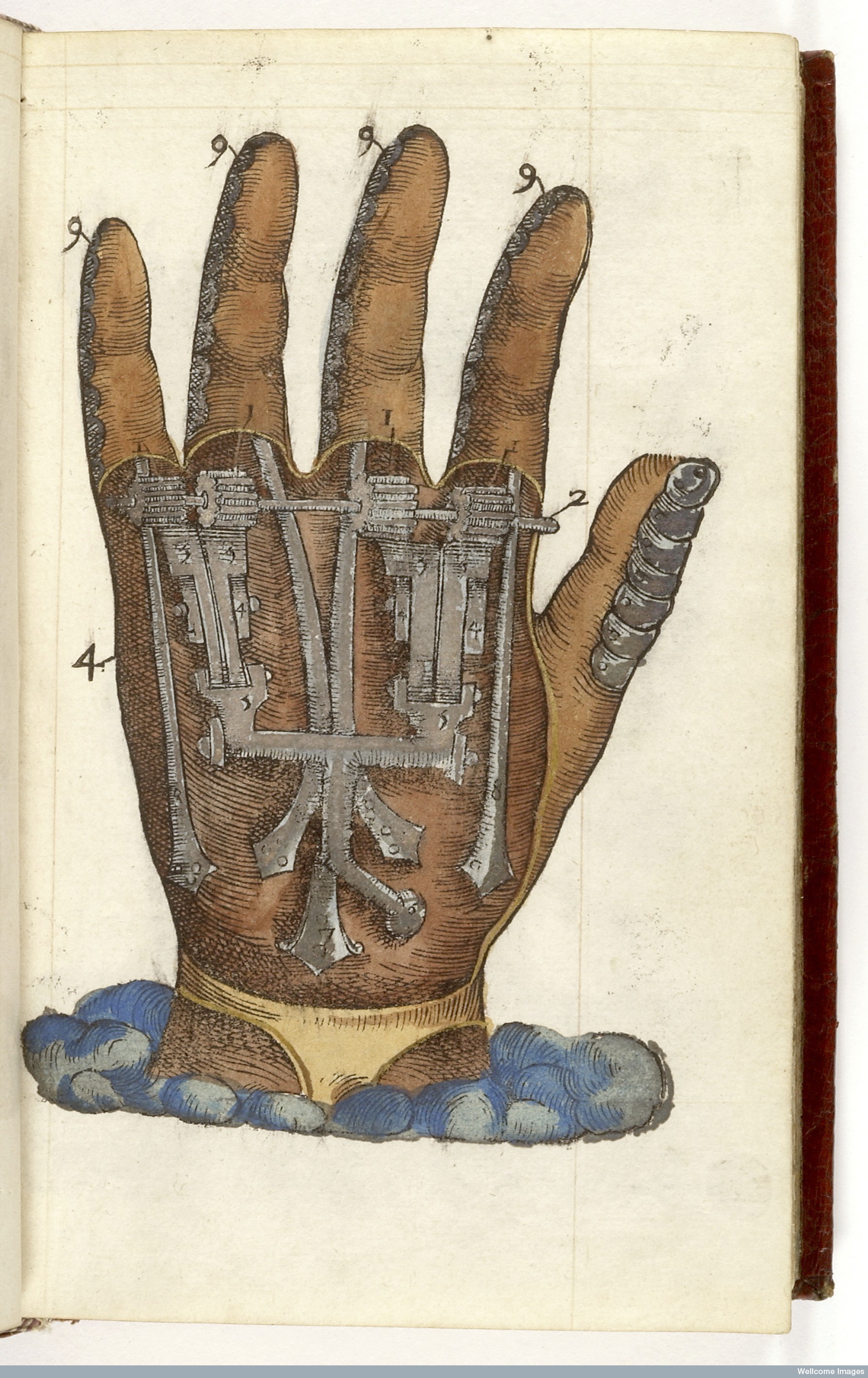
The image above is an illustration of a mechanical hand from 1564.
h/t @kirstinbutler
Rebecca Onion is a writer and academic living in Philadelphia. She runs Slate.com’s history blog, The Vault. Follow her on Twitter: @rebeccaonion.
Related Content:
The Getty Puts 4600 Art Images Into the Public Domain (and There’s More to Come)
The National Gallery Makes 25,000 Images of Artwork Freely Available Online
Read More...Google’s Music Timeline: A Visualization of 60 Years of Changing Musical Tastes

The state of music has changed radically in recent years. Of course, the largest change that springs to mind is Napster, the program that made collective musical sharing possible and triggered the inexorable decline in record sales in the early 2000s. Business model aside, however, the music industry has also weathered tremendously volatile changes in taste over the past half-century.
To see just how dramatic the changes in musical fashion have been, check out Google’s new Music Timeline, pictured above. This simple, color-coded chart displays the popularity of various genres from 1950 onwards (pre-50s sales data is just too spotty and inconsistent). While jazz record sales held the lion’s share of the market throughout much of the 1950’s, the advent of rock and pop acts such as the Beatles in the 1960s relegated jazz to the minor leagues.
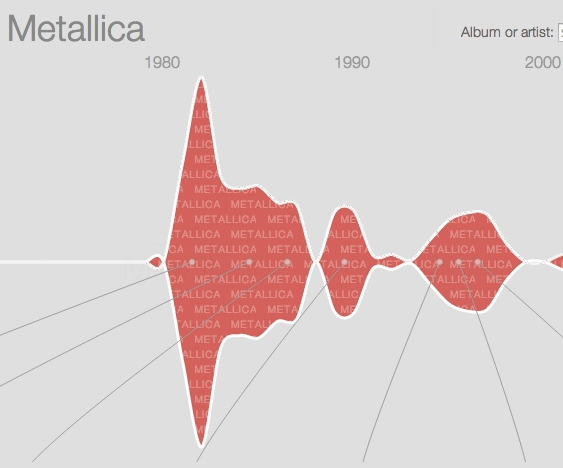
The timeline also allows you to look at the popularity of various bands throughout the course of their careers. Metallica, the litigious critics of Napster’s file-sharing ways, are an interesting example of the waxing and waning of a particular band’s success. Initial spike of popularity aside, as is clear from the image right above, the band had been relatively successful with each of their studio albums. After the release of their cover album in 1998, entitled Garage Inc., things quickly headed south. Whether it’s because of the Napster debacle of 2000, when the band’s lawsuit effectively shut down the company, or a regrettable change of direction, many former fans simply weren’t interested anymore.
Before fans come to the defense of whichever bands were slighted by Google’s visualization, a few caveats: the data used to judge relative success is derived from Google Play user libraries. The more users have an album, the more successful it’s deemed by the algorithm. Additionally, if you’re a classical music fan, you’re out of luck. For various logistical reasons, Google decided against its inclusion in the timeline.
For more information about Google’s Music Timeline, click here. For a Michael Hann’s first look review over at The Guardian’s music blog, which discusses the possible skews in the data, head this way.
Ilia Blinderman is a Montreal-based culture and science writer. Follow him at @iliablinderman.
Related Content:
The History of Music Told in Seven Rapidly Illustrated Minutes
100 Years of Rock in Less Than a Minute: From Gospel to Grunge
The Story of the Bass: New Video Gives Us 500 Years of Music History in 8 Minutes
Read More...Support Us
We're hoping to rely on loyal readers, rather than erratic ads. Please click the Donate button and support Open Culture. You can use Paypal, Venmo, Patreon, even Crypto! We thank you!

About Us

Open Culture scours the web for the best educational media. We find the free courses and audio books you need, the language lessons & educational videos you want, and plenty of enlightenment in between.
Advertise With Us

FREE UPDATES!
GET OUR DAILY EMAIL
Get the best cultural and educational resources on the web curated for you in a daily email. We never spam. Unsubscribe at any time.
FOLLOW ON SOCIAL MEDIA

Open Culture editor Dan Colman scours the web for the best educational media. He finds the free courses and audio books you need, the language lessons & movies you want, and plenty of enlightenment in between.
Advertise With Us

