Watch Bill Gates Lose a Chess Match in 79 Seconds to the New World Chess Champion Magnus Carlsen
Last November Magnus Carlsen, then only 22 years old, became the Chess World Champion when he soundly defeated Viswanathan Anand in a best-of-12 series match held in Chennai, India. Carlsen won three games, tied ten, and lost none. Only the second chess champion from the West since World War II (and the first since the “eccentric genius” Bobby Fischer), Carlsen suddenly found himself a celebrity of sorts, getting airtime on TV shows. Appearing on the Scandinavian talk show, Skavlan, a few days ago, Carlsen delighted viewers when he played a game of speed chess against Bill Gates, the wunderkind of a previous generation, who co-founded Microsoft when he was only 20 years old. So how did Gates hold up? Well, let’s just say that, true to its name, it was a game of speed chess. Gates lost speedily — in 79 seconds and just nine moves.
Not that he needs it, Bill got a little consolation yesterday when it was announced that he and Melinda will be the commencement speakers at Stanford’s graduation this coming June.
Related Content:
A Famous Chess Match from 1910 Reenacted with Claymation
Chess Rivals Bobby Fischer and Boris Spassky Meet in the ‘Match of the Century’
Boris Karloff and Bela Lugosi Square Off in a Monstrous Game of Chess (1934)
Read More...Watch the Complete, Crowdsourced Concert Film of Neil Young’s Great Carnegie Hall Show (1/7/14)
On January 7th, Neil Young played an acoustic solo concert at Carnegie Hall and treated the audience to what Rolling Stone calls, “an absolutely jaw-dropping two hour and 20-minute show that focused largely on his golden period of 1966 to 1978.” “It was, without a doubt, one of the greatest Neil Young shows of the past decade, at least when he wasn’t playing with Crazy Horse.” Above, we have a crowdsourced concert film of that entire glorious show. It was stitched together and uploaded to Youtube by Reelife Documentary Productions. Find the 23-song setlist here.
via @SteveSilberman
Related Content:
See Neil Young Perform Classic Songs in 1971 BBC Concert: “Old Man,” “Heart of Gold” & More
Great Story: How Neil Young Introduced His Classic 1972 Album Harvest to Graham Nash
‘The Needle and the Damage Done’: Neil Young Plays Two Songs on The Johnny Cash Show, 1971
Neil Young Busking in Glasgow, 1976: The Story Behind the Footage
Read More...Lewis Carroll’s 8 Still-Relevant Rules For Letter-Writing
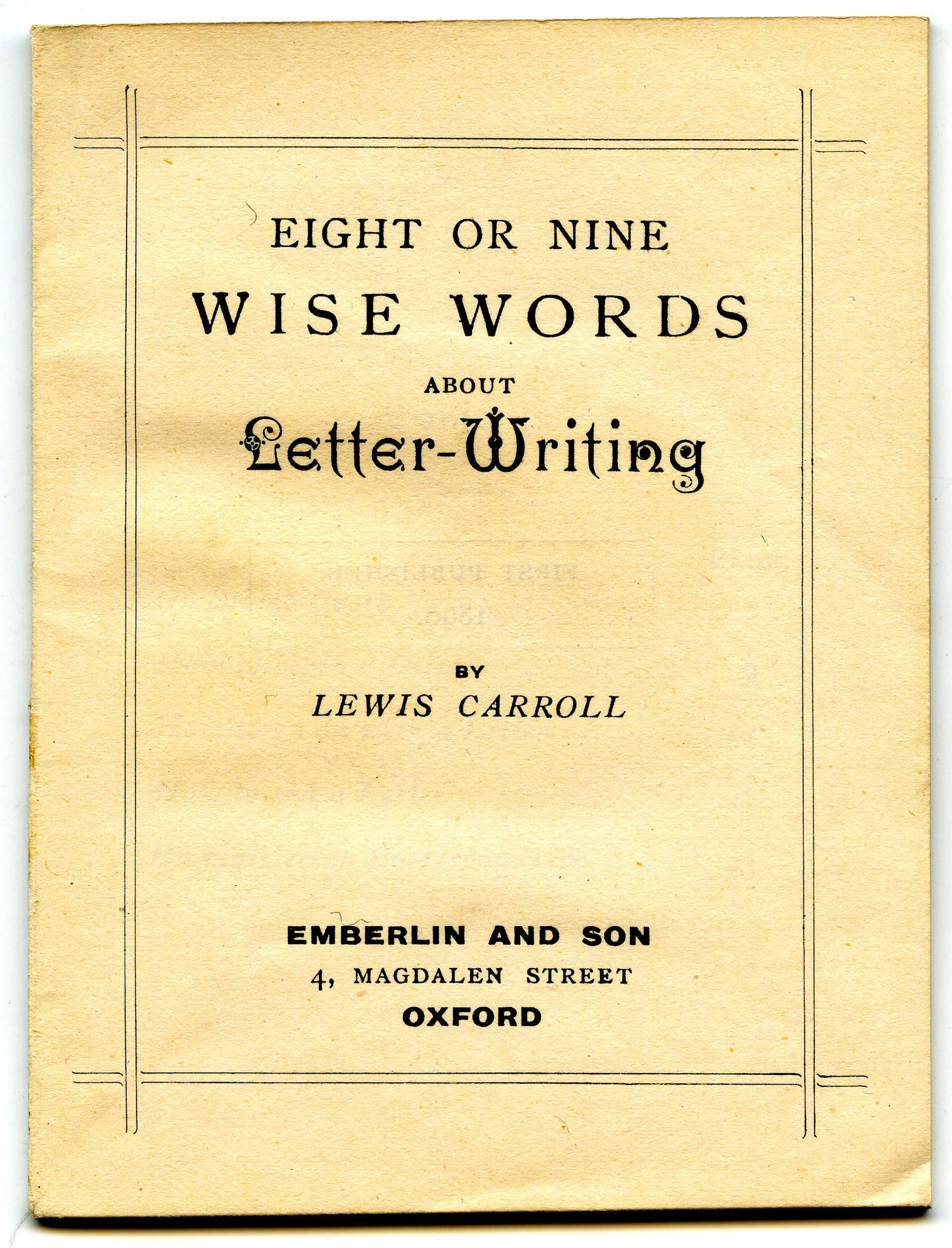
My graduate school supervisor taught me all I know about professional email etiquette. Vague language? Poor form. Typos? Nothing worse. Run-on paragraphs? A big no-no. Spelling your recipient’s name wrong? No coming back from that one. Unfortunately, hastily composed emails and ambiguous phrasing are all too common, particularly with the high volume of emails many people send daily. Skimping on the courtesy and the proofreading, however, is likely to cost you points with your recipient. Thankfully, we’ve provided a list of correspondence best practices, compiled by an authority on letters: Lewis Carroll (who, incidentally, would have celebrated his 182nd birthday today). In 1890, Carroll began to sell a Wonderland Stamp Case, which helped its users to organize their various postage stamps. Paired with the case was a short essay, entitled “Eight Or Nine Wise Words About Letter-Writing.”
The initial guide, of course, refers to pen and paper correspondence. In fact, Carroll’s foremost precept, which instructs one to write legibly, is no longer a concern in the digital age. Nevertheless, the remaining eight rules provide a clear and simple crib sheet for letter-writing that has stood the test of time remarkably well:
1) Start by addressing any questions the receiver previously had - “Don’t fill more than a page and a half with apologies for not having written sooner!
The best subject, to begin with, is your friend’s last letter. Write with the letter open before you. Answer his questions, and make any remarks his letter suggests. Then go on to what you want to say yourself. This arrangement is more courteous, and pleasanter for the reader, than to fill the letter with your own invaluable remarks, and then hastily answer your friend’s questions in a postscript. Your friend is much more likely to enjoy your wit, after his own anxiety for information has been satisfied.”
2) Don’t repeat yourself - “When once you have said your say, fully and clearly, on a certain point, and have failed to convince your friend, drop that subject: to repeat your arguments, all over again, will simply lead to his doing the same…”
3) Write with a level head — “When you have written a letter that you feel may possibly irritate your friend, however necessary you may have felt it to so express yourself, put it aside till the next day. Then read it over again, and fancy it addressed to yourself. This will often lead to your writing it all over again, taking out a lot of the vinegar and pepper, and putting in honey instead, and thus making a much more palatable dish of it!”
4) When in doubt, err on the side of courtesy - “If your friend makes a severe remark, either leave it unnoticed, or make your reply distinctly less severe: and if he makes a friendly remark, tending towards ‘making up’ the little difference that has arisen between you, let your reply be distinctly more friendly. If, in picking a quarrel, each party declined to go more than three-eighths of the way, and if, in making friends, each was ready to go five-eighths of the way—why, there would be more reconciliations than quarrels! Which is like the Irishman’s remonstrance to his gad-about daughter—‘Shure, you’re always goin’ out! You go out three times, for wanst that you come in!’ ”
5) Don’t try to have the last word — “How many a controversy would be nipped in the bud, if each was anxious to let the other have the last word! Never mind how telling a rejoinder you leave unuttered: never mind your friend’s supposing that you are silent from lack of anything to say: let the thing drop, as soon as it is possible without discourtesy: remember ‘speech is silvern, but silence is golden’! (N.B.—If you are a gentleman, and your friend a lady, this Rule is superfluous: you won’t get the last word!)”
6) Humor is hard to translate to writing. Be obvious. - “If it should ever occur to you to write, jestingly, in dispraise of your friend, be sure you exaggerate enough to make the jesting obvious: a word spoken in jest, but taken as earnest, may lead to very serious consequences. I have known it to lead to the breaking-off of a friendship. Suppose, for instance, you wish to remind your friend of a sovereign you have lent him, which he has forgotten to repay—you might quite mean the words “I mention it, as you seem to have a conveniently bad memory for debts”, in jest: yet there would be nothing to wonder at if he took offence at that way of putting it. But, suppose you wrote “Long observation of your career, as a pickpocket and a burglar, has convinced me that my one lingering hope, for recovering that sovereign I lent you, is to say ‘Pay up, or I’ll summons yer!’” he would indeed be a matter-of-fact friend if he took that as seriously meant!”
7) Don’t forget that attachment! — “When you say, in your letter, “I enclose cheque for £5”, or “I enclose John’s letter for you to see”, leave off writing for a moment—go and get the document referred to—and put it into the envelope. Otherwise, you are pretty certain to find it lying about, after the Post has gone!”
8) Using a postscript? Make it short — “A Postscript is a very useful invention: but it is not meant (as so many ladies suppose) to contain the real gist of the letter: it serves rather to throw into the shade any little matter we do not wish to make a fuss about.”
Casual Victorian-era “silly women!” sexism aside, Carroll’s tips are surprisingly fresh and applicable. If you’re planning on engaging in some serious snail-mail correspondence, we suggest you check out Carroll’s complete essay over at Project Gutenberg.
Ilia Blinderman is a Montreal-based culture and science writer. Follow him at @iliablinderman.
Related Content:
See Salvador Dali’s Illustrations for the 1969 Edition of Alice’s Adventures in Wonderland
The Real Alice in Wonderland Circa 1862
Read More...
“Exceptional, Spooky and Beautiful” Moments With Birds: Dennis Hlynsky’s Creepy Nature Videos
If, by some stretch of the imagination, the end timers have it right, I hope artist Dennis Hlynsky will consider setting up his tripod as demons spew forth from the earth’s crust.
His small brains en masse project has me convinced that he is the perfect person to capture such an event. Have a look at how he documents the comings and goings of birds.
I’ve never experienced a starling murmuration myself, outside of the famous, shot-on-the-fly footage (right above) of Sophie Windsor Clive and Liberty Smith, indie filmmakers who chanced to find themselves in the right canoe at the right time, ornithologically speaking. I admire these young women’s sang-froid. I would’ve been cowering and slashing at the air with my paddles. That funnel cloud of black wings is unnerving even from the safe remove of my living room, but a groovy soundtrack by Nomad Soul Collective encourages even the most bird-phobic amongst us (me) to see it as something gorgeous and awe-inspiring, too.
Hlynsky doesn’t attempt to lead the witness with reassuring sound cues. Instead, he amps up the creepy via “extruded time,” layering sequences of frames atop one another until the darkest pixels become tracers emphasizing flight paths. The combination of everyday sound and visual portent makes it dreadfully easy to imagine one’s truck breaking down at an intersection right around the 7 minute mark.
Perhaps I’ve seen too many zombie movies.
Or have I?
Hlynsky is obviously fascinated by nature, but he also states that “to some degree these videos are studies of mob behavior. Are these decisions instinctual or small thoughtful considerations? Does one leader guide the group or is there a common brain? Is a virus a single creature or a diffused body that we inhabit?”
Put another way, perhaps there’s a reason it’s called a murder of crows, as opposed to a brunch, hug or sweatshirt of crows. Hlynsky, who’s the type of guy to seek their company out, describes his time spent filming them to be among the most “exceptional, spooky and beautiful” moments of his life.
As for these New Jersey seagulls, “throw a french fry in the air and within 30 seconds the entire screech of birds will come.” Yikes. Here, extruded time conspires with the ambient sounds of a boardwalk amusement park, in a tour-de-force of avian-inspired psychic unrest.
Paging Tippi Hedren… I’m out of here!
Related Content:
The Falcon and the Murmuration: Nature’s Aerial Battle Above Rome
ParaHawking in Nepal: What It’s Really Like to Fly with Birds
Ayun Halliday wishes she had a cat instead of a mean, orange-striped owl. Follow her @AyunHalliday
Read More...Where to Find Free Art Images & Books from Great Museums, and Free Books from University Presses
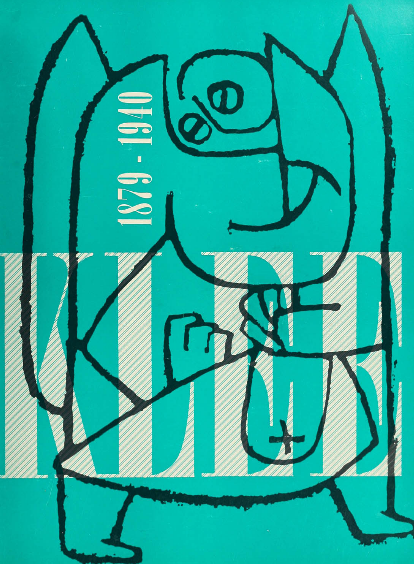
In recent years, many great art museums have decided to open up their collections, putting online huge troves of images that showcase the masterpieces hanging on their walls. They’ve also made available free art catalogues and books, letting you learn all about important artists and styles of painting. Now, university presses and libraries are starting to follow suit, giving readers free access to books from their archives. We’ve tried to keep you posted on these cultural developments here on Open Culture. But you’ve likely missed a great resource or two. To make sure you stay up to speed, we offer a roundup below:
Art Books
- Download 395 Art Catalogs from The Metropolitan Museum of Art
- Free: The Guggenheim Puts 99 Modern Art Books Online
- Download Over 250 Free Art Books From the Getty Museum
Art Images
- The British Library Puts 1,000,000 Images into the Public Domain, Making Them Free to Reuse & Remix
- 40,000 Artworks from 250 Museums, Now Viewable for Free at Google Art Project
- The Rijksmuseum Puts 125,000 Dutch Masterpieces Online, and Lets You Remix Its Art
- The National Gallery Makes 25,000 Images of Artwork Freely Available Online
- LA County Museum Makes 20,000 Artistic Images Available for Free Download
- The Getty Puts 4600 Art Images Into the Public Domain
- New Robert Rauschenberg Digital Collection Lets You Download Free High-Res Images of the Artist’s Work
- Download 100,000+ Images From The History of Medicine, All Free Courtesy of The Wellcome Library
University Presses
- Read 700 Free eBooks Made Available by the University of California Press
- A New Free eBook Every Month from the University of Chicago Press
If we’re missing any great collection, please let us know in the comments section below. We’re always love to discover a new storehouse of free knowledge. And we’ll make sure that readers learn about them.
Related Content:
825 Free Online Courses from Top Universities
500 Free eBooks: Download to Kindle, iPad/iPhone & Nook
550 Free Audio Books: Download Great Books for Free
Learn 46 Languages Online for Free: Spanish, Chinese, English & More
625 Free Movies Online: Great Classics, Indies, Noir, Westerns, etc.
Read More...A New Free eBook Every Month from the University of Chicago Press
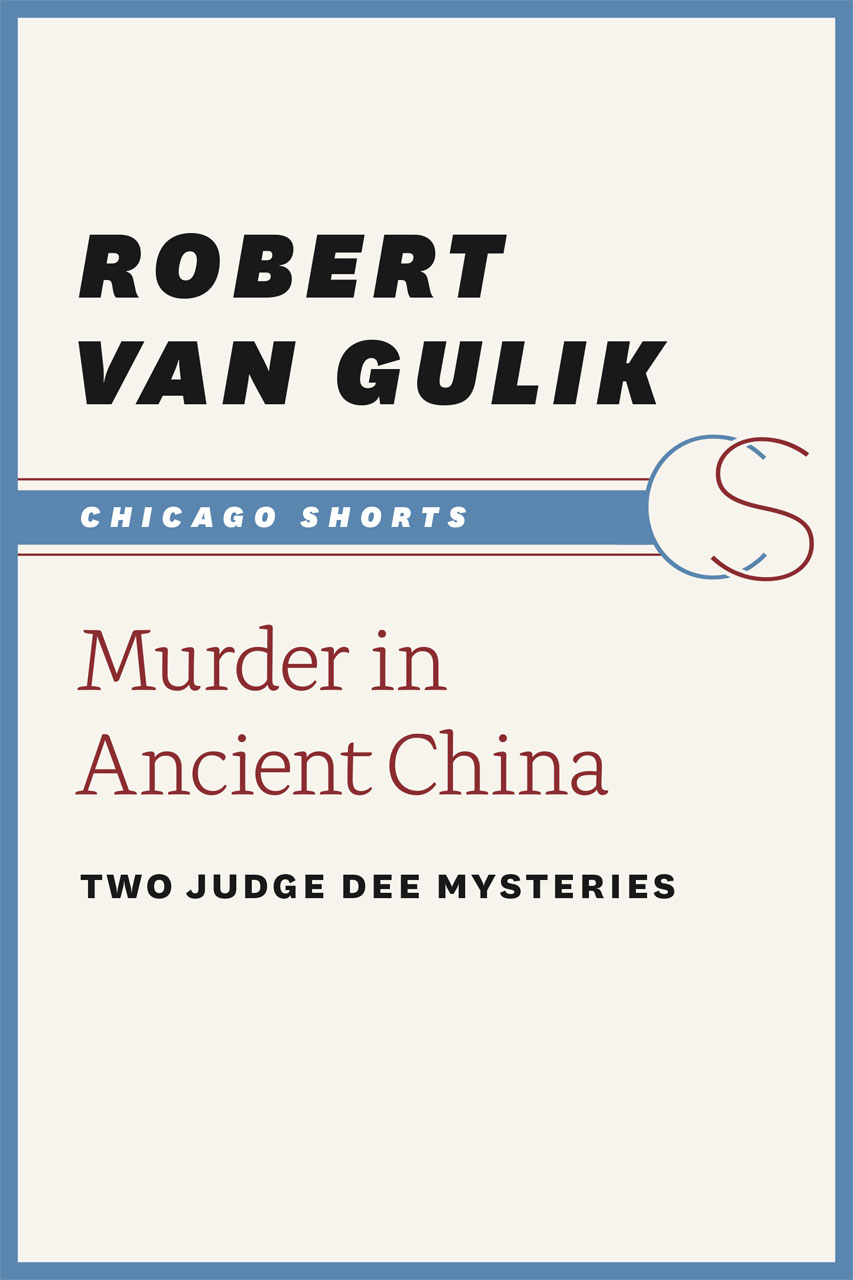
Here’s a little tip. Every month the University of Chicago Press lets you download a free ebook. If you go to this page, you can put your name on an email list and they’ll let you know when a new book is available. The current free book (for January 2014) is Murder in Ancient China by Robert Van Gulik. According to the press, the book is “available on our website DRM-free in your choice of an EPUB file (for most e‑reading devices, phones, and computers), as well as in a PRC file (for the Kindle). Or, you can get Murder in Ancient China free thoughout January at leading e‑book retailers, including in the Amazon Kindle store, at Apple iBooks, and at GooglePlay.”
Related Content:
Read 700 Free eBooks Made Available by the University of California Press
500 Free eBooks: Download to Kindle, iPad/iPhone & Nook
Read More...Build a DIY Rubberband Guitar and Celebrate New York’s Styrofoam Ban
In one of its final acts of 2013, the New York City Council got with the times, passing a ban on polystyrene foam food containers and non-biodegradable packing peanuts.
The widely hailed reform isn’t slated to go into effect for another year, ostensibly to give the container industry a chance to squeeze into its environmentalist suit. (Good luck with that.)
The delay also affords those of us who live here ample time to stockpile the offending substance for future homemade musical instruments.
If you’re fretting over a relative lack of instrument building experience, relax.Three minutes is more than enough time for John Bertles, composer, arts educator and founder of Bash the Trash, to show you how you can make beautiful music from (mostly) scavenged materials. (Entirely scavenged, should you luck into a supply of giant rubber bands. I presume you have access to the more advanced version’s paper clips and leftover chopsticks. That alone justifies your soon-to-be Styro-free Panda Express delivery habit.)
If you’ve been building rubber band guitars since nursery school, Bertles’ video lesson still merits a listen, to hear how the sort of sounds practiced fingers are able to coax from these humble materials.
PS: Lest we get hung up on technicalities: Styrofoam is a trademarked polystyrene product of Dow Chemical. To quote Bertles, who has genuine claims on giving it a meaningful second life, “great material for building musical instruments…terrible for the earth.”
Note: If the video above intrigues you, we’d heartily recommend that you visit our previous posts — The Recycled Orchestra: Paraguayan Youth Play Mozart with Instruments Cleverly Made Out of Trash and A Young Frank Zappa Turns the Bicycle into a Musical Instrument on The Steve Allen Show (1963)
Above you can watch John making a cardboard tube guitar.
Ayun Halliday pledges to rock one of these in the 2014 Coney Island Mermaid Parade. Follow her @AyunHalliday
Read More...John Lennon Plays Basketball with Miles Davis and Hangs Out with Allen Ginsberg & Friends
I’ve always had the impression of John Lennon as an aloof figure, and I’ve sometimes had difficulty reconciling the give peace a chance persona with the angry young man and his acid tongue. Motorhead’s Lemmy once called him “the asshole of the band,” saying, “if you read his books, he’s not the peace-loving nice guy that you heard about.” That may be partly true (his first wife Cynthia might agree), but it needn’t negate his ideals nor his activism and charity. Lennon was complicated, and probably not an easy person to get close to. On the other hand, he may be the most self-revealing of all the Beatles (literally). Perhaps—as Lennon says in voice-over narration above—his life, like his experimental 8mm films, was “self-edited.”
Though not shot by Lennon himself (and not technically “home movies” as the YouTube uploader describes them), the candid films above and below show a relaxed and playful Lennon at his 31st birthday party on October 9, 1971, goofing off with Yoko and several other well-known figures (the same day, an exhibition of Lennon and Ono’s art opened in Syracuse). Allen Ginsberg, Ringo Starr, and Phil Spector bob in and out of the shaky frame below.
Above, Miles Davis hangs out with the couple and plays basketball with Lennon. Keener eyes than mine may spot other legendary celebrities. Avant-garde filmmaker and onetime Warhol cameraman Jonas Mekas shot the footage, calling it “Happy Birthday to John.” Mekas describes the audio track as “a series of improvised songs, sung by John, Ringo, Yoko Ono, and their friends—not a clean studio recording, but as a birthday singing, free and happy.” In a 2002 interview, he conveyed his impressions of Lennon:
John was very open and curious, a very quick sort of person, who caught on immediately. He did a lot of 8mm filming himself. At the beginning of Happy Birthday John, you will hear him talking about what he was trying to do.
Related Content:
Watch John Lennon and Yoko Ono’s Two Appearances on The Dick Cavett Show in 1971 and 72
Bed Peace Revisits John Lennon & Yoko Ono’s Famous Anti-Vietnam Protests
How I Won the War: John Lennon’s Absurdist (Non-Musical) Film Appearance, 1967
Josh Jones is a writer and musician based in Durham, NC. Follow him at @jdmagness
Read More...George Orwell Got a B- at Harvard, When Michael Crichton Submitted an Orwell Essay as His Own
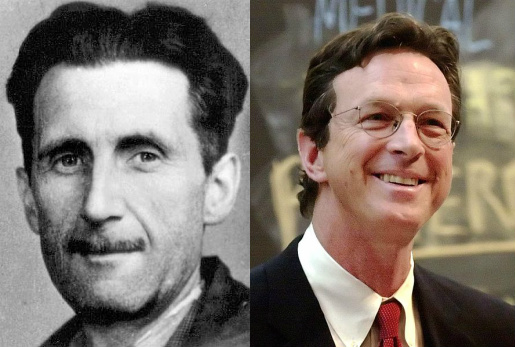
Images via Wikimedia Commons
In his 2002 memoir, Travels, Michael Crichton took his readers back several decades, to the early 1960s when, as a Harvard student, he tried an interesting little experiment in his English class. He recalled:
I had gone to college planning to become a writer, but early on a scientific tendency appeared. In the English department at Harvard, my writing style was severely criticized and I was receiving grades of C or C+ on my papers. At eighteen, I was vain about my writing and felt it was Harvard, and not I, that was in error, so I decided to make an experiment. The next assignment was a paper on Gulliver’s Travels, and I remembered an essay by George Orwell that might fit. With some hesitation, I retyped Orwell’s essay and submitted it as my own. I hesitated because if I were caught for plagiarism I would be expelled; but I was pretty sure that my instructor was not only wrong about writing styles, but poorly read as well. In any case, George Orwell got a B- at Harvard, which convinced me that the English department was too difficult for me.
I decided to study anthropology instead. But I doubted my desire to continue as a graduate student in anthropology, so I began taking premed courses, just in case.
Most likely Crichton submitted Orwell’s essay 1946 essay, “Politics vs. Literature: An Examination of Gulliver’s Travels.” He eventually went to Harvard Medical School but kept writing on the side. Perhaps getting a grade just a shade below Orwell’s B- gave Crichton some bizarre confirmation that he could one day make it as a writer.
Follow Open Culture on Facebook and Twitter and share intelligent media with your friends. Or better yet, sign up for our daily email and get a daily dose of Open Culture in your inbox. And if you want to make sure that our posts definitely appear in your Facebook newsfeed, just follow these simple steps.
Looking for free, professionally-read audio books from Audible.com, including works by Crichton and Orwell? Here’s a great, no-strings-attached deal. If you start a 30 day free trial with Audible.com, you can download two free audio books of your choice. Get more details on the offer here.
via Reddit
Related Content:
George Orwell Explains in a Revealing 1944 Letter Why He’d Write 1984
George Orwell’s Harrowing Race to Finish 1984 Before His Death
Read More...See Carl Sagan’s Childhood Sketches of The Future of Space Travel
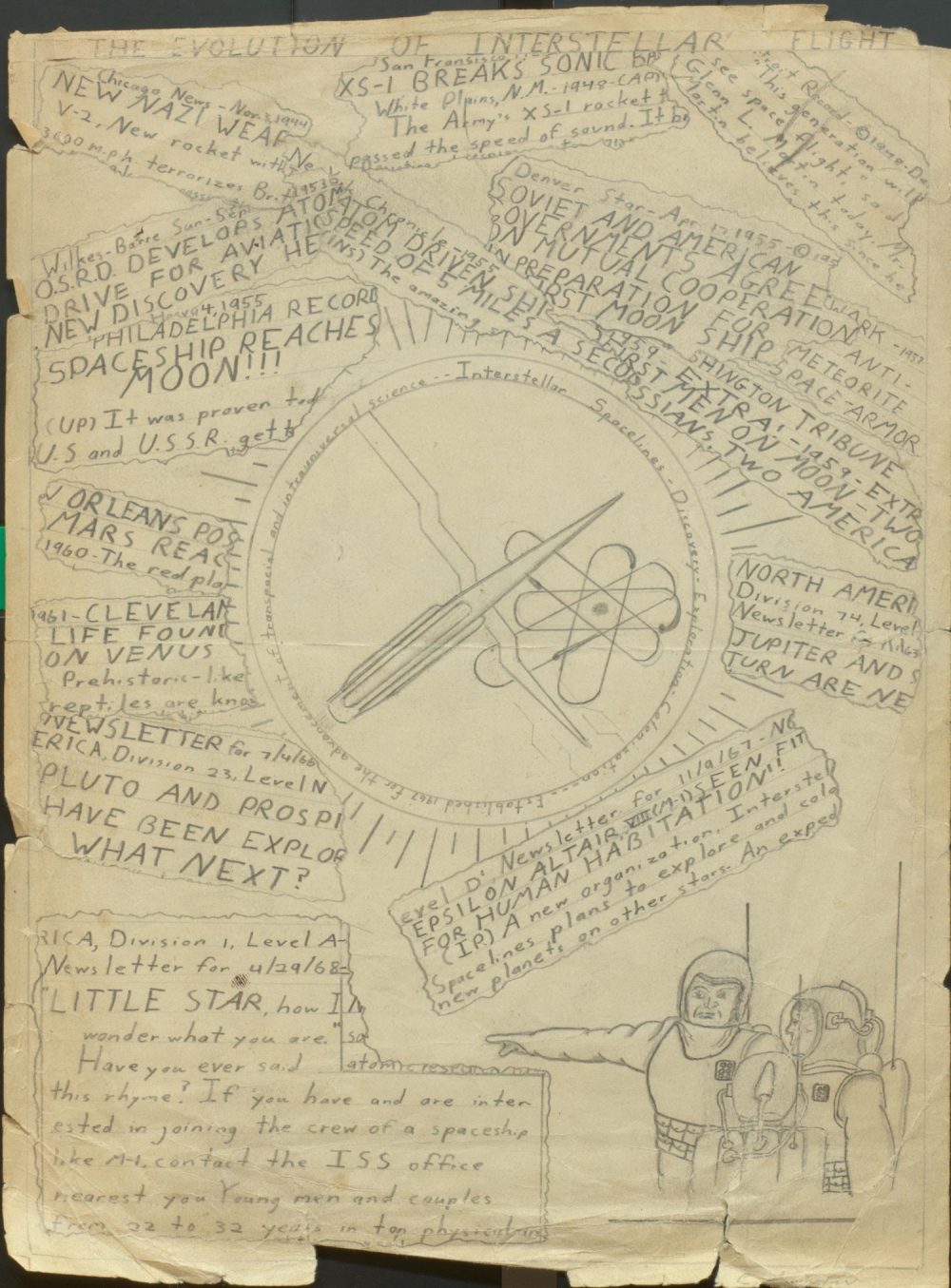
Carl Sagan had his first religious experience at the age of five. Unsurprisingly, it was rooted in science. Sagan, then living in Brooklyn, had started pestering everyone around him about what stars were, and had grown frustrated by his inability to get a straight answer. Like the resourceful five-year-old that he was, the young Sagan took matters into his own hands and proceeded to the library:
“I went to the librarian and asked for a book about stars … And the answer was stunning. It was that the Sun was a star but really close. The stars were suns, but so far away they were just little points of light … The scale of the universe suddenly opened up to me. It was a kind of religious experience. There was a magnificence to it, a grandeur, a scale which has never left me. Never ever left me.”
This sense of universal wonder would eventually lead Sagan to become a well-known astronomer and cosmologist, as well as one of the 20th century’s most beloved science educators. Although he passed away in 1996, aged 62, Sagan’s legacy remains alive and well. This March, a reboot of his famed 1980 PBS show, Comos: A Personal Voyage, will appear on Fox, with the equally great science popularizer Neil DeGrasse Tyson taking Sagan’s role as host. Meanwhile, last November saw the opening of the Carl Sagan and Ann Druyan Archive at the Library of Congress.
Among the papers in the archive was this sketch, titled “The Evolution of Interstellar Flight,” which Sagan drew between the ages of 10 and 13. In the center of the drawing Sagan pencilled the logo of Interstellar Spacelines, which, Sagan imagined, was “Established [in] 1967 for the advancement of transpacial and intrauniversal science.” Its motto? “Discovery –Exploration – Colonization.” Surrounding the logo, Sagan drew assorted newspaper clippings that he imagined could herald the key technological advancements in the space race. Impressively drawn astronauts in the corner aside, I most enjoyed the faux-clipping that read “LIFE FOUND ON VENUS: Prehistoric-like reptiles are…” Good luck containing your sense of wonder on seeing that.
Ilia Blinderman is a Montreal-based culture and science writer. Follow him at @iliablinderman.
Related Content:
Carl Sagan’s Undergrad Reading List: 40 Essential Texts for a Well-Rounded Thinker
Carl Sagan Presents Six Lectures on Earth, Mars & Our Solar System … For Kids (1977)
Carl Sagan, Stephen Hawking & Arthur C. Clarke Discuss God, the Universe, and Everything Else
Read More...Support Us
We're hoping to rely on loyal readers, rather than erratic ads. Please click the Donate button and support Open Culture. You can use Paypal, Venmo, Patreon, even Crypto! We thank you!

About Us

Open Culture scours the web for the best educational media. We find the free courses and audio books you need, the language lessons & educational videos you want, and plenty of enlightenment in between.
Advertise With Us

FREE UPDATES!
GET OUR DAILY EMAIL
Get the best cultural and educational resources on the web curated for you in a daily email. We never spam. Unsubscribe at any time.
FOLLOW ON SOCIAL MEDIA

Open Culture editor Dan Colman scours the web for the best educational media. He finds the free courses and audio books you need, the language lessons & movies you want, and plenty of enlightenment in between.
Advertise With Us


