Read 700 Free eBooks Made Available by the University of California Press
The University of California Press e‑books collection holds books published by UCP (and a select few printed by other academic presses) between 1982–2004. The general public currently has access to 770 books through this initiative. The collection is dynamic, with new titles being added over time.
Readers looking to see what the collection holds can browse by subject. The curators of the site have kindly provided a second browsing page that shows only the publicly accessible books, omitting any frustrating off-limits titles.
The collection’s strengths are in history (particularly American history and the history of California and the West); religion; literary studies; and international studies (with strong selections of Middle Eastern Studies, Asian Studies, and French Studies titles).
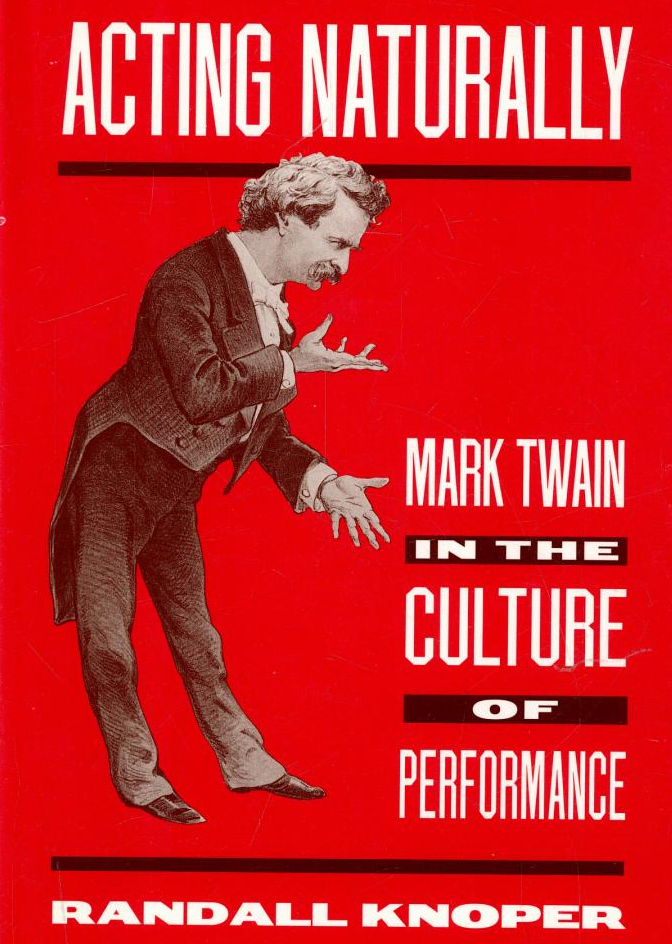
A quick browse yields a multitude of interesting possibilities for future reading: Shelley Streeby’s 2002 book about sensational literature and dime novels in the nineteenth-century United States; Luise White’s intriguing-looking Speaking with Vampires: Rumor and History in Colonial Africa (2000); and Karen Lystra’s 2004 re-examination of Mark Twain’s final years. (The image above comes from another Twain text by Randall Knoper.) Two other noteworthy texts include Roland Barthes’ Incidents and Hugh Kenner’s Chuck Jones: A Flurry of Drawings.
Sadly, you can’t download the books to an e‑reader or tablet. Happily, there is a “bookbag” function that you can use to store your titles, if you need to leave the site and come back.
As always, we’d encourage you to visit our collection of 800 Free eBooks for iPad, Kindle & Other Devices, where we recently added texts by Vladimir Nabokov, Philip K. Dick and others. Also find free courses in our list of 1,700 Free Online Courses from Top Universities.
Rebecca Onion is a writer and academic living in Philadelphia. She runs Slate.com’s history blog, The Vault. Follow her on Twitter:@rebeccaonion.
Related Content:
Free: The Metropolitan Museum of Art and the Guggenheim Offer 474 Free Art Books Online
Read 18 Short Stories From Nobel Prize-Winning Writer Alice Munro Free Online
30 Free Essays & Stories by David Foster Wallace on the Web
Download 14 Great Sci-Fi Stories by Philip K. Dick as Free Audio Books and Free eBooks
Download 20 Popular High School Books Available as Free eBooks & Audio Books
Read More...Watch a Super Cut of Wes Anderson’s Signature Slo-Mo Shots
When you watch a director’s work for a while, you get to know his/her signature tricks — the themes and camera work that appear again and again. A couple years ago, we featured a video called Wes Anderson // FROM ABOVE, a montage capturing Anderson’s penchant for the aerial shot, a move that contributes to the lightness, playfulness and quirkiness of his films. Now comes a super cut of Anderson’s slo-mo shots, compiled by Alejandro Prullansky, set to The Shins’ song, “New Slang.” If you’re looking for a good overview of Wes Anderson’s filmography, we’d encourage you to watch this series: 7 Video Essays on Wes Anderson’s Films: Rushmore, The Royal Tenenbaums & More.
Don’t miss anything from Open Culture. Sign up for our Daily Email or RSS Feed. And we’ll send cultural curiosities your way, every day.
Related Content:
Wes Anderson’s First Short Film: The Black-and-White, Jazz-Scored Bottle Rocket (1992)
Watch Wes Anderson’s Charming New Short Film, Castello Cavalcanti, Starring Jason Schwartzman
Has Wes Anderson Sold Out? Can He Sell Out? Critics Take Up the Debate
Read More...The Curious Story of London’s First Coffeehouses (1650–1675)
 In his 1621 opusThe Anatomy of Melancholy, Robert Burton wrote, “The Turks have a drink called coffa (for they use no wine), so named of a berry as black as soot, and as bitter … which they sip still of, and sup as warm as they can suffer; they spend much time in those coffa-houses, which are somewhat like our alehouses or taverns…”
Several decades later, readers would require no such explanations: England would be awash in coffeehouses, numbering in the thousands. The curious story of how the British swapped much of their daily ale consumption for this “syrop of soot, or essence of old shoes,” is told by Matthew Green in “The Lost World of The London Coffee House,” on the Public Domain Review.
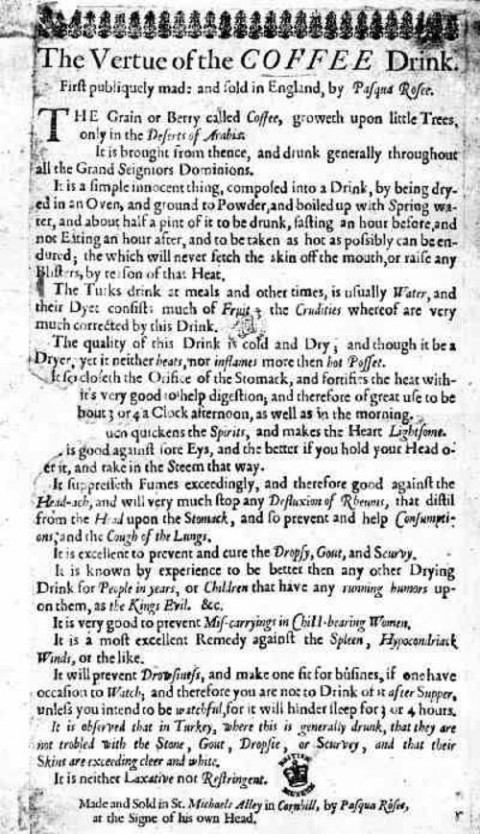
Prior to 1652, when Pasqua Rosée established a small coffeehouse in St. Michael’s Alley in London, coffee was virtually unknown in England. Rosée, a servant of a coffee-loving trader to the Levant, found tremendous success with his venture and, according to Green, was soon selling over 600 servings a day. Above, readers can view Rosée’s original handbill, where the entrepreneur advertised both the therapeutic and prophylactic effects of his wares on digestion, headaches, rheumatism, consumption, cough, dropsy, gout, scurvy, and miscarriages. It’s a wonder anyone ever drinking the stuff got sick.
Coffeehouses quickly became popular places for men to converse and congregate, and Green notes that women soon grew tired of their absence. This exasperation mounted until the 1674 Women’s Petition Against Coffee, which claimed that “Excessive use of that Newfangled, Abominable, Heathenish Liquor called COFFEE” led to England’s falling birthrate, making men “as unfruitful as the sandy deserts, from where that unhappy berry is said to be brought.” Men, as they are wont to do, expressed their disagreement, and stated in Men’s Answer to the Women’s Petition Against Coffee that coffee made “the erection more vigorous, the ejaculation more full, add[ing] a spiritual ascendency to the sperm.”
A year later, coffeehouses found more formidable opposition in the form of King Charles II, who issued the “Proclamation for the suppression of Coffee Houses” in 1675. Charles, however, was more interested in their political effects than the spiritual ascendency of his subjects’ sperm. Coffeehouses provided an opportunity for more mindful and serious conversations than did alehouses, and allowed anyone who paid the single penny entrance charge to participate in discussions — to Charles, these were the ideal circumstances for plotting sedition and treason among the populace. Despite the King’s proclamation, the coffeehouses, buoyed by a supportive public, prevailed.
To read Green’s fascinating essay in full, including a description of the coffeehouse frequented by Alexander Pope, Jonathan Swift, Joseph Addison, and Richard Steele, head over to the Public Domain Review.
Ilia Blinderman is a Montreal-based culture and science writer. Follow him at @iliablinderman.
Related Content:
Men In Commercials Being Jerks About Coffee: A Mashup of 1950s & 1960s TV Ads
The History of Coffee and How It Transformed Our World
Read More...Behold Pablo Picasso’s Illustrations of Balzac’s Short Story “The Hidden Masterpiece” (1931)
Pablo Picasso had a long and complex relationship with book illustration. The modern painter hated to work on spec and resisted taking commissions. Nonetheless, when it came to literature, he made well over 50 exceptions, illustrating the work of scores of authors he admired. As John Golding writes in The Independent, Picasso had always gravitated toward the literary; he wrote prolifically, was “attracted to art that had a literary flavor,” and “preferred the company of writers, particularly poets, to that of other painters and sculptors.” Golding writes of the artist’s particular love for the Spanish Baroque poet Luis de Gongora, whose work he illustrated in a 1948 edition, and who was to “affect the future development of Picasso’s art in a way that his other literary collaborations did not.” But this may be a hasty judgment. As it turned out, Picasso’s 1931 illustration of a short story by Honoré de Balzac, “The Hidden Masterpiece” (Le Chef‑d’oeuvre inconnu), would affect him greatly, and indirectly contributed to the creation of his most famous work, the enormous anti-war canvas Guernica.
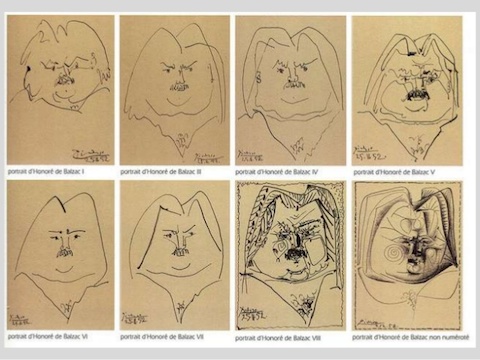
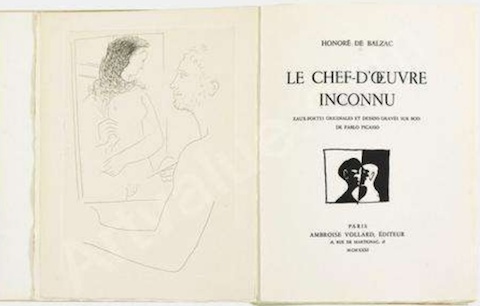
Picasso accepted the Balzac commission from art dealer Ambroise Vollard (see the title page and frontispiece at top, Picasso’s portraits of Balzac above) and completed the thirteen etchings in 1931 for a centennial edition (see ten of the illustrations here). Many have considered these etchings “landmarks in the history of engraving.” Balzac’s story, admired by other painters like Cézanne and Matisse, is among other things a tale of an artist ahead of his time. Set in the 17th century, “The Hidden Masterpiece” tells of an aging painter named Frenhofer, who obsessively labors over a work he has kept secret for years. When two younger admirers, painters Poussin and Porbus, finally manage to see Frenhofer’s secret canvas, they are appalled—it appears to them nothing more than an indistinct mess of lines, colors and shapes—and they mock the older artist and assume their celebrated friend has gone insane. The next day, Frenhofer destroys all his work and kills himself.
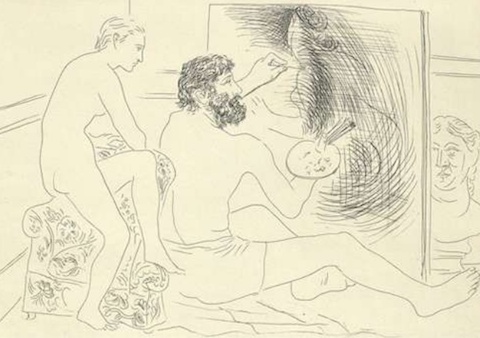
Picasso, writes Thomas Ganzevoort, “had faced something of the same dumbfounded reaction from fellow artists upon showing them his groundbreaking proto-Cubist masterpiece Les Demoiselles d’Avignon.” He later claimed that the ghost of Balzac haunted him, and he found himself so compelled by the story that in 1937, he chose for his new studio a 17th century townhouse located at 7 Rue des Grands-Augustin, the very house many believed to be the setting of the opening scene in “The Hidden Masterpiece.” In April of that year, German warplanes bombed the Spanish Basque city of Guernica, and Picasso abandoned all other projects and set to work on his famous large canvas, which he completed in June of that same year (below, see him in his Grands-Augustin studio, at work on Guernica). Like his earlier, cubist work, Guernica divided critics and perplexed some of his peers. At its unveiling in the 1937 Paris Exhibition, the painting “garnered little attention.” Unlike the tragic Frenhofer of Balzac’s story, however, Picasso did not succumb to self-doubt and lived to see his work vindicated. See this site to learn more about Balzac and Picasso, including discussion of a disputed 1934 drawing some believe to be Picasso’s own “hidden masterpiece.”

Related Content:
Watch Picasso Create Entire Paintings in Magnificent Time-Lapse Film (1956)
A 3D Tour of Picasso’s Guernica
Josh Jones is a writer and musician based in Durham, NC. Follow him at @jdmagness
Read More...Free Online Religion Courses
Get free Religion courses online from the world’s leading universities. You can download these audio & video courses straight to your computer or mp3 player. For more online courses, visit our complete collection of Free Courses.
- A Journey through Western Christianity: from Persecuted Faith to Global Religion (200 — 1650) — Massive Open Online Course (MOOC) — Yale University
- Ancient Israel — Free Online Video — Daniel Fleming, NYU
- Buddhism and Cognitive Science — Free Online Video — John Vervaeke, U Toronto
- Buddhism and Modern Psychology — Free Online Video — Robert Wright, formerly Princeton
- Buddhism Through its Scriptures — Free Online Video — Charles Hallisey, Harvard
- Buddhist Psychology — Free Online Audio — Eleanor Rosch, UC Berkeley
- Christianity and Ethics — Free Online Video — Lynn Mitchell, U. of Houston
- Christianity Through Its Scriptures — Free Online Video — Karen L. King, Harvard
- Faith and Globalization — Free iTunes Video — Tony Blair, Miroslav Volf, Yale
- From Israelite to Jew — Free iTunes Audio, Michael Satlow, Brown University
- Hinduism Through Its Scriptures — Massive Open Online Course (MOOC) — Harvard
- Historical Jesus — Free iTunes Audio — Thomas Sheehan, Stanford University
- History of Christian Philosophy - Free Online Video — Daniel Bonevac, UT Austin
- History of Islamic Society — Free Online Video — Richard Bulliet, Columbia University
- History and Nature of Apologetics — Free iTunes Audio — Cornelius VanTil, Westminster Theological Seminary
- Introduction to the Old Testament (Hebrew Bible) — Free Online Course — Christine Hayes, Yale.
- Introduction to the Quran: The Scripture of Islam — Massive Open Online Course (MOOC) — Notre Dame, Gabriel Said Reynolds
- Introduction to New Testament History and Literature — Free Online Course — Dale B. Martin, Yale
- Introduction to Religion — Free Online Video — Lora Hobbs, Missouri State
- Islam Through Its Scriptures — Massive Open Online Course (MOOC) — Harvard
- Judaism Through Its Scriptures — Massive Open Online Course (MOOC) — Harvard
- Medieval Church — Free iTunes Audio — Carl Trueman, Westminster Theological Seminary
- Philosophy of Religion — Free Online Audio — T. J. Mawson, Oxford
- Philosophy, Science and Religion: Science and Philosophy — Massive Open Online Course (MOOC) — University of Edinburgh
- Religious Literacy: Traditions and Scriptures — Massive Open Online Course (MOOC) — Harvard
- Science, Magic and Religion: From Antiquity to Present — Free Online Video — Courtenay Raia, UCLA
- Science & Religion 101 — Massive Open Online Course (MOOC) — University of Alberta
- Science vs. Religion — Web Video — Mark Vernon, Journalist/Philosopher
- The Bible and English Literature — Free Online Video (+ More Background) — Northrop Frye, U. of Toronto
- The Central Philosophy of Tibet - Free Online Audio — Robert Thurman, Columbia University
- The Hebrew Bible — Free Video — Shaye J.D. Cohen, Harvard
- The Hebrew Scriptures in Judaism & Christianity - Free Video — Shaye J.D. Cohen, Harvard
- The Reformation — Free Video - Carl Trueman, Westminster Theological Seminary
- Religion, Conflict and Peace — Massive Open Online Course (MOOC) — Harvard
- The Talmud: A Methodological Introduction — Massive Open Online Course (MOOC) — Northwestern University
- Theology of Hebrews — Free iTunes Audio — R. Gafin, Westminster Theological Seminary
For a complete list of online courses, please visit our complete collection, 1,700 Free Online Courses from Top Universities.
For a list of online certificate programs, visit 200 Online Certificate & Microcredential Programs from Leading Universities & Companies, which features programs from our partners Coursera, Udacity, FutureLearn and edX.
And if you’re interested in Online Mini-Masters and Master’s Degrees programs from universities, see our collection: Online Degrees & Mini Degrees: Explore Masters, Mini Masters, Bachelors & Mini Bachelors from Top Universities.
Read More...Against All Odds: A Gentle Introduction to Statistics Hosted by Harvard Geneticist Pardis Sabeti (Free Online Course)
Worth a quick mention: Dr. Pardis Sabeti, a media-savvy computational geneticist at Harvard, has teamed up with the Annenberg Foundation, to create a new introduction to statistics. In 31 nicely-produced videos, Against All Odds: Inside Statistics guides “viewers through the wide range of statistical applications used by scientists, business owners, and even Shakespeare scholars, in their work and daily lives.” It’s all about “real people working on real problems.”
The series starts with What Is Statistics?. And then, along the way, the course covers topics like Standard Deviation, Correlation, Samples and Surveys, and more. The clip above comes from the unit called Checking Assumption of Normality. And do note that each video module is complemented by a Student Guide and Faculty Guide specific to the unit.
Against All Odds: Inside Statistics has been added to our collection of Free Math Courses, a subset of our larger collection, 1,700 Free Online Courses from Top Universities.
If you would like to support the mission of Open Culture, consider making a donation to our site. It’s hard to rely 100% on ads, and your contributions will help us continue providing the best free cultural and educational materials to learners everywhere. You can contribute through PayPal, Patreon, and Venmo (@openculture). Thanks!
Related Content:
Statistics Explained Through Modern Dance: A New Way of Teaching a Tough Subject
Calculus Lifesaver: A Free Online Course from Princeton
Read More...Stanford Prof Makes Ukuleles from Wood Floor of New Concert Hall
Last year, Stanford opened a glorious new concert hall. Somewhere during its construction, Steven Sano, a professor in the Music Department, found some extra scraps of Alaskan yellow cedar, the wood used to build the stage floor. He took the wood known “for its resonance and fine grain” to a luthier and came home with two blond-top tenor ukes. They’re on display above. Stanford News has more on the story.
Related Content:
Jake Shimabukuro plays “Bohemian Rhapsody” on the Uke
Musicians Re-Imagine the Complete Songbook of the Beatles on the Ukulele
Amazing Fact: Spaghetti and Ukulele Strings Actually Grow on Trees
Read More...An Introduction to the Political Philosophy of Isaiah Berlin Through His Free Writings & Audio Lectures
Isaiah Berlin casts a long shadow over modern political philosophy. Rising to prominence as a British public intellectual in the 1950s alongside thinkers like A.J. Ayer and Hugh Trevor-Roper, Berlin (writes Joshua Chemiss in The Oxonian Review of Books) was at one time a “cold warrior,” his opposition to Soviet Communism the “lynchpin” of his thought. But his longevity and intellectual vitality meant he was much more besides, and he has remained a popular reference, though, as Chemiss points out, Berlin’s reputation took a beating from critics on the left and right after his death in 1997. Born into a prominent Russian-Jewish family, Berlin grew up in middle class stability until the Russian Revolution dismantled the Czarist Russia of his youth and his family relocated to Britain in 1921.
Berlin’s childhood experience of the Bolsheviks was never far from his mind and precipitated his aversion to violence and coercion, he confesses above in a 1992 interview with his biographer Michael Ignatieff (who spent ten years in conversation with Berlin). Originally broadcast on BBC 2, Ignatieff’s interview serves as an introduction to both the man himself and to his past—in lengthy segments that detail Berlin’s history through photographs and narration. Referring to Berlin’s hugely influential categorization of intellectual history, The Hedgehog and the Fox, Ignatieff tells us: “He once wrote, ‘A fox knows many things, but a hedgehog knows one, big thing.’ He was a hedgehog, all his work was a defense of liberty.… All of his writing can be read as a defense of the individual against the violence of the crowd and the dogma of the party line.”
Berlin was enormously prolific, in print as well as in recorded media, and we have access to several of his lectures online. One radio lecture series, Freedom and its Betrayal, examined six thinkers Berlin identified as “anti-liberal.” Perhaps foremost among these was Jean-Jacques Rousseau. In his lecture on Rousseau above (continued here in Parts 2, 3, 4, 5 & 6), Berlin elaborates on his important distinction between types of liberty, a theme he returned to again and again, most famously in a lecture, eventually published as a 57-page pamphlet, called “Two Concepts of Liberty.” Berlin adapted much of the ideas in these lectures from his Political Ideas in the Romantic Age—written between 1950 and 1952 and published posthumously—a text that Berlin called his “torso.”
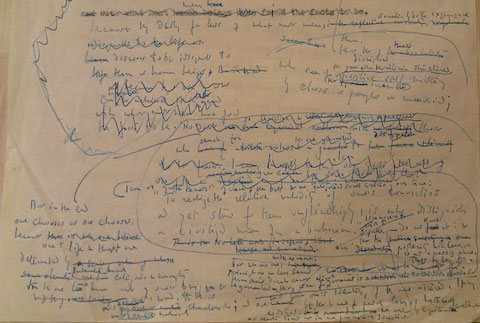
Oxford University hosts an extensive “Isaiah Berlin Virtual Library” that details the composition of “Two Concepts of Liberty,” from its earliest draft stages (above) to its publication history. You can read the full text of the published lecture here and listen to Berlin’s recorded dictation of an early draft below.
In the published version of “Two Concepts of Liberty,” Berlin succinctly sums up his major premise: “To coerce a man is to deprive him of freedom.” Then he goes on:
freedom from what? Almost every moralist in human history has praised freedom. Like happiness and goodness, like nature and reality, the meaning of this term is so porous that there little interpretation that it seems able to resist….[There are] more than two hundred senses.… of this protean word….
Berlin reduces the more than two hundred to two: negative liberty—dealing with the areas of life in which one is free from any interference; and positive liberty—his term for that which interferes in people’s lives for their supposed benefit and protection. Berlin’s conceptions of these two types is anchored in specific geopolitical arrangements and philosophical traditions, as Dwight MacDonald explained in a 1959 review of the published text. He saw Communism as an abuse of positive liberty and wished to enhance so-called negative liberty as much as possible. As such, Berlin is often cited approvingly by politicians and philosophers with more classical, limited understandings of state power, although these may include libertarians as well as liberals, finding common ground in values of ethical pluralism and robust civil liberties, both of which Berlin defended strenuously.
Berlin draws his account of negative liberty from the work of classical liberal political philosophers like John Locke, Adam Smith, and John Stuart Mill. Most of his critique of positive liberty focused on Romanticism and German Idealism, in which he saw the beginnings of totalitarianism (above, hear Berlin’s final 1965 lecture on the “Roots of Romanticism,” continued in Parts 2, 3, 4, 5, 6, & 7). Despite his preoccupation with kinds of freedom, his thought was extraordinarily idiosyncratic, wide-ranging, and diverse. Oxford hopes to soon add the text of much of Berlin’s published work to its Virtual Library. Now, in addition to “Two Concepts of Liberty,” it also houses online text of the essay collection Concepts and Categories. While we await the posting of more Berlin texts, we might attend again to Berlin’s conception of types of freedom, and hear them defined by the philosopher himself in a 1962 interview:
As in the case of words which everyone is in favour of, ‘freedom’ has a very great many senses – some of the world’s worst tyrannies have been undertaken in the name of freedom. Nevertheless, I should say that the word probably has two central senses, at any rate in the West. One is the familiar liberal sense in which freedom means that every man has a life to live and should be given the fullest opportunity of doing so, and that there are only two adequate reasons for controlling men. The first is that there are other goods besides freedom, such as, for example, security or peace or culture, or other things which human beings need, which must be given them, apart from the question of whether they want them or not. Secondly, if one man obtains too much, he will deprive other people of their freedom – freedom for the pike means death to the carp – and this is a perfectly adequate reason for curtailing freedom. Still, curtailing freedom isn’t the same as freedom.
The second sense of the word is not so much a matter of allowing people to do what they want as the idea that I want to be governed by myself and not pushed around by other people; and this idea leads one to the supposition that to be free means to be self-governing. To be self-governing means that the source of authority must lie in me – or in us, if we’re talking about a community. And if the source of freedom lies in me, then it’s comparatively unimportant how much control there is, provided the control is exercised by myself, or my representatives, or my nation, my people, my tribe, my Church, and so forth. Provided that I am governed by people who are sympathetic to me, or understand my interests, I don’t mind how much of my life is pried into, or whether there is a private province which is divided from the public province; and in some modern States – for example the Soviet Union and other States with totalitarian governments – this second view seems to be taken.
Between these two views, I see no possibility of reconciliation.
Related Content:
Leo Strauss: 15 Political Philosophy Courses Online
Introduction to Political Philosophy: A Free Yale Course
Alain de Botton Tweets Short Course in Political Philosophy
Josh Jones is a writer and musician based in Durham, NC. Follow him at @jdmagness
Read More...“Lol My Thesis” Showcases Painfully Hilarious Attempts to Sum up Years of Academic Work in One Sentence
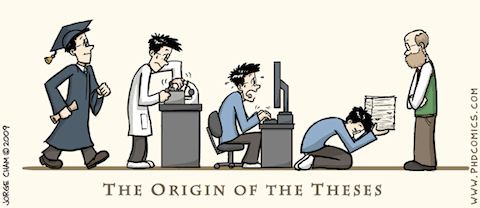
Image from Ph.D. Comics
A true fact about the thesis stage of an advanced degree: Whatever the academic field, whether writing a fifty page bachelor’s or master’s thesis or 250 plus page doctoral dissertation, at some point, you will need to winnow your argument down to an abstract summary of a couple succinct paragraphs. Then, one inevitably finds—when riding elevators with colleagues and mentors, talking to relatives over holiday dinners, justifying one’s existence to friends and acquaintances—that the whole damned thing needs to somehow reduce to one intelligible sentence or two. It’s all anyone has the patience for, honestly, and it saves you the trouble of trying to reconstruct complex arguments for people who won’t understand or care about them and who generally only asked out of politeness anyway.
But how, how, to cram years of research, agony, turmoil, crushing failure and soaring epiphany into bite-sized conversational nuggets without gross oversimplification to the point of tautological absurdity? Can it even be done?! The blog “lol my thesis,” started last year by a Harvard senior studying Human Developmental and Regenerative Biology, suggests that it can, but not without hilarious results. Part of an exploding genre of academic parody (and procrastination) sites, lol my thesis proudly ventures forth in its mission of “summing up years of work in one sentence” with open submissions from current students. Many of the submissions are from the sciences, and many from undergraduate theses, but a fair number also come from humanities and post-graduate studies. Take, for example, the following submission from an MFA Creative Nonfiction student at Emerson College, which directly addresses the intended audience:
“A collection of nonfiction essays, which means they’re written about real people and events, mom. Remember all those times you accused me of not listening to the things you said?”
A passive aggressive example that most of us who’ve been through the process can relate to at some level. Another one that hits home is this, from a Vassar Political Science major, who discovers too late that the argument doesn’t work: “Oops: Turns out self-published poetry didn’t actually affect Indian politics but I’m 60 pages in, so.”
The submissions from the sciences do not disappoint. For example, from a University of Maryland student of Biological Sciences: “We spent thousands of government dollars to create a mouse model for a disease only 32 people in the world have.” And a Science Writing student at M.I.T. gives us this particularly impressive example of brevity: “Wolves + humans, the ultimate frenemies.” Not to be outdone, a Stem Cell Biology student at Harvard offers a grimly terse confessional: “I have killed so many fish.”
The submissions are anonymous, but some good sports have chosen to include links to their theses, endearingly hoping that someone besides their advisor will actually want to read them. Most of the submissions, however, simply combine two qualities every advanced student knows all too well: a well-earned feeling of futility and the mordant wit required to keep going anyway.
More witty summaries can be found at lol my thesis.
Related Contents:
The Illustrated Guide to a Ph.D.
Graduate School Barbie: A New Gift Idea for The Demoralized Grad Student in Your Life
The Ph.D. Grind: Philip J. Guo’s Free Memoir Offers An Insider’s Look at Doctoral Study
Josh Jones is a writer and musician based in Durham, NC. Follow him at @jdmagness
Read More...Four Female Punk Bands That Changed Women’s Role in Rock
Today I am pleased to bring you samplings of a handful of my favorite bands. It so happens they are all mostly-female or female-fronted punk bands. This fact to me seems almost incidental to my enjoyment—these are all fantastic musicians, songwriters, and/or personalities. And yet their commonalities are highly remarkable all the same. Punk introduced aggressive, all-female bands like The Slits and frontwomen like Siouxie Sioux who never had to play vulnerable objects, desperate seductresses, jilted lovers, femme fatales, etc. and yet still manifested their power in their sexuality as well as in their fierce intelligence and fury. In the late ’70s, women strode out in front as leaders in punk scenes in the UK and US, and helped to change the gender politics of rock and roll.
First up, the Runaways, a band best known today for the later careers of guitarists Joan Jett and Lita Ford. The Runaways tend to get unfairly pegged as little more than wards and projects of manager Kim Fowley, but the L.A. band formed organically around Jett and drummer Sandy West in 1975 and succeeded in their own right after splitting with Fowley in 1977. While they did not technically begin as a punk band, they briefly became associated with several New York and London punks, especially due to Jett’s orientation toward glam, garage, and punk. Ford, known for her flashy guitar solos, wanted to go metal (and later did), and the band pulled apart in 1978. The Runaways were so rock n’ roll that they were biggest in Japan, especially their song “Cherry Bomb” from their first, self-titled 1976 album. Watch them play the song above on Japanese TV in ’77.
Next (and my ordering here means nothing, by the way), The Slits. When German-born frontwoman Ari Up (stepdaughter of John Lydon, as it happens) passed away from cancer in 2010, many, many people mourned her death. And many more sent “Slits” trending on all the social networks. It was long past time then for a more public profile of the band, which reformed in 2005 but mostly absent much critical notice. Arising in 1976 from members of a band called Flowers of Romance (later the name of an album and song by Lydon’s Public Image Ltd.), the mostly all-female Slits made a very different sound from the Runaways somewhat formulaic hard rock. Like the Clash, with whom they often played, the Slits evolved from raw street punk to taking reggae ideas and making something new, in their case something weirder, wobblier, and more angular than most anyone else at the time (though later male post-punk bands like Swell Maps and Lydon’s PIL took much from them). See them do “Typical Girls” above in a rare music video, and check out their cover of “Heard it Through the Grapevine.”
Siouxsie Sioux, of Siouxsie and the Banshees, and later the Creatures, began her career in London’s punk scene as a follower of the Sex Pistols. In a scene thronged with inventive kids competing for attention, she stood out. Once she decided to take the stage herself (after an impromptu jam of “The Lord’s Prayer” with guitarist Steve Severin and Sid Vicious on drums) and form her own band, she seemed to Slits guitarist Viv Albertine to have arrived “fully made, fully in control, utterly confident.” Siouxsie was “unlike any female singer before or since,” wrote rock journalist Jon Savage, “commanding yet aloof, entirely modern.” She was also a phenomenal songwriter and, along with The Cure, Bauhaus, and The Damned, gets credit—for better or worse—for the origins of goth rock. See Siouxsie command the stage in 1978 above, doing “Hong Kong Garden.”
I feel I would be most remiss if I did not include Wendy O. Williams. As we seem to endlessly debate the social value of certain female pop stars clumsy attempts to shock us, Williams spent most of the ‘70s onstage topless, sawing guitars in half with chainsaws, and setting cars on fire. Was her band, the Plasmatics, any good? It’s hard to say. They were… uneven. Not much of a singer, Williams and the Plasmatics embraced a more raucous version of the Runaway’s hard rock and eventually moved toward metal. This is not necessarily music you listen to, it’s music you experience, in the sheer amount of barely-controlled chaos Williams and the band conjured onstage. Some of the stunts might look silly in hindsight, but bear in mind, she pushed the boundaries of decorum over thirty years ago with the kind of sexual frankness and power that still makes our culture very nervous. Williams’ antics made her a prime figure for television (like gross-out punk provocateur G.G. Allin, she became something of a novelty act on the talk-show circuit). See her above with the Plasmatics on Solid Gold in 1981, with the added bonus of an interview with the “Madame” puppet (of Wayland Flowers and Madame) after the performance.
I cannot begin to do justice here to the groundswell of excellent female punk bands from the ‘70s and ‘80s (not even to mention the ‘90s), and I can’t overstate their importance. Dr. Helen Reddington, former bassist and singer for ’70s punk band The Chefs, approvingly quotes journalist Caroline Coon, onetime manager of both The Clash and The Slits as saying: “it would be possible to tell the whole story of British punk solely through its female bands and artists” (this is much less the case in U.S. punk history). You might wish to check out the rather crudely made, but interesting documentary She’s a Punk Rocker and the database on punk77.com for more. I haven’t mentioned Patti Smith, but we cover her body of work frequently enough here. Yes, I’ve left off Blondie, and of course X‑Ray Spex, and two more favorites of mine—the sadly underrated but truly awesome Bush Tetras and the obscure, Devo-like Mo-Dettes. The list, as always, could go on, but perhaps some of you have your own favorite female or female-fronted punk bands. If so, add them to the comments, preferably with a link to audio or video.
Related Content:
The Art of Punk Presents a New Documentary on The Dead Kennedys and Their Gritty Aesthetics
New Documentary Brings You Inside Africa’s Little-Known Punk Rock Scene
Josh Jones is a writer and musician based in Durham, NC. Follow him at @jdmagness
Read More...Support Us
We're hoping to rely on loyal readers, rather than erratic ads. Please click the Donate button and support Open Culture. You can use Paypal, Venmo, Patreon, even Crypto! We thank you!

About Us

Open Culture scours the web for the best educational media. We find the free courses and audio books you need, the language lessons & educational videos you want, and plenty of enlightenment in between.
Advertise With Us

FREE UPDATES!
GET OUR DAILY EMAIL
Get the best cultural and educational resources on the web curated for you in a daily email. We never spam. Unsubscribe at any time.
FOLLOW ON SOCIAL MEDIA

Open Culture editor Dan Colman scours the web for the best educational media. He finds the free courses and audio books you need, the language lessons & movies you want, and plenty of enlightenment in between.
Advertise With Us

