“The Tolkien Professor” Presents Three Free Courses on The Lord of the Rings
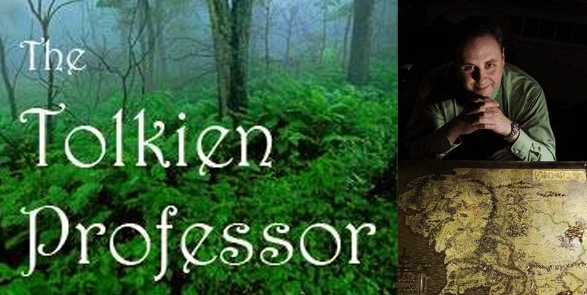
A quick update: Last year, we told you about Corey Olsen, an English Professor at Washington College, who started publishing online lectures on the writing of J.R.R. Tolkien. We initially featured his lecture series on The Hobbit. Now “The Tolkien Professor,” as Olsen is otherwise known, presents a series of online courses on The Lord of the Rings trilogy:
- Lord of the Rings I: The Road Goes Ever On — iTunesU
- Lord of the Rings II: The Two Towers — iTunesU — Web
- Lord of the Rings III: Return of the King - iTunes U — Web
As a bonus, you can access Olsen’s Undergraduate Survey Course on Tolkien (available on the web). The 14-week course was presented and recorded at Washington College in the Spring of 2010.
All of Olsen’s courses are catalogued in the Literature section of our collection of 825 Free Online Courses.
Related Content:
Listen to J.R.R. Tolkien Read a Lengthy Excerpt from The Hobbit (1952)
Fantastic BBC Footage of J.R.R. Tolkien in 1968
Free Audio: Download the Complete Chronicles of Narnia by C.S. Lewis
Read More...Read David Foster Wallace’s Notes From a Tax Accounting Class, Taken to Help Him Write The Pale King
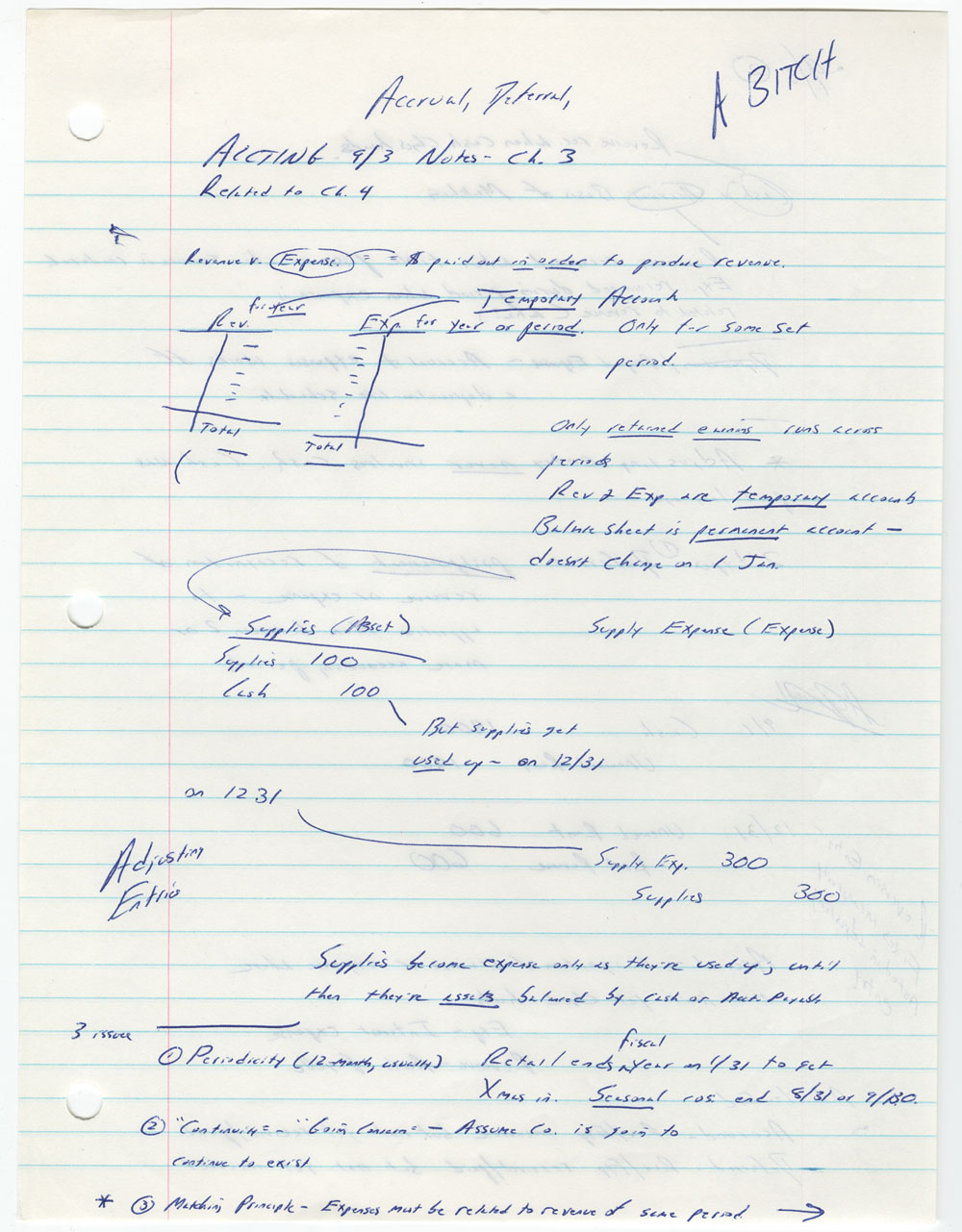
Click images once to enlarge, and twice to zoom in.
There are two ways to gather material for a book. The first is to live life to the full. Ernest Hemingway fished, fought, and went to bullfights. Herman Melville and Charles Bukowski slept their way through an impressive portion of the Western world. Jack Kerouac spent years travelling before he reached the critical moment where he was ready to write On The Road. These authors lived with a palpable intensity, and used their experiences as fuel for their writing. Others, however, did not rely on firsthand accounts. Elmore Leonard paid a legman named Gregg Sutter to do his research, using Sutter’s accounts of locations as the scaffolding for his descriptions. Nathan Englander wrote a finely-tuned novel about the disappeared during Argentina’s Dirty War having only visited Buenos Aires for a week. He did a lot of reading.
In writing The Pale King, a novel of 1980s IRS agents stultified by boredom in Peoria, Illinois, David Foster Wallace joined the latter group. Although Wallace had left an unfinished manuscript when he committed suicide in 2008, he had spent more than a decade working on it. In fact, a year after the release of his opus, Infinite Jest, Wallace enrolled in accounting classes at Illinois State University to learn about precisely what IRS agents did. According to The New York Times’ Jennifer Schuessler, the author began “plowing through shelves of technical literature, transcribing notes on tax scams, criteria for audit and the problem of ‘agent terrorism’ into a series of notebooks.”
Today, we bring you two pages of his notes (click the images to enlarge). In the first, above, Wallace has jotted down a few key points about accrual and deferral, alongside what is likely a note to self on the subject’s difficulty: “A BITCH.”
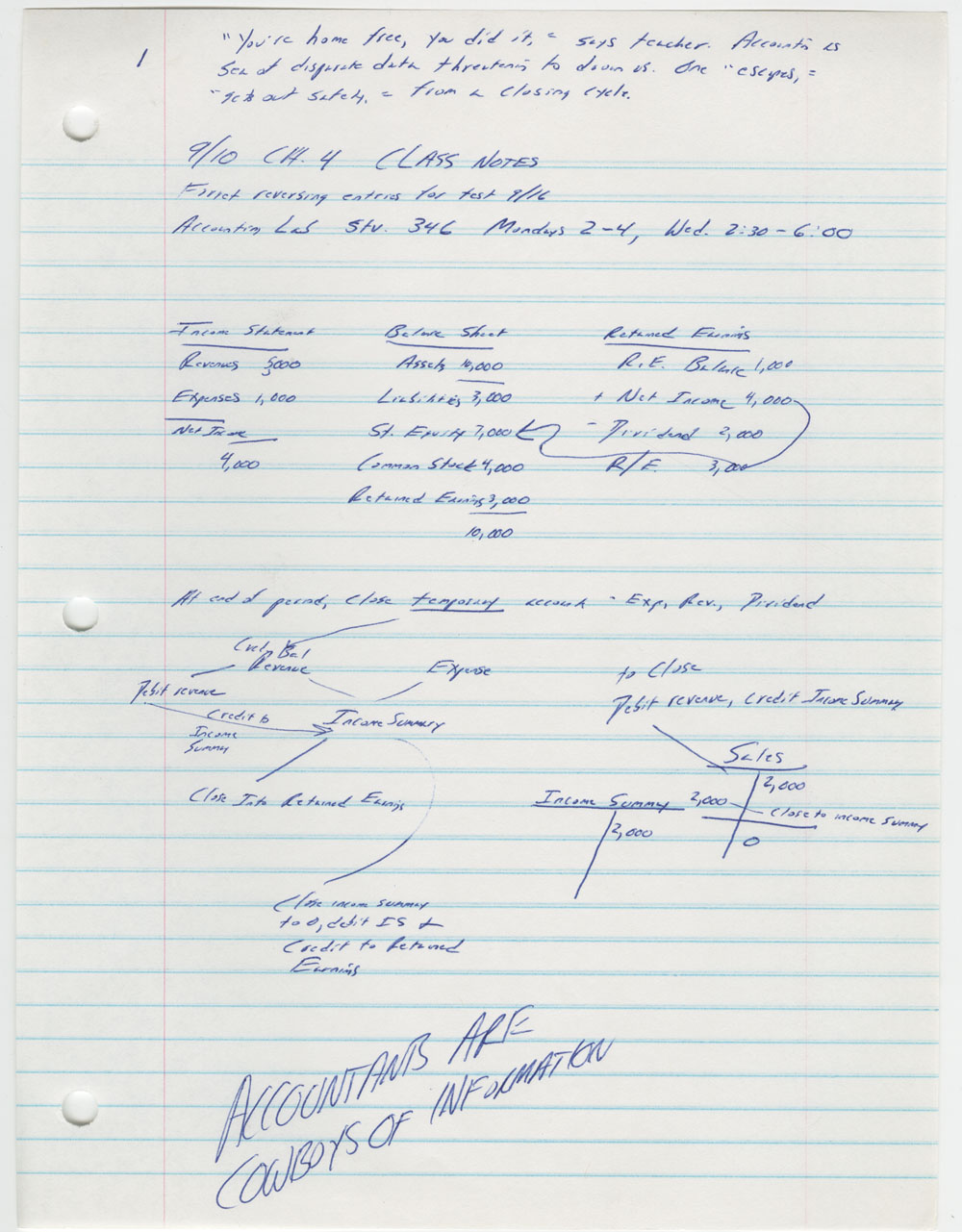
In the second, below, Wallace writes, “‘You’re home free, you did it,’ says teacher. Accounting is sea of disparate data threatening to drown us. One ‘escapes,’ ‘gets out safely’ from a closing cycle.” Cryptic? You bet. But not as cryptic to the untrained eye as “ACCOUNTANTS ARE THE COWBOYS OF INFORMATION,” scrawled diagonally across the bottom of the page.
For an astute interpretation of these notes, I urge you to head over to The New Yorker and read Seth Colter Walls’ “David Foster Wallace’s Tax Classes.”
Ilia Blinderman is a Montreal-based culture and science writer. Follow him at @iliablinderman.
Related Content:
30 Free Essays & Stories by David Foster Wallace on the Web
David Foster Wallace’s Love of Language Revealed by the Books in His Personal Library
The David Foster Wallace Audio Archive: A Little Gift For the Novelist’s 50th Birthday
Read More...How Coffee Affects Your Brain: A Very Quick Primer
The morning cup of coffee sweeps the cobwebs off of your brain. Almost magically. Just like that. If you care to get analytical about what’s going on in your caffeinated brain, we give you a short video from PHD comics — short, of course, for Piled Higher and Deeper. For more of their videos see:
The Higgs Boson, AKA the God Particle, Explained with Animation
What’s Next for the Large Hadron Collider? PhD Comics Introduces the Search for Extra Dimensions
Dark Matter Animated: The Next Frontier of Discovery for Physicists and Cosmologists
Read More...Vintage Photos of a Young Virginia Woolf Playing Cricket (Ages 5 & 12)
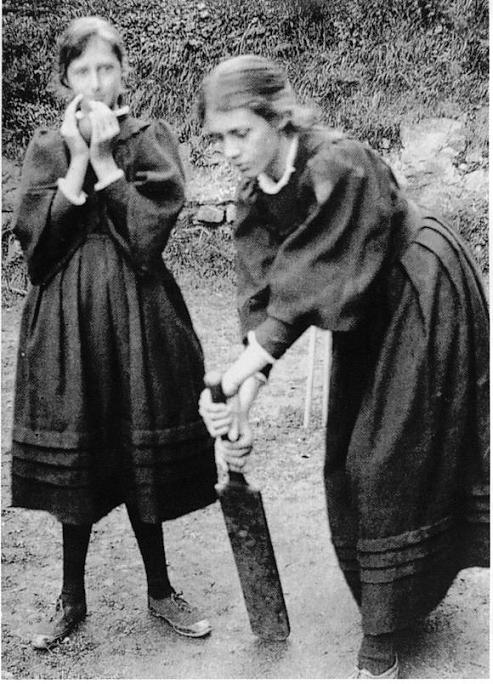
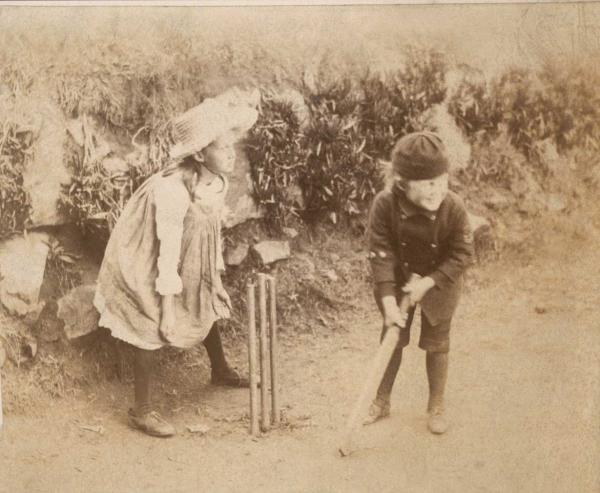
Scenes, I note, seldom illustrate my relation with Vanessa; it has been too deep for ‘scenes’. Vanessa and I were both what we call tomboys; that is, we played cricket, scrambled over rocks, climbed trees, were said not to care for clothes and so on.
Until she was fifteen indeed, she was outwardly sober and austere, the most trustworthy, and always the eldest; sometimes she would lament her “responsibilities”. But beneath the serious surface … there burnt also the…passion for art. …Once I saw her scrawl on a black door a great maze of lines, with white chalk. “When I am a famous painter-” she began, and then turned shy and rubbed it out in her capable way…She was awkward as a long-legged colt.
This is how Virginia Woolf remembered her sister Vanessa Bell in correspondence that’s been revived by a Smith College web site. Later in life, of course, Woolf wrote some of the finest modernist works of the 20th century. Meanwhile Vanessa became a respected painter — see 142 of her paintings here — and a central member of the avant-garde Bloomsbury Group. As adults, they both had a lot of cultural clout. But during another time — during their “tomboy” years — they were just kids looking for a good game of cricket. Above, we have an 1894 picture of Virginia (in the front, about 12 years old) and Vanessa, playing cricket at St. Ives. Below we have a shot, courtesy of Smith’s web site, of 5‑year-old Virginia playing cricket with her little brother Adrian Stephen (also later a member of the Bloomsbury Group) in 1886.
Works by Woolf can be found in our Free Audio Books and Free eBooks collections.
via The Paris Review
Related Content:
Read More...Read 12 Masterful Essays by Joan Didion for Free Online, Spanning Her Career From 1965 to 2013
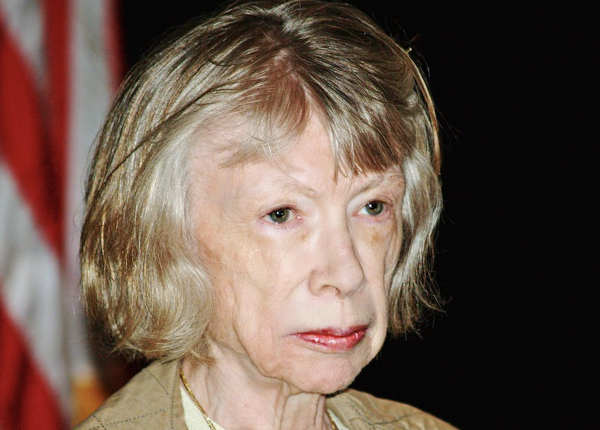
Image by David Shankbone, via Wikimedia Commons
In a classic essay of Joan Didion’s, “Goodbye to All That,” the novelist and writer breaks into her narrative—not for the first or last time—to prod her reader. She rhetorically asks and answers: “…was anyone ever so young? I am here to tell you that someone was.” The wry little moment is perfectly indicative of Didion’s unsparingly ironic critical voice. Didion is a consummate critic, from Greek kritēs, “a judge.” But she is always foremost a judge of herself. An account of Didion’s eight years in New York City, where she wrote her first novel while working for Vogue, “Goodbye to All That” frequently shifts point of view as Didion examines the truth of each statement, her prose moving seamlessly from deliberation to commentary, annotation, aside, and aphorism, like the below:
I want to explain to you, and in the process perhaps to myself, why I no longer live in New York. It is often said that New York is a city for only the very rich and the very poor. It is less often said that New York is also, at least for those of us who came there from somewhere else, a city only for the very young.
Anyone who has ever loved and left New York—or any life-altering city—will know the pangs of resignation Didion captures. These economic times and every other produce many such stories. But Didion made something entirely new of familiar sentiments. Although her essay has inspired a sub-genre, and a collection of breakup letters to New York with the same title, the unsentimental precision and compactness of Didion’s prose is all her own.
The essay appears in 1967’s Slouching Towards Bethlehem, a representative text of the literary nonfiction of the sixties alongside the work of John McPhee, Terry Southern, Tom Wolfe, and Hunter S. Thompson. In Didion’s case, the emphasis must be decidedly on the literary—her essays are as skillfully and imaginatively written as her fiction and in close conversation with their authorial forebears. “Goodbye to All That” takes its title from an earlier memoir, poet and critic Robert Graves’ 1929 account of leaving his hometown in England to fight in World War I. Didion’s appropriation of the title shows in part an ironic undercutting of the memoir as a serious piece of writing.
And yet she is perhaps best known for her work in the genre. Published almost fifty years after Slouching Towards Bethlehem, her 2005 memoir The Year of Magical Thinking is, in poet Robert Pinsky’s words, a “traveler’s faithful account” of the stunningly sudden and crushing personal calamities that claimed the lives of her husband and daughter separately. “Though the material is literally terrible,” Pinsky writes, “the writing is exhilarating and what unfolds resembles an adventure narrative: a forced expedition into those ‘cliffs of fall’ identified by Hopkins.” He refers to lines by the gifted Jesuit poet Gerard Manley Hopkins that Didion quotes in the book: “O the mind, mind has mountains; cliffs of fall / Frightful, sheer, no-man-fathomed. Hold them cheap / May who ne’er hung there.”
The nearly unimpeachably authoritative ethos of Didion’s voice convinces us that she can fearlessly traverse a wild inner landscape most of us trivialize, “hold cheap,” or cannot fathom. And yet, in a 1978 Paris Review interview, Didion—with that technical sleight of hand that is her casual mastery—called herself “a kind of apprentice plumber of fiction, a Cluny Brown at the writer’s trade.” Here she invokes a kind of archetype of literary modesty (John Locke, for example, called himself an “underlabourer” of knowledge) while also figuring herself as the winsome heroine of a 1946 Ernst Lubitsch comedy about a social climber plumber’s niece played by Jennifer Jones, a character who learns to thumb her nose at power and privilege.
A twist of fate—interviewer Linda Kuehl’s death—meant that Didion wrote her own introduction to the Paris Review interview, a very unusual occurrence that allows her to assume the role of her own interpreter, offering ironic prefatory remarks on her self-understanding. After the introduction, it’s difficult not to read the interview as a self-interrogation. Asked about her characterization of writing as a “hostile act” against readers, Didion says, “Obviously I listen to a reader, but the only reader I hear is me. I am always writing to myself. So very possibly I’m committing an aggressive and hostile act toward myself.”
It’s a curious statement. Didion’s cutting wit and fearless vulnerability take in seemingly all—the expanses of her inner world and political scandals and geopolitical intrigues of the outer, which she has dissected for the better part of half a century. Below, we have assembled a selection of Didion’s best essays online. We begin with one from Vogue:
“On Self Respect” (1961)
Didion’s 1979 essay collection The White Album brought together some of her most trenchant and searching essays about her immersion in the counterculture, and the ideological fault lines of the late sixties and seventies. The title essay begins with a gemlike sentence that became the title of a collection of her first seven volumes of nonfiction: “We tell ourselves stories in order to live.” Read two essays from that collection below:
“The Women’s Movement” (1972)
“Holy Water” (1977)
Didion has maintained a vigorous presence at the New York Review of Books since the late seventies, writing primarily on politics. Below are a few of her best known pieces for them:
“Insider Baseball” (1988)
“Eye on the Prize” (1992)
“The Teachings of Speaker Gingrich” (1995)
“Fixed Opinions, or the Hinge of History” (2003)
“Politics in the New Normal America” (2004)
“The Case of Theresa Schiavo” (2005)
“The Deferential Spirit” (2013)
“California Notes” (2016)
Didion continues to write with as much style and sensitivity as she did in her first collection, her voice refined by a lifetime of experience in self-examination and piercing critical appraisal. She got her start at Vogue in the late fifties, and in 2011, she published an autobiographical essay there that returns to the theme of “yearning for a glamorous, grown up life” that she explored in “Goodbye to All That.” In “Sable and Dark Glasses,” Didion’s gaze is steadier, her focus this time not on the naïve young woman tempered and hardened by New York, but on herself as a child “determined to bypass childhood” and emerge as a poised, self-confident 24-year old sophisticate—the perfect New Yorker she never became.
Related Content:
Joan Didion Reads From New Memoir, Blue Nights, in Short Film Directed by Griffin Dunne
30 Free Essays & Stories by David Foster Wallace on the Web
Read 18 Short Stories From Nobel Prize-Winning Writer Alice Munro Free Online
Josh Jones is a writer and musician based in Durham, NC. Follow him at @jdmagness
Read More...How Hunter S. Thompson — and Psilocybin — Influenced the Art of Ralph Steadman, Creating the “Gonzo” Style
Though the two men only occasionally collaborated over their long friendship, the work of Kentucky-born “gonzo” journalist Hunter S. Thompson and that of British illustrator Ralph Steadman enjoy a cultural symbiosis: Thompson’s style of writing puts you in the mind of Steadman’s style of drawing, and vice versa even more so. At this point, I have a hard time imagining any suitable visual accompaniment to the simultaneously clear- and wild-eyed sensibility of Thompsonian prose — “I hate to advocate drugs, alcohol, violence, or insanity to anyone,” he famously said, “but they’ve always worked for me” — other than the bold strokes and violent blotches with which Steadman renders visions of highly controlled madness. The clip above, from Alex Gibney’s documentary Gonzo: The Life and Work of Dr. Hunter S. Thompson, explores the origins of their aesthetic and psychological partnership.
“I think what he saw in this connection was somebody that somehow saw the thing in pictures as he saw it in life,” says Steadman. “Our chemistry there made gonzo possible.” We then see the relatively tame, conventional style in which he drew before Thompson roared into his life, bearing a handful of psilocybin. Their paths had converged at the Kentucky Derby, which Scanlan’s magazine had assigned them to cover, and the drugs made the already grotesque scene even more vividly troubling. “I was a quiet boy,” Steadman remembers. “Decent. An innocent abroad. So I guess it was attractive, that kind of raciness. I think the birth of gonzo happened when the evil came out of me in the drawings.” You can read the groundbreaking fruit of their hallucinogenically enhanced labors, “The Kentucky Derby is Decadent and Depraved,” at our collection of Hunter Thompson articles online. For more on Steadman’s technique and career, which continues today, watch the Economist’s visit to the “savage satirist’s” studio just above.
You can find a fairly comprehensive compendium of Steadman’s art in the 1998 book Gonzo: The Art, which features an introduction by Thompson himself.
Related Content:
Read 10 Free Articles by Hunter S. Thompson That Span His Gonzo Journalist Career (1965–2005)
Fear and Loathing on the Road to Hollywood: The BBC’s 1978 Portrait of Hunter S. Thompson
The Crazy Never Die: Hunter S. Thompson in Rare 1988 Documentary (NSFW)
Hunter S. Thompson’s Harrowing, Chemical-Filled Daily Routine
Colin Marshall hosts and produces Notebook on Cities and Culture and writes essays on cities, Asia, film, literature, and aesthetics. He’s at work on a book about Los Angeles, A Los Angeles Primer. Follow him on Twitter at @colinmarshall or on his brand new Facebook page.
Read More...Jerry Seinfeld and Louis CK in Small Cars and Big Yachts, Getting Coffee
Season 3 of Comedians in Cars Getting Coffee kicks off with Jerry Seinfeld and his pal Louis CK piling into a very small 1959 Fiat Jolly and taking a leisurely (death) ride through New York City. Eventually, they escape the city and wind up at an unexpected place — aboard CK’s yacht. There, they share a cappuccino, navigate various nautical dangers, crack their signature jokes, and kibitz the day away. Not a bad way to pass some time. If you’d like to see Jerry and Louis together in another context, see our previous post: Seinfeld, Louis C.K., Chris Rock, and Ricky Gervais Dissect the Craft of Comedy (NSFW).
Don’t miss anything from Open Culture. Sign up for our Daily Email or RSS Feed. And we’ll send cultural curiosities your way, every day. And if you like what we’re doing, please share our site with family and friends.
Related Content:
The Surreal Short Films of Louis C.K., 1993–1999
How the Great George Carlin Showed Louis CK the Way to Success (NSFW)
David Lynch Teaches Louis C.K. How to Host The David Letterman Show
Read More...Patti Smith Documentary Dream of Life Beautifully Captures the Author’s Life and Long Career (2008)
My wife jokes that I’m pretentious for my love of what she calls “tiny awards” on the covers of movies—little laurel leaf-bound seals of freshness from the art film festival circuit. It’s true, I nearly always bite when unknown films come to me preapproved. Were I to encounter the cover of the 2008 Patti Smith documentary Dream of Life I should be forced to watch it even if were I totally ignorant of Patti Smith. It won several tiny awards—including a Sundance Prize for best cinematography, a well-deserved honor that shows director Steven Sebring’s high regard for his subject. Any worthwhile film about Smith—singer, writer, poet, artist—must privilege the visual as well as the musical and literary. Smith’s world has always been one of high contrast and dangerous prescience, like the work of her childhood friend, photographer Robert Mapplethorpe, with whom she moved to the Chelsea Hotel in 1969 and who took the iconic photo on the cover of her first album, Horses. Her and Mapplethorpe’s storied partnership helped both take New York City by storm. As a young Smith says above, “New York is the thing that seduced me; New York is the thing that formed me; New York is the thing that deformed me.”
Born in Chicago—“mainline of America” she calls it—Smith’s family moved across the Midwest to rural New Jersey. Her work also bespeaks of an experience of Eastern Migration, with nostalgic traces of longing for open spaces. The film opens with a galloping herd of horses, nodding to Smith’s 1975 debut, a blast of punk poetry that still sounds menacing and raw. But the documentary’s title comes from a 1988 record that marked a sort of cesura for Smith, as one period of her life ended and another waited to begin. Produced by her husband, Fred “Sonic” Smith (formerly of the MC5), whom she met in 1976, it’s an album of “polished love songs, lullabies, and political statements” and it’s a very grown-up record, the sometimes adult contemporary sound saved from blandness by Smith’s compelling lyricism and beautiful voice.
Fred “Sonic” Smith fell ill not long after the album, and Patti retired, more or less, from music. She returned to performing and recording after her husband’s death in 1994, after the loss also of her brother and Mapplethorpe. Always an intensely emotional writer and performer, her later period is marked by memorials and meditations on loss—not unusual for an older poet and longtime survivor of rock and roll, as well as the literary and art worlds. All of Smith’s many changes occur before us above as she remembers and reflects in her poet’s voice over that Sundance-winning cinematography. It’s hard to imagine another document—save her National Book Award-winning memoir Just Kids—doing more justice to Smith’s vision than Dream of Life.
This comes to us via BrainPicking’s Maria Popova, who points us toward a coffee-table book of photographs from the film. The selected few she features are stunning indeed.
Related Content:
Patti Smith Reads Her Final Words to Her Dear Friend Robert Mapplethorpe
Four Female Punk Bands That Changed Women’s Role in Rock
Josh Jones is a writer and musician based in Durham, NC. Follow him at @jdmagness
Read More...Watch Morgan Spurlock’s Documentary on the 15-Year-Old Who Invented a New Way to Detect Early Stage Pancreatic Cancer
If you believe, as Whitney Houston once did, that children are our future, you’ll be gratified by the work of Jack Andraka, age 15.
Describing him as a kid with a passion for science is an understatement on par with calling Mr. Peabody a cartoon dog.
Not that I’ve got a crystal ball or anything, but let’s just say if you or your loved one come down with pancreatic cancer a decade from now, you’ll be very glad this young man—the 2012 grand prize winner of the Intel International Science and Engineering Fair, as well as the Smithsonian American Ingenuity Award—didn’t squander his freshman year’s extracurricular hours on sports and glee club.
Instead, he became the “cancer paper boy.” His mentor, Johns Hopkins pathologist and researcher, Anirban Maitra floats comparisons to Edison. As Morgan Spurlock points out in his show documentary on Andraka — You Don’t Know Jack (above) — many of Einstein’s discoveries were made before he stuck his tongue out beneath that white mane.
Spurred on in part by the death of a family friend, Jack, then 14, developed an inexpensive procedure that can diagnose the presence of the notoriously stealthy cancer of the pancreas while treatment is still an option. Through trial and error, he developed an absorbent filter paper dipstick that helps measure the electrical signal of a nanotube network laced with antibodies specific to the protein mesothelin, after a sixth of a drop of blood has been introduced.
As a theater major, I fear I may not be summarizing the science with sufficient accuracy. The Smithsonian published an article describing Jack’s process in detail. While I don’t know much about pancreatic function, cancerous or otherwise, I do know enough to have deep respect for Jack’s supportive parents, and Johns Hopkins University, the only institution (of 200 contacted) to respond in the affirmative when the then-14-year ‑old got in touch, seeking lab space. (Hosting the Center for Talented Youth may have primed them for such queries.) If this science thing doesn’t work out, Jack could totally make a go of it as a publicist. He’s got the tenacity.
Again, it’ll take another ten years or so before the fruits of Jack’s labors can be part of mainstream medical practice, but it does give one hope for the future. Some paper boy!
This little Spurlock film will be added to the Documentary section of our collection of Free Movies Online.
Related Content:
Microscopic Battlefield: Watch as a Killer T Cell Attacks a Cancer Cell
Cancer Patients’ Extreme Makeovers Let Them To Forget Their Illness ‘If Only For A Second’
Comedian Tig Notaro’s “Truly Great” Cancer Stand-up Set Now Available on Louis C.K.’s Website
Ayun Halliday is an author and Chief Primatologist of the East Village Inky, an award-winning, handwritten zine. Follow her @AyunHalliday
Read More...Memory of the Camps (1985): The Holocaust Documentary that Traumatized Alfred Hitchcock, and Remained Unseen for 40 Years
You may have heard the news that the world will soon see “Alfred Hitchcock’s unseen Holocaust documentary.” That intriguing sounding announcement belies a more complicated reality. This new, restored film draws on footage shot by the British Army Film Unit in Nazi concentration camps in 1945, which was actually released in the mid-80s, in a film called Memory of the Camps. This first version, which you can watch above, took nearly forty years to reach the public, when it was finally released in 1984, first at the Berlin Film Festival, then on PBS. Until that time, the original footage sat unused in storage at the Imperial War Museum, consigned there after the Allied military government decided that such publicity for Nazi atrocities wouldn’t get Germany reconstructed any faster. How, right in the aftermath of the Second World War, might we have reacted to its hauntingly revealing coverage of Bergen-Belsen?
According to the Independent, a screening of Memory of the Camps’ material left even Alfred Hitchcock, certainly no stranger to death and malevolence, “so traumatised that he stayed away from Pinewood Studios for a week.” He’d shown up there in the first place as an advisor, and in that capacity offered director Sidney Bernstein advice on how, visually, to place these shocking revelations in a recognizable geographical and human context. “He took a circle round each concentration camp as it were on a map, different villages, different places and the numbers of people,” Bernstein remembers. “Otherwise you could show a concentration camp, as you see them now, and it could be anywhere, miles away from humanity. He brought that into the film.” For more on Memory of the Camps and its upcoming successor, a remastered version with a “lost” sixth reel restored, see also Richard Brody’s related New Yorker post.
Memory of the Camps and other wartime films appears in our collection of 700 Free Movies Online.
Related Content:
Watch World War II Rage Across Europe in a 7 Minute Time-Lapse Film: Every Day From 1939 to 1945
Donald Duck’s Bad Nazi Dream and Four Other Disney Propaganda Cartoons from World War II
How Alice Herz-Sommer, the Oldest Holocaust Survivor, Survived the Horrific Ordeal with Music
Colin Marshall hosts and produces Notebook on Cities and Culture and writes essays on cities, Asia, film, literature, and aesthetics. He’s at work on a book about Los Angeles, A Los Angeles Primer. Follow him on Twitter at @colinmarshall or on his brand new Facebook page.
Read More...Support Us
We're hoping to rely on loyal readers, rather than erratic ads. Please click the Donate button and support Open Culture. You can use Paypal, Venmo, Patreon, even Crypto! We thank you!

About Us

Open Culture scours the web for the best educational media. We find the free courses and audio books you need, the language lessons & educational videos you want, and plenty of enlightenment in between.
Advertise With Us

FREE UPDATES!
GET OUR DAILY EMAIL
Get the best cultural and educational resources on the web curated for you in a daily email. We never spam. Unsubscribe at any time.
FOLLOW ON SOCIAL MEDIA

Open Culture editor Dan Colman scours the web for the best educational media. He finds the free courses and audio books you need, the language lessons & movies you want, and plenty of enlightenment in between.
Advertise With Us


