David Bowie Predicts the Good & Bad of the Internet in 1999: “We’re on the Cusp of Something Exhilarating and Terrifying”
“We’re on the cusp of something exhilarating and terrifying.”
The year is 1999 and David Bowie, in shaggy hair and groovy glasses, has seen the future and it is the Internet.
In this short but fascinating interview with BBC’s stalwart and withering interrogator cum interviewer Jeremy Paxman, Bowie offers a forecast of the decades to come, and gets most of it right, if not all. Paxman dolefully plays devil’s advocate, although I suspect he did really see the Net as a “tool”– simply a repackaging of an existing medium.
“It’s an alien life form that just landed,” Bowie counters.
Bowie, who had set up his own bowie.net as a private ISP the previous year, begins by saying that if he had started his career in 1999, he would not have been a musician, but a “fan collecting records.”
It sounded provocative at the time, but Bowie makes a point here that has taken on more credence in recent years–that the revolutionary status of rock in the ‘60s and ‘70s was tied to its rarity, that the inability to readily hear music gave it power and currency. Rock is now “a career opportunity,” he says, and the Internet now has the allure that rock once did.
What Bowie might not have seen is how quickly that allure would wear off. The Internet no longer has a mystery to it. It’s closer to a public utility, oddly a point that Bowie makes later when talking about the invention of the telephone.
Bowie also approved of the demystification between the artist and audience that the Internet was providing. In his final decade, however, he would seek out anonymity and privacy, dropping his final two albums suddenly without fanfare and refusing all interviews. He also didn’t foresee the kind of trolling that sends celebrities and artists off of social media.
Paxman sees the fragmentation of the Internet as a problem; Bowie sees it as a plus.
“The potential of what the Internet is going to do to society, both good and bad, is unimaginable.”
There’s a lot more to unpack in this segment, and let your differing viewpoints be known in the comments. It’s what Bowie would have wanted.
Related Content:
David Bowie on Why It’s Crazy to Make Art–and We Do It Anyway (1998)
How David Bowie Used William S. Burroughs’ Cut-Up Method to Write His Unforgettable Lyrics
Ted Mills is a freelance writer on the arts who currently hosts the artist interview-based FunkZone Podcast. You can also follow him on Twitter at @tedmills, read his other arts writing at tedmills.com and/or watch his films here.
Read More...Nick Cave Narrates an Animated Film about the Cat Piano, the Twisted 18th Century Musical Instrument Designed to Treat Mental Illness
What do you imagine when you hear the phrase “cat piano”? Some kind of whimsical furry beast with black and white keys for teeth, maybe? A relative of My Neighbor Totoro’s cat bus? Or maybe you picture a piano that contains several caged cats who shriek along an entire scale when keys are pressed that slam sharpened nails into their tails. If this is your answer, you might find people slowly backing away from you at times, or gently suggesting you get some psychiatric help.
But then, imagine that such a perverse oddity was in use by psychiatrists, like the 18th-century German physician Johann Christian Reil, who—reports David McNamee at The Guardian—“wrote that the device was intended to shake mental patients who had lost the ability to focus out of a ‘fixed state’ and into ‘conscious awareness.’”
So long, meds. See you, meditation and mandala coloring books.… I joke, but apparently Dr. Reil was in earnest when he wrote in an 1803 manual for the treatment of mental illness that patients could “be placed so that they are sitting in direct view of the cat’s expressions when the psychiatrist plays a fugue.”
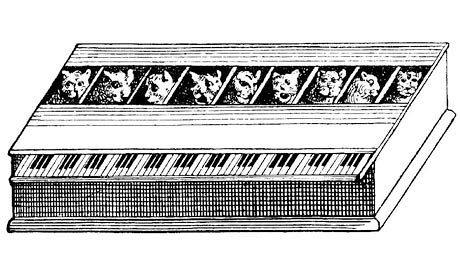
A bafflingly cruel and nonsensical experiment, and we might rejoice to know it probably never took place. But the bizarre idea of the cat piano, or Katzenklavier, did not spring from the weird delusions of one sadistic psychiatrist. It was supposedly invented by German polymath and Jesuit scholar Athanasius Kircher (1602–1680), who has been called “the last Renaissance man” and who made pioneering discoveries in the fields of microbiology, geology, and comparative religion. He was a serious scholar and a man of science. Maybe the Katzenklavier was intended as a sick joke that others took seriously—and for a very long time at that. The illustration of a Katzenklavier above dates from 1667, the one below from 1883.
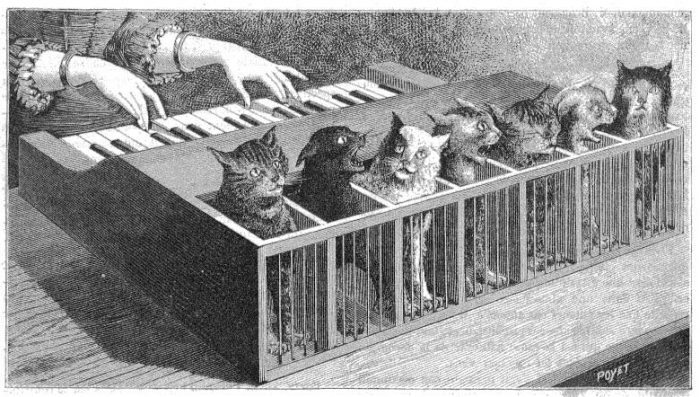
Kircher’s biographer John Glassie admits that, for all his undoubted brilliance, several of his “actual ideas today seem wildly off-base; if not simply bizarre” as well as “inadvertently amusing, right, wrong, half-right, half-baked, ridiculous….” You get the idea. He was an eccentric, not a psychopath. McNamee points to other, likely apocryphal, stories in which cats were supposedly used as instruments. Perhaps, cruel as it seems to us, the cat piano seemed no crueler in previous centuries than the way we taunt our cats today to make them perform for animated GIFs.
But to the cats these distinctions are meaningless. From their point of view, there is no other way to describe the Katzenklavier than as a sinister, terrifying torture device, and those who might use it as monstrous villains. Personally I’d like to give cats the last word on the subject of the Katzenklavier—or at least a few fictional animated, walking, talking, singing cats. Watch the short animation at the top, in which Nick Cave reads a poem by Eddie White about talented cat singers who mysteriously go missing, scooped up by a human for a “harpsichord of harm, the cruelest instrument to spawn from man’s gray cerebral soup.” The story has all the dread and intrigue of Edgar Allan Poe’s best work, and it is in such a milieu of gothic horror that the Katzenklavier belongs.
The Cat Piano narrated by Nick Cave will be added to our list of Free Animations, a subset of our meta collection, 4,000+ Free Movies Online: Great Classics, Indies, Noir, Westerns, Documentaries & More
Related Content:
What People Named Their Cats in the Middle Ages: Gyb, Mite, Méone, Pangur Bán & More
Cats in Japanese Woodblock Prints: How Japan’s Favorite Animals Came to Star in Its Popular Art
Cats in Medieval Manuscripts & Paintings
Josh Jones is a writer and musician based in Durham, NC. Follow him at @jdmagness
Read More...The First Animation That Hayao Miyazaki Directed on His Own: Watch Footage from the Pilot of Yuki’s Sun (1972)
Hayao Miyazaki began his career as an animator in 1963, getting in the door at Toei Animation not long before the company ceased to hire regularly. Miyazaki’s equally retirement-resistant contemporary Tetsuya Chiba, already well on his way to fame as a mangaka, or comic artist, published the series Yuki no Taiyou, or Yuki’s Sun, that same year. But the paths of their work wouldn’t cross until 1972, when Yuki no Taiyou was adapted into a pilot for a prospective animated series, the very first project Miyazaki — who had by that point amassed a good deal of experience as not just a key animator and collaborator with Studio Ghibli co-founder-to-be Isao Takahata, but also as a mangaka himself — directed solo.
Despite having been orphaned as an infant, the titular Yuki grows into a high-spirited tomboy so cheerful as to have developed the odd habit of physically striking other people when she gets too happy.
And as with so many parentless protagonists in children’s fiction, she has not just a distinctive personality but also a story-driving desire to discover the truth about her origins — which, it’s intimated, may not be ordinary, and may indeed be special. Her search for her mother sends her on a quest through mountain, valley, wood, and, given the setting of Japan’s northernmost island of Hokkaido, a great deal of snow (the Japanese word for which is a homophone of Yuki’s name).
Alas, this is a quest television audiences would never see, since the plot for Yuki no Taiyou, footage from which you can see in the five-minute teaser above, didn’t draw a network order for a full series. In some respects, it seems conceptually similar to Sasurai no Shoujo Nell, or Wandering Girl Nell, a voluminously loose adaptation of Charles Dickens’ The Old Curiosity Shop that aired in Japan at the end of the seventies. By that time, Miyazaki had completed work on his first animated feature as director, The Castle of Cagliostro. A few years thereafter, he would adapt his own manga Nausicaä of the Valley of the Wind into a motion picture now widely considered the debut of the lavish, captivating Studio Ghibli style — and whose eponymous protagonist has more than a little in common with the adventurous, nature-loving Yuki.
Related content:
Watch Hayao Miyazaki Animate the Final Shot of His Final Feature Film, The Wind Rises
Hayao Miyazaki’s Universe Recreated in a Wonderful CGI Tribute
Based in Seoul, Colin Marshall writes and broadcasts on cities, language, and culture. His projects include the Substack newsletter Books on Cities and the book The Stateless City: a Walk through 21st-Century Los Angeles. Follow him on Twitter at @colinmarshall or on Facebook.
Read More...The Rolling Stones Introduce Bluesman Howlin’ Wolf on US TV, One of the “Greatest Cultural Moments of the 20th Century” (1965)
Howlin’ Wolf may well have been the greatest blues singer of the 20th century. Certainly many people have said so, but there are other measurements than mere opinion, though it’s one I happen to share. The man born Chester Arthur Burnett also had a profound historical effect on popular culture, and on the way the Chicago blues carried “the sound of Jim Crow,” as Eric Lott writes, into American cities in the north, and into Europe and the UK. Recording for both Chess and Sun Records in the 50s (Sam Phillips said of his voice, “It’s where the soul of man never dies”), Burnett’s raw sound “was at once urgently urban and country plain… southern and rural in instrumentation and howlingly electric in form.”
He was also phenomenal on stage. His hulking six-foot-six frame and intense glowering stare belied some very smooth moves, but his finesse only enhanced his edginess. He seemed at any moment like he might actually turn into a wolf, letting the impulse give out in plaintive, ragged howls and prowls around the stage. “I couldn’t do no yodelin’,” he said, “so I turned to howlin’. And it’s done me just fine.” He played a very mean harmonica and did acrobatic guitar tricks before Hendrix, picked up from his mentor Charlie Patton. And he played with the best musicians, in large part because he was known to pay well and on time. If you wanted to play electric blues, Howlin’ Wolf was a man to watch.
This reputation was Wolf’s entrée to the stage of ABC variety show Shindig! in 1965, opening for the Rolling Stones. He had just returned from his 1964 tour of Europe and the UK with the American Folk Blues Festival, playing to large, appreciative crossover crowds. He’d also just released “Killing Floor,” a record Ted Gioia notes “reached out to young listeners without losing the deep blues feeling that stood as the cornerstone of Wolf’s sound.” The following year, the Rolling Stones insisted that Shindig!’s producers “also feature either Muddy Waters or Howlin’ Wolf” before they would go on the show. Wolf won out over his rival Waters, toned down the theatrics of his act for a more prudish white audience, and “for the first time in his storied career, the celebrated bluesman performed on a national television broadcast.”
Why is this significant? Over the decades, the Stones regularly performed with their blues heroes. But this was new media ground. Brian Jones’ shy, starstruck introduction to Wolf before his performance above conveys what he saw as the importance of the moment. Jones’ biographer Paul Trynka may overstate the case, but in some degree at least, Wolf’s appearance on Shindig! “built a bridge over a cultural abyss and connected America with its own black culture.” The show constituted “a life-changing moment, both for the American teenagers clustered round the TV in their living rooms, and for a generation of blues performers who had been stuck in a cultural ghetto.” One of these teenagers described the event as “like Christmas morning.”
Eric Lott points to the show’s formative importance to the Stones, who “sit scattered around the Shindig! set watching Wolf in full-metal idolatry” as he sings “How Many More Years,” a song Led Zeppelin would later turn into “How Many More Times.” (See the Stones do their Shindig! performance of jangly, subdued “The Last Time,” here.) The performance represents more, however, than the “British Invasion embrace” of the blues. It shows Wolf’s mainstream breakout, and the Stones paying tribute to a founding father of rock and roll, an act of humility in a band not especially known or appreciated for that quality.
“It was altogether appropriate,” says music writer Peter Guralnick, “that they would be sitting at Wolf’s feet… that’s what it represented. His music was not simply the foundation or the cornerstone; it was the most vital thing you could ever imagine.” Guralnick, notes John Burnett at NPR, calls it “one of the greatest cultural moments of the 20th century.” At minimum, Burnett writes, it’s “one of the most incongruous moments in American pop music”—up until the mid-sixties, at least.
Whether or not the moment could live up to its legend, the people involved saw it as groundbreaking. The venerable Son House sat in attendance—“the man who knew Robert Johnson and Charley Patton,” remarked Brian Jones in awe. And the Rolling Stone positioning himself in deference to “Chicago blues,” Trynka writes, “uncompromising music aimed at a black audience, was a radical, epoch-changing step, both for baby boomer Americans and the musicians themselves. Fourteen and fifteen-year-old kids… hardly understood the growth of civil rights; but they could understand the importance of a handsome Englishman who described the mountainous, gravel-voiced bluesman as a ‘hero’ and sat smiling at his feet.”
Related Content:
Chuck Berry Takes Keith Richards to School, Shows Him How to Rock (1987)
The Rolling Stones Jam With Their Idol, Muddy Waters
Josh Jones is a writer and musician based in Durham, NC. Follow him at @jdmagness
Read More...Behold the Kräuterbuch, a Lavishly Illustrated Guide to Plants and Herbs from 1462

When Konrad von Megenberg published his Buch der Natur in the mid-fourteenth century, he won the distinction of having assembled the very first natural history in German. More than half a millennium later, the book still fascinates — not least for its depictions of cats, previously featured here on Open Culture. Even the works derived from it have charms of their own: take the Kräuterbuch (or “Book of Herbs”) from 1462, in which Duke Albrecht III of Bavaria’s personal physician Johannes Hartlieb adapts a section of the Buch der Natur with its own full complement of 160 illustrations.

“Hartlieb’s subject is plants, mostly herbs, and their medical uses,” says the Library of Congress, on whose site you can view and download the book. “What makes the Kräuterbuch special is the side-by-side presentation of text and images. The high cost of such a richly decorated book makes it unlikely that it was actually used by doctors or pharmacists of the time.”

But even if they lack a certain scientific practicality, these botanical presentations have a bright, simple boldness that, in some respect, suits our visual aesthetics here in the early twenty-first century; you could call it a renaissance equivalent of flat design.

“Each chapter of the Kräuterbuch follows a traditional system of botanical classification derived from the Greek philosopher Theophrastus,” writes Hunter Dukes at the Public Domain Review, which also offers a gallery of the book’s illustrations. “Animals are portrayed as pharmacologically knowledgeable, such as in an account of deer rubbing themselves on pepperweed (Lepidium latifolium) to remove hunters’ arrows”; another section holds that “deadly carrots (Thapsia) aid beggars in their deceptions — rubbed on the face, they will produce signs of leprosy, which can also be cured with vinegar.” Discussing the poisonous mandrake (see image immediately above), Hartlieb carries forward von Megenberg’s suggestion “that its magical properties should be kept secret from commoners,” who, naturally, would never be in possession of such a lavish tome. Now all of us can access the Kräuterbuch — and most of us know that we’d be better off not messing around with mandrake at all.

Related content:
Based in Seoul, Colin Marshall writes and broadcasts on cities, language, and culture. His projects include the Substack newsletter Books on Cities and the book The Stateless City: a Walk through 21st-Century Los Angeles. Follow him on Twitter at @colinmarshall or on Facebook.
Read More...Jimi Hendrix Opens for The Monkees on a 1967 Tour; Then Flips Off the Crowd and Quits
It’s easy to dismiss The Monkees. Critics and listeners have been doing it since the sixties, although the band has also come in for its share of reappraisals, particularly for their psych-rock album Head. (That’s the soundtrack from the 1968 Jack Nicholson-directed art film of the same name: “One of the weirdest and best rock movies ever made.”) But whatever you think of The Monkees’ music, you have to admit: they had one of the most extraordinary careers of any band in rock and roll.
They began in 1965 as a troupe of actors in a sitcom that Monkee Micky Dolenz described as being about “an imaginary band… that wanted to be The Beatles,” but “was never successful.” In a very short time, the four members—Dolenz, Peter Tork, Davy Jones, and Michael Nesmith—had mastered their instruments and learned to write their own original songs.
It seemed that almost overnight, they’d gone from lip-syncing boy band comedians to genuine pop stars. (Dolenz describes it as “the equivalent of Leonard Nimoy really becoming a Vulcan.”)
In the summer of 1967, “at the height of Monkeemania,” The Monkees Almanac informs us, the band embarked on a 28-city tour through the United States and England, opening at the Hollywood Bowl just five days after their TV show collected two Primetime Emmy Awards. The oddest thing about the tour: for eight dates, Jimi Hendrix opened for the band with his newly formed Experience, “one of the strangest pairings in rock and roll history.” But at the time, writes Mental Floss, “the pairing actually made a little bit of sense for both acts.” The Monkees wanted credibility, and Hendrix needed a U.S. audience.
He was already a huge star in England, but, despite blowing the crowd away at the Monterey Pop Festival that spring, Hendrix was mostly an unknown quantity to U.S. music buyers. But Dolenz had seen him play in New York and was suitably impressed. When he suggested Hendrix for the tour, the Experience’s manager Mike Jeffery jumped at the chance, thinking he could leverage The Monkees’ huge crowds to break Hendrix in the States. Hendrix himself expressed much less enthusiasm, having called The Monkees’ music “dishwater” in a Melody Maker interview.
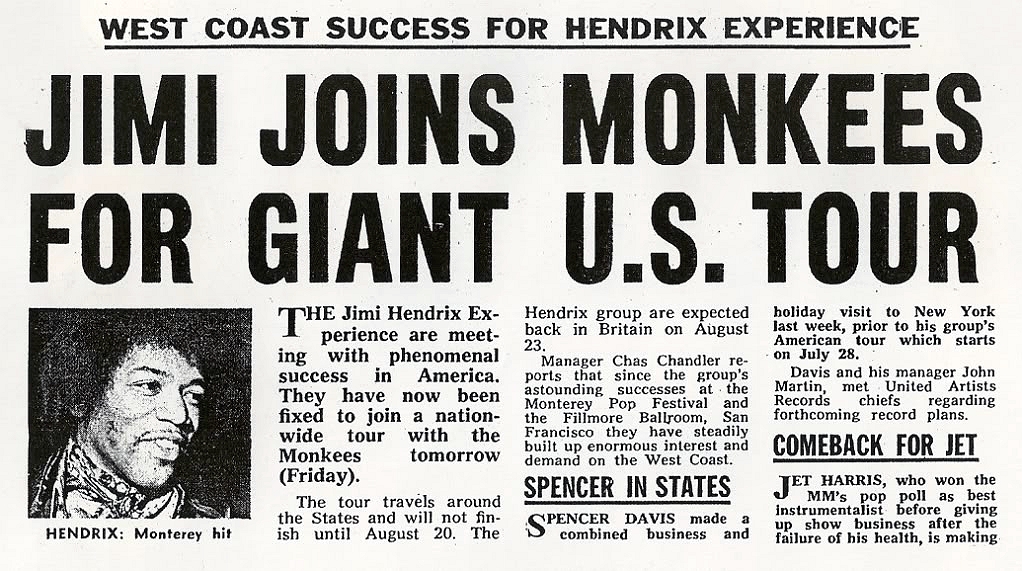
So how did it go? Not well, as you might imagine—certainly not the “West Coast Success” the headline at the top of the post trumpets. Monkees fans—mostly young kids dragging along parental chaperons—had no idea what to make of Hendrix. “Jimi would amble out onto the stage, fire up the amps and break into ‘Purple Haze,’ ” wrote Dolenz in his autobiography, “and the kids in the audience would instantly drown him out with, ‘We Want Davy!!’ God, it was embarrassing.” Although Peter Tork especially among The Monkees’ members was overjoyed to have Hendrix on the tour, he later recalled the pairing as a singularly bad idea: “This is screaming, scaring-your-daddy music compared with The Monkees. It didn’t cross anybody’s mind that it wasn’t gonna fly. And there’s poor Jimi, and the kids go, ‘We want The Monkees, we want The Monkees.’ ”
You can see Tork describe the ill-fated match-up in a hilariously dated MTV clip above. Despite his reservations, Hendrix got on very well with The Monkees. Not so much with their obnoxious fans. “The Jimi Hendrix Experience played just eight of the 29 scheduled tour dates,” writes Mental Floss, “and then on July 16, 1967, Jimi flipped the Forest Hills, Queens, New York, audience off, threw down his guitar and walked away from Monkeemania.” (History.com gives the date as July 17.) No great loss for either band. A couple of months later, Melody Maker presented Hendrix with a “World’s Top Musician” award, and his music hit the U.S. mainstream as well. And The Monkees finished the tour and went on to make Head, the film and album, which, depending on whom you ask, either ruined their rock cred or defined it forever.
Related Content:
Jimi Hendrix Unplugged: Two Great Recordings of Hendrix Playing Acoustic Guitar
How the 1968 Psychedelic Film Head Destroyed the Monkees & Became a Cult Classic
Watch Frank Zappa Play Michael Nesmith (RIP) on The Monkees–and Vice Versa (1967)
How Science Fiction Formed Jimi Hendrix
Josh Jones is a writer and musician based in Durham, NC. Follow him at @jdmagness
Read More...Stephen Fry Explains Why Artificial Intelligence Has a “70% Risk of Killing Us All”
Apart from his comedic, dramatic, and literary endeavors, Stephen Fry is widely known for his avowed technophilia. He once wrote a column on that theme, “Dork Talk,” for the Guardian, in whose inaugural dispatch he laid out his credentials by claiming to have been the owner of only the second Macintosh computer sold in Europe (“Douglas Adams bought the first”), and never to have “met a smartphone I haven’t bought.” But now, like many of us who were “dippy about all things digital” at the end of the last century and the beginning of this one, Fry seems to have his doubts about certain big-tech projects in the works today: take the “$100 billion plan with a 70 percent risk of killing us all” described in the video above.
This plan, of course, has to do with artificial intelligence in general, and “the logical AI subgoals to survive, deceive, and gain power” in particular. Even in this relatively early stage of development, we’ve witnessed AI systems that seem to be altogether too good at their jobs, to the point of engaging in what would count as deceptive and unethical behavior were the subject a human being. (Fry cites the example of a stock market-investing AI that engaged in insider trading, then lied about having done so.) What’s more, “as AI agents take on more complex tasks, they create strategies and subgoals which we can’t see, because they’re hidden among billions of parameters,” and quasi-evolutionary “selection pressures also cause AI to evade safety measures.”
In the video, MIT physicist, and machine learning researcher Max Tegmark speaks portentously of the fact that we are, “right now, building creepy, super-capable, amoral psychopaths that never sleep, think much faster than us, can make copies of themselves, and have nothing human about them whatsoever.” Fry quotes computer scientist Geoffrey Hinton warning that, in inter-AI competition, “the ones with more sense of self-preservation will win, and the more aggressive ones will win, and you’ll get all the problems that jumped-up chimpanzees like us have.” Hinton’s colleague Stuart Russell explains that “we need to worry about machines not because they’re conscious, but because they’re competent. They may take preemptive action to ensure that they can achieve the objective that we gave them,” and that action may be less than impeccably considerate of human life.
Would we be better off just shutting the whole enterprise down? Fry raises philosopher Nick Bostrom’s argument that “stopping AI development could be a mistake, because we could eventually be wiped out by another problem that AI could’ve prevented.” This would seem to dictate a deliberately cautious form of development, but “nearly all AI research funding, hundreds of billions per year, is pushing capabilities for profit; safety efforts are tiny in comparison.” Though “we don’t know if it will be possible to maintain control of super-intelligence,” we can nevertheless “point it in the right direction, instead of rushing to create it with no moral compass and clear reasons to kill us off.” The mind, as they say, is a fine servant but a terrible master; the same holds true, as the case of AI makes us see afresh, for the mind’s creations.
Related content:
Stephen Fry Explains Cloud Computing in a Short Animated Video
Stephen Fry Takes Us Inside the Story of Johannes Gutenberg & the First Printing Press
Neural Networks for Machine Learning: A Free Online Course Taught by Geoffrey Hinton
Based in Seoul, Colin Marshall writes and broadcasts on cities, language, and culture. His projects include the Substack newsletter Books on Cities and the book The Stateless City: a Walk through 21st-Century Los Angeles. Follow him on Twitter at @colinmarshall or on Facebook.
Read More...Watch the 1896 Film The Pistol Duel, a Startling Re-Creation of the Last Days of Pistol Dueling in Mexico
One sometimes hears lamented the tendency of movies to depict Mexico — and in particular, its capital Mexico City — as a threatening, rough-and-tumble place where human life has no value. Such concerns turn out to be nearly as old as cinema itself, having first been raised in response to a roughly thirty-second-long film called Duel au pistolet from 1896. The French title owes to its having a French director: Gabriel Veyre, a contemporary of the cinema-pioneering Lumière brothers who first left France for Latin America in order to screen their early films there.
On his travels, Veyre both exhibited Lumière films and made his own. “Between 1896 and 1897, he directed and produced 35 films in Mexico,” writes Jared Wheeler at Moviegoings. “Many of those films feature the Mexican president Porfirio Díaz in daily activities.” The action captured in Duel au pistolet is “most probably a recreation of a famous duel that had taken place in September 1894, between Colonel Francisco Romero and Jose Verástegui, the postmaster general.” It seems that Romero had overheard Verástegui accusing him of not only sleeping with a mutual friend’s wife, but also of having pulled strings to get that same friend a post in the government.
His honor insulted, Romero demanded that Verástegui settle the matter with pistols in Chapultepec Park. By that time, dueling was a technically illegal but still-common practice, one “governed by a complex system of social norms that were, for some, a source of national pride as a sign of Mexico’s modernity, and of its kinship with other European nations like France.” But if a duel were to be re-created and screened on film out of its cultural context, “would other nations recognize it as an honorable, dignified ritual, or simply see it as a sign that everyday life in Mexico was characterized by violence and barbarism?”
What still impresses about Duel au pistolet (a colorized version of which appears above), nearly 130 years after its debut, is less the impression it gives of Mexico than its startling realism, which has given even some modern-day viewers reason to wonder whether it’s really a re-enactment. Many “have commented on the naturalism of the duelist’s death,” Wheeler writes, “one of the first to be depicted on screen and very much in contrast to the melodramatic style that was more typical of this time.” In real life, it was Verástegui who lost, and Romero’s subsequent trial and imprisonment meant that Mexico’s days of dueling were well and truly numbered — but the history of onscreen violence had only just begun.
Related content:
The Last Duel Took Place in France in 1967, and It’s Caught on Film
Drunk History: An Intoxicated Look at the Famous Alexander Hamilton-Aaron Burr Duel
Watch a Witty, Gritty, Hardboiled Retelling of the Famous Aaron Burr-Alexander Hamilton Duel
Watch the Film That Invented Cinema: Workers Leaving the Lumière Factory in Lyon (1895)
Dueling as a Film Trope: Pretty Much Pop #109 Considers The Last Duel and Its Genre
Based in Seoul, Colin Marshall writes and broadcasts on cities, language, and culture. His projects include the Substack newsletter Books on Cities and the book The Stateless City: a Walk through 21st-Century Los Angeles. Follow him on Twitter at @colinmarshall or on Facebook.
Read More...Sex and Alcohol in Medieval Times: A Look into the Pleasures of the Middle Ages
Playing video games, road-tripping across America, binge-listening to podcasts, chatting with artificial intelligence: these are a few of our modern pleasures not just unknown to, but unimaginable by, humanity in the Middle Ages. Yet medieval people were, after all, people, and as Terence put it more than a millennium before their time, humani nil a me alienum puto. For us moderns, it’s a common blunder to regard distant eras through the lens of our own standards and expectations, which prevents us from truly understanding how our listeners lived and thought. But perhaps we can begin from a considerable patch of common ground: medievals, too, liked their sex and booze.
Such are the points emphasized by medieval historian Eleanor Janega in these episodes of History Hit, which examine the more-than-age-old enjoyments in which people indulged between antiquity and modernity. Our received image of Europe in the Middle Ages may be one of Church-dominated, dankly pleasure-free societies, but Janega and historian of sexuality Kate Lister point out that, strict though the religious dictates may have been about sexual activity and other matters besides, many simply ignored them. (And though they may have lacked access to daily hot showers, we can rest assured that they were much more concerned with how they smelled than we might imagine.) In any case, reproduction was one thing, and courtly love — or indeed commercial love — quite another.
As Billy Crystal famously joked, “Women need a reason to have sex. Men just need a place.” In the Middle Ages, the place was often a problem for women as well as men, but also for nobles as well as commoners (though some royalty did enjoy the benefit of a curtain around their four-poster bed, which afforded at least the illusion of privacy). It seems to have been much easier to find somewhere to drink, according to Janega’s episode about alcohol. In it, she visits a fine example of “the humble pub,” where even medieval Brits would go to drink their ale, beer not yet having been invented — and to tell their stories, a practice that would become so deeply ingrained in the culture as to provide a formal foundation for the Canterbury Tales. Even if Chaucer, as a pub-owner interviewee reminds us, invented English literature as we know it, we should bear in mind that sex hardly began with Wife of Bath.
Related content:
How to Make Medieval Mead: A 13th Century Recipe
What Sex Was Like in Medieval Times?: Historians Look at How People Got It On in the Dark Ages
How Toilets Worked in Ancient Rome and Medieval England
Based in Seoul, Colin Marshall writes and broadcasts on cities, language, and culture. His projects include the Substack newsletter Books on Cities and the book The Stateless City: a Walk through 21st-Century Los Angeles. Follow him on Twitter at @colinmarshall or on Facebook.
Read More...Buckminster Fuller Tells the World “Everything He Knows” in a 42-Hour Lecture Series (1975)
History seems to have settled Buckminster Fuller’s reputation as a man ahead of his time. He inspires short, witty popular videos like YouTuber Joe Scott’s “The Man Who Saw The Future,” and the ongoing legacy of the Buckminster Fuller Institute (BFI), who note that “Fuller’s ideas and work continue to influence new generations of designers, architects, scientists and artists working to create a sustainable planet.”
Brilliant futurist though he was, Fuller might also be called the man who saw the present and the past—as much as a single individual could seemingly hold in their mind at once. He was “a man who is intensely interested in almost everything,” wrote Calvin Tomkins at The New Yorker in 1965, the year of Fuller’s 70th birthday. Fuller was as eager to pass on as much knowledge as he could collect in his long, productive career, spanning his early epiphanies in the 1920s to his final public talks in the early 80s.
“The somewhat overwhelming effect of a Fuller monologue,” wrote Tomkins, “is well known today in many parts of the world.” His lectures leapt from subject to subject, incorporating ancient and modern history, mathematics, linguistics, architecture, archaeology, philosophy, religion, and—in the example Tomkins gives—“irrefutable data on tides, prevailing winds,” and “boat design.” His discourses issue forth in wave after wave of information.
Fuller could talk at length and with authority about virtually anything—especially about himself and his own work, in his own special jargon of “unique Bucky-isms: special phrases, terminology, unusual sentence structures, etc.,” writes BFI. He may not always have been particularly humble, yet he spoke and wrote with a lack of prejudice and an open curiosity and that is the opposite of arrogance. Such is the impression we get of Fuller in the series of talks he recorded ten years after Tomkin’s New Yorker portrait.
Made in January of 1975, Buckminster Fuller: Everything I Know captured Fuller’s “entire life’s work” in 42 hours of “thinking out loud lectures [that examine] in depth all of Fuller’s major inventions and discoveries from the 1927 Dymaxion car, house, car and bathroom, through the Wichita House, geodesic domes, and tensegrity structures, as well as the contents of Synergetics. Autobiographical in parts, Fuller recounts his own personal history in the context of the history of science and industrialization.”
He begins, however, in his first lecture at the top, not with himself, but with his primary subject of concern: “all humanity,” a species that begins always in nakedness and ignorance and manages to figure it out “entirely by trial and error,” he says. Fuller marvels at the advances of “early Hindu and Chinese” civilizations—as he had at the Maori in Tomkin’s anecdote, who “had been among the first peoples to discover the principles of celestial navigation” and “found a way of sailing around the world… at least ten thousand years ago.”
The leap from ancient civilizations to “what is called World War I” is “just a little jump in information,” he says in his first lecture, but when Fuller comes to his own lifetime, he shows how many “little jumps” one human being could witness in a lifetime in the 20th century. “The year I was born Marconi invented the wireless,” says Fuller. “When I was 14 man did get to the North Pole, and when I was 16 he got to the South Pole.”
When Fuller was 7, “the Wright brothers suddenly flew,” he says, “and my memory is vivid enough of seven to remember that for about a year the engineering societies were trying to prove it was a hoax because it was absolutely impossible for man to do that.” What it showed young Bucky Fuller was that “impossibles are happening.” If Fuller was a visionary, he redefined the word—as a term for those with an expansive, infinitely curious vision of a possible world that already exists all around us.
See Fuller’s complete lecture series, Everything I Know, at the Internet Archive, and read edited transcripts of his talks at the Buckminster Fuller Institute.
Everything I Know will be added to our collection, 1,700 Free Online Courses from Top Universities.
Related Content:
Bertrand Russell & Buckminster Fuller on Why We Should Work Less, and Live and Learn More
A Harrowing Test Drive of Buckminster Fuller’s 1933 Dymaxion Car: Art That Is Scary to Ride
The Life & Times of Buckminster Fuller’s Geodesic Dome: A Documentary
Buckminster Fuller Documented His Life Every 15 Minutes, from 1920 Until 1983
Josh Jones is a writer and musician based in Durham, NC. Follow him at @jdmagness
Read More...Support Us
We're hoping to rely on loyal readers, rather than erratic ads. Please click the Donate button and support Open Culture. You can use Paypal, Venmo, Patreon, even Crypto! We thank you!

About Us

Open Culture scours the web for the best educational media. We find the free courses and audio books you need, the language lessons & educational videos you want, and plenty of enlightenment in between.
Advertise With Us
FREE UPDATES!
GET OUR DAILY EMAIL
Get the best cultural and educational resources on the web curated for you in a daily email. We never spam. Unsubscribe at any time.
FOLLOW ON SOCIAL MEDIA
Open Culture editor Dan Colman scours the web for the best educational media. He finds the free courses and audio books you need, the language lessons & movies you want, and plenty of enlightenment in between.
Advertise With Us

