Meet Madame Inès Decourcelle, One of the Very First Female Taxi Drivers in Paris (Circa 1908)
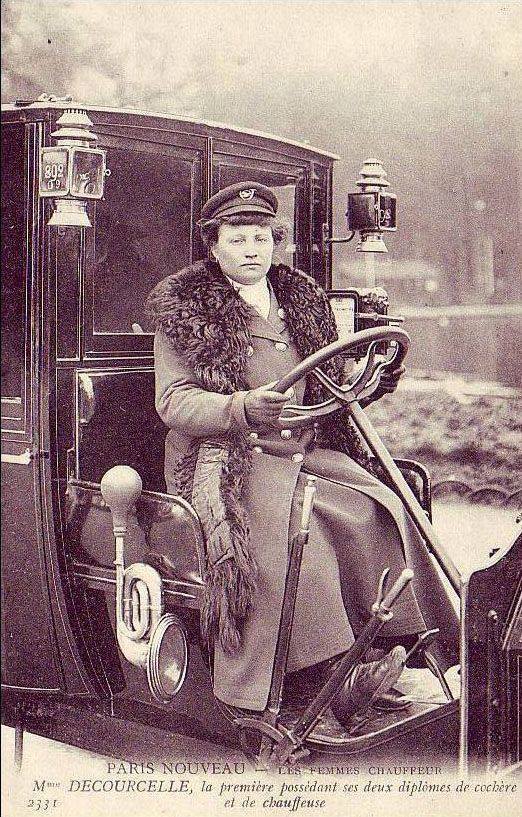
If you can read this, you almost certainly know the French word for a professional automobile driver. That’s because we use the same word in English: chauffeur. French nouns, unlike English ones, come in masculine and feminine varieties, and that -eur ending unmistakably indicates one of the former. What, then, to call a woman who works behind the wheel? Chauffeuse would be the natural option, if it didn’t already refer to a kind of fireside lounge chair. One could also feminize cocher, another word for driver, but cochère, too, is already taken by an arched entryway (which architectural detail, notably, meets the vehicular realm in the form of the porte-cochère).
As often, the difficulty of pinning down the right term here reflects the scarcity of the underlying concept. In much of the world today, driving isn’t considered the most feminine of occupations. That was even truer in the Paris of the early twentieth century, when the first woman to get her taxi license made history — or rather, when the first women to get their taxi licenses made history. A 1908 dispatch from the Motor-Car Journal’s Paris correspondent describes a certain Mademoiselle Gaby Pohlen as having “obtained her driver’s license to drive a motor taxicab from the Prefecture of Police.” Even at the time of writing, “her example has already been followed by Madame Decourcelle.”
According to Jeroen Booij at PreWarCar.com, however, “three ladies supposedly began an apprenticeship in 1906 to drive a motorized carriage in the City of Light. A lady named Madame Dufaut-Charnier supposedly got her degree as early as February 1907.” But Madame Inès Decourcelle “is believed to be the first to receive her full taxi licence in April 1908, making her the first woman in history to drive a taxi in the streets of Paris. The fact is that she became the subject of a number of daily newspaper articles claiming this, as she was seen on so many postcards from Paris naming her the first ‘femme chauffeur.’ ” After seeing one such story in Le Journal, another woman “wrote to the paper in a particularly irritated way, claiming that not Madame Decourcelle but she, Mademoiselle Gaby Pohlen, earned the title,” having started driving back in 1906.
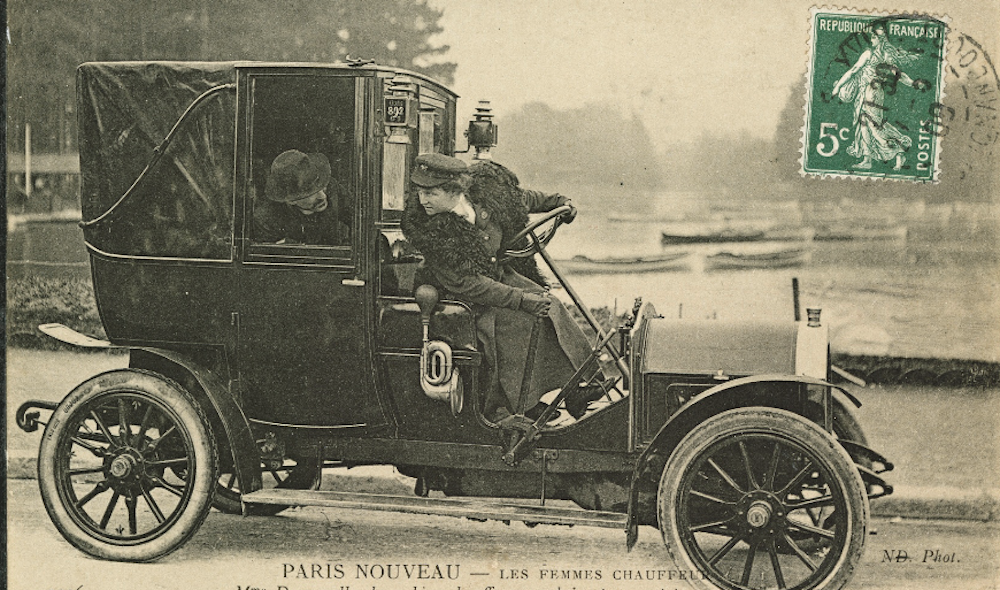
The commenters at PreWarCar.com have put some thought toward clarifying the matter. Given the era, when the automobile itself was still a novelty, one of them suspects confusion about “whether all those named were licensed horse-drawn or motor cab drivers,” explaining that Pohlen and Decourcelles “both reportedly obtained licenses to drive motor taxi-cabs in spring 1908.” While the photogenic and somewhat eccentric Pohlen may have started out first, “Mme. Decourcelles’ claim to fame was that she was the first to get “diplomas” as both a horse ‘cochère’ and a motor ‘chauffeuse.’ ” This, another commenter adds, was “an incredible achievement at the time,” no matter which word — or words — the Académie Française approves to describe it.
Related content:
Paris Had a Moving Sidewalk in 1900, and a Thomas Edison Film Captured It in Action
The Timeless Beauty of the Citroën DS, the Car Mythologized by Roland Barthes (1957)
Take a Virtual Drive through London, Tokyo, Los Angeles & 45 Other World Cities
Robert De Niro’s Taxi Cab License Used to Prepare for Taxi Driver (1976)
Based in Seoul, Colin Marshall writes and broadcasts on cities, language, and culture. His projects include the Substack newsletter Books on Cities and the book The Stateless City: a Walk through 21st-Century Los Angeles. Follow him on Twitter at @colinmarshall or on Facebook.
Read More...When the Grateful Dead Played at the Egyptian Pyramids, in the Shadow of the Sphinx (1978)
In September of 1978, the Grateful Dead traveled to Egypt and played three shows at the Great Pyramid of Giza, with the Great Sphinx looking over their shoulders. It wasn’t the first time a rock band played in an ancient setting. Pink Floyd performed songs in the middle of the Amphitheatre of Pompeii in October 1971. But Floyd performed to an “empty” house, playing to no live fans, only ghosts. (Watch footage here.) The Dead’s shows, on the other hand, were real gigs, attended by Deadheads who made the journey over, and they could thank Phil Lesh for putting it all in motion. Lesh later said, “it sort of became my project because I was one of the first people in the band who was on the trip of playing at places of power. You know, power that’s been preserved from the ancient world. The pyramids are like the obvious number one choice because no matter what anyone thinks they might be, there is definitely some kind of mojo about the pyramids.”
Logistically speaking, the concerts weren’t the easiest to stage. Rolling Stone reported that an “equipment truck got stuck in sand and had to be towed by camels.” Because the electricity in Egypt was an “a winkin’, blinkin’ affair,” Bob Weir later recalled, the jetlagged band had difficulties recording the first of the three shows. But, as with most adventures, the inconveniences were offset by the wondrous nature of the experience.
Weir captured it well when he said: “I got to a point where the head of the Sphinx was lined up with the top of the Great Pyramid, all lit up. All of a sudden, I went to this timeless place. The sounds from the stage — they could have been from any time. It was as if I went into eternity.” The Sphinx and Great Pyramid date back to roughly 2560 BC.
The Dead were joined on this trip by the counterculture author Ken Kesey (not to mention Bill Graham and Bill Walton) who apparently captured footage on Super‑8 reels. (Watch it above.) Kesey himself later tried to explain the symbolism of the visit, saying: “The people who were there recognized this as a respectful and holy event that went back to something we can all just barely glimpse, them and us both. Our relationship to ancient humans. To this place on the planet. To the planet’s place in the universe. All that cosmic stuff is what the Dead are based on. The Egyptians could understand that.”
At the very top of the post, you can see the Dead performing “Ollin Arageed,” with Egyptian oudist Hamza el-Din and other local musicians, before seguing into “Fire on the Mountain.” The clip gives you a good feel for the awe-inspiring scene. Just above, we have a longer playlist of performances that took place on September 16, 1978 — the same night there was a lunar eclipse. The complete 9/16/78 show can be streamed on Archive.org, as can the shows from 9/14 and 9/15. A 2CD/1 DVD package (Rocking the Cradle: Egypt 1978) captures the Dead’s visit and can be purchased online.
To get more on the Pyramid concerts, read Chapter 43 of Dennis McNally’s book, A Long Strange Trip: The Inside History of the Grateful Dead. And here you can see Dead & Co’s homage to the Egypt adventure at the Sphere in Vegas. Enjoy.
Related Content:
A Walking Tour Around the Pyramids of Giza: 2 Hours in Hi Def
Read More...The Page That Changed Comics Forever: Discover the Innovative 1950s Comic Book That Almost Went Unpublished
If you grew up reading American comic books during the second half of the twentieth century, you’ll be familiar with the seal of the Comics Code Authority. I remember seeing it stamped onto the upper-right corner of issues of titles from The Amazing Spider-Man to reprints of Carl Barks’ Scrooge McDuck stories to Jughead Double Digest, but I can’t say I paid it much mind at the time. This was in the nineteen-nineties, by which time the Comics Code itself has lost much of its force. But back when it was created, in 1954, it had as much restrictive power over the content of comic books as the “Hays Code” once had over motion pictures.
According to the video from Youtuber matttt above, the Comics Code was implemented in response to one publisher above all: EC Comics, whose grim and graphic titles like Tales from the Crypt and The Vault of Horror made both a big impact on popular culture and a dent in the reputation of the comics industry. Closing ranks, that industry formed the Comics Code Authority to enforce a regime of self-censorship, mangling EC in its gears just as it was about to publish one of the most innovative stories in its form: “Master Race,” the tale of an ex-SS officer in modern-day New York, by an artist named Bernard Krigstein.
At its height, EC was a veritable comics factory, with a set of procedures in place that ensured the efficient production of cheap thrills — often at considerable cost to the potential of the medium. Krigstein, who’d always harbored higher artistic aspirations, chafed at these limitations, finding such workarounds as subdividing rigidly defined panel spaces into sets of sequential images, the better to convey movement and action. Nowhere did this technique prove more effective than in “Master Race,” with its practically cinematic tour de force sequence in which the haunted Carl Reissman slips under the wheels of a passing subway train.
Quality takes time, and Krigstein missed the story’s deadline just before the Comics Code went into force. “Master Race” was published a few months later, albeit in one of EC’s new, sanitized, and thus much less popular titles. The methods of visual storytelling he refined have now become standard elements of comic art, but the medium’s enthusiasts can sense how far Krigstein could have gone, if not for the frustration that ultimately caused him to abandon comics for a career as a high-school teacher: “Something tremendous could have been done,” he said, “if only they’d let me do it.” With the Comics Code long since defunct — and now that EC’s most disturbing comics look tame — content has become a free-for-all. But what artist dares to be as bold as Krigstein in pushing forward the form?
Related content:
1950s Pulp Comic Adaptations of Ray Bradbury Stories Getting Republished
Why the Short-Lived Calvin and Hobbes Is Still One of the Most Beloved & Influential Comic Strips
How Art Spiegelman Designs Comic Books: A Breakdown of His Masterpiece, Maus
Based in Seoul, Colin Marshall writes and broadcasts on cities, language, and culture. His projects include the Substack newsletter Books on Cities and the book The Stateless City: a Walk through 21st-Century Los Angeles. Follow him on Twitter at @colinmarshall or on Facebook.
Read More...When Slavoj Žižek and Jordan Peterson Debated Capitalism Versus Marxism
Karl Marx was a German philosopher-historian (with a few other pursuits besides) who wrote in pursuit of an understanding of industrial society as he knew it in the nineteenth century and what its future evolution held in store. There are good reasons to read his work still today, especially if you have an interest in the history of economic and sociological theory, or in the time and places he lived. But in the almost century-and-a-half since his death — and more so during the twentieth century, during which the ostensibly Marxist project of the Soviet Union rose and fell — he’s turned from a historical figure into an iconic specter, representing either penetrating insight into or catastrophic delusion about the organization of human society.
It was surely Marx’s tendency to inflame strong opinions that got him placed at the center of a debate between the psychologist/cultural commentator Jordan Peterson and the philosopher/cultural theorist Slavoj Žižek. The event took place in 2019, at Toronto’s Sony Center, billed as a clash of the titans on the subject of “Happiness: Capitalism vs. Marxism.”
In fact, it ended up covering a wide range of twenty-first-century issues, with each of the two unorthodox, highly recognizable public intellectuals giving characteristic performances on the economic and political ideologies of the day. Yet they aren’t as opposed as one might have imagined: “I cannot but notice the irony of how Peterson and I, the participants in this duel of the century, are both marginalized by the official academic community,” Žižek remarks early on.
Indeed, writes the Guardian’s Stephen Marche, “the great surprise of this debate turned out to be how much in common the old-school Marxist and the Canadian identity politics refusenik had. One hated communism. The other hated communism but thought that capitalism possessed inherent contradictions. The first one agreed that capitalism possessed inherent contradictions.” Nevertheless, as in many a debate, the surprising common ground is more interesting than the predictable points of conflict, especially on themes broader than any set of ‑isms. “My basic dogma is, happiness should be treated as a necessary by-product,” says Žižek. “If you focus on it, you are lost.” To this proposition Peterson later gives his hearty assent. As for what, exactly, to focus on instead of happiness… well, that’s a matter of debate.
Related content:
Slavoj Žižek Calls Political Correctness a Form of “Modern Totalitarianism”
Karl Marx & the Flaws of Capitalism: Lex Fridman Talks with Professor Richard Wolff
Clash of the Titans: Noam Chomsky & Michel Foucault Debate Human Nature & Power on Dutch TV, 1971
Slavoj Žižek Responds to Noam Chomsky: ‘I Don’t Know a Guy Who Was So Often Empirically Wrong’
An AI Generated, Never-Ending Discussion Between Werner Herzog and Slavoj Žižek
Based in Seoul, Colin Marshall writes and broadcasts on cities, language, and culture. His projects include the Substack newsletter Books on Cities and the book The Stateless City: a Walk through 21st-Century Los Angeles. Follow him on Twitter at @colinmarshall or on Facebook.
Read More...The Cramps Play a Mental Health Hospital in Napa, California in 1978: The Punkest of Punk Concerts
“We’re The Cramps, and we’re from New York City, and we drove 3,000 miles to play for you people.” So begins one of the oddest but also the punkest of punk rock concerts in history, as The Cramps play for a crowd at a state mental hospital in Napa, California. The date was June 13, 1978, a time when Napa was more known for the hospital than for its burgeoning wine industry.
Lead vocalist Lux Interior made this introduction after the first number, “Mystery Plane.” The band played on a patio, several steps above the courtyard at the institution, while the band’s friends hung out with the 100 or so patients in attendance.
“And somebody told me you people are crazy, but I’m not so sure about that,” Lux continues in the video. “You seem to be all right to me.” Indeed, most everybody seems to be having a hell of a time, some dancing as if they’re at a sock hop, others just completely thrashing about.
This wasn’t the first band to have played at the institution, as the hospital’s Bart Swain, who invited The Cramps to Napa, often brought in musicians to expand the patients’ horizons. But on that night a video camera was also brought along to record the set. (Swain worried about preserving the anonymity of the residents.)
Another band on the bill, The Mutants, didn’t get videotaped, possibly because the sun had gone down around this time. Either way, it is a very rare slice of punk history, with few comparisons apart from the Sex Pistols playing Chelmsford prison and when a little known thrash metal band called Gobstopper played a Christmas party at a home for developmentally disabled kids and adults.
According to this article on the event, Napa State still stands but the chances of such a concert happening again are slim. The majority of its tenants are now both violent offenders and mentally unstable, too dangerous a venue for anybody to play, no matter how punk.
If you would like to support the mission of Open Culture, consider making a donation to our site. It’s hard to rely 100% on ads, and your contributions will help us continue providing the best free cultural and educational materials to learners everywhere. You can contribute through PayPal, Patreon, and Venmo (@openculture). Thanks!
Related Content:
Ted Mills is a freelance writer on the arts who currently hosts the artist interview-based FunkZone Podcast. You can also follow him on Twitter at @tedmills, read his other arts writing at tedmills.com and/or watch his films here.
Read More...Face to Face with Carl Jung: ‘Man Cannot Stand a Meaningless Life’ (1959)
Carl Gustav Jung, founder of analytic psychology and explorer of the collective unconscious, was born on July 26, 1875 in the village of Kesswil, in the Thurgau canton of Switzerland. Above, we present a fascinating 39-minute interview of Jung by John Freeman for the BBC program Face to Face. It was filmed at Jung’s home at Küsnacht, on the shore of Lake Zürich, and broadcast on October 22, 1959, when Jung was 84 years old. He speaks on a range of subjects, from his childhood and education to his association with Sigmund Freud and his views on death, religion and the future of the human race. At one point Freeman asks Jung whether he believes in God, and Jung seems to hesitate. “It’s difficult to answer,” he says. “I know. I don’t need to believe. I know.”
If you would like to support the mission of Open Culture, consider making a donation to our site. It’s hard to rely 100% on ads, and your contributions will help us continue providing the best free cultural and educational materials to learners everywhere. You can contribute through PayPal, Patreon, and Venmo (@openculture). Thanks!
Related Content:
The Famous Break Up of Sigmund Freud & Carl Jung Explained in a New Animated Video
How Carl Jung Inspired the Creation of Alcoholics Anonymous
Take Carl Jung’s Word Association Test, a Quick Route Into the Subconscious (1910)
Carl Jung’s Hand-Drawn, Rarely-Seen Manuscript The Red Book
Read More...
Behold James Sowerby’s Strikingly Illustrated New Elucidation of Colours (1809)
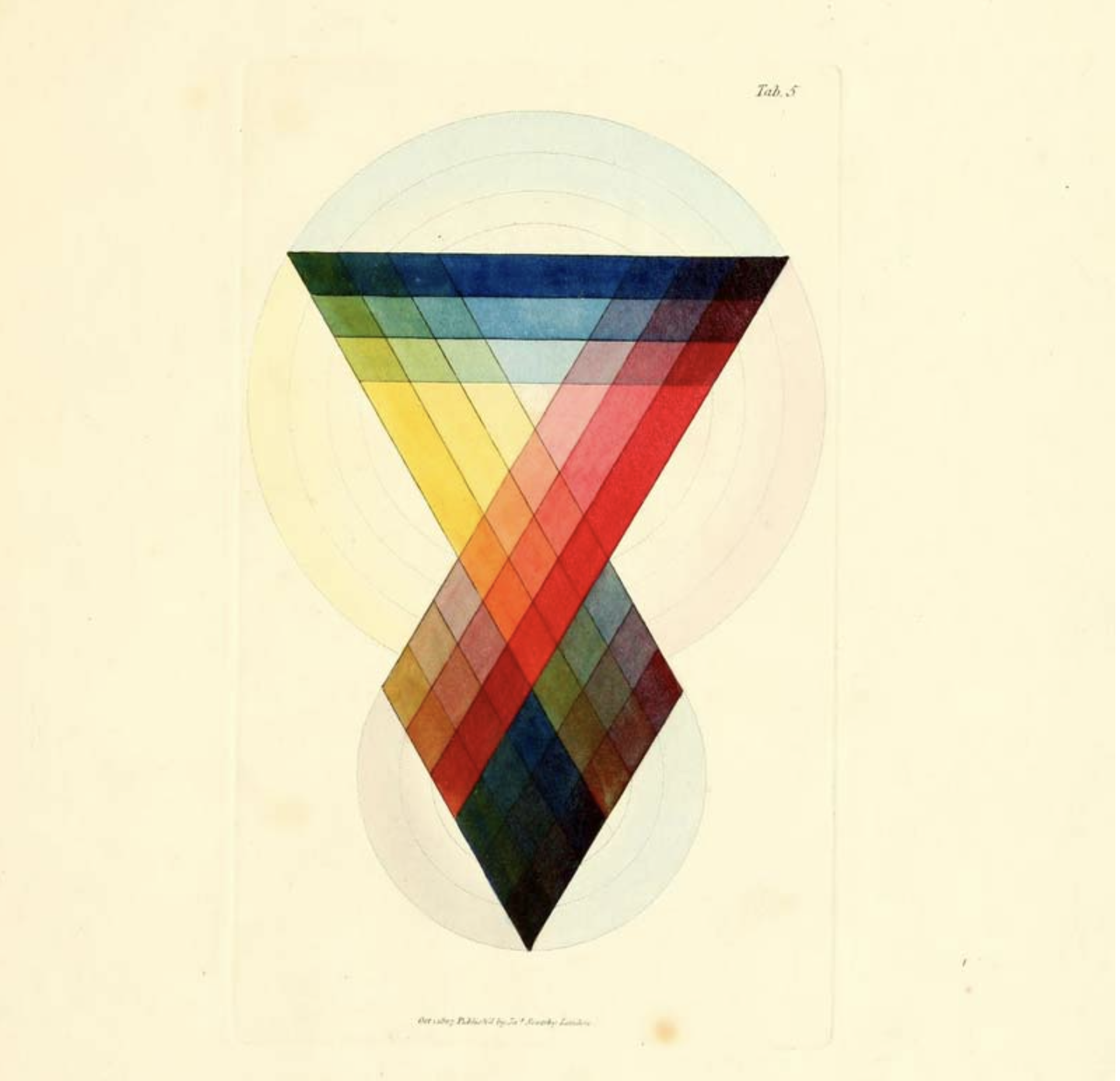
James Sowerby was an artist dedicated to the natural world. It thus comes as no surprise that he was also enormously interested in color, especially given the era in which he lived. Born in 1757, he made his professional start as a painter of flowers: a viable career path in those days, at least to those with Sowerby’s talent and dedication. It was in 1790 that he began what would end up being the 23-years-in-the-making English Botany, the landmark 36-volume work for which he remains best known today. Its 2,592 images captured the full range of his country’s flora, some of them in hues that readers had never before encountered in real life.
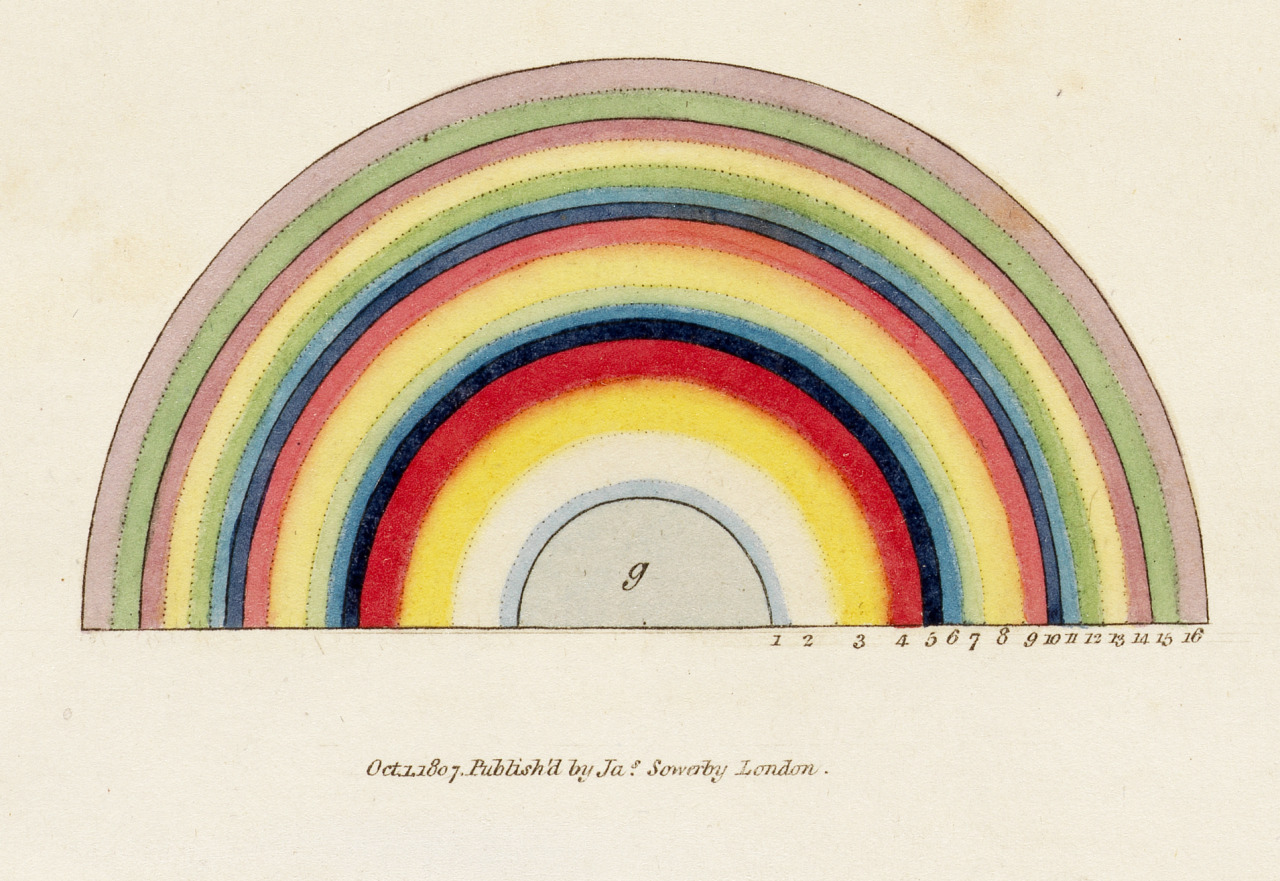
Alas, writes Joyce Dixon at Shaping Colour, “as the years passed, Sowerby watched with dismay as the bright hues of his hand-colored engravings began to fade and decay — the inevitable action of time and chemical instability working away at his watercolor pigments.” This inspired another ambitious artistic-scientific project: “to develop a standard, universal and permanent method of representing natural color.” In 1809, he invented a device he called the “Chromatometer,” which “presented a standard, measurable prismatic spectrum to the user.” Looking through a prism, that user could theoretically “pinpoint specific colors in the spectrum revealed by the prism, offering a standard reference for a specific hue” identified in reality.
The Chromatometer never proved viable, writes Paul Sorene at Flashbak, “because it was too fiddly and botanists often worked at night,” but the work that documented it lives on. A New Elucidation of Colours, Original, Prismatic and Material: Showing Their Concordance in the Three Primitives, Yellow, Red and Blue: and the Means of Producing, Measuring and Mixing Them: with some Observations on the Accuracy of Sir Isaac Newton presents a system of color theory based on red, yellow, and blue (unlike modern systems, not red, green, and blue). At the same time that Sowerby was developing it, his countryman Thomas Young was putting together a scientific theory of his own about how all perception of color arises from the eye combining just three wavelengths — a theory that turned out to be true.
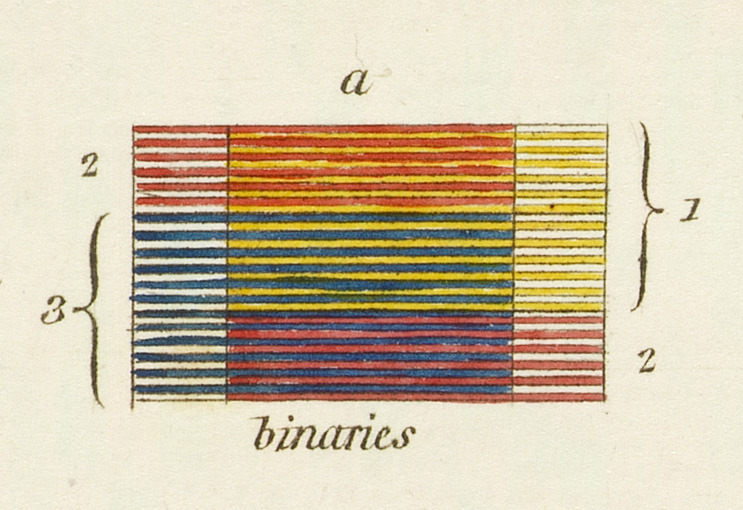
You can read or download A New Elucidation at the Wellcome Collection or the Internet Archive. These digitized versions include all of Sowerby’s original illustrations, for use with the Chromatometer and otherwise, which remain aesthetically compelling these two centuries later. But as underscored by the copious amounts of text, they reflect a time when humanity was coming into an understanding of not just how to replicate colors reliably and accurately, but of the nature of color itself. Sowerby may not have had the last word on the subject, despite having corrected no less a forebear than Newton, but his investigations can only have helped him look even more closely at the natural kingdoms he meant to capture — including that of minerals, which was also beckoning at the time.
via Flashbak
Related content:
A 900-Page Pre-Pantone Guide to Color from 1692: A Complete High-Resolution Digital Scan
The Vibrant Color Wheels Designed by Goethe, Newton & Other Theorists of Color (1665–1810)
Based in Seoul, Colin Marshall writes and broadcasts on cities, language, and culture. His projects include the Substack newsletter Books on Cities and the book The Stateless City: a Walk through 21st-Century Los Angeles. Follow him on Twitter at @colinmarshall or on Facebook.
Read More...The “Nonsense” Botanical Illustrations of Victorian Artist-Poet Edward Lear (1871–77)
Since the Victorian era, Edward Lear’s “The Owl and the Pussy-Cat” has been, for generation upon generation in the English-speaking world, the kind of poem that one simply knows, whether one remembers actually having read it or not. As with most such works that seep so permanently into the culture, it doesn’t quite represent its author in full. Though more or less of a piece with his celebrated “nonsense” verse (which I myself read in childhood, more than a century after its initial publication), it hints only vaguely at his intense artistic engagement with the natural world, through the observation and lively portrayal of which he made his name as an illustrator.
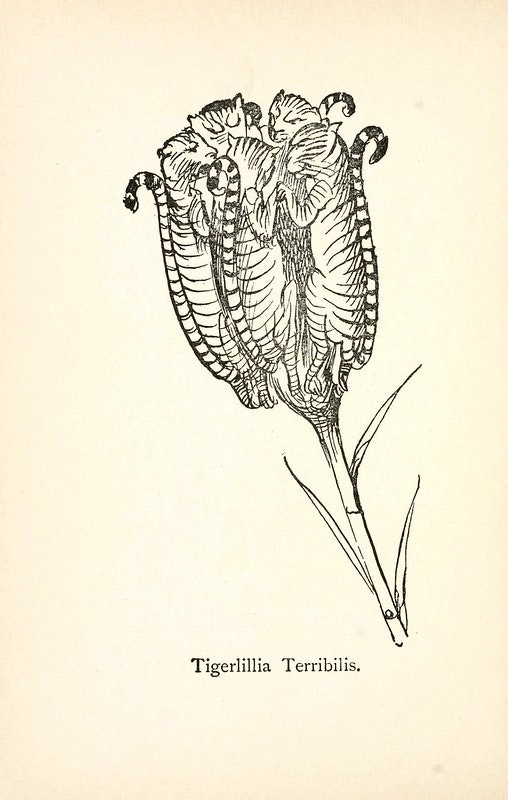
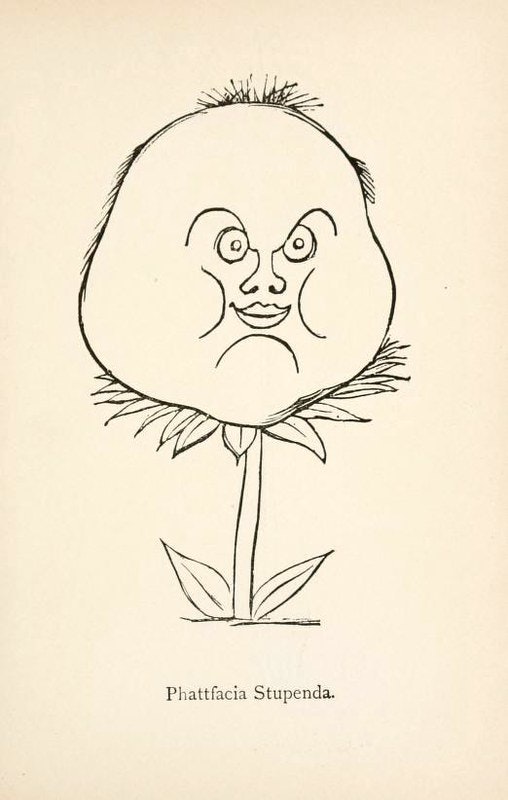
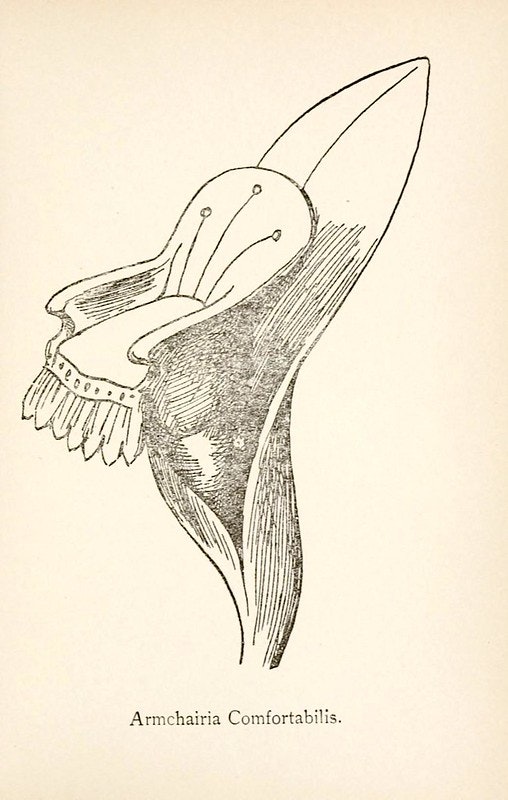
“Lear was an attentive and informed reader of Darwin; he worked with John Gould, the natural-history entrepreneur who had actually picked apart the varieties of finch that Darwin had brought back from the Galápagos Islands,” writes the New Yorker’s Adam Gopnik, noting that his work evidences a Linnaean obsession “with the power of naming, with sticking a tag on a thing which gives it a place at, and on, the table.” Lear gave Latin names to at least two real species of parrots, but he also fabricated such chimeras as Phattfacia Stupenda, Armchairia Comfortabilis, Tigerlilia Terribilis, examples of which he also illustrates in his Nonsense Botany series of the eighteen-seventies.
Lear’s “penchant for the natural world,” says The Dilettante, shaped his “knack for inventing ridiculous landscapes and anthropomorphizing all kind of creatures and objects. The result is a surreal Learean world of Scroobious Pips, Quangle Wangles, and Great Gromboolian Plains.” His “fanciful re-sculpting of the physical world is brilliantly exemplified” in his Nonsense Botany, with its “sketches and entertaining captions read as a taxonomy of incongruous plant-creatures.” Whether at the Public Domain Review or Project Gutenberg, you can gaze upon them all and experience not just light amusement, but also a kind of astonishment at Lear’s peculiar talent: he doesn’t “find the amazing in the ordinary,” as Gopnik puts it; “he finds the ordinary in the amazing.”
Related content:
Based in Seoul, Colin Marshall writes and broadcasts on cities, language, and culture. His projects include the Substack newsletter Books on Cities and the book The Stateless City: a Walk through 21st-Century Los Angeles. Follow him on Twitter at @colinmarshall or on Facebook.
Read More...Simone de Beauvoir Explains “Why I’m a Feminist” in a Rare TV Interview (1975)
In Simone de Beauvoir’s 1945 novel The Blood of Others, the narrator, Jean Blomart, reports on his childhood friend Marcel’s reaction to the word “revolution”:
It was senseless to try to change anything in the world or in life; things were bad enough even if one did not meddle with them. Everything that her heart and her mind condemned she rabidly defended—my father, marriage, capitalism. Because the wrong lay not in the institutions, but in the depths of our being. We must huddle in a corner and make ourselves as small as possible. Better to accept everything than to make an abortive effort, doomed in advance to failure.
Marcel’s fearful fatalism represents everything De Beauvoir condemned in her writing, most notably her groundbreaking 1949 study, The Second Sex, often credited as the foundational text of second-wave feminism. De Beauvoir rejected the idea that women’s historical subjection was in any way natural—“in the depths of our being.” Instead, her analysis faulted the very institutions Marcel defends: patriarchy, marriage, capitalist exploitation.
In the 1975 interview above with French journalist Jean-Louis Servan-Schreiber—“Why I’m a Feminist”—De Beauvoir picks up the ideas of The Second Sex, which Servan-Schreiber calls as important an “ideological reference” for feminists as Marx’s Capital is for communists. He asks De Beauvoir about one of her most quoted lines: “One is not born a woman, one becomes one.” Her reply shows how far in advance she was of post-modern anti-essentialism, and how much of a debt later feminist thinkers owe to her ideas:
Yes, that formula is the basis of all my theories…. Its meaning is very simple, that being a woman is not a natural fact. It’s the result of a certain history. There is no biological or psychological destiny that defines a woman as such…. Baby girls are manufactured to become women.”
Without denying the fact of biological difference, De Beauvoir debunks the notion that sex differences are sufficient to justify gender-based hierarchies of status and social power. Women’s second-class status, she argues, results from a long historical process; even if institutions no longer intentionally deprive women of power, they still intend to hold on to the power men have historically accrued.
Almost 50 years after this interview—and 75 years since The Second Sex—the debates De Beauvoir helped initiate rage on, with no sign of abating anytime soon. Although Servan-Schreiber calls feminism a “rising force” that promises “profound changes,” one wonders whether De Beauvoir, who died in 1986, would be dismayed by the plight of women in much of the world today. But then again, unlike her character Marcel, De Beauvoir was a fighter, not likely to “huddle in a corner” and give in. Servan-Schreiber states above that De Beauvoir “has always refused, until this year, to appear on TV,” but he is mistaken. In 1967, she appeared with her partner Jean-Paul Sartre on a French-Canadian program called Dossiers.
If you would like to support the mission of Open Culture, consider making a donation to our site. It’s hard to rely 100% on ads, and your contributions will help us continue providing the best free cultural and educational materials to learners everywhere. You can contribute through PayPal, Patreon, and Venmo (@openculture). Thanks!
Related Content:
An Animated Introduction to the Feminist Philosophy of Simone de Beauvoir
Simone de Beauvoir Speaks on American TV (in English) About Feminism, Abortion & More (1976)
Simone de Beauvoir Tells Studs Terkel How She Became an Intellectual and Feminist (1960)
Simone de Beauvoir’s Philosophy on Finding Meaning in Old Age
Josh Jones is a writer and musician based in Washington, DC. Follow him at @jdmagness
Read More...Martin Scorsese Plays Vincent Van Gogh in a Short, Surreal Film by Akira Kurosawa
The idea of the auteur director has been a controversial one at times given the sheer number of people required at every stage to produce a film. But it hangs together for me when you look at the films of say, Martin Scorsese or Akira Kurosawa, both directors with very distinctive visual languages and ways of moving the camera. Granted, neither director would be who he is without their crack teams of actors, writers, composers, cinematographers, etc. But it is part of their genius to consistently pull those teams together to realize visions that none of the individuals involved could fully see on their own. Though the final product may be the result of millions of dollars and thousands of hours of work by hundreds of people, the films of an auteur take shape foremost in the directors’ mind’s eye (and paintings and storyboards) rather than the writer’s script or producer’s conference room.
These directors are driven, like painters, to realize their visions, and in Kurosawa’s case, that drive lasted right up until the end of his life. (It was his wish to die on set, though an accident left him unable to walk and put an end to his directing career three years before the end of his life.) A painter himself, his films have always been colorful and painterly, and his final few projects were intensely so. One of those last films, 1990’s Dreams, the first of his films for which he alone wrote the screenplay, not only originated fully in Kurosawa’s mind, but in his unconscious. A departure from his typically epic narratives, the film follows various Kurosawa surrogates through eight vignettes, based on eight recurring dreams, each one unfolding with a surreal logic all of its own. In the fifth short episode, “Crows,” Kurosawa casts Scorsese, his fellow auteur and his equal as a visual stylist, as Vincent Van Gogh.
The camera begins in a gallery, moving restlessly before several Van Gogh paintings and behind an art student—identifiable as a Kurosawa stand-in by the floppy white hat he puts on in the next scene, when he wanders into the French countryside of the paintings. The fields, bridge, and barns are rendered in Van Gogh’s brilliant colors and skewed lines—and the student journeys further in to meet the artist himself: Scorsese in red beard and bandaged ear. This is the only episode in the film not in Japanese; the student speaks French to a group of women, and Van Gogh speaks Scorsese’s New York-accented English, giving a lesson on “natural beauty” (the video above adds Spanish subtitles). It is not the most convincing performance from Scorsese, but that hardly seems to be the point. This is not so much Scorsese as Van Gogh, but rather Van Gogh as Scorsese, and Kurosawa dreams himself as a younger acolyte of his American counterpart.
“Crows,” writes Vincent Canby, is the “least characteristic segment ” of Dreams—the others manifest much more familiar, more Japanese, scenes and themes. But it is for that reason that “Crows” is perhaps the most revealing of Kurosawa’s statements on his status as an auteur and his relationship with his peers. He approaches Van Gogh/Scorsese not as a rival or even an equal, but as a student, filled with questions and a desire to understand the artist’s methods and motives. The short segment speaks to the way Kurosawa eagerly learned much from Western artists even as he mastered his own cinematic language with distinctly Japanese stories. In this way, he manifested yet another quality of the auteur: a truly international approach to film that transcends barriers of language and culture.
You can purchase a copy of Kurosawa’s complete film here.
Related Content:
The Paintings of Akira Kurosawa
Revisit Martin Scorsese’s Hand-Drawn Storyboards for Taxi Driver
Josh Jones is a writer and musician based in Durham, NC. Follow him at @jdmagness
Read More...Support Us
We're hoping to rely on loyal readers, rather than erratic ads. Please click the Donate button and support Open Culture. You can use Paypal, Venmo, Patreon, even Crypto! We thank you!

About Us

Open Culture scours the web for the best educational media. We find the free courses and audio books you need, the language lessons & educational videos you want, and plenty of enlightenment in between.
Advertise With Us
FREE UPDATES!
GET OUR DAILY EMAIL
Get the best cultural and educational resources on the web curated for you in a daily email. We never spam. Unsubscribe at any time.
FOLLOW ON SOCIAL MEDIA
Open Culture editor Dan Colman scours the web for the best educational media. He finds the free courses and audio books you need, the language lessons & movies you want, and plenty of enlightenment in between.
Advertise With Us

