Oscar-Winning Director Frank Capra Made an Educational Science Film Warning of Climate Change in 1958
In 2015, we highlighted for you The Strange Case of the Cosmic Rays, a largely-forgotten 1957 educational science film. The production is notable partly because it was shot by Frank Capra, the influential director who had won not one, not two, but three Oscars for best director. And also because the film featured puppets of Fyodor Dostoevsky, Charles Dickens & Edgar Allan Poe. Don’t believe me? Then watch here.
But the subject of today’s post is not The Strange Case of the Cosmic Rays. It’s another of the four films that Capra created for “The Bell Laboratory Science Series.” It’s called The Unchained Goddess, and it has its own reasons for getting highlighted here.
Shown on American TV and later in US classrooms, The Unchained Goddess explains what weather is, and how weather works. And, really quite presciently, it talks about the risk of man-made climate change … in 1958. One of the narrators declares:
Even now, man may be unwittingly changing the world’s climate through the waste products of its civilization. Due to our releases in factories and automobiles every year of more than six billion tons of carbon dioxide, which helps the air absorb heat from the sun, our atmosphere may be getting warmer.
And is that bad, the question gets asked?:
Well, it’s been calculated a few degrees rise in the Earth’s temperature would melt the polar ice caps. And if this happens, an inland sea would fill a good portion of the Mississippi valley. Tourists in glass bottom boats would be viewing the drowned towers of Miami through 150 feet of tropical water. For in weather, we’re not only dealing with forces of a far greater variety than even the atomic physicist encounters, but with life itself.
Interesting dialogue, to be sure. But what makes it all the more intriguing is this: Frank Capra co-wrote the script for the film, and he was no liberal. He was a conservative Republican, who strongly opposed F.D.R. and celebrated American individualism. But Capra studied chemical engineering at Caltech and put stock in scientific research — before it became ideologically anathema to do so.
You can watch the key climate change scene from The Unchained Goddess up top, and the full film below. It’s also added to our collection, 4,000+ Free Movies Online: Great Classics, Indies, Noir, Westerns, Documentaries & More:
Related Content:
Carl Sagan Warns Congress about Climate Change (1985)
Puppets of Dostoevsky, Dickens & Poe Star in 1950s Frank Capra Educational Film
Open Planet Lets You Download & Use 4,500 Free Videos That Document Nature & Climate Change
Read More...
Eno: The New “Generative Documentary” on Brian Eno That’s Never the Same Movie Twice
Brian Eno once wrote that “it’s possible that our grandchildren will look at us in wonder and say, ‘You mean you used to listen to to exactly the same thing over and over again?’ ” That speculation comes from an essay on what he calls “generative music,” which is automatically produced by digital systems in accordance with human-set rules and preferences: “like live music, it is always different. Like recorded music, it is free of time-and-place limitations.” These words were first published nearly 30 years ago, in his book A Year with Swollen Appendices. Today, he has at least one grandchild, whose handwriting figures in one of the music videos from his latest solo album. That particular work may be non-generative, but his interest in the concept of the generative in art endures.
This year, Eno even stars in a generative documentary about his life as an artist, music producer, and “sonic landscaper” directed by Gary Hustwit, best known for Helvetica and other non-fiction films on design. The New York Times’ Rob Tannenbaum writes that Eno “is unlike any other portrait of a musician. It’s not even a portrait, because it isn’t fixed or static. Instead, Hustwit used a proprietary software program that reconfigures the length, structure and contents of the movie.” This suited both Eno’s professional philosophy and his antipathy to the conventional documentary form. “Our lives are stories we write and rewrite,” Tannenbaum quotes him as writing in an e‑mail. ‘There is no single reliable narrative of a life.”
In fact, there are about 52 quintillion different narratives, to go by the estimate of possible permutations of Eno Hustwit has given in interviews. “We could make a 10-hour series about Brian, and we still wouldn’t be scratching the surface of everything he’s done,” he told The Verge. “I just added a bunch of footage this past week that’s going into the Film Forum week two runs, which has never been in the system before.” Not only do “we get to keep digging into the footage and bringing new things into it, but we also get to keep changing the software. And I don’t know, in a year from now, what the film will look like or what the streaming versions of it will be.”
What Eno didn’t have to clarify in 1996, but Hustwit has to clarify in 2024, is that this kind of generative film isn’t generated by artificial intelligence. Emphasizing that “the data set is all our material,” including 30 hours of interviews and 500 hours of conventionally shot film, Hustwit frames his enterprise’s custom software, acronymically called Brain One, “as more like gardening.” That metaphor could have come straight from Eno himself, who’s spoken about “changing the idea of the composer from somebody who stood at the top of a process and dictated precisely how it was carried out, to somebody who stood at the bottom of a process who carefully planted some rather well-selected seeds.” Eventually, “you stop thinking of yourself as me, the controller, you the audience, and you start thinking of all of us as the audience, all of us as people enjoying the garden together.”
Related content:
Eno: A 1973 Mini-Doc Shows Brian Eno at the Beginning of His Solo Career
Watch Brian Eno’s “Video Paintings,” Where 1980s TV Technology Meets Visual Art
Brian Eno on Creating Music and Art As Imaginary Landscapes (1989)
How David Byrne and Brian Eno Make Music Together: A Short Documentary
Watch Another Green World, a Hypnotic Portrait of Brian Eno (2010)
Watch Brian Eno’s Experimental Film “The Ship,” Made with Artificial Intelligence
Based in Seoul, Colin Marshall writes and broadcasts on cities, language, and culture. His projects include the Substack newsletter Books on Cities and the book The Stateless City: a Walk through 21st-Century Los Angeles. Follow him on Twitter at @colinmarshall or on Facebook.
Read More...How Choose Your Own Adventure Books Became Beloved Among Generations of Readers
We’ve all read plenty of literature written in the first person, and plenty of literature written in the third person. The second person, with its main subject of neither “I” nor “he” or “she” but “you,” is considerably harder to come by, and the writers who take it up tend to be experimenters (like B. S. Johnson or Georges Perec) or brazen in some other sense (like the Jay McInerney of Bright Lights, Big City). But if you grew up in the America of the nineteen-eighties or nineties, there’s a decent chance you absorbed a mega-dose of second-person narrative without even realizing it. It would have come in the form of Choose Your Own Adventure books, with that tantalizing promise on their covers: “YOU’RE THE STAR OF THE STORY!”
You can hear the story of Choose Your Own Adventure books themselves told in the Galaxy Media Video at the top of the post — or, with greater homage paid to the branching-text form, in this recent New Yorker piece by Leslie Jamison. Reading a “Choose book,” she writes, “you got to imagine that you were getting into trouble in outer space, or in the future, or under the sea. You got to make choices every few pages: Do you ask the ghost about her intentions, or run away? Do you rebel against the alien overlords, or blindly obey them?”
The second-person voice gave these books a bracing immediacy, but their real appeal lay, of course, in the choices they offered, and even more so in the consequences: sometimes glory, sometimes death, and more often a fate unsettlingly in between.
The concept from which Choose Your Own Adventure books evolved was first conceived in the seventies by Edward Packard, a lawyer with a habit of consulting his children about what should happen next in their bedtime stories. His name will sound familiar indeed to anyone who lived a Choose books-laden childhood. He wrote the very first volume, The Cave of Time from 1979, as well as many that followed, including such memorably frightening or bizarre early issues as The Mystery of Chimney Rock, with its perilous haunted house, and Inside UFO 54–40, which offered a glimpse of paradise only to readers who “cheated” by ignoring its fixed decision paths.
Back in the early nineties, when I was combing second-hand shops for Choose Your Own Adventure books, I quickly came to prefer the volumes from the late seventies and early eighties, with their exotically passé aesthetics and their relatively unsanitized content. In the video just above, writer-Youtuber Jason Arnopp looks at The Mystery of Chimney Rock and the later The Horror of High Ridge, whose illustrations of murderous Old West apparitions (none of whom have any regard for the lives of the wholesome-looking, sweater-clad teens at the center of the story) have stuck with me to this day. Adulthood has turned out to involve no confrontations with bloodthirsty ghosts wielding tomahawks and hot pokers. Nevertheless, Choose Your Own Adventure books taught generations of us the important lesson that there’s no such thing as a clear-cut decision; you’ve just got to turn the page and hope for the best.
Related content:
The 100 Greatest Children’s Books of All Time, According to 177 Books Experts from 56 Countries
Digital Archives Give You Free Access to Thousands of Historical Children’s Books
Enter an Archive of 7,000 Historical Children’s Books, All Digitized & Free to Read Online
Play The Hitchhiker’s Guide to the Galaxy Video Game Free Online, Designed by Douglas Adams in 1984
Based in Seoul, Colin Marshall writes and broadcasts on cities, language, and culture. His projects include the Substack newsletter Books on Cities and the book The Stateless City: a Walk through 21st-Century Los Angeles. Follow him on Twitter at @colinmarshall or on Facebook.
Read More...You Can Buy Historic Italian Houses for €1 — But What’s the Catch?
From Abruzzo to Vergemoli, small Italian towns and villages have recently been making their historic homes available for purchase for as low as €1. Given the picturesque nature of many of these places, such offers have proven practically irresistible to foreign buyers who’ve made their money and are looking to escape the big-city rat race, or even those simply prone to Under the Tuscan Sun-type fantasies. But this is, of course, more than just a matter of wiring a single Euro and jetting off to a life of rustic beauty and simplicity. As shown in these videos from Explained with Dom and Insider News, you’ve got to put much more money into the acquisition and rehabilitation of these houses, not to mention the sweat equity involved.
“As young Italians increasingly migrate to the city” — if not to other countries entirely — “and choose cosmopolitan jobs over rural and community vocations, many of Italy’s prettiest remote villages are becoming abandoned, with tiny, ageing populations that are beginning to die off,” write the Independent’s Lucy Thackray.
“Some elderly Italians have found themselves with no one to leave their house to, bequeathing it instead to the local authorities, who have to decide what to do with it, while some younger citizens have inherited properties in areas they have no intention of moving to.” And so “around 25 Italian municipalities are making prospective homeowners an offer they can’t refuse,” though certain conditions do apply.
Old and less than immaculately maintained on the whole, these houses tend to require renovations “in the region of €20,000–50,000 depending on the size of the property.” And the authorities do make sure you’ll actually perform the work: “new owners are required to submit details of a renovation project within two to 12 months of purchase (depending on the location), start work within one year, and complete it within the next three.” Add on all the additional (and often unexpected) fees, and even a best-case scenario starts to look pricey. Still, if you’re totally committed to rehabilitating a venerable Italian home — and not just to rent it out to vacationers, which some areas explicitly prohibit — it might sound like a fair enough deal.
One thing is certain: anyone looking to buy into one of Italy’s cheap-house schemes (at a price of €1 or otherwise) should go in with not just sufficient knowledge of domestic architecture and remodeling, but also a familiarity with Italian ways of doing business — which have done their part to contribute to the so-called “Italian disease” that has saddled the country with decades of economic stagnation, but aren’t likely to change any time soon. And above all, it should go without saying that the first step of acting on a desire to play a part in bringing one of Italy’s “ghost towns” back to life is learning the Italian language — a task you can start right here on Open Culture. Buona fortuna to you.
Related content:
Exploring the Greatest of Italy’s 6,000 Ghost Towns: Take a Tour of Craco, Italy
Venice Explained: Its Architecture, Its Streets, Its Canals, and How Best to Experience Them All
Based in Seoul, Colin Marshall writes and broadcasts on cities, language, and culture. His projects include the Substack newsletter Books on Cities and the book The Stateless City: a Walk through 21st-Century Los Angeles. Follow him on Twitter at @colinmarshall or on Facebook.
Read More...Jimi Hendrix Unplugged: Two Great Recordings of Hendrix Playing Acoustic Guitar
As a young guitar player, perhaps no one inspired me as much as Jimi Hendrix, though I never dreamed I’d attain even a fraction of his skill. But what attracted me to him was his near-total lack of formality—he didn’t read music, wasn’t trained in any classical sense, played an upside-down right-handed guitar as a lefty, and fully engaged his head and heart in every note, never pausing for an instant (so it seemed) to second-guess whether it was the right one. I knew his raw emotive playing was firmly rooted in the Delta blues, but it wasn’t until later in my musical journey that I discovered his return to more traditional form after he disbanded The Experience and formed Band of Gypsys with Billy Cox and Buddy Miles. While most of the recordings he made with them didn’t see official release, they’ve appeared since his death in compilation after boxset after compilation, including one of the most beloved of Hendrix’s blues songs, “Hear My Train A Comin’.”
Originally titled “Get My Heart Back Together” when he played it at Woodstock in 1969, the song is pure roots, with lyrics that bespeak of both Hendrix’s loneliness and his playful dreams of greatness. (“I’m gonna buy this town / And put it all in my shoe.”) Several versions of the song float around on various posthumous releases—both live and as studio outtakes (including two different takes on the excellent 1994 Blues).
But we have the rare treat, above, of seeing Hendrix play the song on a twelve-string acoustic guitar, Lead Belly’s instrument of choice. The footage comes from the 1973 documentary film Jimi Hendrix (which you can watch on YouTube for $2.99). Hendrix first plays the intro, seated alone in an all-white studio, playing folk-style with the fingers of his left hand. It is, of course, flawless, yet still he stops and asks the filmmakers for a redo. “I was scared to death,” he says, betraying the shyness and self-doubt that lurked beneath his mind-blowing ability and flamboyant persona. His playing is no less perfect when he picks up the tune again and plays it through.
Solo acoustic recordings of Hendrix—film and audio—are incredibly rare. If like me you’re a fan of Hendrix, acoustic blues, or both, this video will make you hunger for more Jimi unplugged. While Hendrix did more than anyone before him to turn guitar amps into instruments with his squalls of electric feedback and distorted wah-wah squeals, when you strip his playing down to basics, he’s still pretty much as good as it gets.
If you would like to support the mission of Open Culture, consider making a donation to our site. It’s hard to rely 100% on ads, and your contributions will help us continue providing the best free cultural and educational materials to learners everywhere. You can contribute through PayPal, Patreon, and Venmo (@openculture). Thanks!
Related Content:
Jimi Hendrix Plays “Sgt. Pepper’s Lonely Hearts Club Band” Days After the Song Was Released (1967)
Behold Moebius’ Many Psychedelic Illustrations of Jimi Hendrix
Josh Jones is a writer and musician based in Durham, NC. Follow him at @jdmagness.
Read More...Honoré de Balzac Writes About “The Pleasures and Pains of Coffee,” and His Epic Coffee Addiction
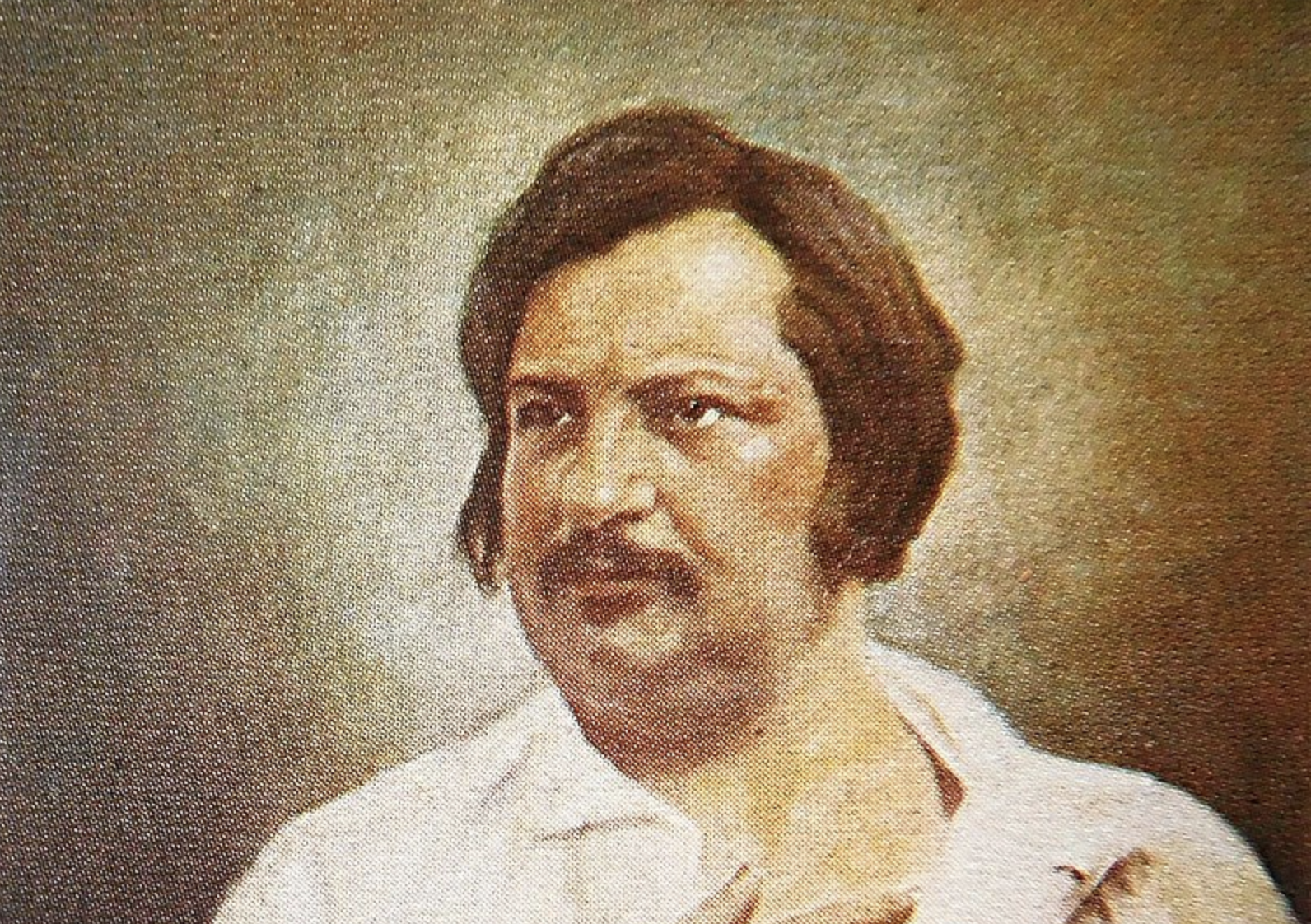
174 years after his death, Honoré de Balzac remains an extremely modern-sounding wag. Were he alive today, he’d no doubt be pounding out his provocative observations in a coffice, a café whose free wifi, lenient staff, and abundant electrical outlets make it a magnet for writers.
One has a hunch Starbucks would not suffice…
Judging by his humorous essay, “The Pleasures and Pains of Coffee,” Balzac would seek out a place that stays open past midnight, and the strongest, most arcane brewing methods. The Bucket of Black Snakes was his Green Fairy. He was that most cunning of addicts, sometimes imbibing up to 50 cups of coffee a day, carefully husbanding his binges, knowing just when to pull back from the edge in order to prolong his vice.
Coffee — he called it a “great power in [his] life” — made possible a grueling writing schedule that had him going to bed at six, rising at 1am to work until eight in the morning, then grabbing forty winks before putting in another seven hours.
It takes more than a couple of cappuccinos to maintain that kind of pace. Whenever a reasonable human dose failed to stimulate, Balzac would begin eating coffee powder on an empty stomach, a “horrible, rather brutal method” that he recommended “only to men of excessive vigor, men with thick black hair and skin covered with liver spots, men with big square hands and legs shaped like bowling pins.”
Apparently it got the job done. He cranked out eighty-five novels in twenty years and died at 51. The cause? Too much work and caffeine, they like to say. Other speculated causes of death include hypertension, atherosclerosis, and even syphilis.
Above, watch actor Paul Giamatti play Balzac all hopped up on coffee. And here you can behold The Coffee Pot That Fueled Honoré de Balzac’s Coffee Addiction.
Related Content:
Paul Giamatti Plays Honoré de Balzac, Hopped Up on 50 Coffees Per Day
Philosophers Drinking Coffee: The Excessive Habits of Kant, Voltaire & Kierkegaard
“The Virtues of Coffee” Explained in 1690 Ad: The Cure for Lethargy, Scurvy, Dropsy, Gout & More
Ayun Halliday hasn’t touched the stuff for two whole weeks. Follow her @AyunHallliday
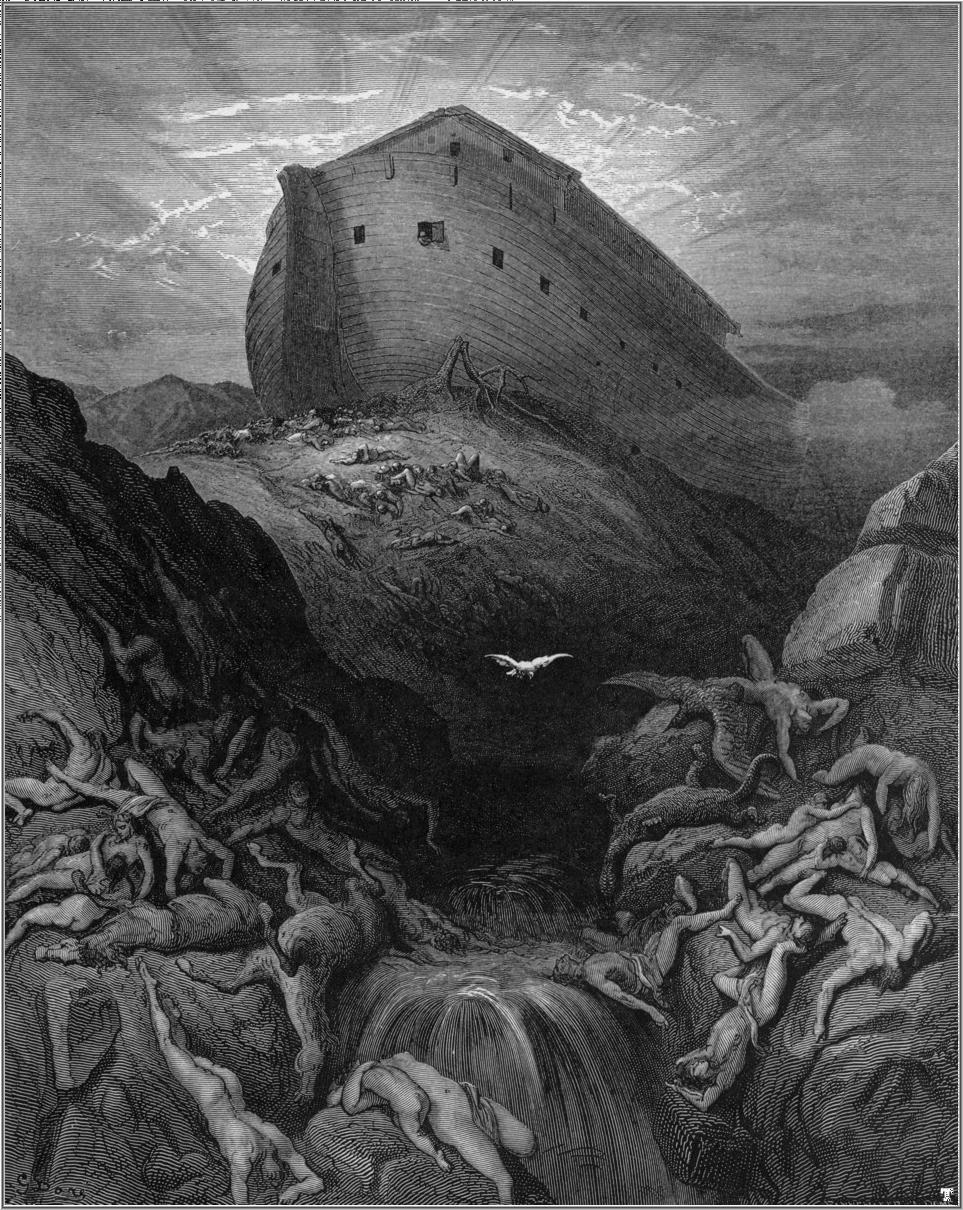
Read More...Behold Gustave Doré’s Dramatic Illustrations of the Bible (1866)
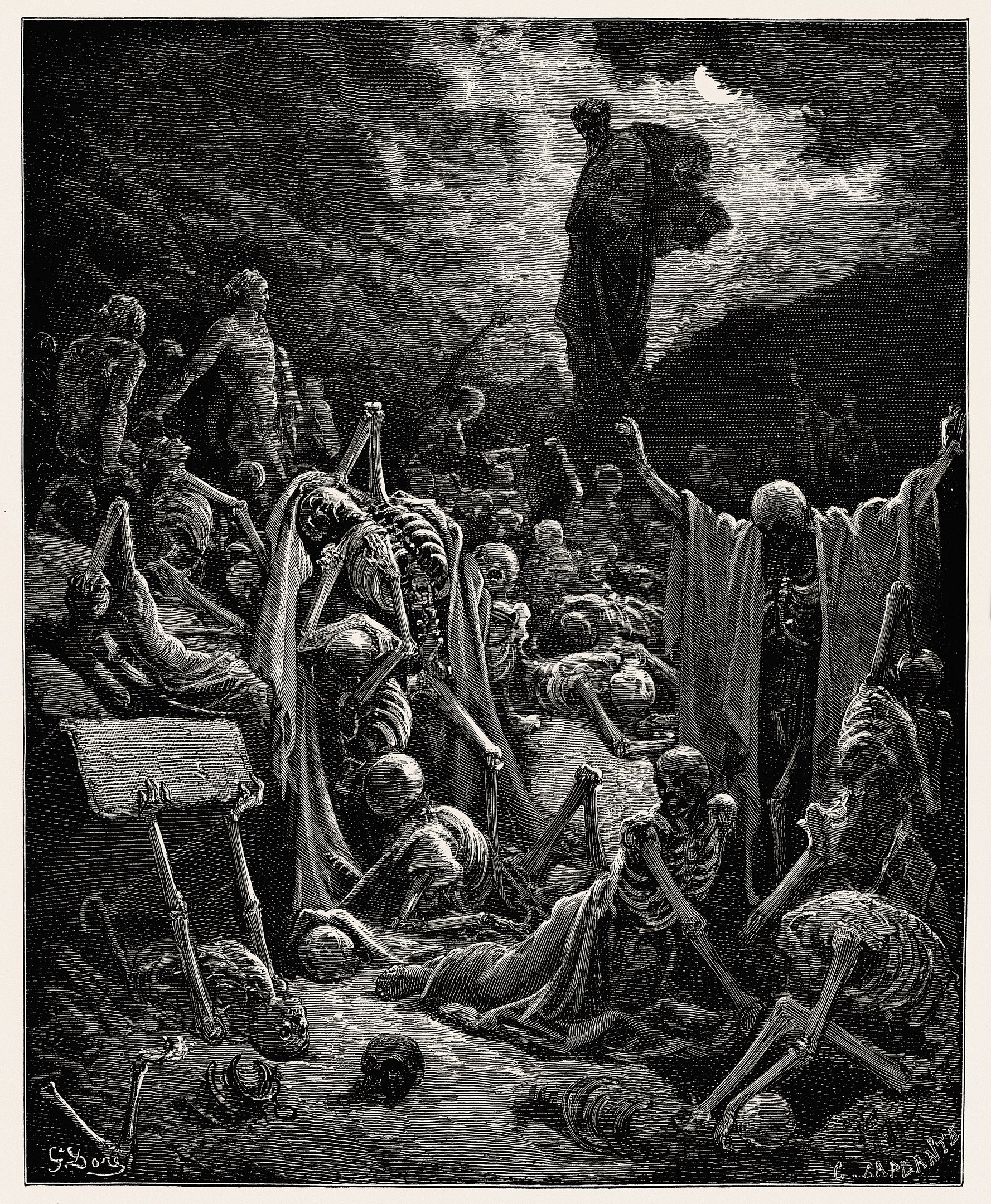
One occasionally hears it said that, thanks to the internet, all the books truly worth reading are free: Shakespeare, Don Quixote, the stories of Edgar Allan Poe, the Divine Comedy, the Bible. Can it be a coincidence that all of these works inspired illustrations by Gustave Doré? When he was active in mid-nineteenth-century France, he worked in a variety of forms, including painting, sculpture, and even comics and caricatures. But he lives on through nothing so much as his woodblock-print illustrations of what we now consider classics of Western literature — and, in the case of La Grande Bible de Tours, a text we could describe as “super-canonical.”
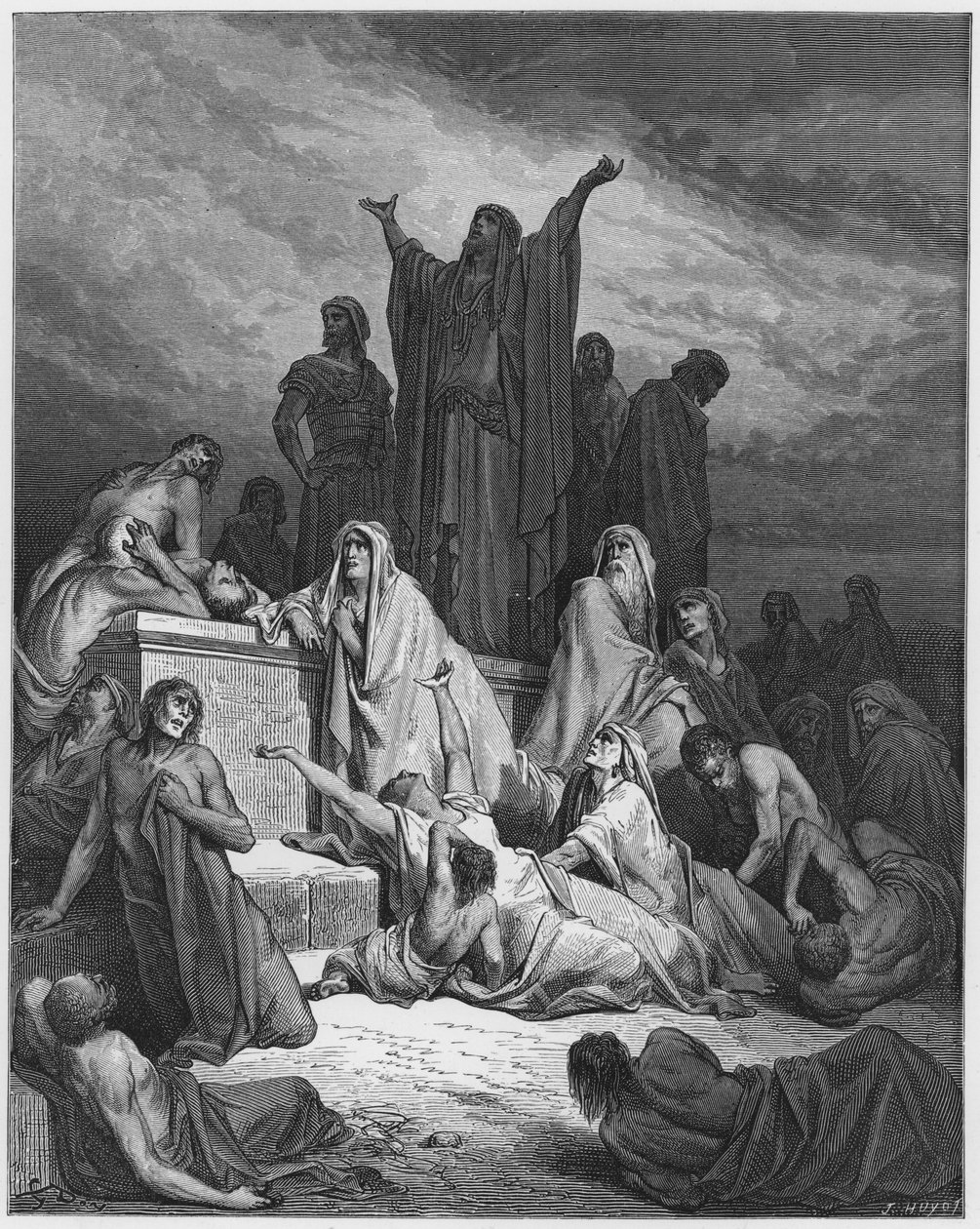
Doré took on the task of designing 241 engravings for a luxurious new French-language edition of the Vulgate Bible in the mid-eighteen-sixties. The project “offered him an almost endless series of intensely dramatic events,” writes biographer Joanna Richardson: “the looming tower of Babel, the plague of darkness in Egypt, the death of Samson, Isaiah’s vision of the destruction of Babylon.”
All provided practically ideal showcases for the elements of Doré’s intensely Romantic style: “the mountain scenes, the lurid skies, the complicated battles, the almost unremitting brutalism.” But along with the Old Testament “massacres and murders, decapitations and avenging angels” come Victorian angels, Victorian women, and Victorian children, “sentimental or wise beyond their years.”
Those choices may have been motivated by the simultaneous publication of La Grande Bible de Tours in both France and the United Kingdom. In any event, the edition proved successful enough on both sides of the Channel that a major exhibition of Doré’s work opened in London the very next year.
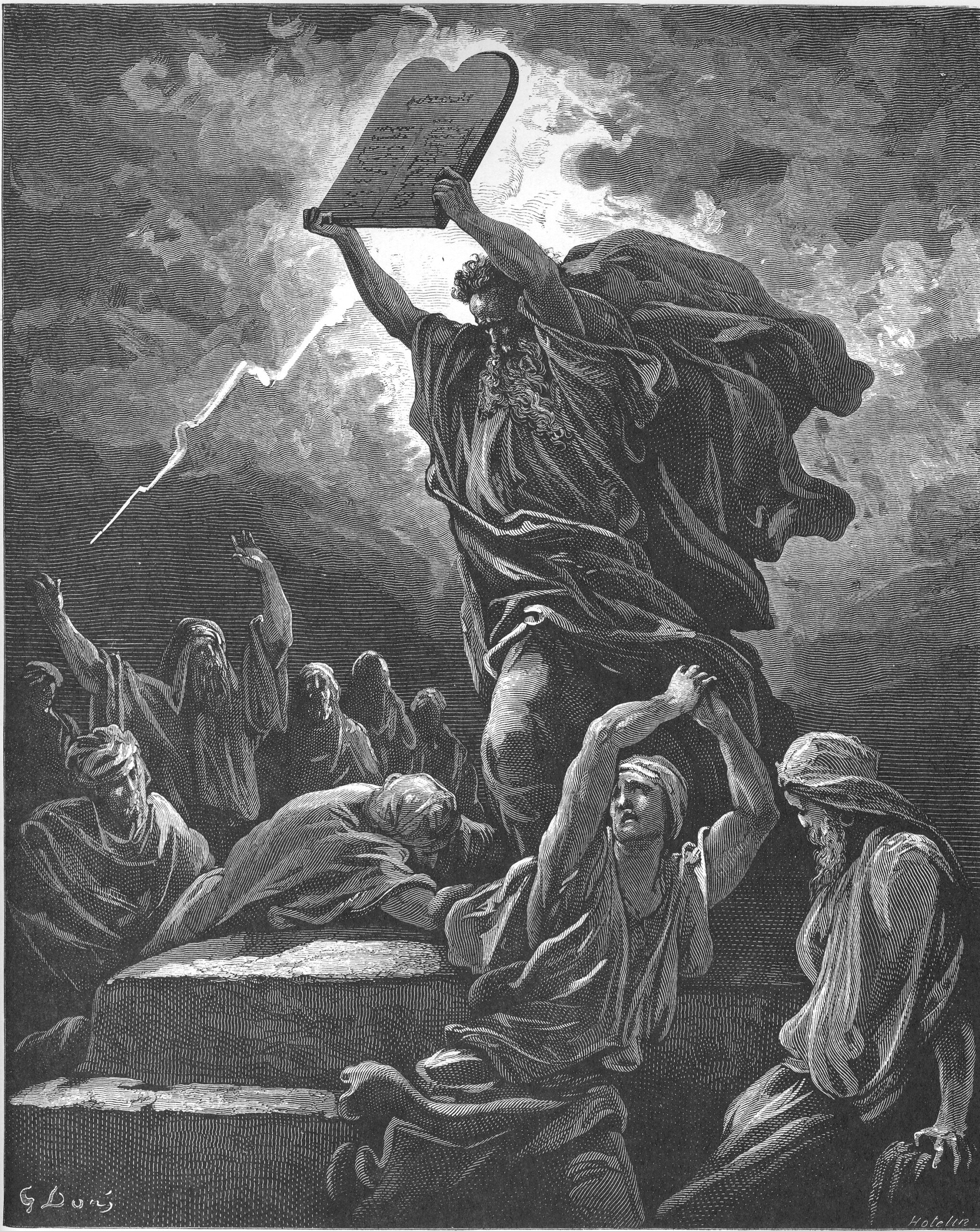
Though visibly rooted in their time and place — as well as in the artist’s personal sensibilities and the aesthetic currents in which he was caught up — Doré’s visions of the Bible still make an impact with their rich and immediately recognizable chiaroscuro portrayals of scenes that have long resonated through the whole of Western culture. You can see the whole series on Wikipedia, or as collected in The Doré Gallery of Bible Illustrations at Project Gutenberg — all, of course, for no charge.
Related content:
Gustave Doré’s Dramatic Illustrations of Dante’s Divine Comedy
Gustave Doré’s Exquisite Engravings of Cervantes’ Don Quixote
Gustave Doré’s Macabre Illustrations of Edgar Allan Poe’s “The Raven” (1884)
Salvador Dalí’s Illustrations for the Bible (1963)
Based in Seoul, Colin Marshall writes and broadcasts on cities, language, and culture. His projects include the Substack newsletter Books on Cities and the book The Stateless City: a Walk through 21st-Century Los Angeles. Follow him on Twitter at @colinmarshall or on Facebook.
Read More...Watch Tom Waits For No One, the Pioneering Animated Music Video from 1979
Tom Waits For No One, above, is surely the only film in history to have won an Oscar for Scientific and Technical Achievement for its creator and a first place award at the Hollywood Erotic Film and Video Festival.
Director John Lamb and his partner, Bruce Lyon also deserve recognition for their taste in source material. Singer Tom Waits’ “The One That Got Away” is about as cool as it gets, and the animated Waits is a dead ringer for his then-28-year-old counterpart, with eyes and choppers slightly exaggerated for maximum effect.
The short was conceived as a demo model. Lyon and Lamb hoped to convince Ralph Bakshi, director of the feature-length, X‑rated, cartoon adaptation of R Crumb’s Fritz the Cat, to use their newly patented “pencil preview” technique on an upcoming project. The result is definitely more provocative than the non-narrative bouncing ball videos developers would use to show off fledgling CGI techniques a decade or so later.
A portion of raw footage shows Waits and exotic dancer Donna Gordon—who had previously appeared in John Cassavetes’ The Killing of a Chinese Bookie—slinking around a largely bare soundstage. The crew amassed 13 hours of video that were whittled down to 5,500 Rotoscoped frames. These were individually re-drawn, inked, and hand-painted onto celluloid acetate.
Gordon, whose animated look appears to have exerted quite an influence on the following decade’s cartoon femme fatale, Jessica Rabbit, recollected that her co-star was “very nice, shy and quiet” and that he smelled strongly of cigarettes and booze.
Just as Gordon’s fantasy stripper eluded the animated Waits, this innovative film failed to find distribution, and without commercial release, it sank into obscurity.
(I invite Waits fans to join me in imagining an alternate universe, in which it becomes the greatest Saturday morning cartoon ever, providing morning-after comfort to a very particular breed of hungover early-80s nighthawks.)
Related Content:
A Fan-Made Film Reconstructs an Entire Tom Waits Concert from His “Glitter and Doom Tour” (2008)
Tom Waits’ Many Appearances on David Letterman, From 1983 to 2015
Tom Waits Names 14 of His Favorite Art Films
Tom Waits Makes a List of His Top 20 Favorite Albums of All Time
Ayun Halliday is an author, illustrator, and Chief Primatologist of the East Village Inky zine. Follow her @AyunHalliday
Read More...The Internet Archive Rescues MTV News’ Web Site, Making 460,000+ of Its Pages Searchable Again

Image via Internet Archive
Last month, MTV News’ web site went missing. Or at least almost all of it did, including an archive of stories going back to 1997. To some of us, and especially to those of us old enough to have grown up watching MTV on actual television, that won’t sound like an especially long time. But if you remember the hit singles of that year — “Barely Breathing,” “Semi-Charmed Life,” “MMMBop,” the Princess Diana-memorializing “Candle in the Wind” — you’ll start to feel a bit more historical distance. And if you consider all that’s happened in not just music but entertainment in general over the past 27 years, coverage of that period of great change in popular culture and technology will seem invaluable.
It will thus come as a relief to hear that, despite Paramount Global’s corporate decision to purge MTV News’ online content (as well as that of Comedy Central, TVLand and CMT), much of the site has been resurrected on the Internet Archive, which now offers “a searchable index of 460,575 web pages previously published at mtv.com/news.”
So reports Variety’s Todd Spangler, noting that the content “is not the full complement of what was published over the span of more than two decades. In addition, some images in the archived pages of MTV News on the service are unavailable. But the new collection at least ensures, for the time being, that much of MTV News’ articles remain accessible in some form.”
MTV News itself shut down in May of last year. It had begun in 1987 as a segment called “This Week in Rock” anchored by a print journalist named Kurt Loder. “I was working at Rolling Stone and everybody that wrote about rock music, as it was called at the time, had a very down point of view about MTV,” Loder recalls in an interview with that magazine. But choosing to throw himself into this new form of infotainment gave him the chance to get to know the likes of Madonna, Prince, and Nirvana (the death of whose singer Kurt Cobain became one of his career-defining stories). “You could just fly off anywhere you wanted and do all this stuff,” Loder says. “It was a great time. I’m not sure it’ll ever be back, but something else will.” Whatever it is, may the Internet Archive be here to preserve it.
Related content:
Watch the First Two Hours of MTV’s Inaugural Broadcast (August 1, 1981)
All the Music Played on MTV’s 120 Minutes: A 2,500-Video Youtube Playlist
Enter “The Magazine Rack,” the Internet Archive’s Collection of 34,000 Digitized Magazines
Based in Seoul, Colin Marshall writes and broadcasts on cities, language, and culture. His projects include the Substack newsletter Books on Cities and the book The Stateless City: a Walk through 21st-Century Los Angeles. Follow him on Twitter at @colinmarshall or on Facebook.
Read More...“Tsundoku,” the Japanese Word for the New Books That Pile Up on Our Shelves, Should Enter the English Language
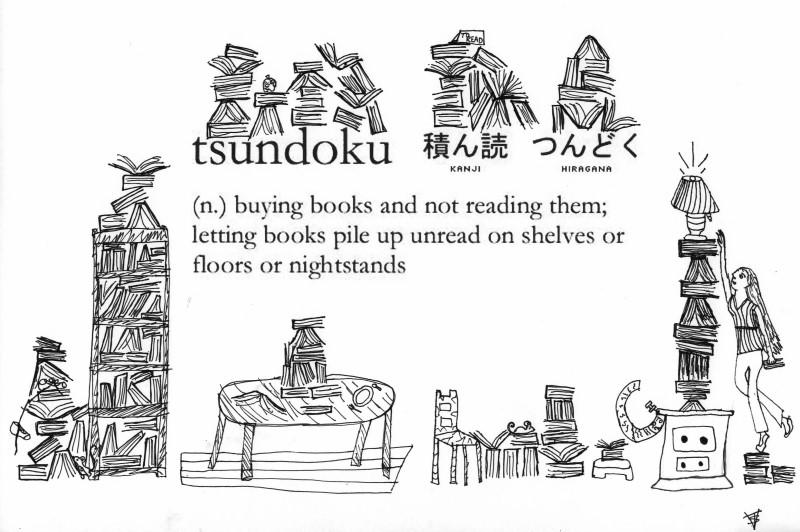
There are some words out there that are brilliantly evocative and at the same time impossible to fully translate. Yiddish has the word shlimazl, which basically means a perpetually unlucky person. German has the word Backpfeifengesicht, which roughly means a face that is badly in need of a fist. And then there’s the Japanese word tsundoku, which perfectly describes the state of my apartment. It means buying books and letting them pile up unread.
The word dates back to the very beginning of modern Japan, the Meiji era (1868–1912) and has its origins in a pun. Tsundoku, which literally means reading pile, is written in Japanese as 積ん読. Tsunde oku means to let something pile up and is written 積んでおく. Some wag around the turn of the century swapped out that oku (おく) in tsunde oku for doku (読) – meaning to read. Then since tsunde doku is hard to say, the word got mushed together to form tsundoku.
As with other Japanese words like karaoke, tsunami, and otaku, I think it’s high time that tsundoku enter the English language. Now if only we can figure out a word to describe unread ebooks that languish on your Kindle. E‑tsundoku? Tsunkindle? Contemplate the matter for a while.
The illustration above was made when a Redditor asked his daughter to illustrate the word “Tsundoku,” and she did not disappoint.
Note: An earlier version of this post appeared on our site in July 2014.
If you would like to support the mission of Open Culture, consider making a donation to our site. It’s hard to rely 100% on ads, and your contributions will help us continue providing the best free cultural and educational materials to learners everywhere. You can contribute through PayPal, Patreon, and Venmo (@openculture). Thanks!
Related Content:
The Virtue of Owning Books You Haven’t Read: Why Umberto Eco Kept an “Antilibrary”
An Archive of Vividly Illustrated Japanese Schoolbooks, from the 1800s to World War II
Jonathan Crow is a Los Angeles-based writer and filmmaker whose work has appeared in Yahoo!, The Hollywood Reporter, and other publications. You can follow him at @jonccrow. And check out his art blog Veeptopus.
Read More...Support Us
We're hoping to rely on loyal readers, rather than erratic ads. Please click the Donate button and support Open Culture. You can use Paypal, Venmo, Patreon, even Crypto! We thank you!

About Us

Open Culture scours the web for the best educational media. We find the free courses and audio books you need, the language lessons & educational videos you want, and plenty of enlightenment in between.
Advertise With Us
FREE UPDATES!
GET OUR DAILY EMAIL
Get the best cultural and educational resources on the web curated for you in a daily email. We never spam. Unsubscribe at any time.
FOLLOW ON SOCIAL MEDIA
Open Culture editor Dan Colman scours the web for the best educational media. He finds the free courses and audio books you need, the language lessons & movies you want, and plenty of enlightenment in between.
Advertise With Us

