“Get Data”: UCSD Neuroscience Grad Students Create Parody Video to Tune of Daft Punk’s ‘Get Lucky’
Last month, the UCSD Neurosciences Graduate Program held a little party at a local bar, and the invitation (above) came in the form of a video based on Daft Punk’s popular video/song “Get Lucky” (below). Writes a local San Diego newspaper: “In sweet, funny and saucy ways, [the video] shows the stress and madness grad students go through in trying to come up with new data for scientific studies. The students released the video to coincide with this week’s Society of Neuroscience meeting at the San Diego Convention Center.” Enjoy the clip and find more grad school oddities below.
Related Content:
Physical Attraction: Marriage Proposal Comes in the Form of a Physics Paper
Graduate School Barbie: A New Gift Idea for The Demoralized Grad Student in Your Life
The Illustrated Guide to a Ph.D.
Serial Entrepreneur Damon Horowitz Says “Quit Your Tech Job and Get a Ph.D. in the Humanities”
Read More...Turn Your Bike into an Electric Hybrid with MIT’s “Copenhagen Wheel”
Bonaverde’s “Roast-Grind-Brew Coffee Machine” seemed like one of the cooler inventions I’ve recently stumbled upon. But then I came across this: The Copenhagen Wheel. Originally created by researchers at MIT, the Copenhagen Wheel “transforms ordinary bicycles quickly into hybrid e‑bikes.” It allows bike riders to “capture the energy dissipated while cycling and braking and save it for when you need a bit of a boost” — like climbing a hill in San Francisco. The wheel also feeds data to your iPhone, allowing you to monitor pollution levels, traffic congestion, and road conditions in real-time. After spending several years in development, the wheel can now be pre-ordered online and it will ship next spring. It retails for $699.
Get more background information on The Copenhagen Wheel via this MIT web site.
Related Content:
Science Behind the Bike: Four Videos from the Open University on the Eve of the Tour de France
Brussels Express: The Perils of Cycling in Europe’s Most Congested City
David Byrne: From Talking Heads Frontman to Leading Urban Cyclist
Read More...
The World’s First “Roast-Grind-Brew” Coffee Machine Could Bring About a Coffee Revolution
Bonaverde is “a small, dedicated team of young, sleepless Berliner entrepreneurs that [have] made it their goal to revolutionize the coffee world.” How? By building the world’s first “Roast-Grind-Brew Coffee Machine.” Other machines might grind and brew the coffee. This one will roast the beans too, which is no trivial innovation. It promises to significantly decrease the number of steps, and the amount of time, it takes to turn a harvested coffee bean into your morning cup of joe, which means a much fresher cup of coffee. And perhaps a cheaper one too.
Bonaverde has already developed a prototype. (See how it works below.) Now the venture needs to bring the machine into production. Through a Kickstarter campaign ending on December 8th, the venture initially hoped to raise $135,000. But it has already blown past that figure, raising $582,693 thus far. Anyone who contributes $250 (or more) to the campaign will get one of the very first Roast-Grind-Brew Coffee Machines, plus 6.6 lbs. (3kg) of green coffee. Theoretically all you need to brew one very fresh cup of coffee. Find more information on the next-generation coffee machine over on Bonaverde’s Kickstarter page.
Related Content:
“The Vertue of the COFFEE Drink”: London’s First Cafe Creates Ad for Coffee in the 1650s
The History of Coffee and How It Transformed Our World
How Climate Change Is Threatening Your Daily Cup of Coffee
A Short, Animated Look at What’s Inside Your Average Cup of Coffee
Read More...John Cleese Stars in a Morbidly Funny Anti-Smoking Campaign (1992–1994)
In 1992, the Health Education Authority (HEA) began running a series of ads on British television starring the Monty Python comedian and ex-smoker, John Cleese. Smoking remained the #1 cause of premature death in the UK, and the HEA wanted to see if a media campaign could make a dent in the epidemic. As part of a controlled experiment (all detailed here), ads starring Cleese were shown in certain parts of the UK (but not others), and they used morbid humor and macabre scenarios “first to engage the viewers’ curiosity,” and then to “highlight the dangers of smoking, show[ing] the ridiculousness of the smoking habit.” Finally, viewers were given a phone number to call where they could get more information on how to quit.
So what were the results? During the campaign (which ran from 1992 to 1994), the “quitline” received around 20,000 calls overall. Data crunchers later found that the control groups exposed to the ads quit smoking at a higher rate than groups that hadn’t seen the commercials. Plus the relapse rates of the control group were lower than the norm. All of this led the government to conclude that “anti-smoking TV advertising should be undertaken routinely as an essential component of any population smoking reduction strategy.” In this post, we’ve highlighted three of the better preserved ads in the campaign.
Related Content:
An Anti, Anti-Smoking Announcement from John Waters
Bertrand Russell: “I Owe My Life to Smoking”
John Cleese’s Philosophy of Creativity: Creating Oases for Childlike Play
Read More...Filmmaker Luis Buñuel Shows How to Make the Perfect Dry Martini
The once-surrealist (and, in a sense, always surrealist) Spanish filmmaker Luis Buñuel made such classically bleak, humorous, and bleakly humorous pictures like Viridiana, The Exterminating Angel, The Discreet Charm of the Bourgeoisie, and That Obscure Object of Desire. He also made personal connections with an international range of idiosyncratic creative luminaries including Federico García Lorca, Sergei Eisenstein, Charlie Chaplin, Aldous Huxley, Pablo Picasso, Bertolt Brecht, Octavio Paz, Alexander Calder, and Salvador Dalí (his collaborator on the notorious short Un Chien Andalou and L’Age d’Or). Having lived a life like that, Buñuel surely couldn’t help but write one of the most fascinating autobiographies in print. To become such a human cultural nexus, one needs not make motion pictures as enduringly striking as Buñuel’s, but one must certainly make a dry martini on the level of his own. Fortunately for the aspiring Buñuels of the world, My Last Sigh, that formidably intriguing life story, includes his personal recipe.
Dangerous Minds has posted the relevant excerpt. “To provoke, or sustain, a reverie in a bar, you have to drink English gin, especially in the form of the dry martini,” writes Buñuel. “To be frank, given the primordial role in my life played by the dry martini, I think I really ought to give it at least a page.” He recommends that “the ice be so cold and hard that it won’t melt, since nothing’s worse than a watery martini,” then offers up his procedure, “the fruit of long experimentation and guaranteed to produce perfect results. The day before your guests arrive, put all the ingredients—glasses, gin, and shaker—in the refrigerator. Use a thermometer to make sure the ice is about twenty degrees below zero (centigrade). Don’t take anything out until your friends arrive; then pour a few drops of Noilly Prat and half a demitasse spoon of Angostura bitters over the ice. Stir it, then pour it out, keeping only the ice, which retains a faint taste of both. Then pour straight gin over the ice, stir it again, and serve.” In the clip above, you can witness the man himself in action, a sight that gets me wondering whether Buñuel ever crossed paths with John Updike. Imagining such a meeting sets the mind reeling, but few quotes seem as apropos here as the New England novelist’s observation that “excellence in the great things is built upon excellence in the small.”
Related Content:
Two Vintage Films by Salvador Dalí and Luis Buñuel: Un Chien Andalou and L’Age d’Or
David Lynch Teaches You to Cook His Quinoa Recipe in a Weird, Surrealist Video
The Recipes of Iconic Authors: Jane Austen, Sylvia Plath, Roald Dahl, the Marquis de Sade & More
Colin Marshall hosts and produces Notebook on Cities and Culture and writes essays on cities, Asia, film, literature, and aesthetics. He’s at work on a book about Los Angeles, A Los Angeles Primer. Follow him on Twitter at @colinmarshall or on his brand new Facebook page.
Read More...Download a Prototype of Ever, Jane, a Video Game That Takes You Inside the Virtual World of Jane Austen
A few days ago, 3 Turn Productions finished raising $109,563 (from 1,600 backers) on Kickstarter to fund the development of “Ever, Jane,” a virtual game that allows people to role-play in Regency Period England. 3 Turn describes the gist of their game as follows:
Similar to traditional role playing games, we advance our character through experience, but that is where the similarities end. Ever, Jane is about playing the actual character in the game, building stories. Our quests are derived from player’s actions and stories. And we gossip rather than swords and magic to demolish our enemies and aid our friends.
Try to win the sympathy of Lizzie Bennet by telling lies about your rival, as Mr. Wickham does, but be careful. The system will notify someone if they are being talked about too often and a good sleuth may find the player who is spreading such rumors. If you are caught in your lies, the consequences you intended for your target will hit you two-fold.
A description is nice, but a demo is even better. And happily you can download a prototype that “provides fully functional infrastructure for both the gossip and the invitation systems as well as a 3D village in which you can walk about, bowing and curtsying to people appropriately.” There’s also a tutorial that walks you through the basic mechanics and UI. (It should be included in the download from this link.) More information about Ever, Jane can be found on the project’s Kickstarter page.
via Metafilter
Related Content:
As Pride and Prejudice Turns 200, Read Jane Austen’s Manuscripts Online
‘Pride and Prejudice’ Author Jane Austen Will Appear on the £10 Note
Jane Austen, Game Theorist: UCLA Poli Sci Prof Finds Shrewd Strategy in “Cluelessness”
Long Live Glitch! The Art & Code from the Game Now Released into the Public Domain
Find Austen’s works in our collections of Free eBooks and Free Audio Books
Read More...Susan Sontag’s 50 Favorite Films (and Her Own Cinematic Creations)
Susan Sontag’s fans would each describe her a little differently: many would call her a writer, of course, though some would opt for more specificity, calling her a novelist if they like her fiction or a critic if they don’t. Others, speaking more grandly, might prefer to simply call her an “intellectual.” Under this wide umbrella Sontag produced a variety of works for the page, the stage, and even the screen. Between 1969 and 1983, she made four films: 1969’s Duett för kannibaler (Duet for Cannibals), 1971’s Broder Carl (Brother Carl), 1974’s Promised Lands, and, above, 1983’s Unguided Tour, also known as Letter from Venice. Sontag adapted the Italian-language feature from her story of the same name, originally published in 1977 in the New Yorker. Promised Lands, her only documentary, meditates on Arab-Israeli relations at the end of the Yom Kippur War. The Bergmanesque, symbolism-filled Brother Carl takes place, suitably, at a Swedish island resort.
And her debut Duet for Cannibals, according to Dangerous Minds, embodies — or, if you like, cinematizes — her touted distaste for the interpretation of artworks. Sontag, they say, “sought to liberate art from interpretation (which is a bit ironic, of course, for someone who was essentially an exalted critic). When it came to her own film, she made something that intended to deliberately confound the notion that there was any sort of underlying meaning beyond exactly what the audience was seeing on the screen directly in front of them.”
Sontag’s famous 1966 essay “Against Interpretation” counts here as essential reading, not just before you watch her own films, but also before you watch through her list of favorite films. Richard Brody, posting in the New Yorker, recommends accompanying it with “The Decay of Cinema,” which Sontag wrote three decades later in the New York Times, and in which she declares that “you hardly find anymore, at least among the young, the distinctive cinephilic love of movies that is not simply love of but a certain taste in films (grounded in a vast appetite for seeing and reseeing as much as possible of cinema’s glorious past).”
Reading over the top fifty films she considered the greatest back in 1977 (and published in her volume of journals As Consciousness is Harnessed to Flesh), we find plenty of evidence Sontag herself, unsurprisingly, had such a cinephilic love of and vast appetite for movies, especially for European filmmakers but also the best-known Japanese ones of the day:
1. Bresson, Pickpocket
2. Kubrick, 2001
3. Vidor, The Big Parade
4. Visconti, Ossessione
5. Kurosawa, High and Low
6. [Hans-Jürgen] Syberberg, Hitler
7. Godard, 2 ou 3 Choses …
8. Rossellini, Louis XIV
9. Renoir, La Règle du Jeu
10. Ozu, Tokyo Story
11. Dreyer, Gertrud
12. Eisenstein, Potemkin
13. Von Sternberg, The Blue Angel
14. Lang, Dr. Mabuse
15. Antonioni, L’Eclisse
16. Bresson, Un Condamné à Mort …
17. Gance, Napoléon
18. Vertov, The Man with the [Movie] Camera
19. [Louis] Feuillade, Judex
20. Anger, Inauguration of the Pleasure Dome
21. Godard, Vivre Sa Vie
22. Bellocchio, Pugni in Tasca
23. [Marcel] Carné, Les Enfants du Paradis
24. Kurosawa, The Seven Samurai
25. [Jacques] Tati, Playtime
26. Truffaut, L’Enfant Sauvage
27. [Jacques] Rivette, L’Amour Fou
28. Eisenstein, Strike
29. Von Stroheim, Greed
30. Straub, …Anna Magdalena Bach
31. Taviani bro[ther]s, Padre Padrone
32. Resnais, Muriel
33. [Jacques] Becker, Le Trou
34. Cocteau, La Belle et la Bête
35. Bergman, Persona
36. [Rainer Werner] Fassbinder, … Petra von Kant
37. Griffith, Intolerance
38. Godard, Contempt
39. [Chris] Marker, La Jetée
40. Conner, Crossroads
41. Fassbinder, Chinese Roulette
42. Renoir, La Grande Illusion
43. [Max] Ophüls, The Earrings of Madame de …
44. [Iosif] Kheifits, The Lady with the Little Dog
45. Godard, Les Carabiniers
46. Bresson, Lancelot du Lac
47. Ford, The Searchers
48. Bertolucci, Prima della Rivoluzione
49. Pasolini, Teorema
50. [Leontine] Sagan, Mädchen in Uniform
“She was wrong,” Brody writes of Sontag’s epitaph for her kind of enthusiasm for film. “Cinephilia was there, but, for certain practical reasons, it was relatively quiet. It’s not quiet anymore, and great, distinctive movies were issuing from around the world.” As ever, “the narrative of nostalgia for a lost golden age is really one of the writer’s own nostalgia for youth” — but in her youth as well as afterward, Sontag saw some astonishing movies indeed.
Find a wide range of avant-garde films in our collection, 4,000+ Free Movies Online: Great Classics, Indies, Noir, Westerns, Documentaries & More.
via The New Yorker
Related Content:
A Young Jean-Luc Godard Picks the 10 Best American Films Ever Made (1963)
Martin Scorsese Reveals His 12 Favorite Movies (and Writes a New Essay on Film Preservation)
Stanley Kubrick’s List of Top 10 Films (The First and Only List He Ever Created)
Colin Marshall hosts and produces Notebook on Cities and Culture and writes essays on cities, Asia, film, literature, and aesthetics. He’s at work on a book about Los Angeles, A Los Angeles Primer. Follow him on Twitter at @colinmarshall or on his brand new Facebook page.
Read More...See the Original Magazine Publication of Heart of Darkness and Other Great Works by Joseph Conrad
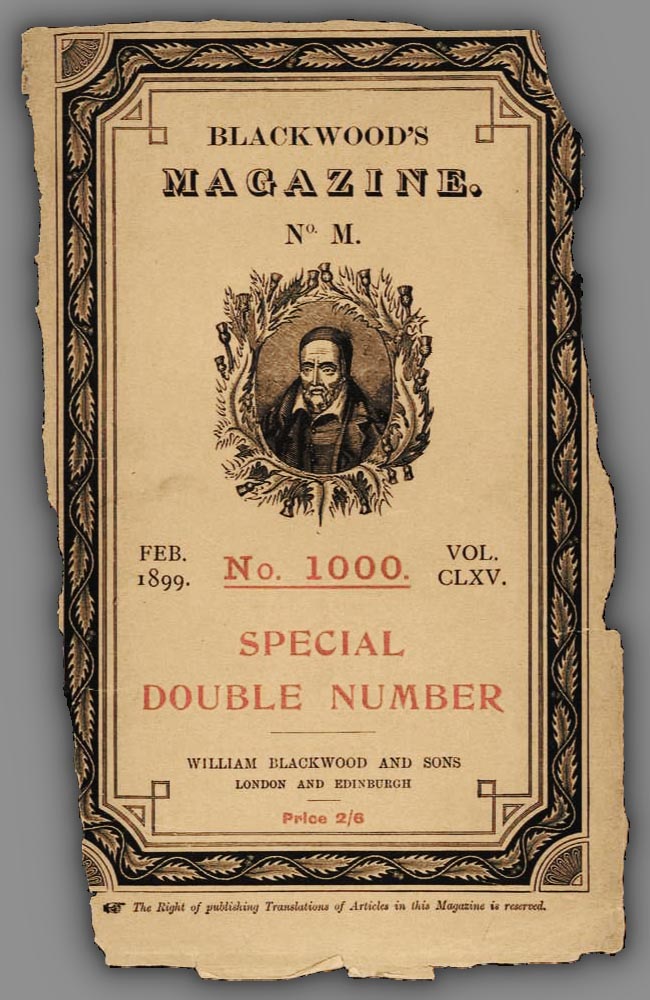
Like many other novelists of his era, Joseph Conrad began by publishing his work in serialized magazines. Novel serialization, which had first gained popularity and commercial appeal with Charles Dickens’ Pickwick Papers in 1836, was commonplace throughout the 19th century. By the time that Conrad released his first novel in 1895, entitled Almayer’s Folly, publishing serious work within the pages of weekly literary periodicals had become de rigueur. Indeed, Scribner’s Monthly magazine noted that it is the “second and third rate novelist who could not get published in a magazine and is obliged to publish in a volume, and it is in a magazine that the best novelists always appear first.” Although Scribner’s claim doubtless contains an element of self-promotion, one cannot deny that it is precisely through serialized publication that Conrad joined the ranks of literary greats such as Alexandre Dumas, Henry James, Gustave Flaubert, and Leo Tolstoy.
Through the website Conrad First: The Joseph Conrad Periodical Archive, contemporary readers can enjoy the original, digitized versions of Conrad’s first editions. The database, which holds some 80,000 images and links to over a hundred periodicals, includes the original releases for Conrad’s many novels, including Heart of Darkness (1899, Blackwood’s Magazine), Lord Jim (1899, Blackwood’s Magazine), Nostromo (1904, T.P.‘s Weekly), and The Secret Agent (1906, Ridgway’s Magazine), as well as essays, such as Rudyard Kipling: A Criticism on His Poems and A propos of Alphonse Daudet. For those more interested in household goods of yore than Conrad’s prose, these pages will also prove enjoyable; ads for the Harlene Remedy for Baldness and requests imploring readers to Employ British Labour abound.
Related Content:
Alfred Hitchcock Adapts Joseph Conrad’s Novel of Terrorism in Sabotage (1936)
Listen as Orson Welles Reads ‘The Secret Sharer,’ by Joseph Conrad
We Were Wanderers on a Prehistoric Earth: A Short Film Inspired by Joseph Conrad
Read More...Neil deGrasse Tyson Talks Asteroid Physics & “Non Newtonian Solids” with Inspiring 9‑Year-Old Student
Just this week, some new test results showed that American teens, compared to other students worldwide, “failed to reach the top 20 in math, science or reading,” according to The Guardian. Afterwards, Arne Duncan, the U.S. Secretary of Education, called the results a “picture of educational stagnation.”
The results are deflating. But maybe we shouldn’t lose hope, not when we have kids like Jacob coming of age, and teachers like Neil deGrasse Tyson mentoring him along. Speaking last month at Grand Valley State University in Michigan, Tyson fielded a question — the last question of the night — from a nine-year-old elementary school student named Jacob. To paraphrase, Jake wanted to know why we couldn’t shoot a “chunk of random material” at a hypothetical asteroid and stop it from hitting earth. This ends up being the first of a two-part question, which leads Jacob to demonstrate physics concepts with his clipboard and debate whether these flying objects share properties with “non-Newtonian solids.” Yes, I’m feeling a little better about the American educational system, especially since Jake’s dad confirms on YouTube that his son attends “great public schools.”
You can find Neil’s complete GVSU talk here.
Related Content:
Neil deGrasse Tyson Lists 8 (Free) Books Every Intelligent Person Should Read
Physics: Free Online Courses from Great Universities
Christopher Hitchens Creates a Reading List for Eight-Year-Old Girl
Free Comic Books Turns Kids Onto Physics: Start With the Adventures of Nikola Tesla
200 Free Kids Educational Resources: Video Lessons, Apps, Books, Websites & More
Read More...The Library: A World History Presents a Stunning Visual Survey of The World’s Great Libraries
Voluminously well-read author and amateur librarian Alberto Manguel opens The Library at Night, a compendious treatise on the role of the library in human culture, with a startlingly bleak question. “Why then do we do it?” He asks, why do we “continue to assemble whatever scraps of information we can gather in scrolls and books and computer chips, on shelf after library shelf” when “outside theology and fantastic literature, few can doubt that the main features of our universe are its dearth of meaning and lack of discernible purpose.” Manguel goes on—in beautifully illustrated chapter after themed chapter—to list in fine detail the host of virtues each of his favorite libraries possesses, answering his own question by reference to the beautiful microcosmic orders great libraries manifest.
A new book, The Library: A World History by author James Campbell and photographer Will Pryce, takes a more workmanlike approach to the subject, steering clear of Manguel’s metaphysics. Even so, the book will deeply move lovers of libraries and historians alike, perhaps even to ecstasy. One Amazon reviewer put it simply: “Book Porn at its best.”
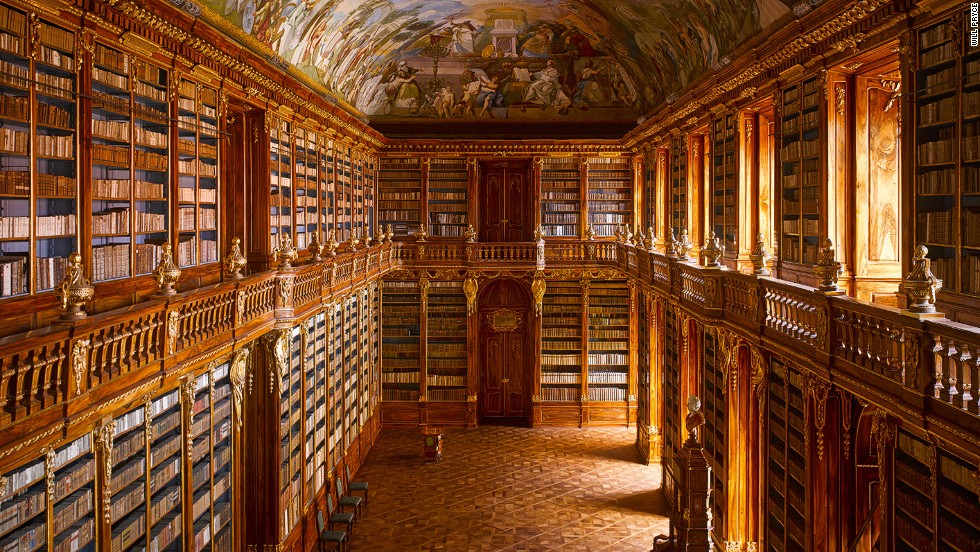
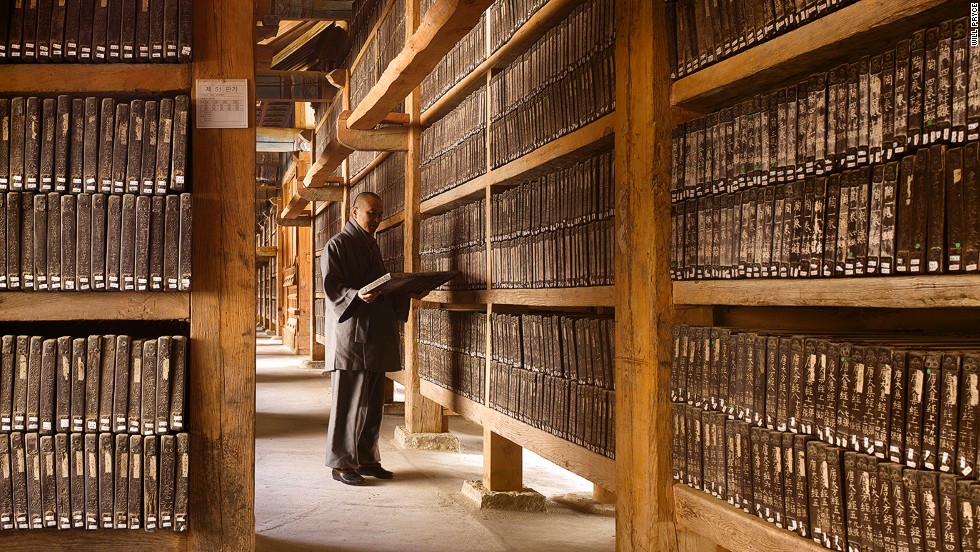
Boing Boing calls Pryce’s photographs “the centerpiece of the book,” and you can see why in a couple of selections here. Even without his eyesight, this is a project that would have delighted that rhapsodist of the library, Jorge Luis Borges. At the top, see the Strahov Abbey library in Prague. Halfway across the world, we have the Tripitaka Koreana library in South Korea (above). CNN has a gallery of Pryce’s photographic tributes to the world’s greatest libraries, and find here a critical review of the book by The Guardian’s Tom Lamont, who laments that the book solely “focuses on institutions created for the privileged.”
Related Content:
A Look Inside Marilyn Monroe’s Personal Library
The Odd Collection of Books in the Guantanamo Prison Library
David Foster Wallace’s Love of Language Revealed by the Books in His Personal Library
Josh Jones is a writer and musician based in Durham, NC. Follow him at @jdmagness
Read More...Support Us
We're hoping to rely on loyal readers, rather than erratic ads. Please click the Donate button and support Open Culture. You can use Paypal, Venmo, Patreon, even Crypto! We thank you!

About Us

Open Culture scours the web for the best educational media. We find the free courses and audio books you need, the language lessons & educational videos you want, and plenty of enlightenment in between.
Advertise With Us

FREE UPDATES!
GET OUR DAILY EMAIL
Get the best cultural and educational resources on the web curated for you in a daily email. We never spam. Unsubscribe at any time.
FOLLOW ON SOCIAL MEDIA

Open Culture editor Dan Colman scours the web for the best educational media. He finds the free courses and audio books you need, the language lessons & movies you want, and plenty of enlightenment in between.
Advertise With Us

