Oxford University Presents the 550-Year-Old Gutenberg Bible in Spectacular, High-Res Detail
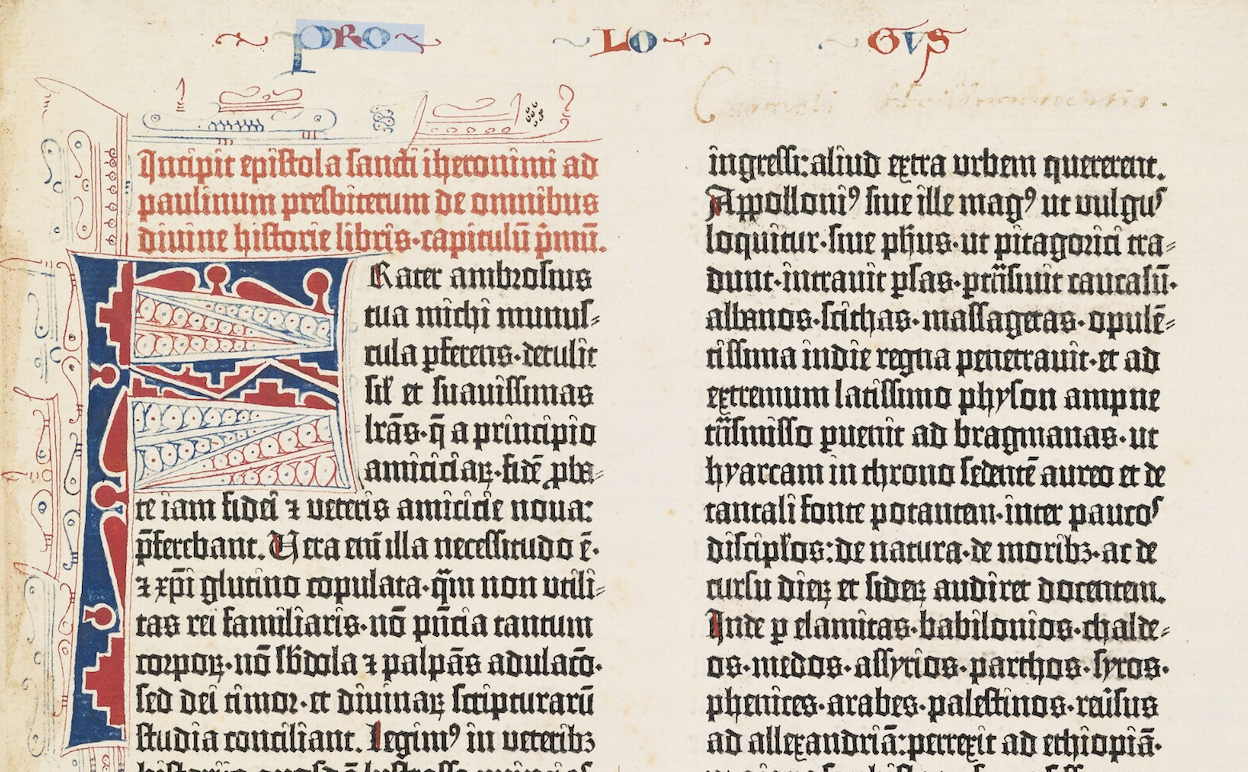
The great British empiricist Francis Bacon once remarked that Johannes Gutenberg’s printing press “changed the whole face and state of the world.” Although Gutenberg did not independently devise the press, he invented a mass-production process of moveable type and concocted an oil-based ink which, when combined with the wooden press, revolutionized the flow of information. Books could now be published in vast quantities, at only a fraction of the time required previously.
For his first seminal printing, Gutenberg picked the Bible — an obvious choice for a Christian, and in retrospect, perhaps the only book whose historical significance rivals that of Gutenberg’s invention. Produced in 1454 or 1455, the few surviving copies of Gutenberg’s Bible remain exemplars of the printer’s forethought and craftsmanship; the page dimensions, it is believed, were devised by Gutenberg to echo the golden ratio of Greek aesthetics. The first page appears above.
This Tuesday, The Polonsy Foundation Digitization Project, which aims to digitize the collections of Oxford’s Bodleian Libraries and the Vatican’s Biblioteca Apostolica, made a virtual version of the Gutenberg Bible available online. Readers fluent in vulgate can now put down their dog-eared bibles and enter the information age with this frighteningly high-resolution cover-to-cover scan of Gutenberg’s original printing. In addition to examining its finely drawn initials and curlicues, you can also browse other early bibles, including a beautifully colored 13th century Hebrew tome, and the delicate illustrations within a 10th century Greek volume. We’ve included two images below:
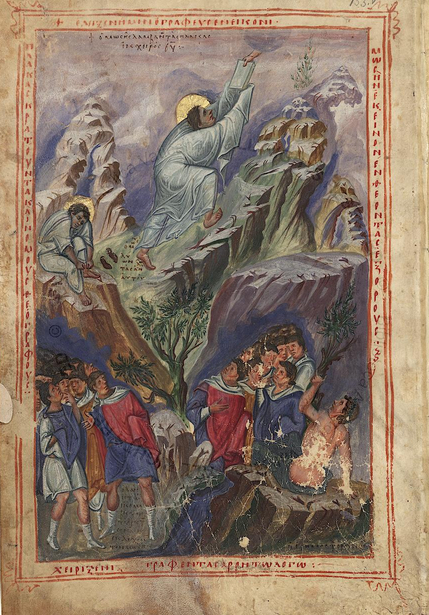
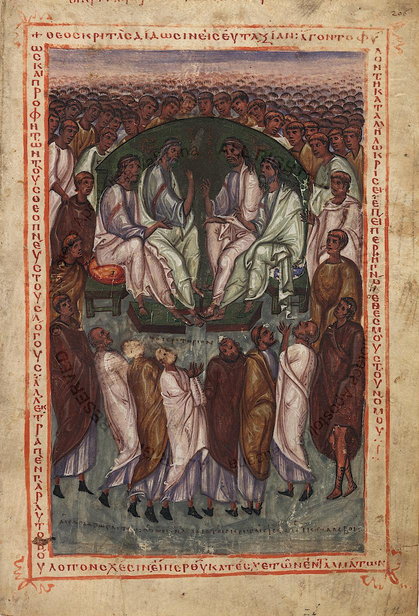
via Hyperallergic
Ilia Blinderman is a Montreal-based culture and science writer. Follow him at @iliablinderman.
Related Content:
Google Puts The Dead Sea Scrolls Online (in Super High Resolution)
Take First-Class Philosophy Lectures Anywhere with Free Oxford Podcasts
Read More...Alice Munro Talks About the Writing Life in Her Nobel Prize Interview
On October 10th, Canadian writer Alice Munro won the Nobel Prize in Literature. And if you’re not familiar with her work, we suggest that you spend time reading the 18 Free Short Stories we gathered in our celebratory post.
Traditionally, recipients of the Nobel Prize travel to Sweden to accept the award in mid December. But the 82-year-old writer, citing poor health, decided to stay home and forego making the customary acceptance speech in Stockholm. (See past speeches by Hemingway, Faulkner, Steinbeck, V.S. Naipaul and others here.) Fans of Munro weren’t left empty-handed, however. From the comfort of her daughter’s home in Victoria, British Columbia, Munro sat down for an informal, 30-minute interview and talked about many things: how she first began writing and telling stories; how she gained (and lost) confidence as a writer; how she mentally maps out her stories; how she has become a different writer with age; how the writing life for women has changed over the years; and much more. You can watch the complete Nobel interview above.
via Page-Turner
Related Content:
On His 100th Birthday, Hear Albert Camus Deliver His Nobel Prize Acceptance Speech (1957)
7 Nobel Speeches by 7 Great Writers: Hemingway, Faulkner, and More
Read 18 Short Stories From Nobel Prize-Winning Writer Alice Munro Free Online
Read More...Ed Wood’s Plan 9 From Outer Space: “The Worst Movie Ever Made,” “The Ultimate Cult Flick,” or Both?
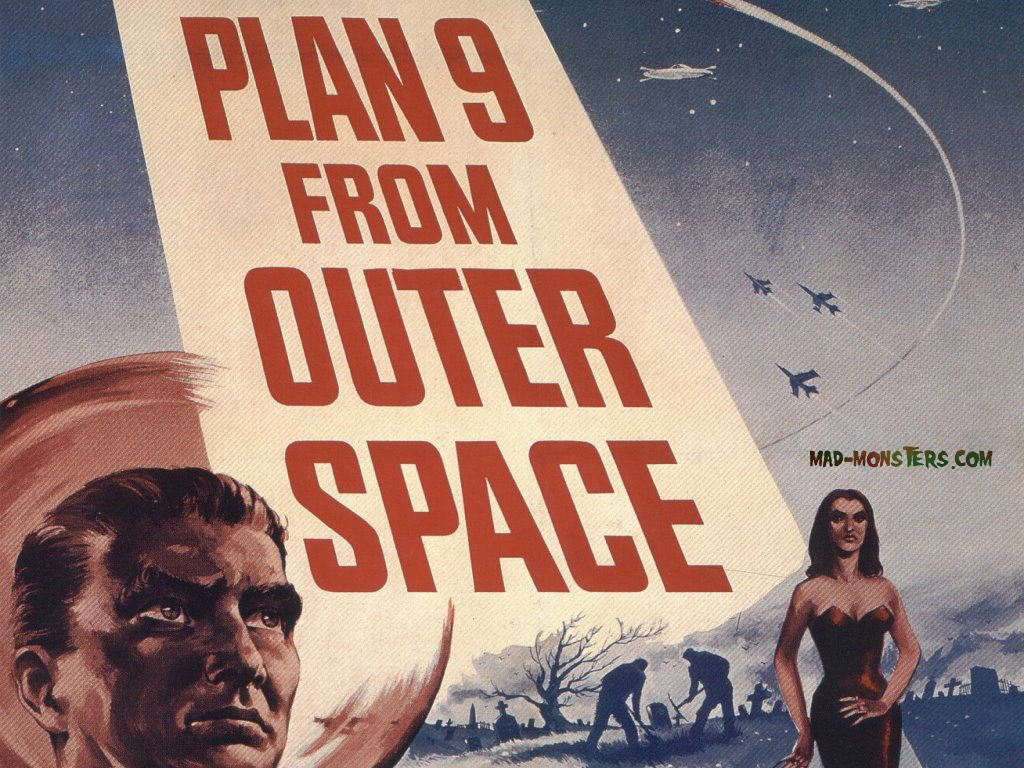
I had an adolescent fascination with Ed Wood. I mean that literally: I spent a sizable chunk of my adolescence watching the films of, reading about, and even reading the books by writer-director (and occasional cross-dresser) Edward D. Wood Jr. What, I asked, could have driven the man to make, and keep on making, the films that would ultimately define the category, quite popular during my teen years, of “so bad it’s good” cinema? None of his numerous, all unabashedly low-budget pictures have done more for that form than 1959’s Plan 9 from Outer Space, a breathless, nearly budgetless tale in which Wood throws together aliens, zombies, looming nuclear annihilation, and Bela Lugosi. Well, he almost throws in Bela Lugosi: as depicted in Tim Burton’s 1994 biopic Ed Wood, he characteristically spliced in existing footage of the by-then deceased icon of horror film, cast his wife’s chiropractor (instructed to hold a cape over his face) as a double, billed Lugosi as the star, and hoped for the best.
You can watch the fruit of that and other highly unorthodox filmmaking efforts on the part of Wood and his faithful bunch of long-suffering collaborators at the top of the post. Just below, we have a clip from Ed Wood, which in large part deals with how its indefatigable protagonist, played by a wholesomely gung-ho Johnny Depp, came to make Plan 9 in the first place. This montage recreates the shooting of sequences Wood’s fans will have long since burned into their visual memory: George “The Animal” Steele as Swedish ex-wrestler Tor Johnson rising ineptly from the grave, Bill Murray as would-be transsexual Bunny Breckenridge affectlessly giving his henchman orders to execute the title plan, a trio of toy flying saucers lowered on fishing wire into a model Hollywood. In 1980, Michael and Harry Medved dubbed Plan 9 “worst movie ever made,” initiating its ascent from decades of obscurity to the status of, as John Wirt puts it, “the ultimate cult flick.” Critics tend to regard Ed Wood as a “good” movie, and Wood’s projects, especially Plan 9, as “bad” movies, yet both entertain at very high levels indeed, making us ask an important question, another one I asked myself in the thick of my Wood period: what makes a movie “good” or “bad,” anyway?
Plan 9 from Outer Space can always be found in our collection, 4,000+ Free Movies Online: Great Classics, Indies, Noir, Westerns, Documentaries & More.
Related Content:
Troma Entertainment, the Maker of Acclaimed B‑Movies, Puts 150 Free Films on YouTube
Six Early Short Films By Tim Burton
Tim Burton Shoots Two Music Videos for The Killers
Bela Lugosi Discusses His Drug Habit as He Leaves the Hospital in 1955
Tim Burton’s The World of Stainboy: Watch the Complete Animated Series
Colin Marshall hosts and produces Notebook on Cities and Culture and writes essays on cities, Asia, film, literature, and aesthetics. He’s at work on a book about Los Angeles, A Los Angeles Primer. Follow him on Twitter at @colinmarshall or on his brand new Facebook page.
Read More...Great New Archive Lets You Hear the Sounds of New York City During the Roaring 20s
The French refer to the decade between 1920 and 1929 as les Années folles, “the crazy years,” which is apt when you consider how the French middle and upper classes generally loosened their brassieres and defined modern bohemia, à la Coco Chanel.
But the American moniker — the Roaring 20s — fits too. Nearly everything about that decade roared: cars, jazz, manufacturing, construction.
Din, in fact, came to define the age, particularly in big cities and especially in New York. An unnamed Japanese visitor was quoted upon his visit to that city in 1920: “My first impression of New York was its noise. When I know what they mean, I will understand civilization.”
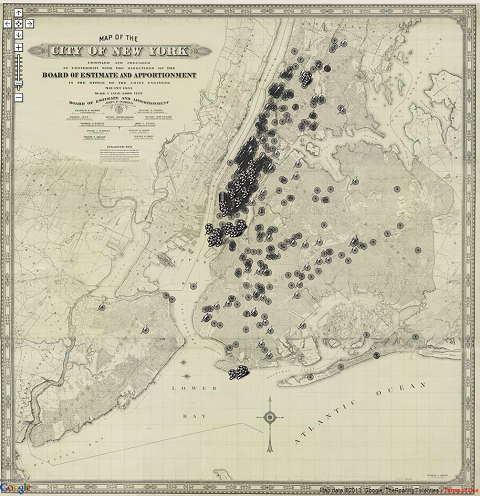
A Princeton history professor took that challenge at face value, while capturing a broader industrial era. The Roaring Twenties is an audio (and to some extent video) archive of what New York City sounded like from 1900 to 1933. Professor Emily Thompson and designer Scott Mahoy have created a lovely site that’s fun to explore. The archive includes a beautiful 1933 map of New York City loaded with links to noise complaints (screenshot at top), complete with documentation. New York had long been a place where people from all over the world lived on top of one another, but noise levels were shifting—getting louder and more varied, that is—and the city was inundated with complaints about ferry whistles, radio shops, street traffic, the clatter of restaurant dishwashing, and all manner of construction.
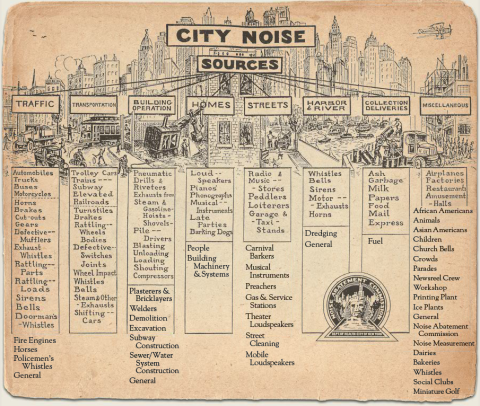
Sensitivity to the city’s volume was high. The city’s Noise Abatement Commission measured the “deafening effect” of sound in Times Square. The women’s cafeteria in the New York Life Insurance building was designed with state-of-the-art acoustics to keep the noise of the city out and the sound of office workers in.
Cortlandt Street in lower Manhattan was lined with radio shops, each broadcasting different music. Don’t miss that video, which you’ll find by scanning the Space tab map.
You can also move through time on the site, listening to the city’s cacophony from the early 1900s up to the 1930s, or browse a menu of noise sources from home sounds to the noise of the harbors and rivers. Again, you can visit the The Roaring Twenties site here.
via i09
Related Content:
Alan Lomax’s Music Archive Houses Over 17,400 Folk Recordings From 1946 to the 1990s
The Challenge of Archiving Sound + Vision in the 21st Century
Kate Rix writes about education and digital media. Follow her on Twitter.
Read More...The (Beautiful) Physics of Adding Cream to Your Coffee
Here’s a quick scenario for you. You’ve poured yourself a fresh cup of black coffee, and you want to keep it hot until you’re ready to drink it. Are you making a mistake by adding cream to that coffee? Does coffee with cream cool faster than black coffee left alone? Intuition says yes. The laws of physics lead to a different conclusion.
Last year, the web site Modernist Cuisine gave three reasons why “coffee with cream cools about 20% slower than black coffee” alone. To summarize:
1) Black coffee is darker, and dark colors emit heat faster than light colors. As such, “by lightening the color of your coffee, you slow the rate at which it cools,” if only slightly.
2) The Stefan-Boltzmann Law (apparently) says that hotter surfaces radiate heat faster than cooler ones. So if you add cream to a cup of black coffee, it might lower the temperature of that cup of coffee. However that cup could still cool at a slower rate than a cup of hot black coffee.
3) Finally, and perhaps most importantly, “adding cream thickens the coffee (adds viscosity), so it evaporates slower.” And, in turn, less heat gets carried away by the evaporation.
To top things off, Modernist Cuisine also produced a video showing cream being poured into coffee in super slow motion. Even if you don’t care to consider the physics of coffee & cream, it’s pretty cool to watch an average cup of joe getting turned into a roiling sea.
via Petapixel
Related Content:
The Physics of Coffee Rings Finally Explained
“The Vertue of the COFFEE Drink”: London’s First Cafe Creates Ad for Coffee in the 1650s
Read More...Gustave Doré’s Exquisite Engravings of Cervantes’ Don Quixote
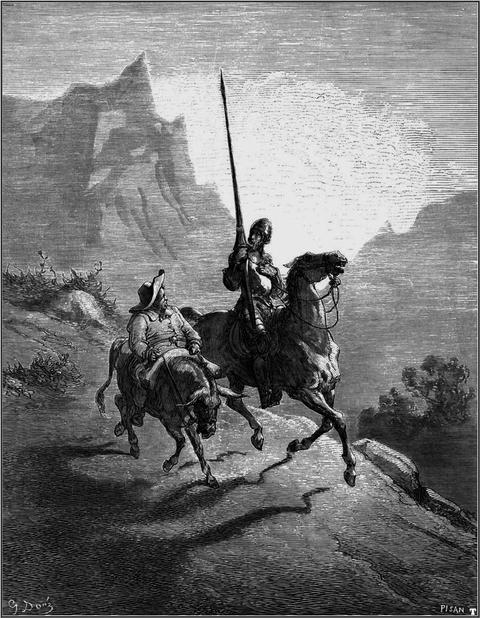
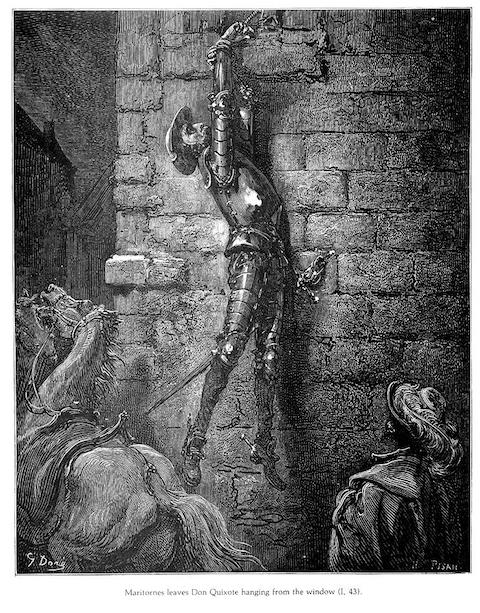
In a now defunct listing from Bauman Rare Books for an 1868 edition of Miguel de Cervantes’ Don Quixote with illustrations by Gustave Doré, we find the following unattributed quotation: “in every English-speaking home where they can spell the word ‘art,’ you will find Doré editions.” It’s odd that the homes should be “English-speaking” when Doré’s illustrations were originally an 1860 French commission, but the quote at least demonstrates the enormous popularity of Doré’s Quixote. His renderings were so influential they determined the look of Quixote and Sancho Panza in many subsequent illustrated versions, stage and film productions, and readers’ imaginations.
Perhaps the most successful illustrator of the 19th century, the dapper Doré was also at work on a momentous commission—this time from an English publisher—to illustrate the Bible. He went on to editions of Rime of the Ancient Mariner, Paradise Lost, The Divine Comedy, Poe’s The Raven, and many other famous works of literature. But his Don Quixote may be the literary commission for which he’s best remembered.
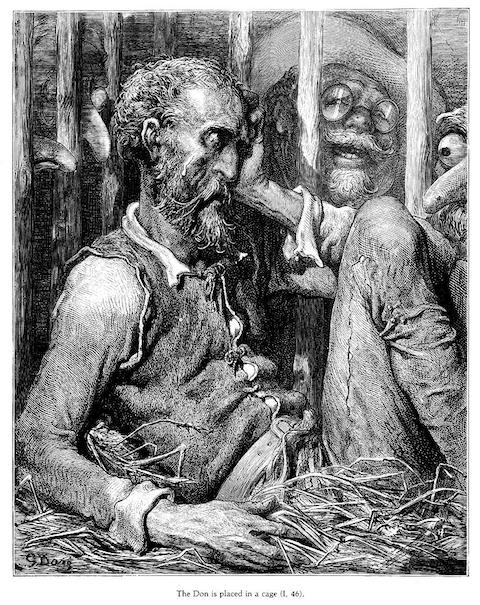
Doré apparently entered a crowded field when he took on Cervantes’ foundational text. For a little context, Bauman Rare Books also quotes a certain scholar surnamed “Ray,” who offers this précis of the edition’s creation:
Don Quixote was a text calculated to test even Doré. He was matching himself against Coypel and Tony Johannot, not to mention the Spanish illustrators of the great Ibarra edition published in Madrid in 1780. He met the challenge superbly… At first he intended only 40 designs, but Cervantes’ book captured his imagination, and he arranged for a major work… Don Quixote and Sancho Panza reached their definitive rendering in Doré’s designs.
Doré ended up completing over 200 illustrations for his edition. You can see a couple of those “definitive,” and exquisite, engravings above and below. The editors of Bibliokept maintain a separate site posting all of the Doré Quixote illustrations. Project Gutenberg has an English full text Quixote with the illustrations scanned in, and the University of Buffalo has an extensive searchable digital collection of Doré illustrations. And if you just have to conform to the tastes of “every English-speaking home where they can spell the word ‘art’ ” and own a Doré Quixote of your own, you can purchase a re-creation of an 1870 edition for only three monthly installments of $125. It’s a “publishing treasure.” Princeton University has more information on the engravings.
via Bibliokept
Related Content:
Gustave Doré’s Dramatic Illustrations of Dante’s Divine Comedy
Salvador Dalí’s 100 Illustrations of Dante’s The Divine Comedy
Henri Matisse Illustrates 1935 Edition of James Joyce’s Ulysses
Josh Jones is a writer and musician based in Durham, NC. Follow him at @jdmagness
Read More...Google’s Moving Ad About 1947 Partition of India & Pakistan Tops 10 Million Views
Recently, Wired writer Steve Silberman (aka @stevesilberman) shot us a note on Twitter, saying, “@openculture, do not miss this brilliant ad. Most touching movie (in 3 mins!) I’ve seen in years.” Released on November 13th, the video has already clocked over 10 million views. But chances are you haven’t seen it. And that’s because it’s targeted to the web-enabled middle class of India and Pakistan. As The Dawn, Pakistan’s oldest English newspaper, describes it, the Google-created ad entitled “Reunion” “portrays two childhood friends, now elderly men, who haven’t seen each other since they were separated by the 1947 partition that created India and Pakistan from the old British empire in South Asia. Partition sparked a mass exodus as millions of Muslims and Hindus fled across the new borders amid religious violence.” Now Google search products are helping to bring old friends and neighbors back together.
Cynics may be quick to judge this a saccharine, manipulative ad. But others are seeing in it something else — a sign that “personal connections between Indians and Pakistanis run deep.” Even if their governments gain something from keeping the conflict alive, everyday people in India and Pakistan are increasingly ready to put history aside.
Note: If you click CC at the bottom of the video, you can use captions to translate the film into nine languages, including French, Malayalam and Urdu. It is preset to English.
Don’t miss anything from Open Culture. Sign up for our Daily Email orRSS Feed. And we’ll send quality culture your way, every day.
Read More...The Clash Mauls a Teddy Bear and Plays Two Songs on The Tom Snyder Show (1981)
The Clash’s Sandinista!, their fourth and penultimate studio album (let’s not talk about Cut the Crap) inspired critical rhapsodies and rose to the top of lists everywhere in 1981. When I encountered it almost ten years later as a young fan, I didn’t give it much of a chance, except for a song with the same name as my beleaguered hometown’s NBA team. In hindsight, it was my loss, but it’s also true that nearly every generation of Clash fans, including the very first, has put their finger on the band’s moment of either “selling out” or sharply declining. Maybe for me it was what a Rolling Stone review called Sandinista!’s “mainstream moves” and “studio sophistication.” Maybe it was the “whiff of grandeur” of the triple album. I think it also had to do with what Tom Snyder, in his 1981 interview with the band above, says of them in his introduction: they preferred to be identified “not so much as a Rock and Roll group but as a ‘News-giving group.’”
It was hardly news when I heard it, and I didn’t much care for topical songs anyway. But I’ve always admired Joe Strummer’s sincerity and sense of political urgency. I don’t know how seriously Strummer takes Snyder’s “News-giving” open, but he rolls with it, and the band turns on the charm offensive, alternately cuddling and abusing a teddy bear (against Snyder’s protestations), professing their sincere loyalty to their fans, and covering the host with merchandise. It’s a fun eight and half minutes. Then they do two songs, “The Magnificent Seven” (above), from Sandinista!, and “This is Radio Clash” (below), which doesn’t appear on any of their studio albums. Behind Mick Jones’ wall of amps, pioneering graffiti artist Futura 2000 spray-paints some unidentifiable words, and beneath the whole affair is what Dangerous Minds calls “an undercurrent of controlled mayhem.” This kind of TV just doesn’t happen anymore.
Related Content:
Mick Jones Plays Three Classics by The Clash at the Public Library
The Clash: Westway to the World (The 2002 Grammy Winning Film)
The Clash Live in Tokyo, 1982: Watch the Complete Concert
Josh Jones is a writer and musician based in Durham, NC. Follow him at @jdmagness
Read More...View Bill Gates’ Mobile Library: The Books & Courses That Help Him Change The World
Stepping down as Microsoft’s chief executive officer in 2000 had given Bill Gates some extra time, which the autodidact immediately expended by attempting to learn… well, everything. Perhaps Gates threw himself at learning to make up for abandoning college for greater pursuits—he attended Harvard but left after two years’ study to pursue his passion for computers. Whatever his reasons, Gates has begun to assiduously learn all he can about the world, and is recording his education process for posterity on his website, The Gates Notes. As the video above explains, Microsoft’s founder has listened to hundreds of hours of university lectures from The Teaching Company; he got hooked after listening to Robert Whaples’ Modern Economic Issues and breezing through Timothy Taylor’s America and the New Global Economy. His number one pick? Big History which is taught by David Christian and, Gates says, “is still my favorite course of all. The course is so broad that it synthesizes the history of everything including the sciences into one framework.”
Wherever Gates travels, he is also eternally accompanied by his reading bag. Surprised that the herald of the digital age is packing paperbacks? Don’t be. “I’m still pretty much an old-school print guy,” Gates writes, “because I like to jot notes in the margins, but I assume I’ll move over to ebooks when annotation features get better.”
Last week, Gates showed WIRED the contents of his decidedly 20th century mobile library. The books, which Gates replenishes at an impressive rate, encompass an admirable breadth of topics. As befitting the overseer of the Bill and Melinda Gates Foundation, the majority of Gates’ reading consists of non-fiction (only Gary Shteyngart’s recent novel made the fiction cut this round). History, psychology, science, sound business counsel, sociology, economics, and history all make up the dizzying array of Gates’ everyday reading. Here is a selection from WIRED’s partial list, including Gates’ own comments on the importance of each choice:
-Feynman’s Tips on Physics by Richard Feynman– A short companion book to Richard Feynman’s classic Lectures on Physics. Always worthwhile to return to the feet of the master.
-Super Sad True Love Story: A Novel by Gary Shteyngart– I don’t read a lot of fiction, but I thought this was an interesting study of the moral implications of technology. Will technology contribute to everyone’s well-being or just make people more narcissistic?
-The Cartoon Introduction to Statistics by Grady Klein– Bought this to use with one of my kids. Helpful in explaining a complicated subject to a teenager.
-The Path Between the Seas: The Creation of the Panama Canal by David McCullough – I read this to prepare for a family vacation to Panama. It’s pure McCullough: epic drama, political intrigue, heartbreaking defeats, and eventual triumph.
-The Better Angels of Our Nature: Why Violence Has Declined by Steven Pinker– One of the most important books I’ve read. Steven Pinker demonstrates how the world evolved to be far less violent. Counterintuitive, if you watch the news, but true.
We’ve also used the trusty Control + Scroll function to zoom in and name a few additional titles:
An Uncertain Glory: India and its Contradictions by Jean Drèze and Amartya Sen
Engineers of Victory: The Problem Solvers Who Turned The Tide in The Second World War by Paul Kennedy
The Price of Inequality: How Today’s Divided Society Endangers Our Future by Joseph Stiglitz
Why Does College Cost So Much? By Robert Archibald and David Feldman
Mondo Agnelli: Fiat, Chrysler, and the Power of a Dynasty by Jennifer Clark
How Children Succeed: Grit, Curiosity, and the Hidden Power of Character by Paul Tough
The One World Schoolhouse: Education Reimagined by Salman Khan
Far From The Tree by Andrew Solomon
For the original list, head over to WIRED. For more of Gates’ commentary, check out his site, The Gates Notes, here. You can also continue your self-education by visiting our lists of Free Online Courses, Free eBooks, Free Audio Books, Free Language Lessons, Free Textbooks, and Free MOOCs.
Ilia Blinderman is a Montreal-based culture and science writer. Follow him at @iliablinderman.
Read More...The Pulp Fiction Archive: The Cheap, Thrilling Stories That Entertained a Generation of Readers (1896–1946)
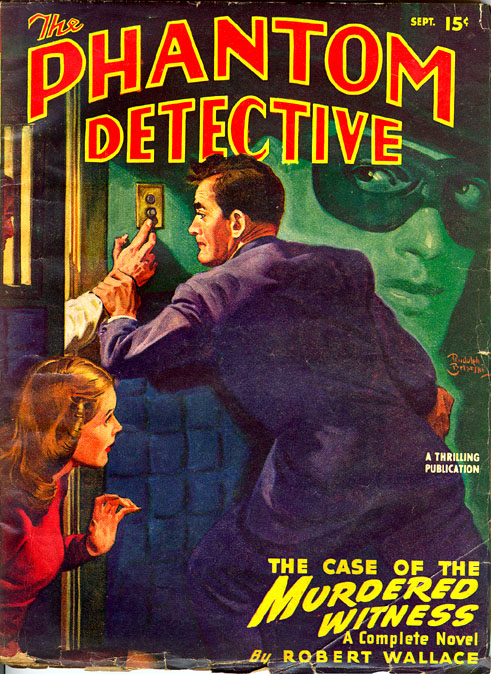
For the first half of the twentieth century, pulp magazines were a quintessential form of American entertainment. Printed on cheap, wood pulp paper, the “pulps” (as opposed to the “glossies” or “slicks,” such as The New Yorker) had names like The Black Mask and Amazing Stories, and promised readers supposedly true accounts of adventure, exploitation, heroism, and ingenuity. Such outlets offered a steady stream of work for stables of fiction writers, with content ranging from short stories about intrepid explorers saving damsels from Nazis/Communists (depending on the precise time of publication) to novel-length man vs. beast accounts of courage and cunning. This, incidentally, gave birth to the term “pulp fiction,” popularized in the 1990s by Quentin Tarantino’s eponymous film.
In the 1950s, the pulps went into a steep decline. In addition to television, paperback novels, and comic books, the pulps were overtaken by the more explicit, and even lower brow men’s adventure magazines (readers of Truman Capote’s In Cold Blood may remember Perry Smith, the sociopathic misfit who murdered the Clutter family, being an enthusiastic reader of these early lads’ mags). Thanks to The Pulp Magazines Project, however, many of the most famous publications remain accessible today through a well-designed online interface. Hundreds of issues have been archived in the database that spans from 1896 through to 1946. It includes large magazines, such as The Argosy and Adventure, and smaller, more specialized fare, such as Air Wonder Stories and Basketball Stories. Although good writing occasionally made its way into the pulps, don’t expect these magazines to mirror the literary depth of serialized publications of the 19th century; rather, the archive provides a terrifically entertaining look at the popular reading of early 20th century America.
To browse the complete database, head over to The Pulp Magazines Project.
If you would like to support the mission of Open Culture, consider making a donation to our site. It’s hard to rely 100% on ads, and your contributions will help us continue providing the best free cultural and educational materials to learners everywhere. You can contribute through PayPal, Patreon, and Venmo (@openculture). Thanks!
Related Content:
Quentin Tarantino Gives Sneak Peek of Pulp Fiction to Jon Stewart (1994)
Isaac Asimov Recalls the Golden Age of Science Fiction (1937–1950)
Did Shakespeare Write Pulp Fiction? (No, But If He Did, It’d Sound Like This)
Download 14 Great Sci-Fi Stories by Philip K. Dick as Free Audio Books and Free eBooks
Read More...Support Us
We're hoping to rely on loyal readers, rather than erratic ads. Please click the Donate button and support Open Culture. You can use Paypal, Venmo, Patreon, even Crypto! We thank you!

About Us

Open Culture scours the web for the best educational media. We find the free courses and audio books you need, the language lessons & educational videos you want, and plenty of enlightenment in between.
Advertise With Us

FREE UPDATES!
GET OUR DAILY EMAIL
Get the best cultural and educational resources on the web curated for you in a daily email. We never spam. Unsubscribe at any time.
FOLLOW ON SOCIAL MEDIA

Open Culture editor Dan Colman scours the web for the best educational media. He finds the free courses and audio books you need, the language lessons & movies you want, and plenty of enlightenment in between.
Advertise With Us


