Watch an Animation of Shaun Tan’s All-Ages Picture Book The Lost Thing
What would you do if you crossed paths with a jingling lost thing whose oven-shaped body, crustaceous claws, and fleshy tentacles would seem right at home in Hieronymus Bosch’s Garden of Earthly Delights?
Scream? Run? Release your bowels?
The anonymous narrator of The Lost Thing, a fifteen-minute animation born of Shaun Tan’s all-ages picture book, attempts, instead, to identify it empirically through careful observation, calibrated measurement, and controlled experimentation. When the scientific approach fails, he assumes responsibility for his strange find, leading it through a clanking, grimy landscape where sanitation crews deflate beach balls with pointy sticks after the joyless holiday crowds are dismissed—a vision of steampunk in defeat.
We’re loathe to hit you with any more spoilers. Suffice it to say that this is a fine example of innovatively adapted source material, and that eventually our stoic hero—voiced by British-born Australian comic Tim Minchin—and his charge arrive in a landscape that should cause the inhabitants of the Island of Misfit Toys to stop mooning over Santa.
You will find The Lost Thing listed in the Animation section of our collection of Free Movies Online.
Related Content:
Watch a Whimsical Animation of Italo Calvino’s Short Story “The Distance of the Moon”
Watch Animations of Oscar Wilde’s Children’s Stories “The Happy Prince” and “The Selfish Giant”
Harder Than It Looks: How to Make a Great Stop Motion Animation
Ayun Halliday picks all manner of jetsam off the curbs of her Brooklyn neighborhood. Follow her @AyunHalliday
Read More...John Searle Makes A Forceful Case for Studying Consciousness, Where Everything Else Begins
Consciousness is the single most important aspect of our lives, says philosopher John Searle. Why? “It’s a necessary condition on anything being important in our lives,” he says. “If you care about science, philosophy, music, art — whatever — it’s no good if you are a zombie or in a coma.”
Searle is one of today’s preeminent philosophers of mind. Author of the famous “Chinese Room” argument against the possibility of true artificial intelligence, Searle has been a persistent thorn in the side of those who would reduce consciousness to computation, or conflate it with behavior. Despite its intrinsically subjective nature, consciousness is an irreducible biological phenomenon, he says, “as much subject to scientific analysis as any other phenomenon in biology, or for that matter the rest of science.”
Searle made his remarks at the May 3 TEDx conference at CERN — the European Organization for Nuclear Research — near Geneva, Switzerland. The video above gives a thought-provoking overview of his basic conclusions about consciousness, but to delve deeper into Searle’s philosophy of mind — and also his philosophy of language and society — see our earlier post about his online Berkeley lectures: “Philosophy with John Searle: Three Free Courses.”
Related content:
John Searle on Foucault and the Obscurantism in French Philosophy
What Do Most Philosophers Believe? A Wide-Ranging Survey Project Gives Us Some Idea
Download 90 Free Philosophy Courses and Start Living the Examined Life
Read More...Virginia Woolf’s Handwritten Suicide Note: A Painful and Poignant Farewell (1941)
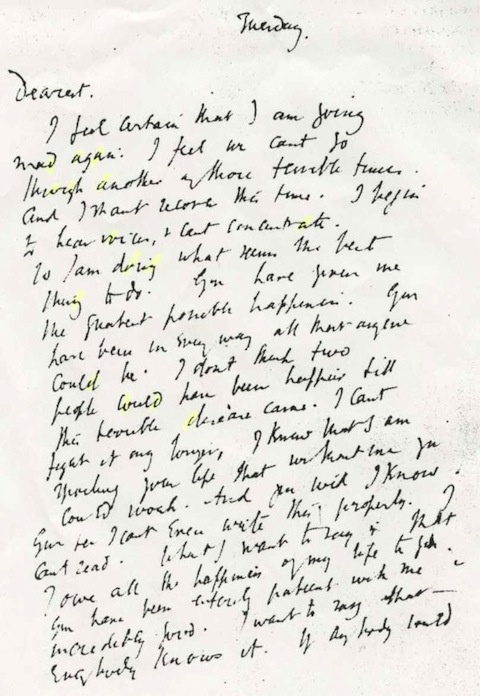
It seems like a very morbid and inhuman practice to treat the suicide note as a piece of literature, even if the author of said note is a writer as famous as Virginia Woolf. And yet, why not? I can anticipate all sorts of ethical objections having to do with decency, and I share some of those sentiments. Let us not forget, however, that death has often been a literary occasion: the long tradition of recorded last words ranges from deathbed confessions to the strangely theatrical genre of the gallows speech (see Socrates, Anne Boleyn, or John Brown). Like those unforgettable figures of history, Virginia Woolf’s last scripted words are pored over by lay readers and scholars alike (see, for example, pages on Woolf’s final words from Smith College and Yale).
Woolf’s death, in March of 1941, occasioned the third of her suicide letters, and yes, it feels unseemly to linger over her last piece of prose. Perhaps it is the mode of death, suicide still being a societal taboo, thought of as tragic even when it’s undertaken calmly and rationally by someone ready to leave this world. And in many cases, especially those involving mental illness, death seems so needless, so extreme. Such was the case with Woolf, who drowned herself after a long struggle with what would probably be called today bipolar disorder. Her suicide note, written to her husband Leonard, is a haunting and beautiful document, in all its unadorned sincerity behind which much turmoil and anguish lie. See a scan of the handwritten note at the top, and read the full transcript below. Directly above, you can hear a dramatic reading of Woolf’s note, such a wrenching missive because it is not a farewell to the world at large, but rather to a trusted friend and lover.
Dearest,
I feel certain I am going mad again. I feel we can’t go through another of those terrible times. And I shan’t recover this time. I begin to hear voices, and I can’t concentrate. So I am doing what seems the best thing to do. You have given me the greatest possible happiness. You have been in every way all that anyone could be. I don’t think two people could have been happier till this terrible disease came. I can’t fight any longer. I know that I am spoiling your life, that without me you could work. And you will I know. You see I can’t even write this properly. I can’t read. What I want to say is I owe all the happiness of my life to you. You have been entirely patient with me and incredibly good. I want to say that — everybody knows it. If anybody could have saved me it would have been you. Everything has gone from me but the certainty of your goodness. I can’t go on spoiling your life any longer.
I don’t think two people could have been happier than we have been.
Related Content:
“A Haunted House” by Virginia Woolf
Find Works by Virginia Woolf in Our Collections of Free Audio Books and Free eBooks.
Josh Jones is a writer and musician based in Durham, NC. Follow him at @jdmagness
Read More...Did Hollywood Movies Studios “Collaborate” with Hitler During WW II? Historian Makes the Case
As anyone who watches the History Channel can tell you, stories about the Second World War still fascinate. Stories about Nazi Germany specifically seem to fascinate more than they ever have before. Combine that with the current American desire to gaze upon the dark side of its own once-beloved institutions, and Harvard historian Ben Urwand may have a hit on his hands when his book The Collaboration: Hollywood’s Pact with Hitler comes out next month. (Read an excerpt here.) Emory University historian Deborah Lipstadt uses an even more apt term: “I think what this guy has found could be a blockbuster.” She is quoted in an article by the New York Times’ Jennifer Schuessler on Urwand, his discoveries, and his book. “On page after page,” Schuessler writes, “[Urwand] shows studio bosses, many of them Jewish immigrants, cutting films scene by scene to suit Nazi officials; producing material that could be seamlessly repurposed in Nazi propaganda films; and, according to one document, helping to finance the manufacture of German armaments.”
As if Urwand’s findings about these deals between Hollywood studios and the Third Reich won’t cause enough of a stir by themselves, his perspective on them has already fired up an academic controversy. Schuessler quotes Brandeis’ Thomas P. Doherty as calling Urwand’s use of the word “collaboration” a “slander” and mentions, by contrast, University of Southern California history professor Steven J. Ross’ forthcoming book which tells “the little-known story of an extensive anti-Nazi spy ring that began operating in Los Angeles in 1934, financed by the very studio bosses who were cutting films to satisfy Nazi officials.” You can read a fuller critique of Urwand’s arguments from Doherty at the Hollywood Reporter. At the top, you can watch that publication’s brief conversation with Urwand himself, in which he explains and defends his use of the word “collaboration” — which, he says, the Hollywood executives in question used themselves. Finally, just above, you can hear more from Urwand in Harvard University Press’ clip about The Collaboration. As with most modern research into World War II, the book no doubt raises more historical and moral questions than we can answer, though I do doubt that anyone who reads it will ever watch pictures from Hollywood’s Golden Age in quite the same way again.
Related Content:
Rare 1940 Audio: Thomas Mann Explains the Nazis’ Ulterior Motive for Spreading Anti-Semitism
The Making of a Nazi: Disney’s 1943 Animated Short
The Nazis’ 10 Control-Freak Rules for Jazz Performers: A Strange List from World War II
Colin Marshall hosts and produces Notebook on Cities and Culture and writes essays on literature, film, cities, Asia, and aesthetics. He’s at work on a book about Los Angeles, A Los Angeles Primer. Follow him on Twitter at @colinmarshall.
Read More...Robert Crumb Illustrates Philip K. Dick’s Infamous, Hallucinatory Meeting with God (1974)
“I saw God,” Fat states, and Kevin and I and Sherri state, “No, you just saw something like God, exactly like God.” And having spoke, we do not stay to hear the answer, like jesting Pilate, upon his asking, “What is truth?”
–Philip K. Dick, VALIS
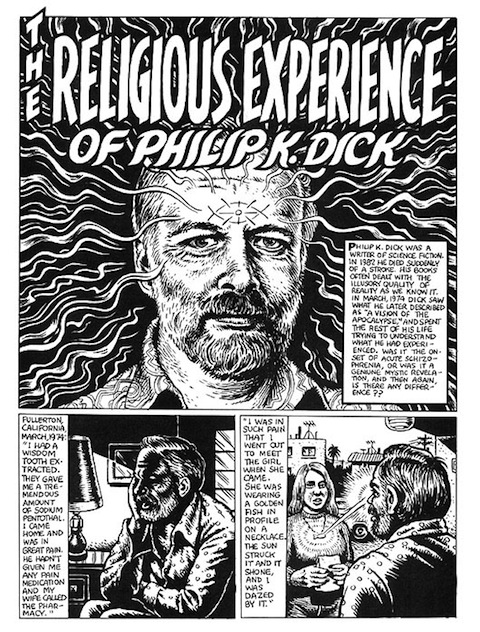
In the months of February and March, 1974, Philip K. Dick met God, or something like God, or what he thought was God, at least, in a hallucinatory experience he chronicled in several obsessively dense diaries that recently saw publication as The Exegesis of Philip K. Dick, a work of deeply personal theo-philosophical reflection akin to Carl Jung’s The Red Book. Whatever it was he encountered—Dick was never too dogmatic about it—he ended up referring to it as Zebra, or by the acronym VALIS, Vast Active Living Intelligence System, also the title of a novel detailing the experiences of one very PKD-like character with the improbable name of “Horselover Fat.”
LSD-triggered psychotic break, genuine religious experience, or something else entirely, whatever Dick’s encounter meant, he didn’t let the opportunity to turn it into art slip by him, and neither did outsider cartoonist and PKD fan Robert Crumb. In issue #17 of the underground comix magazine Weirdo, Crumb narrated and illustrated Dick’s meeting with a divine intelligence in the appropriately titled “The Religious Experience of Philip K. Dick.” It was eventually collected in the edition, The Weirdo Years by R. Crumb: 1981-’93. (See the comic in motion in the awkward, amateur video above.) The comic quotes directly from Dick’s telling of the event, which began with a wisdom tooth extraction and was ultimately triggered by a golden Christian fish symbol worn around the neck of a pharmaceutical delivery girl. Most PKD fans will be familiar with the story, whether they treat it as gospel or not, but to see it illustrated with such empathetic intensity by Crumb is truly a treat.
If you only know Crumb as the creator of lascivious Rubenesque women and schlubby, druggy horndog hipsters (like Fritz the Cat), you may be surprised by these emotionally realist illustrations. If you know Crumb’s more serious work, like his take on the book of Genesis, you won’t. In either case, fans of Dick, Crumb, or—most likely—both, won’t want to miss this.
Related Content:
Download 14 Great Sci-Fi Stories by Philip K. Dick as Free Audio Books and Free eBooks
Josh Jones is a writer and musician based in Durham, NC. Follow him at @jdmagness
Read More...The Hand Puppets That Bauhaus Artist Paul Klee Made for His Young Son
My kids used to beg their dad to help out with their impromptu puppet shows. He complied by having our daughter’s favorite baby doll deliver an interminable curtain speech, hectoring the audience (me) to become subscribers and make donations via the small envelope they’d find tucked in their programs.
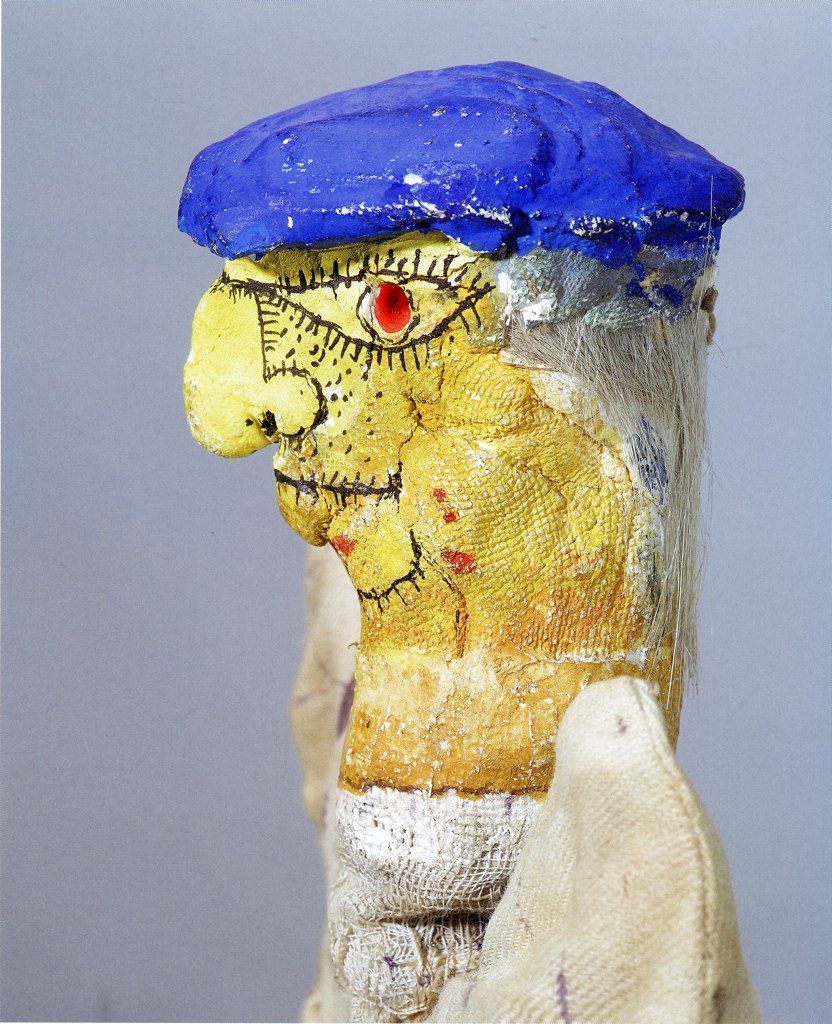
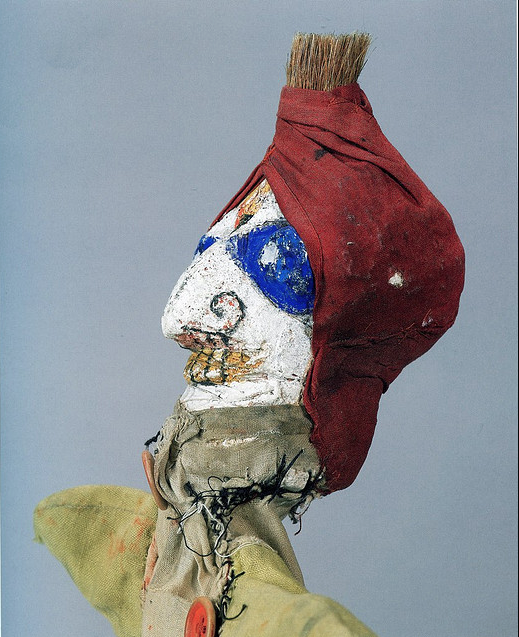
Like my husband, artist Paul Klee (1879–1940) loomed large in his child’s early puppet work. To mark his son Felix’s ninth birthday, Klee fashioned eight hand puppets based on stock characters from Kasperl and Gretl — Germany’s answer to Punch and Judy. The boy took to them so enthusiastically that his dad kept going, creating something in the neighborhood of fifty puppets between 1916 and 1925. The cast soon expanded to include cartoonish political figures, a self-portrait, and less recognizable characters with a decidedly Dada-ist bent. Klee also fixed Felix up with a flea market frame that served as the proscenium for the shows he put on in a doorway of the family’s tiny apartment.
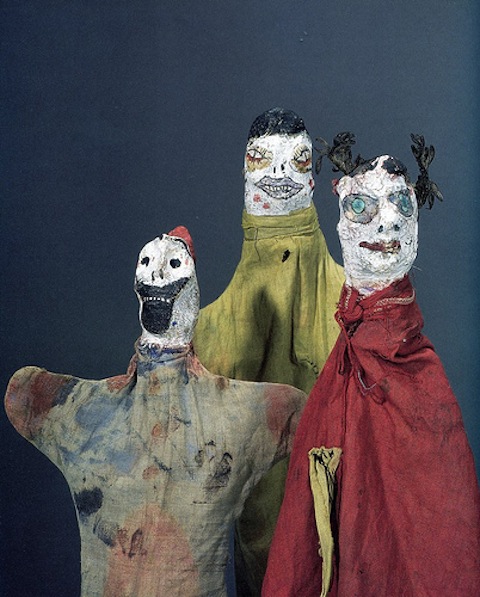
When Felix set out into the world at the age of eighteen, he packed his favorite childhood puppets, while his dad hung onto the ones born of his years on the faculty of the Bauhaus. Felix’s portion of the collection was almost entirely destroyed during the bombing of Wurzburg in World War II. Dr. Death was the only member of the original eight to escape unscathed.
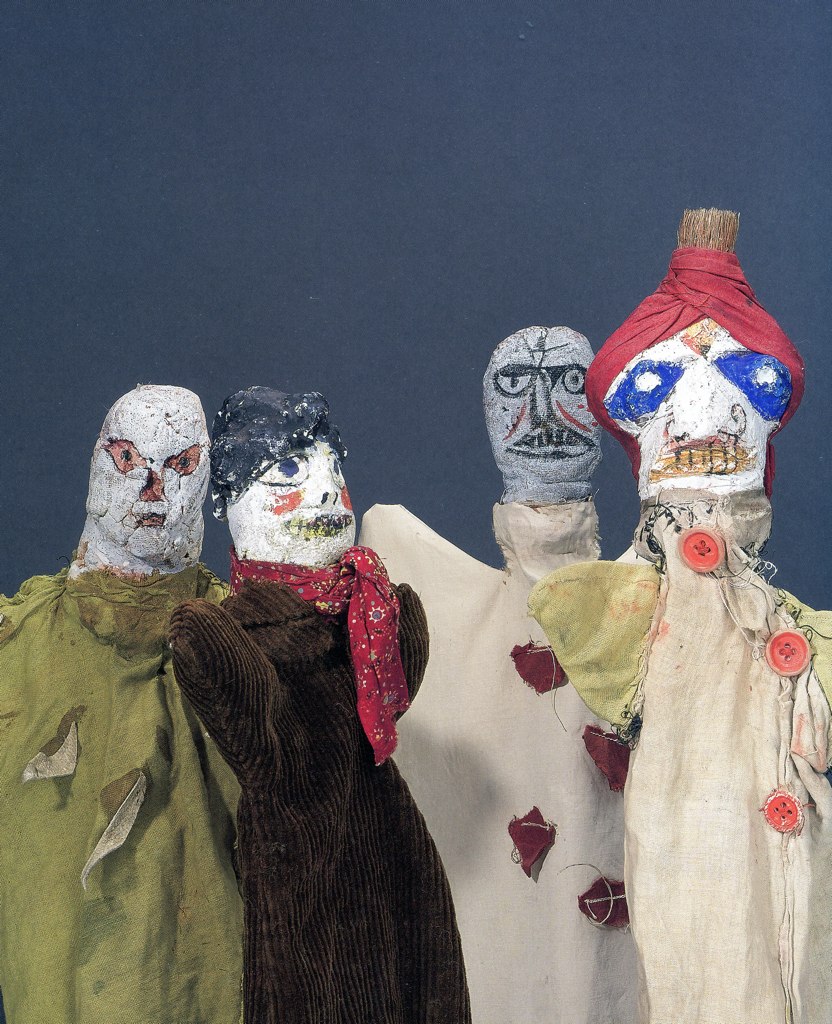
You can find a gallery of Klee’s puppets here, and a book dedicated to Klee’s puppetry here.
If you would like to support the mission of Open Culture, consider making a donation to our site. It’s hard to rely 100% on ads, and your contributions will help us continue providing the best free cultural and educational materials to learners everywhere. You can contribute through PayPal, Patreon, and Venmo (@openculture). Thanks!
Related Content:
Tchaikovsky Puppet in Timelapse Film
Puppet Making with Jim Henson: A Priceless Primer from 1969
Bauhaus, Modernism & Other Design Movements Explained by New Animated Video Series
Free: The Metropolitan Museum of Art and the Guggenheim Offer 474 Free Art Books Online
Ayun Halliday is okay with puppets as long as she can hold them at arm’s length. Follow her @AyunHalliday
Read More...“Notes from a Dirty Old Man”: Charles Bukowski’s Lost Cartoons from the 60s and 70s
The poet Charles Bukowski has appeared often on Open Culture lately, and I have no objection. Not only do I savor writing about a literary figure thoroughly representative of Los Angeles, where I live, but about one who, even nineteen years after his death, keeps producing interesting things. Or at least we keep finding them.
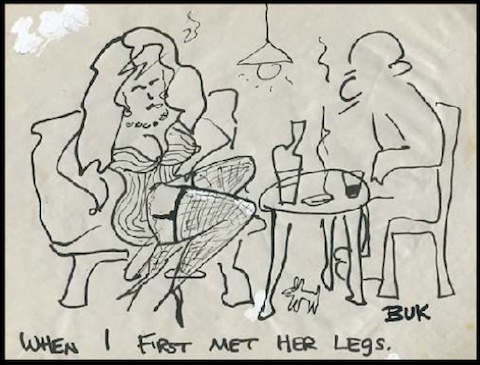
A case in point comes from this post by Stephen J. Gertz of Booktryst about evidence rediscovered earlier this year of Bukowski’s efforts as a cartoonist: “Nineteen long-lost original drawings by Charles Bukowski, America’s poet laureate of the depths, surfaced at the 46th California International Antiquarian Book Fair February 15–17, 2013, offered by ReadInk of Los Angeles. Sixteen of them appeared as accompaniment to Bukowski’s classic column in the Los Angeles Free Press (The Freep), ‘Notes of a Dirty Old Man’. The remaining three originally appeared in Sunset Palms Hotel, Issue #4 (1974).”
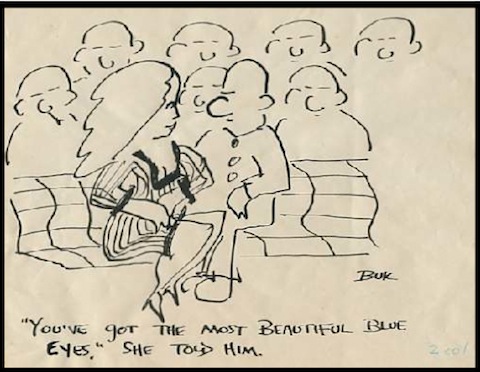
Less comics per se than drawn windows into Bukowski’s worldview, these panels show, in a shaky yet bold line, the poet’s views on drinking, smoking, staying in bed, and conducting relations with the fairer sex. “Until its termination in 1976,” Gertz continues, “Bukowski’s ‘Notes of a Dirty Old Man’ was probably the single biggest contributing factor to both the spread of his literary fame and his local notoriety as a hard-living, hard-drinking L.A. character.” The very idea of Bukowski as a regular columnist may strike some familiar with his poetry as incongruous, but you can get an idea of how the gig formed his literary persona by reading the 1969 collection Notes of a Dirty Old Man and the 2011 More Notes of a Dirty Old Man: The Uncollected Columns. Neither, however, contain Bukowski’s illustrations, but now you can appreciate them on the internet. They almost make you believe the man could have published a cartoon or two in the New Yorker, but no — wrong coast. (And wrong sensibility, certainly.)
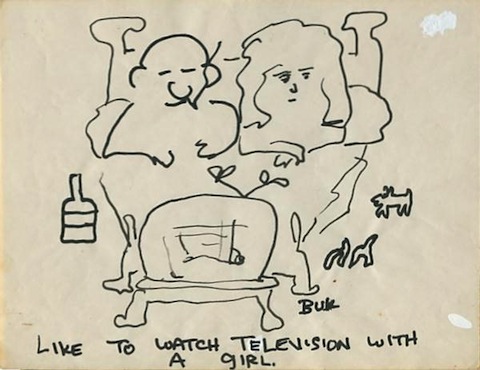
via Book Tryst
Related Content:
Listen to Charles Bukowski Poems Being Read by Bukowski, Tom Waits and Bono
Charles Bukowski Sets His Amusing Conditions for Giving a Poetry Reading (1971)
“Don’t Try”: Charles Bukowski’s Concise Philosophy of Art and Life
Charles Bukowski: Depression and Three Days in Bed Can Restore Your Creative Juices (NSFW)
Colin Marshall hosts and produces Notebook on Cities and Culture and writes essays on literature, film, cities, Asia, and aesthetics. He’s at work on a book about Los Angeles, A Los Angeles Primer. Follow him on Twitter at @colinmarshall.
Read More...Vladimir Nabokov Creates a Hand-Drawn Map of James Joyce’s Ulysses
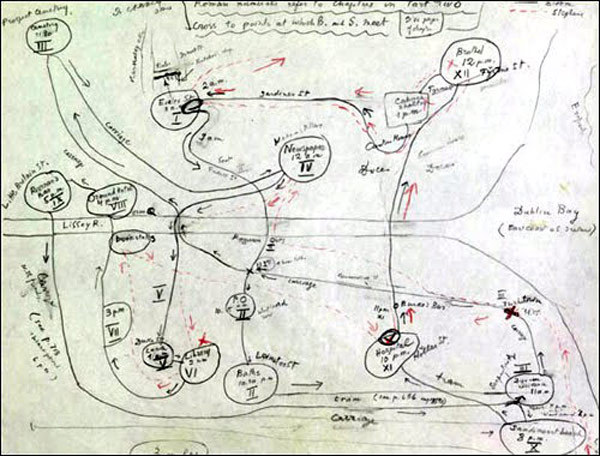
Click the image above for a larger version
Just above you’ll find a sketched-out map of the paths Stephen Dedalus and Leopold Bloom took through Dublin on June 16, 1904. If you’ve ever read James Joyce’s Ulysses (find it in our lists of Free eBooks and Free Audio Books), you may well have tried drawing one of these yourself, connecting the locations as each chapter finds one of the protagonists somewhere else in Ireland’s capital on that “ordinary” day. Maybe you wanted to test the plausibility of the common assertion that, given accuracy and detail with which Joyce wrote about the city, one could, in case of the apocalypse, build the city all over again using the novel as a plan. This particular Ulysses fan map, however, comes from the hand of a very special reader indeed: Vladimir Nabokov, author of a few much-discussed works of twentieth-century literature himself, including Lolita, Pale Fire, and Speak, Memory.
For those who teach Ulysses, Nabokov has a suggestion: “Instead of perpetuating the pretentious nonsense of Homeric, chromatic, and visceral chapter headings, instructors should prepare maps of Dublin with Bloom’s and Stephen’s intertwining itineraries clearly traced.” A post from Raynor Ganan quotes him as saying that, adding, “Would you not have donated a litre of your own spinal fluid to audit this lecture?” Indeed, Nabokov speaks from experience, having not only produced well-respected literature but taught it, too. The fruits of his time at the front of the classroom appear in his collection Lectures on Literature, though if you want to get as close as possible to the experience of sitting in on one of Nabokov’s classes, go back into our archives and watch the WQED dramatization, starring Christopher Plummer, of his talk on Kafka at Cornell. It won’t give you any insight into Joyce’s Dublin, granted, but some Yale grad students’ more recent project to digitally, interactively map Ulysses just might.
If you would like to support the mission of Open Culture, consider making a donation to our site. It’s hard to rely 100% on ads, and your contributions will help us continue providing the best free cultural and educational materials to learners everywhere. You can contribute through PayPal, Patreon, and Venmo (@openculture). Thanks!
Related Content:
Vladimir Nabokov (Channelled by Christopher Plummer) Teaches Kafka at Cornell
James Joyce, With His Eyesight Failing, Draws a Sketch of Leopold Bloom (1926)
Read Joyce’s Ulysses Line by Line, for the Next 22 Years, with Frank Delaney’s Podcast
James Joyce’s Ulysses: Download the Free Audio Book
Colin Marshall hosts and produces Notebook on Cities and Culture and writes essays on literature, film, cities, Asia, and aesthetics. He’s at work on a book about Los Angeles, A Los Angeles Primer. Follow him on Twitter at @colinmarshall.
Read More...Free: Stream New Albums by Bob Dylan, Neko Case & Sly And The Family Stone
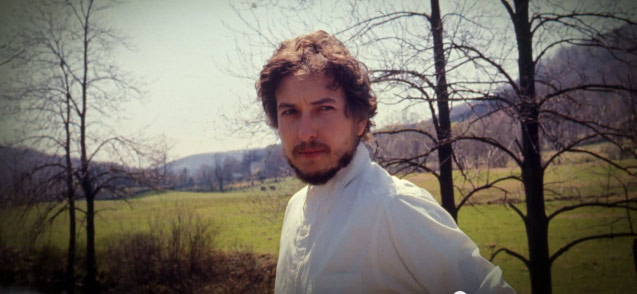 Next week — August 27th, to be precise — Columbia Records will release Bob Dylan’s The Bootleg Series, Vol. 10 — Another Self Portrait (1969–1971), a collection of 35 tracks (unreleased recordings, demos and alternate takes) that were largley recorded during studio sessions for the 1970 albums Self Portrait and New Morning. If you’re looking for a little preview, then head over to NPR’s First Listen site where 15 tracks are streaming for free … for a limited time. Titles include “Time Passes Slowly #1”, which features Dylan playing with George Harrison; a version of “If Not for You” performed solo with only violin accompaniment; and a live version of “Highway 61 Revisited” recorded by Dylan, backed by The Band, at the Isle of Wight concert in 1969.
Also streaming this week on NPR’s site is Neko Case’s new album The Worse Things Get, The Harder I Fight, plus Sly And The Family Stone’s Highlights From ‘Higher!’
Enjoy the free listens while they last.
Related Content:
Bob Dylan and The Grateful Dead Rehearse Together in Summer 1987. Listen to 74 Tracks.
Two Legends Together: A Young Bob Dylan Talks and Plays on The Studs Terkel Program, 1963
Read More...Read “Slight Rebellion Off Madison,” J.D. Salinger’s First Story in The New Yorker & Early Holden Caulfield Story (1946)
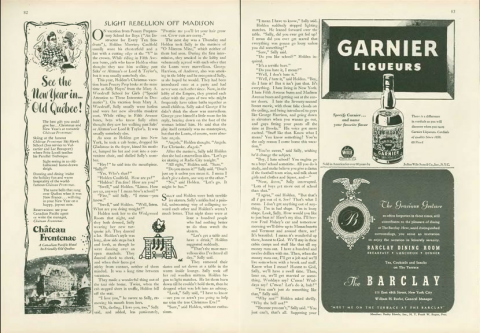 “Slight Rebellion Off Madison” — The first story J.D. Salinger ever published in The New Yorker was also a story that introduced readers to his most famous character, Holden Caulfield, long before the publication of The Catcher in the Rye. According to Paul Alexander’s biography of Salinger, the editors of The New Yorker accepted “Slight Rebellion Off Madison” back in 1941, but delayed publishing it when the US entered World War II. The time just didn’t feel right for a story about jaded, cynical youth. Eventually the war ended and the story appeared in the magazine on December 21, 1946. The Catcher in the Rye came out five years later, in July, 1951.
In the story, Holden Caulfield, “on vacation from Pencey Preparatory School for Boys,” meets up in New York City with Sally Hayes, also on vacation from prep school, and together they go to the movies, smoke in the lobby, drink, complain about the tedium of school, dream of leaving the big city for Vermont, and maybe getting married one day. Other characters who later appear in Salinger’s generation-defining novel — for example, Carl Luce — also make appearances too.
You can read “Slight Rebellion Off Madison” in the New Yorker archive. Click here to see a facsimile of how the story originally appeared in the magazine. When you click through, please click on the image/page to zoom into the text.
Note: Another story story featuring Holden Caulfield — “I’m Crazy” — appeared in the December, 22 1945 edition of Collier’s. It starts here and ends here.
Related Content:
J.D. Salinger, Out for a Stroll: Reclusive Author of The Catcher in the Rye Caught on Film
Holden Caulfield in NYC: An Interactive Map
The New Yorker’s Fiction Podcast: Where Great Writers Read Stories by Great Writers
Read More...Support Us
We're hoping to rely on loyal readers, rather than erratic ads. Please click the Donate button and support Open Culture. You can use Paypal, Venmo, Patreon, even Crypto! We thank you!

About Us

Open Culture scours the web for the best educational media. We find the free courses and audio books you need, the language lessons & educational videos you want, and plenty of enlightenment in between.
Advertise With Us

FREE UPDATES!
GET OUR DAILY EMAIL
Get the best cultural and educational resources on the web curated for you in a daily email. We never spam. Unsubscribe at any time.
FOLLOW ON SOCIAL MEDIA

Open Culture editor Dan Colman scours the web for the best educational media. He finds the free courses and audio books you need, the language lessons & movies you want, and plenty of enlightenment in between.
Advertise With Us

