Flashmob Performs The Beatles’ ‘Here Comes the Sun’ in Madrid Unemployment Office
One of my favorite songs comes from the Quiet Beatle, George Harrison. A tune that can rival anything from the Lennon/McCartney songbook, Here Comes the Sun was written in 1969, during a fairly bleak time. Harrison sets the scene is his 1980 book, I, Me, Mine. He recalls:
“Here Comes the Sun” was written at the time when Apple [the Beatles’ record label] was getting like school, where we had to go and be businessmen: ‘Sign this’ and ‘sign that’. Anyway, it seems as if winter in England goes on forever, by the time spring comes you really deserve it. So one day I decided I was going to sag off Apple and I went over to Eric Clapton’s house. The relief of not having to go see all those dopey accountants was wonderful, and I walked around the garden with one of Eric’s acoustic guitars and wrote “Here Comes the Sun.”
It’s a song about getting through the darkness — personal, professional, seasonal, etc. And it’s simply a perfect pick for the flashmob performance you’ll witness above. Unlike so many other feel-good flashmob performances staged in Europe (see below), this one takes place in a dreary unemployment office in Spain (Madrid, to be precise) where unemployment hovers around 26% and homelessness is on the rise. It doesn’t try to sugarcoat life in Spain. It just provides a little ray of hope.
This video was shot back in January. According to a recent IMF report, conditions will remain difficult in Spain for years to come, but some new data hints that the worst may be over. Or so we hope.
Related Content:
Here Comes The Sun: The Lost Guitar Solo by George Harrison
Beethoven’s “Ode to Joy” Movingly Flashmobbed in Spain
Copenhagen Philharmonic Plays Ravel’s Bolero at Train Station
Read More...Dueling Divas: Aretha Franklin and Dionne Warwick Sing Two Classic Versions of ‘I Say a Little Prayer’
Dionne Warwick:
Aretha Franklin and Dionne Warwick are two of the highest charting women in music history. Between them, they’ve made 129 appearances in the Billboard Hot 100. Two of those were with the same song: the 1966 Burt Bacharach and Hal David composition, “I Say a Little Prayer.”
The song was written especially for Warwick. David’s lyrics are about a woman’s daily thoughts of her man, who is away in Vietnam. Bacharach arranged and produced the original recording in April of 1966, but was unhappy with the result. “I thought I blew it,” he told the Los Angeles Times in 1998. “The tempo seemed too fast. I never wanted the record to come out. So what happens? They put out the record and it was a huge hit. I was wrong.” The song was released over Bacharach’s objections in October, 1967 and rose to number 4 on the Billboard Hot 100 and number 8 on the Billboard R & B charts.
Aretha Franklin:
A few months after Warwick’s single came out, Aretha Franklin and The Sweet Inspirations were singing “I Say a Little Prayer” for fun during a break in recording sessions for Aretha Now. Producer Jerry Wexler liked what he heard, and decided to record the song. With Franklin on piano and the Muscle Shoals Rhythm Section behind her, it was recorded in one take. Franklin’s version has more of a gospel and rhythm & blues feel, with a fluid call-and-response interplay between the lead and backup singers.
Released in July of 1968, the single was less of a crossover hit than Warwick’s version — it peaked at number 10 on the Hot 100 chart — but rose all the way to number 3 on the R & B chart. Overshadowed at first, Franklin’s recording has grown in stature over the years. Even Bacharach likes it better than the one he made with Warwick. As he told Mitch Albom earlier this year, “Aretha just made a far better record.”
You can listen above, as Warwick performs “I Say a Little Prayer” in an unidentified television broadcast and Franklin sings it with the Sweethearts of Soul on the August 31, 1970 Cliff Richard Show. Tell us: Which version do you think is better?
Related content:
Aretha Franklin Performs ‘Respect’ Live in the South of France, 1970
The Queen of Soul Conquers Europe: Aretha Franklin in Amsterdam, 1968
Read More...The Breaking Bad Theme Played with Meth Lab Equipment
Last night marked the beginning of the final season of Breaking Bad, the AMC television series that chronicles the life and times of Walter White, the chemistry teacher-turned-meth kingpin. To get in the spirit of things, Andrew Huang decided to record the Breaking Bad theme song with a guitar and some meth lab equipment. On his YouTube page he writes:
I don’t know anything about making meth but a little Googling let me know that if you come across a meth lab you might find, among other things:
- propane cylinders
— rubber tubing
— paper towels
— coffee filters
— laboratory beakers
— measuring cups
— buckets
— plastic bottles
— frying pansOther than the guitar, all of the sounds in this piece were produced using the items above, with minimal effects and some speed adjustments to change pitches.
via Devour
Related Content:
Watch the Original Audition Tapes for Breaking Bad Before the Final Season Debuts
Inside Breaking Bad: Watch Conan O’Brien’s Extended Interview with the Show’s Cast and Creator
Inside Breaking Bad: Watch Conan O’Brien’s Extended Interview with the Show’s Cast and Creator
Read More...What Prisoners Ate at Alcatraz in 1946: A Vintage Prison Menu
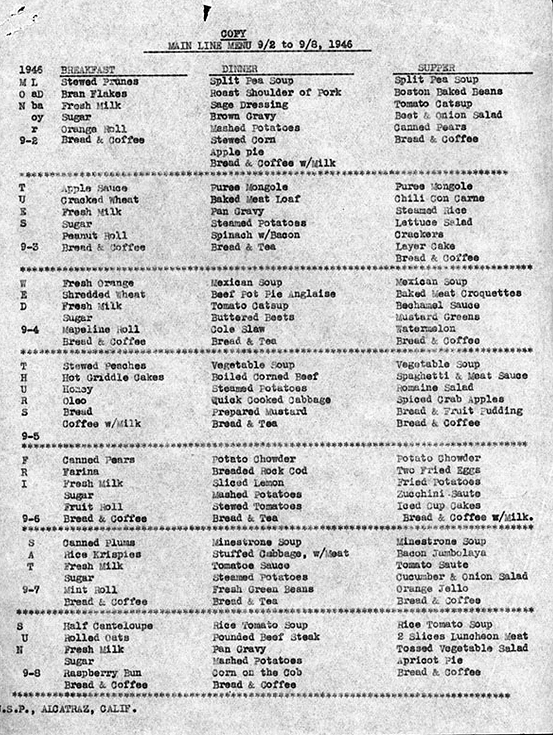 Why would you want to escape from Alcatraz when you could eat Beef Pot Pie Anglaise for lunch on Tuesday, Baked Meat Croquettes on Wednesday, and Bacon Jambalaya on Saturday? On second thought, why wouldn’t you want to escape.
Above, we have the actual menu for the meals served at Alcatraz during one week in September, 1946. (View it in a slightly larger format here.) Alcatraz was, of course, a high security federal prison that operated off of the coast of San Francisco from 1933 until 1963. Some of America’s more notorious criminals spent time dining there — good fellows like Al Capone, George “Machine Gun” Kelly, Bumpy Johnson, and James “Whitey” Bulger.
As you may know, Bulger is now back on trial in Boston. After being released from prison during the 1960s, he allegedly re-immersed himself in the world of organized crime, before eventually spending 16 years living as a fugitive, largely in California. While on the lam, he amazingly had the chutzpah to visit Alcatraz (now a tourist site) and pose for a picture where he donned a striped suit and stood behind mock prison bars. I have to wonder whether he had some Puree Mongole for old times’ sake?
via SF Gate and Laughing Squid
Related Content:
The Odd Collection of Books in the Guantanamo Prison Library
See a Peruvian Prison Seized with Dance Fever as They Try to Break a Guinness World Record
Philosophy in Prison: Weighty Conversations about Right and Wrong
Read More...Read Marx’s Capital with David Harvey, and Then Help Translate His Free Course Into 36 Languages
Here’s an update to our original 2011 post: The social theorist and geographer David Harvey has produced a free online course where he gives a close reading of Karl Marx’s Capital (1867). Often considered to be Marx’s masterpiece, Capital is where he elaborated a critique of capitalism and laid the groundwork for an ideology that took the 20th century by storm. Harvey has taught courses on Capital for over 40 years, both in universities (Johns Hopkins and CUNY) and in the community as well. Now his 26 lecture course is freely available on the web. You can watch the first lecture above. (It’s preceded by an introductory, six-minute interview.) The rest of the lectures can be accessed via Harvey’s web site, YouTube, iTunes, and the Economics section of our collection of Free Online Courses.
Marking a new phase of the project, Professor Harvey is now looking for volunteers to help translate his lectures into 36 languages. If you speak English and languages like Urdu, Arabic or Italian (just to list a few), you can start helping with translations here.
Also note that Harvey published A Companion to Marx’s Capital in 2010. It’s something you’ll want read along with the lectures.
Related Content:
The Crisis of Capitalism Animated (with David Harvey)
Read More...Watch the Original Audition Tapes for Breaking Bad Before the Final Season Debuts
“Breaking Bad is the first story to truly commit the full spectrum of New Mexico to film,” writes Rachel Syme in a New Yorker post on the critically acclaimed AMC series’ use of and effect on her home state. “The grandiose vistas, the soaring altitudes, the banal office complexes, the Kokopellis and Kachina dolls, the seamy warehouses, the marshmallow clouds. The show seems to root itself deeper in the landscape with every new montage. It has become our newest monument.” With the concluding season of the exploits of chemistry-teacher-turned-methamphetamine-dealer Walter White debuting this Sunday, Breaking Bad fans have no doubt steeled themselves for a televisual plunge back into its very own Albuquerque, which “still looks like the Wild West, a scorched, hazy, lawless place where rugged individualism might just tip over into criminal behavior at any moment,” an interpretation Syme deems “not wholly inaccurate.”
To assist you in your own re-entry into Breaking Bad’s thoroughly amoral but unstoppably compelling reality, we’ve rounded up a few audition tapes which let you witness the early formation of three of the show’s characters. Everyone talks about Bryan Cranston’s starring performance as Walter, and given his grounded execution of a near-novelistic arc of improbable transformation, rightly so. But what about his wife and eventual money launderer Skyler, as portrayed by Anna Gunn? Or her brother-in-law Hank, the gung-ho DEA agent played by Dean Norris? Or Aaron Paul as Jesse, Walter’s former student and current partner in crime? In a series so highly praised for the writing of its characters, you don’t want to think about just one. Or maybe your memories of them have grown dim, in which case you’ll want to spend eight minutes with this recap of the previous seasons before you settle down for the final one.
Related Content:
Inside Breaking Bad: Watch Conan O’Brien’s Extended Interview with the Show’s Cast and Creator
Inside Breaking Bad: Watch Conan O’Brien’s Extended Interview with the Show’s Cast and Creator
Colin Marshall hosts and produces Notebook on Cities and Culture and writes essays on literature, film, cities, Asia, and aesthetics. He’s at work on a book about Los Angeles, A Los Angeles Primer. Follow him on Twitter at @colinmarshall.
Read More...Allan Bloom’s Lectures on Socrates (Boston College, 1983)
According to Archive.org: “Allan Bloom delivered this talk as part of the series entitled “Philosophic Perspectives” at Boston College in 1983. The series was intended to help teachers of undergraduates in their teaching of those great works that are essential to a liberal education. The series addressed the decline of liberal learning in the Universities, in America especially. In this lecture Bloom discusses the founding of the idea of liberal education, and the meaning of the philosophic life expressed in the example of Socrates. The conflict between Philosophy and the City, or Philosophy and Political Life is explored by way of an interpretation of Plato’s Apology of Socrates.”
Lecture 1:
Lecture 2:
Lecture 3:
Lecture 4:
This course has been added to our collection of 750 Free Courses Online.
Read More...Allan Bloom’s Lectures on Machiavelli (Boston College, 1983)
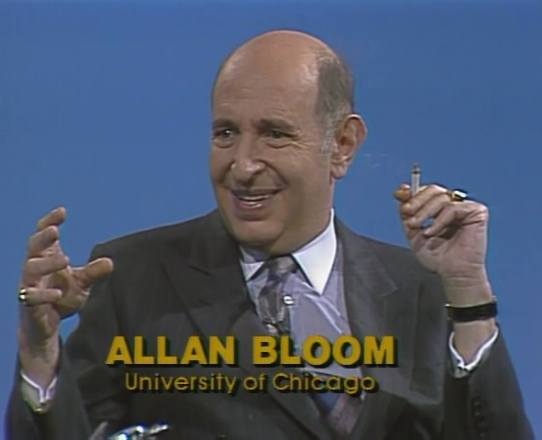
According to Archive.org: “Allan Bloom delivered this talk as part of the series entitled “Philosophic Perspectives” at Boston College in 1983. The series was intended to help teachers of undergraduates in their teaching of those great works that are essential to a liberal education. The series addressed the decline of liberal learning in the Universities, in America especially. This lecture presents an interpretation of Machiavelli’s “Prince” and teaches one how to understand Machiavelli’s art of writing. An interpretation of the “Prince” is given chapter by chapter.”
You can stream the five audio lectures below.
Lecture 1:
Lecture 2:
Lecture 3:
Lecture 4:
Lecture 5:
See our collection, 1,700 Free Online Courses from Top Universities.
Read More...See a Peruvian Prison Seized with Dance Fever as They Try to Break a Guinness World Record
Imagine the trailer for this Hollywood movie:
(Shots of muscular, heavily tattooed gang-bangers glowering, fighting, smoking pot, and enjoying super-hot twice-weekly conjugal visits)
“In a hellish, overstuffed maximum security prison in Peru…”
(Close up of Vin Diesel or Vin Diesel-type wiping away a tear as he bids goodbye to a neatly dressed, bespectacled teenage girl)
“One man will do whatever it takes to win the respect of his daughter…”
(Cut to Vin in a colorful, coordinated outfit, leading hundreds of fellow inmates in an aerobics class as they attempt to break a Guinness World Record)
No doubt it would be godawful. That’s not to say convicted kidnapper Alejandro Nuñez del Arco’s story isn’t inspiring in the original.
Colonel Tomas Garay, who greenlighted del Arco’s Full Body aerobics class back in November, is pleased by the changes in attitude he’s noticed at Lurigancho, “a branch of hell” where drugs, alcohol, and violence were previously the norm. Although the sport, a cardiovascular workout combining dance, boxing, and Tae Bo was invented by a Peruvian man, macho inmates were standoffish at first. A mere eight attended del Arco’s first class. By June 14, the date he attempted to best the Philippines’ Cebu Prison’s world record for the most people dancing behind bars, at least 1179 of his fellow inmates were raging with dance fever. Talk about transformative effects…
Hopefully not coming soon to a theater near you, unless it’s as an expansion of the five-minute documentary above.
Related Content:
Tilda Swinton and Barry White Lead 1500 People in Dance-Along to Honor Roger Ebert
Prisoners Dance to Michael Jackson Tunes in the Philippines
Ayun Halliday can zumba with the best of ’em. Follow her @AyunHalliday
Read More...Richard Feynman’s Letter to His Departed Wife: “You, Dead, Are So Much Better Than Anyone Else Alive” (1946)
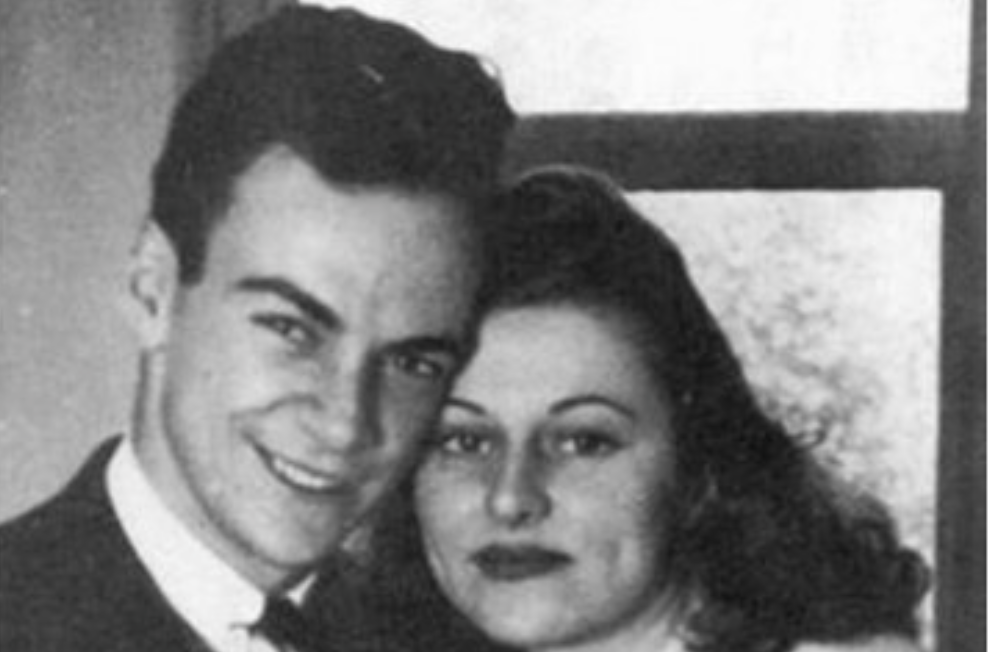
In June 1945, the 27-year-old physicist Richard Feynman lost his wife, Arline Feynman, to tuberculosis. Only 25 years old, she was Richard’s high-school sweetheart. And yet she was much more. As Lawrence Krauss writes in 2012 biography on Feynman:
Richard and Arline were soul mates. They were not clones of each other, but symbiotic opposites — each completed the other. Arline admired Richard’s obvious scientific brilliance, and Richard clearly adored the fact that she loved and understood things he could barely appreciate at the time. But what they shared, most of all, was a love of life and a spirit of adventure.
During their years together, Richard and Arline exchanged frequent letters, many now collected in the volume, Perfectly Reasonable Deviations from the Beaten Track. But none is more poignant than the one written to Arline sixteen months after her death. Still despairing, still lost, Feynman wrote a cathartic letter that was sealed and never opened until his own death in 1988. Deeply touching, it reads as follows:
October 17, 1946
D’Arline,
I adore you, sweetheart.
I know how much you like to hear that — but I don’t only write it because you like it — I write it because it makes me warm all over inside to write it to you.
It is such a terribly long time since I last wrote to you — almost two years but I know you’ll excuse me because you understand how I am, stubborn and realistic; and I thought there was no sense to writing.
But now I know my darling wife that it is right to do what I have delayed in doing, and that I have done so much in the past. I want to tell you I love you. I want to love you. I always will love you.
I find it hard to understand in my mind what it means to love you after you are dead — but I still want to comfort and take care of you — and I want you to love me and care for me. I want to have problems to discuss with you — I want to do little projects with you. I never thought until just now that we can do that. What should we do. We started to learn to make clothes together — or learn Chinese — or getting a movie projector. Can’t I do something now? No. I am alone without you and you were the “idea-woman” and general instigator of all our wild adventures.
When you were sick you worried because you could not give me something that you wanted to and thought I needed. You needn’t have worried. Just as I told you then there was no real need because I loved you in so many ways so much. And now it is clearly even more true — you can give me nothing now yet I love you so that you stand in my way of loving anyone else — but I want you to stand there. You, dead, are so much better than anyone else alive.
I know you will assure me that I am foolish and that you want me to have full happiness and don’t want to be in my way. I’ll bet you are surprised that I don’t even have a girlfriend (except you, sweetheart) after two years. But you can’t help it, darling, nor can I — I don’t understand it, for I have met many girls and very nice ones and I don’t want to remain alone — but in two or three meetings they all seem ashes. You only are left to me. You are real.
My darling wife, I do adore you.
I love my wife. My wife is dead.
Rich.
PS Please excuse my not mailing this — but I don’t know your new address.
via the always great Letters of Note
Relate Content:
‘The Character of Physical Law’: Richard Feynman’s Legendary Lecture Series at Cornell, 1964
Richard Feynman Presents Quantum Electrodynamics for the NonScientist
Leonard Susskind, Father of String Theory, Warmly Remembers His Friend, Richard Feynman
Read More...Support Us
We're hoping to rely on loyal readers, rather than erratic ads. Please click the Donate button and support Open Culture. You can use Paypal, Venmo, Patreon, even Crypto! We thank you!

About Us

Open Culture scours the web for the best educational media. We find the free courses and audio books you need, the language lessons & educational videos you want, and plenty of enlightenment in between.
Advertise With Us

FREE UPDATES!
GET OUR DAILY EMAIL
Get the best cultural and educational resources on the web curated for you in a daily email. We never spam. Unsubscribe at any time.
FOLLOW ON SOCIAL MEDIA

Open Culture editor Dan Colman scours the web for the best educational media. He finds the free courses and audio books you need, the language lessons & movies you want, and plenty of enlightenment in between.
Advertise With Us


