John, Paul and George Perform Dueling Guitar Solos on The Beatles’ Farewell Song (1969)
It all came to an end with “The End,” the last real track on the Beatles’ final studio album Abbey Road.* Recorded in July and August of 1969, “The End” takes up the last 2 minutes and 20 seconds of the masterful 16-minute medley (listen here) that brings Abbey Road to a climax. And it features some of the last great “cosmic, philosophical lines” (as John Lennon later called them) the Beatles left us to ponder:
And in the end,
The love you take,
Is equal to the love you make.
The song also gave us something we weren’t accustomed to: all four Beatles performing a solo. Any ardent Beatles fan knows that Ringo Starr never liked drum solos. As Paul recalled years later, “[Ringo] hated drummers who did lengthy drum solos. We all did.” Despite this general view, McCartney thought a solo worked on this final track, and it took a fair amount of “gentle persuasion” before Starr relented and gave us the only drum solo performed on a Beatles album. You can hear it below.
The End has another signature moment — the moment when Paul, George and John sparred on lead guitars, playing solos in rapid succession, without missing a beat. As you’ll see in the annotated video above, Paul kicks things off with a solo that features some fancy string bends. George picks up with some melodic slides. And John takes over with his own distortion-filled solo. Around it goes three times, until we reach the end.
If you’re into Beatles guitar solos, make sure you don’t miss “Here Comes The Sun: The Lost Guitar Solo by George Harrison.” It’s delightful.
Note: When we call “The End” the last real track on Abbey Road, we’re discounting “Her Majesty,” the 23-second song that was tacked on as something of an afterthought. We call Abbey Road the last studio album because it was recorded after (though released before) Let It Be.
Related Content:
Guitarist Randy Bachman Demystifies the Opening Chord of ‘A Hard Day’s Night’
The Beatles: Unplugged Collects Acoustic Demos of White Album Songs (1968)
Peter Sellers Reads The Beatles’ “She Loves You” in Four Voices
Read More...Martin Heidegger Talks About Language, Being, Marx & Religion in Vintage 1960s Interviews
German philosopher Martin Heidegger, whom readers of post-structuralist theory have to thank for popularizing the ubiquitous phrase “always already,” was a very labored writer who coined much of his own terminology and gave many a translator migraines. His prose betrays an obsession with the power of language that many of his students and successors, such as Jacques Derrida and Michel Foucault, inherited in the construction of their own elaborate theories. While Heidegger’s first book Being and Time (1927) had enormous influence on Existentialist and Phenomenological thought, he also wrote extensively on technology, theology, and art and poetics, engaging with the ideas of Edmund Husserl, Kierkegaard, Nietzsche, and the romantic German poet Friedrich Hӧlderlin.
In the short film above, see the man himself in excerpts from a lecture and three different interviews. The footage comes from a 1975 documentary called Heidegger’s Speeches. Heidegger first discusses some theory of language, quoting Goethe, then, in an interview, talks about how he came to the central preoccupation of his philosophical career: the “question of being,” or Dasein. The third interview concerns Heidegger’s thoughts on Karl Marx. He quotes Marx’s radical dictum, “philosophers have only interpreted the world; the point is to change it,” and offers a critical perspective based in hermeneutics. In the fourth and final interview segment, Heidegger proffers some thoughts on religion and communism.
For a much fuller picture of Heidegger’s life and work, watch the BBC documentary above, from their Existentialist series “Human All Too Human” that begins with Nietzsche and ends with Sartre. And this page also has video of a number of philosophers discussing Heidegger’s work, which left such a lasting impression on the character of late modern and postmodern thought that it’s hard to find a contemporary philosopher who doesn’t owe some sort of debt to him.
It may be impossible to overstate Heidegger’s importance to twentieth century European philosophy in general, and upon several prominent Jewish thinkers in particular like his former student and lover Hannah Arendt and ethicist Emmanuel Levinas. But it also must be said that Heidegger’s legacy is tainted with controversy. While it’s typically good form to separate a thinker’s work from his or her personal lapses, Heidegger’s lapses of judgment, if that’s what they were, are not so easy to ignore. As the documentary above informs us, Heidegger was a Nazi. A reviewer of a recent biography colorfully sums up the case this way:
Let’s be clear about this: Martin Heidegger, a thinker many regard as the most important philosopher of the twentieth century, was indeed a bona-fide, arm-aloft, palm-outstretched Nazi. Zealously renewing his party membership every year between 1933 and 1945, his commitment to the National Socialist cause was unstinting. Nowhere was this more in evidence than in his public role as rector of Freiburg University, where he praised ‘the inner truth and greatness’ of Nazism in his 1933 rectoral address, and later penned a paean to murdered Nazi thug Leo Schlageter. Heidegger was no token fascist; he was jack-booted and ready. Wearing a swastika on his lapel at all times he, alongside his proud, virulently anti-Semitic wife, also practised private discrimination against Jews, from fellow existentialist philosopher Karl Jaspers to his one-time mentor Edmund Husserl. Not that he was without friends. In fact his friendship with Eugene Fischer, director of Berlin Institute for Racial Hygiene, lasted years.
Heidegger’s Nazi sympathies are hardly evident in his philosophical work, yet it is still difficult for many readers to reconcile these facts about his life. Some refer to a 1966 Der Spiegel interview in which the philosopher explained away his Nazism as exigent circumstances. Sort of what we call today a non-apology apology. Others, like onetime admirer Levinas, don’t find the task so easy. In a commentary on forgiveness, Levinas once wrote, “One can forgive many Germans, but there are some Germans it is difficult to forgive. It is difficult to forgive Heidegger.”
You can find more resources on Heidegger in our archive of free online philosophy courses.
Related Content:
Friedrich Nietzsche & Existentialism Explained to Five-Year-Olds (in Comical Video by Reddit)
Walter Kaufmann’s Lectures on Nietzsche, Kierkegaard and Sartre (1960)
Hannah Arendt’s Original Articles on “the Banality of Evil” in the New Yorker Archive
Josh Jones is a writer and musician based in Washington, DC. Follow him @jdmagness
Read More...Abandoned Alternate Titles for Two Great Films: Kubrick’s Dr. Strangelove and Hitchcock’s Vertigo
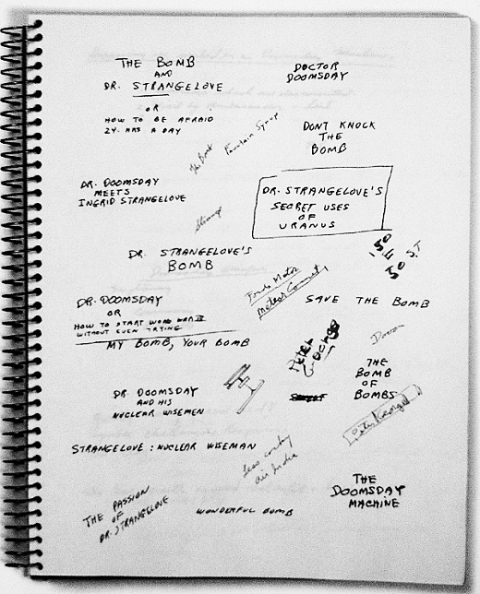
We have here a page out of Stanley Kubrick’s notebook, which Lists of Note—the sister site of Letters of Note, always a favorite of ours here at Open Culture—posted as a collection of alternative titles for Dr. Strangelove. The list includes Dr. Doomsday, The Doomsday Machine, Dr. Doomsday and His Nuclear Women, Don’t Knock the Bomb: these ideas came not from an interfering studio, but from Kubrick’s own mind as he worked his way toward the most suitable name. You can see him getting closer; while this page doesn’t include the film’s final title, Dr. Strangelove: Or, How I Learned to Stop Worrying and Love the Bomb, it does include Dr. Strangelove’s Bomb, Strangelove; Nuclear Wiseman, and the Gibsonian-sounding The Passion of Dr. Strangelove. I myself will always wonder how Dr. Strangelove’s Secret Uses of Uranus would have played, but when you deal with cinematic craftsmen as detail-oriented and reputedly “perfectionist” as Kubrick, you know that their driving desire to get things right extends all the way to their titles and beyond.
This holds just as true for Alfred Hitchcock. Alone in the Dark, Behind the Mask, The Dark Tower, Without a Trace, all possible titles for the movie we now know as Vertigo. When Hitchcock’s San Francisco psychological thriller recently topped Sight and Sound’s critics poll of the greatest films of all time, it surely did so for cinematic merits having nothing to do with its name.
But would a Vertigo by any other title feel quite as fresh and gripping today, 55 years after it first came out? This goes especially for the pre-threadbare titles I rattled off above, which only account for four of 47 of the suggestions Paramount Pictures executive Sam Frey pitched to Hitchcock, including Deceit, Deceitful, and, for good measure, Deception. You can read all of them below, or at Lists of Note. I quite like The Face Variations, but Hitchcock knew his project most intimately, and thus knew that Vertigo it had to be.
- Afraid to Love
- Alone in the Dark
- The Apparition
- Behind the Mask
- Carlotta
- Checkmate
- Conscience
- Cry from the Rooftop
- The Dark Tower
- Deceit
- Deceitful
- Deception
- Don’t Leave Me
- Dream Without Ending
- The Face Variations
- Footsteps
- For the Last Time
- The Hidden life
- In the Shadows
- The Investigator
- A Life Is Forever
- The Lure
- Malice
- The Mask and the Face
- The Mask Illusion
- My Madeleine
- A Matter of Fact
- Never Leave Me
- Night Shade
- Nothing Is Forever
- Past, Present and Future
- The Phantom
- The Second Chance
- The Shadow
- Shadow and Substance
- Shadow on the Stairs
- Shock
- Steps on the Stairs
- Terror
- To Live Again
- Tonight Is Ours
- Too Late My Love
- Two Kinds of Women
- The Unknown
- Wanted
- Without A Trace
- The Witness
Related Content:
Inside Dr. Strangelove: Documentary Reveals How a Cold War Story Became a Kubrick Classic
20 Free Hitchcock Movies Online
Colin Marshall hosts and produces Notebook on Cities and Culture and writes essays on literature, film, cities, Asia, and aesthetics. He’s at work on a book about Los Angeles, A Los Angeles Primer. Follow him on Twitter at @colinmarshall.
Read More...CERN Physicist Explains the Origins of the Universe for Beginners with a Short Animated Video
If you have kids, you’re going to get the inevitable question: Where did the universe come from? And you’re likely going to take a long pause before trying to present the science of the big bang. Before you head down that path, know this: CERN physicist Tom Whyntie has created a new TED-ED video that explains, in three animated minutes, how the universe began, why it’s expanding, and other basic phenomena that concern cosmologists and particle physicists. Phew. By the time you’re done, you might be eagerly awaiting a where-do-babies-come-from video. That’s hopefully somewhere in TED-ED’s media pipeline too.
Related Content:
200 Free Kids Educational Resources: Video Lessons, Apps, Books, Websites & More
The Story Of Menstruation: Walt Disney’s Sex Ed Film from 1946
Read More...Legendary Guitarist Andrés Segovia Plays J.S. Bach at the Alhambra, 1976
In 1976 the great classical guitarist Andés Segovia returned to Granada, Spain, the city of his childhood, to perform a few pieces on film at the 14th century Moorish palace, the Alhambra.
In the scene above, the 84-year-old Segovia plays a pair of gavottes from his own transcription of Johann Sebastian Bach’s Suite for Solo Cello No. 6 in D Major, BMV 1012. A gavotte is a kind of folk dance, originally from France, that was popular during the Baroque period. Bach often incorporated them into his suites and partitas. In this performance, Segovia transitions from the bright and lively Gavotte I to the more restrained Gavotte II at the 1:54 mark.
The scene is from the documentary Andrés Segovia: The Song of the Guitar, which is available on a two-film DVD, Andrés Segovia: In Portrait. For more on Segovia, including his performance of Isaac Albéniz’s “The Legend of Asturias” from the same film, see our 2011 post: “Andrés Segovia, Father of Classical Guitar, at the Alhambra.”
If you would like to support the mission of Open Culture, consider making a donation to our site. It’s hard to rely 100% on ads, and your contributions will help us continue providing the best free cultural and educational materials to learners everywhere. You can contribute through PayPal, Patreon, and Venmo (@openculture). Thanks!
Related Content:
The Genius of J.S. Bach’s “Crab Canon” Visualized on a Möbius Strip
Glenn Gould Explains the Genius of Johann Sebastian Bach (1962)
Read More...Sex Pistols Frontman Johnny Rotten Weighs In On Lady Gaga, Paul McCartney, Madonna & Katy Perry
Opinions may be like that other thing everyone has, but nobody’s got opinions like John Lydon, a.k.a. Johnny Rotten of the Sex Pistols and Public Image Limited. The punk tastemaker never holds back, and that’s why he’s so much fun in interviews. Take the clip above, from an appearance on the UK’s Absolute Radio. Lydon offers his take on a few artists, some contemporary, some aging pop stars. With no evidence of irony, he calls Lady Gaga “fantastic… witty, clever,” and says her songwriting is “bang up there.” Each to his own, I guess. Of Paul McCartney (who Lydon calls “McCarthy”), he says the former Beatle recently sang “like an old donkey.” He opines that “Blondie” (does he mean Debbie Harry? Or are we back to Gaga?) “really is a dobbin,” and Madonna is “kind of humorless.”
It’s all off-the-cuff good fun, nothing formal, unlike the review above, where Lydon employs his considerable critical acumen in a serious review of a very serious film: Katy Perry’s Part of Me. Although “not generally a film critic,” Lydon lets his gift for sarcastic understatement loose on a few clips from the movie. His review mostly focuses on Perry’s image, which seems appropriate. He’s pleased she shaves her armpits, but not with her various dye jobs. He reaches out to Perry in a very heartfelt way after seeing her father, who is, he says, a “nutter.” And oh, there’s so much more, but you should watch it for yourself.
Public commentary is not something Lydon has only taken up in his old age, though he has made a second career of it lately. Last year, Dangerous Minds dug up a recording of a 20-year-old Johnny Rotten spinning his records for Capital Radio in 1977 (below). He plays some Bowie (but he’s not a fan), Can, Captain Beefheart, John Cale, and plenty of dub reggae, introducing each track with his characteristic wit. Apparently, Sex Pistols manager Malcolm McLaren didn’t want him to do it and hated the interview and record selections, but Johnny Rotten has never been one to do what he’s told. Good for him—it’s an excellent listen. You can find a full transcript and tracklist of the session here.
Related Content:
“Joe Strummer’s London Calling”: All Eight Episodes of Strummer’s UK Radio Show Free Online
2009 Kate Bush Documentary Dubs Her “Queen of British Pop”
Malcolm McLaren: The Quest for Authentic Creativity
Josh Jones is a writer and musician based in Washington, DC. Follow him @jdmagness
Read More...The Beatles’ “Hey Jude” Reworked from Major to Minor Scale; Ella’s “Summertime” Goes Minor to Major
A commonplace in rock and pop songwriting: minor keys are sad (or dark or soft) and major keys are happy (upbeat, extroverted, etc.). Want to add some complexity? Set happy lyrics in a minor key or vice versa. You don’t need much theory to grasp the concept (applying it effectively is another matter). But even for classically trained composers, the why of it all is still a bit of a mystery. Guardian classical music blogger Tom Service suggests that since the 17th century, it’s become learned behavior, as is our tendency to fall into minor thirds when communicating sadness through speech. Whether a natural or cultural phenomenon, there’s no doubt that transposing tonality can give a song vastly different emotional resonance.
Which is exactly what happened with a recent viral digital experiment: a tweak of R.E.M.’s tortured “Losing My Religion” from minor to major so upset religious blogger Matthew Linder, he commented that the “change in tonality whitewashes the sorrowful song and brings in the Pollyannaism of REM’s much derided ‘Shiny Happy People.’” Now I happen to think “Shiny Happy People” is a completely stupid yet loveable song, but he does have a point. The tonality hack, originally performed by MajorScaledTV, has also been done several times by Ukrainian YouTube user MajorVsMinor, real name Oleg Berg and his daughter Diana. The Bergs take songs like the godawful “Final Countdown” by Europe and make them almost listenable, or ruin songs like “Hey Jude” (above).
And sometimes a fascinating thing happens. Remember that counterpoint between tonality and content I noted above? In some cases, the entire effect of a song depends upon that tension, as is the case with George Gershwin’s “Summertime” from Porgy and Bess. In the tweaked Ella Fitzgerald version above, the lyrics—“and the living is easy”—lose their sexiness, their melancholy undertones and strained irony, when the tune sounds as happy and straightforward as the words. This is not an improvement, of course, but an interesting example of how form and content push against each other in compositions more musically sophisticated and emotionally complex than “Final Countdown.” Once these tweaked versions of popular songs lose their appeal as viral curiosities (if they haven’t already), they’re sure to make excellent teaching tools for musicology professors.
MajorVsMinor have applied their treatment to over two dozen popular songs and film and video game themes. Want to know how they do it? Watch Oleg and Diana reveal their secrets in the video above. There’s quite a bit more to their process than Evolver.fm assumed about MajorScaledTV’s REM experiment.
via BoingBoing
Related Content:
R.E.M.’s “Losing My Religion” Reworked from Minor to Major Scale
Bobby McFerrin Shows the Power of the Pentatonic Scale
History of Rock: New MOOC Presents the Music of Elvis, Dylan, Beatles, Stones, Hendrix & More
Josh Jones is a writer and musician based in Washington, DC. Follow him @jdmagness
Read More...“Hummingbird,” A New Form of Music Notation That’s Easier to Learn and Faster to Read
If you learned to play a musical instrument as a kid, you likely remember your first encounter with traditional music notation. You remember being baffled by the symbols denoting quarter notes, eighth notes, sixteenth notes. Or the difficulty of reading notes located above or below the staff. The Western system of music notation goes back hundreds of years, and it has been befuddling students for generations. Enter Blake West, a piano teacher from Austin, Texas, who enlisted his old friend Mike Sall, a data visualization wiz, to create a more intuitive form of music notation. They dubbed it “Hummingbird,” and between the two videos on this page and this complete reference guide, you’ll get a quick feel for the concepts underlying this new way of reading music. On the Hummingbird website, you can also find 26 songs — everything ranging from Bach’s “Ode to Joy” to Ozzy Osbourne’s “Crazy Train” — rewritten in a format that budding music students will love.
via Kottke
Related Content:
How a Bach Canon Works. Brilliant.
85,000 Classical Music Scores on the Web
Bobby McFerrin Shows the Power of the Pentatonic Scale
Listening to Music (Yale) in Our Collection 700 Free Online Courses
Read More...Bitcoin, the New Decentralized Digital Currency, Demystified in a Three Minute Video
They sound like something out of science fiction, but Bitcoins are getting just a little bit more real every day. They’re intangible and invisible, but bitcoins recently attracted some real investment capital from the Winklevoss twins, who first dreamed up the idea for Facebook — or so their lawsuit argued.
A bit of background: Bitcoins are a virtual currency system. They were programmed by an anonymous programmer(s?) in 2009. There are a limited number of possible bitcoins that can ever be traded—21 million—and the “coins” become available incrementally. That process is crowdsourced (anybody can mint bitcoins) but it requires solving complex encryption problems. Most bitcoin miners have an army of computer hardware to do the work for them.
What can a bitcoin buy? It depends. The currency’s value has been gyrating wildly in recent weeks, from a value of just a few dollars up to $266 and then back down to about $100. So far bitcoins are accepted as currency by somewhat shady electronics websites that claim to be sending a message to big retailers: start accepting the virtual currency or miss out on a big market share (that hasn’t developed yet).
Last week came the announcement that Cameron and Tyler Winklevoss—former rivals to Mark Zuckerberg—own one percent of all the bitcoins in circulation, the biggest stake so far. That news inspired debate over what, exactly, bitcoins are and whether they’re important.
They aren’t the first virtual currency and they aren’t being used widely in commerce. Some economists have weighed in to say that unless people stop hording bitcoins as an investment and start spending them, they are meaningless. The bitcoin experiment may show the way to a digital currency of the future. But, until it pans out, we recommend that you hang onto your dollars. And if you’re still trying to get your arms around the whole concept of the bitcoin, we suggest spending a few minutes with the video primer above.
Kate Rix writes about digital media and education. Visit her website: .
Read More...
The Always-NSFW Kevin Smith and Jason Mewes Catch Up in Jay and Silent Bob Get Old Podcast
With 1994’s Clerks, Kevin Smith opened up the floodgates for independently produced, micro-budget, dialogue-intensive, cursing-intensive movies by, for, and about a certain stripe of feckless Generation‑X twentysomething. These pictures showcased more aggressively foulmouthed (but, in their way, more energetic) versions of the overgrown kids and/or stalled adults whose meandering lives Richard Linklater had dramatized in Slacker three years before. (Watch Slacker online here.) Clerks hit when I hadn’t yet grown out of comic book-reading pre-adolescence, though I do remember becoming aware of Smith’s work from an ad on the back of, yes, a comic book. The page advertised Mallrats, Smith’s big-budget Clerks followup; in its corner posed a pair of smirking young longhairs. “Snootchie bootchies,” read an inexplicable voice bubble emanating from the thinner of the two. I had to know: who were those guys? The zeitgeist now recognizes Jay and Silent Bob, the outwardly dumb but startlingly wise drug dealers played by Jason Mewes and Kevin Smith himself, as having stolen Clerks’ show. (You can watch one of their finer moments in Mallrats above.)
Smith used the characters in Mallrats as well, and went on to write them into subsequent movies like Chasing Amy, Dogma, and of course Clerks II and Jay and Silent Bob Strike Back, their presence unifying all these stories into one coherent reality. Cinephiles argue over whether Smith has delivered on his promise as a director, but some fans think the man has found his true voice as a podcaster. Today, on his own podcast network, he hosts a staggering array of shows, including SModcast, SMoviemakers, Hollywood Babble-On, and Fat Man on Batman. Jay and Silent Bob Get Old (Web — iTunes — RSS feed) reunites the 42-year-old Smith and the 38-year-old Mewes for regular conversations about adulthood, fame, and struggles with sobriety (in Mewes’ case) and weight (in Smith’s), always featuring the most vulgar jokes imaginable. If you haven’t caught up with these guys since the nineties, have a listen to their podcast’s so-very-Not-Safe-for-Work first episode above. They’ve even got back into character for Jay and Silent Bob’s Super Groovy Cartoon Movie, which begins its roadshow across North America on April 20.
Related Content:
Watch Free Online: Richard Linklater’s Slacker, the Classic Gen‑X Indie Film
Colin Marshall hosts and produces Notebook on Cities and Culture and writes essays on literature, film, cities, Asia, and aesthetics. He’s at work on a book about Los Angeles, A Los Angeles Primer. Follow him on Twitter at @colinmarshall.
Read More...Support Us
We're hoping to rely on loyal readers, rather than erratic ads. Please click the Donate button and support Open Culture. You can use Paypal, Venmo, Patreon, even Crypto! We thank you!

About Us

Open Culture scours the web for the best educational media. We find the free courses and audio books you need, the language lessons & educational videos you want, and plenty of enlightenment in between.
Advertise With Us

FREE UPDATES!
GET OUR DAILY EMAIL
Get the best cultural and educational resources on the web curated for you in a daily email. We never spam. Unsubscribe at any time.
FOLLOW ON SOCIAL MEDIA

Open Culture editor Dan Colman scours the web for the best educational media. He finds the free courses and audio books you need, the language lessons & movies you want, and plenty of enlightenment in between.
Advertise With Us


