Free: Download Dan Brown’s Bestseller, The DaVinci Code, Until March 24
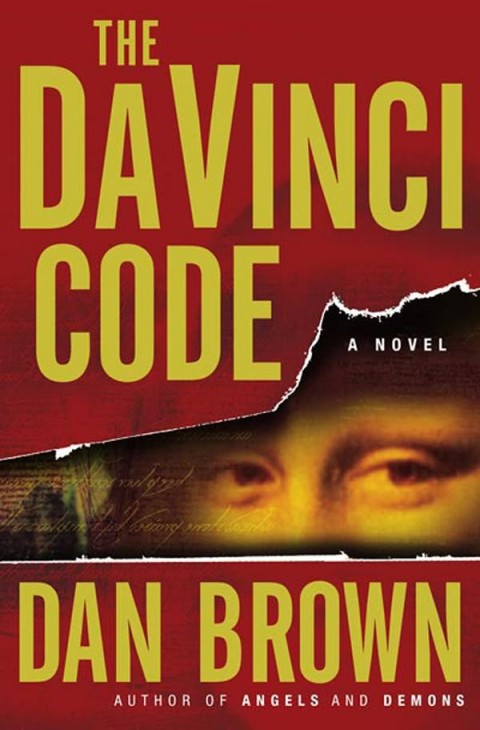 I’ll be the first one to admit it, The DaVinci Code isn’t exactly an easy fit on a site that promises to talk about “the best cultural media” out there. But Dan Brown’s 2003 mystery novel has sold north of 80 million copies and now finds itself translated into 44 languages. And the Louvre figures centrally in the book’s plot. That gives it some cultural cred, no? Okay, maybe not! Anyway, to celebrate the 10th anniversary of the book’s publication, Doubleday has decided to give away copies of the bestseller through March 24, making the book available as a free download on multiple ebook platforms: Amazon, Apple iBookstore, Barnes & Noble, Google, Sony Reader, and Kobo. According to Galleycat, the download will include “the prologue and first chapter of Inferno, Brown’s upcoming novel.”
Meanwhile, if you’re looking for a weightier read, don’t miss our collection of 375 Free eBooks for the Kindle, iPad and Nook
H/T Mediabistro
Read More...The Rise of Webcomics: PBS’ Off Book Series Explores the Emergence of New Popular Art Form
I’m a paper loyalist by age and inclination. I don’t begrudge those who do the bulk of their reading digitally, I just prefer the familiarity and object-ness of the printed page. As a lover of comics and graphic novels, my brick and mortar needs are more than met by the comparative wealth of indie shops and festivals here in New York City, as well as its beleaguered public library system.
I couldn’t help noticing, though, that many of the newer titles I favor got their start online. The proponents of the form who discuss the Rise of Webcomics for PBS’ Off Book series make a compelling case for exploring that realm a bit more fulsomely.
Many artists who put their stuff up on the web benefit from the immediacy of the act and the—theoretically—larger audience. But publishing in this format also opens it up for Sam Brown and Andrew Hussie to create a large body of work based on reader suggestions. Hussie takes full advantage of the multi platform possibilities. Lucy Knisley, no stranger to editorial refinement in a more traditional publication model, gives her monsters of the id free rein online. And Nick Gurewitch’s Perry Bible Fellowship (though he yanked a couple of them offline to “make the book more special”) is the vessel into which his torrent of hilarious, dissociative ideas flows.
Related Content:
Join Cartoonist Lynda Barry for a University-Level Course on Doodling and Neuroscience
Ayun Halliday’s favorite webcomic (until now the only one she read) remains Hyperbole and a Half.
Read More...Are You Ready for the Return of Lost Species?: Stewart Brand on the Dawn of De-Extinction
The Earth is losing life forms at a disturbing rate. The biologist Edward O. Wilson has estimated that at least 27,000 species per year are disappearing from our planet. That’s an average of 74 species a day, or three every hour. Researchers warn that if we stay on this track, the Earth will enter its sixth mass extinction–the first since the one that killed off the dinosaurs.
With animal and plant habitats being crowded out by a human population that has passed the 7 billion mark and is growing at a rate of 70 million people per year, scientists attempting to stem the tide of extinction have their work cut out for them. The vast majority of efforts, of course, are aimed at preserving endangered species and making sure more species do not become endangered. But one man is spearheading a bold project to actually bring back species we have already lost.
Stewart Brand first came to notoriety in the 1960s, as one of Ken Kesey’s Merry Pranksters and as the creator of the Whole Earth Catalog. In 1996 he co-founded the Long Now Foundation, dedicated to fostering long-term thinking in our accelerating culture, with its “pathologically short attention span.” One of Brand’s pet projects at Long Now is Revive & Restore, a program to coordinate genetic research into bringing back presently extinct species. Brand spoke about the project (see above) on February 27 at a TED conference in Long Beach, California.
Revive & Restore’s first project is to bring back the passenger pigeon, a bird that died off in 1914 but was once so abundant that migratory flocks in North America would darken the sky. The passenger pigeon was chosen as the initial project because it is better-known than many extinct species and because the bird’s DNA (taken from museum specimens) has already been sequenced. But Brand promises that the passenger pigeon is only the beginning. “The fact is,” he says, “humans have made a huge hole in nature in the last 10,000 years. We have the ability now, and maybe the moral obligation, to repair some of the damage.”
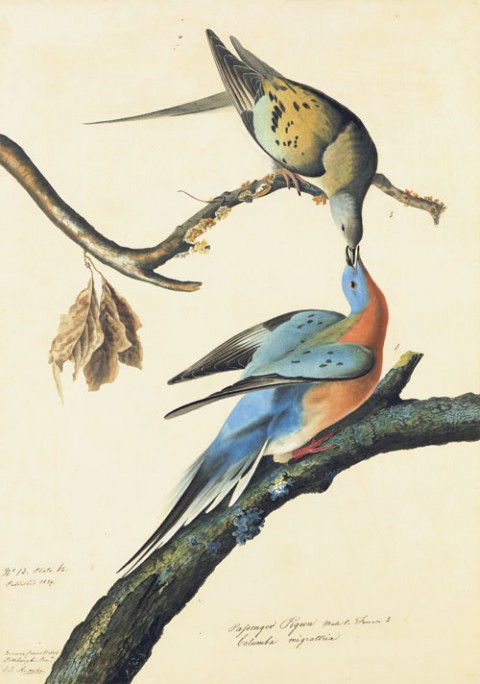
Passenger Pigeon (Ectopistes migratorius) by John James Audubon, 1824. Watercolor, pastel, graphite, gouache, black chalk and black ink on paper. The image depicts a behavior known as “billing,” in which one bird shares food by regurgitating it into the bill of another. The male, with it’s more colorful plumage, is shown standing on the lower branch, with the female up above.
Read More...The Life and Controversial Work of Photographer Robert Mapplethorpe Profiled in 1988 Documentary
In March 1988, the BBC’s Arena turned its lens toward photographer Robert Mapplethorpe. The television documentary series had already spent well over a decade cultivating a reputation for covering everything—Superman, Philip K. Dick, the fallen Soviet empire, the Ford Cortina—but some viewers must still have felt a bit startled by the choice of such a controversial artist, let alone by how mild and non-threatening he ultimately seems. Mapplethorpe had made his name both in portraiture, especially of musicians, and in highly charged erotic imagery. This latter current in his work, did not, of course, please everybody. By the time the Arena profile aired, Mapplethorpe, suffering from AIDS, would have only one year of life remaining, with the worst of the high-profile battles over his artistic value and/or “obscenity” still to come.
Though wary of extinguishing the mystery of his photographs by saying too much about them, Mapplethorpe does reveal what sounds like an important element of his motivation, especially in the face of the obscenity charges: “I wanted to retain the forbidden feeling of pornography and make an art statement, to make something uniquely my own.” We see the man at work, and we hear a good deal more from him in an on-camera interview. Novelist Edmund White appears to provide context and commentary, as do several of the people Mapplethorpe photographed, both those who sought fame and those who otherwise avoided it. Covering Mapplethorpe’s life as much as it does his work, the broadcast naturally includes a conversation with Patti Smith, noted rocker and perhaps the photographer’s closest friend. For ideal supplementary reading, have a look at Smith’s Mapplethorpe-centric memoir Just Kids, about which we’ve posted before.
Related content:
Patti Smith Remembers Robert Mapplethorpe
Patti Smith Reads Her Final Words to Robert Mapplethorpe
Colin Marshall hosts and produces Notebook on Cities and Culture and writes essays on literature, film, cities, Asia, and aesthetics. He’s at work on a book about Los Angeles, A Los Angeles Primer. Follow him on Twitter at @colinmarshall.
Read More...10 Free Stories by George Saunders, Author of Tenth of December, “The Best Book You’ll Read This Year”
For writers and serious readers, George Saunders is anything but a newcomer. Saunders published his first short story with The New Yorker back in 1992, and his new stories have regularly debuted in the magazine’s Fiction section ever since. Over the years, he has gained the reputation of being a “writer’s writer,” with authors like Tobias Wolff saying about Saunders: “He’s been one of the luminous spots of our literature for the past 20 years.” But despite his literary accomplishments, and despite winning the prestigious MacArthur award in 2006, George Saunders never quite became a household name until January 6 of this year. On that day, The New York Times published an article with the title, “George Saunders Has Written the Best Book You’ll Read This Year,” a pretty bold declaration given that 2013 still had 359 days to go. Since then, Saunders has found himself in the limelight talking about Tenth of December, his newly-published collection of short stories. You can watch him give a reading at Google above, or make appearances on the PBS News Hour and The Colbert Report.
If you’re not familiar with Saunders’ writing, then we have you covered. Below we’ve collected 10 stories by the author, all free to read online. Even better, the list features three stories from Tenth of December, including the story after which the book takes its name. All stories from the new collection have an asterisk next to the title.
- The Semplica-Girl Diaries * — New Yorker, October 2012
- Tenth of December * — New Yorker, October 2011
- The Red Bow — Esquire, April 2009
- Puppy * — New Yorker, May 2007
- CommComm — New Yorker, August 2005
- Bohemians — New Yorker, January 2004
- Adams — New Yorker, August 2004
- Jon — New Yorker, January 2003
- Sea Oak — Barcelona Review, 2000
- A Lack of Order in the Floating Object Room — Northwest Review, 1986
Related Content
George Saunders Extols the Virtues of Kindness in 2013 Speech to Syracuse University Grads
Neil Gaiman’s Free Short Stories
Free Philip K. Dick: Download 11 Great Science Fiction Stories
30 Free Essays & Stories by David Foster Wallace on the Web
375 Free eBooks: Download to Kindle, iPad/iPhone & Nook
Read More...The Zen Wisdom of Alan Watts Animated by the Creators of South Park, Trey Parker and Matt Stone
Alan Watts began popularizing the teachings of Zen Buddhism, Hinduism, and Taoism in America during the 1950s. He taught at the Academy of Asian Studies in San Francisco, wrote Way of Zen and other bestselling books, gave talks on the radio (listen here), and developed TV programs introducing Americans to the seemingly exotic practice of meditation. Don’t miss his 1960 TV program called “The Silent Mind.”
Watts died almost 40 years ago, but his legacy remains alive, partly thanks to his son, partly thanks to vintage videos captured on YouTube, and partly thanks to people like Trey Parker and Matt Stone — that’s right, the creators of South Park. There’s not much information known about them, but somewhere back in 2007, Parker and Stone produced videos that animated (audio) lectures given by Watts many moons ago. The topics deal with music, life, and philosophical personality types. Meanwhile, the aesthetic is distinctly South Parkean, minus the outrageous potty humor, of course. The project is an old favorite of ours and today we decided to bring it back.
Related Content:
Alan Watts Introduces America to Meditation & Eastern Philosophy (1960)
Alan Watts On Why Our Minds And Technology Can’t Grasp Reality
“The Central Philosophy of Tibet” by Robert Thurman, Columbia University. Added to the Philosophy Section of our list of Free Online Courses
What If Money Was No Object?: Thoughts on the Art of Living from Eastern Philosopher Alan Watts
Read More...A Gallery of Stanley Kubrick Cinemagraphs: Iconic Moments Briefly Animated
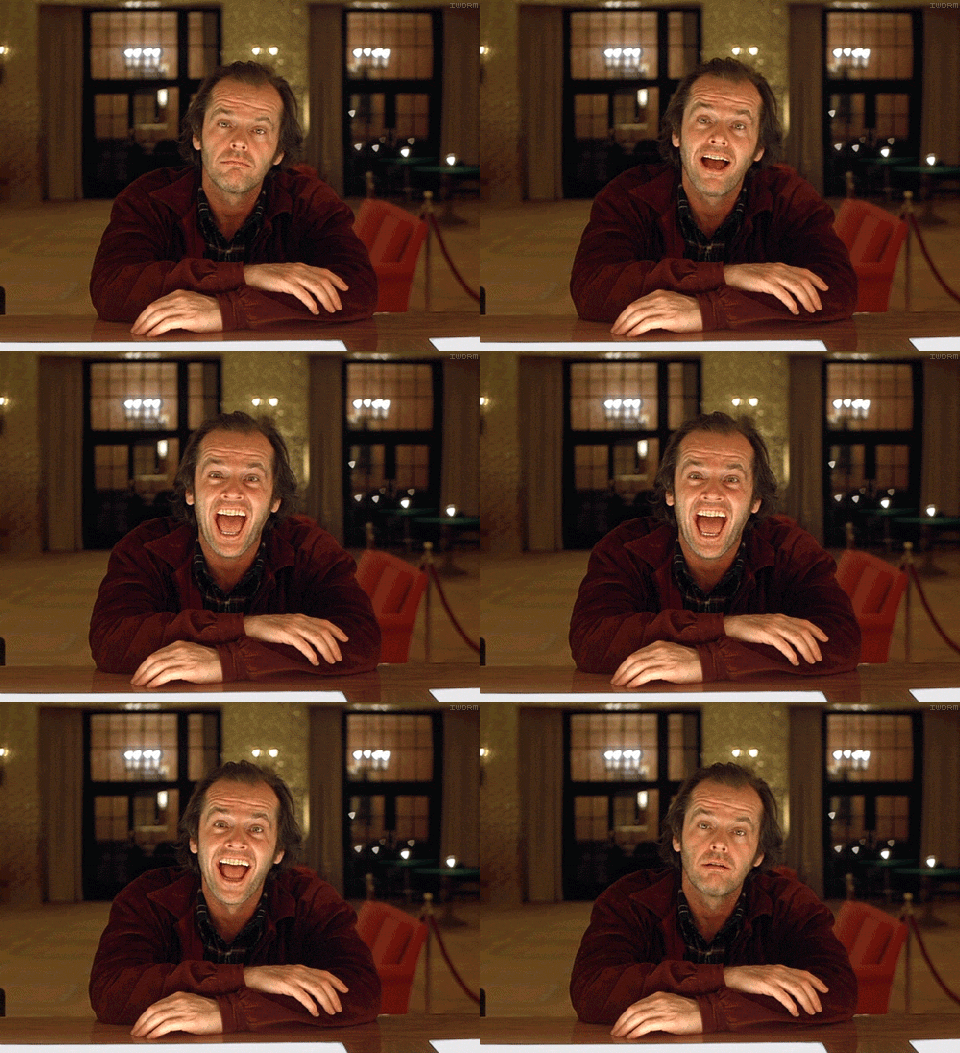
Type “stupid animated gif”—or words to that effect—into your preferred search engine and you’ll be rewarded with an abundance of germane material.
Meanwhile a search on “animated gif of Stanley Kubrick rolling in his grave” fails to yield anything of significance.
Pity. I guess we’ll just have to imagine how the late perfectionist and celebrated director would have reacted to a gallery of his most iconic images, downloaded and doctored into infinitely looping, minimally animated snippets.
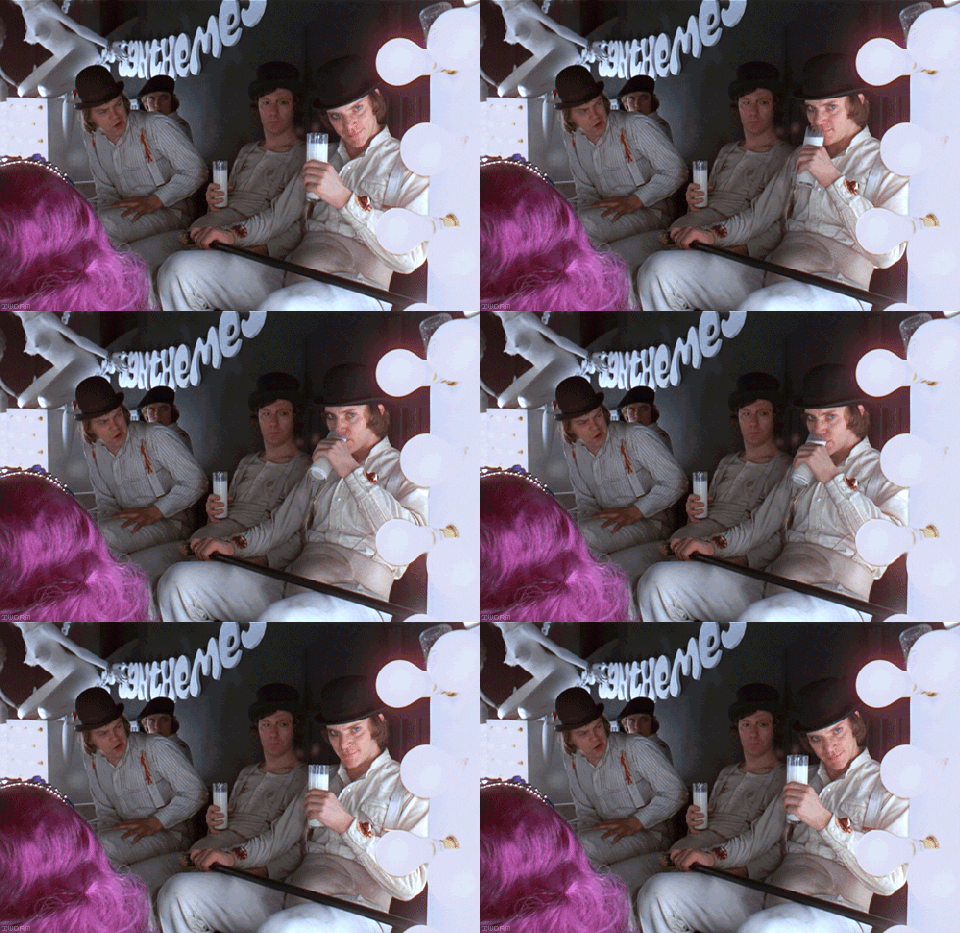
Perhaps I presume. Perhaps he’d be praying for someone to reanimate him, so he could haunt the realm of the late night chatrooms, his every observation and opinion punctuated with a languid Sue Lyons lifting her head in Lolita, or a diabolical Clockwork Orange toast.
Admittedly, the longer one watches George C Scott’s General Turgidson working over a mouthful of gum, or Jack Nicholson acting four kinds of crazy, the more tempting it is to put together a cinemagraph of one’s own. That’s the high flying term assigned to the form by artist Kevin Burg and photographer Jamie Beck who allegedly invented (and later trademarked) it while covering New York Fashion Week. To quote supermodel Coco Rocha, as they do on their website, “it’s more than a photo but not quite a video.”
Be forewarned that it’s not a project for the Photoshop newbie. Maybe the instructional video below just makes it seem so. (Though if you’re looking for an instructional video on how not to make an instructional video, this is very instructional indeed. If not, stick with a more straight forward, non-film-based how to. Stanley Kubrick, this guy ain’t.)
Related Content:
The Cinemagraph: A Haunting Photo/Video Hybrid
Signature Shots from the Films of Stanley Kubrick: One-Point Perspective
Napoleon: The Greatest Movie Stanley Kubrick Never Made
Ayun Halliday recommends Stanley Kubrick’s “Paths of Glory” in its original form.
Read More...Peter Gabriel and Genesis Live on Belgian TV in 1972: The Full Show
Here’s a rare treat for fans of early 70s progressive rock: Peter Gabriel and Genesis together at the beginning of the band’s classic period, performing live on the Belgian TV show Pop Shop in March of 1972. The half-hour film captures the group a little more than a year after Phil Collins and Steve Hackett joined, and before Gabriel started dressing up in outlandish costumes. The lineup includes Gabriel on flute, tambourine and lead vocals, Collins on drums and backing vocals, Hackett on lead guitar, Tony Banks on keyboards and rhythm guitar, and Michael Rutherford on bass and rhythm guitar. Here’s the setlist:
- “The Fountain of Salmacis”
- “Twilight Alehouse”
- “The Musical Box”
- “The Return of the Giant Hogweed”
The songs are all from the 1971 album Nursery Cryme, except “Twilight Alehouse,” which the group had been performing live since 1970 but wouldn’t release on an album until 1998, when the song was included in the boxed set Genesis Archive 1967–75. Gabriel co-founded Genesis in 1967 and left the band in 1975. Collins then took over on lead vocals.
If you would like to support the mission of Open Culture, consider making a donation to our site. It’s hard to rely 100% on ads, and your contributions will help us continue providing the best free cultural and educational materials to learners everywhere. You can contribute through PayPal, Patreon, and Venmo (@openculture). Thanks!
Related Content:
Peter Gabriel and His Big Orchestra Play Live at the Ed Sullivan Theater
Keith Moon, Drummer of The Who, Passes Out at 1973 Concert; 19-Year-Old Fan Takes Over
Watch Pink Floyd Plays Live in the Ruins of Pompeii (1972)
Read More...BBC Radio Adaptation of Neil Gaiman’s Neverwhere Begins Saturday: A Preview
American radio dramas, once the pride of the medium, died out soon after the rise of television. But U.S. listeners in search of continued dramatic innovation over the airwaves need only turn their ears toward the other side of the Atlantic, where the BBC has kept the craft in sturdy working order. This Saturday, March 16, brings the debut of a much-anticipated BBC Radio 4 series adapted from the work of a British storyteller with inter-generational, international appeal, and a hybrid fantastical-realist sensibility all his own. The writer? Neil Gaiman. The drama? Neverwhere. Astute fans will know that Gaiman crafted this “urban fantasy” series first as a television series, and then as a novel. It went on to become a comic book, then a stage production and now, adapted by Dirk Maggs, a radio play. Has the man’s work transcended all limits of form?
When Neverwhere begins, non‑U.K. residents can listen on the BBC’s site here. At the moment, it offers a slew of preview clips to give you a flavor of just how Gaiman’s material sounds as interpreted by cast including James McAvoy, Natalie Dormer, Benedict Cumberbatch, and Christopher Lee. With just music, sound effects, and the voices of these formidable thespians, the BBC’s experts will tell Gaiman’s story of two Londons: “London Above,” the one we all know and some of us love, and “London Below,” the city’s underground parallel inhabited by the grotesque, the flamboyant, the anachronistic, or—depending on your feelings about London Above—the more grotesque, the more flamboyant, and the more anachronistic. Hear what happens between these two visions of London with Neverwhere’s first, hour-long episode on Saturday and its subsequent five half-hour episodes from Monday, March 18 onward. All episodes will stay available on demand until March 29. You can read more details on the BBC Radio 4 Neverwhere about page.
Related Content:
Neil Gaiman’s Free Short Stories
Neil Gaiman Launches New Crowdsourced Storytelling Project (Sponsored by the New BlackBerry)
Colin Marshall hosts and produces Notebook on Cities and Culture and writes essays on literature, film, cities, Asia, and aesthetics. He’s at work on a book about Los Angeles, A Los Angeles Primer. Follow him on Twitter at @colinmarshall.
Read More...Creative Commons Announces “School of Open” with Courses to Focus on Digital Openness
Just in time to celebrate Open Education Week, here comes a new initiative, the School of Open, a learning environment focused on increasing our understanding of “openness” and the benefits it brings to creativity and education in the digital age.
Developed by the collaborative education platform Peer to Peer University (P2PU) with organizational support from Creative Commons, the School of Open aims to spread understanding of the power of this brave new world through free online classes.
We hear about it all the time: Universal access to research, education and culture—all good things, without a doubt—made possible by things like open source software, open educational resources and the like.
But what are these various communities and what do they mean? How can we all learn more and get involved?
School of Open has rolled the conversation back to square one so that understanding the basics is easy. Through a list of new courses created by users and experts, people can learn more about what “openness” means and how to apply it. There are stand-alone courses on copyright, writing for Wikipedia, the collaborative environment of open science, and the process behind making open video.
These free courses start March 18 (sign up by clicking the “start course” button by Sunday, March 17):
- Copyright 4 Educators (US)
- Copyright 4 Educators (AUS)
- Creative Commons for K‑12 Educators
- Writing Wikipedia Articles: The Basics and Beyond
These free courses are open for you to take at any time:
- Get a CC license. Put it on your website
- Open Science: An Introduction
- Open data for GLAMs
- Intro to Openness in Education
- A Look at Open Video
- Contributing to Wikimedia Commons
- Open Detective
The approach at P2PU encourages people to work together, assess one another’s work, and provide constructive feedback. It’s a great place to learn how to design your own course, because the design process is broken down step-by-step, and course content is vetted by users and P2PU staff. The tutorial shows you how the process works.
P2PU is also a place to learn more about what is open content and what is not. Participants in the ongoing course Open Detective learn to identify open source media and then demonstrate mastery by making something of their own using only open content. What if you’re really, really proud of the resource you create in Open Detective? Take it to the next level and get a Creative Commons license to make your work available without giving up full copyright. You guessed it, there’s a course for that too.
Open Education Week is in full swing (through Monday the 18th). There’s a full schedule of webinars to check out, including discussions about the implications of open access for political structures like the World Bank, and the impact of open, global teaching in Syria.
Related Content:
Total Noob to Learning Online? P2PU’s Peer-to-Peer Courses Hold Your Hand
A Meta List of MOOCs
What Entered the Public Domain in 2013? Zip, Nada, Zilch!
Noam Chomsky Spells Out the Purpose of Education
Kate Rix writes about digital media and education. Visit her website at .
Read More...Support Us
We're hoping to rely on loyal readers, rather than erratic ads. Please click the Donate button and support Open Culture. You can use Paypal, Venmo, Patreon, even Crypto! We thank you!

About Us

Open Culture scours the web for the best educational media. We find the free courses and audio books you need, the language lessons & educational videos you want, and plenty of enlightenment in between.
Advertise With Us

FREE UPDATES!
GET OUR DAILY EMAIL
Get the best cultural and educational resources on the web curated for you in a daily email. We never spam. Unsubscribe at any time.
FOLLOW ON SOCIAL MEDIA

Open Culture editor Dan Colman scours the web for the best educational media. He finds the free courses and audio books you need, the language lessons & movies you want, and plenty of enlightenment in between.
Advertise With Us

